Tag: Buster Keaton

Consider it Stolen! —the curious case of “Singin’ in the Rain”

POST 433
Saturday, December 16, 2017
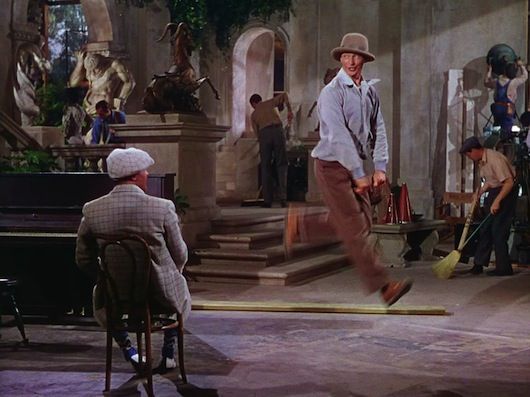
Donald O’Connor: “Make ’em Laugh”

Way back in the day, 1980 to be precise, when I was working with Joe Killian and Michael Zerphy, whenever we saw other performers do a bit we really liked, we’d say “consider it stolen!” I think the phrase originated with Joe, but he may have stolen it.

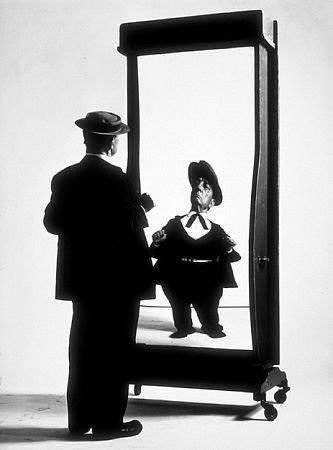
You know what they say, there’s nothing new under the sun, and that mostly holds true for physical comedy. I’m always amused, for example, when the Marx Brothers (or even Lucille Ball) are given credit for originating the broken mirror routine (Duck Soup), when in fact it not only appears in many early silent film comedies, but is referenced in even earlier reviews of vaudeville acts. Sure, there’s originality, but there’s a whole lot of borrowing going on and —if we’re lucky— creative reshaping of traditional materials.
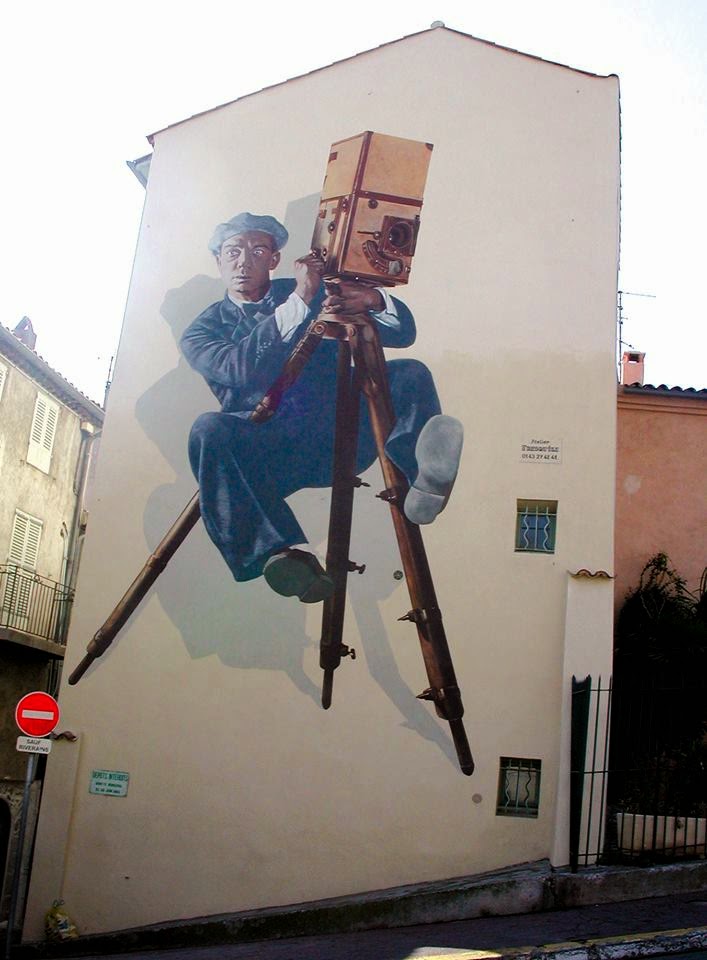
Keaton as The Cameraman

The historian-detective in me has enjoyed tracing this kind of thing, for example in this post on what I call the oblivious gag. My return to this theme is inspired by some excellent detective work done by silent film pianist and historian Ben Model, showing how Singin’ in the Rain (1952) borrowed from Buster Keaton’s The Cameraman (1928). But we’ll get to that juicy discovery a bit later…

You all know Singin’ in the Rain, right? If not, you’re in for a treat! It’s a corny but delightful MGM musical from1952 starring Gene Kelly, Debbie Reynolds, and Donald O’Connor, all about the rough transition from silent film to sound. The remarkable thing about Singin’ in the Rain is that it began not as a story idea but as a musical woven around old songs, but also a musical partially woven around old physical comedy material.

The big musical link was Arthur Freed. As Cecil Adams points out in this Straight Dope article, “Freed, the producer responsible for most of the MGM musicals of the 40s and 50s, began his career as a songwriter. “Singin’ in the Rain” was part of Brown and Freed’s score for MGM’s first “all talking, all singing, all dancing” musical, The Hollywood Revue of 1929. In 1952, Freed decided to use his own songbook as the basis for an original musical, as he had done with Jerome Kern’s songs in 1946 (Till the Clouds Roll By) and George Gershwin’s in 1951 (An American in Paris).”

They had Freed’s songs, might as well shape a show around them!

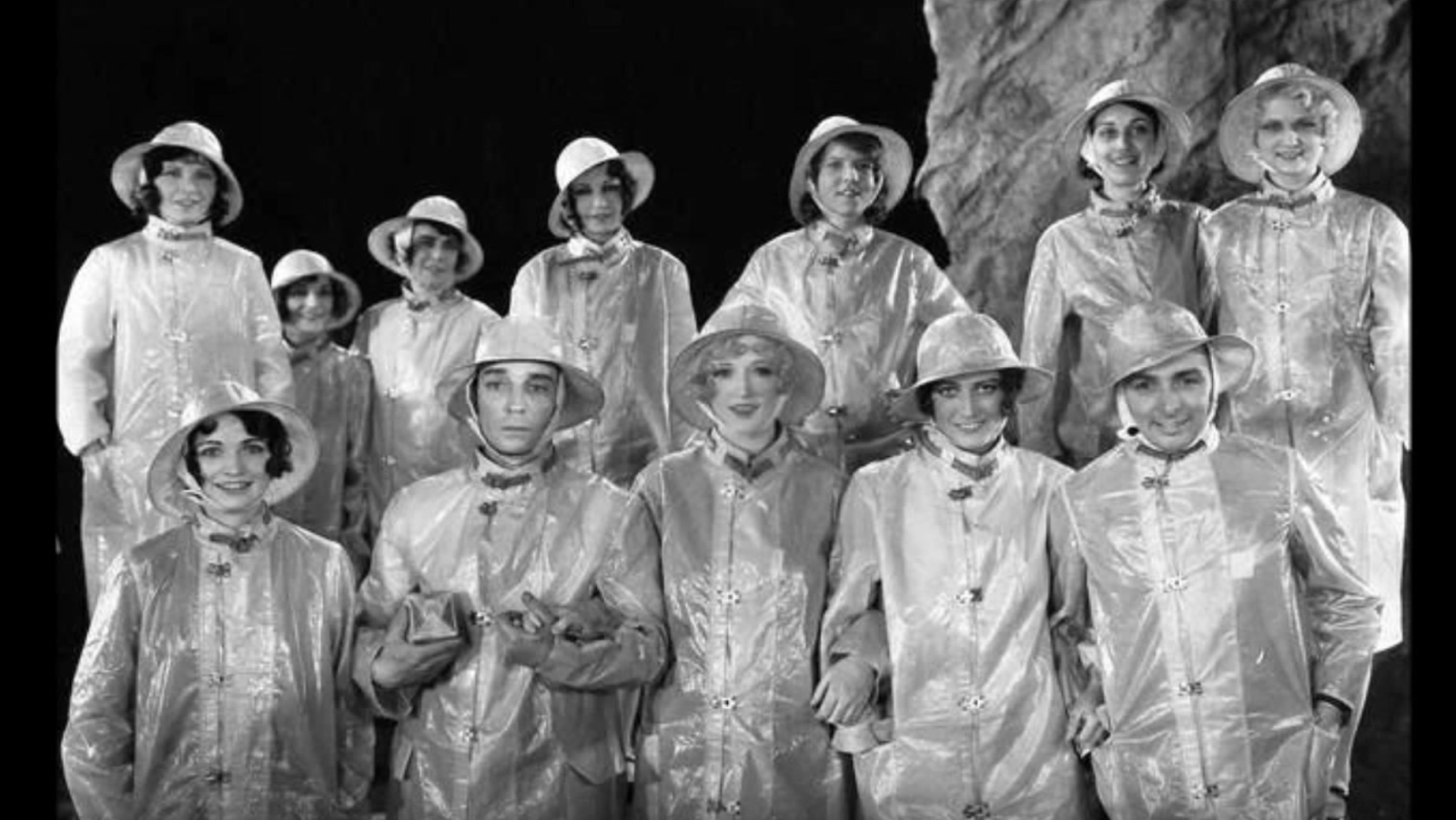
So the song Singin’ in the Rain goes all the way back to one of the two first big MGM musicals of the sound era, which featured “30 MGM stars! More Stars Than There Are in Heaven!” Here it is, the show’s big finale:

Not only did the songs come first, but the fact that they all came from the late 1920s gave screenwriters Comden & Green the idea for the story. According to this piece on the Cafe Songbook site, “Betty Comden and Adolph Green returned to M-G-M in May of 1950 to begin work on the screenplay for the movie they had been contracted to write, believing they were also contracted to write the lyrics for its songs. M-G-M clarified the terms of the contract to them. It was the studio’s option regarding the lyrics and M-G-M’s choice was that all the songs would be by the songwriting team of Arthur Freed (the film’s producer) and Nacio Herb Brown, his songwriting partner. Furthermore, they would be almost exclusively songs from their existing catalog. While looking at these songs, Comden and Green noticed that Freed-Brown songs such as “Should I?,” “All I Do Is Dream of You,” “Good Morning,” You Were Meant for me,” “You Are My Lucky Star,” “Singin’ in the Rain,” etc. were written in the late twenties which gave them the idea to create a story that came from that period; and the lynch pin of the plot they created was based on the disastrous results that sometimes occurred when silent screen actors and actresses were forced to talk on screen, to be heard no matter how awful they might sound.”

All these songs made it into the film, or should I say “made the film”?
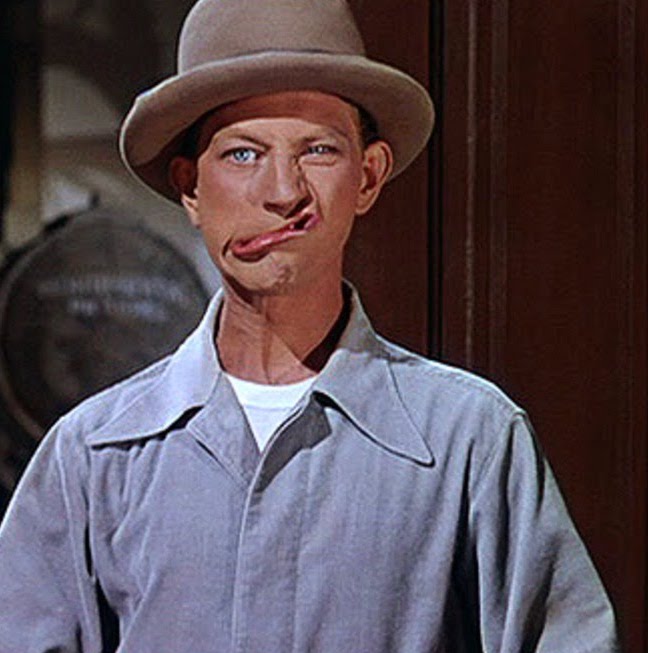
Donald O’Connor

A Tale of Two Tunes
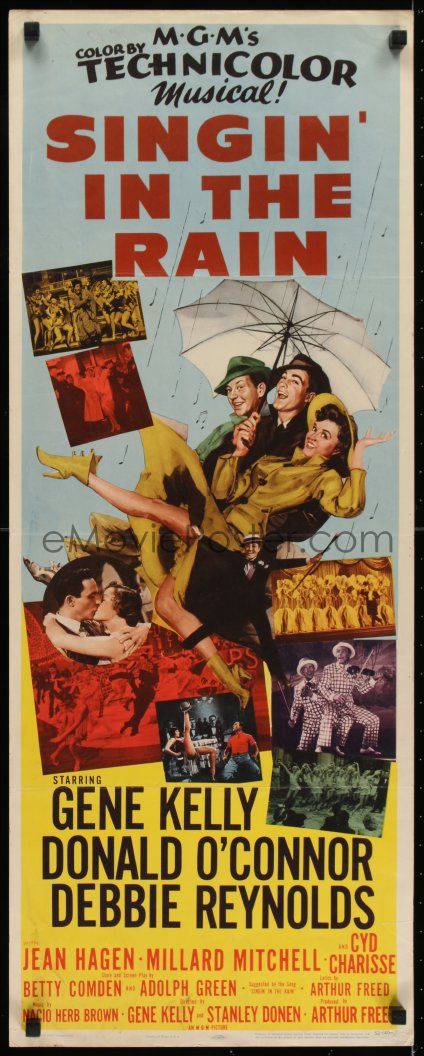
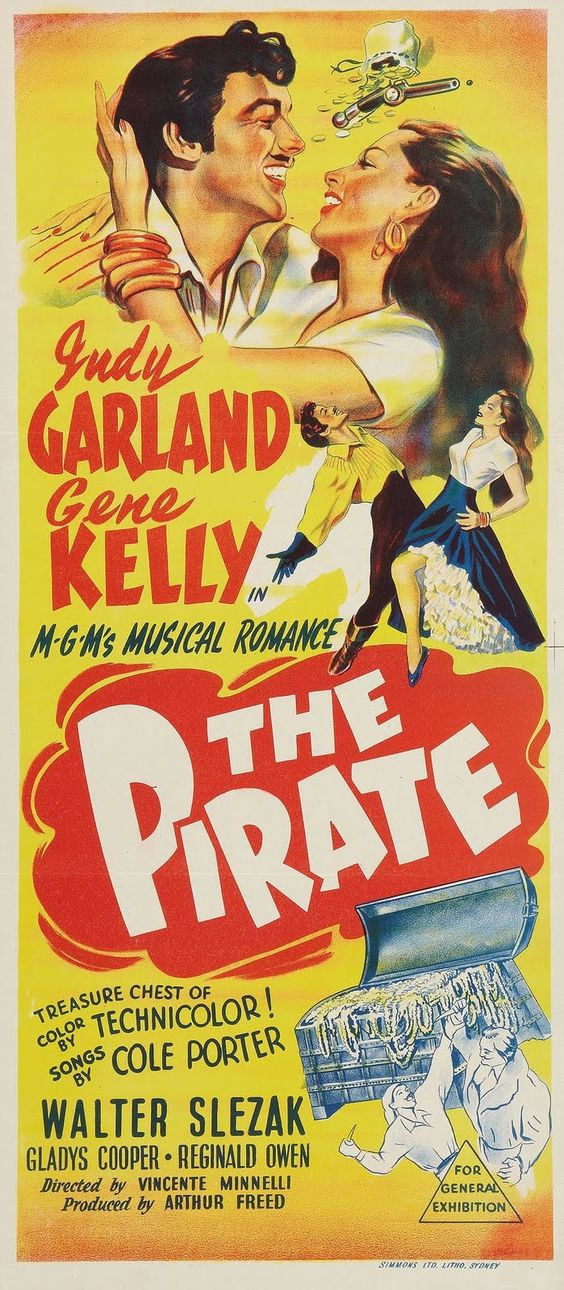
The film was coming together, but co-director Stanley Donen still wanted a solo number for Donald O’Connor, who played Gene Kelly’s comic sidekick and was a talented and very physical comedian. In fact, O’Connor’s parents were vaudevillians, his father an Irish-born circus strongman, dancer, and comedian, and his mother a circus acrobat, bareback rider, tightrope walker, and dancer. There was nothing in the Arthur Freed oeuvre that fit, but that didn’t stop MGM from doing some more borrowing. They just went back to an earlier MGM movie starring Gene Kelly, The Pirate (1948), and “borrowed” from Cole Porter instead.

Again according to Cecil Adams, “Donen suggested that Brown and Freed write a new song, pointing to Porter’s “Be a Clown” as the sort of thing he thought would fit in at that point in the script. Brown and Freed obliged —maybe too well— with “Make ‘Em Laugh.” Donen called it “100 percent plagiarism,” but Freed was the boss and the song went into the film. Cole Porter never sued, although he obviously had grounds enough. Apparently he was still grateful to Freed for giving him the assignment for The Pirate at a time when Porter’s career was suffering from two consecutive Broadway flops.”

Grateful, or simply too afraid of MGM’s power?

So that’s the background. Ironically, Kelly sang the original “Be a Clown” song, and in Make ’em Laugh, it is O’Connor singing to cheer up Kelly’s character. Here’s a short comparison, brief excerpts from each so you can see the similarity between the two tunes and the message.

But it’s not just the tune that was lifted.  The Make ‘en Laugh lyrics directly paraphrase those of Be a Clown. Clever but barely disguised plagiarism:

In The Pirate, Kelly is about to be hung by his neck in the town square. O’Connor quotes what that immortal bard, Samuel J. Snodgrass, said “as he was about to be led to the guillotine.”
While O’Connor’s dad advised him to “be an actor my son, but be a comical one,” Kelly was only three when his “clever” mom told him “I’ve got your future sewn up if you take this advice: be a clown, be a clown.”

And why go into the funny business? Because you’ll get rich, unlike in those other more effete professions. Kelly’s mom asks him “Why be a great composer with your rent in arrears? Why be a major poet and you’ll owe it for years? A college education I should never propose. A bachelor’s degree won’t even keep you in clothes.” Likewise, O’Connor’s dad warns him that “you could study Shakespeare and be quite elite, and you could charm the critics and have nothing to eat.”

But if you’re funny, what happens?  Kelly is promised  a bright future where he’ll “only stop with top folks” and “he’ll never lack” and “millions you will win.” O’Connor likewise will have “the world at your feet.”
Okay, sounds good. But what does it take to be funny? Kelly’s clown is instructed to…
• show ‘em tricks, tell ‘em jokes
• wear the cap and the bells
• be a crack Jackanapes
• give ’em quips, give ’em fun
• act the fool, play the calf
• stand on your head
• wiggle your ears
• wear a painted mustache
• spin on your nose
• quack like a duck

O’Connor’s comical actor must…

• slip on a banana peel
• [perform] old honky-tonk monkeyshines
• tell ‘em a joke, but give it plenty of hoke.
• take a fall, butt a wall, split a seam.
• start off by pretending you’re a dancer with grace, wiggle till they’re giggling all over the place, then get a great big custard pie in the face

The actual acts differ more than the lyrics because they are structured around the individual talents of the performers. “Be a Clown” actually is done twice in The Pirate, first with Kelly and the fabulous Nicklaus Brothers, and is later reprised by Kelly and Judy Garland. In both cases, it’s a partner number with more of a dance base to it. O’Connor, on the other hand, is both a better comedian and a far more skilled acrobat. The result, one of the greatest physical comedy acts ever, became his signature piece.

Here are the complete versions. Enjoy!

Be a Clown #1 (Kelly & the Nicklaus Brothers)


Be a Clown #2 (Kelly & Judy Garland)

Make ’em Laugh


The Plot Thickens

Keaton & Josephine the
monkey in The Cameraman


But that’s just the beginning! As I said at the top, this blog post got jump-started by Ben Model unearthing a less obvious and even more fascinating Singin’ in the Rain borrow. And this one is all the juicier because it involves our hero, Buster Keaton.

Take it away, Ben…

Wow! Like I said, great detective work. And as if that wasn’t amazing enough, think back to the original version of the song from The Hollywood Revue of 1929.  In that cavalcade of stars, did you notice the one luminary who couldn’t / wouldn’t have “a smile on his face”?  Yep, that’s “the great stoneface” himself at the 39-second mark.
The one thing I would add to Ben’s chronology is that in the years before Singin’ in the Rain (1952), Keaton was an uncredited gag writer for a bunch of MGM movies, including the Marx. Brothers, but especially a slew of Red Skelton vehicles, right up to his 1950 Watch the Birdie, which was partially a remake of The Cameraman, and two more 1951 Skelton films.  So if Keaton wasn’t directly consulted on Singin’ in the Rain, he was certainly still a presence at the studio. It was also in 1950 that his appearance on the Ed Wynn Show led to a lot of work on early television and made him less dependent on the Hollywood film industry.
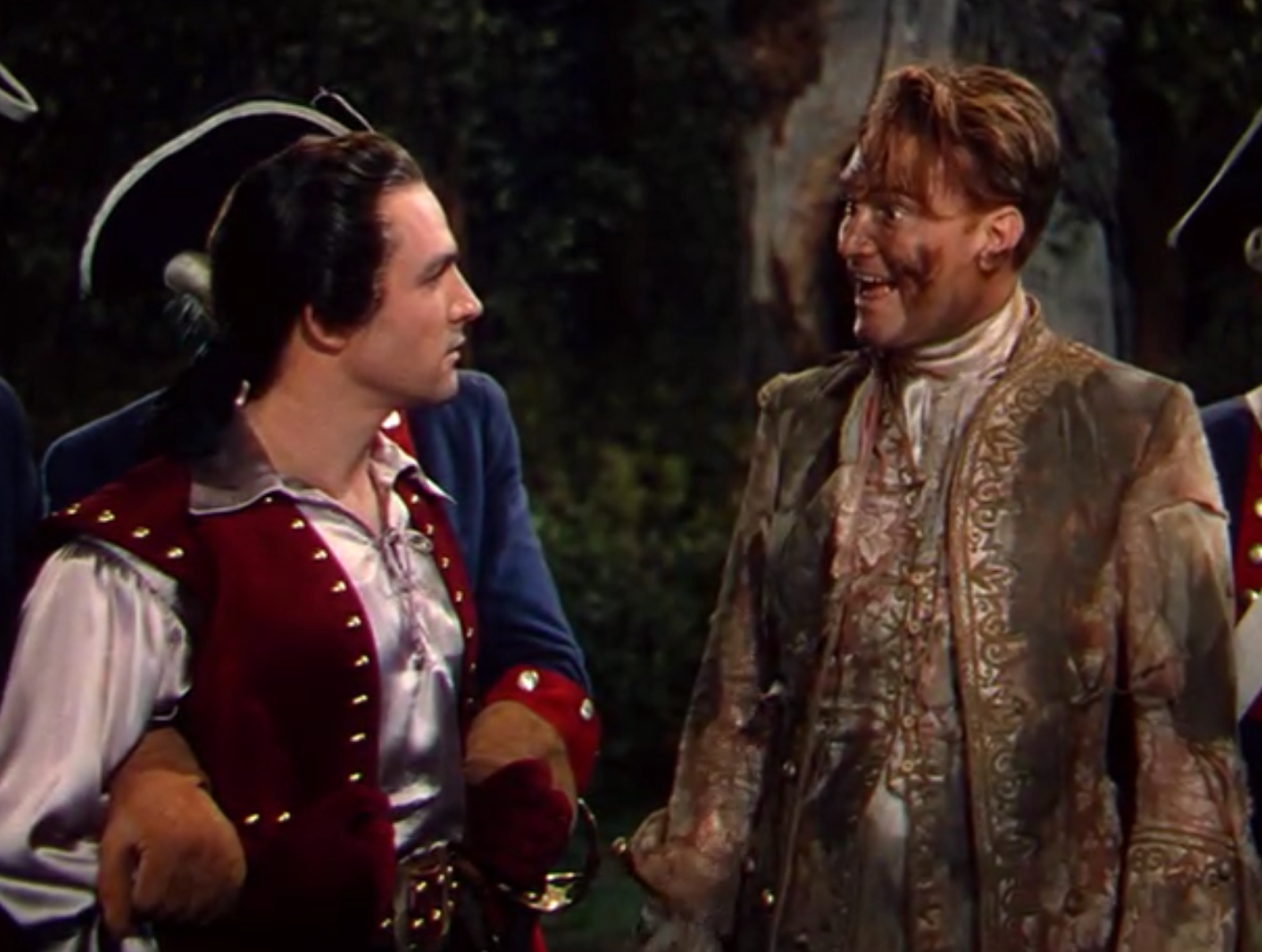
Kelly & Skelton in Du Barry Was a Lady

And speaking of Red Skelton…
A talented pantomimist, Red Skelton, like Keaton, had grown up in show business, performing in medicine shows at the age of ten, and later burlesque and vaudeville. Keaton’s work with him in the 1940s would be enough to fill another blog post (don’t get me started!), but there are a couple of possible links between Skelton and Singin’ in the Rain. Gene Kelly’s “Broadway Ballet” fantasy sequence was apparently based on an idea that was used for MGM’s Du Barry Was a Lady (1943), starring Skelton as a nightclub worker who dreams that he’s King Louis XV. And who was his romantic rival for Lucille Ball’s affections in that one? Gene Kelly, natch. (And before the film, it was a Broadway musical starring Bert Lahr chasing Ethel Merman.)

But even more interesting than that is the similarity between some of Skelton’s pratfall moves from Du Barry and those of O’Connor, as seen in this comparison video. In the first part, Skelton and friend think they have tricked Gene Kelly into downing the drink with the Mickey Finn, but (of course!) the glasses have been switched, which leads to Skelton’s wonderful drunk pratfall sequence. Skeleton is drunk, O’Conner is giddy, but the writhing around and the circular movements when on their side on the floor are strikingly similar.

Did O’Connor borrow this? Who knows? —but not necessarily. It’s just as likely that these moves were standard fare. After all, the 108 pratfall was also common property (if you could do it!). Still, you need someone to preserve the vocabulary, and in the yakkety-yak-yak 1940s, that someone may well have been Red Skelton.

Of course, once you start making these connections, it’s endless —ancestry.com run amok— so I’ll stop the narrative here and just leave you with a few tidbits for dessert…

• When they made the biopic The Buster Keaton Story in 1957, can you guess who played Keaton? Dramatic pause. Are you really guessing? Space filler. Space filler Space filler. More space filler. Even more space filler. Yep, Donald O’Connor. This stuff’s downright incestuous.

• Trav SD points out that Singin’ in the Rain producer/songwriter Arthur Freed wrote material for the Marx Brothers’ act and performed in their sketches way back in their vaudeville days.

• As for the Nicklaus Brothers, according to Wikipedia “this dance sequence was omitted when shown in some cities in the South, such as Memphis, because it featured black performers the Nicholas Brothers, Fayard and Harold, dancing with Kelly. It was the first time they had danced onscreen with a Caucasian, and while it was Kelly’s insistence that they perform with him, they were the ones who were punished. Essentially blackballed, they moved to Europe and did not return until the mid-60s.”

• Kevin Kline does his own version of “Be a Clown” in the 2004 Cole Porter biopic, De-Lovely. Interesting enough and a much bigger production number.

• In 2006 or so, Volkswagon did this commercial where they remade Gene Kelly’s dance in the rain, using his face and choreography but a break dancer’s body and moves. Very interesting!

• Anthony Balducci, whose Journal blog I highly recommend, has an excellent piece about gag borrowing/ stealing, with some interesting comparisons between the tv work of Ernie Kovacs and the sketches of the British comedy duo Morecambe & Wise.

• For a list of Keaton’s uncredited gag writing, see Buster Keaton: Cut To The Chase by Marion Meade.

• Keaton’s downward spiral as a star at MGM is chronicled in Kevin Brownlow’s 2004 documentary, So Funny It Hurt: Buster Keaton and MGM. It is included as part of the DVD set, Buster Keaton Collection: (The Cameraman / Spite Marriage / Free & Easy).

Braggedy-brag-brag, but my personal show-biz DNA intersects with several of the performers mentioned here:
—My first acting job was just days past my 7th birthday, a skit with Skelton and Jackie Gleason on the Red Skelton Show. Skelton had worked extensively with Keaton, and Keaton had done a version of clown Sliver Oakley’s classic one-man baseball pantomime in The Cameraman. The skit I did with Gleason & Skelton was —yep!— about a baseball game. Also, around this time, Skelton did some research for creating his Freddie the Freeloader tramp clown. He visited Coney Island and studied the clown Freddy the Tramp, later “borrowing” some of his bits for his new character. Freddy the Tramp was the father of my long-time clown partner, Fred Yockers. When Fred, Jan Greenfield, and I started the First NY International Clown-Theatre Festival in 1983, Skelton agreed to be honorary chairperson, though we never actually got to speak with him.
—Keaton was on the Ed Wynn Show in 1950, and I was on a tv show with Wynn about nine years later. (There’s no way telling which of us Wynn preferred working with.)
— In The Pirate, the great character actor Walter Slezak played the town mayor who (spoiler alert!) is really the pirate Macoco. In 1958 I acted with Slezak on “Beaver Patrol,” a comic drama on the U.S. Steel Hour about an eccentric New York uncle who visits relatives in Beverly Hills, takes over a scout troupe, and teaches the spoiled rich kids gritty New York City stuff. Yes, I’m the one looking at the camera. I do remember Slezak as being very affable and a pleasure to work with.

SHARE
EXPLORE FURTHER

Video from the Early 1800s! (or, In Search of the Harlequinade)

POST 423
Monday, May 30, 2016
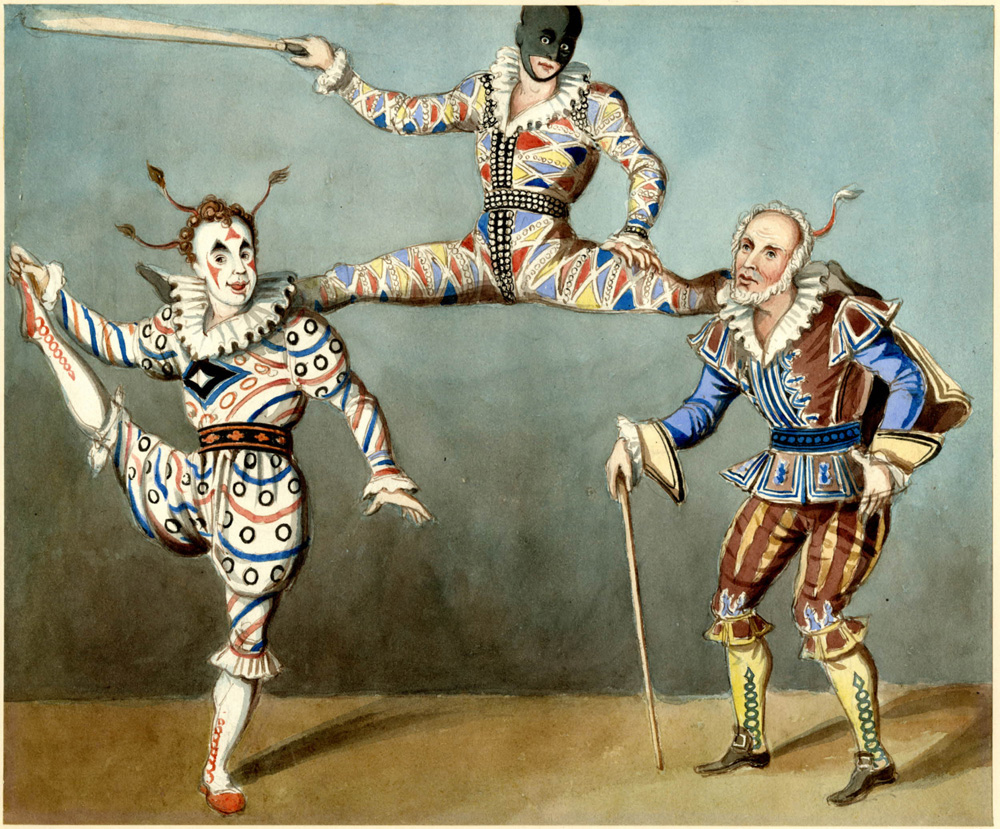
(L-R), Joseph Grimaldi as Clown, Tom Ellar as Harlequin, James Barnes as Pantaloon (watercolor, British Museum)

The harlequinade is the holy grail of physical comedy.

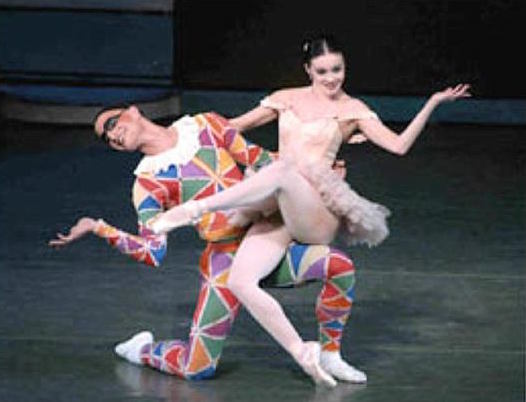
No, not the kind of harlequinade you’ll find if you do a YouTube search. That’s George Balanchine’s ballet, based on a 1900 Russian work, Harlequin’s Millions, by Marius Petipa. The ballet is a prettier and romanticized version of the commedia tradition and of the Arlecchino/Harlequin character, sorely lacking the robust physical comedy of the earlier harlequinade that was central to 19th-century English pantomime during the Joseph Grimaldi era.

NYC Ballet’s “Harlequinade”

That earlier, off-the-wall harlequinade is what we’re searching for because it was by all reports highly skilled, wildly imaginative, and surrealistically insane AND provides the strongest direct link we have from the commedia dell’arte to 20th-century silent film comedy. And let’s face it: silent film comedy remains the major inspiration for today’s physical comedians.

And I know what you title-readers are saying: that’s impossible, of course there’s no video from the early 1800s. Ah, but wait a minute, there actually is. Sorta kinda…. but we’ll get to that later.

First here’s a pretty good introduction to the harlequinade from some clown book written forty years ago:

It was in the harlequinade, the long chase scene that concluded most nineteenth-century English pantomimes, that rough-and tumble comedy became an obsession and an art form. In those days, pantomimes were divided into two parts, a short opening — a fairy tale in dance, dialogue, and song — and the madcap harlequinade. The two halves were linked by a transformation scene in which a benevolent agent such as Mother Goose or a Fairy Queen miraculously changed the characters of the opening into such stock types as Harlequin, Columbine, Pantaloon, and Clown. The plot shared by both parts usually centered around the romance between two young lovers (later Harlequin and Columbine) who were determined to be united, the opposition of the girl’s father (later Pantaloon) notwithstanding. The inevitable result was a long chase scene with Pantaloon and his not-so-loyal servant, Clown, in hot pursuit of Harlequin and Columbine. It was as if a performance of Cinderella suddenly turned into a Keystone Cops comedy.

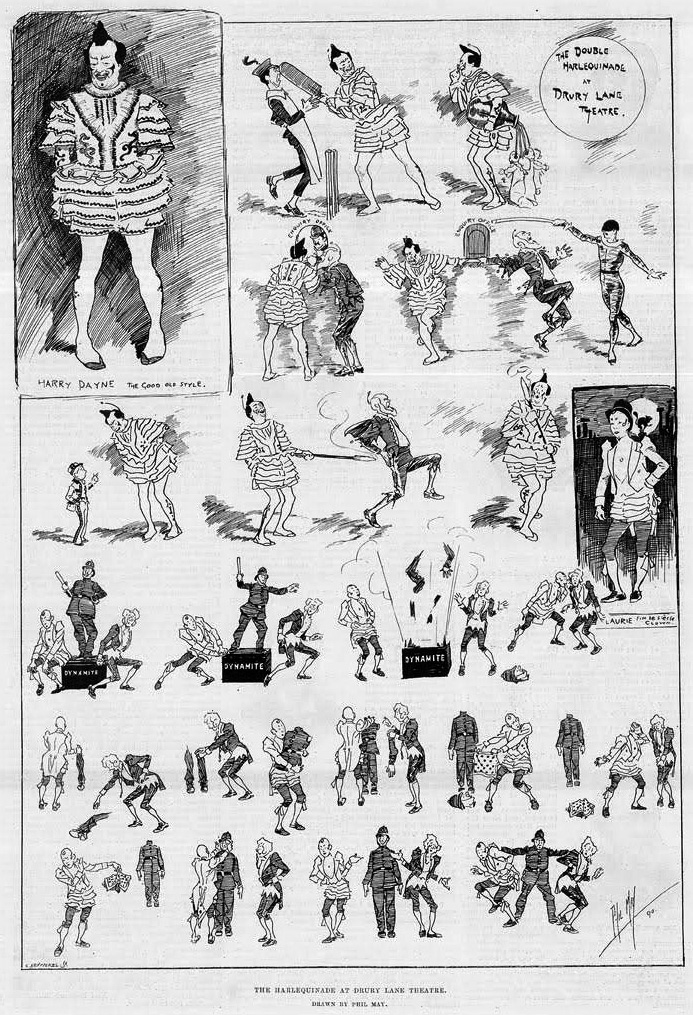
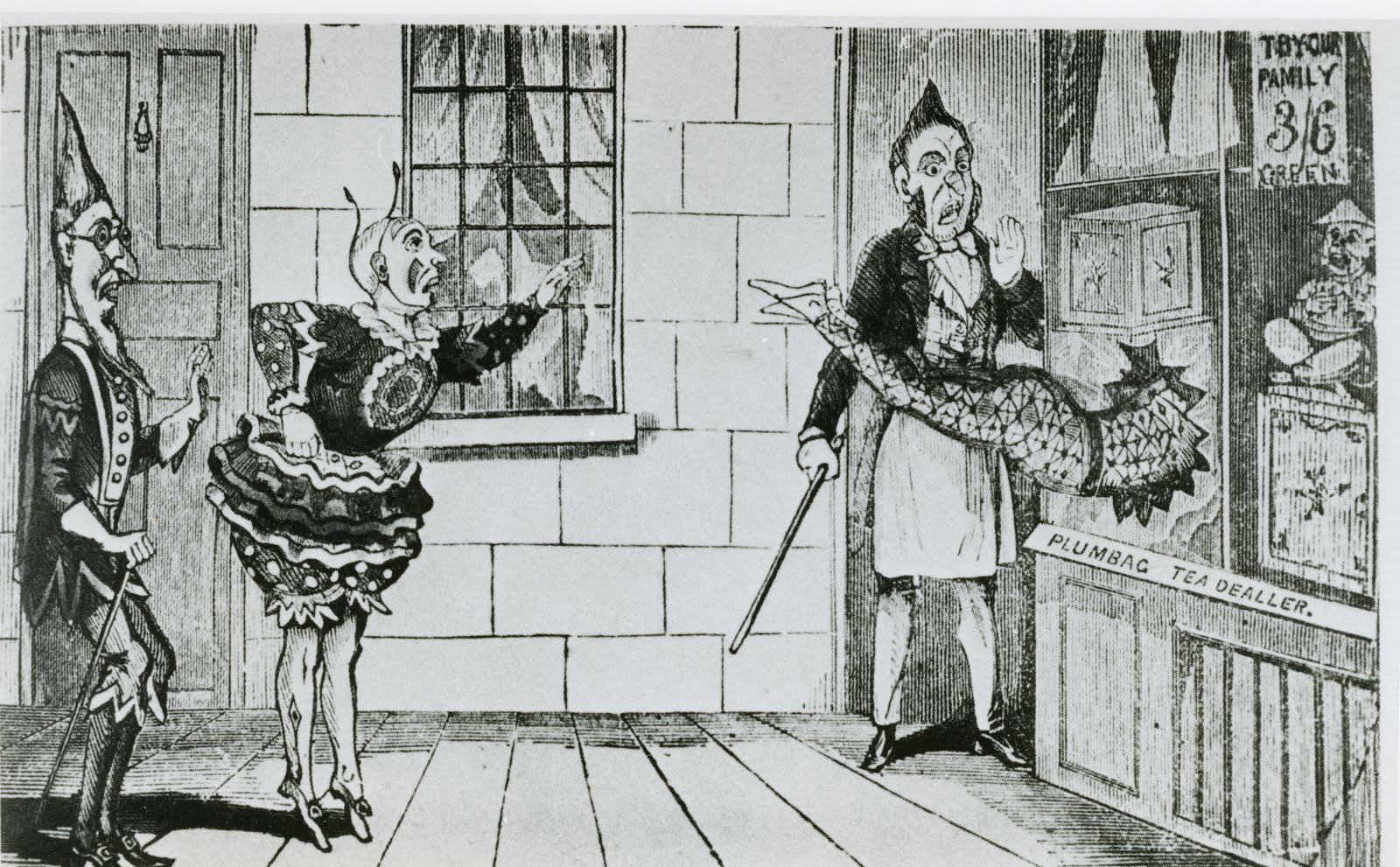
Scenes from the harlequinade (c.1890), including blowing up the policeman and reassembling him, by caricaturist Phil May. Courtesy of Jonathan Lyons, from his excellent book “Comedy for Animators” Click to enlarge!

 The harlequinade began with the Clown’s traditional boisterous greeting, “Hello, here we are again” — a sure signal of the delights to come. The chase scene that followed was merely an excuse for a long succession of practical jokes and for dizzying displays of acrobatic agility. The actors danced on stilts, walked on barrels, suffered jarring pratfalls, and performed tricks of contortion (often disguised as animals), feats of strength, and daring leaps.

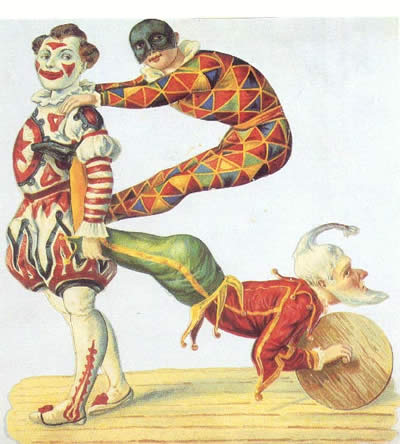
Early 19thcentury cutout figures

Because they were performed on stage rather than in a circus ring, these pantomimes took full advantage of a wide assortment of trapdoors and elaborate trickwork. Nothing was ever what it appeared to be: illusions from stage magic became valuable comic tools; scenery could be transformed instantaneously into something quite different; objects literally took on a life of their own; and Clowns and Harlequins miraculously appeared and disappeared through undetectable gaps in the floor and walls. There was even a standard joke that some performers never met, for while one was going up to the stage, the other was coming down.

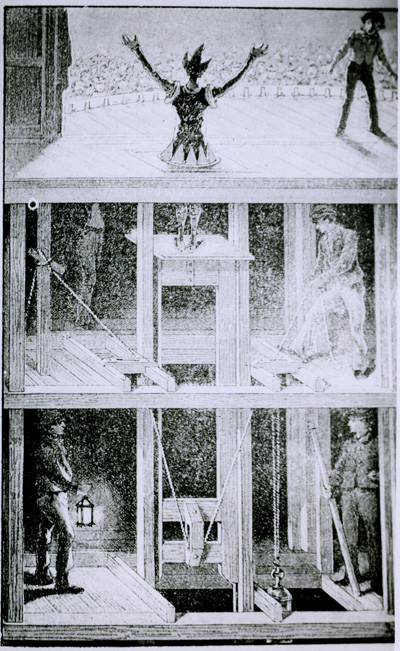
The star trap in action. Drawing
from Georges Moynet, Trucs et Decors.

French poet Theodore de Banville wrote in 1880 that… “…between the adjective “possible” and the adjective “impossible” the English pantomimist has made his choice: he has chosen the adjective “impossible.” He lives in the impossible; if it is impossible, he does it. He hides where it is impossible to hide, he passes through openings that are smaller than his body, he stands on supports that are too weak to support his weight; while being closely observed, he executes movements that are absolutely undetectable, he balances on an umbrella, he curls up inside a guitar case without it bothering him in the least, and throughout, he flees, he escapes, he leaps, he flies through the air. And what drives him on? The remembrance of having been a bird, the regret of no longer being one, the will to again become one.”

The stage in most pantomime theaters included a trapdoor known as the “star trap” or, internationally, as the “English trap.” This trap was usually circular in shape and consisted of sixteen triangle-like sections of one and-one-half-inch planking that were so lightly secured to the surrounding floor that the least bit of pressure from below forced them open. Underneath it (in the area below the stage) was a platform on pulleys, designed rather like an elevator, that could catapult a performer through the stage floor faster than the eye could see. When the counterweights attached to the platform were released, the performer — sometimes Clown, but more often a supernatural sprite — was shot through the trap to appear suddenly as if out of nowhere. The performer had to remain poised, for any sudden movement could result in a grave accident.

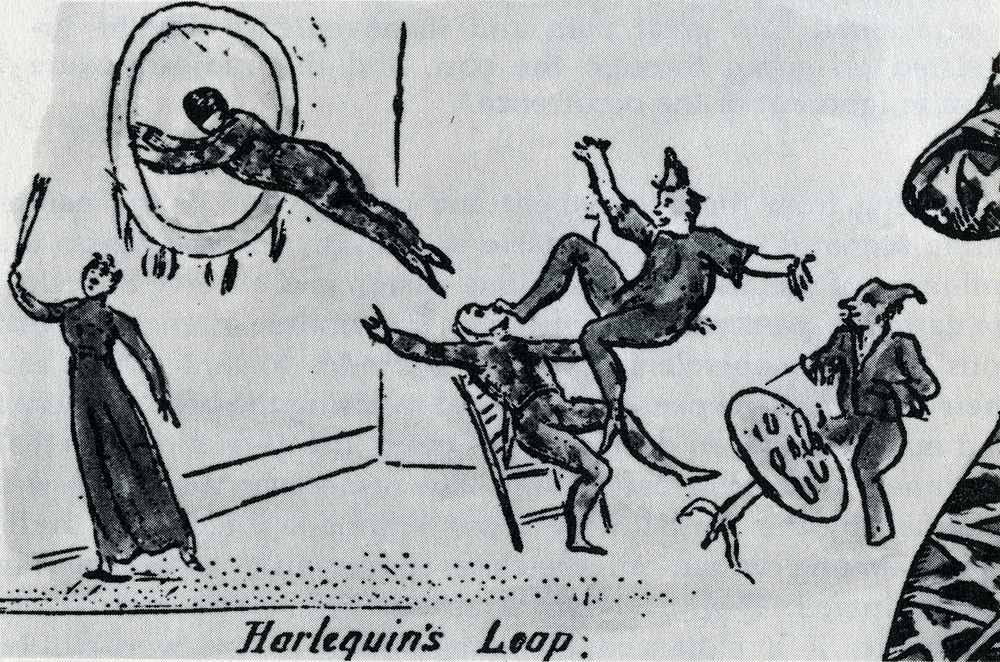
Harlequin dives thru a trap in the wall

 Similar to this was the “vampire trap,” said to have first been seen in 1820 in James Planché’s melodrama, The Vampyre; or, the Bride of the Isles. It was a segmented trapdoor on spring hinges, usually consisting of two spring leaves, which assumed its original configuration after the performer had passed through it, thus enabling him to enter or exit through what seemed to be a solid surface. These vampire traps were frequently placed in flats and drops so that Harlequin could escape his would-be captors by leaping through a “solid” clock or mirror. In John Fairburn’s description of Harlequin and Mother Goose, for example:


A bustle ensues, they [Clown and Pantaloon] endeavor to secure Harlequin, who eludes their grasp, and leaps through the face of the clock, which immediately represents a sportsman with his gun cock’d, the Clown opens the clock door, and a Harlequin appears as a pendulum, the Clown saying shoot, present, fire, the sportsman lets off his piece, and the Clown falls down, during which period Columbine and Harlequin escape, (who had previously entered through the panel). Pantaloon and the Clown run off in pursuit.


As another pantomime succinctly put it, “Aristotle in book concerning entertainments has laid it down as a principal rule that Harlequin is always to escape.”

These leaps and falls were not without their dangers. An acrobatic Clown by the name of Bradbury, whose fearless jumps included one from the flies down to the stage, wore protective pads on his head, shoulders, elbows, hips, knees, and heels. Leaping through trapdoors was especially
difficult. The performer’s trajectory had to be exact; otherwise, he might crash into the scenery instead of disappearing through the appropriate flap. This took considerable training. First of all, he had to be remarkably adept at high, diving forward rolls. The process of diving through the trap was a unique experience, something he could practice only by doing. He had to be certain that his body remained elongated until had cleared the trap. If out of instinct he drew in his knees, he would bruise them badly against the bottom of the opening. Once through the trap, his hands had to be ready to take his weight as he tucked into a forward roll.

Tom Ellar in the role of Harlequin leaps through a mirror.

The dangers were multiplied when Harlequin, perhaps with a
boost from a concealed springboard, catapulted through a trap-door
located somewhat higher off the ground. In such cases, stagehands had to
be positioned in the wings, like firemen below a burning building, to
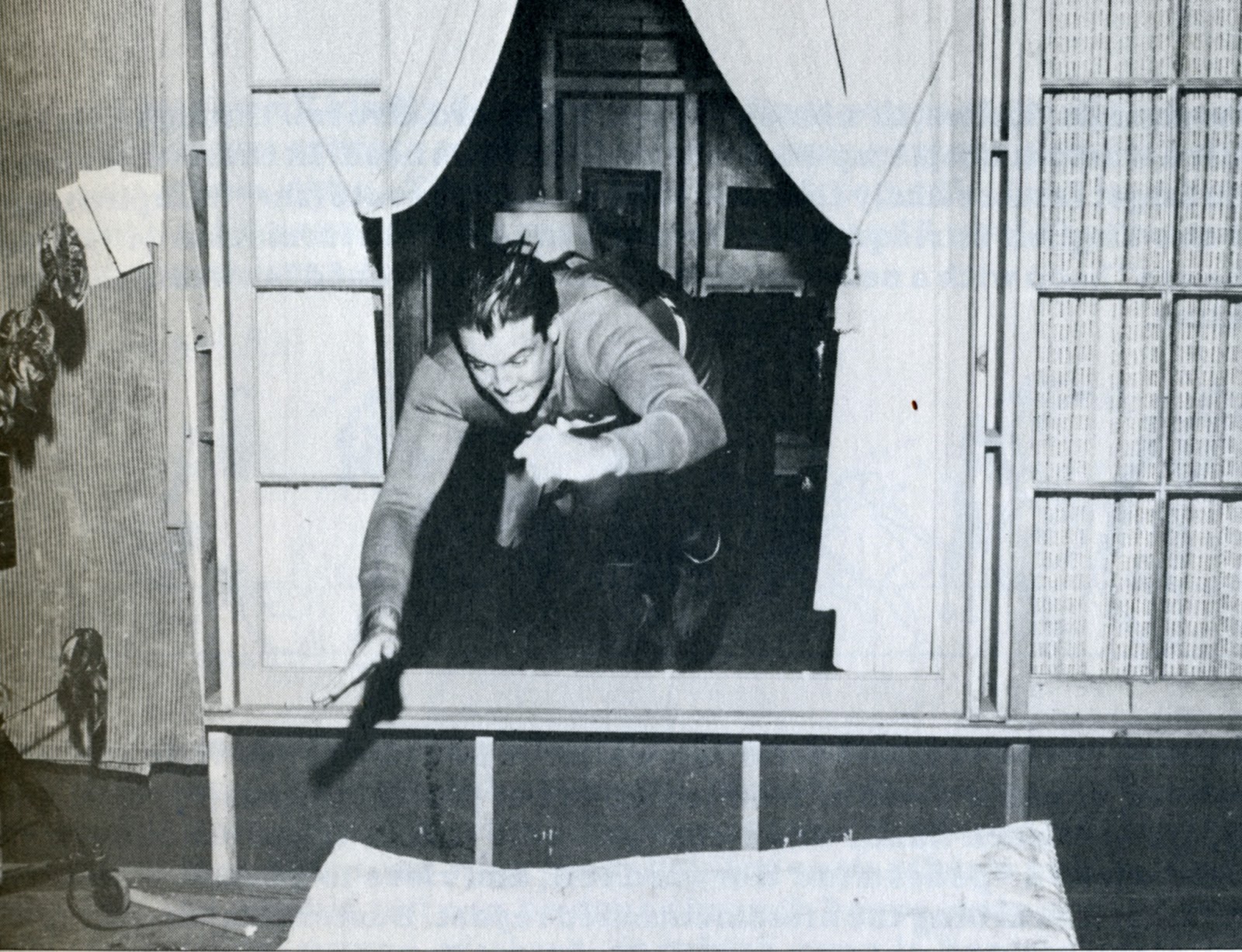
catch the leaping actor in a blanket. The stagehands expected to be
tipped for their services, and it was unwise to ignore their demands.
When Tom Ellar, the famous Harlequin, did just that, his leap through
the clock resulted in an unpleasant surprise. There was no one there to
catch him and he was lucky to escape with only a broken hand.

Even Superman needed help.

In the harlequinade, all of this related acrobatic work went hand in hand with the rough-and-tumble violence of slapstick comedy. Mastery of the fake blow and the relatively painless pratfall were essential to the harlequinade characters as they are to today’s movie stuntmen. The art of the swift kick in the pants was likewise eagerly cultivated. Butter was generously used by Clown to grease the path of shopkeepers, policemen, and Pantaloon, encouraging slipping and sliding and yet a few more pratfalls. The slapstick itself, which had been introduced to England by seventeenth-century Arlecchinos, was “improved” by inserting gun powder between the two sticks to add to the noise. To vary the arsenal somewhat, another comic weapon was popularized: Clown’s red-hot poker. Sneaking around the stage and indicating his intended victim, Clown would ask the audience, “Shall I?” When they gleefully shouted back, “Yes!”, the poker was firmly applied to the seat of the innocent victim’s pants. The pain was minor in comparison to what Clown felt when, later in the show, he accidentally sat down on the poker.

This knockabout business was the duty of all the principal harlequinade
characters, including the elderly Pantaloon, who was a frequent victim
of the Clown’s blows. Even Joseph Grimaldi, who was considered by his
contemporaries to be a rather non-acrobatic Clown, was an excellent
stage swordsman and choreographer of mock fights, and well accustomed to
being knocked about. “It is absolutely surprising,” wrote a London
Times critic, “that any human head or hide can resist the rough trials
which he volunteers. Serious tumbles from serious heights, innumerable
kicks, and incessant beatings come on him as matters of common
occurrence, and leave him every night fresh and free for the next
night’s flagellation.”

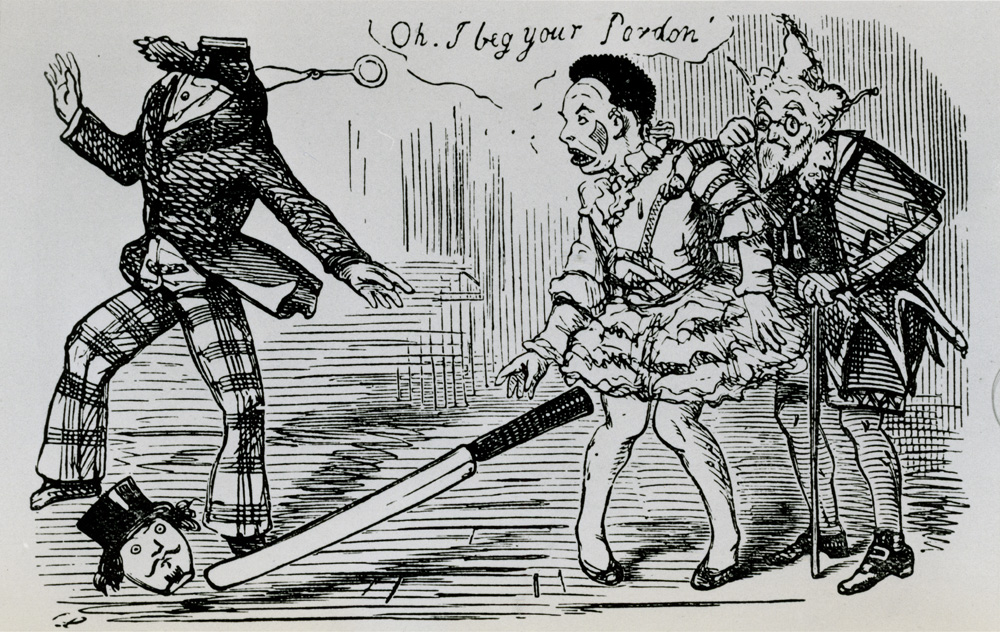
A standard decapitation effect.

 Much of the harlequinade violence depended upon special effects. With one’s real head hidden beneath a coat at what appeared to be chest level, an artificial head could be worn and used for a comical decapitation effect. Clown boldly swings his sword, and the man’s head falls off and rolls through a trapdoor. Clown says, “Oh, I beg your pardon,” and a real head resembling the artificial one pops through the stage floor to ask, “Where’s my body?” In another old scene, wrote a theatre critic, “Clown was mangled flat as a flounder, but we were relieved by his appearing down the chimney immediately afterwards in his natural shape just as if nothing had happened.”

OK, you get the idea. There’s more: animal impersonations; large-scale magic illusions, and of course the comic genius of Joseph Grimaldi, but I know you’re still asking, where’s the video??

So here’s Exhibit #1, an amazing clip from the 1929 Lupino Lane movie, Joyland. (Feel free to turn off the music.)

Exhibit #2, a year earlier, is from Lane’s Three Musketeers spoof, Sword Points. Lane was making about ten films a year in those days. Some were pretty formulaic but still rich in physical comedy.

Pretty impressive, eh, and a good match for the description you just read?

But why do I say this is likely the equivalent of footage from the 1820s? Because Lupino Lane (born Henry William George Lupino) was, like Grimaldi, descended from a storied Italian theatrical family who were big stars of English pantomime. Georgius Luppino (as it was then spelled) came to England in 1634, and his son (also Georgius) made his pantomime debut in 1718 in The Two Harlequins,  and thereafter that’s pretty much what the Lupinos did.”Our family holds the record for hurtling through stage traps,” bragged Lane. “My record of jumping 8′ and 5″ has never been beaten. My record of 83 traps in six minutes made at the London Hippodrome has never been beaten.”

And here’s what Lupino Lane’s biographer has to say about it:

In Victorian times the family was closely connected with the Britannia Theatre, Hoxton, the “Old Brit,” which was owned by Mrs. Sara Lane, the celebrated actress and great-aunt of Lupino Lane. Five generations of Lupinos appeared there, and the harlequinade was often a family affair. In 1880, George Lupino appeared as Harlequin, Arthur Lupino as Pantaloon, Harry Lupino as a comic policeman, and George Lupino Jr. as Clown. With the turn of the century, the old-style pantomime, and in particular the harlequinade, began to die out… One of its last strongholds was the Britannia, and the last of the old-time clowns was George Lupino (1853–1932).
— Born to Star: The Lupino Lane Story by James Dillon White

Our hero Lupino Lane was born into all this tradition in 1892 and —like Grimaldi before him and Keaton after him— thrown onto the stage as a young boy, taking the name Lupino Lane in honor of the aforementioned impresario aunt, Sara Lane. The rest is history.

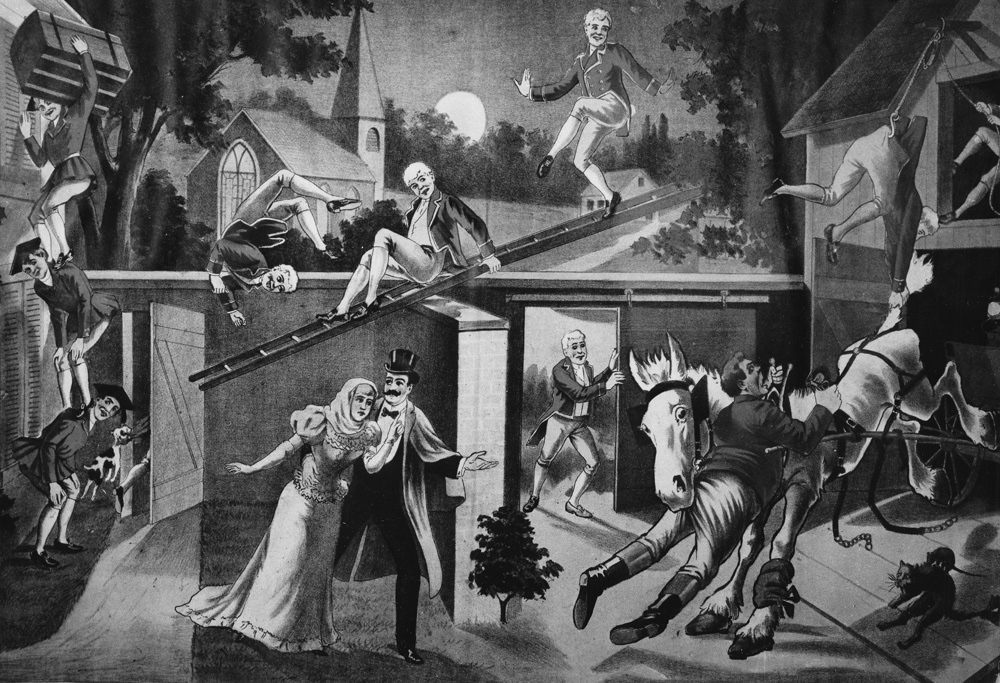
There were of course other thru lines. As the harlequinade faded in the 19th-century, its highly physical tradition was picked up by the Hanlon-Lees (Voyage en Suisse), who in America influenced the Byrne Brothers (Eight Bells), who in turn influenced Buster Keaton. For example, both the 3-high pyramid used for elopement in Keaton’s Neighbors and the ladder on top of the fence from Cops can be seen three decades earlier in this Byrnes Brothers poster for Eight Bells, which was still touring as late as 1914 and was made into a film (unfortunately lost) in 1916.

Keaton, who grew up in vaudeville as part of his
family’s knockabout comedy act, made considerable use of trapdoors
or their equivalent in many of his films. This memorable sequence from The High Sign (1921) is the best example.

Finally, one more video from the early 1800s, a wonderful sequence from Keaton’s Sherlock, Jr.

Have I made my case or what?

LINKS:
• Some of the best material on Lane is to be found in Anthony Balducci’s encyclopedic works, The Funny Parts: A History of Film Comedy Routines and Gags and  Eighteen Comedians of Silent Film.
The Pantomime Life of Joseph Grimaldi: Laughter, Madness and the Story of Britain’s Greatest Comedian is an excellent new biography of the great clown.

SHARE
EXPLORE FURTHER

Rube Goldberg + Physical Comedy = Joseph Herscher

POST 414
Wednesday, December 30, 2015

When I was setting up The (Very) Physical Comedy Institute in 2014, I heard from a prospective student who said he was a kinetic artist who had been building Rube Goldberg machines for many years and was now trying to integrate human performance into his work —thus his interest in physical comedy. It was Joseph Herscher, a New Zealander living in Brooklyn, and though I didn’t know Joseph personally, I’d actually read about his work (which has millions of hits on YouTube) and had even done a blog post on him way back in 2012.

I already loved his stuff, and especially the idea of integrating it more with physical comedy, so my immediate reaction was “yes, come as a student, but also come as a teacher!” Which he did, but more on that later…

Rube Goldberg (1883–1970) was an inventor and cartoonist who drew popular cartoons of elaborate gadgets that performed simple tasks in the most convoluted way imaginable. His influence on such silent film comedians as Charley Bowers and Buster Keaton was unmistakeable.

To give you an idea of what I’m talking about, here’s “The Page Turner,” an absolutely insane machine that saves Joseph from going to all that trouble of having to use his own hands to turn the page of his morning newspaper. I can’t for the life of me understand why every home doesn’t have one of these.

Hah!

You can see the introduction of the human character in that one, but his first big foray into human physical comedy was “The Dresser.”

You won’t be surprised to learn that “The Dresser” was a year in the making! Well, we didn’t have a year at The (Very) Physical Comedy Institute, so what Joseph did in his class was to hang some ropes on pulleys from the Celebration Barn rafters and then add in some objects with kinetic potential. From there we developed our own chain reactions and tried to create sequences involving human behavior.

Before we got to play with the toys, however, we did a variation on the old Viola Spolin building-a-human-machine improv. This one, a “slapping machine,” was pretty funny. It was half over before I thought to whip out my phone camera and start recording, but you’ll get the idea. (Left to right: Shane Baker, Sara Ski, Drew Richardson, Michael Trautman, and Leland Faulkner)

It was a giant leap forward to next be playing with all kinds of moving objects. All you’re going to see in the next clip are the beginnings of some rough ideas being sketched out. We didn’t have a year, we had an hour or two! (With Shane Baker, Angela Delfini, Sara Ski, Hank Smith, Michael Trautman, Bronwyn Sims, and yes, that’s me at the end patiently awaiting my fate.)

In another class at the institute, DIY Silent Filmmaking, co-taught by Lee Faulkner and Drew Richardson, Joseph was in a group with three other students —Adina Valerio, Steven Koehler, and Bronwyn Sims. Not surprisingly, their film wasn’t exactly prop-free:

Fast-forward to summer 2015, when Joseph returned to New Zealand to create a four-part web series, “Jiwi’s Machines.” These pieces are actual comedy sketches revolving around three characters: Jiwi, the mad, messy inventor (played by Joseph); Jiwi’s compulsively tidy sister Jane; and whatever guy Jane is foolish enough to try to impress when Jiwi is within striking distance. I was honored to consult on some of this work, as did my NYC clown colleague, Hilary Chaplain.

Here’s the first in the series, “Crumbs”:

Joseph has also been a participant in our weekly NYC Physical Comedy Lab in Williamsburgh, Brooklyn. (Check out our page on Facebook!) One day last spring we played with a sequence he wanted to use in the web series. The idea was for a chair to shoot backwards, then stop suddenly and catapult its occupant back and up, to be caught by her romantic partner. This is us trying it out, with Mik Kuhlman doing the pushing.

And here’s that same scene in Jiwi espisode 4, “Recipe for Disaster.”

Not the height hoped for, but at least Jane got her happy ending! You can see the full Jiwi series, as well as the marvelous work that came before it simply by clicking here. Enjoy!!

SHARE
EXPLORE FURTHER

Learning from Keaton

POST 409
Thursday, December 3, 2015

I’m always amazed to find young physical comedians who study and work hard at their craft and yet have only minimal familiarity with the silent films of Buster Keaton.

WTF?!?!

When I was in my early 20s —the pre VCR days— the only way to see his films was to go to Manhattan’s Elgin Cinema (now the Joyce Theatre) for the annual Keaton festival and try to take in the enormous breadth of his work —without a rewind button. In the audience were half of the city’s clowns, all muttering “how did he do that?” Nowadays, with DVD and the internet, there’s no obstacle to appreciating and learning from the master.

So buy the DVD set and keep the remote handy. Meanwhile, here are several excellent video pieces analyzing his work. The first is from the noteworthy video series by Tony Zhou, Every Frame a Painting, which reminds us that Keaton was also a damn good film director, one who firmly believed that physical comedy should not be faked. (Thanks to Skye Leith and Mark Mitton for the link on this one!)

__________________________________
“One reason Sennet did not hire trained acrobats for his Keystone force was because a trained acrobat seldom can get laughs in pictures when taking a comedy fall.  He looks what he is, a trained acrobat doing his stuff, instead of a character in the picture taking a stumble accidentally…  Though I have been called an acrobat, I would say I am only a half-acrobat, at most.  What I do know about is body control.”
—Buster Keaton, My Wonderful World of Slapstick
__________________________________

Sometimes Keaton is known too much for his stunts and not enough for his talents as a comic actor. Here’s a sweet two-and-a-half minute compilation of reaction shots by the great stoneface. (Thanks to Larry Pisoni for the link!)

__________________________________
Interesting fact: Did you know that Buster Keaton couldn’t do a back handspring? He learned his acrobatics in vaudeville, not in a gymnasium.
__________________________________

Okay: “half-acrobat,” comic actor, writer, stuntman, film director. But did you know that Keaton was also an early pioneer of film special effects? Here’s a thorough documentary on the making of one of my favorite Keaton movies, Sherlock, Jr.  This was put out by Kino in 2010 and the main credit reads: Written by David B. Pearson with Patricia Eliot Tobias.

If Keaton has a worthy successor in film, it’s probably Jackie Chan. Here’s Tony Zhou again with a spot-on analysis of how physical comedy works in Chan’s films. Some really good insights.

In his notes to the YouTube video, Zhou summarized Chan’s approach as follows:


The 9 Principles of Action Comedy
1. Start with a DISADVANTAGE
2. Use the ENVIRONMENT
3. Be CLEAR in your shots
4. Action & Reaction in the SAME frame
5. Do as many TAKES as necessary
6. Let the audience feel the RHYTHM
7. In editing, TWO good hits = ONE great hit
8. PAIN is humanizing
9. Earn your FINISH

If you haven’t seen enough, here are two more related pieces from Zhou’s Every Frame a Painting series:
• Edgar Wright: How to Do Visual Comedy

You can support Every Frame a Painting here.
SHARE
EXPLORE FURTHER

Sexagenarian Physical Comedy

POST 403
Friday, March 20, 2015

 
I was going to call this post “Old-Fart Physical Comedy” but I thought I’d pull in more readers this way. Sexagenarian must have something to do with sex, right? Maybe there’ll even be pictures! No, but while you’re here…

Mike (“Buster the Clown”) Bednarek writes: : One week short of turning 60, nursing an aching back, and fully realizing and appreciating the growing limitations  on my physical body when it asks to do some of the same bits from 10, 20, 30 years ago, I’ve got a question for you. What do older physical comedians/clowns do when their bodies tell their heads (usually after the fact, when it’s too late): “Are you f—ing nuts?”

Well, I’m 66 and still throwing my weary bones around, so I think this is a very good question and that a serious answer would make for a useful blog post. So do any aging veterans of the physical comedy wars want to share their old-fart experiences and longevity recommendations with our readers? If so, just e-mail me a few thoughts and I’ll take it from there.

Meanwhile, we might as well laugh at ourselves, so here are two comic takes on the sexagenarian physical comedian. The first is a 1959 performance by the Talo Boys on the French tv show La Piste aux Étoiles, live from the Moulin de la Galette. (Thanks to Max Weldy for the original video!) The opening is pretty much straight acrobatics, though we see that some troupe members are  not exactly spring chickens. At the 1:45 mark they get into some comedy schtick, but the old-man physical comedy starts at 4:40 when they re-enter as moustachioed “acrobates de la Belle Époque.”

And 54 years later here’s a piece in a similar (varicose) vein by “Fumagali and their Fumaboys,” as they appeared on another French tv show, Le Plus Grand Cabaret du Monde (2013), and which I saw that same year at the Cirque d’Hiver in Paris.

Update (3-21-15)  
Raffaele De Ritis writes: Fuma Boys act was conceived and created in the late 90s by Bernhard Paul, collector and founder of Circus Roncalli, under direct and deliberate inspiration of Talo Boys.

And just for inspiration, here’s how Buster Keaton entered his sixties.

And finally, one more cartoon…

Update (3-21-15):
Click here  for a similar piece by Fratelli Bologna from about 1989. Thanks to Drew Letchworth for the link, who writes “We weren’t Sexagenarians when we did this piece, but we are now. We developed The Old Act in part because we found that we were getting too old to do the young act.”

SHARE
EXPLORE FURTHER

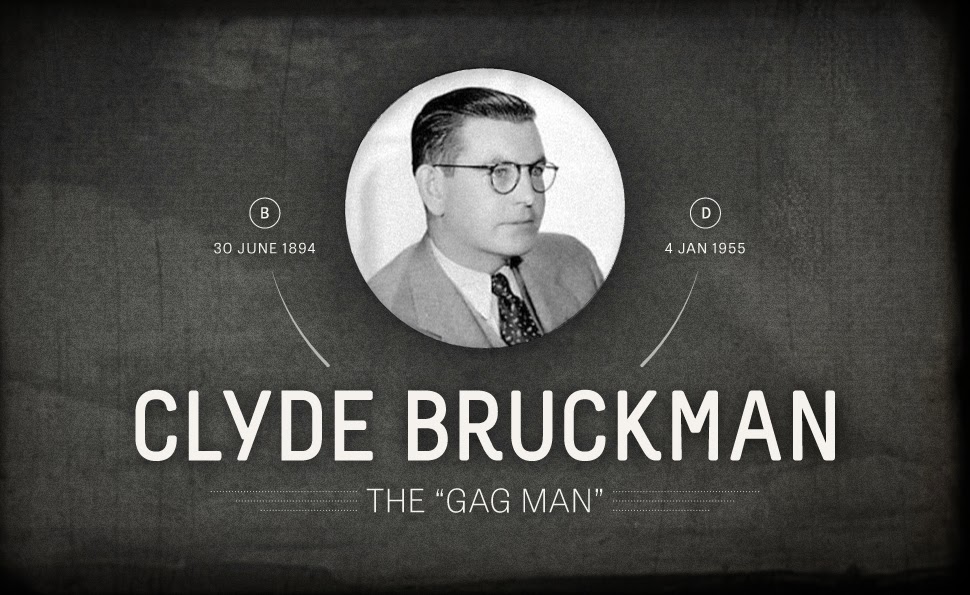
Clyde Bruckman: The Gag Man

POST 383
Monday, June 30, 2014

Today is the 120th birthday of Clyde Bruckman.

Clyde who?

You’ve probably never heard of him because, even in his heyday, he was never actually famous. He was for many years a gag writer for Buster Keaton who also directed for Harold Lloyd, Laurel & Hardy, and W.C. Fields, and wrote for Abbot & Costello and the Three Stooges. In the silent film era and beyond, when the gags often came first in the creative process and the story second, “gag writer” was a recognizable job description.

____________________________

One joke of the time was that Keaton’s employment application consisted of two questions: “Are you a good actor?” and “Are you a good baseball player?” and a passing grade was 50 percent. Brand ran into Bruckman, realized he was a natural fit for Keaton’s studio, arranged a lunch, and Bruckman started the next Monday, in a dual role as “outfielder and writer.”  — Matthew Dessem

____________________________

Being a gag writer also got him into trouble, because when a decade later he recycled Harold Lloyd gags for Three Stooges movies — certainly a common practice at the time — Lloyd sued Columbia Pictures for $1.7 million and “won.” Well, won, but only won $40,000, perhaps enough to pay his lawyers. As somewhat of a physical comedy historian, I’d have to take Bruckman’s side on this one. So many of the gags of that era were lifted from earlier movies, films that it was assumed would never be seen again. And in any case, you can find references to many of these same gags being performed on the variety stage long before the advent of film. Nothing new under the sun. T’ain’t what ya do, it’s the way hows ya do it.

I mention Bruckman today not only because it’s his birthday but as an excuse to encourage you to check out an excellent article on him which sheds some light on how gag writers worked in the 20s and 30s. And all you have to do is click here to read The Gag Man by Matthew Dessem.

SHARE
EXPLORE FURTHER

That’s Not Funny! (Yes It Is!!)

POST 379
Monday, April 28, 2014


“That’s not funny!”

You’ve all been told that, right? You just finished loudly laughing at something — or maybe you did something you thought deserved a big guffaw — and instead of the laughs spreading like wildfire, you are shut down with a stern “that’s not funny!” And of course this cuts both ways. As would-be comedy experts, most of us are pretty damn opinionated about the subject and may often find what passes for funny to be pretty lame indeed.

So who’s right?

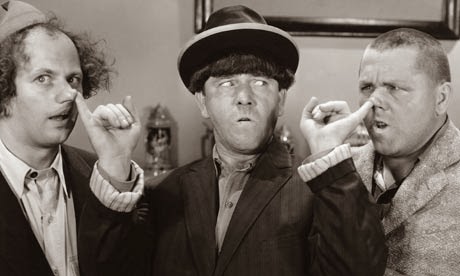
The obvious answer is that if you think it’s funny, then it is — to you. Laughter is subjective, a matter of taste, cultural orientation, and individual psychology. You may really dig the Three Stooges, perhaps because of their sheer relentless anarchy; or you may dismiss them, perhaps because of a lack of subtlety in characterization and story. A matter of taste, yes, but also a matter of emphasis.

This recurring argument came up because of three recent comments to this blog by three experts in the field. Dominique Jando, renowned circus historian, clown teacher, and mastermind of the Circopedia web site, wrote this about a video I posted of Ukrainian clown Kotini Junior:


Physically, Kotini is very impressive. Unfortunately, I cannot see anything in his character that is emotionally working — neither his makeup, nor his facial expressions. He is just manic and seems angry. That’s probably why he is not well known: With a more engaging character (and possibly a more expanded repertoire), he would be working everywhere!

And here’s the video:

A video I posted of a ballet parody, Le Grande Pas de Deux, and which I described as “very funny,” elicited a similar response. First, here’s the video:

Avner Eisenberg, aka Avner the Eccentric, wrote “Enjoyed it, but… The cow looks real, but why is it there? They certainly can dance! But comedy? Not so sure.”

Dave Carlyon, clown and circus historian, was more sure:


While this has some funny moments, I think it represents the problem that physical comedy and clowning often slide into. It piles on random bits, with little regard for relationship, reality, or internal logic.

Cow: Other than the sight gag, how does it fit anything? When the guy loses the gal, he does seem to consult it (6:00) but doesn’t look where the cow presumably told him to find her, instead simply making a conventional ballet move and going where the choreography indicated. 


Purse: Why is this in it? She drops it and picks it up at random moments, not even fitting the music. Its only real purpose seems to be to hold confetti to toss (8:53), but even then, the execution is awkward and the timing is bad.


Relationship: It’s never clear how they fit together. Early, he tugs her (2:38) in a kind of comic bullying that fits the classic top banana / second banana, but other times they’re smoothly in sync. I could understand if they’re falling apart as a pair but these goofy moves are random. Sometimes they have no relationship at all: She spins till she’s dizzy (7:21-7:31) and he simply waits his turn (7:45), showing no concern for her, nor smugness that he’s better, nor even comic impatience waiting for his turn. He’s not a character in a comic piece, he’s just a dancer waiting for his cue.


Reality: The lack of a clear relationship is part of the larger failure of reality. He nearly kicks her as she crawls off (5:43, 5:48) — which is simply awkward choreography — but only 7 seconds later (5:55), he can’t figure out where she is.


Dance: It’s not good as dance. The traditional moves are often as awkward as the jokey ones, and the movement doesn’t always match the music. It seems likely that the choreographer thought what too many clowns and physical comedians do, “It’s comedy so anything’s okay.”


Parody: Even here it fails. Goofy moves interrupt classic dance moves but with no particular purpose, rhythm, or reason. The laughs hint at this failure: They’re sporadic, and often simply bursts of a laugh-like noise to indicate they got the joke.


The irony is that this mess is fixable. Gimme two hours with these two, and it’d have a comic structure, relationship, and consistent laughs.

Now the funny thing is that these three éminences grises sound exactly like me. You may have noticed that I don’t use this blog to criticize work that I don’t like, but as my friends can tell you, these are the kind of critiques I annoyingly make after many a performance of movement theatre: “the character relationships are poorly defined, the narrative is weak” etc. etc. And when I teach or direct physical comedy, these are the elements I try to integrate with the more technical aspects, in the belief that the laughs will be deeper and more memorable when they’re rooted in reality.

BUT….

There’s another side to this argument…. maybe several…. so let me play devil’s advocate here.

Audience Reaction
I sure heard some loud and sustained laughter, but if Christian Spuck’s Grand Pas de Deux really isn’t funny, then why has it been in the Stuttgarter Ballet repertoire for a full 15 years now? Those Germans must have a weird sense of humor, right? Apparently not, because the piece has also become a worldwide success, including performances by the American Ballet Theatre. It was described by Dance Magazine as a “witty, parodic gala favorite” and by the New York Times as “a redeemingly funny sendup of ballet gala duets.” I found a couple of bad reviews online, comparing it unfavorably to the spoofs of Les Ballets Trockadero de Monte Carlo, but more common were comments such as “pure fun” and “brought the house down.” In other words, a lot of people have indeed found this “very funny,” without necessarily caring why the cow is there or how strong the relationship is between the characters. What gives? Are they just dumber than us?

You Had to be There
Some of it is situational: they’re sitting in the audience in a fancy theatre, probably all dressed up, and certainly are not like the rest of us, at home in our underwear reading my blog. They’ve just watched some highly aesthetic ballet, performed more or less perfectly, and they’re ready for comic relief. Of course it’s funnier live and in that context.

Getting the Jokes
It’s not funny if you don’t get the jokes, and you may need to be a ballet aficionado who’s been sitting in those same seats for half a lifetime to get most of them. Here’s my evidence, a review from the UK newspaper The Spectator:

Another reference-ridden duet concluded the first part. Created in 1999, Christian Spuck’s Le Grand Pas de Deux is one of the very few successfully comic takes on ballet I have seen. In front of a reclining cow, a ballerina — complete with tutu, tiara, glasses and a red handbag — and her dashing partner dance to Rossini’s La Gazza Ladra, liberally quoting, in a variety of hysterically funny ways, from all the known classics. It is a firework performance, which ties in splendidly with the opening.


“Reference-ridden” and “liberally quoting, in a variety of hysterically funny ways, from all the known classics.” Not only did this critic, certainly no country bumpkin, find it “hysterical” — which is a notch or two above “very funny” — but she also makes the point that it was constantly referencing specific moments from classical ballet. There’s similar evidence from other critics: “Taking its cue from the classical Russian tradition, you can spot signature moves from Swan Lake, Giselle and Sleeping Beauty.” And: “A parody of many a pyrotechnic Grand Pas de Deux (and a quote from Giselle Act II).” And: “The slapstick touches — flat feet, a ballerina in spectacles — are funny for anyone, while the sly satire will delight ballet aficionados.” It’s no wonder that this piece gets performed so much at gala benefits: it works best with a knowledgeable audience.

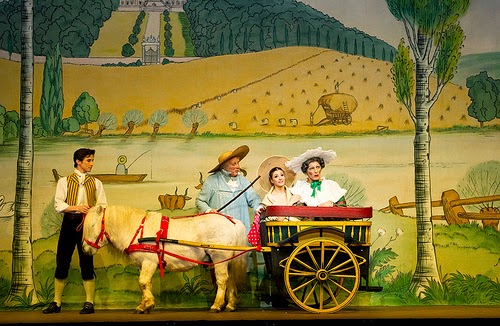
But what about that disappointing cow, so lifelike yet so inert? Bad comedy or an inside joke? Here’s a guess: classical 19th-century story ballets are full of bucolic scenes, with farms and peasants and barnyard animals in the background, while in the foreground cavort the principal dancers, who clearly would be more at home in the royal palace. It didn’t take me long to come up with these images from La Fille Mal Gardée:

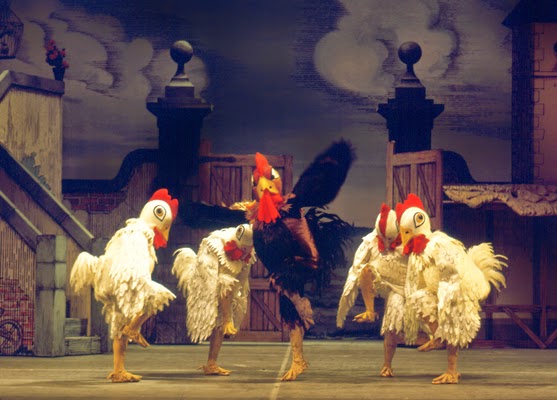
Holy cow, what’s that I see in the background? Vachement lifeless and inert? I rest my case, your honor!

In Spuck’s parody, the cow doesn’t have to be involved to be funny. Indeed, it may be funnier because it’s simply and incongruously there, alone on a bare stage, representing all those other fake animals in all those other story ballets.

My point is this: just as you shouldn’t call baseball “boring” if you don’t understand the subtleties of the game, you can’t critique a parody unless you’re very familiar with what’s being parodied.

The Intentional Fallacy
This term refers to the dumbass mistakes critics make when (according to more than one standard definition) they try to “judge a work of art by assuming they actually know the intent or purpose of the artist who created it.”

What we laud as great art today was often maligned as garbage when it first premiered because critics thought the artist’s intention was to do what everyone else was doing, but not succeeding, rather than trying to break new ground. Rotten Reviews, a compendium of scathing criticisms of work we now revere, gives a great perspective on this. The early impressionist painters got this treatment, as did most modern art movements, not to mention jazz and hip-hop. Waiting for Godot was initially trashed because “nothing happened” and it didn’t have a traditional beginning-middle-end narrative structure — as if that had been Beckett’s intention, but he just couldn’t figure out how to do it. Even Walter Kerr, champion and great appreciator of silent film comedy, haughtily dismissed Godot as a “cerebral tennis match” when it opened in New York in 1956. It’s a natural reaction, but one to beware of.

In this case, I think the intentional fallacy being made is the notion that the piece is or should be all about story and character relationship. The official line, at least since Aristotle, is that story is everything. It’s how we make sense of our lives. And if you have academic training in drama, as Dave and I both do, then this is the way you are trained to think. A more cynical post-modern view is that story is at best an artificial construct to entertain an audience (and sell them a product), and at worst a tool that manipulates our emotions, brainwashing us into patterns of perception that sell a political product.

My argument would be more mundane: that the Grand Pas de Deux is in fact not about two characters trying to do a dance but screwing up and falling apart along the way. It is not about their moment-to-moment psychology and motivation. For example, at some points we laugh because they do something clumsy, but at other points because they’re clever enough to deliberately insert contemporary dance moves into the choreography. Yes, that’s inconsistent characterization, but it’s on purpose and doesn’t matter. It’s just two performers skewing ballet tradition from every conceivable angle with reckless abandon for maximum laughs. No one cares about a character arc. It’s more of a collage than a narrative.

We all look for different things. I find it particularly interesting, as Robert Knopf points out in his book The Theatre and Cinema of Buster Keaton, that the surrealists had no interest in the widely acclaimed narrative films of the 20s, preferring instead the work of Keaton and other eccentric filmmakers. Indeed, surrealist leader André Breton had a habit of visiting Paris cinemas, viewing fragments of films by chance alone, “appreciating nothing so much as dropping into the cinema when whatever was playing was playing, at any point in the show, and leaving at the first hint of boredom… to rush off to another cinema where we behaved in the same way…. we left our seats without even knowing the title of the film, which was of no importance to us anyway.”

Yeah, I know, we’ve all done that with our television’s remote control, but the surrealists were looking for something specific, and it wasn’t old-fashioned storytelling. Knopf writes:

Keaton is able to fill his narrative containers with a special substance, an amalgam of vaudeville, melodrama, optical illusion, and his unique vision of the world… Whereas classical critics view Keaton’s films for the logic of their narrative structure, surrealist critics search for the ways in which Keaton questions the logic of the world. Keaton never intended to create surrealist films, yet the ways in which his films challenge logic, reason, and causality influenced the surrealists, who saw in his films and those of many of the silent film comedians an involuntary surrealism.

It wasn’t just the surrealists. Dadaists, futurists, and the Russian avant-garde all looked to silent film and the variety theatre for new structures, ranging from dreamscapes to shocking cabarets to what Sergei Eisenstein called “a montage of attractions.”

Which brings me to the clown Kotini Junior. He displays great dexterity with eccentric movement — reason enough for me to post his work on this blog — but as Dominique Jando rightly observes, he is manic and his character has no psychological depth. I agree, but I don’t think that was his intention. I’m pretty sure that he does what he does as a conscious choice. He offers us not a sympathetic character who we’re supposed to identify with, but rather an insane dream featuring a creature with a chair problem whose body frantically twists and warps in ways human bodies usually can’t. It’s a different approach, but one that the surrealists, with their insistence on the primacy of the dreamworld, might have enthusiastically embraced.
Or the Italian futurists, for that matter. Couldn’t this quote from Marinetti’s manifesto, The Variety Theatre (1913), apply to Kotini? “The conventional theatre exalts the inner life, professorial meditation, libraries, museums, monotonous crises of conscience, stupid analyses of feelings, in other words (dirty thing and dirty word), psychology, whereas the Variety Theatre exalts action, heroism, life in the open air, dexterity, the authority of instinct and intuition. To psychology it opposes what I call body-madness.”

It’s an extreme dichotomy and no doubt overly simplistic, but it’s another example of alternative ways of looking at performance.

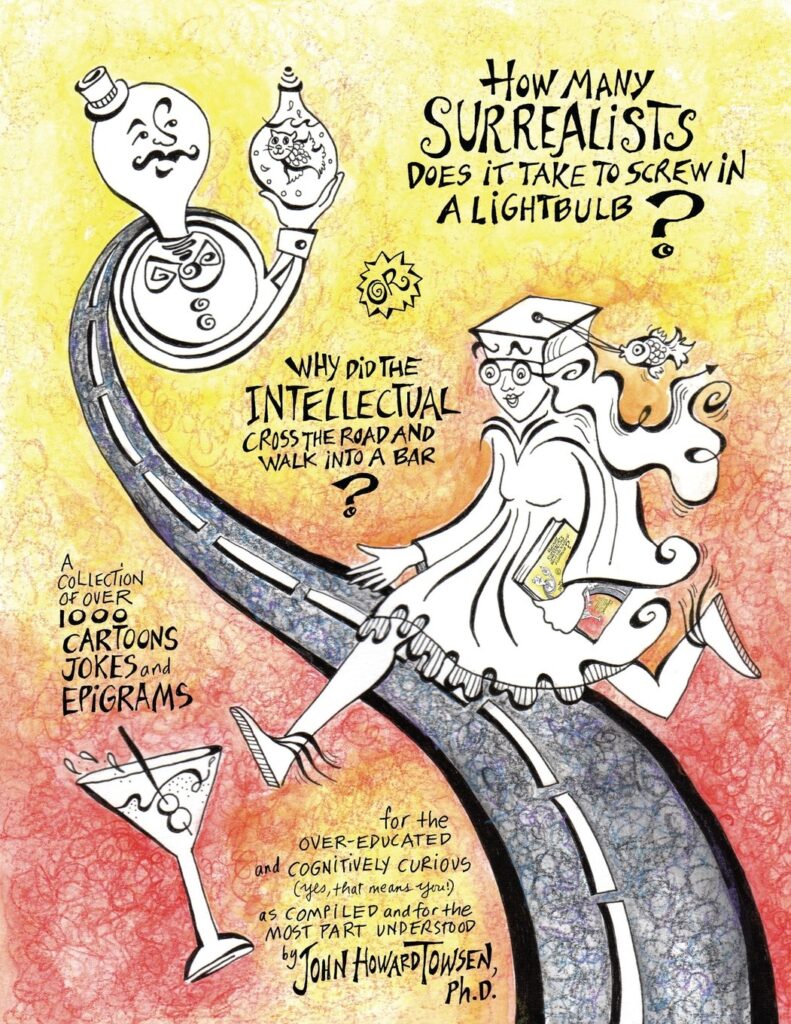
And not to beat a dead cow, but returning to our bovine friend one last time… it too could be seen in a surrealistic context. The cow could be funny because it’s totally random, and the joke is on us because we expect it to be part of the action. Or as another joke goes: “How many surrealists does it take to screw in a lightbulb?” — “Fish.”

Maybe if Dave (or Avner or I) re-directed Le Grand Pas de Deux, the relationships and narrative would be stronger, but I wouldn’t automatically assume the Stuttgart audience would like it any better. Maybe we would, maybe an audience of our picking would, but not necessarily most people, and certainly not everyone. And of course there’s the danger of it becoming a lot less funny because we might lose a lot of the jokes that the audience is already laughing at.

Conclusion? There’s more than one way to skin a funny bone. I’d say laugh at what you like…. because you will anyway.

LINKS:
• My blog post about clown Kotini Junior.
• My blog post about Christian Spuck’s Grand Pas de Deux.

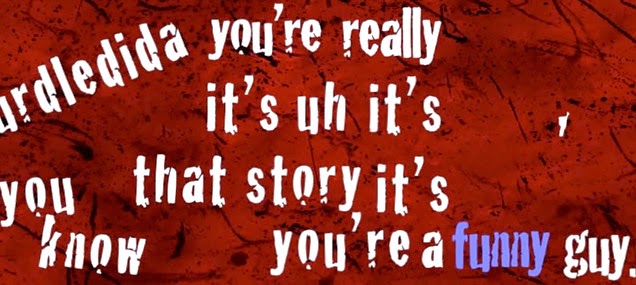
Where all that wacky “what’s so funny?” typography comes from.

SHARE
EXPLORE FURTHER

Your Physical Comedy Easter Basket

POST 377
Saturday, April 19, 2014

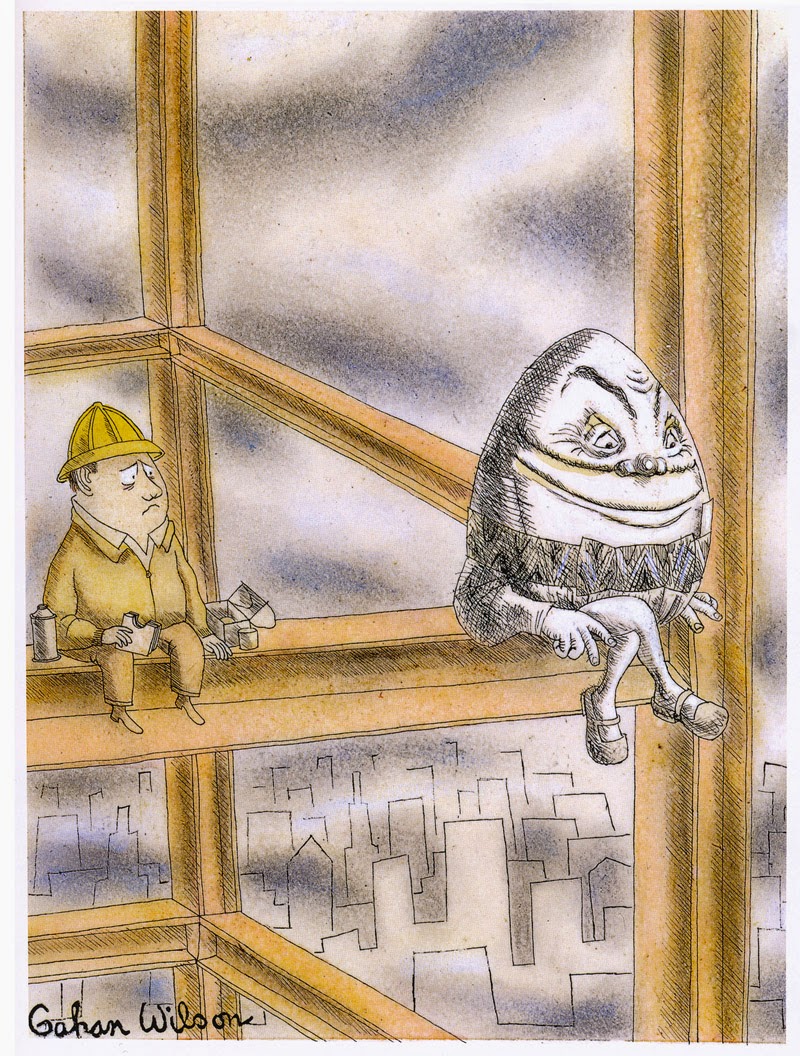
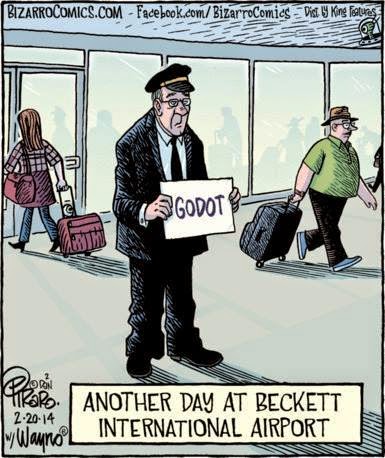
If you excitedly ripped open your physical comedy Christmas stocking, if you quickly devoured your physical comedy Valentine’s Day chocolates, if you got all giddy over this spring’s Premio de Primavera, then you’ll be hopping like crazy over the dozen goodies the Easter Bunny just brought you. One hundred percent recycled from my private collection and from links that came by way of such usual suspects as Drew Richardson, Lee Faulkner, Greg DeSanto, and no doubt other folks who I am forgetting. As usual, click on any image to enlarge.

Gahan Wilson

Gahan Wilson
SHARE
EXPLORE FURTHER

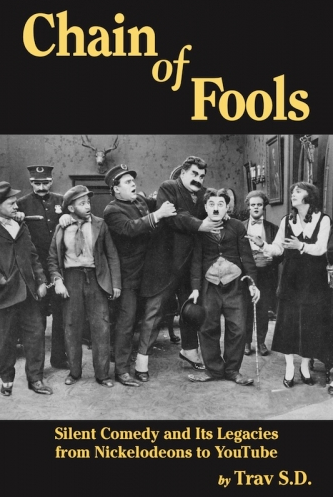
Book Report: Chain of Fools

POST 376
Thursday, April 17, 2014

Chain of Fools
Silent Comedy and Its Legacies
from Nickelodeons to YouTube
by Trav S.D.

Trav S.D. —oddly enough named after his gritty home town in the middle of South Dakota’s Badlands — is a so-good-he’s-bad vaudevillian: a performer, producer, historian, popularizer, and blogger whose popular blog Travalanche is a must for the variety arts fan.

I remember when I first came across his book, No Applause, Just Throw Money: The Book that Made Vaudeville Famous. I couldn’t help but think “do we really need another history of vaudeville?” Then I read the book and discovered that the author was a really good writer, a prodigious researcher, and had a fresh slant on his subject matter. When I heard he was publishing a book on silent film comedy, I couldn’t help but think “do we really need another history of silent film comedy?” Then I read the book and… yep, you guessed it.

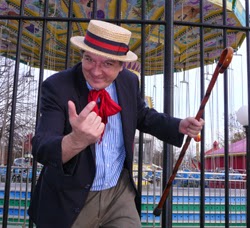
Trav S.D.

A lot of people read book reviews but don’t read books, but if you’re just the opposite and are already zoning out then let me cut to the chase and simply say that if you’re reading this blog (on purpose) then you’ll probably find Chain of Fools highly entertaining and informative.

Here’s just a few of the things you will like about it:

• I highlighted something on almost every page. It’s just chock full of info that was new to me and very interesting.
• He writes very lively and conversational prose, the kind I like to write but don’t always succeed at. Nothing pedantic here. He searches for and almost always finds an interesting way to say what he has to say.

• He’s very good at context. You really get the feeling what the work and artistic environment must have been for those creating this new medium.
• He makes a convincing case for silent film comedy as a unique art form and not just as a collection of funny performers.
• He doesn’t pretend that every silent film comedy was wonderful.
• He’s strong on the relationship between story and character.

• He appreciates what Paris and French culture meant to the arts and the growth of cinema.
• He makes Mack Sennett very interesting.
• He has fresh insights on many of the comedians; Harry Langdon and Lupino Lane, to name just two.

Any weaknesses, quibbles, reservations?


• It’s sparsely illustrated, and the discussion of individual films will have much more value if you have them on DVD or can find them online. Since he can’t assume you do, a lot of space has to be devoted to plot summaries. He handles them well, but exposition is exposition.
• His pre-cinema comedy history is sketchy and is missing some pretty clear links between the two eras.
• Physical techniques aren’t discussed in any detail.
• Max Linder’s feature films are given short shrift, and some of the comedians of the 40s and 50s (e.g., 3 Stooges; Abbott & Costello; Ritz Brothers; Jerry Lewis) are a little too summarily dismissed for my taste.
• There are a few errors I caught. For example, Keaton’s pole vault in College is lauded, but this was actually performed by gold medalist Lee Barnes, and it was apparently the only time (at least in the silent era) when Keaton used a stunt double. That being said, there’s no reason to doubt the overall accuracy of the work.

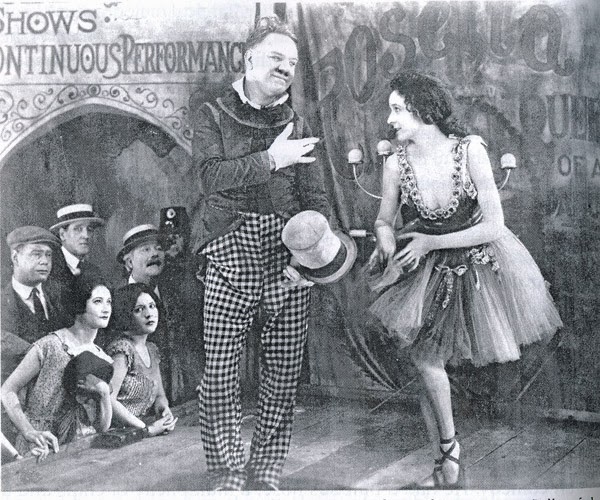
W.C. Fields in Sally of the Sawdust

Here are a few samples of his excellent writing:

I tend to think of Keaton as a verb; Chaplin as a noun.


This principle of ultimate action, of perpetual motion, was not discovered overnight, but came gradually, experimentally, in the same way Jackson Pollock arrived at drip painting or Charlie Parker came to bebop. It was a process of taking matters a little further, a little further, a little further over dozens of films until Sennett hit a new comedy dimension that looked like universal chaos.


There was very little precedent for what Sennett would now attempt. This would be the first time in history a studio head would endeavor to staff an entire company with absurd types. Sennett’s comedians resembled human cartoons: fat men, bean poles, vamps, men with funny mustaches, matronly wives and mothers-in-law wielding rolling pins and umbrellas; geezers with canes and long beards, bratty children with enormous lollipops. Diminutive heroes; terrifyingly large villains.


Keaton’s character may have a place in society, but he realizes that this is no guarantee of security or even tranquiity. What about the safe that may fall on your head? Or conversely, the wallet full of money that may miraculously fall into your hands. Rich or poor makes no difference. Fate makes playthings of us all. Man plans. God laughs. Keaton seems to feel no need to comfort us about this. No one emerges to make things better. The world is  cruel, capricious, barren of any special benevolence. It is this lack of faith or optimism perhaps that causes Keaton’s comedies to speak more to our time than to his own, and made him a big hit with European audiences even as many Americans were scratching their heads.

______________________

You can buy Chain of Fools here.

SHARE
EXPLORE FURTHER

Comedy Acrobatics Nirvana

POST 332
Monday, August 5, 2013
The Gaspards


Yes, right here! I hit the jackpot this past weekend, and of course I’m sharing the wealth with you. Here’s the story….

Although I’m partial to the use of physical comedy within a storyline, as in silent film comedy, I’ve always gotten a big kick out of pure comedy acrobatic acts, especially when they involve eccentric movement, partner work, and some sturdy furniture. I was first exposed to this when performing on the Hubert Castle Circus in the late 70s on the same bill with the Gaspards, whose table acrobatic numéro had many of the same moves you’ll see in the vidéos below.

The Gaspards

I’ve never been able to track down the Gaspards, and just have a few snapshots of them taken at another venue, but about six years ago in London I watched a video clip of what I thought was the sharpest knockabout act I’d ever seen. Of course I wanted a copy, but the collector who had shown it to me promptly disappeared from the face of the earth. Luckily I had written down the name of the act — the Mathurins — and never forgot about it. Then a week or so ago I finally tracked them down to a November 24, 1957 appearance on the British tv variety hour, Sunday Night at the London Palladium, sort of England’s Ed Sullivan Show. I got to see the clip for the second time ever on Friday.
I was happy, but then happier still on Saturday when on another episode of the same show I discovered  the Trio Rayros, another excellent comedy acrobatic act, who had twice appeared on Ed Sullivan (5-11-58 and 4-4-59).

And then this morning I woke up to find that my old friend Julia Pearlstein had sent me a link from Carlos Müller to a 1910 film of comic acrobats from the archives of the Cinémathèque Royale de Belgique. And guess what? It’s really good too!

So let’s start with the 1910 anonymous film of three anonymous acrobats. This begins with some standard acrobatics but gets wackier and wackier, and is full of nifty moves, including monkey rolls, pitches to 2-highs, pitches to back sits, eccentric walks, a hat dive, a jump to a thigh stand, the old putt-putt, and some great front fish flops. It’s amazing to see so many of these same comic bits in use a half century earlier, yet more evidence that physical comedy vocabulary was transmitted by variety performers directly into early film comedies.

Fast forward to November 24, 1957 and the Mathurins. Many of the same pitches, 2-highs, and partner balances, but more trips, slaps and falls, some ahead-of-its time break dancing, awesome table and chair moves, and the best peanut rolls this side of China… a knockabout encyclopedia!

Did he really say “it looks easy”???  I’m speechless on that one.  
And here’s the Trio Rayros at the Palladium three years later (10-4-60). Some of the same plus a 3-high column collapse, and a few nice creative touches with the suitcases. The whole idea of embedding the trampoline, while common nowadays, what with the popularity of wall trampolining, was likely pretty unusual back then. My favorite parts are of course the silly bits: the quickie walk up to and down from the 2-high and the “chair-pull” sequence with the suitcases.

Hmm… the 1910 clip comes from Belgium; the Mathurins were from France; Trio Rayros sounds Spanish but they use the French word for baggage (bagage). The Gaspards were French. As we say in French, coincidence? Maybe not, maybe this specific brand of comedy acrobatics was just more of a French tradition….
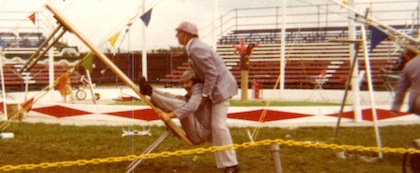
• The pratfall that begins with laying first one straight leg horizontally across the top of the table and then, rather optimistically, the other leg, was a trademark of Buster Keaton, which you can see him do during different stages of his life right here.
• You can see more table acrobatics in this previous post, but I’m also going to repeat here one of the clips from that post because it belongs to the same genre as what you just watched. This was from the Colgate Comedy Hour (hosted by Abbott & Costello on November 23, 1952), and the performers are the Schaller Brothers, who also had a comedy trampoline act.

Bon weekend!
SHARE
EXPLORE FURTHER
Check out My New Book

Visual and verbal humor for the cognitively and artistically curious!

“A book to treasure!”
—Bill Irwin

Upcoming Events