I have yet to find any biographical information on the multi-talented Georges Holmes, but this performance is from the French tv show La Piste aux Etoiles, from the same 1959 broadcast as Les Marcellys in my previous post. Also, his first name is spelled the French way, and the few words he speaks are in French, so let’s assume he’s French. He’s a tap dancer, acrobat, magician, and object manipulator. He’s quite the human smokestack, and also does one of my favorite “stupid human tricks,” the back roll with the cup of water. A variety artist full of variety!
I don’t know about you, but I still remember as a kid upsetting my parents by trying the old trick of yanking a tablecloth out from underneath some dishes and glasses with, er, mixed results. I’ve also written about this trick, including an advanced variation, in this blog post. But now I can offer a more scientific explanation….
First a little background: there’s an organization and web site, coursera.org, that distributes free, interactive online classes from major universities. I decided to enroll in “How Things Work: The Physics of Everyday Objects” because, well, I’m interested in that kind of stuff. And here’s the professor, Louis Bloomfield of the University of Virginia, beginning his very first lecture with — you guessed it — the tablecloth trick.
While Bloomfield makes a distinction between the scientist who shows how things work and the magician who hides things, he is in fact being a bit tricky here himself. For example, he says he’s adding a degree of difficulty by pouring wine into the glass. Yes, the spilled wine would make a mess, but of course the added weight makes the glass less likely to tip over in the first place. And removing the wine bottle from the table hardly seems insignificant. Because of its shape and higher center of gravity, the wine bottle is far more likely to be displaced than the plate.
His very next demo is conisderably more interesting and uses a trick I’d never seen:
Drew Richardson is visiting and we were watching this together, leading us to brainstorm on how this could be turned into a clown bit. Hmm… It might be hard to find a reason to be sticking a pencil in a Coke bottle, but what if the pencil were a straw, a straw that somehow you couldn’t insert in the usual manner? But wouldn’t a straw, because it’s so light, be more affected by air currents and be in danger of missing the opening? Maybe you could make your own “straw” out of heavier material. In fact, the object wouldn’t have to be hollow so long as there were an opening visible on each end. (3D printer, anyone?) Now for the hoop. You can see why you’d need it rather than, say, a rectangular frame (too much friction), but what would the excuse be for having a hoop handy? A hat band? It would have to be perfectly circular. A spring-form pan?? Well, you get the idea. I’m sure this is how Grock worked.
Anyway, good stuff, and the course just started this week, so if you want to enroll, just go to coursera.org. Did I mention that it’s free?
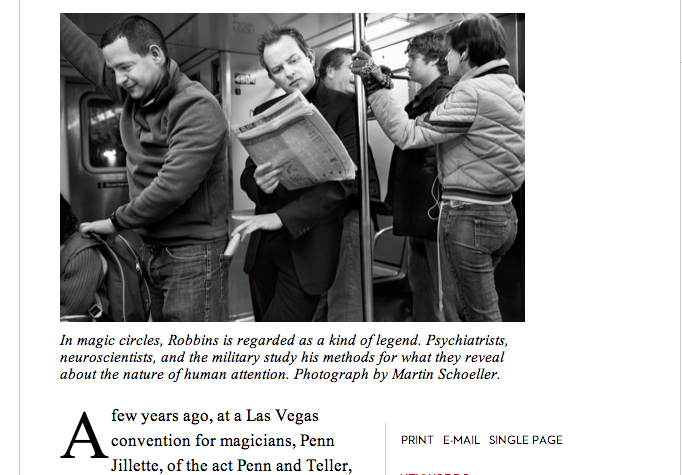
You may not think of pickpocketing as entertainment, much less physical comedy, but it can be both. I still recall with delight Philippe Petit’s street act in the days before the World Trade Center walk, which included juggling, tight rope walking, and other stuff, including some very amusing picking of spectators’ pockets. Now comes this fascinating article in The New Yorker about another entertaining pickpocket, Apollo Robbins.
You can read the whole article here.
And here’s that bookmentioned in the article about magic and neuroscience.
An entertaining 5-minute youTube video promoting a series Robbins did for National Geographic.
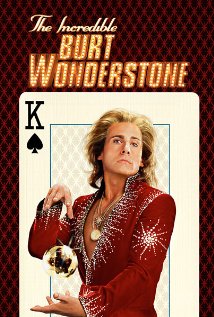
Due for release on March 15th, this movie about Vegas magicians looks to be a hoot — and to have a good deal of physical comedy. Wonderstone (Steve Carell) and his former partner (Steve Buscemi) must reunite to take on an up-and-coming street performer (Jim Carrey). Any similarity to Siegfried & Roy and to David Blaine is purely coincidental! (heh heh) Add in Alan Arkin as the elderly magician who inspired Burt and you have quite a heady mix of comedic talent.
Click here for the IMDB page.
Thanks to Jim Moore of vaudevisuals.com for the link.
If you’re in the world of magic, you’re no doubt already familiar with Yann Frisch, whose videos are going viral and whose many honors include winning French, European and World magic championships in the past few years. I, on the other hand, had never heard of him, but was schooled once again by Tanya Solomon, author of an earlier and very popular guest post for this blog on comedy magic.
Yann’s signature piece is this modern version of the traditional cup and balls routine, Baltass. (bal = ball; tasse = cup) As with the best comedy magic, the tricks happen to the performer, and the tricks are indeed amazing, blending rapid-fire sleight of hand with flashes of some very nifty juggling — not surprising since he’s a product of French circus schools:
After starting juggling and magic at the age of ten, I entered in a district circus school, and began to build regular numbers combining these two disciplines. At 17, I joined the circus school in Lyon, and after that the circus school in Toulouse. I will stay two years and I will create another number in addition to “Baltass,” my cup and balls routine, before I leave school. I am currently working on two long forms of entertainment: a solo, and a trio with two friends from Toulouse.
Here’s the act.
And here’s what looks to be an earlier variation on it:
Click here for Yann’s web site (not much info, though).
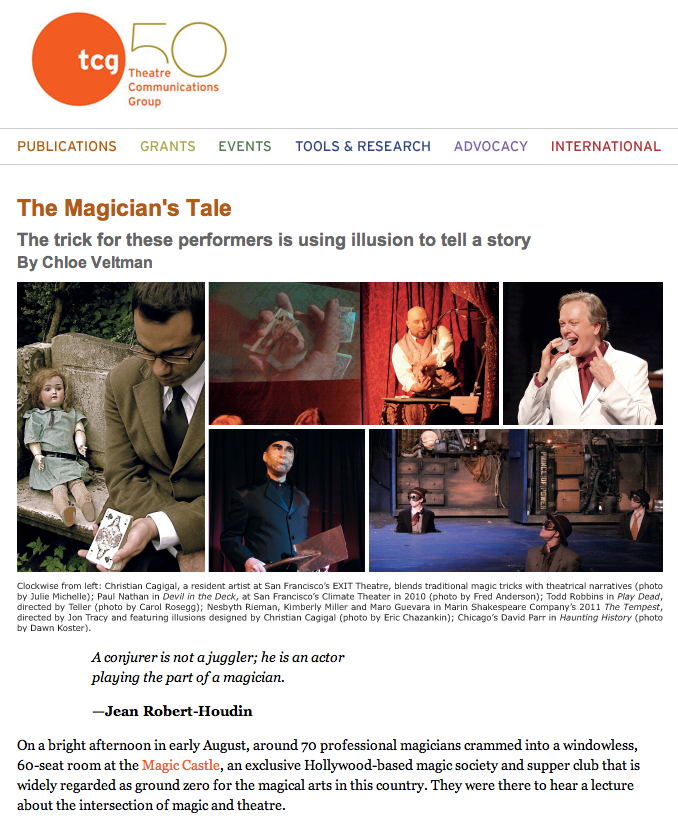
I was just about to move on from the topic of magic (see three previous posts) when Billy Schultz sent me this article by Chloe Veltman from American Theatre magazine. Nothing about physical comedy, but a lot about magic as theatre.
When I knew that Ben Robinson and Julian Olf would be contributing their writing on magic as guest posts, I asked my friend Tanya Solomon to recommend some good comedy magic to me. I’ve always had some interest in magic, but never pursued it and basically know very little. Tanya on the other hand is a veteran New York variety performer who combines all sorts of clowning, dance, and magic in her performances — plus she even works part-time in a magic store! When she came back to me with a thorough list of recommended videos, I thought it would be great if she would expand it into another guest post for the blogopedia. Take it away, Tanya (but don’t make it vanish)…. —jt ________________________________
Startling transformations. Hubris. Violations of logic and laws of nature. The basic elements of stage magic would seem to make it fertile soil for physical comedy.
And yet most “comedy magic” comes more from the standup comic tradition (Mac King, Harry Anderson, and David Williamson, to name a few funny ones). When physical comedy is used, it usually follows the narrative of the arrogant magician whose tricks fail and expose themselves. The classic act of this type is the late Carl Ballantine’s:
Done well, by performers like Otto Wessely and Kohl & Co., this is great comedy. But when John gave me the chance to pick out some favorite funny magic, I decided to represent a less common type of act: one in which physical comedy is used and the magic (though not necessarily the magician!) is effective.
One of the greatest theatrical challenges in magic is getting around the “I can do something you can’t” presentation. The mystery should be fun, not frustrating, for the audience. With that in mind, please note the variety of characters and situations of the magicians in these videos. Some (Voronin, Gartner) are powerful magi dealing with comeuppance. Buka is unable to predict or control his own magic. Tom Mullica is the victim of bizarre physical occurrences. And Tina Lenert’s character isn’t even a magician — which I find interesting, as she is the only woman in this lineup. (Women in magic are rare; women in comedy magic are almost non-existent.) Her act is in the tradition of Cardini’s — magical events befalling someone going about non-magical business. (See an analysis and video of Cardini in the previous post.)
And so, a sampler of physical comedy in magic:
The hilariously diabolical Maestro Voronin will mesmerize you…no matter what befalls him in the process. Yevgeniy Voronin, from Ukraine, is featured in
Teatro Zinzanni in San Francisco.
I don’t know anything about this team, Roy Gartner & James, but I love their comedy relationship. And their magic.
Tom Mullica ran the Tom-Foolery, a magic bar in Atlanta, where he developed his famous acts. He had to quit smoking, but he kept the rubber face, and now performs a Red Skelton tribute in Branson.
The use of sound and rhythm by this fellow, Buka, is bizarre and unique, and his manipulations are impeccable. Funny stuff, but unfortunately an ethnic stereotype (Turkish?). Can’t find any info on Buka except that he is Russian and lives in Romania…and that “buka” means “bogeyman” in Russian.
Tina Lenert takes a classic mime/clown bit and adds sleight of hand. This is her signature act, and probably the best-regarded use of mime technique in magic. (Raymond Crowe, the Australian “Unusualist”, has an excellent DVD on the subject.)
Topper Martyn (1923-2004) had a long career as a comedy juggler and magician, including years in ice shows(!). The beginning of this video shows how he opened his “World’s Third Worst Magician” act. In his book Topper’s Mad Mad Magic — the best resource on comedy magic I’ve found so far — he lists the contents of his coat: “200 billiard balls, 1 cannonball, 10 wooden eggs, 8 folding dice, 2 giant rubber dice, 1 spring duck, 1 large spring snake, 6 small spring snakes, 300-500 playing cards, 1 string of flags, 50 coins, 1 rubber dove”. Martyn commented, “Although I love to burlesque magic… there are no exposures in [my act]. The average audience is not interested in magic secrets; they love buffoonery, spectacle, action, and surprise.”
Sylvester the Jester plays a “real live cartoon” character. His humor is a bit “nutty” for my taste, but he’s incredibly inventive, and has created many effects.
Legend has it that Lou Jacobs himself told Charlie Frye to get out of Ringling’s clown alley and hit the variety stage. Frye is a master juggler and magician, known for his “Eccentricks” instructional videos which teach skills with a physical comedy presentation. Here’s a kinetic bit he does with linking rings and a floating bowling ball.
Because this is just a sampler, I’m going to skip over some better-known acts — the Banana Man, Steve Martin’s Flydini, and Penn & Teller are among my favorites — and instead focus on a wonderful obscurity: “The Amazing Dr. Clutterhouse”. No footage of this act is available, though tribute acts have been reported once in a while. My description comes from old magazines and a booklet published by Magic Inc.
In mid-20th century Chicago — then the capital of American magic — audiences were said to have wept and screamed at the antics of Dr. Clutterhouse, played by Elmer Gylleck, a hobbyist magician who created his original, ingenious props. Thunderous circus music played, and a bumbling gentleman in a walrus moustache and derby shuffled onstage. His wand escaped him, and ghosts and snakes flew from his briefcase, followed by revolver shots. Endless chaos ensued: an umbrella appeared in his pocket, an egg broke on him, a handkerchief refused to leave his hands. He tried to adjust his table, which collapsed further the more he tried to fix its rubbery legs. Clutterhouse shot the table dead. He couldn’t control the massive amounts of paper and silk he pulled from his hat, and a rabbit’s head kept popping out to mock his confusion. He put in a final colossal effort, was swallowed by a cloud of feathers, and pulled out a yard-long dead chicken. Finally, he produced two live rabbits, and exited, relieved.
A final note: this selection is mostly limited to one branch of magic, manipulation (i.e. sleight of hand for stage), which just happens to be my favorite. Other categories, such as mentalism (mindreading) and closeup card tricks, don’t lend themselves to physical comedy. But you might ask, why aren’t large-scale illusions included? Well, it might be my taste (I don’t like the Vegas style that goes with the big boxes by financial necessity). Or, my perception that “comedy” in big illusion magic is limited to tired one-liners and sight gags might be correct.
At any rate, having scoured YouTube, these are the only illusion-scale performers who got my vote as being true physical comedy. Scott & Muriel, who call their work “slapstick magic,” are currently performing in the Big Apple Circus.
But who knows…perhaps someone somewhere is hammering together a comedy illusion on the scale of the Hanlon Brothers. Maybe there’s funding for it. Maybe there’s even an audience! Vegas, anyone?
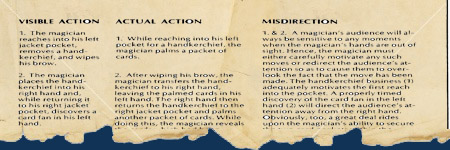
We continue our look at magic technique with this revealing analysis of the performance of the great magician, Cardini, by an old colleague of mine, Julian Olf. This article first appeared in a 1974 popular entertainments issue of The Drama Review (TDR) that I worked on as an editor in my grad school days at NYU. Even back then I realized that Julian’s take on magic as a form of acting offered a fresh perspective, and re-reading it today only reinforces that opinion. So happy to have tracked Julian down, and much thanks to him for kindly granting permission to share his work with readers of this blogopedia.
In his youth, Julian studied sleight-of-hand magic with the vaudeville magician Jack Miller. He later shifted his concentration to a study of theatre history and dramatic literature, receiving graduate degrees in these subjects from Columbia and NYU. He recently retired from the University of Massachusetts, Amherst, where he taught playwriting, dramaturgy, and chaired the department. His plays have been produced in New York, Boston, Amherst, Los Angeles and Vancouver. His comedy, 1-900-Sex-Date, won the Nantucket Short Play Award. His one-character play, People Almost Always Smell Good in the Art Museum, was produced at UMass-Amherst, published in the fall 2008 issue of the Massachusetts Review, and nominated for a national Pushcart Prize. His screenplay, Anthony, inspired by Shakespeare’s Hamlet, received a Gold Award at WorldFest International Film Festival (Houston) and was given a professional reading by The Drama Garage of Hollywood. His screen adaptation of Henry James’s short story, The Liar, was a finalist in America’s Best Screenplays. Click here for more information.
I’ve appended the only video footage of Cardini I could find. Julian points out that his article was based on his viewing of a different performance of Cardini, so readers should not attempt to match his narrative with the exact sequence in the video. The article is in pdf format and can be enlarged or downloaded using the buttons at the bottom of the Scribd window.—jt
_________________________________
And here’s that footage of Cardini; a big thanks to blog reader Eddie Walsh for alerting me to a higher quality copy of the video than I had originally posted! —jt
Ben Robinsonis both a master magician and an historian of magic, author of Twelve Have Died: Bullet Catching, The Story & Secrets and of The MagiCIAn: John Mulholland’s Secret Life, as well as numerous articles for major magic publications. Just last month, Ben’s decades-long research into the use of magic in silent films came to fruition with publication of his latest book, Magic and the Silent Clowns — a subject that had received scant attention until Ben’s work. Concurrent with that, Ben helped curate a fascinating show at New York’s Museum of the Moving Image entitled Magicians on Screen, including both a magic performance by Ben and a lecture-demo on the subject of magic and the silent clowns. In fact, Ben had first proposed the idea to the museum back in the 80s. Patience is indeed a virtue — though persistence sure helps! This blogopedia is very pleased to be able to share the first chapter from Magic & the Silent Clowns, and to be able to match Ben’s enthusiastic prose with a few video clips.
_____________________________________
Keaton the Conjuror
Buster Keaton’s education and use of the conjurer’s illusionary techniques.
by Ben Robinson
“Once Pop accidentally wrecked another act by tossing me into the backdrop curtain. This was the turn of Madame Herrmann, the widow of Herrmann the Great, one of the most popular magicians. She was working some of his simpler tricks. At the finish of her act she had dozens of white doves flying to her from every corner of the stage.” (My Wonderful World of Slapstick, p27)
Buster Keaton was an illusionist.
It is said that the world’s greatest illusionist, or magician, would never be truly known by the public at large. Why? Because so great a “talent” wouldn’t need the adulation, as the prowess by which the work was deployed would be best praised by not even being seen. In the shadows of show business and art, there would lie success. In the French this is referred to as eminence grise. While Buster is certainly known, his use of illusion is at best appreciated as an auxiliary component to the gag.
However, a deeper look into Buster’s upbringing and eventual use of his fantastic vaudeville education clearly expresses itself in his movies, some of his TV appearances and, more notably, when meeting the media. It might be assumed that the Keaton we see is an image he is in total control of. That being said, the controlled image we always saw was one of a surreal world where “magic” was part of the landscape, like air. In the famous Sid Avery photograph of Keaton, titled “What Elephant?” while Keaton looks forward, with his hand on his brow, the elephant’s trunk winds through his other arm, the pachyderm quietly standing behind the comedian. This is a vanishing elephant only to the person closest to the king of the forest, a good metaphor for Keaton’s “magic.”
While the examples of Keaton’s legerdemain are too numerous for inclusion here, this notion may bear some examination in the following examples.
Clearly, legend has it that Buster received his nickname from Houdini. While this may be a matter of conjecture, the legend sticks (and most vaudevillians would tell you that when it comes down to printing the myth or the truth, they yowl, “the myth, print that!”).
That Joe Keaton and Harry Houdini (1874-1926) once appeared before the audiences of the Midwest in a tent show is certainly a fact. It is also a fact that this show, The Keaton-Houdini Medicine Show, was not a great success, and occurred years before Houdini’s triumphant success in Europe in 1900. Of his father Keaton remarks that “he was an eccentric dancer, not an acrobat, but damn near.” The same might be said of Keaton: he wasn’t a magician in the classic sense, but damn near. Like a classic magician, everything that he saw, particularly of the mechanical variety, was always filed away in his memory for future use. His summer home amidst the actor’s colony in Muskegon, Michigan was not far from a little town named Marshall, among its distinctions being the home of the very first electrified house in the US. Called Honolulu House, it doesn’t have the electric staircase (escalator) Buster later used in his movie The Electric House, but it does have many other mechanical wonders, including the sliding bathtub that switches between rooms that Buster used on celluloid.
Backstage, Buster saw it all. He refers to utilizing some of Houdini’s tricks in his movie Sherlock Junior, and even opens Cops with a line credited to Houdini: “Love laughs at Locksmiths.” He also acknowledges a relatively little-remembered genuine Chinese vaudeville illusionist, Ching Ling Foo — whose grand feats included turning a somersault in mid-air and when he returned to a standing position, he held a bowl of goldfish that
appeared from nowhere!
Young Buster grew up learning that magic had to be “justified” or plausible for the introduction of an illusion. He realized in his movie-making career that “cartoon or impossible” gags (and illusions) had to be justified, like his jumping and impossibly disappearing into the briefcase held by a man (dressed as a woman) accomplice on the street (Sherlock Jr.)….
….or appearing as nine individual dancers on stage at the same time (The Playhouse)….
….or avoiding the tornado winds by hiding in a magician’s prop (Steamboat Bill Jr.)….
Whenever magic occurred, Keaton might have been justifying his conceit he explained as “I always want the audience to out guess me, and then I double cross them.”
Keaton’s use of illusion was not always as a trick per se. When the house he moves across the train tracks in One Week narrowly escapes destruction by an oncoming train, another train enters the frame — and his on-screen drama — and demolishes what we only thought, seconds before, was safe. The revelation of the perceptual difference of the first train set the audience up for the wow appearance of the second train.
Similarly a magician will make a scarf appear, only to have the audience relax at that manifestation. When a dove flutters from the folds of that scarf, there comes the “topper.” Buster just played with much larger props.
This type of drama, albeit small, is as much part of the conjurer’s lexicon as a rabbit and a hat. Magicians refer to this type of presentation as a “sucker gag.” Feigned failure, only to be consummated by winning success, or in the previous example, unexpected total destruction.
I believe Buster was schooled in such thinking about surprise (both magic and comedy being dependent on surprise) by his vaudeville and mud show upbringing. The magician’s technique he learned as a child pervaded his work on screen and elsewhere. On stage in France, in the late 1940s, he counseled the clowns in the Cirque Medrano how to get more out of the crowded clown car gag. Multiple large clowns (always ending with the largest of all) simply emerging from a small vehicle was impossible. Once Keaton showed them how the impossibility became surprising, then the illusion became magical, funny and even more surprising. How many times have we all seen this? And how many times have we seen the clowns emerge with beach chairs and finally a clown emerging with a full tray of food including a stuffed turkey? These were Keaton’s touches he culled from the Hanlon Bros. performance of clowning, magic and illusion that took place in
Europe and the US prior to 1900.
And now for the magic that hits you as reality. This may give you an example of Buster’s eminence grise.
Remember the famous scene in Sherlock Junior where Buster is “shadowing” a man walking in front of him? Now, watch as the man tosses a cigarette behind him which Buster catches, takes a drag of and then discards…or does he? Given that Buster is the fellow who had a whole side of a building fall around him, missing him by mere inches, I think handling a lighted cigarette in flight was child’s play for him. But slow down the image and you will see a nifty piece of sleight of hand he no doubt executed on many occasions, being an inveterate cigarette smoker.
Other hand magic: in The Cameraman Buster tried to catch the fancy of the photo assignment secretary by making a quarter disappear in his hand, only to be revealed from behind his ear.
In Steamboat Bill Jr., when attempting to have his father receive a loaf of bread in jail, Buster mimes the contents of the bread and involves another deception of the hands. Effortlessly. Gracefully. As if he yawned.
All magical illusions are understood by the student of the art, firstly through small, hand-held deceptions. Given Buster’s consummate understanding of the nature of his medium (in this case, film) it is likely Buster combined this understanding with his familiarity with the scene backstage where magicians show each other tricks they carry with them, one time known as “vest pocket magic.”
The point: Buster understood close-up magic because he was schooled in close-up magic from day one.
Whether it was dangling from a rope to save his wife from the pitfalls of a raging waterfall (a la Houdini) in Our Hospitality or making it appear as if he simply caught a lighted cigarette from the air, Keaton saw the meshing of illusion and reality in every situation, and exploited it. While performing off stage for a visiting film crew, in his later years, he created the illusion of catching a train, and bringing a 10-ton locomotive to a halt. One might say this was a developed version of catching the side of a moving car and being whisked from view, as in one of his short comedies.
Jack Flosso, the late owner of the world’s oldest magic shop, knew Keaton remotely through his father, the great Al Flosso, veteran of thousands of vaudeville and Coney Island sideshow performances. Flosso says, “When you do magic and don’t admit it, that’s great. Harpo did that, and where’d ya think he got that…Keaton! Buster had an eye for everything. Remember that.” That Keaton’s silent, surreal illusions should find a home in the 1930s amidst Harpo’s arsenal of wonders is not surprising to any Keaton scholar. What is delightful is that Keaton’s use of illusion was an integral part of his day-to-day life.
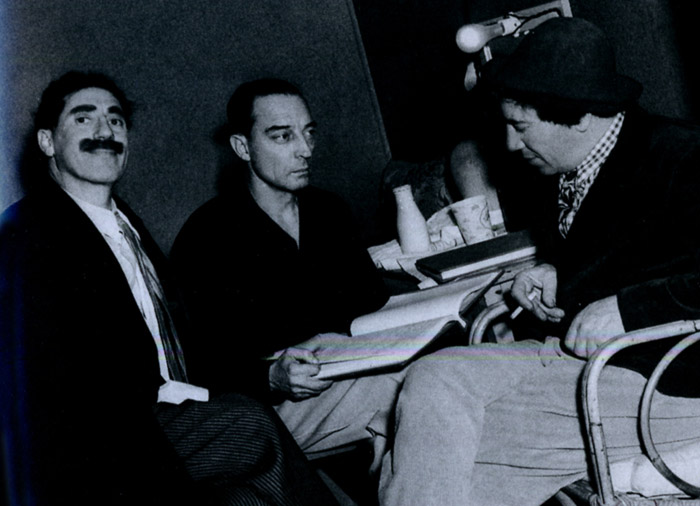
Buster Keaton working as a gag writer for the Marx Brothers
He frequently polished a window near him only to surprise his viewers by putting his head through the glass he had just polished, revealing that his polishing was deft pantomime… the illusionary transparent glass was only perceived as solid by his impromptu audience. Many remark what a great practical joker he was. Such visual jokes have their roots in illusion. In several newsreels depicting Buster at play one finds Keaton doing something short and sweet like sewing his fingers together (later adopted by Red Skelton) or making a baseball disappear for a dog (but not for the rest of the audience). Anything surprising, anything out of the ordinary from this apparently “ordinary” man made his magic more memorable and surprising.
We always hear of the “magic of the movies.” Buster Keaton is a master of a special type of movie magic that, often, you don’t even realize is right in front of you!
_________________________________________________
Sources:
Beckett, Samuel., FILM, Grove Press, NY 1969.
Bengtson, John., Silent Echoes (Discovering Early Hollywood Through the Films of Buster Keaton), Santa Monica Press, CA 2000.
Blesh, Rudi., Keaton, The Macmillan Company, New York, NY 1966.
Dardis, Tom., KEATON — The Man Who Wouldn’t Lie Down, Limelight Edition, 1996
Kerr, Walter., The Silent Clowns, Da Capo Press, NY 1975.
Keaton, Buster with Charles Samuels., My Wonderful World of Slapstick, Doubleday & Co., NY 1960.
Kline, Jim., The Complete Films of Buster Keaton, Citadel Press, NY 1993.
Knopf, Robert., The Theater and Cinema of Buster Keaton, Princeton University, Press, NJ 1999.
Meade, Marion., Buster Keaton Cut to the Chase., Harper Collins, NY 1995.
Tobias, Patricia Eliot, Ed., The Great Stone Face, The Magazine of the Damfinos, The International Buster Keaton Society, Volume 1, 1996.
Interview with Jack Flosso in New York City, December, 1999.
Kevin Brownlow, & David Gill (producers)., Keaton — A Hard Act to Follow, Thames TV production, 1987.
________________________________________
This article was originally published in The Keaton Chronicle, the magazine of the International Buster Keaton Society, The Damfino’s, in the Vol. 10 Issue 4, Autumn, 2002. Reprinted by permission. It is also part of Ben Robinson’s book Magic & The Silent Clowns (2011).
________________________________________
Visit Ben’s web site here, where you can also purchase his book directly via PayPal.