I was researching something else on Dominique Jando’s excellent Circopediaweb site (which I highly recommend!) and came across this gem and thought it worth a cross-posting. After all, if I had never seen this it’s likely many of you haven’t either.
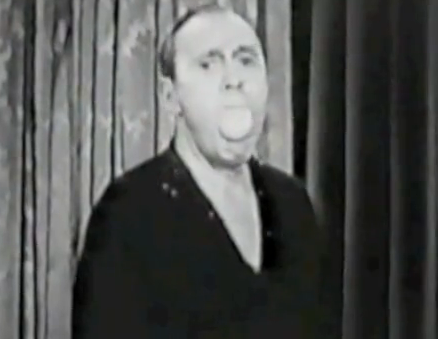
This is Francis Brunn, one of the greatest jugglers ever (you’ll see why) making an appearance on the Jack Benny Show back in 1961. Benny was an ex-vaudevillian with a dry wit and real talent as a violinist, but certainly not known as a physical comedian. Here he does get a bit physical, though Dominique assures me that the pratfall was done by a stunt double, though one with a pretty believable physical resemblance.
Click here or on the screen image below to go to Circopedia and see the video, then stick around a bit and browse the site!
British television comedian Benny Hill made a long career out of sight gags, British musical hall routines, and leering sexual humor. Other than his trademark Yakety Sax sped-up chase scenes, however, you wouldn’t necessarily think of him as a very physical comedian… and this skit probably won’t change your mind. “Scuttle’s Keep Fit Brigade” has some fun with acrobatics, but that’s about it. Like most of Hill’s work, very uneven, some good bits, nothing great, but at least there’s a lot crammed into a short amount of time. In other words, modern television.
Clown friends come to my apartment, look at all my books and DVDs, and are impressed with how much I must know. I do the same thing at my doctor’s office. All those thick volumes line the walls. Surely he’s read them all. He does know what he’s doing, right? Right??
Well, I’m hoping my doctor’s doing a helluva better job than me, because I know I can’t keep up. I continue to collect, but finding the time to read or watch is another matter. I’ve waited months or even years with great anticipation for a new DVD box set to appear, snatched it up on its release date, and then never watched more than a half hour of it. “I’ll get around to it… one of these days.”
Of course not every book makes for an engrossing read, nor is every multi-disc DVD collection a non-stop laff riot. Yes, I’m a fan of silent film comedy, but much of it is formulaic and only sporadically entertaining, and when you’re tracing the early years of a famed comedian, you discover that they are human too and that it took them quite a while to reach their stride. Their development process may be historically interesting, but you really have to be in the right mood for that. And if you’re writing a physical comedy blogopedia, you feel obligated to take notes on it as well. Hmm, maybe I’ll watch another episode of [fill in the blank] on Hulu tonight instead.
So, why this review?
Well, they say you can’t teach an old dog new tricks, but I’m experimenting on myself nonetheless: instead of undertaking the daunting task of viewing all six volumes of the admirable new Ernie Kovacs Collection and posting some sort of comprehensive report — a homework assignment I might never finish — I decided that for the time being I’d limit myself to the first disc, and hopefully add on later. So here goes……
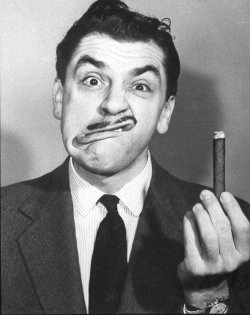
Ernie Kovacs was an early pioneer of television comedy whose brilliant career was cut short when he died in a car accident in 1962, ten days shy of his 43rd birthday. Here’s why you might find him interesting:
• His comedy was conceptual, improvisational, and often brilliant; he was an absurdist and post-modernist before his time
• He was a visual comedian, and has been described as the “Buster Keaton of television.” Although not a physical performer in the knockabout sense of Keaton and Lloyd, he had an affinity for silent film and often used it as inspiration for his own work, especially his character Eugene. • He wrote for Mad Magazine for a few years. • He was a VFX innovator, what were known in those days as “camera tricks,” and is credited with the invention of television’s first form of “greenscreen” effect. • He coined the sign-off line “It’s been real.”
For more of an overview, here’s part of a Carl Reiner tribute to Kovacs:
Early Television
Although I still pass for 29 (or so), I can actually tell you a thing or two about early television. My first acting job, a baseball skit with Red Skelton and Jackie Gleason on the Red Skelton Show, went into rehearsal just before my seventh birthday in 1955, only four years after Kovacs’ first shows in Philadelphia. Television was 100% live in those days, and if my family wanted to watch me perform, they had to go to a more prosperous neighbor’s house, because like many people we did not yet own a TV. And the only reason we have recordings of any shows before 1957, when videotape came into use, was the kinescope: basically the results of a 16mm film camera being pointed at a television monitor.
Most of these “kinos” did not survive. Early episodes of the Tonight Show Starring Johnny Carson were dumped in the Hudson River to save on storage costs. NBC was actually dubbing over Ernie Kovacs tapes to record game shows, and much of his work was lost forever. When Kovacs’ widow Edie Adams caught wind of this, she had the smarts to buy up any and all kinescopes and videotapes of her husband’s work that still survived, without which this DVD collection would not exist.
[ASIDE: One more old-man anecdote. In 1957, I had a small role in Rodgers and Hammerstein’s Cinderella, starring Julie Andrews, and with Edie Adams, wife of Ernie Kovacs, playing the fairy godmother. We were in rehearsal for a month at CBS Color Studio 72 on NYC’s upper east side, and though I know I met Rodgers or Hammerstein (don’t remember which), I’d like to think that Kovacs must have dropped by from time to time that month to visit his wife and that we were at least in the same room… and perhaps he even said “hi, kiddo” to me. And speaking of kinescopes (I told you this was an aside), the black-and-white kinescope recording of the live color telecast of Cinderella was re-broadcast on PBS in 2004 as part of its Great Performances series, and I actually got a royalty check for $285, a mere 47 years later; no residuals on the DVD, though.]
What I do remember about those days was that television was more like off-off-Broadway than the slick high-tech advertising machine we’re so used to today. Smaller crews, less equipment, more chaos. Even Cinderella, the most lavish production of that era with 56 performers, 33 musicians and 80 stagehands, had only four cameras! I think what happens in the early days, where everyone’s just learning the medium, is that there’s both a rare chance to invent whatever you want but also a push towards “what works,” towards a safe commercial product. Somehow Kovacs managed to be a leading innovator while enjoying enough commercial success to stay on the air.
Disc One — The Early Years
What we see on this first disc is Kovacs from 1951 and 1952, working in a small ramshackle studio, no laugh track, no audience except his crew — a preference he was to retain — and trying out all kinds of bits. There is no fourth wall, no pretense at naturalism. He breaks character, chats with the cameraman, the other performers. You see his mind constantly working. Anything goes, no apologies.
Here are a few sample clips to whet your appetite, interspersed with some choice quotes from the excellent DVD booklet.
In this enduring bit, Kovacs teaches “you ladies” how to use the dials on your new-fangled television set.
______________________________________
“Ernie Kovacs knew exactly what to do with television before television knew what to do with itself. It’s sixty years later and we still haven’t caught up.”— David Letterman
______________________________________
A very short William Tell gag with a simple camera trick.
______________________________________
“It’s appropriate that television is considered a medium, because it’s rare if it’s ever well done.” — Ernie Kovacs
______________________________________
A silly enough whipcracker gag.
______________________________________
“How many recent geniuses… are so utterly erased from their right place in cultural memory? In Ernie Kovacs’ case, literally erased. Taped over, for crissakes. This goes beyond any artist’s worst fears of being out-of-print, or of receding in mists of antiquity, or even of being a victim of the chemical time bomb of nitrate prints that have devoured century-old silent films.: this is more recent and irresponsible and lousy than that. They taped over his work, the fuckers. Here’s Ernie Kovacs, the bridging figure, at the very least, between Groucho Marx and David Letterman; the immediate and proximate father, at the very least, of both Monty Python’s Flying Circus and Nam June Paik; the uncle, at the very least, of Laugh-In and the Tonight Show and a thousand lesser television moments; the permissive next-door neighbor, at the very least, of Donald Barthelme and Frank Zappa. ” — Jonathan Lethem, novelist (Motherless Brooklyn; Chronic City)
______________________________________
If you saw this mock commercial for Briefy cigarettes on Saturday Night Live, it would be 30 seconds long. Kovacs rambles on for almost four minutes — “When I flounder, I flounder” — but it was all part of his endearing persona.
______________________________________
“The Ernie Kovacs Show knocked me sideways into a world where the bizarre and the daft and the preposterous all lived happily alongside wisdom, wit and perception. I had never experienced anything so visually absurd and inventive. It was sublime.” — Terry Gilliam, original Monty Python member; director (Time Bandits; Brazil)
______________________________________
An opening to one of his shows from August, 1951, done partly in the style of silent film.
______________________________________
I would say that there’s more of the same on disc one, and there is, but there’s even more variety: puppet shows, classical theatre parodies, eccentric music numbers à la Spike Jones, cooking routines, and more. Should you buy this box set based on what I’ve watched so far? Yep! The material’s great and everything about the collection is quite well done, not surprising since it was curated by New York’s own silent film historian and piano accompanist, Ben Model. You can get it herefor under $40. As I’ve preached before, if fans like you and me don’t buy this stuff, they’re not going to keep making it. And it’s so much better than watching crappy compressed 2-minute excerpts on YouTube.
Finally, if you want links, I’ll give ya links. The Wikipedia article on Kovacs has some good information, but for more go to the source: Al Quagliata and Ben Model have three — count ’em, three — Kovacs web sites up there:
Old joke: Two professors chatting. First Professor:I say, Rodney, have you read Derrida’s treatise on grammatology? Second Professor:Read it? I haven’t even taught it!
Dick Van Dyke, physical comedian and star of stage and screen, has written a new book, Dick Van Dyke: My Lucky Life In and Out of Show Business. I haven’t read it, but I sure am writing this blog post about it.
Well, in my defense, I did listen to a 7-minute promo interview with him two days ago on NPR, and now you can too by clicking here.
I never saw Mary Poppins or Chitty Chitty Bang Bang (I have sons, not daughters), and the only time I saw Van Dyke live was as Harold Hill in a NYC revival of The Music Man; let’s just say he was not right for the part. But I did grow up watching the Dick Van Dyke Show (created by Carl Reiner), one of the best sitcoms ever if you’re trolling for physical comedy gems.
Starting in season two, the show started with one of these three variations on tripping or almost tripping over an ottoman as he comes in the door. Thank you, YouTuber James Troutman, for this montage of all three versions:
Not every episode was full of physical comedy, but there were indeed some gems. Here’s a highlight reel that conveniently proves my point.
Hats off to YouTube member Paul Hansen for the excellent edit! And speaking of edits, here’s a YouTube remix of a Van Dyke pantomime routine.
I did an earlier post of Van Dyke doing a “fake” physical comedy lecture, the kind where his speech gets undercut by physical mishaps. You can read the whole post here, but because I don’t want to tax you with the arduous task of actually having to click on a link, here’s that video clip again:
Finally, if you’re new to the Dick Van Dyke Show, you can watch nearly all of the episodes (with new commercials) on Hulu by clicking here or without commercials on Netflix Instant Play (if you’re a member).
December 2025 Update: All 5 seasons are now available for free on YouTube, but with commercials unless you have YouTube Premium.
Think Abbott & Costello and you think Who’s on First? and other classic verbal routines from the heyday of burlesque. Lots of intricate wordplay, the comic effect multiplied by Lou Costello’s expressive reactions. While Bud Abbott stands there, calm and “reasonable,” his feet firmly planted, Costello’s takes and double-takes convulse his body, a quivering bowl of jello on the verge of spilling over. More robust movement — I’m talking dance, acrobatics, slapstick — is seen less often in their work, which is why I enjoyed the following piece so much.
The show is The Colgate Comedy Hour, for which Abbott & Costello shared hosting duties with Martin & Lewis, Eddie Cantor, and others. The year was 1952, and the theme for that episode the inauguration of President Dwight Eisenhower. Costello’s going to the inaugural ball and so he gets Grace Hartman to teach him to dance. The piece starts slow but gets a lot more physical starting around the 3 ½-minute mark, and includes a brief but nice use of the broken mirror gag and an apparently unintentional pants malfunction. This was live television, after all.
Later in the same show we see them at the ball, where one mishap leads to another, cascading into knockabout mayhem aided greatly by breakaway props and furniture. Some of the technique is fine, but more than one punch misses the mark (see Abbott’s at 1:51), and curiously some blows produce noise while others don’t. Kind of sloppy, even for live television.
Yes, that’s supposed to be outgoing President Harry Truman salvaging part of the piano, tickling the ivories having been one of his hobbies.
Finally, for more than you’d ever want to know about the Who’s on First? routine, see this previous post.
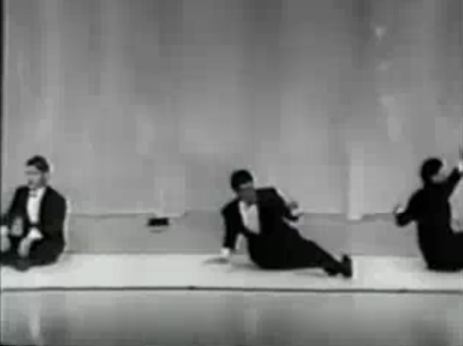
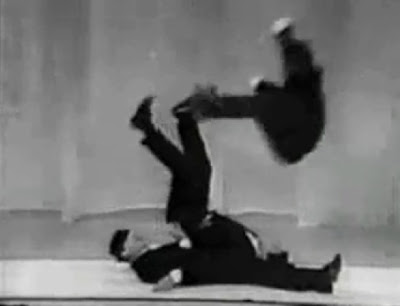
Here’s another strong comedy acrobatic act, which you already saw a short segment of if you read my post on Charlie Rivel. That’s the Three Rebertis doing the “little bridge.” Thanks to Nicanor Cancellieri for sending me this one, which comes originally from Raffaele De Ritis, who I finally got to meet in Barcelona, and whose blogs, Novelties & Wonders and Storia del Circo, are well worth your time. Raffaele is also one of the brains behind the Circopedia web site, the internet’s best English-language resource for circus history.
The clip is from a 1966 Hollywood Palace television variety show, which is a good source for a lot of physical comedy performance. Like a lot of these acts, the sequences alternate between straight acrobatic tricks and some real nice comedy bits. I especially liked the mock combat segment, with echoes of the theme music to the Batman tv show, which had had its network premiere just nine months before then and was all the rage.
Click here or on the image below to go to the video.
We interrupt all these reports from San Francisco to bring you this emergency message. There was a Super Bowl yesterday. There were a lot of commercials. Advertisers paid $3 million for a 30-second spot. The least you could do is watch.
Yes, this post is yet another example of the stupid things you can end up exploring once you start writing a blog like this (and by you I mean me). Since Super Bowl commercials supposedly represent American advertising at its best, I was hoping it would prove incredibly illuminating to see what role if any physical comedy played in these ads. Of course this means I actually had to watch all of them, for which each and every one of you should be paying me very large sums of money.
I did find ten commercials sortakinda worth your 30 seconds.
Bud Light: Light House A party at a house built out of Bud Lite beer cans. The catch is that the cans are not empty, so the guests can’t resist grabbing a can to drink and, well, just imagine the consequences.
Grade: B Keaton’s One Week it ain’t, but funny enough; maybe I’d give it a higher rating if the beer weren’t so piss poor.
Snickers: Betty White Snickers candy bars give you instant energy, and if you don’t have energy you might play football like 88-year-old actress Betty White.
Grade: B– The two tackles are well done, but I didn’t get the lack of transitions between old and young. Morphing anyone?
Focus on the Family: Tebow & Mom More unnecessary roughness as another defenseless women gets blindsided in this rather odd commercial by a Christian family group.
Grade: C+ Funny idea but they didn’t get enough out of it. I would have liked to see them do more with the hit and with her reaction. Can’t she drag him for a couple of yards?
Doritos: Dog Gets Revenge Live-action dog mixed with CG effects to prove how irresistible Doritos are.
Grade: C— Sorry, the stiff animation was too distracting for me to be amused by this. Real dogs are cute but…
Doritos: Playing Nice Guy arrives for date with hot single mom whose son slaps him as a warning to lay off the Doritos and lay off his mom.
Grade: B+ Funny, economical, good enough slap. I think reactions sell the gag, so I would have extended that final stare-down a few more seconds. C’mon, what’s an extra $300,000 to milk that laugh?
Doritos: Miracle A guy fakes his own death so he can be buried alive in Doritos and watch the Super Bowl in peace. Makes sense to me. But who can sit still during a football game?
Grade: B— Did I mention that reactions sell the gag? I wanted more of a take on the churchgoers before the friend jumps up to save the day.
Budweiser: Body Bridge The bridge is out so how will that Budweiser truck get through??
Career Builder: Casual Fridays When casual Fridays go too far. More physique than physical, but…
Grade: B This commercial immediately preceded a Dockers commercial with men walking around in their underpants. Is there a movement afoot that I don’t know about? Anyway, funny enough, I liked the boldness, but two problems: Aren’t most people these days more concerned with having a job, preferably one with health insurance, than they are with things getting too loosey-goosey at the workplace? And though like you, dear reader, I happen to have a perfect body, do they really need to take cheap shots at those who don’t?
KGB: Sumo Wrestling Information is power. Lack of information = instant death by sumo.
Grade: B— Again the moment of impact is not shown. Conscious decision or shortcut? I’m visualizing all 600 pounds of Sumo Jelly soaring through the air and flattening this guy, all in slow motion.
Coca-Cola: Sleepwalking Shades of Harold Lloyd as our hero threads his way through unseen horrors.
Grade: B I liked bumping into the elephant best. _______________________
Those were my top ten, but there were a bunch more with physical comedy elements, including the following: • A Hyundai Sonata ad with dozens of hands lifting a car like some Pilobolus dance piece. • A Boost Mobile ad with retired football stars trying to sing and dance, exposing body fat and even a thong. • A Bud Light ad in which the imminent annihilation of planet earth triggers a wild Bud Light party at an observatory. • A Volkswagon ad that instructs us to punch the one we’re with when we spot a new VW. • An Emerald Nuts ad with humans as performing dolphins. • A Doritos ad that proves stealing Doritos has its consequences.
You can see every single Super Bowl ad by clicking here, not that I would necessarily recommend it.
Okay, perhaps not “incredibly illuminating,” but notice that a lot of them did have physical comedy roots. It sure seems to me that there was more of this, and more live-action than animation, than in previous years, but I think I’ll leave it to someone else to explore that trend. And as much as I like physical comedy, I thought the most effective ad was probably the cars.com commercial. Of course there are plenty of polls online expressing different (= less valid) opinions.
And I’ll close with a funny hors-de-compétition commercial from SunLife involving Cirque du Soleil performers. It’s not physical exactly and it was actually aired during the post-game show, so you won’t find it among the galleries of Super Bowl commercials, but I like.
P.S. — Braveaux, Saints! But next year J-E-T-S all the way.
Today is the 73rd birthday of Tommy Smothers and, as much as I think it’s important to honor the work of those who have passed away, it’s a pleasure to be able to salute a fine comedian who is still very much with us. Tommy Smothers was one-half of the Smothers Brothers, partnering his younger brother Dick (born 11-20-39) on their own CBS television variety show. They are still active and in fact both can be seen in cameo roles in last year’s The Informant!. The Smothers Brothers’ m.o. was folk music, not physical comedy, but their act was right out of vaudeville with Dick playing straightman on string bass to a confused, emotional Tommy on acoustic guitar. You never knew what words would come from Tommy’s mouth. His character was the one who blurts out what everyone else may be thinking but is afraid to say out loud.
But this is a physical comedy blog, so here’s a clip of Tommy showing some pretty cool chops on the yoyo!
And here they are (their actual voices) as part of a Bart Simpson dream (he badly wants a brother) on an episode this past December on The Simpsons:
Fired from CBS? Yes, another reason to praise the Smothers Brothers is that back in the turbulent Vietnam War era, long before cable tv and the internet, when three major networks controlled everything Americans saw and heard on television, and most entertainers chose not to make waves, the Smothers Brothers continuously fought back against this wall of censorship. They engaged in weekly battles with the CBS censors, who insisted that television was entertainment, pure and simple, and that politics was bad for business. They lost most of these battles, but paved the way for the greater freedom enjoyed today by such satirists as Jon Stewart and Steven Colbert.
One of the biggest controversies was over a Harry Bealfonte song that was accompanied by footage of police violence at the 1968 Democratic Convention in Chicago. The song (video clip below) was not aired and later that season the Smothers Brothers were booted off the air for refusing to cave to the censors. This Wikipedia summary pretty much nails it:
With the focus of the show having evolved towards a more youth-oriented one, the show became both popular and controversial for those same references to youth culture and the issues that both interested and affected this particular target audience. Three specific targets of satire — racism, the President of the United States, and the Vietnam War — would wind up defining the show’s content for the remainder of its run, and eventually lead to its demise.
Whereas most older audiences were tuning into shows like the western Bonanza, the younger generation — ages 15–25 — were watching the Smothers’ more socially relevant humor.
The Brothers soon found themselves in regular conflicts with CBS‘ networkcensors. At the start of the 1968/69 season, the network ordered that the Smothers deliver their shows finished and ready to air ten days before airdate so that the censors could edit the shows as necessary. In the season premiere, CBS deleted the entire segment of Belafonte singing “Lord, Don’t Stop the Carnival” against a backdrop of the havoc during the 1968 Democratic National Convention, along with two lines from a satire of their main competitor, Bonanza. As the year progressed, battles over content continued, including a David Steinberg sermon about Moses and the Burning Bush.
With some local stations making their own deletions of controversial skits or comments, the continuing problems over the show reached a boiling point after CBS showed a rerun on March 9, 1969. The network explained the decision by stating that because that week’s episode did not arrive in time to be previewed, it would not be shown. In that program, Joan Baez paid tribute to her then-husband–David Harris–who was entering jail after refusing military service, while comedian Jackie Mason made a joke about children “playing doctor.” When the show finally did air, two months later, the network allowed Baez to state that her husband was in prison, but edited out the reason.
Despite the conflict, the show was picked up for the 1969-70 season on March 14, seemingly ending the debate over the show’s status. However, network CEO and President, William S. Paley, abruptly canceled the show on April 4, 1969. The reason given by CBS was based on the Smothers’ refusal to meet the pre-air delivery dates as specified by the network in order to accommodate review by the censors before airing. This cancellation led the Brothers to file a successful breach of contract suit against the network, although the suit failed to see the Brothers or their show returned to the air.[2] Despite this cancellation, the show went on to win the Emmy Award that year for best writing. The saga of the cancellation of the show is the subject of a 2002 documentary film, Smothered.[3]
Here’s a telegram from CBS staking out their right to pre-censor the show, followed by the Harry Belafonte clip that did not make it to the airwaves in the fall of 1968.
The Video That Dared Not Be Shown:
As this final note from Wikipedia shows, the Smothers Brothers did receive some vindication decades later: In 2003, the brothers were awarded the George Carlin Freedom of Expression Award from the Video Software Dealers’ Association. The award recognizes the brothers’ “extraordinary comic gifts and their unfailing support of the First Amendment.” In September 2008, during the 60th Primetime Emmy Awards, Tommy Smothers, a lead writer of “The Smothers Brothers Comedy Hour” was belatedly awarded a 1968 Emmy for Outstanding Writing In A Comedic Series. In 1968, Tommy Smothers had refused to let his name be on the list of writers nominated for the Emmy because he felt his name was too volatile, and thus when the writing staff won he was the only member not to receive the award.