Tag: Music

Guest Post: Ashley Griffin on Physical Comedy in Musical Theater

POST 320
Wednesday, January 16, 2013

I am pleased to be able to introduce a new contributor to this blog who, like my other guest writers, knows a lot of stuff that I don’t. Ashley Griffin is a writer, actor, singer, and dancer whose expertise is in the area of musical theatre, the history of which she has taught at New York University. She has performed on- and off-Broadway as well as in Los Angeles, Chicago, and London. Her plays have been produced off-Broadway, in L.A, and Chicago, and she is most well known as the creator of the pop-culture phenomenon Twilight: The Unauthorized Musical Parody. Ashley has a long-time interest in circus, clowning, and physical comedy, and one of her current projects is a collaboration with Joel Jeske on a physical comedy version of Alice in Wonderland. — jt
_______________________________________
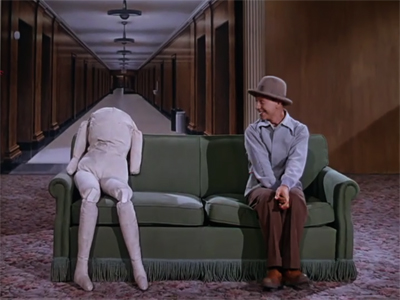
Donald O’Connor in Singing in the Rain

When John asked me to write a guest post about physical comedy in musical theatre, I instantly started brainstorming on all the wonderful performers and shows I would reference, all the great examples I would pull out like….um…well…that one thing in…no…wait…um…uh…shoot. Wait, that’s not right! Musical theater was, at least partly, founded with physical comedy as one of its main elements. It’s a staple, right? Let’s go back a bit….

In essence, the American musical was created out of two very different art forms that were popular in the early 1900s: operetta, and ethnic theatre. As I discussed in my blog entry Changed For Good – or The Famous Thesis, operetta, a lighter version of traditional opera (think Babes in Toyland) was considered sophisticated entertainment.

Operetta was the basis for the traditional musical theatre form – a narrative story told through song, occasionally employing dialogue in between numbers. Ethnic theater – especially Yiddish and Jewish theater — was thriving in America at the same time as operetta, and was hugely popular. It was, however, often looked down upon as “low” theater, and not respected the same way operetta was.

This dichotomy has found its way into contemporary musical theater, where it seems all shows are either delegated to the “high art” category (think The Light in the Piazza, or anything Sondheim) or the “popular, financially successful” category (think Mamma Mia! and Cats.) It seems that as far as the critics are concerned, never the twain shall meet, although there have been some rare “grey area” shows that might fall into both categories.

Though physical comedy was not a huge staple of operetta, it was all but mandatory in ethnic theater, which in general was far more comedy-based. It was this type of theater that eventually developed into vaudeville in the 1920s and 30s. In fact, physical comedy was such a staple that almost all the famous silent movie comedians began their careers in vaudeville. Vaudeville was not what we would currently term “musical theater.” There was not a single narrative — in fact it was made up of a collection of “acts.” Some of these acts, however, did have mini-narratives, and might even use music to tell their story.  Some of these sketches became so popular; they eventually evolved into full-length pieces.

The most famous example of this was the Marx Brothers, who began their career in vaudeville, pairing their natural comic talent with their adept musical skill. They became so famous that in the early 1920s they were asked to create a full length review, I’ll Say She Is, which was followed by The Cocoanuts and then Animal Crackers – both Broadway musicals (with music and lyrics by Irving Berlin, no less) that went on to become classic films.

The physical comedy genius of the Marx brothers has been brilliantly analyzed by writers far more knowledgeable of the subject then me. But what is unusual in terms of the musical form is how much they rely on physicality not for gags (though they do that) but to advance the story, create the world, and develop character. They almost use a comic physicality to replace dance — which traditionally has been the third component of the “integrated musical” — the “physical” component along with singing, and acting.  Harpo, for example, never speaks a word.

After that, the waters get a bit murky. While the “first” musical is generally agreed to have been The Black Crook, it was Show Boat that truly began paving the way to what we now consider the classical musical. Show Boat was every inch an operetta and, indeed, that’s the direction musicals have been heading ever since. In fact, quite a bit of the comedy in the late 20s / early 30s on Broadway was found in review shows like The Garrick Gaieties – the SNL of their day (though there were certainly comic musicals, for example Good News in the 1920s, and Babes in Arms in the 1930s.) But there was a strong trend in the 30s towards verbal comedy, and parody as opposed to physical. While film saw the rise of screwball comedies, in general American entertainment reacted to the Depression with a desire for glamor and escapism.

The 40s and 50s ushered in the “Golden Age of Broadway,” largely heralded by the collaboration of Rodgers and Hammerstein. Although their shows were landmarks, none could really be described as funny, although South Pacific (which won the Pulitzer Prize) does open act two with a holiday performance put on by the nurses and Seabees, which includes a drag performance of “Honey Bun” with nurse Nellie dressed as a sailor, and one of the sailors dressed as the “honey bun” of the song — complete with coconut bra and grass skirt.

Another gender-reversed comic moment occurred around the same time in the musical White Christmas, which was a film musical first, long before it was recently adapted for the stage. In White Christmas, the male leads first encounter the female leads when the two girls perform a song called “Sisters” as part of their nightclub routine. Later, in order to help the girls escape from the police, the guys wind up taking their places in the act — creating comic hilarity when they begrudgingly perform the girl’s number to the “t.”

There is also of course the classic number “Make ‘em Laugh” from Singing in the Rain, which was also a film long before it was on the stage.

“Make ‘em Laugh” was in itself a deliberate reference to “Be a Clown” from The Pirate – also a movie, never a stage musical.

 Are we noticing a pattern here? Film has a great history of physical comedy. Theater…well…kind of stumbled along the way.  Or at least, we don’t have hard evidence to the contrary.

Part of the difficulty of commenting on physical comedy in musical theater, especially during this time period, is in a lack of recorded performance. Most physical comedy is not written down. Even when an entire sketch is nothing but physical comedy, it is usually written as a simple outline meant to help the performers remember the order of actions. A talented physical comedian could turn the stage direction “he goes to the mirror and shaves” into a half-hour, riotous routine.
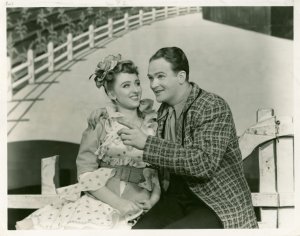
The original Ado Annie (Celeste Holm) from Oklahoma

Film is forever — and we can easily find the physical comedy in films from the beginning of the medium onwards. We have almost no visual record of most live musical theater shows written before the 1970s — and therefore only have the scripts to go by. And the scripts are not much help. For example, “classic” musicals are somewhat characterized by their character structure of having two principle “romantic leads” and the secondary “comic leads.” In Oklahoma, Laurie and Curly are the romantic leads, and Will and Ado Annie are the comic leads. I’ve seen Ado Annie played completely deadpan, and with raucous physicality – and both are hysterical. However, one is physical comedy, and the other is not. It’s up to the performer, and not dictated by the material. And we don’t have records of a lot of performances.

The further we get away from vaudeville, the further the musical gets away from physical comedy. We get comic moments, certainly, but nothing groundbreaking, or revolutionary or, sadly, hardly ever relevant to the plot. Ado Annie can certainly be played by a physical comedian; but if it’s not, it won’t devastate the show. This of course leads me to ask: why is this so? Well, my personal experience leads me to conclude this:

Being a musical theater performer requires an immense amount of training in many different fields. First you have to sing. And especially today, you can’t just sing – if you’re a girl you have to belt, and sing legit. Then you have to act. And you have to dance — that includes at bare minimum tap, jazz, and ballet. Each of those elements could take up a lifetime of study. As it is in most musical theater training programs, acting seems to fall by the wayside. Nowadays you practically have to play an instrument too. (You can’t audition for Once or, well, any John Doyle production if you don’t.) And it helps to know aerial acrobatics and gymnastics. You know, for Spiderman, Wicked, Peter Pan, The Pirate Queen, and every vampire musical. Learning physical comedy is not a casual skill you can just “pick up.” The amount of work required to be really good at it is one reason it’s probably not emphasized, at least in training programs.

Then there’s also the issue of musical theater and “high art.” Physical comedy is a vocabulary in and of itself that, to be truly incorporated into a musical, would not only have to have performers capable of doing it, but writers who are adept at writing it. All musical theater writers have to be incredibly well trained in music theory, composition, etc. Book writers analyze structure. To truly incorporate physical comedy means being fluent in it. That’s much easier in a traditional physical comedy show where the performer almost always has a hand in creating a piece. In musical theater, a team of people write a show, then give it to actors who are expected to, yes, bring themselves to a role, but most importantly translate the vision of the writer(s) and director(s). Either the writers have to write a piece with physical comedy clearly in it, then find performers who can sing, act, dance, and do physical comedy, or else an actor might find one or two small moments to bring in some physical comedy, but it’s never going to completely define the role, or the show.
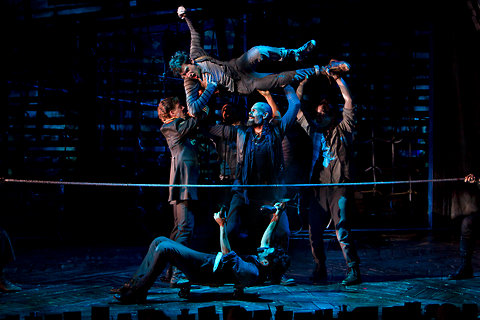
from the original off-Broadway production of Peter and the Starcatcher

This seems to be at least slightly different with plays as opposed to musicals – we all know and love Noises Off – but that was written as a farce. Robin Williams, Steve Martin, and Bill Irwin did a Broadway revival of Waiting for Godot that used quite extensive physical comedy — but those were adept physical comedians who were allowed to reinterpret a text. Most recently, Peter and the Starcatcher on Broadway utilized great physical comedy, and was a rare exception where both the writer and cast understood the vocabulary. But that was also in essence a play, not a musical.

There is of course the amazing Bill Irwin — and his Broadway work — but those were physical comedy plays that happened to go to Broadway. Not to mention the fact that musicals are so expensive to produce now that they must run several years just to make their money back. That means living through far more than the original cast. Can you imagine if they had to hold auditions to recast Bill Irwin in Regard of Flight? I doubt it would continue running for very long. And one of the reasons is that what’s funny on one person may not be funny on another.
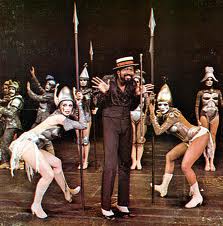
The original production of Pippin

In the 1970s, some experimental theater techniques began to make their way into mainstream musical theater – most notably (and I emphasize him because of his physicality) with Bob Fosse. The 70s, following upon the work of the amazing Jerome Robbins, became a time when physicality began to become more of a storytelling device. Pippin for example, uses an ensemble of highly stylized “players” (complete with white face) who lead an innocent (Pippin) down a path searching for ultimate fulfillment. While this is certainly not a physical comedy show, it is arguably a physical show, and therefore moments of physical comedy do come in to it.

In the early 2000s, Broadway saw a return to the “good old fashioned musical comedy” with The Producers. This was truly a landmark show in many ways, partly because there literally hadn’t been an original, traditional musical comedy in a very long time. The Producers featured great moments of physical comedy, such as this one that was featured on the Tony awards. Notice the use of the walkers, not to mention the beautiful physicality of the performers. Those are guys and  girls playing the little old ladies.

Jeffry Denman

I have to take a moment to reference one of the best resources when it comes to physical comedy in musical theater (and there aren’t a ton.) The wonderful book A Year With The Producers by Jeffry Denman is a must read for anyone interested in theater, comedy, or being entertained/educated in any way. It chronicles Jeffry’s year auditioning for/being cast in/performing with The Producers on Broadway in which he played/created a myriad of hysterical characters His description of both his process, and the inner workings of musical theater (which would be greatly enlightening to any physical comedians who aren’t as familiar with the world of musical theater) are genius.

Here’s Jeffry’s piece “A Drop in the Bucket” from his choreography demo reel.

I also mention Jeffry for another reason – I had the great fortune to get to work with him on Twilight: The Unauthorized Musical Parody and got to see first-hand his genius at creating brilliant characters and comedy moments. We were very fortunate that all of our Twilight cast members were fantastic comedians, and I especially noticed in how many different shows Jeff was able to introduce brilliant elements of physical comedy, so I highly recommend checking out Jeff’s book and looking at his process.

The following year, Broadway and musical theater were shaken up by the truly genius musical Urinetown. Part of what made this show feel so fresh and original was that it was created by the experimental theater group the Neo Futurists — who used many of their experimental conceits and techniques within a traditional musical theater structure. Check out this clip of their Tony awards performance (yes, they were winners that night.)

I particularly love their unusual use of physical humor in this number. The physical comedy “gag” is not the focus of the piece – it is the elephant in the room. Notice the lovely young girl bound up and gagged who proceeds to do all the choreography, even though she is tied up for the whole number. And notice how the fact that there is a dancing hostage is never acknowledged. Brilliance. Even more so when you know the show and realize how much this moment is actually advancing the plot.
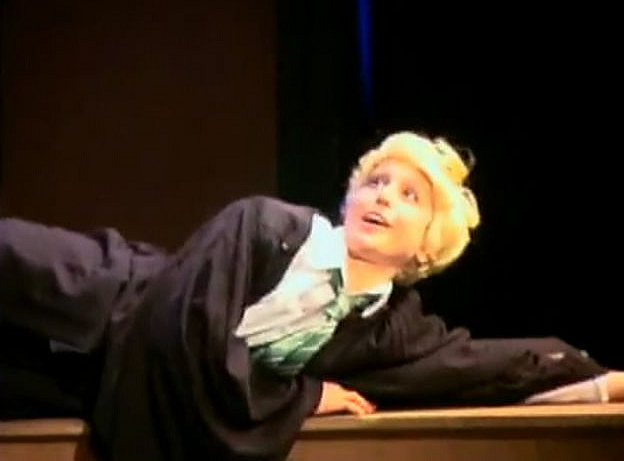
Another shout out also has to go to the incomparable Lauren Lopez, who first gained notoriety for her performance as Draco Malfoy in the youTube sensation, A Very Potter Musical. Though this is not a Broadway show, Ms. Lopez wonderfully created physical comedy moments within the musical as a way to define Draco’s character, and his relationships with other characters. Here’s a highlights reel. It’s a great example of some of the “underground” work being done in musical theater. Physicality really starts around :44

As with Mr. Denman, I’ve seen Ms. Lopez’s work in many projects, and she always brings a unique physical comedy element to whatever she’s doing. I wish everyone reading could watch her live performing as the spastic child Renesmee in Twilight. Her talent as a physical comedian, as well as a musical theater performer is one of the reasons I work with her so often.

Then there are moments of physical comedy in musical theater that don’t relate to a specific show. My favorite is Bill Irwin and Karen Ziemba’s interpretation of Sondheim’s song “Sooner or Later” for “Sondheim: A Celebration at Carnegie Hall.” The song was originally written for the film Dick Tracy.

What is the future of physical comedy in musical theater? It’s hard to say. With the advent of the rock musical (Rent, American Idiot, Next To Normal), original comedies in general on Broadway seem to be diminishing. Then again the recent show Bloody Bloody Andrew Jackson managed to incorporate elements of physical comedy into a rock musical. The 25th Annual Putnam County Spelling Bee was highly physical, but it was more a use of funny physicality than actual physical comedy. The Book of Mormon also has moments of physical comedy; one of my favorites, and one of the most subtle, is at the end of the song “I Believe.” See how hopeful Mormon Elder Price and evil warlord “Butt-Fucking-Naked” (yes, that’s his name) relate to each other. It’s at the very end of the song:

However, and I may get some flack for this, I think most of the humor in Book of Mormon is based on verbal and musical jokes, how people look, and the situations they are put in — which is not true-blue physical comedy, although there are certainly elements of that in the show as well most notably in the song “Turn It Off.”

Truly incorporating physical comedy into musical theater is tricky. Musical theater is by nature narrative-driven, and is largely verbal. It has to be. The performers are singing more than half the show, not to mention the fact that it would be near impossible to perform comic physical moments while singing for purely technical reasons. In film, on the other hand, you have multiple takes, not to mention usually having a playback recording. Physical comedy is by nature episodic and non-verbal. I think in some ways the decline of physical comedy in musical theater can be linked to the decline of dance in musical theater. The fact that almost no new shows use dance to advance the story is a real sore spot in the musical theater community. I think that if there were a way to open a dialogue between the two schools something revolutionary would take place. But there needs to be a sharing of vocabulary. In the words of Elder Price: “I believe!”

_________________________

Click here for Ashley’s blog, visit her on Facebook, follow her on Twitter, view her youTube channel, and read her Guide to Collaboration.
SHARE
EXPLORE FURTHER

The Maestrositites — in “Topeka Tomorrow!!”

POST 315
Monday, December 17, 2012

I’ve been enjoying the oddball music and physical comedy of the Maestrositites for a couple of years now, but didn’t want to write about them until I first did my Spike Jones post.  I didn’t realize it would take me two years to get around to it!

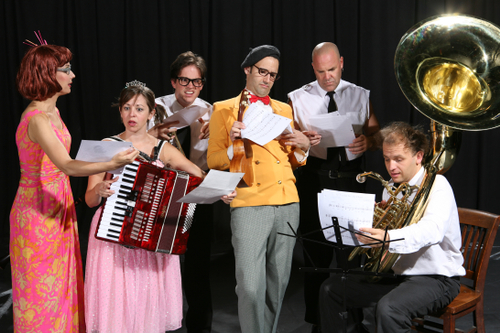
The Maestrositites shows I’d seen were all wild and wooly musical presentations, very much in the great tradition of maestro Jones, so I was intrigued to hear that their newest project was a pilot for a television comedy or webisode, with stories based on the characters developed for their concerts. You know, like The Monkees, only the Maestrositites were a band first. Oh yeah, and funnier.

I was lucky enough to see the pilot with a live audience, and the laughter was pretty much non-stop. See for yourself!

I asked company member David Gochfeld if they would like to add anything about their work, and he and his cohorts were kind enough to put together the following overview:

We’ve been working together in this group for over 5 years, in a lot of different formats (among other things, we’ve been on the radio, on TV in China, played corporate events, been strolling entertainers, guests at innumerable variety shows, and hosts of our own.)  During that time our characters have grown deeply dimensional, with very rich backstories and common history.  There are a million story ideas below the surface, which we intend to continue to explore.


This piece was conceived as a pilot for a TV (or Web) series.  This is an idea we’ve been discussing for several years, and finally decided that we needed to make this so we could show other people what we had in mind.  We funded it through Kickstarter, and it was great to finally get the funding and be able to start writing the stuff we’ve always known was in there. We have ideas for a bunch more episodes, and are looking forward to having opportunities to further develop this world.


We also want to acknowledge our director, Morgan Nichols, who has understood our aesthetic and our comedy from day one, and who has an amazing talent for helping clowns bring what’s really funny about them to the screen.  He knew exactly how to come into our process and help us focus and make what we had in our heads, and also how to keep us on track even when our clowns were going off in different directions.


In terms of our creative process, Andy Sapora notes: “We often end up writing funny stuff when we are sitting around learning the music and we start to fool around. It’s very common for our music rehearsals to turn into the five of us sitting around making ourselves laugh. And then we say, “let’s write that down” and “we’ll do that someday— when we have a budget”.  Another great thing is that we know all of our characters so well, that we’re all capable of writing in the voice of each other’s characters.  For instance, when we have an idea of something funny, it’s fairly easy for us to agree on which character should do the set-up and which  character would say which part of the joke.”


Finally, we have a couple of other projects in the works.  One is further development of the show we have developed with the orchestral conductor Dorothy Savitch and the Brooklyn Conservatory Community Orchestra.  In it, the Maestrosities become involved in narrating Peter and the Wolf, with hilarious results… and then perform a comic movement piece to The William Tell Overture.  We have a trailer from one of the productions of this piece at this youTube link.

We’re also starting to work on a full-length stage show, which will allow us to explore more of our backstory and many more of the comic ideas we’ve generated along the way, along with more of the music we’ve been working on.


Click here for the Maestrositites web site.
SHARE
EXPLORE FURTHER

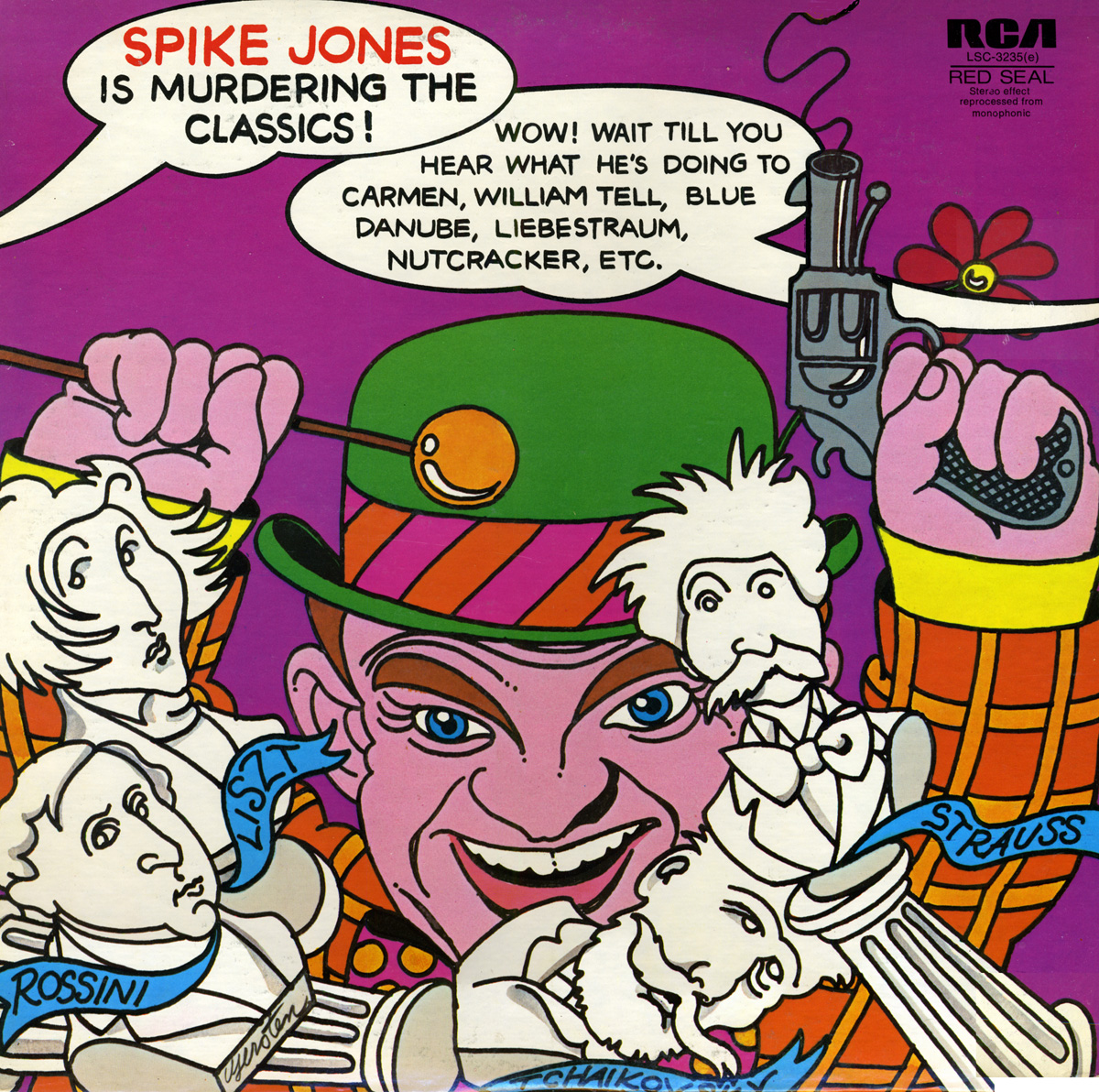
DVD Report: The Best of Spike Jones

POST 314
Sunday, December 16, 2012

No, not the very modern film and music video director Spike Jonze, but comedy musician and television variety star Spike Jones (1911–1965). My first introduction to the loony imagination of this latter-day vaudevillian was via audio tapes in the 1970s. I could only guess what his antics looked like, but it was funny enough, and I seem to recall my partner Fred Yockers and I sometimes using it as pre-show music. It certainly got us in the mood, if not the audience. Some material made it to VHS by the 1980s, and eventually to DVD, but The Best of Spike Jones is the first remastered, fairly definitive sampling of his work. It actually came out a couple of years ago and I bought a copy right away, fully intending to write a blog post on it “next week.” Well, better late than never….

So why should you care about Spike Jones? Easy, because he….
• kept alive the “crazy comedy” tradition of Olsen & Johnson (Helzapoppin‘), the Ritz Brothers, and the Marx Brothers
• was very funny and innovative
• used a lot of physical gags
• bridged the gap between vaudeville and television, featuring a lot of old-timey physical comedians on his show
• worked with funny people like Doodles Weaver (uncle of Sigourney!), Eddie Kline (directed Keaton and W.C. Fields), and the banjo player and natural clown, Freddy Morgan (see below).
• was a major influence on the comedy of Ernie Kovacs, “Weird Al” Yankovic, Dr. Demento, Laugh-In, Frank Zappa, George Carlin, and Billy Crystal, as well as such current New York groups as Polygraph Lounge and The Maestrosities…. but more on them soon.

….and, most important…
• frequently used whistles, cowbells, gun shots, mouth sounds, feathers, rubber chickens, pants drops, and trapdoors

This is a 3-dvd set, with 3½ hours of material on the first two discs, and the two pilots they shot (tv tryout episodes, not aviators!) comprise disc three. You can pick it up for $25 on Amazon, and it’s well worth the price. Here are just a few samples…

The self-deprecating introduction to their show:

Followed by a typically insane and fast-paced music number, which ends up involving eccentric dancing, juggling hatchets, oddball instrumentations, and the destruction of instruments (decades before The Who).

Peter James, slapping himself silly and showing some fancy chops that predate break dancing by half a lifetime:

And the rubber-faced Freddy Morgan:

There’s so much more I could include, but I have Christmas shopping to do. Maybe you should just buy this one for yourself!

SHARE
EXPLORE FURTHER

True Faith

POST 275
Tuesday, September 4, 2012

Here’s a curiosity I stumbled upon while sitting in a bar with some clowns in Vilnius (Lithuania) this summer. In one of those rare moments when television coverage wasn’t devoted to the Olympics, our eyes all took notice of a slaphappy video playing on the tv above us. I am proud to say that I was still sober enough to write down the name that flashed on the screen at the end. I guess it must have been early in the evening.

The group is New Order, the track is True Faith, and the physical business gets more elaborate around the two-and-a-half minute mark…

And if you’re wondering about the connection between all this mayhem and the lyrics, here they are. I’m guessing it has something to do with that lost childhood that was replaced by fear.


I feel so extraordinary
Something’s got a hold on me
I get this feeling I’m in motion
A sudden sense of liberty
I don’t care ’cause I’m not there
And I don’t care if I’m here tomorrow
Again and again I’ve taken too much
Of the things that cost you too much
I used to think that the day would never come
I’d see delight in the shade of the morning sun
My morning sun is the drug that brings me near
To the childhood I lost, replaced by fear
I used to think that the day would never come
That my life would depend on the morning sun…

When I was a very small boy,
Very small boys talked to me
Now that we’ve grown up together
They’re afraid of what they see
That’s the price that we all pay
Our valued destiny comes to nothing
I can’t tell you where we’re going
I guess there was just no way of knowing
I used to think that the day would never come
I’d see delight in the shade of the morning sun
My morning sun is the drug that brings me near
To the childhood I lost, replaced by fear
I used to think that the day would never come
That my life would depend on the morning sun…

I feel so extraordinary
Something’s got a hold on me
I get this feeling I’m in motion
A sudden sense of liberty
The chances are we’ve gone too far
You took my time and you took my money
Now I fear you’ve left me standing
In a world that’s so demanding
I used to think that the day would never come
I’d see delight in the shade of the morning sun
My morning sun is the drug that brings me near
To the childhood I lost, replaced by fear
I used to think that the day would never come
That my life would depend on the morning sun…
SHARE
EXPLORE FURTHER

Walking Sideways

POST 272
Thursday, May 10, 2012

NY Times video: Acrobat stunt doubles walk the Metropolitan Opera’s elaborate set in Robert Lepage’s staging of Richard Wagner’s “Ring” cycle. Thanks to Riley Kellogg for the link!

SHARE
EXPLORE FURTHER

Library Clearout Discovers Priceless Silent Movie Music

POST 179
Saturday, August 13, 2011

From the BBC wire, 12 August 2011. Richard Westcott reports:
Staff at Birmingham’s Central Library have discovered a priceless collection of more than 500 silent movie music scores. They made the find during a clearout before a move to a new building and unearthed more than just a bit of old junk.

Here’s the video:

More informative is this longer article from the Birmingham Post. It notes that…
•  The treasure trove included Marche Groteque (1916),”a unique theme from a Charlie Chaplin film.”
• “There’s a lot of European material here that didn’t make it to the States, because they had so much material they didn’t need to buy from European stuff.”
• “Experts say the discovery disproves the myth that film-goers were routinely subjected to a single pianist to accompany the likes of Chaplin and Buster Keaton and shows musical directors used a wide range of themes to cover action, comedy and tragedy.”

SHARE
EXPLORE FURTHER

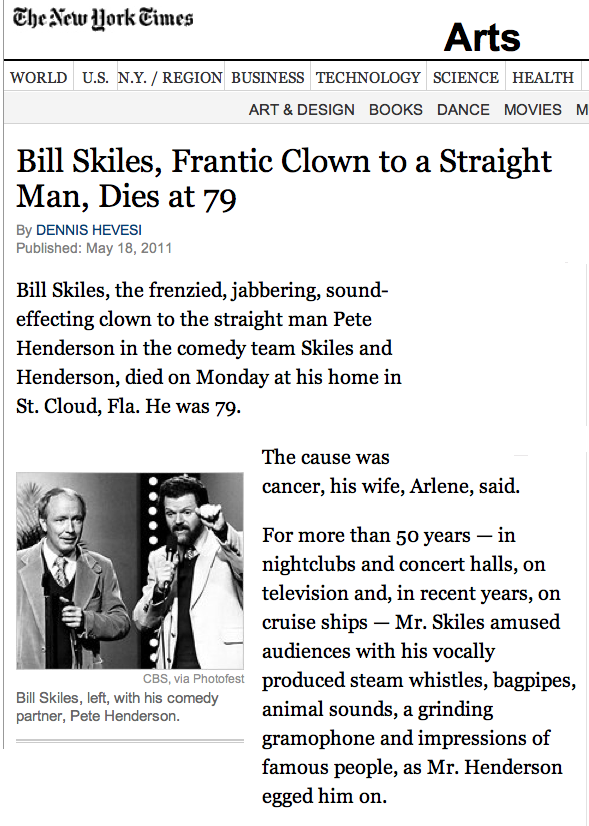
Bill Skiles, Frantic Clown to a Straight Man, Dies at 79

POST 139
Friday, May 20, 2011

Read the whole obituary here and visit their Wikipedia page here.

And here are a couple of clips from the Skiles & Henderson YouTube channel:

SHARE
EXPLORE FURTHER

Charlie Cairoli — Rare Footage

POST 79
Thursday, February 25, 2010

Back in 1985 through some contact in Germany I vaguely remember as “clown David” (hello, wherever you are!), I got hold of what I’m pretty sure was the first tape of Grock’s full-length show to make its way to the United States. We premiered it on what today would be considered a small television set for an appreciative audience (that included Bill Irwin) at our 2nd NY International Clown-Theatre Festival. Also on that tape was this unidentified clip starring Charlie Cairoli (1910—1980) doing some musical clowning and busting out with some killer dance steps. I guess it’s rarer than I realized, because not only don’t I see it anywhere on the web, I don’t see any of his work.

This is surprising, since Cairoli had a long and prolific career as a clown, including a lot of television work. A few highlights:

• Born in Italy into a Franco-Italian circus family, married Violetta Fratellini, settled in England in 1939, which he made his permanent home and where he reigned as its most celebrated clown for four decades.
• He performed in the Blackpool Tower Circus every summer for 39 or 40 years in a row (depending on which source you believe) as well as in English pantomimes, television shows, and films.
• Television appearances included the Ed Sullivan Show, Hollywood Palace, and This is Your Life.
• As Pat Cashin points out on his blog, Caroli’s 100th birthday was just 11 days ago. (Despite my frequent birthday salutes, in this case I was oblivious, just happening to come across the clip two days ago while digitizing some old tapes.)


The most informative bio of Cairoli is not from his Wikipedia page but from the excellent but hard to find Clowns & Farceurs:


Cairoli (Charlie), born Affori, Italy, 1910. Died Blackpool, U.K., 1980. He was known to the English as “Our Charlie.” They had adopted him because, for 39 years, he made them laugh, performing five months each season in the ring of the Tower Circus in Blackpool. Appreciated by the French in 1929 as “Carletto,” part of a classical trio with his father Jean-Marie and his brother Filip (or the marvelous Porto). Upon arriving in England in 1939 he changed his approach and took advantage of all the possibilities offered by British clowning, what one might call “foam & water pantomime,” a style intentionally violent, even cruel. His first partner (1947) was his father, after which he had as his whiteface clown partner Paul Freeman (1948—1959); Paul King (1960—1967); Paul Connor (1968—1973); and his son, Charles Jr., starting in 1974. Contrary to custom, only the name Charlie Cairoli appeared on the posters and programs, those around him often forming an anonymous troupe, referred to only as “and Company.” From this troupe there emerged in 1953 the grimacer Jimmy Buchanan, who played suffering and sadness with a passivity that was irresistibly droll. Charlie Cairoli differed from other augustes because he was the instigator of the gag; it often seemed the only reason his straightman was there was because of tradition and to provide more amplitude to the musical interludes. Charlie Cairoli’s talent was all-encompassing, including broad farce that some might consider to be of questionable taste. And connoisseurs who study his mimicry, listen to his musical selections, or delight in his inventions, perceive that what guides them is not so much the choice of a repertoire but rather a concession to certain comic processes.

[My loose translation; not really sure what they’re trying to say with that last sentence.]

As you will see, this clip looks to be from a movie, perhaps Happidrome (1943). Although the whiteface clown is likewise not identified, if it is Happidrome then according to the cast list for that movie in IMDB we are watrching the “Cairoli brothers.” However, the notation on the box of the original PAL VHS tape I received says it is Charlie Cairoli and father.

It’s quite a strange clip, I suspect from a low-budget production. Supposedly they’re performing for a live audience, but other than the couple in the box there’s not much public in evidence until the curtain call shot. The first part is too verbal for my tastes and not all that interesting, but the last two minutes are dynamite.


_________________________

Update (2-28-10): In my undying efforts to be consistently senile, I overlooked that I had another clip of Cairoli, this one from the London Hippodrome in 1966. In some bits he’s more the straightman than the auguste. I’m thinking that the clown in the suit and crumpled hat with feather who comes close to stealing the show must be the above-mentioned Jimmy Buchanan.

_________________________
Update (4-22-10): Just received this e-mail:

Hi John, I can assure you that it is Jimmy Buchanan as Charlie’s stooge in the clip. Thanks for the opportunity of viewing it. — Kind regards, Brian Nicholson (designer of The Charlie Cairoli Exhibition at Blackpool Tower).
_________________________

SHARE
EXPLORE FURTHER

The Barios at the London Hippodrome

POST 76
Sunday, February 21, 2010

Presenting the Barios Trio!

The Barios, whose heyday was the 60s and 70s, claimed a proud clown lineage, that of the Meschi Italian clown brothers, better known as Dario & Bario, one of the most highly regarded European clown teams of the entre-deux-guerres era. Dario Meschi (1880–1962) played the elegant whitfeace clown to the auguste of his brother Manrico, known as Bario (1888–1974).

Bario’s two sons, Freddy (1922–1988) and Nello (1918–2000), joined forces with Freddy’s wife, Henny Sosman (born 1923), to form the Bario trio, sometimes referred to as the Junior Barios, whose photo and videos you see below. Henny likewise hailed from European clown royalty, as she was the daughter of the auguste Martin Sosman and cousin of clown Pipo Sosman (Gustave Joseph Sosman). Tony Bario (died 2007), son of Freddy & Henny, was an accomplished musician and conducted the Cirque d’Hiver orchestra.


The brothers in the trio act both work as augustes, with Henny playing it straight, though her function is more that of a ringmaster than of a whiteface clown. This musical clown entrée is from a television circus taped at the London Hippodrome in 1966, and has a fair amount of physical business.

The Barios did lots of television. Here’s a tv clip with the brothers in tuxedos. This one was on YouTube but disappeared. I snatched it from DailyMotion.com in case it was in danger of vanishing from there as well. Haven’t managed to lose the little ads at the bottom without cropping the video… well, at least not yet.

Update (2-26-10): I totally forgot I had this circus clip of the Barios performing their trick car act in Stockholm and preserved on a 1990 French television special, Piste de Clowns.

SHARE
EXPLORE FURTHER

Happy Birthday, Tommy Smothers!

POST 62
Tuesday, February 2, 2010

Today is the 73rd birthday of Tommy Smothers and, as much as I think it’s important to honor the work of those who have passed away, it’s a pleasure to be able to salute a fine comedian who is still very much with us. Tommy Smothers was one-half of the Smothers Brothers, partnering his younger brother Dick (born 11-20-39) on their own CBS television variety show. They are still active and in fact both can be seen in cameo roles in last year’s The Informant!.

The Smothers Brothers’ m.o. was folk music, not physical comedy, but their act was right out of vaudeville with Dick playing straightman on string bass to a confused, emotional Tommy on acoustic guitar. You never knew what words would come from Tommy’s mouth. His character was the one who blurts out what everyone else may be thinking but is afraid to say out loud.

But this is a physical comedy blog, so here’s a clip of Tommy showing some pretty cool chops on the yoyo!

And here they are (their actual voices) as part of a Bart Simpson dream (he badly wants a brother) on an episode this past December on The Simpsons:

Fired from CBS? Yes, another reason to praise the Smothers Brothers is that back in the turbulent Vietnam War era, long before cable tv and the internet, when three major networks controlled everything Americans saw and heard on television, and most entertainers chose not to make waves, the Smothers Brothers continuously fought back against this wall of censorship. They engaged in weekly battles with the CBS censors, who insisted that television was entertainment, pure and simple, and that politics was bad for business. They lost most of these battles, but paved the way for the greater freedom enjoyed today by such satirists as Jon Stewart and Steven Colbert.

One of the biggest controversies was over a Harry Bealfonte song that was accompanied by footage of police violence at the 1968 Democratic Convention in Chicago. The song (video clip below) was not aired and later that season the Smothers Brothers were booted off the air for refusing to cave to the censors. This Wikipedia summary pretty much nails it:

With the focus of the show having evolved towards a more youth-oriented one, the show became both popular and controversial for those same references to youth culture and the issues that both interested and affected this particular target audience. Three specific targets of satire — racism, the President of the United States, and the Vietnam War — would wind up defining the show’s content for the remainder of its run, and eventually lead to its demise.

Whereas most older audiences were tuning into shows like the western Bonanza, the younger generation — ages 15–25 — were watching the Smothers’ more socially relevant humor.

The Brothers soon found themselves in regular conflicts with CBSnetwork censors. At the start of the 1968/69 season, the network ordered that the Smothers deliver their shows finished and ready to air ten days before airdate so that the censors could edit the shows as necessary. In the season premiere, CBS deleted the entire segment of Belafonte singing “Lord, Don’t Stop the Carnival” against a backdrop of the havoc during the 1968 Democratic National Convention, along with two lines from a satire of their main competitor, Bonanza. As the year progressed, battles over content continued, including a David Steinberg sermon about Moses and the Burning Bush.

With some local stations making their own deletions of controversial skits or comments, the continuing problems over the show reached a boiling point after CBS showed a rerun on March 9, 1969. The network explained the decision by stating that because that week’s episode did not arrive in time to be previewed, it would not be shown. In that program, Joan Baez paid tribute to her then-husband–David Harris–who was entering jail after refusing military service, while comedian Jackie Mason made a joke about children “playing doctor.” When the show finally did air, two months later, the network allowed Baez to state that her husband was in prison, but edited out the reason.

Despite the conflict, the show was picked up for the 1969-70 season on March 14, seemingly ending the debate over the show’s status. However, network CEO and President, William S. Paley, abruptly canceled the show on April 4, 1969. The reason given by CBS was based on the Smothers’ refusal to meet the pre-air delivery dates as specified by the network in order to accommodate review by the censors before airing. This cancellation led the Brothers to file a successful breach of contract suit against the network, although the suit failed to see the Brothers or their show returned to the air.[2] Despite this cancellation, the show went on to win the Emmy Award that year for best writing. The saga of the cancellation of the show is the subject of a 2002 documentary film, Smothered.[3]

Here’s a telegram from CBS staking out their right to pre-censor the show, followed by the Harry Belafonte clip that did not make it to the airwaves in the fall of 1968.


The Video That Dared Not Be Shown:

As this final note from Wikipedia shows, the Smothers Brothers did receive some vindication decades later:
In 2003, the brothers were awarded the George Carlin Freedom of Expression Award from the Video Software Dealers’ Association. The award recognizes the brothers’ “extraordinary comic gifts and their unfailing support of the
First Amendment.” In September 2008, during the 60th Primetime Emmy Awards, Tommy Smothers, a lead writer of “The Smothers Brothers Comedy Hour” was belatedly awarded a 1968 Emmy for Outstanding Writing In A Comedic Series. In 1968, Tommy Smothers had refused to let his name be on the list of writers nominated for the Emmy because he felt his name was too volatile, and thus when the writing staff won he was the only member not to receive the award.

SHARE
EXPLORE FURTHER
Check out My New Book

Visual and verbal humor for the cognitively and artistically curious!

“A book to treasure!”
—Bill Irwin

Upcoming Events