Tag: Mime

The 2016 London International Mime Festival

POST 415
Wednesday, January 13, 2016

If I weren’t in Costa Rica right now I’d be seriously wishing I were in London. Even if you’ve never been and might never go, it’s good to know that the London International Mime Festival is now entering its 40th year. Since its inception in 1977, the festival has gone way beyond mime to encompass circus, clown, physical theatre, mask work, puppetry, and more. In the process, it has not only popularized a lot of deserving movement-oriented work, but has opened eyes outside the already converted. As the NY Times comments this week, “over four decades it has had a significant impact on British theater, disrupting the dominance of scripted plays —something that hasn’t quite happened the same way in the United States.”

You can read the Times article here, but meanwhile here are some preview images and videos of five of this month’s offerings that highlight physical comedy.

ALL GENIUS ALL IDIOT 
Svalbard (Sweden)

Svalbard bends the edges of contemporary circus and blends it with theatre, physical comedy and live music to create a truly original piece that you will remember for its surreal quality as well as its awe-inspiring skills.

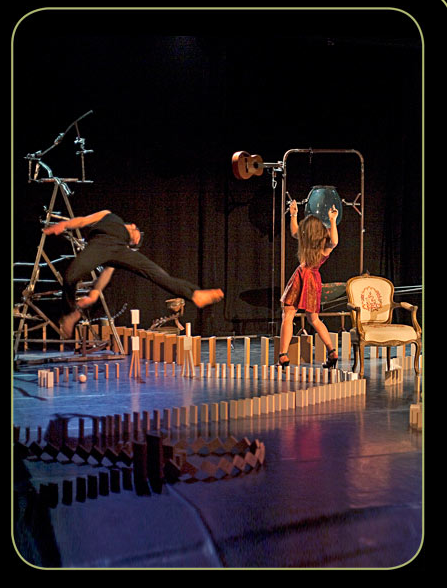
EXPIRY DATE
BabaFish (Belgium)

Dominoes topple… an hourglass is overturned. Time is ever-present in this ephemeral retrospective of one man’s life, his scattered memories conveyed through acrobatics, movement, music and dance… Assisted by her father, an inventor by trade, Swedish-born artist Anna Nilsson has devised a Heath Robinson-esque set, where a ball bearing spins around weird and wonderful machinery and pendulums wave. It provides a poignant backdrop for an abstract tale about time running out, characterised by four performers and their unpredictable mix of acting, juggling, hand-balancing and singing.

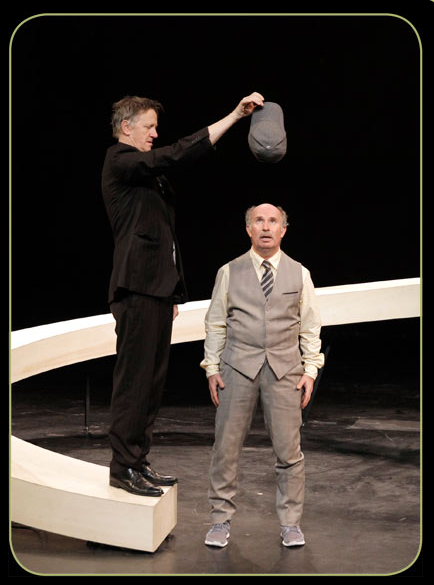
MARCEL

Théâtre des Bouffes du Nord, Paris (France)
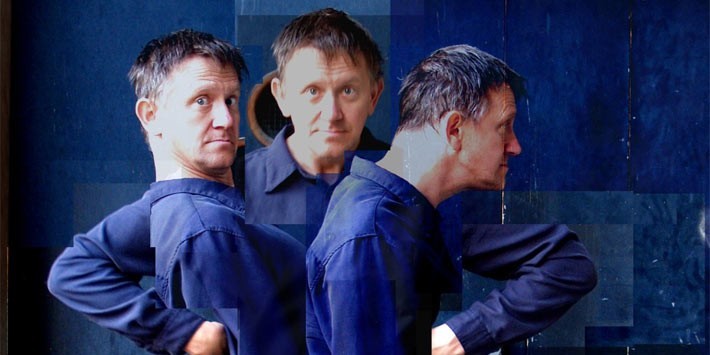
By and with Jos Houben and Marcello Magni

“An entire performance history lurks behind this ticklish two hander, the opener for the London International Mime Festival, created by Jos Houben and Marcello Magni, two of contemporary theatre’s greatest clowns. This funny, heart-breaking show celebrates the pair’s relationship stretching back to the early 1980s with Complicite and ground-breaking shows such as A Minute Too Late and More Bigger Snacks Now. It also draws on the history of clowning from commedia dell’arte to the slapstick of 19th-century music hall and early 20th-century film… the show continually reaches out to the audience, playing us with a knowing sweetness. It’s a brief hour that gives the kiss of life to the ancient art of the gag.” —Lyn Gardner, The Guardian

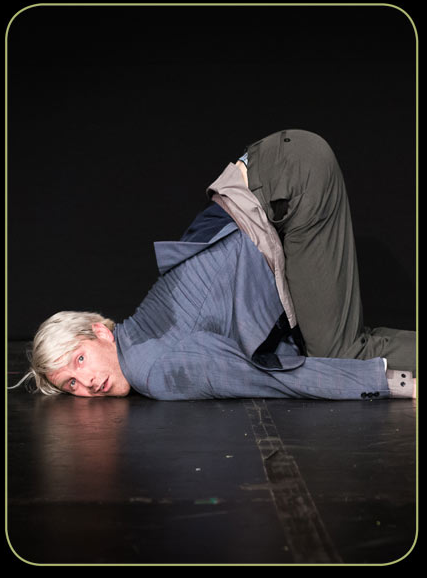
INFINITA

Familie Floez (Germany)

In Infinita, a cast of irresistible, larger-than-life characters are seen both as warring children, and then in later life as residents of an old people’s home. The wily games of nursery one-upmanship seem hardly to change with the passage of time; survival of the craftiest is still the rule of the day. Infinita plays out in a succession of increasingly hilarious scenes, combining poignancy, astute observation and some superbly skilled slapstick.


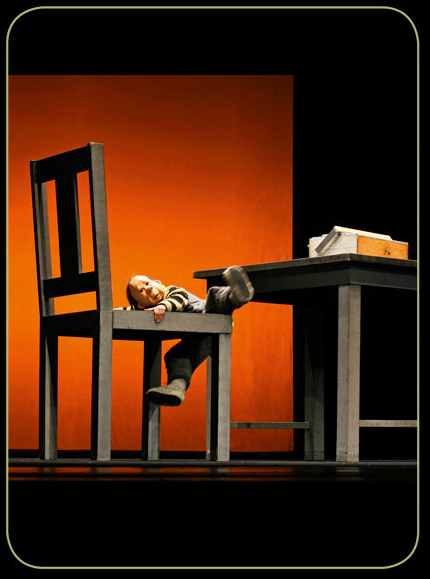
NAUTILUS
Trygve Wakenshaw (New Zealand)

NAUTILUS is the final part of rubber-limbed Trygve’s ‘underwater trilogy’, the follow-up to delirious, sell-out physical comedies KRAKEN (LIMF’15) and SQUIDBOY. Oozing with whimsy, dripping with charm and magnificently mad, Trygve is his own animator in a cartoon world. A master of risqué innocence, he trained with Philippe Gaulier, developing a uniquely eccentric style of mime-comedy that has won him legions of fans the world over.

SHARE
EXPLORE FURTHER

Pierrots de la Nuit

POST 257
Saturday, March 31, 2012

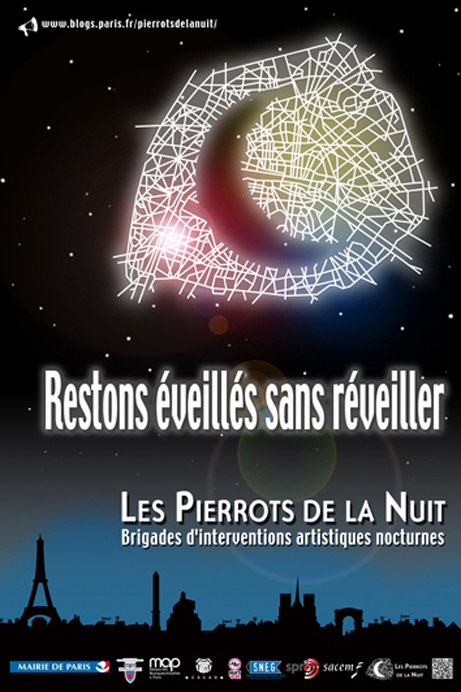
First we had this post about mimes directing traffic in Caracas, Venezuela, and now by way of my old friend Jim Jackson comes news that the mayor of Paris is employing “nocturnal artistic intervention squads” to help quiet  down rowdy late-night partiers.

Here’s the article from Blouin Artinfo:

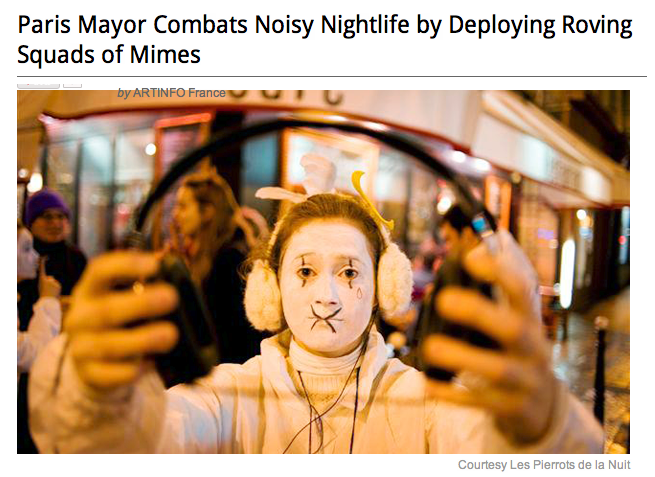
Imagine: You’re out on the town in Paris, perhaps knocking back a few too many glasses of Bordeaux, when, all of a sudden, a sad-eyed clown taps you on the shoulder and starts a mime performance called “The Rite of Sleep.” No, you aren’t dreaming, this person is not the fruit of your (slightly) inebriated imagination, nor even a pickpocket trying to lift your wallet.
You have encountered a “Pierrot de la Nuit,” or Night Mime. These “nocturnal artistic intervention squads” are officially being launched this weekend in 15 Parisian neighborhoods. It’s an initiative of the Paris mayor’s office, which has adopted a strategy that has already proven effective in Vienna and the Spanish cities of Tarragona and Barcelona. According to a statement from the city of Paris, the aim is to use “language, theater, mime, and dance to raise awareness among residents, bar-owners, and night-owls” about noise pollution.
But how is this going to go over with a Parisian population of inveterate complainers and partiers, who have already been mourning the death of Paris nightlife for several years now? Couldn’t it backfire by activating their rebellious streak? To deal with a reluctant public, the initiative mixes street art and mediation. The 37 mimes work in trios (two performers and a mediator) and employ all their abilities (mime, acrobatics, dance) to encourage people to celebrate without shouting so that everyone can get along. In June — when the warm weather brings out even more revelers — their ranks will increase to 60 performers with 20 much-needed (we’re guessing) mediators.

So are these mimes just cops dressed as jesters? It seems not. Speaking several languages, sporting colorful costumes, their goal is simply to calm everyone down so that the night can be enjoyed by all. The statement from the Paris mayor’s office strikes a reassuring tone: “street performance is not perceived as aggression; on the contrary, it obliges people to listen and be respectful.” As the mimes themselves put it, “silence is not repressive, but a form of sharing.”

The Night Mimes have a blog and Facebook page, which will provide videos, updates, and even announcements of other nighttime performances such as concerts (a bit paradoxical, isn’t it?).

To get a sense of what these performances — part quality-of-life outreach, part happenings — are like, click on the video below:

SHARE
EXPLORE FURTHER

Mime Bashing

POST 242
Friday, February 10, 2012
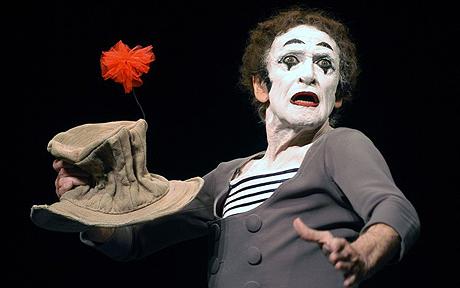
Marcel Marceau

I suppose I could write a post about the virtues and limitations of mime training, but this isn’t it. Sure, I took a smattering of classes, studying with Reid Gilbert, René Houtrides, Tom Leabhart, and Moni Yakim (and salivating over Children of Paradise), but I never really took to mime. (Translation: I sucked at it.) So instead of a treatise, just a few hopefully amusing snapshots of mime’s public image over the years.

There was a time back in the day, following on the first wave of Marcel Marceau’s popularity, that an aura of bold creativity was associated with mime.

And then there was the backlash.

Maybe it was all those white-faced pantomimists who thought being trapped inside an imaginary box was a profound statement on the human condition. Maybe it was all the Shields & Yarnell wannabees,  mimicking people on the street for cheap laughs. Or maybe it was all Woody Allen’s fault.

In A Little Louder, Please, a 1966 comic piece for The New Yorker,  Allen pointed out the obvious: much of the audience just didn’t get it:

The curtain-raiser was a little silent entertainment entitled Going to a Picnic. The mime… proceeded to spread a picnic blanket, and, instantly, my old confusion set in. He was either spreading a picnic blanket or milking a small goat. Next, he elaborately removed his shoes, except that I’m not positive they were his shoes, because he drank one of them and mailed the other to Pittsburgh. I say “Pittsburgh,” but actually it is hard to mime the concept of Pittsburgh, and as I look back on it, I now think what he was miming was not Pittsburgh at all but a man driving a golf cart through a revolving door — or possibly two men dismantling a printing press.

And so on and so forth. You can read the whole selection here.

Not only were mimes confusing, they were annoying as hell. Before you knew it, mime bashing had become quite acceptable. If you couldn’t make derogatory jokes about minorities, women, or gays, you could still put down mimes and — ha ha — not worry about them talking back.

This had been going on for a long time already when Bill Irwin was recruited to play an annoying mime (“worse than Hare Krishnas”) in the 1991 movie, Scenes from a Mall, co-starring (guess who?) Woody Allen. (In fairness to Woody, he didn’t direct this one, Paul Mazursky did.) Here’s a compilation of the annoying mime scenes:

I hadn’t thought much about mime lately, at least not about traditional illusion pantomime, until last month when I had two pantomime sightings. The first was Brooklyn clown and mime Jeff Seal, who decided to make a video based on all those Shit __ Say videos so popular on YouTube today. (Shit Girls Say; Shit Boyfriends Say; Shit Hipsters Say; etc.) You guessed it: Jeff did Shit Mimes Say. It turns out so did several other people, but I’m happy to report that his is by far the best:

So far mimes aren’t looking great in this post, so let’s go to my second pantomime sighting: Billy the Mime. Friends encouraged me to see his show at UCB (Upright Citizen’s Brigade), a home for up-and-coming stand-up and sketch comics. How would a mime do there, especially one who wore the traditional costume and whiteface, and communicated through placards and silent illusions?

Quite well, actually. His show sold out and the audience laughed a lot; there was no mime bashing from that crowd. His technique is good, but what separates him from a lot of mime is his weighty and at times sensationalist subject matter. A lot of the content is sexual, and he does not hesitate to mime a variety of sexual acts in graphic detail. If anything, he can be faulted for sometimes being lewd and outrageous just for the shock value. Still, many of the pieces are quite good. First his publicity trailer:

And A Night at Monticello:

Somehow I can’t quite imagine Marceau performing that one!

SHARE
EXPLORE FURTHER

The London International Mime Festival

POST 216
Friday, November 25, 2011

I live in New York and have this thing called a job, otherwise the London International Mime Festival would be a good excuse to visit The Big Smoke for nineteen days this January (as if I needed an excuse). If you’re closer to London and less tied down, you’d be crazy to miss it.

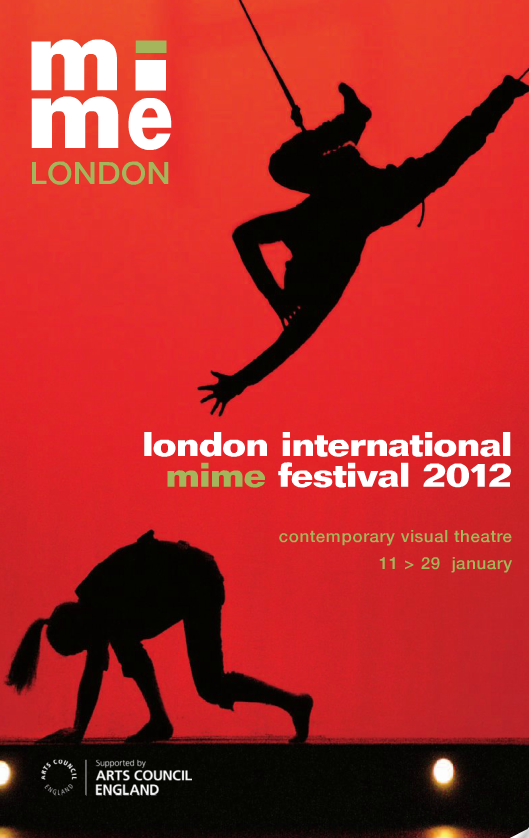
The first thing you need to know about this festival, which has been held annually since 1977, is that it’s no longer strictly a mime festival, but rather a heady mix of nouveau cirque, clowning, physical comedy, dance, puppetry, movement theatre and, yes, mime. In fact, they subtitle it “contemporary visual theatre.” The second thing you need to know is that they bring in some very good work indeed.

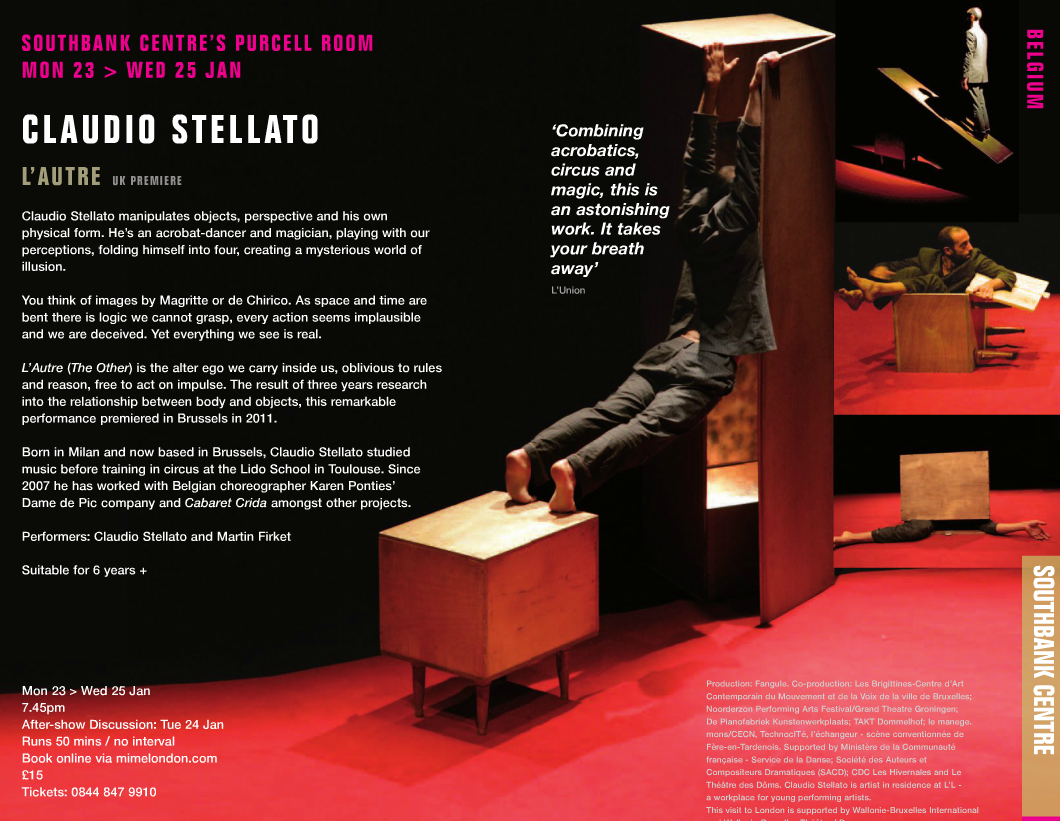
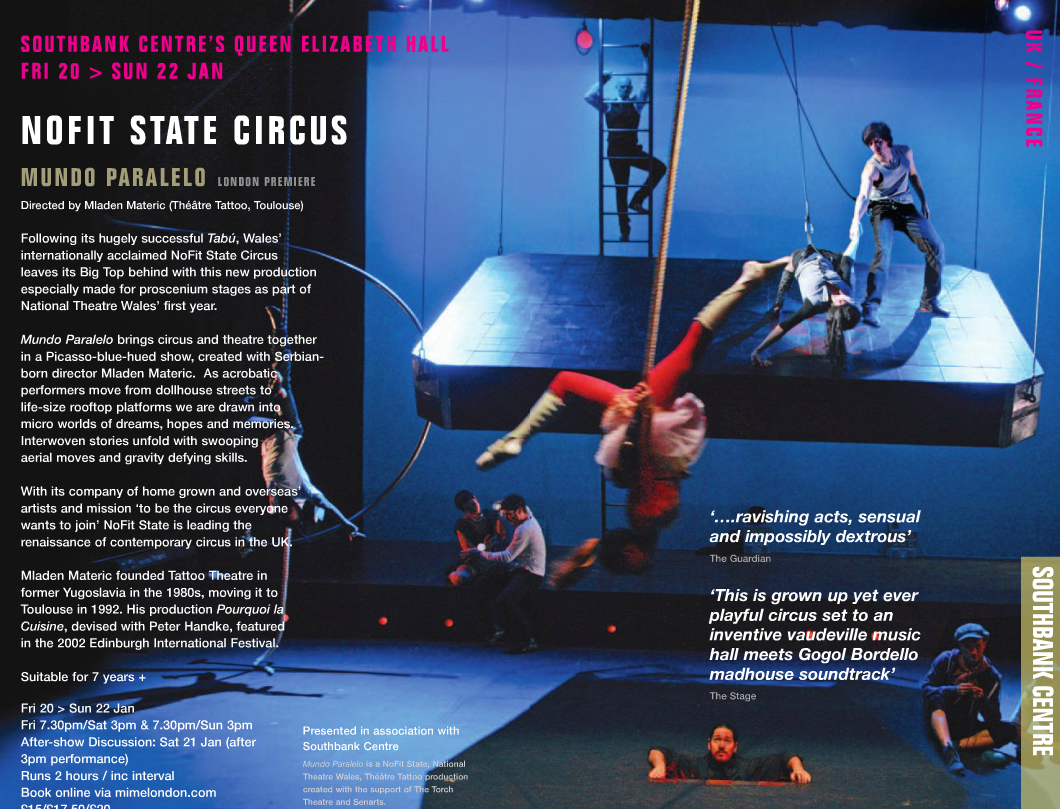
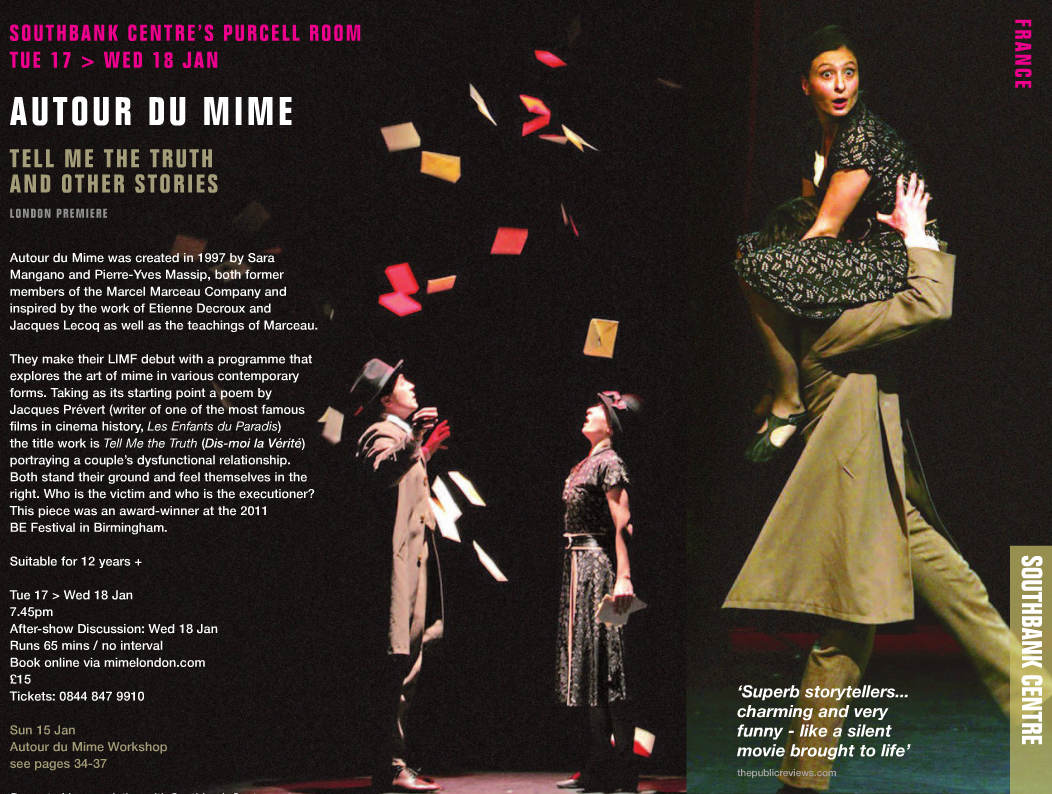
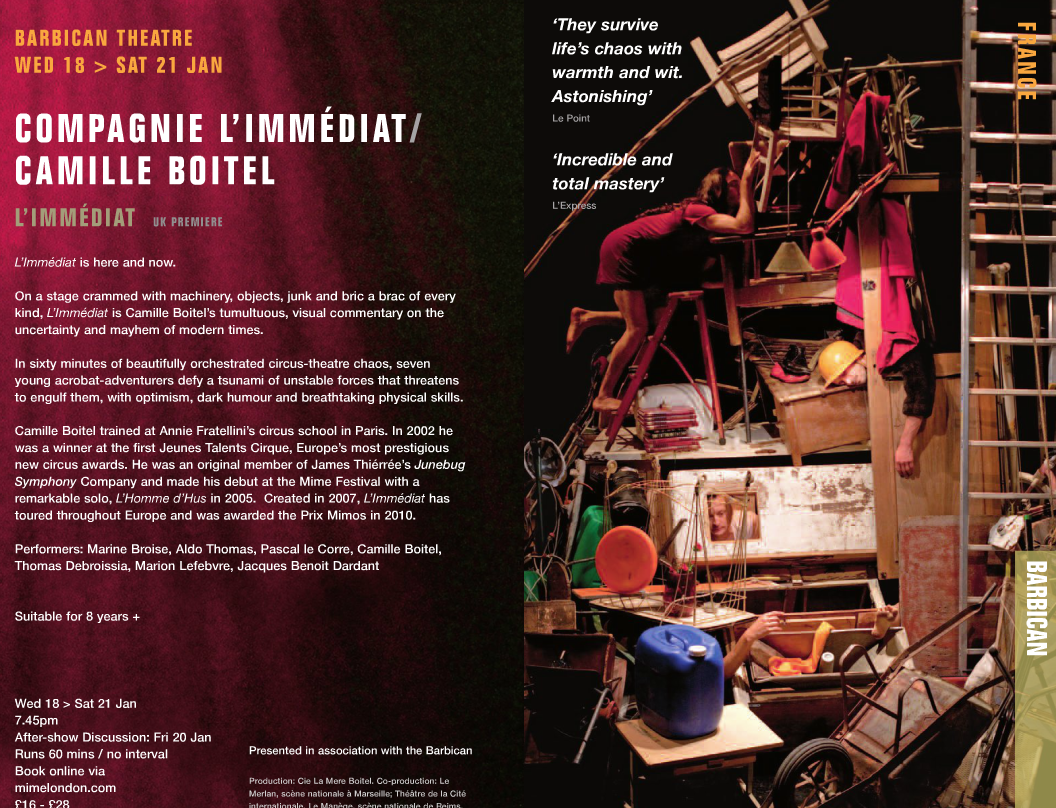
Here are a few shots from their new brochure for 2012; click on the images for larger versions.

The festival runs from January 11th to January 29th, and tickets are only £15. You can view and download the brochure here and visit the full web site here.
SHARE
EXPLORE FURTHER

What Will They Think of Next Department: Mimes Directing Traffic (for real)

POST 201
Friday, October 14, 2011

Associated Press, Caracas: Mimes gesture as they stand in a crosswalk in Caracas, Venezuela, Friday Oct. 7, 2011. The mayor of the city’s eastern district of Sucre has launched a unique program aimed to encourage civility among reckless drivers and careless pedestrians, putting 120 mimes at intersections to politely and silently scold violators. The campaign kicked off this week as mimes posted at busy intersections mocked people who jaywalked or acted brutish behind the wheel. (AP Photo/Ariana Cubillos)

Click here for the full article. Thanks to Marisol Rosa-Shapiro for the link!

SHARE
EXPLORE FURTHER

Jos Houben: The Art of Laughter

POST 196
Saturday, October 1, 2011

It takes more than a little bravery to tell an audience outright that you are going to explain to them how comedy works and that you intend to make them laugh a lot in the process, even suggesting that they don’t have much choice in the matter. But if they don’t laugh, you lose on two counts. And it takes a lot of talent, training, and practice to pull it off as well as Jos Houben did Tuesday night in New York at an evening hosted by the Alliance Française as part of their Crossing the Line performance series. Yes, lots of laughs and a standing ovation.

Jos is one part vintage vaudevillian and one part Lecoq-trained movement specialist, a dynamic combination that infuses The Art of Laughter with a whole lot of fun and just as much insight. With only a chair, table, bottle, glass, hat, and napkin as props, this “master class” breaks physical comedy down into manageable chunks, building both the gags and the theory as he goes.

The bottom line for Jos is the human body — “none of you showed up here tonight without yours” — and especially the significance of our verticality, which our egos so readily equate with dignity. Some of this reminds me of a Tom Leabhart lecture-demo on the inner experience / physical manifestation work of François Delsarte, which certainly influenced modern mime, but with Jos the backbone is clearly connected to the funny bone. Many of the comic moments that arise, from the simplest trip to disastrously awkward encounters with the opposite sex, are funny because of our deviance from this vertical ideal.

Jos starts with the simplest physical comedy moves: a trip, a hand fumbling an object, a shoe flying off. How do we react to these? What if others are watching?? He builds these blunders into various combinations and then lets them occur in simple situations with the other. What happens between a man and a woman? Between two guys?

There are a few clips on YouTube, and I offer four below to give you a taste, but they fail to convey the overarching narrative that makes the whole of this presentation far greater than its (excellent) parts. If you have the opportunity to see this show live — and Jos does perform it in English and in French all over the world — do not miss it!

Preview, in French:

Again in French, two more sustained sequences. The first selection focuses on body parts, starting with the pelvis.

The second clip demonstrates creating “an accident” and building it into a sequence.

Some Links:
Read Jos’s impressive bio here.
See the work of Jos’s students from the École Jacques Lecoq, performing at the Louvre, in this previous post.
Web site for the École Jacques Lecoq, where Jos currently teaches.
See Jos in New York, November 9th thru December 4th, in Fragments, short pieces by Samuel Beckett, directed by Peter Brook.

SHARE
EXPLORE FURTHER

Movement Training for Actors

POST 190
Monday, September 12, 2011
Moni Yakim teaches a class at Juilliard
(Photo: Jessica Katz)

The notion that physical comedians and other movement artists might have something to teach traditional actors goes back at least a century, when such innovative directors as Jacques Copeau in France and Vsevolod Meyerhold in Russia hired accomplished clowns and variety performers as guest instructors. In the United States, this became a trend in the 60s and 70s as “experimental” theatres sought to break the confines of the fourth wall and Stanislavski method acting to forge more theatrical performance styles.

Jewel Walker and Hovey Burgess were two of the first teachers to become influential fixtures at major universities ((Carnegie-Mellon and NYU). Nowadays no respectable college acting program is without its movement specialist and — if you believe the optimistic job descriptions you see in the ad postings — the desired skill set includes mime, circus, clown, acrobatics, masks, dance, biomechanics, yoga, and stage combat, not to mention the techniques of Laban, Feldenkrais, Alexander, Grotowski, Decroux, Lecoq, and Pilates. If you can integrate it with vocal training, so much the better! All this for a position that is often low on the faculty pay scale and not even tenure-track.

Movement training for actors was not just some trendy idea that came and went. It is now widely accepted in the profession and has demonstrably expanded the range and possibilities of many a successful performer. I bring this up because I recently stumbled upon two useful articles on the subject in American Theatre magazine that are available on the web. This first offers a broad survey of the field, what the disciplines are, and what value various teachers and performers see in it.

Here are a few quotes:
“Suppose I hit a line drive over the head of the second baseman. I’m off running right away. And I’m watching the ball, and there comes the possibility I can get to second base on this hit. My body knows without looking where first base is, and I need to watch only the ball and the fielder. If I have to look down at my feet, I’ve lost. That’s like being on stage—you have to be super aware.” — Jewel Walker
“What is essential? It tends to change, depending upon the time period. I’ve been teaching for a long time, and students used to be a bit more out there and crazy: curious, and wildly splattering themselves on the walls. So it was a matter of focusing that wild energy. Students coming in now are better trained, in many ways, and more disciplined. Sometimes you want to tweak that wildness.” — Jim Calder
“The hardest things to teach actors are that the pedestrian body embodies a kind of virtuosity, and that movement has a theatrical power that must be trusted in its own right. Actors want to act; they want to create some reason why they are standing on the stage. I take that away from an actor—I say, ‘Oh, just raise your arm, just take four steps to the right, just bow your head’—it has meaning. The body is expressing things that are way beyond what you can impose on it in this moment.” — Annie Parsons
“Three strong voices spoke to me—Bertolt Brecht, Jerzy Grotowski and Étienne Decroux—and I see them as a triangle of aspects of what I think constitutes full actor training. From Grotowski, it was the visceral aspect, of going beyond the socially acceptable and really finding the primal, visceral self; and from Brecht it was the whole aspect of dramaturgy and social relevance and the importance of the relationship of the artist on stage to the audience. And from Decroux, the concept of shape and form spoke to me—this idea of the actor’s ability to physically manifest thought and give specificity to emotion…. The laws of physics tell us that gravity falls through us and pulls us to a perfect vertical. And life pushes us off of that sense of neutrality. If we understand that neutrality, then we understand how a character is pulled off of being perfect. Life creates our imperfections. And a character is a beautiful collection of imperfections.”  — Kari Margolis

“I deal with various forms of the mask, including the red nose. One is the full-faced character mask; it is a nonverbal mask. I follow that by the neutral, universal mask—also nonverbal—and that I follow with the character half-mask, which is a verbal mask. All of that is followed by the red nose, for what I call contemporary classic clowning. [Prior to the clown work, Francesconi works with…] “…movement improvisation, which is nonverbal. It is somewhat abstract, somewhat of a combination of modern dance and eccentric behavior, which is the basis, really, of physical comedy. ‘Eccentric behavior’ could be something as simple as a body part going out of control. It is essential that the early work be somewhat abstract and focused on the body in space, rather than on creating story.”
— Robert Francesconi

You can read the whole article here.
The second article features ten prominent performers, each explaining what approach they use for creating a more dynamic stage presence.
Again some quotes:
“I encourage Synetic actors to train in parkour movements because there is an emphasis on gaining knowledge of one’s body in space as it relates to dangers (falling, colliding with objects, losing balance) and applying that knowledge to move through obstacles with ease and safety. To me, parkour is about understanding the relationship between your body and the physical world, and enjoying it. Learn to fall, roll, land, climb and interact with the physical world so that you can perform better in your run, play or dance piece. The real joy of parkour is that it changes how you look at your environment—everything becomes a potential playground!” — Ben Cunis
“Lecoq is a way, a path—not a ‘technique’—that asks the actor: What do you have to say? Tragedy, commedia and bouffon all have a different approach, but the overarching theme in Lecoq is ‘actor as creator.’ The process helps you develop your own voice, not just as an actor but also as a theatre artist. That rounded training is lacking in the U.S. The empowerment of the actor to understand more than just the role he is playing is not often embraced here, and in New York there is a palpable hunger for physical-theatre training.” — Richard Crawford
“I just played Florindo, the boastful lover in A Servant of Two Masters, at Yale Rep. I went back to basics: leading with the chest, exercising muscles in my back, realizing how to look upward when I walked around, asking where my character’s power comes from. Florindo is a funny character, but not to himself. Even doing commedia, I had to find the truth in this body. I did a whole monologue walking straight downstage till I got to the apron, and then ran all the way back crying and yelling. To do that eight times a week, you have to go back to your training. That’s what Moni’s [Yakim] about: the freedom inside the body when doing these extreme characterizations.” — Jesse Perez
And you can read that whole article here.
The articles have lots of links, plus the reader comments to each article provide some additional information and pespectives.
SHARE
EXPLORE FURTHER

Complete Books: More Commedia (en français)

POST 173
Thursday, August 4, 2011

Let’s give the French some credit!

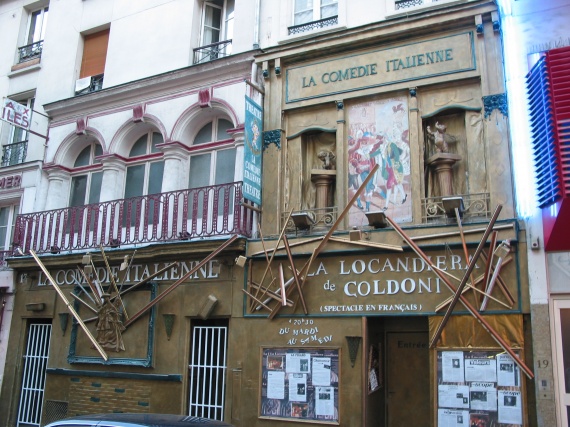
They may tend to over-intellectualize, but historically they have been enthusiastic fans and loyal supporters of clowns, mime, and circus. Commedia troupes — la Comédie-Italienne — made their homes in Paris, and while the best clowns may have been from England, Italy, or Spain, often they had to come to the French capital to be fully appreciated.

The French also write (and even read!) books, so it’s not surprising that some of the best works on this whole physical comedy tradition were written in French. My own Clowns book would have been significantly diminished had I not been able to read Rémy, Thétard, Strehly, Perrodil, Adrian, and many others. And if I’m a bit of a francophile, you’ll have to forgive me, because the truth is I’ve been bought: in 1990 I had a Fulbright fellowship to France to study physical comedy, half of which was funded by the French government. I have, however, been dutifully repaying them ever since (with interest) in the form of regularly scheduled purchases of French wine, with a marked preference for the earthier Bordeaux reds.

But enough about moi. Google tells me a lot of my blog fans come from la France, and je sais for a fact that more than a few of my Anglophone readers also lisent French. The least I can do is include a few free books en français.

Holy vache, I see que this blog post se transforme progressivement into français…. ça is becoming vachement dif. Tant pis, car maintenant vous devez souffrir mon français maladroit!

Okay, eau quais…. allons-y!

Masques et Bouffons de Maurice Sand (1860)
Commençons par Masques et Bouffons de Maurice Sand, mon introduction et la traduction anglaise de laquelle j’ai déjà publié dans ce précédent post.

Tome 1:

Masques_et_Bouffons_vol01

Tome 2:

Masques Et Bouffons Vol02


Mémoires de Carlo Gozzi (1797)
Mon introduction et la traduction anglaise se trouvent aussi dans ce précédent post.

MémoirsDeGozzi

Mimes et Pierrots: Notes et Documents de Paul Hugounet  (1889)
Le dernier, mais non le moindre, c’est le plus tôt importante étude scientifique de la pantomime, celle de Paul Hugounet (né 1859), un contemporain de Charles Deburau. Après les trois premiers chapitres, ce livre se concentre sur la pantomime française du 19ème siècle.

Mimes Et Pierrots


Prochainement: des livres en français sur le Théâtre des Funambules.

SHARE
EXPLORE FURTHER

Complete Book: “Masks and Marionettes” by Joseph Kennard

POST 167
Tuesday, July 19, 2011

When I was writing Clowns, these were the books I consulted the most for my section on commedia dell’arte:
Masks, Mimes & Miracles by Alardyce Nicoll
The World of Harlequin by Alardyce Nicoll
The Italian Comedy by Pierre Duchartre
The History of the Harlequinade by Maurice Sand
Scenarios of the Commedia Dell’Arte by Flaminio Scala
• The Commedia Dell’Arte by Giacomo Oreglia

I did not read Masks and Marionettes by Joseph Kennard, nor have I since then, but browsing through it now it seems to be a reasonable overview of the subject, and one that touches on the closely related puppet theatre of the time. And since the above-mentioned books are not available for free and this one is, I though it worth including here.

Masks and Marionettes

SHARE
EXPLORE FURTHER

Gamarjobat — Silliness Supreme

POST 150
Wednesday, June 8, 2011

You’ve probably already seen most of the mime-y shtick these guys do, but their high energy and inspired silliness make it fresh and funny.  Thanks to Jeff Seal for the link.

SHARE
EXPLORE FURTHER
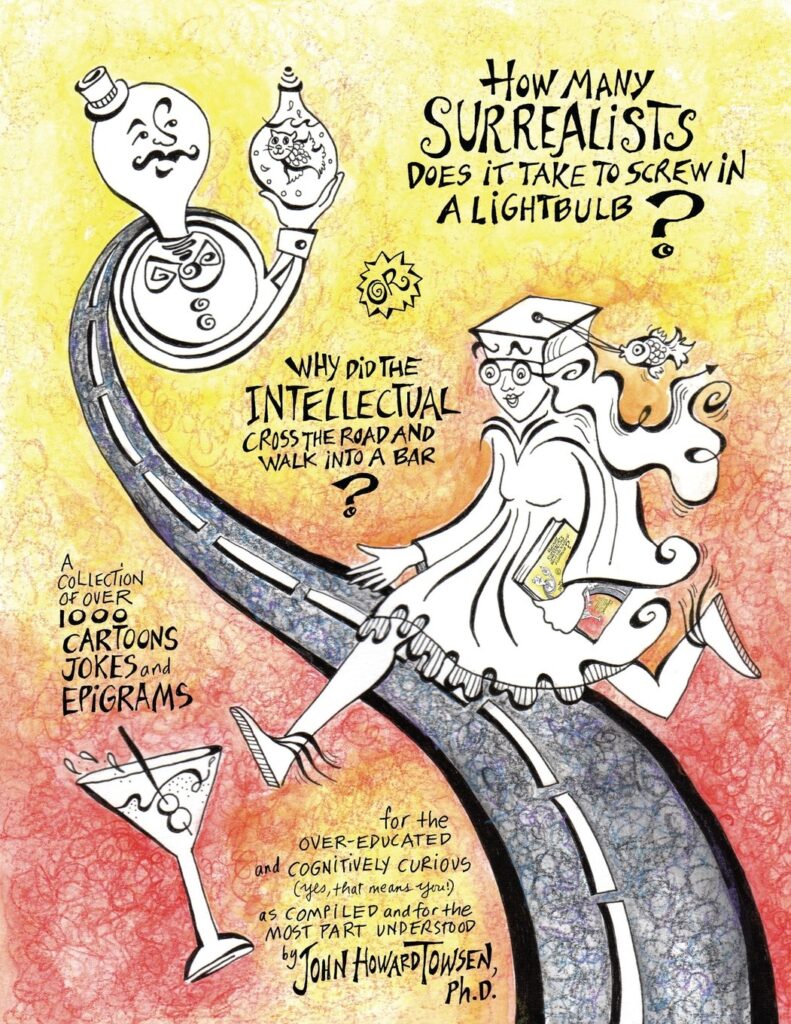
Check out My New Book

Visual and verbal humor for the cognitively and artistically curious!

“A book to treasure!”
—Bill Irwin

Upcoming Events