 |
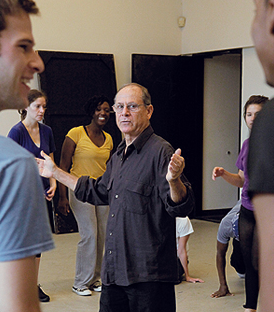
Moni Yakim teaches a class at Juilliard
(Photo: Jessica Katz) |
The notion that physical comedians and other movement artists might have something to teach traditional actors goes back at least a century, when such innovative directors as Jacques Copeau in France and Vsevolod Meyerhold in Russia hired accomplished clowns and variety performers as guest instructors. In the United States, this became a trend in the 60s and 70s as “experimental” theatres sought to break the confines of the fourth wall and Stanislavski method acting to forge more theatrical performance styles.
Jewel Walker and Hovey Burgess were two of the first teachers to become influential fixtures at major universities ((Carnegie-Mellon and NYU). Nowadays no respectable college acting program is without its movement specialist and — if you believe the optimistic job descriptions you see in the ad postings — the desired skill set includes mime, circus, clown, acrobatics, masks, dance, biomechanics, yoga, and stage combat, not to mention the techniques of Laban, Feldenkrais, Alexander, Grotowski, Decroux, Lecoq, and Pilates. If you can integrate it with vocal training, so much the better! All this for a position that is often low on the faculty pay scale and not even tenure-track.
Movement training for actors was not just some trendy idea that came and went. It is now widely accepted in the profession and has demonstrably expanded the range and possibilities of many a successful performer. I bring this up because I recently stumbled upon two useful articles on the subject in American Theatre magazine that are available on the web. This first offers a broad survey of the field, what the disciplines are, and what value various teachers and performers see in it.
Here are a few quotes:
“Suppose I hit a line drive over the head of the second baseman. I’m off running right away. And I’m watching the ball, and there comes the possibility I can get to second base on this hit. My body knows without looking where first base is, and I need to watch only the ball and the fielder. If I have to look down at my feet, I’ve lost. That’s like being on stage—you have to be super aware.” — Jewel Walker
“What is essential? It tends to change, depending upon the time period. I’ve been teaching for a long time, and students used to be a bit more out there and crazy: curious, and wildly splattering themselves on the walls. So it was a matter of focusing that wild energy. Students coming in now are better trained, in many ways, and more disciplined. Sometimes you want to tweak that wildness.” — Jim Calder
“The hardest things to teach actors are that the pedestrian body embodies a kind of virtuosity, and that movement has a theatrical power that must be trusted in its own right. Actors want to act; they want to create some reason why they are standing on the stage. I take that away from an actor—I say, ‘Oh, just raise your arm, just take four steps to the right, just bow your head’—it has meaning. The body is expressing things that are way beyond what you can impose on it in this moment.” — Annie Parsons
“Three strong voices spoke to me—Bertolt Brecht, Jerzy Grotowski and Étienne Decroux—and I see them as a triangle of aspects of what I think constitutes full actor training. From Grotowski, it was the visceral aspect, of going beyond the socially acceptable and really finding the primal, visceral self; and from Brecht it was the whole aspect of dramaturgy and social relevance and the importance of the relationship of the artist on stage to the audience. And from Decroux, the concept of shape and form spoke to me—this idea of the actor’s ability to physically manifest thought and give specificity to emotion…. The laws of physics tell us that gravity falls through us and pulls us to a perfect vertical. And life pushes us off of that sense of neutrality. If we understand that neutrality, then we understand how a character is pulled off of being perfect. Life creates our imperfections. And a character is a beautiful collection of imperfections.” — Kari Margolis
“I deal with various forms of the mask, including the red nose. One is the full-faced character mask; it is a nonverbal mask. I follow that by the neutral, universal mask—also nonverbal—and that I follow with the character half-mask, which is a verbal mask. All of that is followed by the red nose, for what I call contemporary classic clowning. [Prior to the clown work, Francesconi works with…] “…movement improvisation, which is nonverbal. It is somewhat abstract, somewhat of a combination of modern dance and eccentric behavior, which is the basis, really, of physical comedy. ‘Eccentric behavior’ could be something as simple as a body part going out of control. It is essential that the early work be somewhat abstract and focused on the body in space, rather than on creating story.”
— Robert Francesconi
You can read the whole article
here.
The second article features ten prominent performers, each explaining what approach they use for creating a more dynamic stage presence.
Again some quotes:
“I encourage Synetic actors to train in parkour movements because there is an emphasis on gaining knowledge of one’s body in space as it relates to dangers (falling, colliding with objects, losing balance) and applying that knowledge to move through obstacles with ease and safety. To me, parkour is about understanding the relationship between your body and the physical world, and enjoying it. Learn to fall, roll, land, climb and interact with the physical world so that you can perform better in your run, play or dance piece. The real joy of parkour is that it changes how you look at your environment—everything becomes a potential playground!” — Ben Cunis
“Lecoq is a way, a path—not a ‘technique’—that asks the actor: What do you have to say? Tragedy, commedia and bouffon all have a different approach, but the overarching theme in Lecoq is ‘actor as creator.’ The process helps you develop your own voice, not just as an actor but also as a theatre artist. That rounded training is lacking in the U.S. The empowerment of the actor to understand more than just the role he is playing is not often embraced here, and in New York there is a palpable hunger for physical-theatre training.” — Richard Crawford
“I just played Florindo, the boastful lover in A Servant of Two Masters, at Yale Rep. I went back to basics: leading with the chest, exercising muscles in my back, realizing how to look upward when I walked around, asking where my character’s power comes from. Florindo is a funny character, but not to himself. Even doing commedia, I had to find the truth in this body. I did a whole monologue walking straight downstage till I got to the apron, and then ran all the way back crying and yelling. To do that eight times a week, you have to go back to your training. That’s what Moni’s [Yakim] about: the freedom inside the body when doing these extreme characterizations.” — Jesse Perez
And you can read that whole article
here.
The articles have lots of links, plus the reader comments to each article provide some additional information and pespectives.