Search Results for: label/Hovey Burgess

Guest Post: Hovey Burgess on Cirkus Cirkör

POST 117
Friday, April 1, 2011


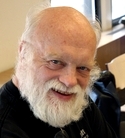
Hovey Burgess is a circus performer, educator, and historian no doubt known to many of you. American performers mining the circus/commedia  tradition who do not hail from traditional circus families can usually trace some portion of their training directly or indirectly to Hovey’s classes, myself included. Author of the how-to guide, Circus Techniques, Hovey is also one of the top authorities on the history of the circus. He was an indispensable resource for me when I was writing Clowns back in the 70s, and has continued to be so today in the writing of this blog. It is therefore a great honor to have him share his erudition with my readers as an example of the kind of writing and research the art of circus truly deserves.


Back in November 2009, I wrote a blog post on Sweden’s Cirkus Cirkör when they appeared at the Brooklyn Academy of Music. I tried to limit myself to covering some physical comedy elements that I thought worth reporting, but I could not help but take issue with a negative review of the show that had appeared in
The New York Times.  Because I found their critic to be uninformed and therefore unqualified, I wrote the following:  “It’s perfectly fine for someone not to have liked this show. I’m not at all opposed to the idea of serious circus criticism, but I think the “paper of record” might want to apply the same standards to all circuses, and find a writer with real expertise in the area. As my friend Dave Carlyon pointed out, if you’re going to write about opera, it’s not enough just to know about the performing arts, you actually have to know about music. Likewise… well, you get the point. Hmm… maybe the Times should hire Hovey as their circus reviewer.”
Well, guess what? The
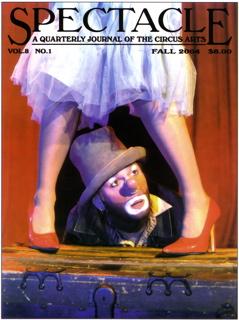
Times still hasn’t hired Hovey but Ernest Albrecht, editor of the excellent quarterly journal of circus, Spectacle, and author of The New American Circus, did get Hovey to review this very same show, and to me his review should serve as a model for well-informed circus criticism. My special thanks to Mr. Albrecht for his kind permission to reprint this article from the pages of Spectacle. — jt

But first some links:
Other posts to this blog involving Hovey
Hovey’s commedia workshops with Stanley Allan Sherman
Spectacle magazine
_________________________________________________

Cirkus Cirkör

Sweden’s Cirkus Cirkör made its American début, in an edition entitled “Inside Out,” at the Brooklyn Academy of Music, November 12-15, 2009 (five performances). The cast consisted of eight circus performers: Anna Lagerkvist, André Farstad, Jens Engman, Jay Gillian, Mirja Jauhiainen, Sanna Kopra, Angela Wand and Fefe Deijfen, backed up by Irya’s Playground, a live rock band: Irya Gmeyner (vocals), Pange Öberg (bass), Erik Nilsson (drums), Ludvig Rylander (keyboard) and Jon Bergström (guitar). The show was directed by Tilde Björfors, who founded the company in 1995.
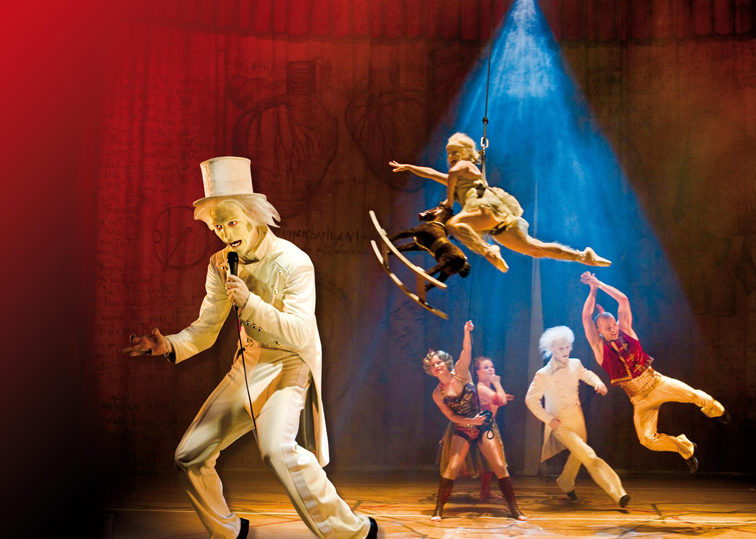
The meaning of Cirkus is fairly obvious. It means “Circus” in Swedish (and in Danish as well). The meaning of Cirkör is somewhat more obscure. It comes from the French word “Cirque”, which also means “Circus” and the French word “Coeur”, which means “Heart”. Through the miracle of elision then, “Cirk” (Cirque) plus “Kör” (Coeur) gives us “Cirkör”, which still means “Circus Heart” in French, but with Swedish orthography, and fewer letters. The Swedish word for “Heart” is “Hjärta”.

Before we return to issues of the “Heart”, there is another word that Swedish culture has given us: “smörgåsbord.” Smörgåsbord might well be used, metaphorically, to describe the multi-flavored Cirkus Cirkör. It puts so much on one’s plate that there could well be some things not to like.

One course has little to do, technically, with true traditional circus, but may appeal to five-year-olds. There is a bicycle that “generates” electricity to run the stage lighting, and a rocking horse that goes through the motions of a liberty horse. One sees the most rudimentary rolling globe and some single hula-hoop action that does not seem much of a challenge, but the presentation is done with the most positive energy and styling imaginable.
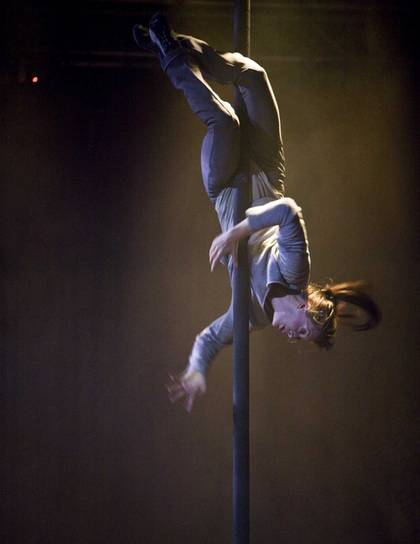
1) Another course is on the cutting edge of circus technique and seems calculated to appeal to the most diligent of circus aficionados and to be appreciated by the most exacting of circus connoisseurs. Three examples in this category could knock your socks off:1.) Swedish-born Anna Lagerkvist offers a delightfully amazing, and as far as I know unprecedented, female solo Chinese pole act. Her skills are of the highest order of magnitude that I have ever seen in this, usually male, genre.


2) Ohio-born Jay Gilligan has come up with a novel format of presenting some remarkable numbers juggling—manipulating as many as six (6) clubs; seven (7) balls or nine (9) rings. Backed up by a very vocal percussionist and two able male assistants, Jay is even more the master of the plan B approach than he is of juggling. He pushes the envelope to the maximum, and if he succeeds it is simply incredible, but it is also incredible if he should miss, because a miss can become, according to his whim and fate, a smooth transition into a new routine, a “this-is-so-difficult-it-takes-several-tries” trick, or a comedy of errors. The sequence of tricks is subject to change, and no two performances are the same.

3) There are a number of remarkable all-female double trapeze acts around these days, and one of them is decidedly the Finnish-born team of Mirja Tuulinkki Jauhiainen (Miku, for short) and Sanna Kopra. They have been working together for over a decade and their transitions are as smooth as can be. They finish (no pun intended) with a somersault (hands-to-hands).

In between is a middle-ground course of work that represents neither a send-up of circus nor a state-of-the-art stretch: Pagoda of Chairs, Cyr Wheel, Lyra, Pommel Hand-Balancing, and Teeterboard. Note, however, that some of the teeterboard work is in the Korean teeterboard tradition (swing-time somersaults at both ends) and is impressively done with a regulation–sized teeterboard, not the oversized teeterboard used by Cirque du Soleil a few years back.
So what are we to make of all this? Is it a show padded and peppered with dross and clap-trap? The great Swedish filmmaker Ingmar Bergman (1918-2007) made two films that dealt with itinerant circus performers: Gycklarnas afton/Sawdust and Tinsel/The Naked Night (1953) and Det sjunde inseglet/The Seventh Seal (1957).

When asked the intention of his films, Bergman always endeavored to reply as evasively as possible. The name of one of the characters in Cirkus Cirkör is Julia P. It seems that Cirkus Cirkör exhibits the same adversity to spelling things out for us.

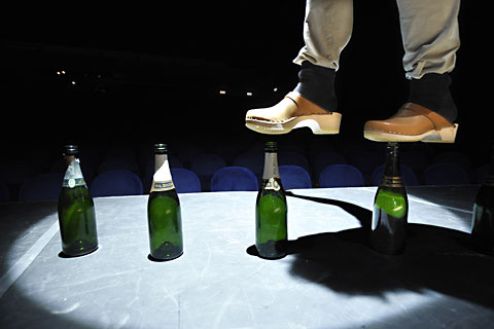
There are clues. The character Julia P. (played by Angela Wand) has a beard and is an accomplished dancer. That might point to Julia Pastrana (1834-1860), the most famous bearded woman in history. There are also red herrings. The character Julia P. is a hunchback, a sort of “Quasimoda of Notre Dame”, if you will, and adept at balancing on bottles. This is a skill rarely seen today, but it was a specialty of the clown Jean-Baptiste Auriol (ca. 1800-1881), who appeared at Franconi’s Cirque Olympique in Paris, and whose lifetime eclipsed that of Julia Pastrana.

In life, Julia Pastrana was exhibited throughout the United States and Europe. In the motion picture La donna scimmia/Le Mari de la femme á barbe/The Ape Woman (1964) the role of “Maria”, played by Annie Giradoux, is obviously based on the life of Julia Pastrana.

After her death in Moscow in 1860, Julia Pastrana was embalmed and mummified and continued to be exhibited, as in life. She was exhibited in the United States as late as 1971. She was exhibited, as a mummy, in Sweden (Yes, in Sweden.) as early as 1864, and as late as 1973, when authorities shut down the exhibit. Banned as an exhibit practically everywhere, she was put in storage in Norway, never to be seen in public again.

Julia Pastrana did, however, make scientific headline news in May of 2009, when Chinese medical researchers identified her extremely rare condition (congenital generalized hypertrichosis terminalis) as a genomic disorder and mapped the specific genes in the 17th human chromosome that are responsible.

Let us now return to the issues of the “Heart”. Julia Pastrana was of Native American Indian stock, born in Mexico, the land of the Aztecs, best known, perhaps, for their human sacrifices in which a priest would cut living hearts from the chests of the sacrificial victims, captured in war for that very purpose.
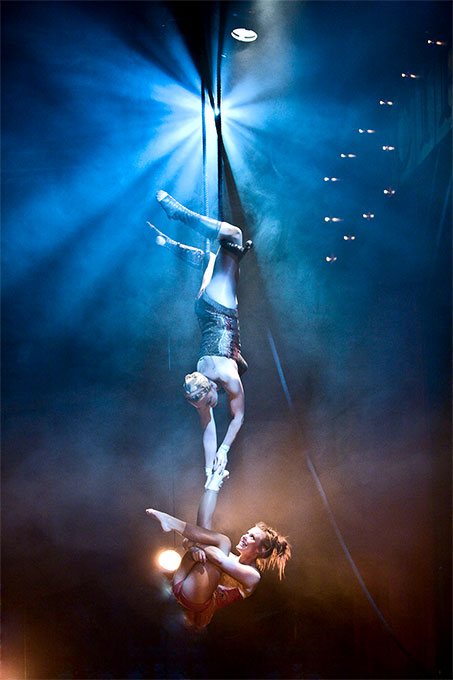
In the course of Cirkus Cirkör, Julia P. reaches inside the chest of the variously-named character (Saga, Stephanie, Stacey…) played by Anna Lagerkvist, and pulls out her heart. Somehow she survives the ordeal, and her heart becomes a considerable burden to her as it grows to mammoth proportions.

I must say that I find myself intrigued by these potentially off-putting constructs of allusion and symbol, much the way some people are drawn to Herman Melville’s Moby Dick (1851), James Joyce’s Ulysses (1922), or Hermann Hesse’s Magister Ludi (1943). Cirkus Cirkör begins to take on some of the magical proportions of Charles G. Finney’s The Circus of Dr. Lao (1935). Cirkus Cirkör leaves so much to the imagination, to research, to be “smoked out”, that, if these intrigues be valid, it could be argued that Cirkus Cirkör has accomplished something that no other circus has ever done before.
SHARE
EXPLORE FURTHER

Movement Training for Actors

POST 190
Monday, September 12, 2011
Moni Yakim teaches a class at Juilliard
(Photo: Jessica Katz)

The notion that physical comedians and other movement artists might have something to teach traditional actors goes back at least a century, when such innovative directors as Jacques Copeau in France and Vsevolod Meyerhold in Russia hired accomplished clowns and variety performers as guest instructors. In the United States, this became a trend in the 60s and 70s as “experimental” theatres sought to break the confines of the fourth wall and Stanislavski method acting to forge more theatrical performance styles.

Jewel Walker and Hovey Burgess were two of the first teachers to become influential fixtures at major universities ((Carnegie-Mellon and NYU). Nowadays no respectable college acting program is without its movement specialist and — if you believe the optimistic job descriptions you see in the ad postings — the desired skill set includes mime, circus, clown, acrobatics, masks, dance, biomechanics, yoga, and stage combat, not to mention the techniques of Laban, Feldenkrais, Alexander, Grotowski, Decroux, Lecoq, and Pilates. If you can integrate it with vocal training, so much the better! All this for a position that is often low on the faculty pay scale and not even tenure-track.

Movement training for actors was not just some trendy idea that came and went. It is now widely accepted in the profession and has demonstrably expanded the range and possibilities of many a successful performer. I bring this up because I recently stumbled upon two useful articles on the subject in American Theatre magazine that are available on the web. This first offers a broad survey of the field, what the disciplines are, and what value various teachers and performers see in it.

Here are a few quotes:
“Suppose I hit a line drive over the head of the second baseman. I’m off running right away. And I’m watching the ball, and there comes the possibility I can get to second base on this hit. My body knows without looking where first base is, and I need to watch only the ball and the fielder. If I have to look down at my feet, I’ve lost. That’s like being on stage—you have to be super aware.” — Jewel Walker
“What is essential? It tends to change, depending upon the time period. I’ve been teaching for a long time, and students used to be a bit more out there and crazy: curious, and wildly splattering themselves on the walls. So it was a matter of focusing that wild energy. Students coming in now are better trained, in many ways, and more disciplined. Sometimes you want to tweak that wildness.” — Jim Calder
“The hardest things to teach actors are that the pedestrian body embodies a kind of virtuosity, and that movement has a theatrical power that must be trusted in its own right. Actors want to act; they want to create some reason why they are standing on the stage. I take that away from an actor—I say, ‘Oh, just raise your arm, just take four steps to the right, just bow your head’—it has meaning. The body is expressing things that are way beyond what you can impose on it in this moment.” — Annie Parsons
“Three strong voices spoke to me—Bertolt Brecht, Jerzy Grotowski and Étienne Decroux—and I see them as a triangle of aspects of what I think constitutes full actor training. From Grotowski, it was the visceral aspect, of going beyond the socially acceptable and really finding the primal, visceral self; and from Brecht it was the whole aspect of dramaturgy and social relevance and the importance of the relationship of the artist on stage to the audience. And from Decroux, the concept of shape and form spoke to me—this idea of the actor’s ability to physically manifest thought and give specificity to emotion…. The laws of physics tell us that gravity falls through us and pulls us to a perfect vertical. And life pushes us off of that sense of neutrality. If we understand that neutrality, then we understand how a character is pulled off of being perfect. Life creates our imperfections. And a character is a beautiful collection of imperfections.”  — Kari Margolis

“I deal with various forms of the mask, including the red nose. One is the full-faced character mask; it is a nonverbal mask. I follow that by the neutral, universal mask—also nonverbal—and that I follow with the character half-mask, which is a verbal mask. All of that is followed by the red nose, for what I call contemporary classic clowning. [Prior to the clown work, Francesconi works with…] “…movement improvisation, which is nonverbal. It is somewhat abstract, somewhat of a combination of modern dance and eccentric behavior, which is the basis, really, of physical comedy. ‘Eccentric behavior’ could be something as simple as a body part going out of control. It is essential that the early work be somewhat abstract and focused on the body in space, rather than on creating story.”
— Robert Francesconi

You can read the whole article here.
The second article features ten prominent performers, each explaining what approach they use for creating a more dynamic stage presence.
Again some quotes:
“I encourage Synetic actors to train in parkour movements because there is an emphasis on gaining knowledge of one’s body in space as it relates to dangers (falling, colliding with objects, losing balance) and applying that knowledge to move through obstacles with ease and safety. To me, parkour is about understanding the relationship between your body and the physical world, and enjoying it. Learn to fall, roll, land, climb and interact with the physical world so that you can perform better in your run, play or dance piece. The real joy of parkour is that it changes how you look at your environment—everything becomes a potential playground!” — Ben Cunis
“Lecoq is a way, a path—not a ‘technique’—that asks the actor: What do you have to say? Tragedy, commedia and bouffon all have a different approach, but the overarching theme in Lecoq is ‘actor as creator.’ The process helps you develop your own voice, not just as an actor but also as a theatre artist. That rounded training is lacking in the U.S. The empowerment of the actor to understand more than just the role he is playing is not often embraced here, and in New York there is a palpable hunger for physical-theatre training.” — Richard Crawford
“I just played Florindo, the boastful lover in A Servant of Two Masters, at Yale Rep. I went back to basics: leading with the chest, exercising muscles in my back, realizing how to look upward when I walked around, asking where my character’s power comes from. Florindo is a funny character, but not to himself. Even doing commedia, I had to find the truth in this body. I did a whole monologue walking straight downstage till I got to the apron, and then ran all the way back crying and yelling. To do that eight times a week, you have to go back to your training. That’s what Moni’s [Yakim] about: the freedom inside the body when doing these extreme characterizations.” — Jesse Perez
And you can read that whole article here.
The articles have lots of links, plus the reader comments to each article provide some additional information and pespectives.
SHARE
EXPLORE FURTHER

Charlie Rivel: Homage to a Catalonian Clown — Live from Barcelona! #4

POST 84
Wednesday, March 10, 2010

It is my last night in Barcelona and Jango Edwards brought together for dinner all of the clown / circus /variety historians he could muster in the person of Raffaele De Ritis, whose blog, Novelties and Wonders, is indeed full of wonders; Pat Cashin, whose Clown Alley blog is the place to go for all things clown; Greg DeSanto, director of the International Clown Hall of Fame and Research Center; and yours truly. Or to paraphrase John F. Kennedy, there hasn’t been a greater concentration of clown knowledge at one table since Tristan Rémy dined alone.

This being Catalonia, the meandering conversation had to come around to its most famous clown, Charlie Rivel (1896 –1983). In fact, in Barcelona’s Joan Brossa Gardens you will find a statue (photo, below) of Rivel , and there is even a Charlie Rivel Museum in his birthplace, the village of Cubelles, half way down the coast between here and Tarragona.

Born Josep Andreu Lasserre, his father was a Catalan trapeze artist and his mother a French acrobat. By age two he was performing in his father’s risley act. Thus was launched an eight-decade performing career that brought him the kind of superstar status in Europe only enjoyed by clowns like Grock and the Fratellini.

It’s been decades since I read Rivel’s autobiography, Poor Clown so I won’t pretend to be an expert on his life. Instead I will turn you right back over to Raffaele De Ritis, whose article on Rivel on Circopedia is the best starting point. Once you promise me you’ve read that, I’ll share a few video highlights with you.

Okay, did you really read it? Alrighty then, let’s get started…

Because many of the clips we have of Rivel are from late in his long performing career, his early days as an acrobat and an acrobatic clown tend to be overlooked. But you already knew that, right? Here are two shots of him as the topmounter in an unconventional two-high, courtesy of circus practitioner, teacher, and historian Hovey Burgess:

According to the Circopedia bio, one of the tricks he and his brothers became known for was “The Little Bridge.” Though I don’t have any footage of this, again with the help of Hovey Burgess I was able to identify the trick and with the help of Nicanor Cancellieri track down what seems to be a more recent version of it as performed by The Three Rebertis.

And as an aside, here’s a third photo supplied by Hovey of Los Yacopis, with this commentary: Note the hands-to-shoulders element (not head-to-head, not, at least, in the moment of this photograph). Irving Pond mentions the Yacopi troupe in Big Top Rhythms (1937) RE: their teeterboard four-person high column. This photograph is from: Julio Revollendo Cardenas CIRCO EN MÉXICO (2004), page 71.


Update from Hovey: I herewith submit two (2) photographs from Fernand Rausser (photographer) Le Cirque (1975) [Toole Stott No. 13,465] which purportedly depict the 1975 Circus Knie revival of the unconventional two-high (page 148) and the “bridge” (page 149) by Rolfe Knie Junior, Juanito Rivel and José Bétrix. If we are to judge from the photograph, and perhaps we should not so judge, the latter seems not quite up to snuff somehow. That is hardly a free head-to-head element that is shown. Hmmm!


Update courtesy of Pat Cashin (3-21-10):
Mystery solved! Here’s our bridge, performed nonchalantly by Rivel and company during a 1937 hospital visit. Click on image.

Hovey Burgess comments: “That is it. But with a couple of twists.This 1937 Viennese version clip is also a five-person bridge akin to the Yacopis photograph. Five people are also hinted at in the somewhat inconclusive 1975 Swiss revival version photograph. Unlike the Rebertis clip, however, the non-feet-to-shoulders link is NOT a straight head-to-head at ANY point shown in the clip, but is reinforced with a Yacopi-like hands-to-shoulders [throughout]. With the Rebertis it is a straight head-to-head (“no hands!”) all the way, both ascending and descending. Mystery solved? Yes, but we would still like to see and know more.”
______________________

And now back to our regularly scheduled program:
Since his father was a trapeze artist, it’s not surprising that comedy trapeze became one of Rivel’s signature acts. Here he is from 1943, when he would have already been 46 or 47.

Later in his career Rivel became more of a minimalist, extracting a lot of clown gold from a chair and a guitar. Here he is on this youTube piece posted by none other than Pat Cashin. Small world, eh?

And here he is on Eurovision Song Contest:

This is the Rivel segment from Fellini’s movie, I Clowns; I’ll try to replace it with a version with English subtitles sometime soon!

And to be thorough, here are Rivel’s sons, the Charlivels, performing their popular night club act, which included singing and acrobatics.

Like I said, check back soon for additional material.

SHARE
EXPLORE FURTHER

Gettin’ Schooled in San Francisco

POST 64
Thursday, February 4, 2010

The Clown Conservatory & The Flying Actor Studio


This January I finally got back to San Francisco for a week, my first visit to the west coast in something like seven years; always flying out of the country instead of across it.

Much to see there — friends, family, a beautiful city, a breathtaking coastline — but no visit to the Bay Area would be complete without checking out the local performance scene. San Francisco has one-tenth the population of New York City, but when it comes to the whole physical comedy / circus /new vaudeville / clown scene, it may have us beat. For starters, they’ve got not one but two — count ’em, two — schools devoted to our favorite art form: the Clown Conservatory (one of several programs offered by the Circus Center) and the Flying Actor Studio, a physical theatre training program under the tutelage of James Donlon and Leonard Pitt. Take that, New York!

A lot of this activity can be traced back to the strong influence of the commedia-style political satire of the San Francisco Mime Troupe, founded by R.G. Davis (see next post) way back in 1959, and the Pickle Family Circus, launched in 1975 by jugglers Peggy Snider, Larry Pisoni, and Cecil MacKinnon, who as the Pickle Family Jugglers had been working with the SF Mime Troupe at the time. Pisoni had vaudevillian grandparents as well as circus training in New York from Hovey Burgess

I once got Paul Binder, director of the Big Apple Circus, very mad at me for writing in our obscure 1980s clown-theatre newsletter that the Pickle Family Circus was America’s only indigenous circus because all of its acts were home-grown. He had a point, some of Big Apple’s were too, but not to the extent that Pickle’s were.

The Pickle’s accomplishments were not insignificant:
• They were living proof of the artistic advantages of the small, intimate one-ring circus format.
• They raised the status of clowning and launched the careers of Larry Pisoni (aka Lorenzo Pickle), Geoff Hoyle (aka Mr. Sniff), and Bill Irwin (aka Willie the Clown). [For more on this, check out Joel Schechter’s book, The Pickle Clowns: New American Circus Comedy]
• They created a new funding model, touring up and down the west coast under the sponsorship of local not-for-profit organizations.
• They gave juggling more prominence in their show; in those days it was not uncommon to go to a circus and not see a single juggling act.
• They established a circus school in San Francisco.

[ Click here to read my post on Humor Abuse, Lorenzo Pisoni’s show about growing up as a child performer on the Pickle Family Circus.]

As a performing unit, the Pickle Family Circus eventually dissolved. It was later replaced by the New Pickle Family Circus, but it has not had the resources to maintain an ongoing ensemble or touring schedule. The school, however, very much survives in the form of the San Francisco Circus Center. Here’s their promo video:


The Clown Conservatory

The Clown Conservatory program is directed by Jeff Raz, who was off performing with Cirque du Soleil’s Corteo during my visit, but I did have a chance to visit with Paoli Lacy, Dominique Jando, and my first juggling teacher, Judy Finelli. I cannot actually offer any behind-the-scenes revelation about the training there because instead of me watching them, they put me to work talking with students and faculty about this and that. (Okay, it’s true, I did just happen to bring along some videos, but that was only because I was afraid that the students — for whom my Clowns book is actually required reading — might ask me questions about it that I wouldn’t be able to answer. Not having read the damn thing since I wrote it 35 years ago, I figured I better have something to distract them with.) However, the facilities, teachers, and students were all impressive, and I do look forward to getting back there.

The clown program takes a full academic year, meeting all day three days a week. Judy felt that this wasn’t really enough time, though I suppose lacking substantial funding you have to give the students time to eke out a living, no? And besides, know any other full-year clown program in the United States?

Admittedly the more training the better, but I also think that clowning is such an all-encompassing art form that no program, no matter its depth, is going to automatically churn out creative and polished performers. Nor should it. Better to think of clown school the way we used to think of an undergraduate education: it exposes you to all the pieces but you have to put them together yourself, over time, with input from an amazing variety of unforeseeable resources.

But if you’re thinking of going to San Francisco, with or without some flowers in your hair, do check out the Clown Conservatory. Here’s the basic info from their web site:

The Clown Conservatory accepts students from a variety of performing arts backgrounds who show a strong potential to become professional clowns, whether in the circus ring, on stage, or in other settings (such as clowning in hospitals). Students submit to a selection process and upon acceptance enter the First Year Program (September to June). Weekly classes (three days-a-week) include:
• Core clowning (classic routines, character development, history, performance, creating material, clowns in community)
• Acrobatics
• Circus skills (juggling, stilt-walking, balancing and more)
• Dance
• Mime
• Body awareness
An Advanced Program (September to May) is offered to Clown Conservatory graduates and qualified non-graduates in one of three specialized tracks:
• Clown Ensemble Performing Track – Creating and performing an original production directed by top professionals (acceptance by audition only)
• Social Circus Track – Instruction and hands-on work in hospital clowning, teaching, clown therapy, and other aspects of Social Circus
• Independent Study Track – Additional one-to-one artistic and business coaching for working performers


Evaluation and Performance
Our program directors and faculty evaluate students on a regular basis. Students are offered an opportunity to perform in front of an audience at the end of each session (December and June), and possibly at other times (every five weeks for Clown students) in order to gain performing experience. When they have completed their course of study and are considered ready for professional work, students are given resources and assistance to help them get started in the circus business.

Some photos of the Circus Center:


Above with Paoli Lacy. Below with Judy Finelli and Dr. Nora Bell


No, we’re not back in the Haight in ’68; that last photo is of clown students doing contact improv.

Finally, if you’re anywhere near SF, get on the Circus Center’s mailing list because they sponsor a lot of performances in the bay area, including a clown cabaret at The Climate Theater on the first Monday of the month. Here’s what went on earlier this week:

LOVE is in the air this month- and it’s funny! Join emcee Jeff Raz, straight off of his tour with Cirque du Soleil’s “Corteo”, advanced students from Tony Award-winning ACT, scenes from the “Monkey King, a Circus Adventure”, graduates from Dell’Arte International, our resident pranksters, Pi, the Physical Comedy Troupe and some very special guests (who may or may not be from a BIG circus, opening soon in San Jose, whose name we cannot mention). Marco Martinez-Galarce’s video art and some students from the Class of 2010 will be making their Clown Cabaret debut; Clown Cabaret Favorites The Stringsters and Jonah, Fae and Calvin of Wuqiao Festival fame will be back, bringing some of their own love.

See what you’re missing?

Update (only 2 days later): “Coastal Carolina University, in association with the Clown Conservatory of San Francisco Circus Center, has just been approved to offer an accredited BFA degree in Physical Theater, the first in the nation!… We are currently recruiting students to begin in the fall of 2010, graduating in the spring of 2014. Students will spend the first 3 years at Coastal Carolina University in a rigorous BFA program, which includes movement, acting, technical theatre, and general education requirements, with a faculty member from the Clown Conservatory in residence for one semester during the sophomore and junior years, and will spend the entire 4th year as first-year students at the Clown Conservatory. As students of Coastal Carolina University, students will be eligible for federal financial aid and student loan packages, and will receive a NAST accredited BFA degree upon graduation.”


The Flying Actor Studio


Right in the heart of downtown San Francisco you will find a handsome and spacious studio that houses what is probably the town’s newest professional performance training center, the Flying Actors Studio, opened this past fall by James Donlon and Leonard Pitt. The focus of the training is physical theatre, defined broadly enough to include “movement, mime, mask, clown, circus arts, improvisation, voice, and new performance.

” They are offering a 28-week professional conservatory program, already up and running, with classes 30 hours per week, as well as shorter courses open to the general public.

Once again your intrepid reporter came away with no eyewitness account of training in progress because they used my arrival as an excuse to stop working and sit down and have a discussion with me. Luckily, animator Jonathon Lyons has already provided this blog with a guest post about an introductory class he took at the studio this past fall. I can report that the students I chatted with for a couple of hours were already quite knowledgeable and bright and seemed to be exploring some very interesting performance areas. I look forward to seeing their work!

Other than the Dell’Arte School of Physical Theatre, almost 300 miles north in Blue Lake, California, I don’t know of another conservatory program in the United States devoted exclusively to physical theatre training. As James Donlon was pointing out to me, there are several university graduate theatre programs with excellent physical theatre training. He should know, having taught at the North Carolina School of the Arts, the Yale School of Drama, and the University of California at Santa Barbara. The difference, however, is that those graduate programs are all geared toward integrating physical training into more text-based theatre, whereas the Flying Actor Studio also encourages the creation of original work whose roots are as much in the body as in the word.

It’s great to see these two highly accomplished artists, both now in their 60s, forsake the easy life and launch such an ambitious enterprise, and one I’m sure they won’t exactly get rich from. The breadth of their experience is staggering. Just a few highlights: Leonard Pitt was a student of Etienne Decroux in Paris, studied mask theater and carving in Bali and performed with the Balinese in their villages and temple festivals, and was movement consultant for the film Jurassic Park. James Donlon has toured internationally to wide acclaim, has taught at several prestigious institutions, was a teacher of Bill Irwin at Ringling Brothers Clown College, and has been a coach for several Oscar-winning actors. Click here for the complete scoop. You can see why I couldn’t resist telling the students how lucky they were to be able to work with them and plug into all the tradition they represent.
_______________

A few photos:


With James Donlon (l.) and Leonard Pitt (r.) .

Physical Comedy in Real Life
So… I’m staying in our home-exchange house in West Portal, about to head downtown to visit the Flying Actor Studio. I like to bike around cities I visit, and I’ve mapped out the route in great detail. I’m excited about this, hills be damned! I’ve been told there’s a bike in the basement I can borrow, but it turns out the tires are flat and there’s no pump. No problem, I wheel the bike to a gas station six blocks away and pump up the tires. The air holds, the tires seem good. I hop on the bike and start pedaling. The pedals spin around very rapidly, as if I’m in a super-low gear… only I notice I’m not going anywhere. I hop off the bike and look down: no chain.

SHARE
EXPLORE FURTHER
Check out My New Book

Visual and verbal humor for the cognitively and artistically curious!

“A book to treasure!”
—Bill Irwin

Upcoming Events