Tag: Charlie Rivel

Ho! Ho! Ho! — A (Baker’s) Dozen of Santa’s Favorite Physical Comedy Acts

POST 434
Friday, December 22, 2017

Your 3 Santas: Hovey Burgess (left), Mr. Clown (center), and yours truly

Here’s a Winter Solstice-Chanukah-Christmas-Kwanza-New Year’s present for you, a compilation of Santa’s favorite physical comedy acts. This year you’re being gifted self-contained acts, not physical comedy that’s part of a narrative, which is why there are no movie clips from Keaton, Chaplin, Lloyd, and the rest of the gang in your stocking. Sure, some of these 13 acts are from movies, but they were just snuck in there like whiskey in the eggnog to punch things up.

So off we go, in no particular order. Happier holidays!

Larraine & Rognan
Her name is often listed as “Lorraine” but her actual name was Jean Larraine. Either way, she’s fabulous. If you’ve never heard of them, that’s because their career ended tragically in an airplane crash that killed him and left her with injuries too severe to continue dancing. You can read more about them in this previous blog post.

Walter Dare Wahl & Emmet Oldfield
I love the movement imagination of these guys. So inventive!


Donald O’Connor:  Make ’em Laugh
You could make a case for this being the best physical comedy act ever. It’s got everything but the kitchen sink. I wrote a lot more about it here.


The Mathurins
HIgh-speed, high-caliber comedy acrobatics (even if the host says “it looks easy”). Not big on character, but boy do you get your money’s worth!


George Carl
There are many versions of this amazing act available online, and I’m sure you’ve all seen at least one. Still, Santa would be remiss to leave him off the list.


Charlie Rivel:  Comedy Trapeze
The legendary Catalonian clown could do it all. This is from the movie, Acrobat-Oh!

Red Skelton:  Guzzler’s Gin (“Smooth!”)
Perhaps the classic drunk act. For more on Red Skelton, see my previous post.

Dick Van Dyke & Rose Marie: Mary’s Drunk Uncle
I came across this piece since I wrote this post and this post about Van Dyke. As with Jean Lorraine, what I absolutely love here is Van Dyke’s back-and-forth between two states of being.

Beijing Opera: The Fight in the Dark
This one goes back centuries, but it’s a masterpiece of physical dexterity. This is the tradition Jackie Chan came from, and it’s easy to see the connections. Fifteen minutes long, and it’s not all comedy, but it’s great.

The Wiere Brothers
A recent discovery, which you can read all about here, and see lots more videos.

Lupino Lane with Lillian Roth (The Love Parade, 1929)
Lupino Lane was one of the great silent film comedians, although his characters never registered as strongly as those of Keaton or Chaplin. He was, however, every bit their match as a physical comedian. A member of the legendary Lupino family, with theatre lineage dating back to the pantomime days of Joseph Grimaldi, he was a superb dancer and acrobat. As it turned out, he could also sing and act well enough to survive the transition to sound. Lubitsch’s Love Parade, starring Maurice Chevalier and Jeanette McDonald, was one of the first good movie musicals, and it signaled Lane’s new career direction. Shortly thereafter he left Hollywood and returned to London, where he remained a star on stage and screen for decades. Lots more on Lane here and here.


The Jovers (1980)
Here’s proof that you don’t have to be skinny and you don’t have to have 15 tricks in a row to do good physical comedy. (Not that there’s anything wrong with that!)

Alrighty then, that’s twelve, one for each day of Christmas, but let’s make this a baker’s dozen in honor of all the people who never bake the rest of the year but are churning out cookies for Santa while we lazily sit around watching these videos.

Wilson & Keppel
Long before Steve Martin’s King Tut, there was this sublimely silly sand dance performed by Jack Wilson, born in Liverpool in 1894, and Joe Keppel, born in Ireland a year later. Wilson and Keppel first performed together in New York in March 1919 as a comedy acrobatic and tap dancing act in vaudeville, and continued working together until 1963. Yep, that’s 44 years together.

Ho! Ho! Ho! indeed.


SHARE
EXPLORE FURTHER

Comedy Acrobatics: The Fine Art of Impaling Oneself on Heavy Metal Apparatus (Ouch!)

POST 126
Friday, April 15, 2011


So here’s the idea:  (non-comedic) acrobatic performers usually execute a series of graceful tricks in order of apparent difficulty. Comedy acrobats use many of the same skills, and may perhaps finish with a flourish of standard tricks, but their m.o. is to emphasize clumsiness or eccentric movement over grace, and indeed to transform whatever (heavy metal) apparatus they’re on into one big obstacle. That pedestal, that ladder becomes an excuse for missteps, pratfalls, and (hopefully mock) pain. 
Getting there is more than half the fun. 

Here are five stellar examples:

Our first heavy metal impaler is the great Catalan clown, Charlie Rivel, doing his comedy trapeze act. This is from 1943, when he would have already been 46 or 47.  For more on Rivel, see my post from last spring.  Apologies for the poor video quality, but it’s the best I’ve got right now.


Next is Larry Griswold, the “Diving Fool,” a Vaudevillian and a gymnastics instructor who with George Nissen (you’ve probably rolled on Nissen mats) developed and popularized the trampoline.  Griswold was an international star during the 50s and 60s.  Here he is on the Frank Sinatra Show in 1951, like Rivel about 46 years old.  A thank you to New York clown and impressario Audrey Crabtree for alerting me to this clip.


One year later (1952), and we have the acrobatic duo Tom & Jerry (not to be confused with the cartoon cat and mouse) on the high bars on an episode of the Colgate Comedy Hour hosted by Abbott & Costello.  The comedic partnering could be better, but some terrific moves.  Not sure who Tom & Jerry were, though one writer on YouTube suggests that “the Aussie brothers, the Shipways, were around about this time; there is a chance this video clip was them.”


In 1962, the comedian
Jimmy Durante — who in the early sound film era had been forced upon Buster Keaton as a co-star in a series of MGM movie shorts — starred as a circus owner and sad tramp clown in the Hollywood extravaganza, Jumbo, directed by Billy Rose.  Here we see his character perform a comedy wire act, complete with Impaling Oneself on Heavy Metal.


I know what you’re thinking: there’s no way Jimmy Durante pulled off all those tricks.  And you would be correct.  He was doubled by the wirewalker Linon (right), whose name does not appear in the movie’s credits.  This was in the days before unions negotiated the full credits we now see at the end of every film.  Still, hardly fair to Linon.

But fast forward half a decade to December 26, 1967, and Jimmy Durante is hosting the television show
 Hollywood Palace on an episode featuring a variety of circus performers, including none other than “The Great Linon.”  To his credit, in the intro to the act, Durante goes out of his way to award Linon a retroactive Jumbo credit, in sheepish-comedic fashion.  Here’s the intro and Linon’s act.


And as for Linon himself, although he appeared on
The Ed Sullivan Show six times and Hollywood Palace twice, I haven’t been able to find any biographical information on him, not even a first name.  Nothing in Thétard, Adrian, Jando, Speaight, Rémy, etc.  Anyone?

Finally, in a similar vein but of more recent vintage, here’s the clown Walter Galetti doing a nice bounding rope act full of mishaps that by now should be looking familiar.  Notice that though he has some serious ropewalking chops, he actually doesn’t start walking on it until well after the 6-minute mark.

SHARE
EXPLORE FURTHER

Charlie Rivel: Homage to a Catalonian Clown — Live from Barcelona! #4

POST 84
Wednesday, March 10, 2010

It is my last night in Barcelona and Jango Edwards brought together for dinner all of the clown / circus /variety historians he could muster in the person of Raffaele De Ritis, whose blog, Novelties and Wonders, is indeed full of wonders; Pat Cashin, whose Clown Alley blog is the place to go for all things clown; Greg DeSanto, director of the International Clown Hall of Fame and Research Center; and yours truly. Or to paraphrase John F. Kennedy, there hasn’t been a greater concentration of clown knowledge at one table since Tristan Rémy dined alone.

This being Catalonia, the meandering conversation had to come around to its most famous clown, Charlie Rivel (1896 –1983). In fact, in Barcelona’s Joan Brossa Gardens you will find a statue (photo, below) of Rivel , and there is even a Charlie Rivel Museum in his birthplace, the village of Cubelles, half way down the coast between here and Tarragona.

Born Josep Andreu Lasserre, his father was a Catalan trapeze artist and his mother a French acrobat. By age two he was performing in his father’s risley act. Thus was launched an eight-decade performing career that brought him the kind of superstar status in Europe only enjoyed by clowns like Grock and the Fratellini.

It’s been decades since I read Rivel’s autobiography, Poor Clown so I won’t pretend to be an expert on his life. Instead I will turn you right back over to Raffaele De Ritis, whose article on Rivel on Circopedia is the best starting point. Once you promise me you’ve read that, I’ll share a few video highlights with you.

Okay, did you really read it? Alrighty then, let’s get started…

Because many of the clips we have of Rivel are from late in his long performing career, his early days as an acrobat and an acrobatic clown tend to be overlooked. But you already knew that, right? Here are two shots of him as the topmounter in an unconventional two-high, courtesy of circus practitioner, teacher, and historian Hovey Burgess:

According to the Circopedia bio, one of the tricks he and his brothers became known for was “The Little Bridge.” Though I don’t have any footage of this, again with the help of Hovey Burgess I was able to identify the trick and with the help of Nicanor Cancellieri track down what seems to be a more recent version of it as performed by The Three Rebertis.

And as an aside, here’s a third photo supplied by Hovey of Los Yacopis, with this commentary: Note the hands-to-shoulders element (not head-to-head, not, at least, in the moment of this photograph). Irving Pond mentions the Yacopi troupe in Big Top Rhythms (1937) RE: their teeterboard four-person high column. This photograph is from: Julio Revollendo Cardenas CIRCO EN MÉXICO (2004), page 71.


Update from Hovey: I herewith submit two (2) photographs from Fernand Rausser (photographer) Le Cirque (1975) [Toole Stott No. 13,465] which purportedly depict the 1975 Circus Knie revival of the unconventional two-high (page 148) and the “bridge” (page 149) by Rolfe Knie Junior, Juanito Rivel and José Bétrix. If we are to judge from the photograph, and perhaps we should not so judge, the latter seems not quite up to snuff somehow. That is hardly a free head-to-head element that is shown. Hmmm!


Update courtesy of Pat Cashin (3-21-10):
Mystery solved! Here’s our bridge, performed nonchalantly by Rivel and company during a 1937 hospital visit. Click on image.

Hovey Burgess comments: “That is it. But with a couple of twists.This 1937 Viennese version clip is also a five-person bridge akin to the Yacopis photograph. Five people are also hinted at in the somewhat inconclusive 1975 Swiss revival version photograph. Unlike the Rebertis clip, however, the non-feet-to-shoulders link is NOT a straight head-to-head at ANY point shown in the clip, but is reinforced with a Yacopi-like hands-to-shoulders [throughout]. With the Rebertis it is a straight head-to-head (“no hands!”) all the way, both ascending and descending. Mystery solved? Yes, but we would still like to see and know more.”
______________________

And now back to our regularly scheduled program:
Since his father was a trapeze artist, it’s not surprising that comedy trapeze became one of Rivel’s signature acts. Here he is from 1943, when he would have already been 46 or 47.

Later in his career Rivel became more of a minimalist, extracting a lot of clown gold from a chair and a guitar. Here he is on this youTube piece posted by none other than Pat Cashin. Small world, eh?

And here he is on Eurovision Song Contest:

This is the Rivel segment from Fellini’s movie, I Clowns; I’ll try to replace it with a version with English subtitles sometime soon!

And to be thorough, here are Rivel’s sons, the Charlivels, performing their popular night club act, which included singing and acrobatics.

Like I said, check back soon for additional material.

SHARE
EXPLORE FURTHER
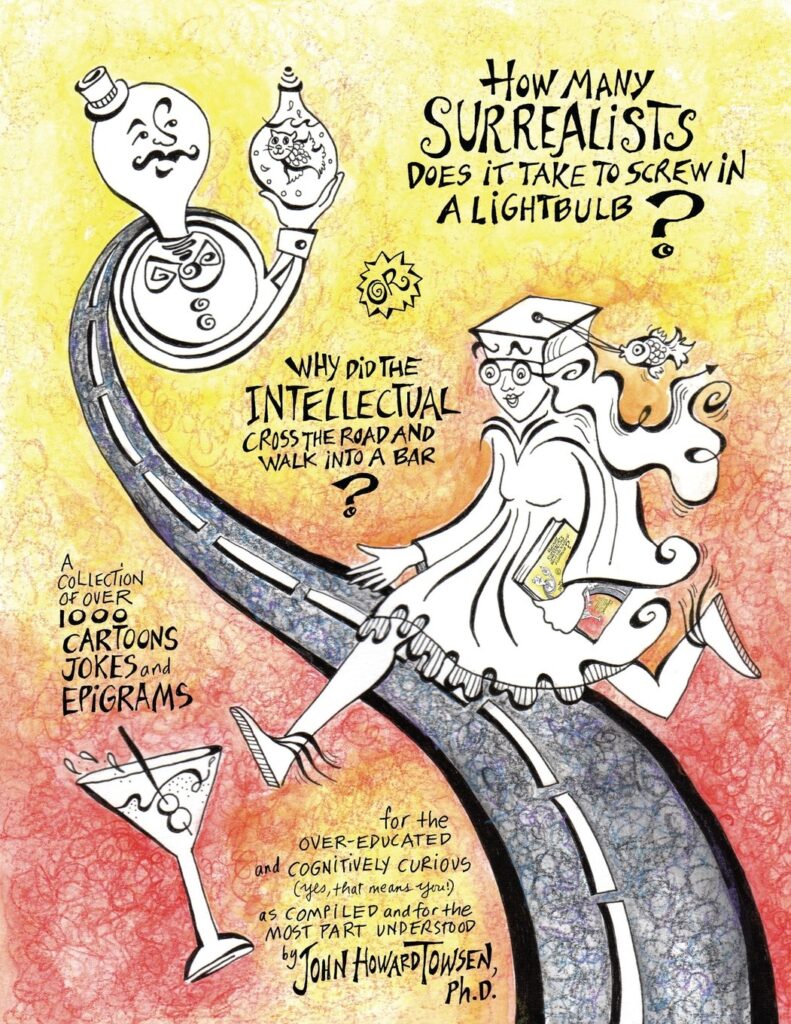
Check out My New Book

Visual and verbal humor for the cognitively and artistically curious!

“A book to treasure!”
—Bill Irwin

Upcoming Events