 |
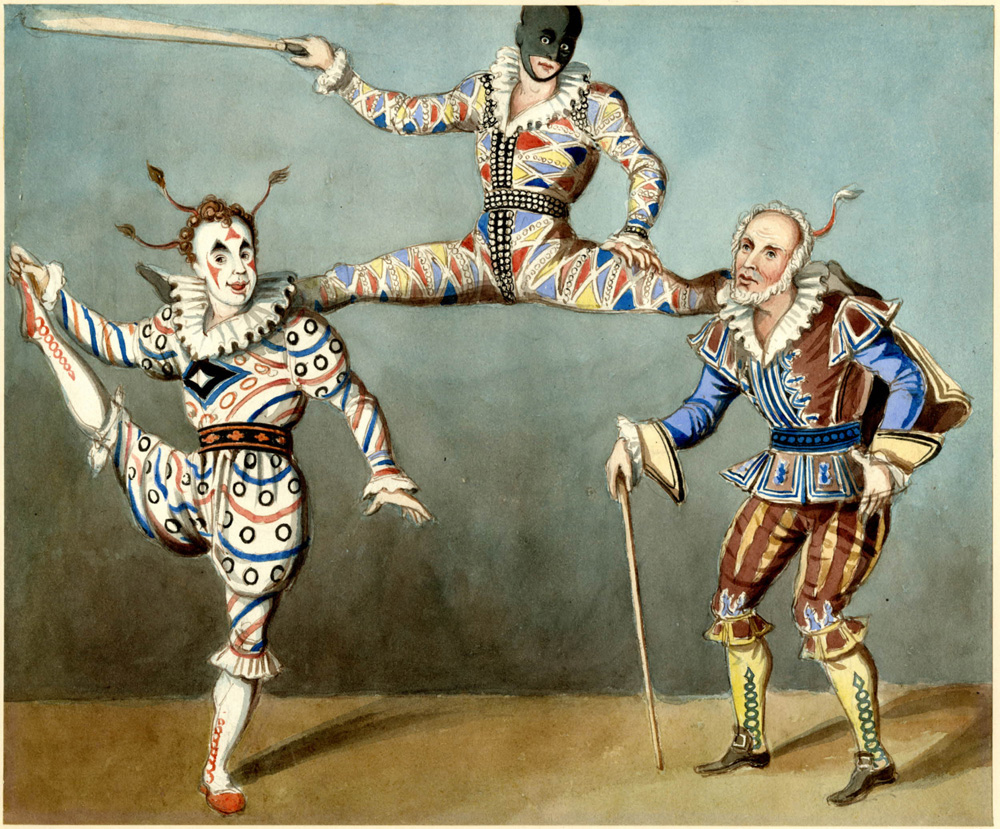
| (L-R), Joseph Grimaldi as Clown, Tom Ellar as Harlequin, James Barnes as Pantaloon (watercolor, British Museum) |
|
The harlequinade is the holy grail of physical comedy.
No, not the kind of harlequinade you’ll find if you do a YouTube search. That’s George Balanchine’s ballet, based on a 1900 Russian work, Harlequin’s Millions, by Marius Petipa. The ballet is a prettier and romanticized version of the commedia tradition and of the Arlecchino/Harlequin character, sorely lacking the robust physical comedy of the earlier harlequinade that was central to 19th-century English pantomime during the Joseph Grimaldi era.
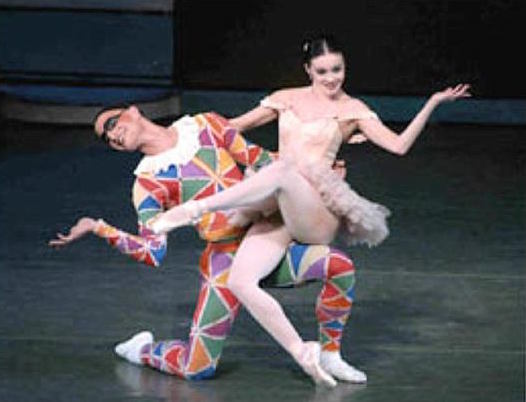 |
| NYC Ballet’s “Harlequinade” |
That earlier, off-the-wall harlequinade is what we’re searching for because it was by all reports highly skilled, wildly imaginative, and surrealistically insane AND provides the strongest direct link we have from the commedia dell’arte to 20th-century silent film comedy. And let’s face it: silent film comedy remains the major inspiration for today’s physical comedians.
And I know what you title-readers are saying: that’s impossible, of course there’s no video from the early 1800s. Ah, but wait a minute, there actually is. Sorta kinda…. but we’ll get to that later.
First here’s a pretty good introduction to the harlequinade from some clown book written forty years ago:
It was in the harlequinade, the long chase scene that concluded most nineteenth-century English pantomimes, that rough-and tumble comedy became an obsession and an art form. In those days, pantomimes were divided into two parts, a short opening — a fairy tale in dance, dialogue, and song — and the madcap harlequinade. The two halves were linked by a transformation scene in which a benevolent agent such as Mother Goose or a Fairy Queen miraculously changed the characters of the opening into such stock types as Harlequin, Columbine, Pantaloon, and Clown. The plot shared by both parts usually centered around the romance between two young lovers (later Harlequin and Columbine) who were determined to be united, the opposition of the girl’s father (later Pantaloon) notwithstanding. The inevitable result was a long chase scene with Pantaloon and his not-so-loyal servant, Clown, in hot pursuit of Harlequin and Columbine. It was as if a performance of Cinderella suddenly turned into a Keystone Cops comedy.
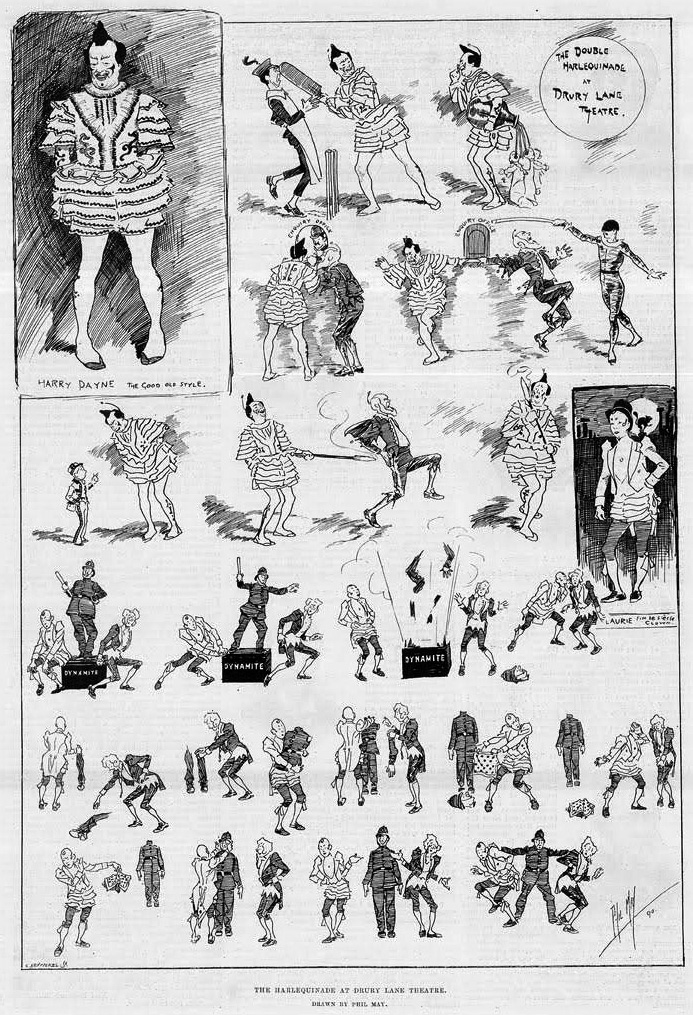 |
| Scenes from the harlequinade (c.1890), including blowing up the policeman and reassembling him, by caricaturist Phil May. Courtesy of Jonathan Lyons, from his excellent book “Comedy for Animators” Click to enlarge! |
The harlequinade began with the Clown’s traditional boisterous greeting, “Hello, here we are again” — a sure signal of the delights to come. The chase scene that followed was merely an excuse for a long succession of practical jokes and for dizzying displays of acrobatic agility. The actors danced on stilts, walked on barrels, suffered jarring pratfalls, and performed tricks of contortion (often disguised as animals), feats of strength, and daring leaps.
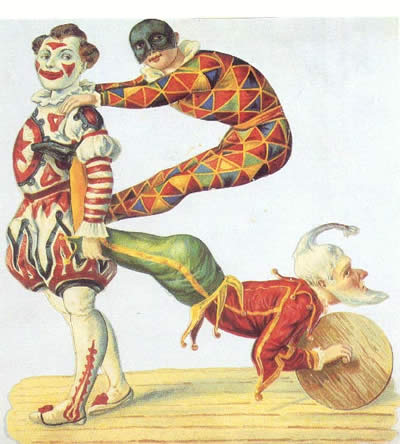 |
| Early 19th–century cutout figures |
Because they were performed on stage rather than in a circus ring, these pantomimes took full advantage of a wide assortment of trapdoors and elaborate trickwork. Nothing was ever what it appeared to be: illusions from stage magic became valuable comic tools; scenery could be transformed instantaneously into something quite different; objects literally took on a life of their own; and Clowns and Harlequins miraculously appeared and disappeared through undetectable gaps in the floor and walls. There was even a standard joke that some performers never met, for while one was going up to the stage, the other was coming down.
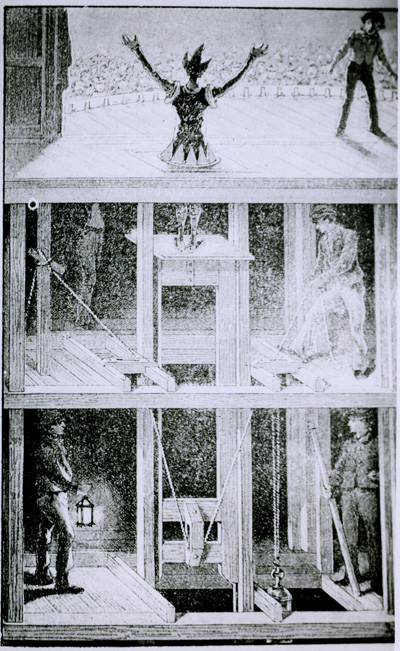 |
The star trap in action. Drawing
from Georges Moynet, Trucs et Decors. |
French poet Theodore de Banville wrote in 1880 that… “…between the adjective “possible” and the adjective “impossible” the English pantomimist has made his choice: he has chosen the adjective “impossible.” He lives in the impossible; if it is impossible, he does it. He hides where it is impossible to hide, he passes through openings that are smaller than his body, he stands on supports that are too weak to support his weight; while being closely observed, he executes movements that are absolutely undetectable, he balances on an umbrella, he curls up inside a guitar case without it bothering him in the least, and throughout, he flees, he escapes, he leaps, he flies through the air. And what drives him on? The remembrance of having been a bird, the regret of no longer being one, the will to again become one.”
The stage in most pantomime theaters included a trapdoor known as the “star trap” or, internationally, as the “English trap.” This trap was usually circular in shape and consisted of sixteen triangle-like sections of one and-one-half-inch planking that were so lightly secured to the surrounding floor that the least bit of pressure from below forced them open. Underneath it (in the area below the stage) was a platform on pulleys, designed rather like an elevator, that could catapult a performer through the stage floor faster than the eye could see. When the counterweights attached to the platform were released, the performer — sometimes Clown, but more often a supernatural sprite — was shot through the trap to appear suddenly as if out of nowhere. The performer had to remain poised, for any sudden movement could result in a grave accident.
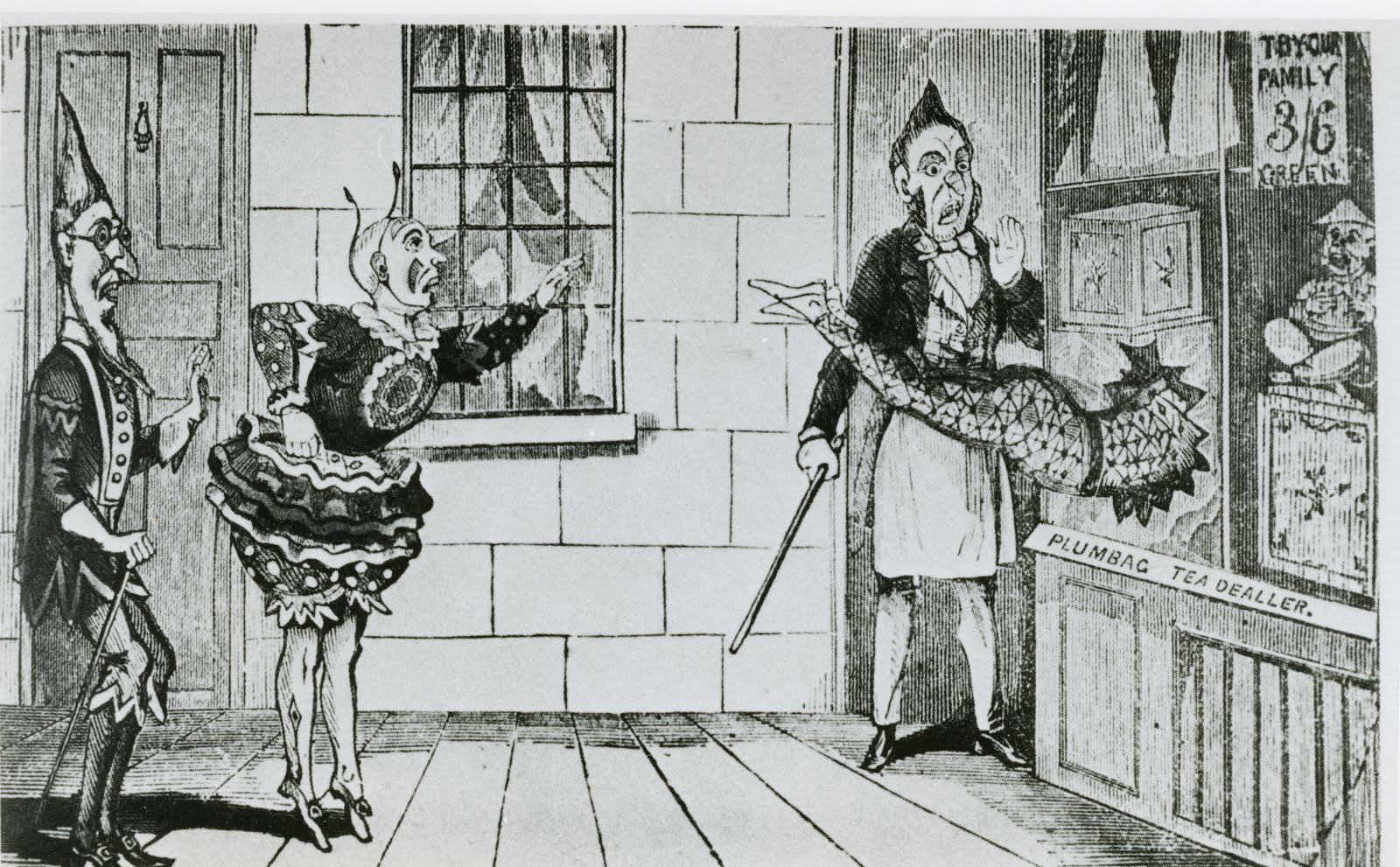 |
| Harlequin dives thru a trap in the wall |
Similar to this was the “vampire trap,” said to have first been seen in 1820 in James Planché’s melodrama, The Vampyre; or, the Bride of the Isles. It was a segmented trapdoor on spring hinges, usually consisting of two spring leaves, which assumed its original configuration after the performer had passed through it, thus enabling him to enter or exit through what seemed to be a solid surface. These vampire traps were frequently placed in flats and drops so that Harlequin could escape his would-be captors by leaping through a “solid” clock or mirror. In John Fairburn’s description of Harlequin and Mother Goose, for example:
A bustle ensues, they [Clown and Pantaloon] endeavor to secure Harlequin, who eludes their grasp, and leaps through the face of the clock, which immediately represents a sportsman with his gun cock’d, the Clown opens the clock door, and a Harlequin appears as a pendulum, the Clown saying shoot, present, fire, the sportsman lets off his piece, and the Clown falls down, during which period Columbine and Harlequin escape, (who had previously entered through the panel). Pantaloon and the Clown run off in pursuit.
As another pantomime succinctly put it, “Aristotle in book concerning entertainments has laid it down as a principal rule that Harlequin is always to escape.”
These leaps and falls were not without their dangers. An acrobatic Clown by the name of Bradbury, whose fearless jumps included one from the flies down to the stage, wore protective pads on his head, shoulders, elbows, hips, knees, and heels. Leaping through trapdoors was especially
difficult. The performer’s trajectory had to be exact; otherwise, he might crash into the scenery instead of disappearing through the appropriate flap. This took considerable training. First of all, he had to be remarkably adept at high, diving forward rolls. The process of diving through the trap was a unique experience, something he could practice only by doing. He had to be certain that his body remained elongated until had cleared the trap. If out of instinct he drew in his knees, he would bruise them badly against the bottom of the opening. Once through the trap, his hands had to be ready to take his weight as he tucked into a forward roll.
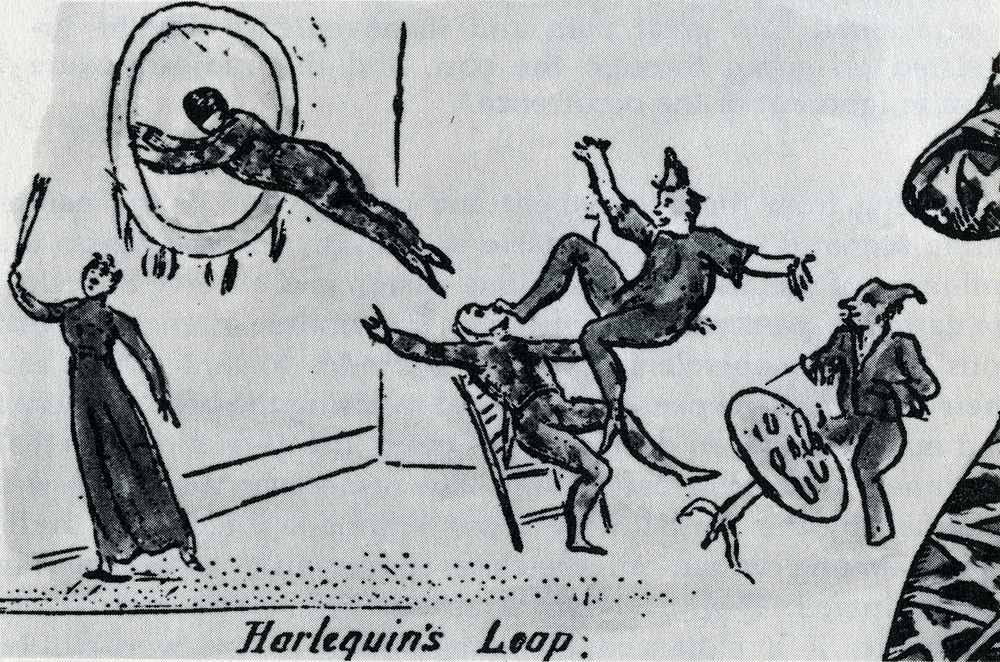 |
| Tom Ellar in the role of Harlequin leaps through a mirror. |
The dangers were multiplied when Harlequin, perhaps with a
boost from a concealed springboard, catapulted through a trap-door
located somewhat higher off the ground. In such cases, stagehands had to
be positioned in the wings, like firemen below a burning building, to
catch the leaping actor in a blanket. The stagehands expected to be
tipped for their services, and it was unwise to ignore their demands.
When Tom Ellar, the famous Harlequin, did just that, his leap through
the clock resulted in an unpleasant surprise. There was no one there to
catch him and he was lucky to escape with only a broken hand.
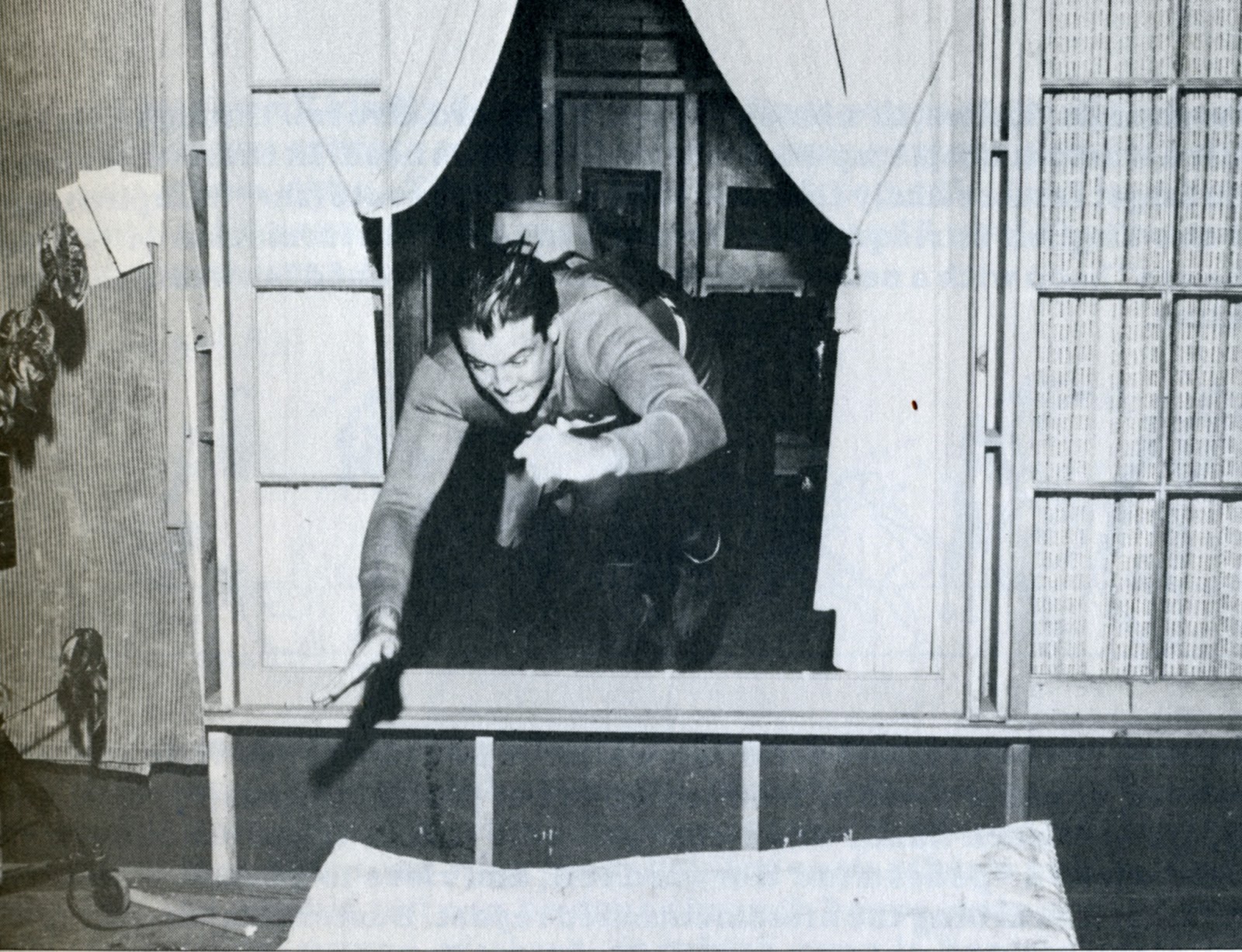 |
| Even Superman needed help. |
In the harlequinade, all of this related acrobatic work went hand in hand with the rough-and-tumble violence of slapstick comedy. Mastery of the fake blow and the relatively painless pratfall were essential to the harlequinade characters as they are to today’s movie stuntmen. The art of the swift kick in the pants was likewise eagerly cultivated. Butter was generously used by Clown to grease the path of shopkeepers, policemen, and Pantaloon, encouraging slipping and sliding and yet a few more pratfalls. The slapstick itself, which had been introduced to England by seventeenth-century Arlecchinos, was “improved” by inserting gun powder between the two sticks to add to the noise. To vary the arsenal somewhat, another comic weapon was popularized: Clown’s red-hot poker. Sneaking around the stage and indicating his intended victim, Clown would ask the audience, “Shall I?” When they gleefully shouted back, “Yes!”, the poker was firmly applied to the seat of the innocent victim’s pants. The pain was minor in comparison to what Clown felt when, later in the show, he accidentally sat down on the poker.
This knockabout business was the duty of all the principal harlequinade
characters, including the elderly Pantaloon, who was a frequent victim
of the Clown’s blows. Even Joseph Grimaldi, who was considered by his
contemporaries to be a rather non-acrobatic Clown, was an excellent
stage swordsman and choreographer of mock fights, and well accustomed to
being knocked about. “It is absolutely surprising,” wrote a London
Times critic, “that any human head or hide can resist the rough trials
which he volunteers. Serious tumbles from serious heights, innumerable
kicks, and incessant beatings come on him as matters of common
occurrence, and leave him every night fresh and free for the next
night’s flagellation.”
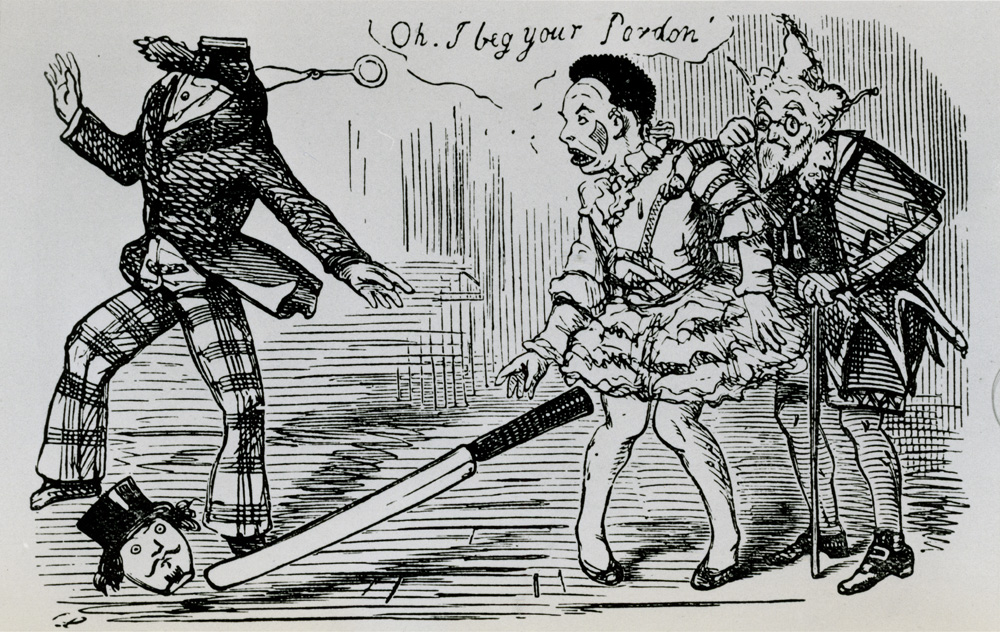 |
| A standard decapitation effect. |
Much of the harlequinade violence depended upon special effects. With one’s real head hidden beneath a coat at what appeared to be chest level, an artificial head could be worn and used for a comical decapitation effect. Clown boldly swings his sword, and the man’s head falls off and rolls through a trapdoor. Clown says, “Oh, I beg your pardon,” and a real head resembling the artificial one pops through the stage floor to ask, “Where’s my body?” In another old scene, wrote a theatre critic, “Clown was mangled flat as a flounder, but we were relieved by his appearing down the chimney immediately afterwards in his natural shape just as if nothing had happened.”
OK, you get the idea. There’s more: animal impersonations; large-scale magic illusions, and of course the comic genius of Joseph Grimaldi, but I know you’re still asking, where’s the video??
So here’s Exhibit #1, an amazing clip from the 1929 Lupino Lane movie, Joyland. (Feel free to turn off the music.)
Exhibit #2, a year earlier, is from Lane’s Three Musketeers spoof, Sword Points. Lane was making about ten films a year in those days. Some were pretty formulaic but still rich in physical comedy.
Pretty impressive, eh, and a good match for the description you just read?
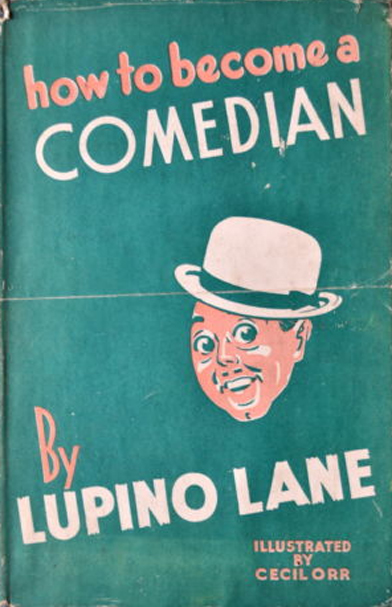
But why do I say this is likely the equivalent of footage from the 1820s? Because Lupino Lane (born Henry William George Lupino) was, like Grimaldi, descended from a storied Italian theatrical family who were big stars of English pantomime. Georgius Luppino (as it was then spelled) came to England in 1634, and his son (also Georgius) made his pantomime debut in 1718 in The Two Harlequins, and thereafter that’s pretty much what the Lupinos did.”Our family holds the record for hurtling through stage traps,” bragged Lane. “My record of jumping 8′ and 5″ has never been beaten. My record of 83 traps in six minutes made at the London Hippodrome has never been beaten.”
And here’s what Lupino Lane’s biographer has to say about it:
In Victorian times the family was closely connected with the Britannia Theatre, Hoxton, the “Old Brit,” which was owned by Mrs. Sara Lane, the celebrated actress and great-aunt of Lupino Lane. Five generations of Lupinos appeared there, and the harlequinade was often a family affair. In 1880, George Lupino appeared as Harlequin, Arthur Lupino as Pantaloon, Harry Lupino as a comic policeman, and George Lupino Jr. as Clown. With the turn of the century, the old-style pantomime, and in particular the harlequinade, began to die out… One of its last strongholds was the Britannia, and the last of the old-time clowns was George Lupino (1853–1932).
— Born to Star: The Lupino Lane Story by James Dillon White
Our hero Lupino Lane was born into all this tradition in 1892 and —like Grimaldi before him and Keaton after him— thrown onto the stage as a young boy, taking the name Lupino Lane in honor of the aforementioned impresario aunt, Sara Lane. The rest is history.
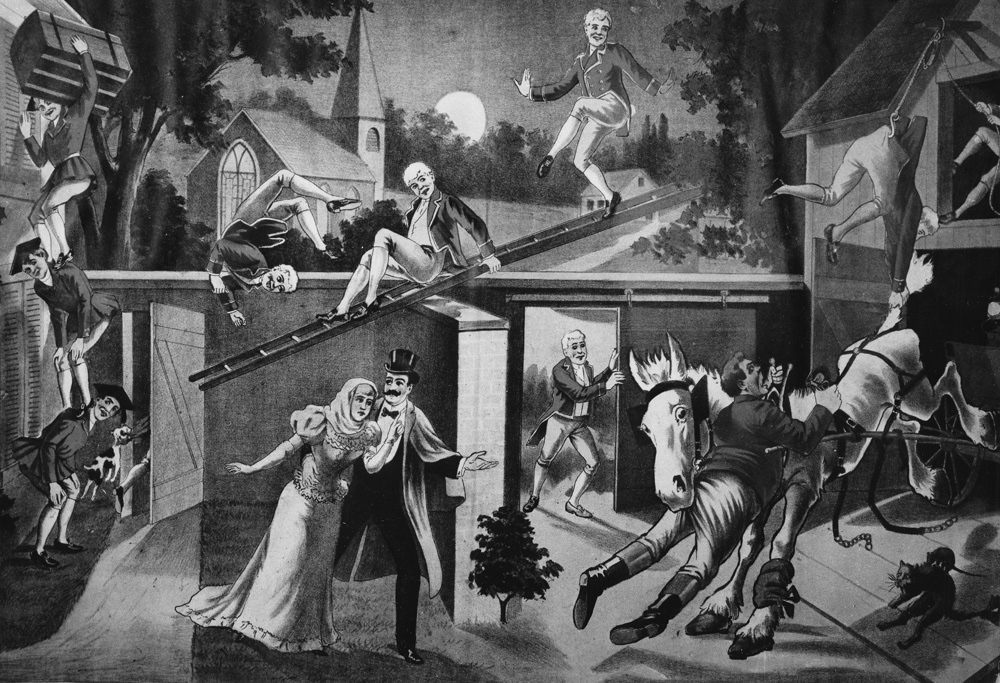
There were of course other thru lines. As the harlequinade faded in the 19th-century, its highly physical tradition was picked up by the Hanlon-Lees (Voyage en Suisse), who in America influenced the Byrne Brothers (Eight Bells), who in turn influenced Buster Keaton. For example, both the 3-high pyramid used for elopement in Keaton’s Neighbors and the ladder on top of the fence from Cops can be seen three decades earlier in this Byrnes Brothers poster for Eight Bells, which was still touring as late as 1914 and was made into a film (unfortunately lost) in 1916.
Keaton, who grew up in vaudeville as part of his
family’s knockabout comedy act, made considerable use of trapdoors
or their equivalent in many of his films. This memorable sequence from The High Sign (1921) is the best example.
Finally, one more video from the early 1800s, a wonderful sequence from Keaton’s Sherlock, Jr.
Have I made my case or what?
LINKS:
• Some of the best material on Lane is to be found in Anthony Balducci’s encyclopedic works, The Funny Parts: A History of Film Comedy Routines and Gags and Eighteen Comedians of Silent Film.
• The Pantomime Life of Joseph Grimaldi: Laughter, Madness and the Story of Britain’s Greatest Comedian is an excellent new biography of the great clown.