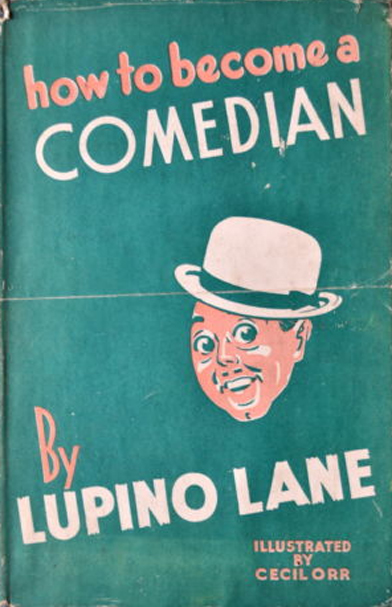
Yes, the blog is back! I’ve pretty much been away from it for a year as I worked on a new book (see sidebar), but I’ve got plenty of new stuff to share. Well, this post’s new stuff is actually quite old, but I’m sure new to most of you: a tutorial on pratfalls from silent film great Lupino Lane’s out-of-print book, How to Become a Comedian.
If you don’t know Lupino Lane (1892–1959), it’s because a lot of his best work is still not available on DVD or YouTube. Growing up in London in the storied Lupino music hall family (dating back to 1612), it was no surprise that he made his stage debut at the age of 4 and was already a seasoned veteran when he made his first film at 23. Lane never developed a clown persona as memorable as that of Chaplin or Keaton (or even Lloyd or Langdon), but he was Keaton’s equal as an acrobat, and Chaplin’s as a dancer, and all three shared an encyclopedic knowledge of physical comedy vocabulary and gags.
Before we get to that tutorial, here’s a clip from Hello, Sailors (1927), co-starring his brother Wallace Lupino, that shows off some of Lane’s acrobatic prowess.
And here’s a spoof of an Apache dance from Fandango (1928). Try to imagine this one with tango music instead!
Yes, Lane was partial to cheap special effects, especially using wires to fly.
Oh yeah, he could sing too. When sound films came in, Lane was better positioned than most for the transition, as he was in some ways more at home in musical comedy than in silent film. No wonder he shows up right away in Ernst Lubitsch’s first talkie, The Love Parade (1929), which starred Maurice Chevalier and Jeanette MacDonald. Here he is with Lillian Roth in a comic turn that showcases all of his talents. (Most of the physical comedy comes after the 2-minute mark.)
After his Hollywood phase in the 20s, Lane returned to England and enjoyed a prosperous film and stage career. In the late 30s he starred in the musical Me and My Girl (a revival made it to Broadway in 1986) for which he created the dance craze “The Lambeth Walk” and became famous all over again. And in 1946 he published How to Become a Comedian. Not necessarily a great book, but a very interesting one, and it does include the following chapter on ”funny falls.”
A lot of standard stuff here, but there are some interesting moves and insights. (Small quibble: I’ve always spelled it “knap,” which Merriam-Webster defines as “to break with a quick blow.”) The instructions are rudimentary at best, so be careful. If you get hurt, I’m not legally liable!
Holidays have become an excuse for me to share a sampling of physical comedy morsels with you. They’re each too small to merit their own blog post, but delicious and nutritious nonetheless. If you like these, make sure you didn’t miss your…
Christmas stocking
Valentine’s Day chocolates
Premio de Primavera
Easter basket
And now for the 5th of May, it’s time to smash open that piñata and see what’s inside. A reminder that you can click on any image to enlarge.
After six months with only a handful of posts, this blog is back, and what better way to restart than with something sublimely silly: Japanese Synchronized Walking!
It just so happens that I’m a big fan of snazzy group movement — Busby Berkeley, marching bands, and massive chase scenes are all A-OK in my book — but this is different. It’s… it’s…. oh just watch first, then I’ll tell you what I’ve learned.
On one level, it’s all so serious, yet a lot of the humor seems intentional, and of course I couldn’t help but enjoy the costume change (0:55,) the domino fall (5:04), the character poses (8:00), and all the intersecting patterns.
Here’s the background, as provided by Makiko Itoh on the web site quora.com.
It is not a competition at all, but an exhibition put on by the Nippon Sport Science University (NSSU), a university dedicated to physical education. Most of the graduates go on to become PE teachers, trainers and coaches.
The movement is called “shuudan koudou”(集団行動)or group movement. It’s similar to military movement exercises, or synchronized marches by marching bands, but more intricate. Among other things it’s supposed to help train the NSSU students to manage large groups in the future. (Japanese schools often have morning exercises and assemblies and such where the entire student body is gathered together. They’re expected to line up at equidistant from each other, stand at attention when the principal comes to the podium and that kind of thing.) I’m guessing though that it’s just a fun thing to do.
Group movement is a tradition at NSSU along with things like cheerleading. As far as I know it’s unique to NSSU. There are no open group movement competitions.
Most people love the synchonized movement and humor, but some find it uncomfortable to watch since it reminds them of military demonstrations that are similarily synchronized.
I’m thinking maybe the unease with it seeming to be too militaristic (or corporate) is what inspired the comic touches.
You can find some variations here and of course via a YouTube search.
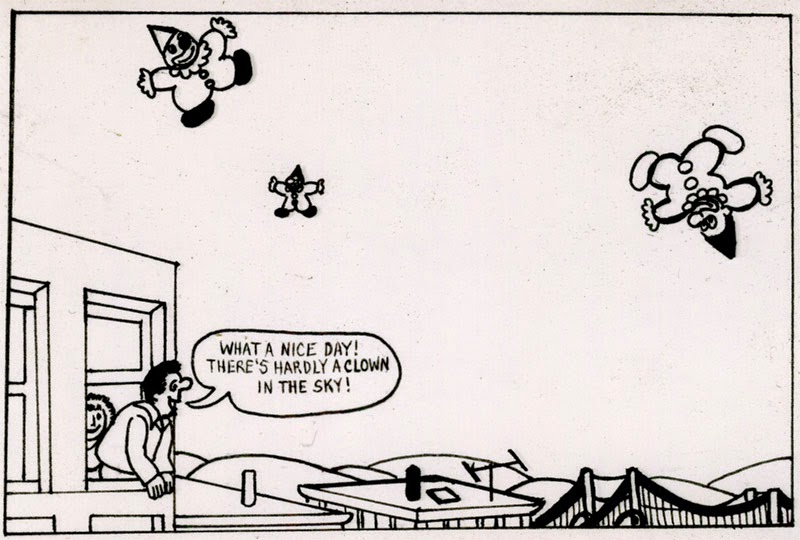
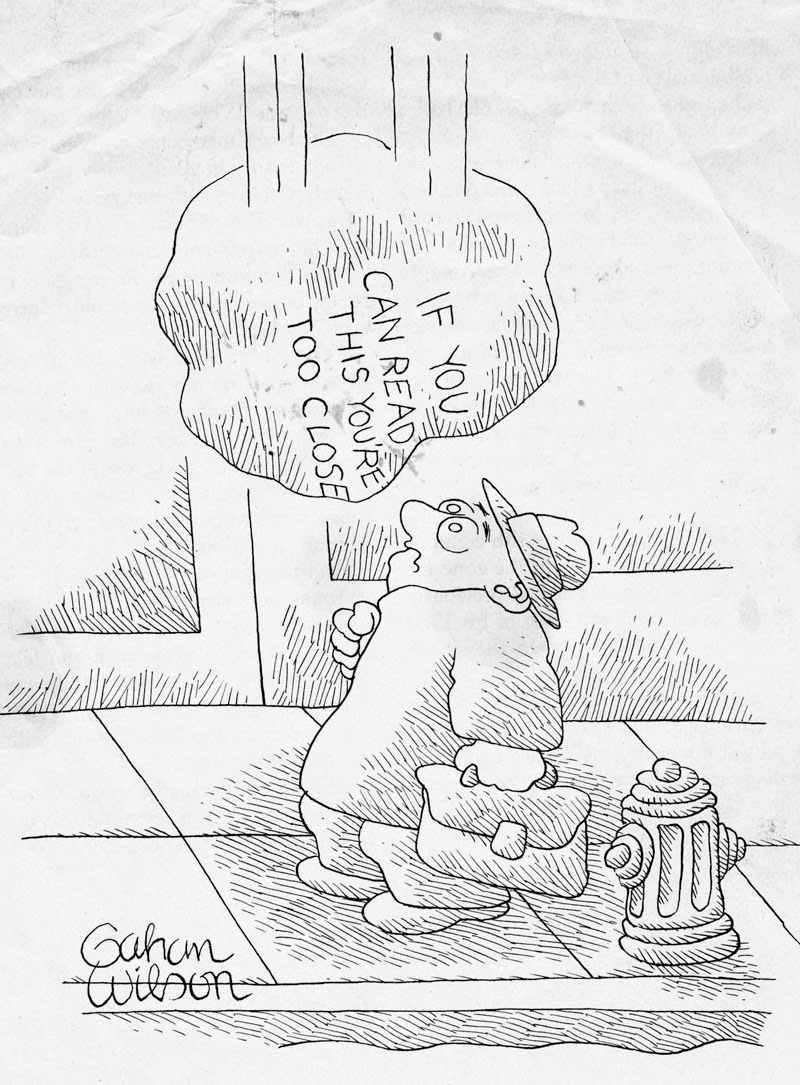
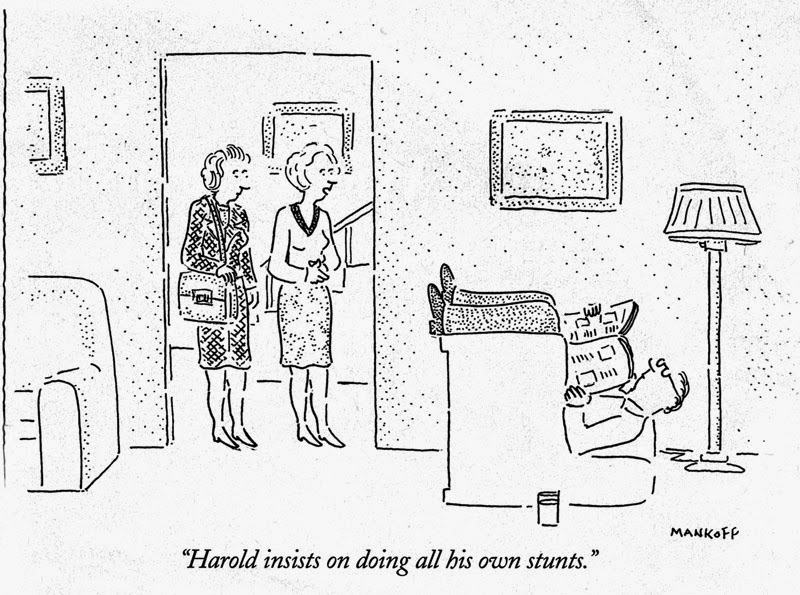
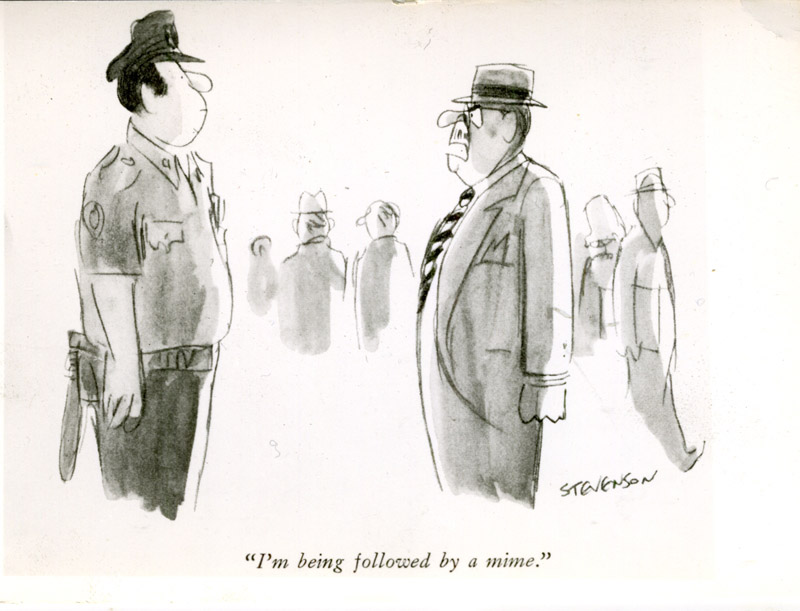
Having retired from full-time college teaching in May after 26 years, I finally have time to rummage through my archives. Much to throw away, but some goodies I’d forgotten about. Here are a few of my favorite physical comedy cartoons from a few decades ago. Click to enlarge.
Enjoy!
Visual and verbal humor for the cognitively and artistically curious!
“A book to treasure!”
—Bill Irwin