When I taught my first physical comedy workshop more than three decades ago, I called it “theatrical acrobatics,” by which I meant adapting and disguising acrobatic vocabulary in order to make it work believably for a character in a comic situation. Everything had to have cause and effect and look natural, not gymnastic. You could learn a lot from silent film comedy, circus clowning, contact improv, Pilobolus, and stage combat, but precious little of it was written down.
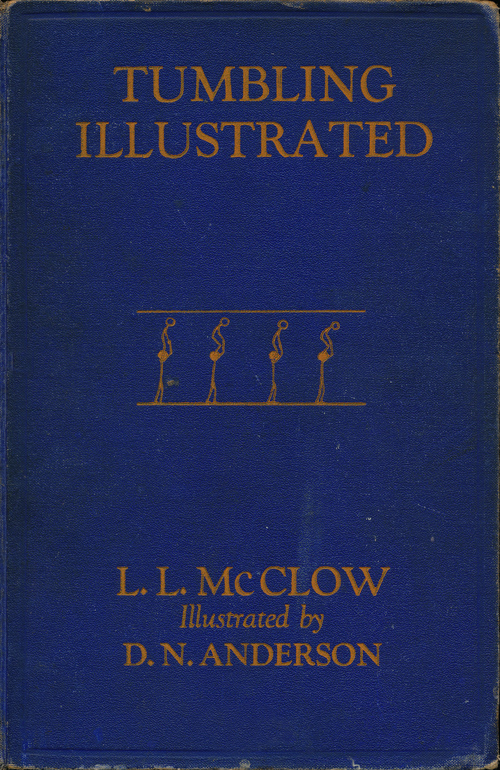
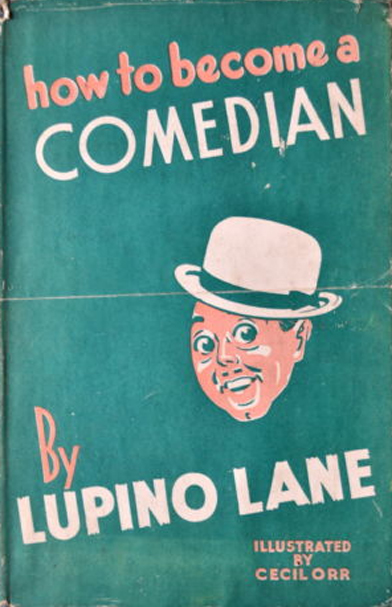
Then one day in a dusty second-hand bookstore on Manhattan’s 4th Avenue, I stumbled across Tumbling Illustrated from 1932, which looked like another one of those not particularly useful old-timey gymnastic books with stick figures and scant explanations of complicated tricks. (My copy had been discarded by the Oakland Public Schools.) But this one was different, because its author, L.L. McClow, must have spent considerable time on or very near the vaudeville stage. In its pages were countless falls, partner moves, and tricks with furniture and props. There’s even a “Clowns” chapter, whose subheadings are:
• Without Apparatus
• Chairs
• Tables
• Barrels
• Miscellaneous
• Combinations
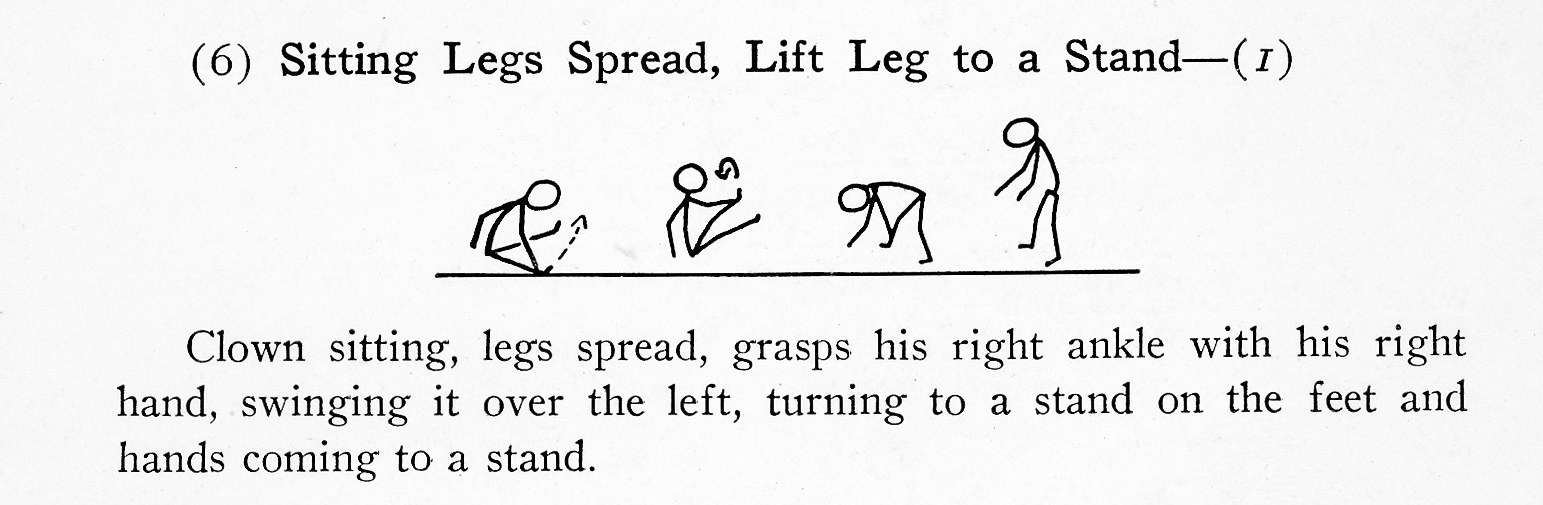
Not all the material’s great and the instructions are often sketchy or non-existent, but there’s much food for thought. And a move that might not look like much can actually be a gem —in the right hands (or in this case legs). Admit it, if you read this one, you wouldn’t be impressed:
But here’s Lupino Lane doing it:
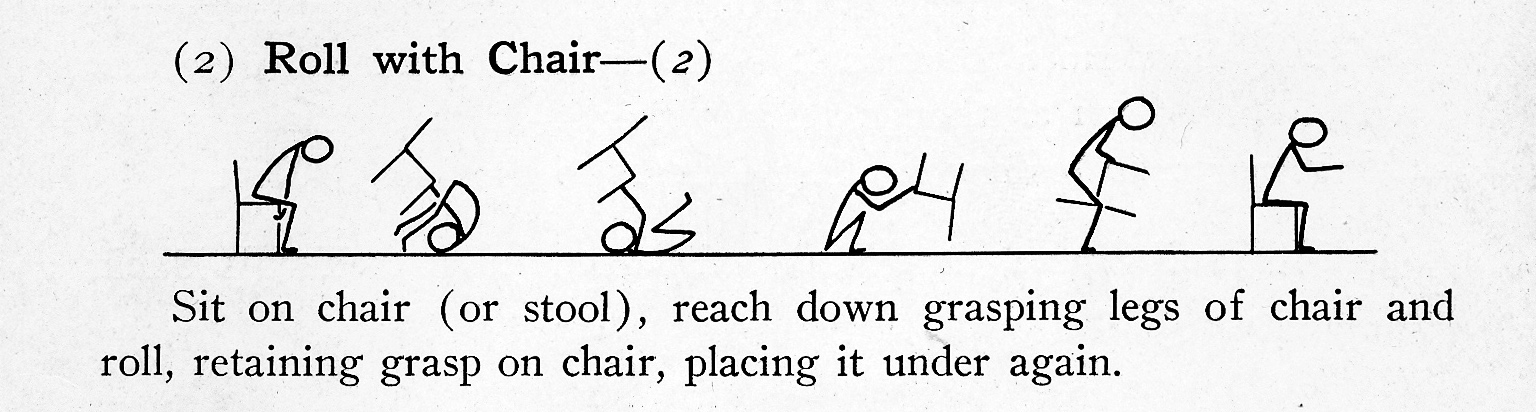
Another example: I never realized a forward roll with a chair was possible until I saw this:
Although I did learn to do the back roll with the chair, I couldn’t do this forward one. Even at that age my hips were just too tight for the follow-through. (No front straddle rolls for me!) But a forward roll taking the chair with you is actually not so hard, and in a typical physical comedy class I teach, about 25% of the students are limber enough to do it.
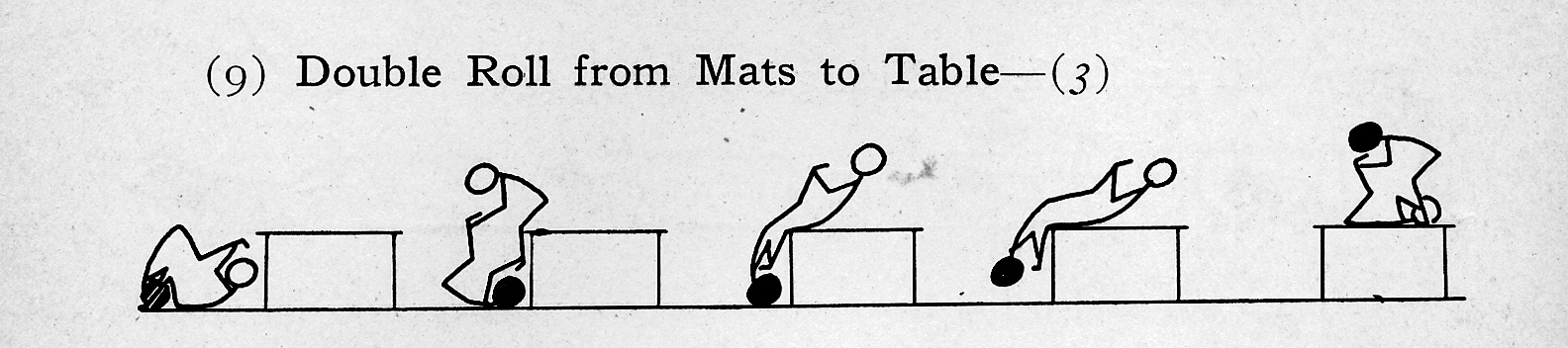
Before I saw my first table act, the Gaspards, I read about the peanut roll on and off the table in McClow:
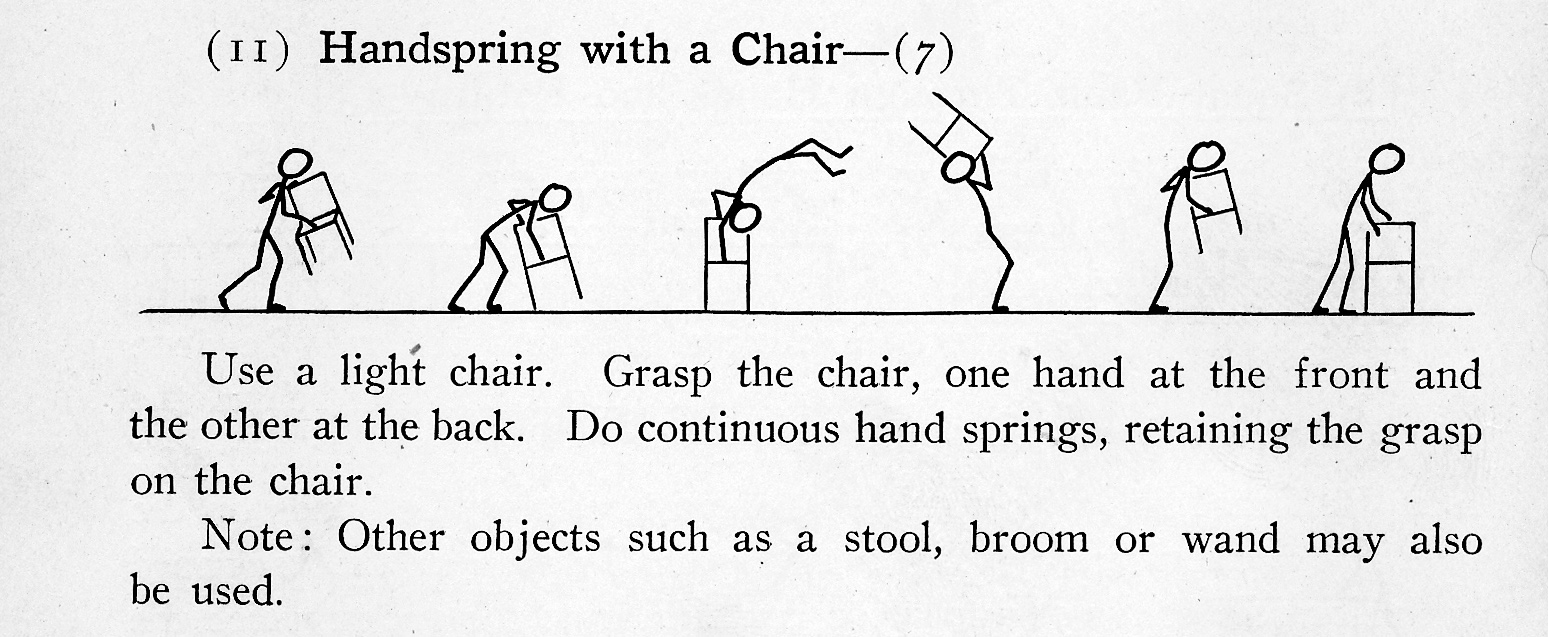
And though I learned the handspring into the chair, I never tried this one (not yet, that is!).
Well, you get the point. I’ve scanned three of the prime chapters for you —Groups, Clowns, and Novelties. Don’t try this stuff at home! (Unless of course you want to.)
Chapter 8 — Groups
Chapter 9 — Clowns
Chapter 10 — Novelties
WARNING: There is a 2012 reprint of this book available on Amazon, but it’s only 88 pages, not 212. Only buy the 1931/1932 edition!
When I did my recent post, Comedy Acrobatics Roundup, I meant to include this wonderfully inventive piece by Walter Dare Wahl and Emmet Oldfield, but somehow it got lost in the shuffle. (Senility is a terrible thing.) Luckily Hilary Chaplain recommended it to the NYC Physical Comedy Lab after Audrey Crabtree had led an exercise in creating physical comedy chain reactions, so now here it is!
Yes, chain reactions, plus body sculpting, role reversal, and great visual originality. Highly creative choreography!
Walter Dare Wahl also appears in this previous post, partnering Hollywood star Betty Hutton. More good stuff!
I was going to call this post “Old-Fart Physical Comedy” but I thought I’d pull in more readers this way. Sexagenarian must have something to do with sex, right? Maybe there’ll even be pictures! No, but while you’re here…
Mike (“Buster the Clown”) Bednarek writes: : One week short of turning 60, nursing an aching back, and fully realizing and appreciating the growing limitations on my physical body when it asks to do some of the same bits from 10, 20, 30 years ago, I’ve got a question for you. What do older physical comedians/clowns do when their bodies tell their heads (usually after the fact, when it’s too late): “Are you f—ing nuts?”
Well, I’m 66 and still throwing my weary bones around, so I think this is a very good question and that a serious answer would make for a useful blog post. So do any aging veterans of the physical comedy wars want to share their old-fart experiences and longevity recommendations with our readers? If so, just e-mail me a few thoughts and I’ll take it from there.
Meanwhile, we might as well laugh at ourselves, so here are two comic takes on the sexagenarian physical comedian. The first is a 1959 performance by the Talo Boys on the French tv show La Piste aux Étoiles, live from the Moulin de la Galette. (Thanks to Max Weldy for the original video!) The opening is pretty much straight acrobatics, though we see that some troupe members are not exactly spring chickens. At the 1:45 mark they get into some comedy schtick, but the old-man physical comedy starts at 4:40 when they re-enter as moustachioed “acrobates de la Belle Époque.”
And 54 years later here’s a piece in a similar (varicose) vein by “Fumagali and their Fumaboys,” as they appeared on another French tv show, Le Plus Grand Cabaret du Monde (2013), and which I saw that same year at the Cirque d’Hiver in Paris.
Update (3-21-15) Raffaele De Ritis writes: Fuma Boys act was conceived and created in the late 90s by Bernhard Paul, collector and founder of Circus Roncalli, under direct and deliberate inspiration of Talo Boys.
And just for inspiration, here’s how Buster Keaton entered his sixties.
And finally, one more cartoon…
Update (3-21-15):
Click here for a similar piece by Fratelli Bologna from about 1989. Thanks to Drew Letchworth for the link, who writes “We weren’t Sexagenarians when we did this piece, but we are now. We developed The Old Act in part because we found that we were getting too old to do the young act.”
Wow! 400 posts!! (Have you read them all?) Never thought I’d make it this far. But it’s fitting that the big 4–0–0 be about comedy acrobatics. Yeah, my keenest interest is physical comedy happening to real characters in real-life situations, but the truth is I never get tired of comedy acrobatics. By which I mean acrobatic acts that are prone to go wrong because at least one performer is blessed with clown DNA. Or that the act is performed by eccentric movers who are just too damn silly to conform to Standard Acrobatic Form.
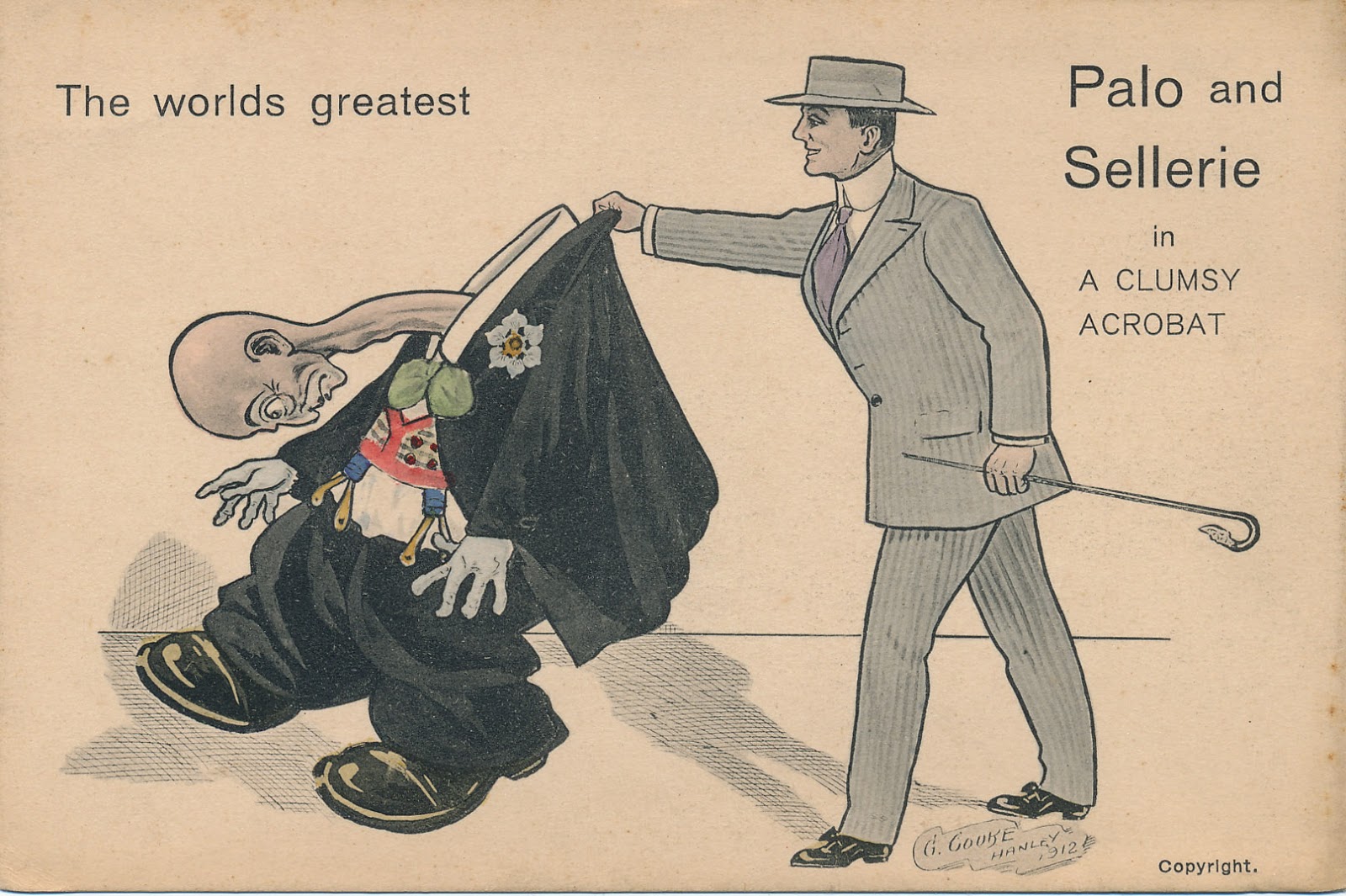
Found this 1912 postcard on eBay, and now I own it. Anyone know anything about Palo or Sellerie?
You guys have sent me a few clips that were new to me but — not to be competitive — I’ve also uncovered a few more, so here’s the latest round-up, presented in what I take to be chronological order. Enjoy!
1900: Georges Méliès
We’ll begin with this curiosity from 1900, Fat and Lean Wrestling Match (Nouvelles Luttes Extravagantes) by Georges Méliès. (You saw Hugo, right?) This one’s full of Méliès’ trademark stop-action substitution camera tricks, some smoother than others, but still it offers a glimpse into variety acts at the turn of the previous century.
1920: The Jumping Tommies
Courtesy of the Library of Congress, which offer this description. Not hilarious, but the short guy has a couple of comic moments and the concluding chair trick is quite nifty.
1935: The Runaway Four
This is a trio I know nothing about, but according to IMDB they were in the short, All-Star Vaudeville (1935), so probably this is from that. No matter. They have serious acrobatic chops and an original brand of humor. They’re amazingly oddball and, for their era, decidedly fey. They establish their tumbling skills in the first 20 seconds, and from there on out they just seem to be free associating.
1945: Donovan and Byl
This is said to be the only recording of Donovan and Byl’s music hall tumbling act, from a film short, Randle and All That. A live audience sure would help, but a nice act indeed. It’s everything that can go wrong while trying to get into a two-high, with a touch of Dead or Alive thrown in at the end. Especially like the head-eating bit!
1959: Les Marcellys
From 1959, here’s a superior table act by the French tumblers, Les Marcellys, filmed at the Moulin de la Galette in Paris for the French tv show, La Piste aux Etoiles.
2013: The Maiers Comedy Trapeze Act
Last but hardly least, here’s a comedy trapeze act that’s recently gone semi-viral. What I like about this one is the commitment to character, matched with inventive trapeze work. They are Sabine Maier and Yogi Mohr, and have lived and worked together since 1988. They are based in Berlin, are approaching 50, and have three children. Yogi plays a goofy-looking nerd, and Sabine a proper lady, perpetually embarrassed. Yogi comments, “We look normal. We don’t even go to the gym. We just do warmups and practice our routine.”
If you want to get analytical, here’s a longer version of the same act.
And one more tidbit from this creative duo:
That should be enough to keep you all off the streets and out of trouble! Some links:
• Web site for Die Maiers.
• All of my comedy acrobatics blog posts.
Special thanks to Dan Vie, Hank Sapoznik, Jeffrey Weissman, Jim Bacci, Riley Kellogg, and Tanya Solomon for the links, plus anyone else I’m likely forgetting!
Two posts ago I highlighted a strong table comedy acrobatic act by Zahir Circo. I also linked to a couple of older posts where I shared earlier versions of this kind of act. Now comes another predecessor,from the French tv show La Piste aux Étoiles, a three-man, three-table act by Les Pauwels, who hail from an eight-generation circus family. Some real nice stuff, including a triple peanut roll under the table!
Again, for you table fans, here are the links to my previous posts on table comedy acrobatics:
You’ll see that the kicking the other guy until you’re too tired to kick any more was done by the guys on the Colgate Comedy Hour in the Tables are Funny post.
Thanks to Jessica Hentoff and Lionel Lutringer for the link!
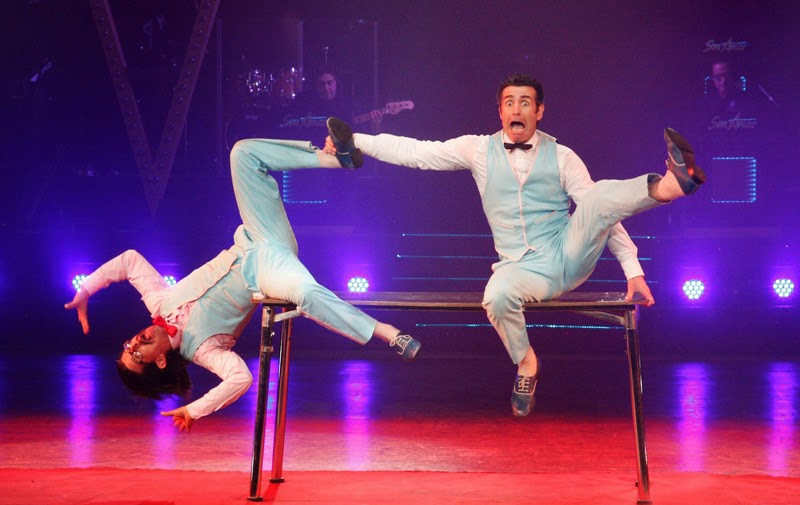
This excellent trio comedy acrobatic act by Barcelona’s Zahir Circo is a virtual encyclopedia of partner and table tricks. I’ve seen most of them at some point before, and done more than a few myself, but here they are crammed into a tight, fast-paced six minutes. A great vocabulary builder for anyone interested in (very) physical comedy!
The three performers are Kike Aguilera (Catalonia), Luciano Martín (Argentina), and Jordan Pudev (Bulgaria). They worked together as a trio for five years, performing throughout Europe as well as in China, until Pudev left the act about five years ago. Now Aguilera and Martín are a duo, and as Zahir Circo also present a wheel act, balancing pole, and juggling.
And what happened to their trio table act once Pudev left? Well, those of you who are variety performers no doubt know what it’s like to reposition material for different venues and situations. Here’s a 12-minute version of the same numéro with only Aguilera and Martín but with some audience participation and even a tabletop Dead or Alive sequence.
If you love this kind of stuff (yes, I do!), then check out these two previous blog posts:
Johnny Hutch, one of the unsung heroes of physical comedy, would have been 100 years old today. As things turned out, he not only made it past his 93rd birthday, but remained active as an acrobatic performer until age 69, and as a teacher and choreographer late into life, last working as a stunt coordinator for the Royal Shakespeare Company at the age of 87. He was also married to the same woman, Jane Phillips, for 66 years, passing away — probably not coincidentally — months after she did in 2006.
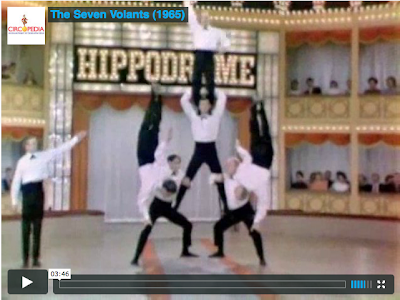
Hutch had a long and illustrious career as a comedy acrobat with such troupes as the Seven Hindustans, the Seven Volants, the Herculeans, and the Half-Wits, appearing more than any other artist ever at the London Palladium, and sharing the stage with such stars as Grock, Louis Armstrong, and Bob Hope. However, he probably gained greatest recognition as Benny Hill’s bald, elderly sidekick in the last two seasons of Hill’s BBC comedy show.
More significant to today’s performers (youse guys) is that Johnny Hutch deserves huge praise for generously sharing his knowledge with others, in the process becoming a key transitional figure between the circus/variety world of the mid-20th century and the alternative theatre world of the past fifty years. He created the Johnny Hutch School of Professional Acrobatics and Stagecraft —”Producers of High Class Specialty Acts. Knockabout and Fight Sequences. Traditional Trap Routines” and coached Robert Downey, Jr. for the title role in the movie Chaplin. He not only worked for established institutions such as the RSC, but also assisted fringier enterprises such asPeople Show and The Kosh, and helped establish Zippos Circus. So giving and dedicated was he to transmitting his skills that he was awarded an MBE (Member of the British Empire) by Queen Elizabeth for “service to young people of the theatrical profession.”
Johnny Hutch as a clown.
As usual, you can learn more about Johnny Hutch on the excellent Circopedia site or by reading his memoir of his early days, Somersaults and Some Aren’t, published as a special edition (no. 165) of King Pole, the British circus magazine.
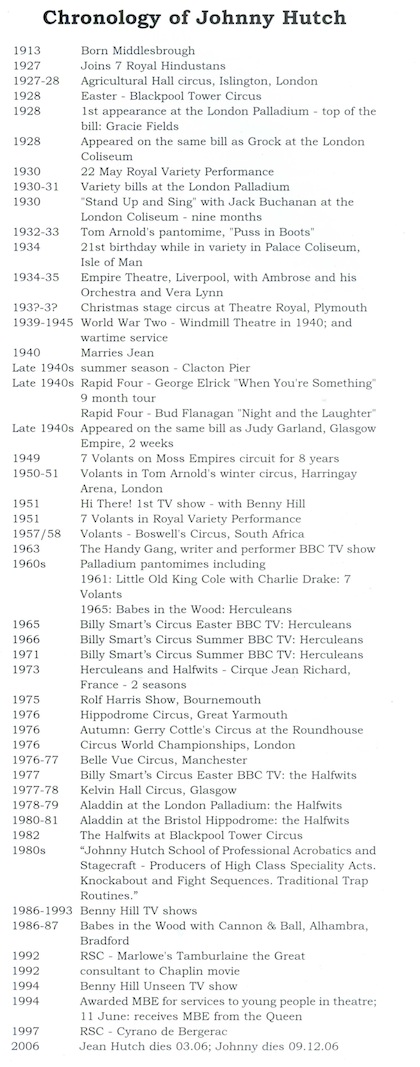
Here are a few video clips, followed by some remembrances by two huge fans, and finally a chronology of Hutch’s life taken from his memoir.
Click here to see Johnny and The Seven Volants on the Circopedia site. This is from 1965.
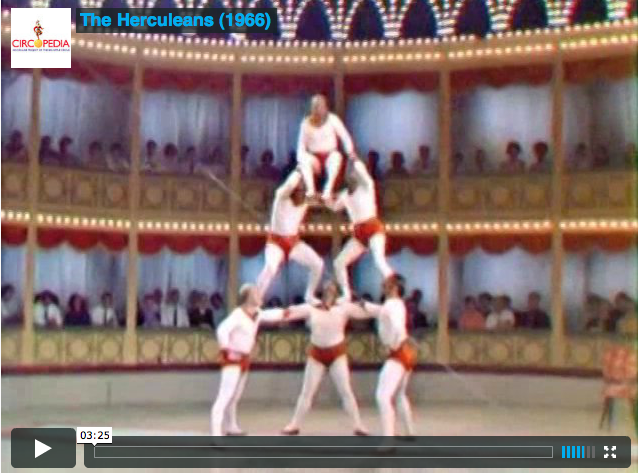
A year later, these are the Herculeans at the Royal Hippodrome. Click here to watch, again at Circopedia.
The Half-Wits
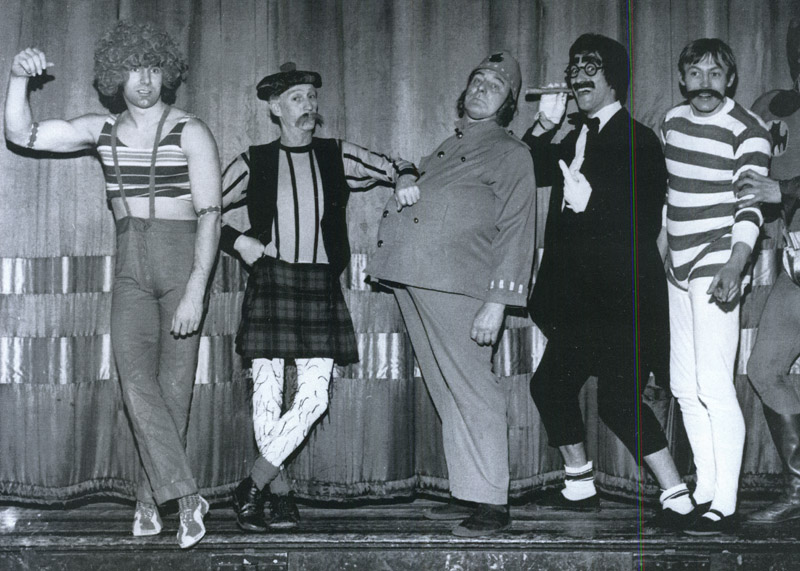
And in 1977, the Half-Wits on the Cliff Richard Seaside Special, filmed at Deauville, France. That’s him second from left in the photo.
This routine, by the way, reminds me of one Victor Gaona taught at Ringling’s Clown College back in 1973, and that has been seen in some form in that circus many times.
A skit from the Benny Hill Show. Recognize anyone?
An obituary by acclaimed British actor Anthony Sher, which first appeared in the London Guardian.
The acrobat Johnny Hutch, who has died aged 93, passed his skills on to actors as well as circus performers. He also became an actor himself – and was the little old man whose bald head was patted by Benny Hill on his television show.I first met Johnny when he trained me for the rope climbing and other acrobatics required for Terry Hands’ 1992 RSC production of Marlowe’s Tamburlaine the Great. I shall never forget the surprise of walking into the gym for our first session and discovering that my teacher was a diminutive man of 79. In reply to my “Hello, how are you?” he said in a broad Yorkshire accent, “No alright, ta, just a bit of arthritis in me wrists – it stops me walking on me hands, and I always like to start the day with a little walk on me hands.”
I was speechless. My own father was roughly the same age, and could barely walk on his feet. Who was this man? Quite a phenomenon, it turned out.
In the months that followed, as Johnny bullied and encouraged me through some punishing training sessions, I grew to love and respect him. He was a little gentleman entertainer who always wore a suit and bow tie to work, and who, with a twinkle in his eye, a story on his lips (“When I was on the bill with Judy Garland …”), and with his feet constantly sliding into a soft-shoe shuffle, led me to a world I did not know but found enchanting – the world of circus, music hall and variety.
Born John Hutchinson in Middlesbrough, Johnny was apprenticed to a troupe of acrobats when he was aged 14. They became the Seven Royal Hindustans, specialising in a mixture of European and Arab tumbling, with Johnny as their star performer. At the beginning of the second world war, he was performing in variety acts at the famous Windmill theatre in Soho, but he soon signed up and became a staff sergeant in the 2nd Independent Parachute Brigade, training men to drop behind enemy lines. He himself made 66 jumps, and fought in north Africa and Italy.
In the early 1950s, Johnny formed the Seven Volants, a fast-moving acrobatic act, which appeared regularly at the London Palladium. In 1957 they toured South Africa with Boswell’s Circus for a year, living on a train with all the other performers: trapeze artists, clowns and animals. Johnny went on to develop two successful comedy acts, the Herculeans and the Half-Wits. They appeared in Las Vegas, and spent two years touring France with Cirque Jean Richard.
In 1976, aged 64, Johnny achieved a remarkable feat: winning the world circus championships by performing a full-twisting backward somersault. But as he finally grew too old for these physical rigours, he simply reinvented himself again and again.
He became a comedy actor – appearing in the Benny Hill Show for eight years until the star’s death in 1993 – and was the stunt-choreographer for the theatre and dance groups, the People’s Show and the Kosh. In 1994 he was awarded an MBE for services to fringe theatre. He helped Martin Burton establish Zippo’s Circus, Britain’s prime touring circus, and was a consultant on Richard Attenborough’s 1992 film Chaplin, coaching Robert Downey Jr in the silent movie star’s slapstick routines. He also worked on the design of the Teletubbies, creating their particular walk.
But I always think that one of Johnny’s most daunting challenges in his later life was to try and turn an out-of-condition actor like me into a superman. As well as making me look good in Tamburlaine, he created some thrilling moments in our 1997 RSC production of Cyrano de Bergerac.
Johnny’s name was invariably linked to that of his wife, Jean, the dancer Jean Phillips, whom he married in 1940; they were a perfect double act, one of those matches made in heaven, inseparable. He was heartbroken when she died last March. He is survived by their son Brian, daughter-in-law Deborah, grandchildren Sophie, George and Eleanor, and great-grandchildren Molly and Clara.
Don Stacey writes: Looking back on his 80-year career in show business, Hutch said, “You had to be versatile to survive in music hall. I became Britain’s finest tumbler. It sounds big-headed but there was nobody to beat me.” He had started work with the Seven Royal Hindustans aged 13 as top mounter in their pyramid – at only 5ft, he was too small to get a job in the local mills. In 1928 he made his first appearance at the London Palladium on a bill topped by Gracie Fields, making her London debut.
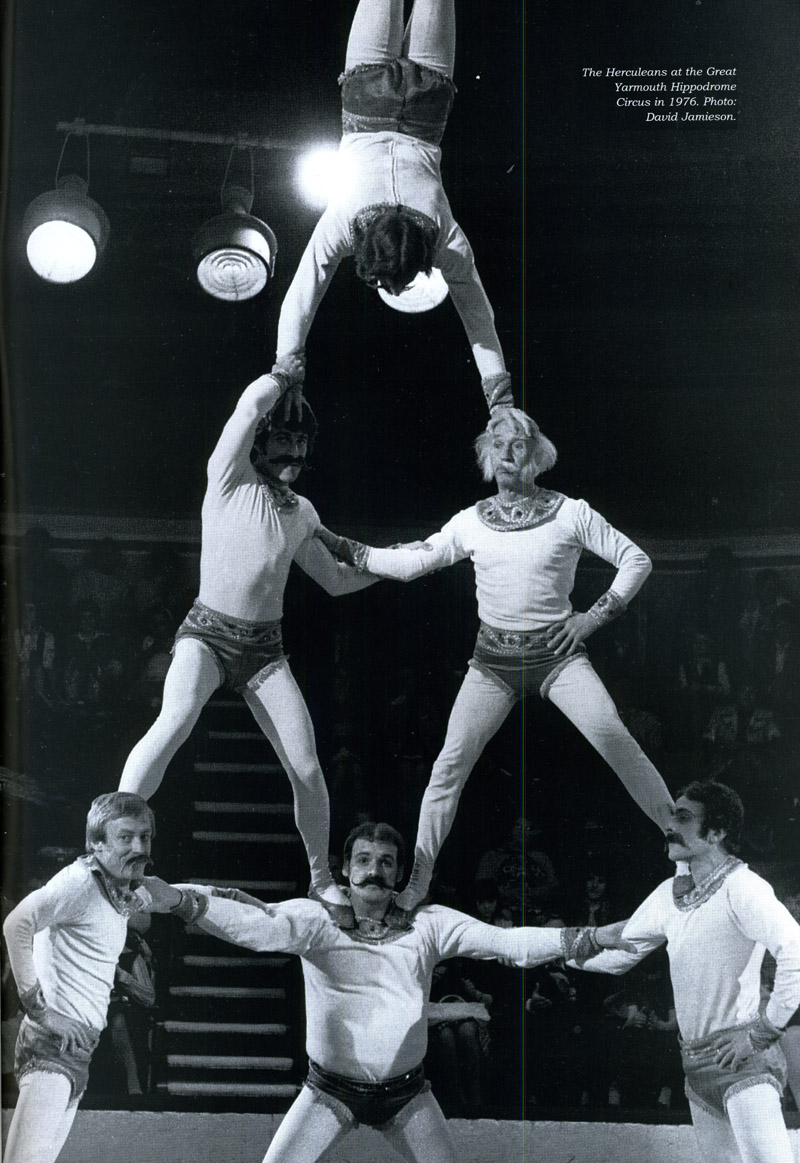
Later, as well as the Seven Volants, he trained groups, such as the Herculeans, who wore old fashioned bloomers, tights and false moustaches. These acts were always in top demand for pantomines – at the Palladium, for instance, they Volants appeared in, among others, Robinson Crusoe, with Englebert Humperdinck, and Aladdin with Cliff Richard, while the Herculeans appeared in Babes in the Wood with Frank Ifield and Sid James.
Hutch continued to arrange knockabout comedy and trapdoor routines in Palladium pantomimes, although he retired from performing them in his 70s.
The Herculeans
And a fond remembrance by our own guest blogger, eccentric dancer and eccentric dance historian Betsy Baytos:
I had the immense pleasure of not only spending time, but filming an extraordinary interview with the great Johnny Hutch back in 1994, for my ‘Funny Feet’ Documentary. Minute and adorable, enthusiastic and funny, energetic, passionate and knowledgeable, it was Johnny, as one of my early interviews and my first in England, who cracked open the door of the Eccentric Dancer’s reach throughout Europe and its strong visual comedic roots.
The two hours on camera were pure delight and he clearly was one of my favorite interviews and greatest inspirations, and we remained in touch for years after. His demonstrations of ‘moonwalking’ and his spontaneous eccentric dance moves to deliver a point he was making, were nothing short of amazing.
He was generous of time and spirit, driving home the importance of having a certain ‘kind of body’ as a necessity in becoming an eccentric dancer. He was also the first to make me aware of how eccentric dance evolved from early pantomine and commedia, and how the French Music Hall had incorporated dance, which led to eccentric. We talked of so many great physical comics and dancers, but a favorite to us both was Grock, which he felt as one of the supreme visual comedians, led to the Eccentric’s character.
He spoke of working with Robert Downey Jr. and how much he enjoyed the experience of passing along Chaplin’s routines. He spoke of when Richard Attenborough called him to first request his assistance and how deflated Attenborough sounded when saying it was a shame no one remembered Chaplin’s routines. But Johnny piped in, “ I know ALL his routines! I used to watch him as a kid!” And he shared with me the incredible outtakes of his working with Downey on the set. I recall asking who might have inspired Chaplin, when he mentioned ‘Fred Kitchen’, whom I must research when back in the UK.
There is so much more, and I cannot wait to transfer his interview when archived, so it will be accessible to all of you! Happy Birthday Johnny! Love, Betsy
__________________________
___________________________
Thank you all! It is never too late to celebrate a life well lived.
Yes, right here! I hit the jackpot this past weekend, and of course I’m sharing the wealth with you. Here’s the story….
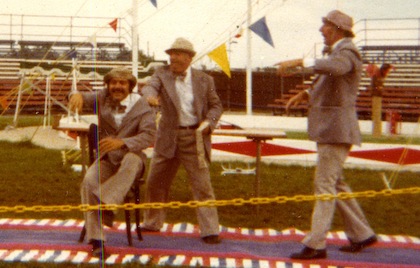
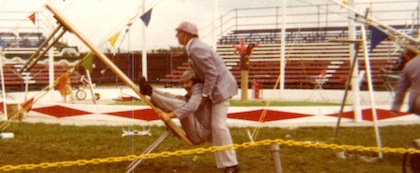
Although I’m partial to the use of physical comedy within a storyline, as in silent film comedy, I’ve always gotten a big kick out of pure comedy acrobatic acts, especially when they involve eccentric movement, partner work, and some sturdy furniture. I was first exposed to this when performing on the Hubert Castle Circus in the late 70s on the same bill with the Gaspards, whose table acrobatic numéro had many of the same moves you’ll see in the vidéos below.
The Gaspards
I’ve never been able to track down the Gaspards, and just have a few snapshots of them taken at another venue, but about six years ago in London I watched a video clip of what I thought was the sharpest knockabout act I’d ever seen. Of course I wanted a copy, but the collector who had shown it to me promptly disappeared from the face of the earth. Luckily I had written down the name of the act — the Mathurins — and never forgot about it. Then a week or so ago I finally tracked them down to a November 24, 1957 appearance on the British tv variety hour, Sunday Night at the London Palladium, sort of England’s Ed Sullivan Show. I got to see the clip for the second time ever on Friday.
I was happy, but then happier still on Saturday when on another episode of the same show I discovered the Trio Rayros, another excellent comedy acrobatic act, who had twice appeared on Ed Sullivan (5-11-58 and 4-4-59).
And then this morning I woke up to find that my old friend Julia Pearlstein had sent me a link from Carlos Müller to a 1910 film of comic acrobats from the archives of the Cinémathèque Royale de Belgique. And guess what? It’s really good too!
So let’s start with the 1910 anonymous film of three anonymous acrobats. This begins with some standard acrobatics but gets wackier and wackier, and is full of nifty moves, including monkey rolls, pitches to 2-highs, pitches to back sits, eccentric walks, a hat dive, a jump to a thigh stand, the old putt-putt, and some great front fish flops. It’s amazing to see so many of these same comic bits in use a half century earlier, yet more evidence that physical comedy vocabulary was transmitted by variety performers directly into early film comedies.
Fast forward to November 24, 1957 and the Mathurins. Many of the same pitches, 2-highs, and partner balances, but more trips, slaps and falls, some ahead-of-its time break dancing, awesome table and chair moves, and the best peanut rolls this side of China… a knockabout encyclopedia!
Did he really say“it looks easy”??? I’m speechless on that one.
And here’s the Trio Rayros at the Palladium three years later (10-4-60). Some of the same plus a 3-high column collapse, and a few nice creative touches with the suitcases. The whole idea of embedding the trampoline, while common nowadays, what with the popularity of wall trampolining, was likely pretty unusual back then. My favorite parts are of course the silly bits: the quickie walk up to and down from the 2-high and the “chair-pull” sequence with the suitcases.
Hmm… the 1910 clip comes from Belgium; the Mathurins were from France; Trio Rayros sounds Spanish but they use the French word for baggage (bagage). The Gaspards were French. As we say in French, coincidence? Maybe not, maybe this specific brand of comedy acrobatics was just more of a French tradition….
• The pratfall that begins with laying first one straight leg horizontally across the top of the table and then, rather optimistically, the other leg, was a trademark of Buster Keaton, which you can see him do during different stages of his life right here.
• You can see more table acrobatics in this previous post, but I’m also going to repeat here one of the clips from that post because it belongs to the same genre as what you just watched. This was from the Colgate Comedy Hour (hosted by Abbott & Costello on November 23, 1952), and the performers are the Schaller Brothers, who also had a comedy trampoline act.
British television comedian Benny Hill made a long career out of sight gags, British musical hall routines, and leering sexual humor. Other than his trademark Yakety Sax sped-up chase scenes, however, you wouldn’t necessarily think of him as a very physical comedian… and this skit probably won’t change your mind. “Scuttle’s Keep Fit Brigade” has some fun with acrobatics, but that’s about it. Like most of Hill’s work, very uneven, some good bits, nothing great, but at least there’s a lot crammed into a short amount of time. In other words, modern television.
Here’s a sweet husband-and-wife comedy acrobatic act with a few choice tricks and lots of personality — very funny. Thanks to Tanya Solomon for the link.
That was from 1980. On YouTube this clip has had, to date, just shy of 160,00 hits, which the lovely Mrs. Jover has lived long enough to savor:
I am in Show Low, AZ, up in the mountains. I am now 83 and well retired. My gorgeous husband passed away a short time ago but I live with my daughter, Wendy, and grandson Michael. The video that you see was a six-minute clip of our act at the MGM in Reno. I am so glad that so many people are still enjoying our performance. —Fe Jover.
Thank you, Fe, for the hearty laughs and the humanity. And gratitude for the technology that allows this to be shared by so many!