Tag: Spain

Zahir Circo: Every Trick in the Book

POST 386
Wednesday, July 30, 2014


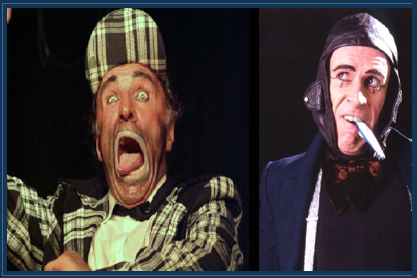
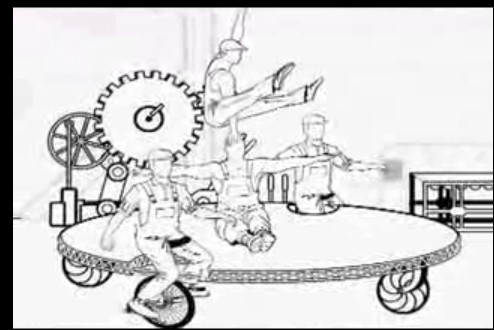
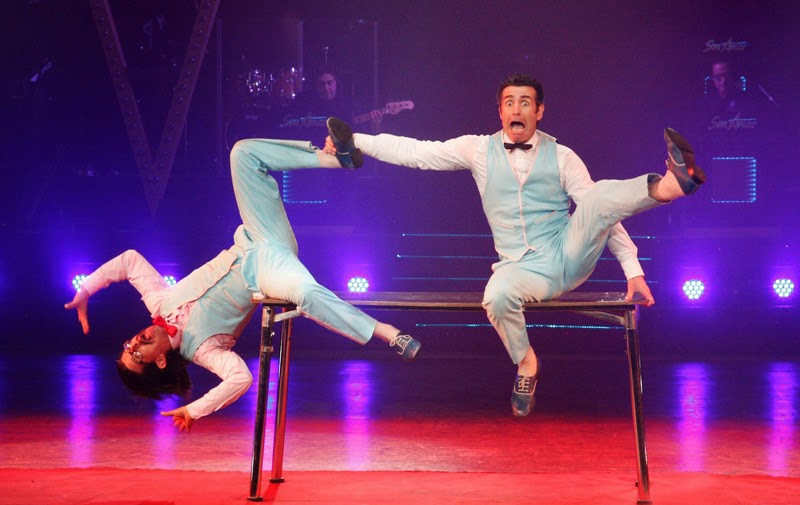
This excellent trio comedy acrobatic act by Barcelona’s Zahir Circo is a virtual encyclopedia of partner and table tricks. I’ve seen most of them at some point before, and done more than a few myself, but here they are crammed into a tight, fast-paced six minutes. A great vocabulary builder for anyone interested in (very) physical comedy!


The three performers are Kike Aguilera (Catalonia), Luciano Martín (Argentina), and Jordan Pudev (Bulgaria). They worked together as a trio for five years, performing throughout Europe as well as in China, until Pudev left the act about five years ago. Now Aguilera and Martín are a duo, and as Zahir Circo also present a wheel act, balancing pole, and juggling.

And what happened to their trio table act once Pudev left? Well, those of you who are variety performers no doubt know what it’s like to reposition material for different venues and situations. Here’s a 12-minute version of the same numéro with only Aguilera and Martín but with some audience participation and even a tabletop Dead or Alive sequence.

If you love this kind of stuff (yes, I do!), then check out these two previous blog posts:

Thanks to Betsy Baytos for the original link and to Edina Papp of Dany Daniel Management for info on the performers.

SHARE
EXPLORE FURTHER

Nouveau Clown Institute 2012 Barcelona Workshops

POST 243
Tuesday, February 14, 2012


These look great, especially that last one!

1.
 The Clown Tribe of a New Paradigm FULL!!

     March 7th to 17th
     Johnny Melville and Jango Edwards
     (400€ — 40 hours of training)

2. Clown Master Class
    April 9th to 14th
    Steve Smith
    (300€ — 24 h
ours of training)
3. The Clown Theory
    May 14th to 18th
   Jango Edwards
    (250€ — 20 hours of training)
4. Physical Comedy
   June 12th to 17th
   John Towsen
   (300€ — 30 hours of training)

 Info and reservations
 Información y reservas
 Cristina
 
nouveauclown@gmail.com
 T-0034 661111127


The Clown Tribe of a New Paradigm
with Johnny Melville & Jango Edwards
March 7th to 17th

is a unique opportunity to train for 10 days with two of the leading teachers of the N.C.I., Johnny Melville & Jango Edwards – who are veterans of stage and screen with thousands of hours of performing experience and success, and who still perform around the globe as comedy surges through their blood and love through their hearts.


La Tribu clown de un Nuevo Paradigma es una oportunidad única de formación con dos de los profesores principales del N.C.I. Johnny Melville y Jango Edwards – veteranos del escenario y las pantallas con miles de horas de actuación, experiencia y éxito, y todavía actuando alrededor del mundo ya que la comedia se desborda en su sangre y sus corazones.


Johnny Melville B.Sc is a trained teacher, actor, clown, writer, director, and a trained Pleiadian Lightworker. In 2001 he won best actor award at the Brooklyn Film Festival. He has performed and taught in over 30 countries and is continually active in the theatre and movie world. Johnny will appear with  Jango in the feature film the Parade of Fools, to she shot in New York in summer of 2012.

Diplomado en Ciencias Sociales, profesor, actor, clown, director y formado en el Pleiadian Lightworker. En el 2001 ganó el premio al mejor actor en el Brooklyn Film Festival. Ha actuado y enseñado en almenos 30 paises y está continuamente en activo en el mundo del teatro y el cine. Johnny aparecerá junto a Jango en el film Parade of Fools, que se filmará en New York el verano del 2012.
www.johnnymelville.com


 Jango Edwards. Founder of the original “Festival of Fools”, director of “The Nouveau Clown Institute” and the “Fools Militia”, creator of “Cabaret Cabrón”, international clown artist, writer, composer, director and producer.  During the past 40 years he has performed and taught in over 30 countries and is constantly active in the evolution of the global clown profession.

Fundador original del “Festival of Fools”, director del “Nouveau Clown Institute” y la “Fools Militia”, creador del Cabaret Cabrón, artista del clown internacional, director y productor. Durante los últimos 40 años ha actuado y enseñado en más de 30 países y está constantemente activo en la evolución global de la profesión de clown.
www.jangoedwards.net  
www.jangoedwards.es


Planeamos abrir un nuevo grupo de “Clown Tribe of a New Paradigme” en verano. Pronto mas información
We plan to open a new group of “Clown Tribe of a New Paradigme” next summer. More info soon!


Clown Master Class with Steve Smith
April 9th to 14th

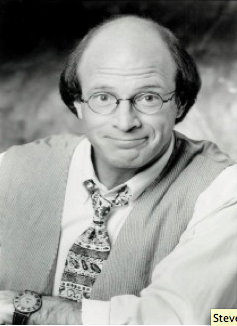
Steve Smith has built a highly-successful career in the entertainment industry, fully utilizing his talents as a writer, performer, producer, teacher, manager and director. He started out as a performer, having studied at the Ringling Bros. and Barnum & Bailey Clown College, earned a BFA in acting from the Goodman School of Drama and studied physical comedy with some of the world’s top performers. He performed in the Greatest Show on Earth for several years before “running away from the circus to join a home.”

Steve has taught extensively and served as the Director of Ringling Bros. and Barnum & Bailey Clown College for ten years, from 1985 – 1994. He has also traveled the world conducting workshops and master classes in physical comedy.  During his tenure as Director of the college, Steve conceived and directed the highly successful 123rd edition of Ringling Bros. and Barnum & Bailey Circus (“The Greatest Show on Earth”).

In 1996, Steve was able to combine his skills as a producer, performer and manager when he served as the Talent Development Coordinator for Chuck Jones Film Productions and he went on to produce and direct numerous shows including several of his own plays and a critically-acclaimed one-man show, Slapstick & Sawdust.

Co-writer & Guest Director of the 2005, 2006, 2008 & 2009 editions of The Big Apple Circus.

Steve Smith ha construido una carrera llena de éxitos en la industria del espectáculo, utilizando plenamente sus talentos como un escritor, performer, productor, profesor, manager y director. Inició su carrera actuando. Estudió en el Ringling Bros. y Barnum y el Bailey Clown College, ganó un BFA en interpretación de la Escuela Goodman de Drama y estudió comedia física con algunos de los mejores performers del mundo. Actuó en el Mayor Espectáculo sobre la Tierra durante varios años antes de “fugarse del circo para unirse a un hogar”

Steve ha dado clases durante largo tiempo y ha sido el Director de Ringling Bros. y Barnum y el Bailey Clown College durante diez años, 1985 – 1994. También ha viajado por el mundo que impartiendo talleres y clases magistrales de comedia física. Durante el tiempo que fue director del Clown College, Steve concibió y dirigió la 123 edición sumamente acertada de Ringling Bros. y Barnum y el Circo Bailey (“el Mayor Espectáculo sobre la Tierra “).

En 1996, Steve fue capaz de combinar sus habilidades como un productor, performer y director como el Coordinador de Desarrollo de Talento para Producciones el Chuck Jones Film Productions y continuó produciendo y dirigiendo numeroso muestra incluyendo varias de sus propios obras y un one-man show aclamado por la crítica, Slapstick & Sawdust.

Co-escritor y director invitado en las ediciones del 2005, 2006, 2008 y 2009 del Big Apple Circus
Clown Theory with Jango Edwards
May 14th to 18th

The art of the clown actor is not just a profession, but a lifestyle that demands an understanding of emotion, sensitivity, passion, pathos and the heart. The essence of clown, in the pure sense, is a combination of innocence and maturity. The Clown Theory Encounter is a way of uniting these qualities so each participant can discover and develop their personal clown, and apply it to their life after the course is completed. A combination of 20 years of professional experience, simple awareness and common logic, enables the instructor to reveal the clown character within each of us.

Through the use of assorted games, physical activities, socio-logical demonstrations, improvisations and performance, each student will find his or her comic simplicity, innocence and logic, which are the fundamental ingredients of the clown formula. A play-environment is created, in which trust within the group ensemble can develop. This motivates the students to remember the innocence they have forgotten. It will also reveal present social and human conditions. It may sound complicated but in fact it’s simple; it is the simplicity that is difficult for us to grasp.

Clown is a social character in all realms of life. The performance situation, be it theater or circus, is probably the most common form through which we know clowns; but it’s the least important. The primary requirements to reveal your personal clown is a knowledge of the comic formula and the creation of a clown heart. You have always had, and always will have, a clown heart, but to revive it demands the simple desire to regain and sustain your youth throughout all aspects of life.

The Clown Theory Class first reveals the innocence each of us has surrendered; and then proves it is never too late to recapture it again. It’s a challenge, it’s revealing but most of all it’s fun. —Jango Edwards

Teoría del Clown con Jango Edwards. El arte del clown actor no es sólo una profesión, es un estilo de vida que requiere la comprensión de la emoción, de la sensibilidad, de la pasión, del patetismo y del corazón.

La esencia del clown, en el sentido más puro, es una combinación de inocencia y madurez. El Encuentro con la Teoría del Clown es una forma de unir esas cualidades de manera que cada participante pueda descubrir y desarrollar su propio clown y aplicarlo en su vida. La combinación de 20 años de experiencia profesional, de simple conocimiento, lógica y sentido común permite al instructor revelar el personaje del clown dentro de cada uno de nosotros.


A través del uso de juegos variados, actividades físicas, demostraciones socio-lógicas, improvisaciones y representaciones, cada estudiante encuentra su propia simplicidad cómica, su inocencia y su lógica; ingredientes fundamentales en la fórmula del clown. Se crea un contexto de juegos en el que desarrollar la confianza y la unión del grupo. Esto motiva que los estudiantes recuerden la inocencia que han olvidado. Y también revela el presente social y la condición humana. Puede sonar complicado pero de hecho es simple; es esta simplicidad lo que nos es tan difícil de agarrar.


El clown es un personaje que socialmente se puede manifiestar en todas las esferas de la vida. Las representaciones en el teatro o en el circo son, probablemente, las formas más comunes a través de las cuales conocemos a los clowns; pero no son las más importantes. Los requisitos primordiales para revelar tu clown personal son el conocimiento de las fórmulas cómicas y la creación de un corazón de clown. Siempre hemos tenido y siempre tendremos un corazón de clown pero revivirlo requiere el simple deseo de recobrar y conservar la juventud en todos y cada uno de los aspectos de la vida.

La Teoría del Clown primero revela la inocencia de la que cada uno de nosotros ha claudicado para luego probar que nunca es demasiado tarde para recuperarla. Es un desafío, es un descubrimiento, pero sobre todo, es divertido!
—Jango Edwards


Physical Comedy with John Towsen
June 12th to 17th 

A hands-on crash course in physical comedy vocabulary for clowns, mimes, actors, and everyone in between. Technique leads to application in short pieces, with an emphasis on character interaction, gag structure, and storytelling. Skills are centered around working with your partner (counterweights, levers, mounts, lifts, partner tumbling) and with the physical world around you (tables, chairs, doors, props, etc.). Some performance experience and a reasonably sound body highly recommended, but all levels of experience welcome.

Comedia Física. Un curso intensivo sobre el terreno sobre el lenguaje de la comedia física para clowns, mimos, actores, y todo lo que pueda haber en medio. Uso de la técnica en piezas cortas, poniendo énfasis en la interacción de personajes, la estructura del gag, y la narración. Las técnicas se centran en el trabajo con el compañero (contrapesos, palancas, montajes, levantamientos, la caída de compañero) y con el mundo físico a nuestro alrededor (mesas, sillas, puertas, apoyos, etc.). Se recomienda tener alguna experiencia en actuación y trabajo corporal previo, pero el curso está abierto a todos los niveles.

John Towsen has taught semester-length physical comedy courses at Princeton University, Ohio University, and the Juilliard School (the latter two for six years each), plus numerous shorter workshops, including at the Nouveau Clown Institute in Barcelona. He has many famous former students but doubts he had anything to do with their success. His once-upon-a-time performance career included 7 years of television acting as a child growing up in New York and a decade of clowning as an adult, from the elementary schools of Long Island to the sands of Saudi Arabia, most of it with partner Fred Yockers. In his other lives he teaches multimedia and digital video in the Creative Arts & Technology program at Bloomfield College, and spends his summers working for the Open Society Institute doing media training for activists in hot spots across the globe. He is the author of Clowns (1976) and was artistic director for the first two New York international clown theatre festivals (1983, 1985). He currently teaches and directs physical comedy in New York City, where he is co-founder with Audrey Crabtree of the NYC Physical Comedy Lab. His latest research on the subject is to be found on his blog: physicalcomedy.blogspot.com

John Towsen ha impartido cursos académicos de comedia física en la Universidad Princeton, la Universidad de Ohio y la Escuela Juilliard (en estas dos últimas durante seis años cada una), más numerosos talleres cortos, el más reciente en el Nouveau Clown Institute de Barcelona. Muchos de sus antiguos estudiantes son famosos, pero duda mucho que su éxito tenga algo que ver con él. En los inicios de su carrera se incluyen 7 años de televisión interpretando a un niño que crece en Nueva York y una década de clown ya como adulto, desde escuelas primarias de Long Island hasta las arenas de Arabia Saudí, la mayor parte de ello con su compañero Fred Yockers. En sus otras vidas ha enseñado multimedia y video digital en el programa Artes Creativas Tecnología del Colegio Bloomfield, y ha pasado sus veranos trabajando para el Open Society Institute preparando a activistas para lugares conflictivos del planeta. Es el autor de Clowns (1976) y fue el director artístico de los dos primeros festivales Internacionales de Clown en Nueva York (1983, 1985).Actualmente enseña y dirige Comedia Física en la ciudad de Nueva York, donde es cofundador con Audrey Crabtree del  NYC Phisical Comedy Lab. Sus últimas investigaciones sobre el tema pueden encontrarse en su blog: physicalcomedy.blogspot.com
SHARE
EXPLORE FURTHER

Cabaret Cabron at the NCI & the Photography of Manel Sala “Ulls” — Live from Barcelona #6

POST 86
Monday, March 15, 2010

There’s a cabaret performance each of the four Saturday nights as part of the month-long curriculum at the Nouveau Clown Institute. I was involved in the first one and even shot some Flip camera video of it. Unfortunately, I later lost the camera with the second-half footage on it. Fortunately, the still photography shot by Manel Sala “Ulls” is extraordinary enough to ease my pain. Click here or on the image to go to his Picasa album of the first cabaret at the The Coco Loconuts Club.

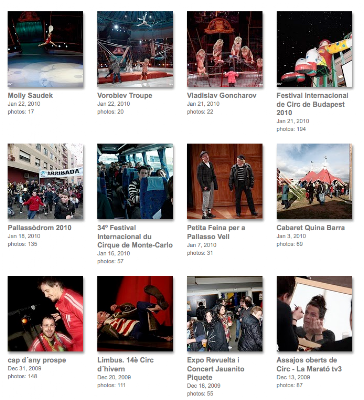
Manel is clearly Europe’s answer to Jim Moore. His Picasa home page has 101 albums, and the vast majority are devoted to circus, clown and cabaret performers, as these screen shots of just some of his albums show:


And for the latest stuff, check out his excellent blog, Circ .. Manel Sala “Ulls”

But back to that first week’s cabaret. A lot of it was put together day-of, but the results were pretty strong, especially for performers working together for the first time. Here are two pieces from the first half, shot from not a perfect angle with my late great Flip camera.

If you watched the first slide show, you might be wondering what all those gleaming bare asses belonging to luxuriously-oiled men were doing in a clown cabaret. Well, they were the Las Vegas Acrobats, as choreographed by Grada Peskens, though no doubt inspired by that Jango Edwards fellow. The challenge here for the performers was to do the act with the utmost conviction, what Jango likes to speak of as one of the twenty axioms of clowning: attitude. Simply put, you the performer have to believe 100% in what you are doing if you want the audience to. Or as Eddie Cantor once said of Laurel & Hardy: “It’s their seriousness that strikes me. They play everything as if it might be Macbeth or Hamlet.”

If for some reason you want a better view of all that flesh, you’ll have to check out Manel’s album.

This next piece grew out of my physical comedy class, and I was very pleased with the creativity the students brought to it. We had been working on chase scenes, a trademark of physical comedy but also a cliché. (Or as Chaplin once complained, must every movie end with a chase?) And for us indoor clowns, without cars and trains and broad avenues and hundreds of cops, what’s possible? The challenge became to draw upon the elements of the chase, but to expand the possibilities by going beyond naturalism, playing with rhythms and embracing the absurd. Six or seven different pieces were created in class and none of them, I’m proud to say, resembled a conventional chase. This piece is based on the famous running of the bulls popular in Pamplona and other Spanish towns.

First a few high-rez stills to make up for the low-rez video.


And here’s the video….

Curtain call. Moi (left) with Jango (in a suit!) and Grada.

SHARE
EXPLORE FURTHER

Charlie Rivel: Homage to a Catalonian Clown — Live from Barcelona! #4

POST 84
Wednesday, March 10, 2010

It is my last night in Barcelona and Jango Edwards brought together for dinner all of the clown / circus /variety historians he could muster in the person of Raffaele De Ritis, whose blog, Novelties and Wonders, is indeed full of wonders; Pat Cashin, whose Clown Alley blog is the place to go for all things clown; Greg DeSanto, director of the International Clown Hall of Fame and Research Center; and yours truly. Or to paraphrase John F. Kennedy, there hasn’t been a greater concentration of clown knowledge at one table since Tristan Rémy dined alone.

This being Catalonia, the meandering conversation had to come around to its most famous clown, Charlie Rivel (1896 –1983). In fact, in Barcelona’s Joan Brossa Gardens you will find a statue (photo, below) of Rivel , and there is even a Charlie Rivel Museum in his birthplace, the village of Cubelles, half way down the coast between here and Tarragona.

Born Josep Andreu Lasserre, his father was a Catalan trapeze artist and his mother a French acrobat. By age two he was performing in his father’s risley act. Thus was launched an eight-decade performing career that brought him the kind of superstar status in Europe only enjoyed by clowns like Grock and the Fratellini.

It’s been decades since I read Rivel’s autobiography, Poor Clown so I won’t pretend to be an expert on his life. Instead I will turn you right back over to Raffaele De Ritis, whose article on Rivel on Circopedia is the best starting point. Once you promise me you’ve read that, I’ll share a few video highlights with you.

Okay, did you really read it? Alrighty then, let’s get started…

Because many of the clips we have of Rivel are from late in his long performing career, his early days as an acrobat and an acrobatic clown tend to be overlooked. But you already knew that, right? Here are two shots of him as the topmounter in an unconventional two-high, courtesy of circus practitioner, teacher, and historian Hovey Burgess:

According to the Circopedia bio, one of the tricks he and his brothers became known for was “The Little Bridge.” Though I don’t have any footage of this, again with the help of Hovey Burgess I was able to identify the trick and with the help of Nicanor Cancellieri track down what seems to be a more recent version of it as performed by The Three Rebertis.

And as an aside, here’s a third photo supplied by Hovey of Los Yacopis, with this commentary: Note the hands-to-shoulders element (not head-to-head, not, at least, in the moment of this photograph). Irving Pond mentions the Yacopi troupe in Big Top Rhythms (1937) RE: their teeterboard four-person high column. This photograph is from: Julio Revollendo Cardenas CIRCO EN MÉXICO (2004), page 71.


Update from Hovey: I herewith submit two (2) photographs from Fernand Rausser (photographer) Le Cirque (1975) [Toole Stott No. 13,465] which purportedly depict the 1975 Circus Knie revival of the unconventional two-high (page 148) and the “bridge” (page 149) by Rolfe Knie Junior, Juanito Rivel and José Bétrix. If we are to judge from the photograph, and perhaps we should not so judge, the latter seems not quite up to snuff somehow. That is hardly a free head-to-head element that is shown. Hmmm!


Update courtesy of Pat Cashin (3-21-10):
Mystery solved! Here’s our bridge, performed nonchalantly by Rivel and company during a 1937 hospital visit. Click on image.

Hovey Burgess comments: “That is it. But with a couple of twists.This 1937 Viennese version clip is also a five-person bridge akin to the Yacopis photograph. Five people are also hinted at in the somewhat inconclusive 1975 Swiss revival version photograph. Unlike the Rebertis clip, however, the non-feet-to-shoulders link is NOT a straight head-to-head at ANY point shown in the clip, but is reinforced with a Yacopi-like hands-to-shoulders [throughout]. With the Rebertis it is a straight head-to-head (“no hands!”) all the way, both ascending and descending. Mystery solved? Yes, but we would still like to see and know more.”
______________________

And now back to our regularly scheduled program:
Since his father was a trapeze artist, it’s not surprising that comedy trapeze became one of Rivel’s signature acts. Here he is from 1943, when he would have already been 46 or 47.

Later in his career Rivel became more of a minimalist, extracting a lot of clown gold from a chair and a guitar. Here he is on this youTube piece posted by none other than Pat Cashin. Small world, eh?

And here he is on Eurovision Song Contest:

This is the Rivel segment from Fellini’s movie, I Clowns; I’ll try to replace it with a version with English subtitles sometime soon!

And to be thorough, here are Rivel’s sons, the Charlivels, performing their popular night club act, which included singing and acrobatics.

Like I said, check back soon for additional material.

SHARE
EXPLORE FURTHER

Tricicle — Live From Barcelona! #3

POST 83
Monday, March 8, 2010

If you spend your days in the United States, chances are you’ve never heard of the Catalonian physical comedy trio, Tricicle. In Europe, however, they’re a well-known brand name, almost a small industry, having performed extensively in major theatres and festivals for over thirty years, as well as on tv and in movies, and even as part of the opening ceremonies for the 1992 Olympics here in Barcelona. Founded by Joan Gracia, Paco Mir and Carles Sans in 1979, they expanded their international reach in 1988 by adding a second 3-man company (photo, right), known as Tricicle-2 or Clownic, which performs pieces from the by-now large Tricicle sketch repertory, and which is who I saw last night.

Here they are (almost) winning racewalking gold at the Olympics. Very funny.

Their theatre work is minimally verbal and can easily be followed by an audience not speaking the language, so I’m sure it travels well. It would be accurate to describe what they do as physical comedy, but it comes more from the world of mime than that of the knockabout comedian and has the feel of sketch comedy without the words. This explanation from their website gets to the point pretty well:

Tricicle’s style is the fruit of an era in which visual humor was rising in popularity. Performers such as Comediants, Jango Edwards, and Albert Vidal were an undeniable point of reference for those wishing to devote their lives to the world of theatre and this was why Joan, Paco and Carles (each one separately) decided to give up their free mornings and enroll at Barcelona’s Institute of Drama with the aim of steeping themselves in all the various types of drama techniques. But how they really learned the bases of their unique style was by memorizing the Lubitsch, Wilder and Keaton films they would see at Barcelona’s Filmoteca and, especially, by dissecting and analysing the performances of humorists appearing in Barcelona, which was then a city thirsty for refreshing entertainment.

Gags are the basis of the company’s theatrical technique. All Tricicle shows are replete with gags and have a seemingly incredible average of one gag per ten seconds. The company’s shows are never considered as finished products and are constantly open to the inclusion of new gags as each production progresses, although they do have their limits. Tricicle draws the line at humor based on bad taste.

From the outset, Tricicle avoided conventional mime techniques and opted for a “realistic” acting style based on day-to-day gesture; Action Theatre, the company calls it, thus comparing it to action cinema in which the characters, who often have very little to say to each other, simply spring into “action.” The company’s style is mainly characterized by its dynamic nature, short scenes, frequent changes of character, natural onomatopoeia (with a very occasional spoken word), the dramatic use of stage props and constant surprises. Their concept is that the audience should leave the theatre without even realizing they have attended a “silent” show. There is nothing worse than hearing someone utter “Why are they not speaking?” during a performance.

The performance I saw was energetic, finely tuned, and very well received by the audience. I found much of it inventive and quite funny — for example, the “if men were pregnant” piece, photo above — but there were also sections and entire pieces where it was all a bit too light and safe, too much like television in its choice of humorous topics and how far it would go with them. I started to want more substance for my 18 euros. And despite the name Clownic and a performance style that could loosely be termed clownesque, do not go expecting to see strong clown characters. Their focus is more on the everyday, on naturalistic behavior, albeit exaggerated, and less on the psychology of memorable individuals.

Their last piece, The Waiting Room, was their strongest in terms of sustained gags and creativity, and you payasos out there will appreciate that it ends with a variation on the classic clown entrée, Dead or Alive. Today I found it on YouTube, though performed by the main company rather than Clownic. See for yourself…

There are a lot more videos on YouTube, but definitely check them out live if they ever come to a theatre near you. Click here for their touring schedule.

SHARE
EXPLORE FURTHER

Nouveau Clown Institute — Live from Barcelona! #1

POST 81
Thursday, March 4, 2010


Greetings from Barcelona, I mean Barthelona, by many reports the coolest city in Europe. And arguably cooler now that it is the home of the Nouveau Clown Institute, an international clown school started just this past year by Jango Edwards, who is amazingly energetic for someone who may or may not be as old as me. I’m running away from administration and he’s starting a school. Go figure.

I’m doing a physical comedy workshop this week for students taking a month-long clown intensive, and I hope to do several blog posts on our work here. There are forty participants from eleven different countries, most of them already working at a professional level, and it is an exciting mix of very creative talent. While many performance academies espouse a particular method (Stanislavsky, Lecoq, Decroux, etc.), these students are being exposed to a wide variety of styles and approaches to clownesque performance. Every few days a new teacher with a new angle. It may get overwhelming at times, but from an educational point of view I like the idea of them getting to play with so much. Plenty of time to sort it out and use what works for them — starting in April.

Here are a few pics of the space at the Roca Umbert Fàbrica de les Arts, a former factory complex being transformed into a formidable arts center.


Today was a good day. As far as I know, we only broke four chairs (here’s two of them) and one table. Don’t tell Jango until after I get paid.


Jango’s Office:


The café, just steps away from the main classroom space.


And here’s Jango (not to be confused with his long-lost cousin, Django Reinhardt) doing the classic but deadly headfirst dive into the cup of water, proving he’s no slouch when it comes to physical comedy.

Stay tuned for more posts from the NCI…

SHARE
EXPLORE FURTHER
Check out My New Book

Visual and verbal humor for the cognitively and artistically curious!

“A book to treasure!”
—Bill Irwin

Upcoming Events