Tag: History

Complete Book: The Mimes of Herodas

POST 164
Thursday, July 14, 2011

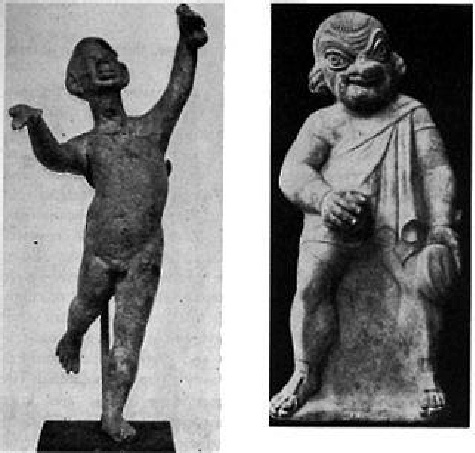
Histories of ancient theatre tend to leave the impression that comedy began with Aristophanes, but Greece already had a rich tradition of commedia-style performance — the Dorian mimes (image, above). As I wrote in chapter two of Clowns…

These Dorian clowns— as well as the short plays they performed —came to be known as 

mimes (mimos). Today mime is usually equated with pantomime, the art of silent acting, but originally the word meant “to imitate” and referred to the performer’s talent for caricature; the ancient mimes were in fact quite talkative. Much of the dialogue apparently was improvised, and since the actors saw little need to preserve in writing what was said on stage, these comic dramas never became dramatic literature.

There is, however, one manuscript unearthed in 1890 that gives us some sense of these ancient skits: the mimes of Herodas. Obviously this text is not improvised, but rather the work of a poet adapting a popular form. This is what the Encyclopædia Britannica says:

Herodas, also called Herondas  (flourished 3rd century bc), Greek poet, probably of the Aegean island of Cos, author of mimes—short dramatic scenes in verse of a world of low life similar to that portrayed in the New Comedy. His work was discovered in a papyrus in 1890 and is the largest collection of the genre. It is written in rough iambic metre and in the vigorous, rather earthy language of the common people. His characters use vehement exclamations, emphatic turns of speech, and proverbs. In pieces of about 100 lines Herodas portrays vivid and entertaining scenes with the characters clearly drawn. The themes cover a range of city life: a procuress attempts to arrange a tryst for a respectable matron while her husband is away; a jealous woman accuses her favourite slave of infidelity and has him bound and sent to receive 2,000 lashes; a desperate mother drags a truant urchin to the schoolmaster. It is thought that these mimes were recited with considerable improvisation by an actor who took the various roles.

Wikipedia offers the following summary of the pieces:

Mime I
In Mime I the old nurse, now the professional go-between or bawd, calls on Metriche, whose husband has been long away in Egypt, and endeavours to excite her interest in a most desirable young man, fallen deeply in love with her at first sight. After hearing all the arguments Metriche declines with dignity, but consoles the old woman with an ample glass of wine, this kind being always represented with the taste of Mrs Gamp.
Mime II
This is a monologue by the “whoremonger” prosecuting a merchant-trader for breaking into his establishment at night and attempting to carry off one of the inmates, who is produced in court. The vulgar blackguard, who is a stranger to any sort of shame, remarking that he has no evidence to call, proceeds to a peroration in the regular oratorical style, appealing to the Coan judges not to be unworthy of their traditional glories. In fact, the whole oration is also a burlesque in every detail of an Attic speech at law; and in this case we have the material from which to estimate the excellence of the parody.
Mime III
Metrotimé, a desperate mother, brings to the schoolmaster Lampriscos her truant son, Cottalos, with whom neither she nor his incapable old father can do anything. In a voluble stream of interminable sentences she narrates his misdeeds and implores the schoolmaster to flog him. The boy accordingly is hoisted on another’s back and flogged; but his spirit does not appear to be subdued, and the mother resorts to the old man after all.
Mime IV
This is a visit of two poor women with an offering to the temple of Asclepius at Cos. While the humble cock is being sacrificed, they turn, like the women in the Ion of Euripides, to admire the works of art; among them a small boy strangling a vulpanser – doubtless the work of Boethus that we knowand a sacrificial procession by Apelles, “the Ephesian,” of whom we have an interesting piece of contemporary eulogy. The oily sacristan is admirably painted in a few slight strokes.
Mime V
This brings us very close to some unpleasant facts of ancient life. The jealous woman accuses one of her slaves, whom she has made her favourite, of infidelity; has him bound and sent degraded through the town to receive 2000 lashes; no sooner is he out of sight than she recalls him to be branded “at one job.” The only pleasing person in the piece is the little maidservant permitted liberties as a verna brought up in the house whose ready tact suggests to her mistress an excuse for postponing execution of a threat made in ungovernable fury.
Mime VI
A friendly chat or a private conversation. The subject is an ugly one, Metro has arrived at Koritto’s house to ask her where she acquired a dildo, but the dialogue is as clever and amusing as the rest, with some delightful touches. Our interest is engaged here in a certain Kerdon, the maker of the dildo and who hides this trade by the front of being a cobbler. On acquiring the information she desired, Metro leaves to seek him out.
Mime VII
The same Kerdon and Metro whom we see in VI appear, Metro bringing some friends to Kerdon’s shoe shop, (his name, which means “profiteer”, had already become generic for the shoemaker as the typical representative of retail trade) he is a little bald man with a fluent tongue, complaining of hard times, who bluffs and wheedles by turns. The sexual undertones which we have come to expect from his involvement in VI are only realized at the end when Metro’s friends have left the shop.
Mime VIII
Opens with the poet waking up his servants to listen to his dream; but we have only the beginning, and the other fragments are very short. Within the limits of 100 lines or less Herodas presents us with a highly entertaining scene and with characters definitely drawn.

Spoiler Alert: This is not necessarily a laugh riot, but if you bring some theatrical imagination to it, the anthropologist in you will get some idea of this early form of comedy.
You’re actually getting two translations for the price of one.  The first is a 1906 verse translation by Hugo Sharpley, the second a 1921 prose version by M. S. Buck.

A Realist of the Aegean

Herodas Prose

SHARE
EXPLORE FURTHER

New Shoes: Today’s Clowns in Europe

POST 116
Wednesday, March 30, 2011

Finally a serious documentary about clowning!

But first some historical perspective:

When famed film director Federico Fellini produced I Clowns for Italian television in 1970, he created a pseudo-documentary, part nostalgia, part fantasy that seduced much of the public but offended many in the world of European clowning.  Fellini’s premise was that clowning was dead, a conclusion he apparently came to before doing any serious research.

Somehow Fellini with all his resources could not even find any footage of classic clowns. Instead we get a futile visit to an archive to see a short clip of the great clown Rhum, only to have the film reel start to burn up in the projector. Clearly the past was lost. 

He either did not know or it did not fit his preconceived notions to mention that there was lots of footage of Charlie Rivel, that Grock’s entire one-man show had been caught on film more than once, and that this very same Rhum had co-starred in a series of short films with Jacques Tati in the 30s! 

Enuf said, but if you want more on the controversy, here’s the reaction the Fellini film got from the writers of the publication, Cirque dans l’Univers (#81):
Fellini’sClowns

Now comes along a new film that attempts to update clown history by covering performers in Europe who it credits with saving a lost art.  Here’s their synopsis:

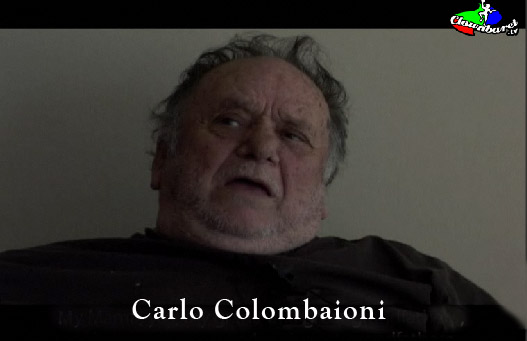
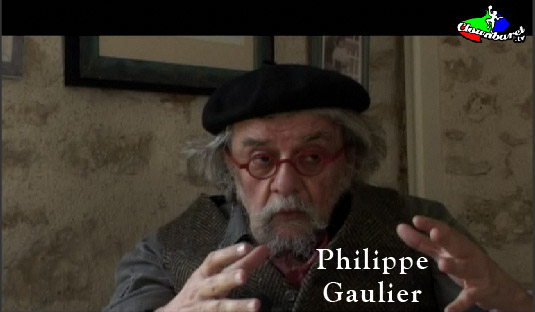
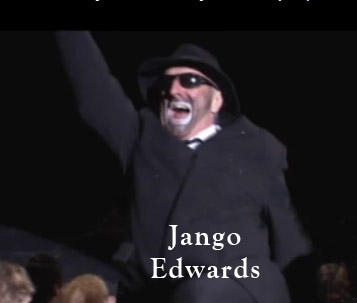
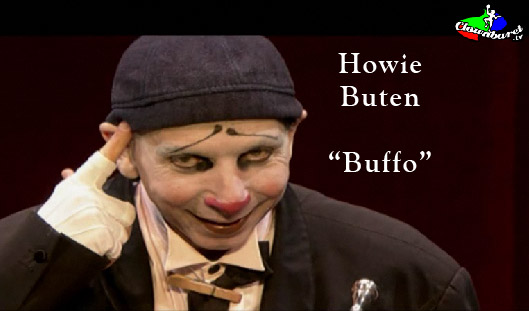
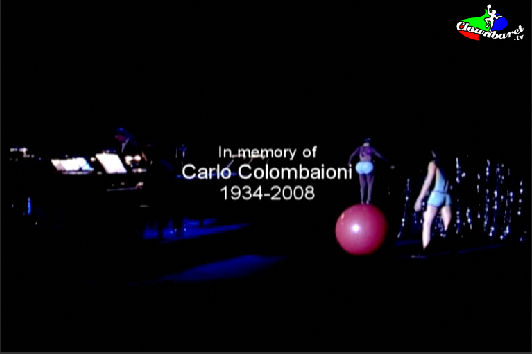
New Shoes: Today’s Clowns in Europe is a unique and original documentary about clowns of the turn of the century, from Carlo Colombaioni up to the present. It offers a vision of the contemporary clown from the point of view of the most renowned figures of the genre, who show us how they think and act, onstage and off. Through the play of two young clowns, we discover how these actors and the clowns they incarnate face the different aspects of life.

And here’s their trailer for it:

The good news is that you can now see a short (54-minute) segment of the documentary on the web. Fundraising is continuing so as to release a full-length, 84-minute version on DVD, complete with special features.

Based on what I’ve seen, this is a substantial piece of work.  Although I might question the premise that just a few decades ago clowning was dead, only to be rescued by this film’s featured performers, what it does do is provide insight into a significant development in the history of clowning: the migration of the clown not only from the circus to the theatre, but into our political and social fabric, as evidenced by such welcome phenomena as hospital clowning, more women in clowning, and Clowns without Borders.

______________________________________________________

“The circus would give you 10 minutes and I wanted 2 hours.” 
— Carlo Colombaioni

______________________________________________________

What I like most about the film is that it lets the clowns speak for themselves — performers and teachers such as Philippe Gaulier, Jango Edwards, Leo Bassi, Johnny Melville, Gardi Hutter, Peter Shub, Slava Polunin, Carlo Colombaioni, and many more — and they are all quite eloquent on issues of creativity, career, gender, and the essence of being a clown. What seems missing in this shorter version and I would hope to see in the final movie are more and longer performance clips.  I’ve seen a lot of these artists perform, but many potential viewers haven’t.  I think there’s a need for more evidence of what this new movement in clowning looks like, even granted that the best clowning can not be fully captured on video.

Though a documentary such as this only scratches the surface of a complex subject, I’m pretty sure you will find this work well worth your time.  And now you can view the 54-minute version at the clownbaret.tv web site by clicking here.

TECH NOTE:  I had problems getting the movie to stream when using the Firefox browser, but it worked fine with the Chrome browser.  It may have been network traffic rather than the browser, but if you have problems, try Chrome.

Like the movie, appreciate the great effort, want to help them complete the final version? Then consider making a donation at the clownbaret web site.

SHARE
EXPLORE FURTHER

Complete Book: Fous et Bouffons (1885)

POST 75
Sunday, February 21, 2010

Fous et Bouffons: un Etude Physiologique, Psychologique et Historique (Fools & Buffoons: A Physiological, Psychological, and Historical Study)
by Dr. Paul Moreau

You have to hand it to the French. They have an appetite for historical research and writing, as well as a keen interest in circus and clowning. Put the two together and the happy result is a lot of good books on the variety arts. When I somehow ended up as a French major in my undergrad years at NYU, I had no real idea how or if I would ever use my meager language skills. Four years later I found myself writing a book about clowns, the research for which would have been impossible had I not been able to read French.

So as we near the end of my posting public domain books about fools and jesters, I throw in a book in French on the subject. I figure there are enough of you gringos who read French, and the blog is getting a lot of visitors from francophile countries, so it may be of use to someone out there. And as I may have mentioned, it is free.

Moreau was a member of the Paris Medical Psychology Association and his approach aspires to be scientific. He was in fact the author of over a dozen books that bridge the gap between medical and psychological issues, tackling such subjects as suicide, childhood madness, and jealous insanity. One contemporary review of the book I found questioned Moreau’s science and opined that “the historical section of the book contains many anecdotes which may amuse those who have nothing better to do than to read them.” Zing!

I doubt H.G. Wells knew of Moreau when he wrote Island of Dr. Moreau, but Wells’ mad scientist is none other than Dr. Paul Moreau, played by Charles Laughton in the 1933 film, Island of Lost Souls. But I digress.

Fous et Bouffons by Dr. Paul Moreau

SHARE
EXPLORE FURTHER

Complete Book: Erasmus’ In Praise of Folly

POST 73
Thursday, February 18, 2010

It turns out Erasmus is not just the name of a high school in New York City. Apparently before he was a high school — about 500 years before — he was also a famous philosopher.

Hey, I’m just kiddin’ ya. I went to graduate school, I know everything there is to know about Erasmus that’s on his Wikipedia page. Like his full name was Desiderius Erasmus, though his friends called him Razzmatazz, that he was born in Rotterdam some time between 1466 and 1469, died in 1536, and in between established quite a reputation for himself as a Dutch Renaissance humanist. See?

But why was he praising folly?

As the forward to this edition says, “under the pleasing mask of Folly our author has uttered truths which are indeed sublime, and in the witty language of the Jester he has exposed the fallacies of ….” Well, the fallacies he exposes are a bit esoteric to us today, having to do with religious controversies raging over the Protestant Reformation. (Good thing we don’t have religious controversies any more.) Erasmus was a Catholic but at one point an ally of Martin Luther and quite critical of the Catholic establishment. Erasmus speaks to us through a voice of his creation, the Greek Goddess of Folly, a personification of folly and a vehicle for launching satirical attacks on his favorite targets.

In Praise of Folly

Okay, so I made up that part about Razzmatazz.

SHARE
EXPLORE FURTHER

Complete Book: Robert Armin’s “Foole upon Foole” and “A Nest of Ninnies”

POST 71
Monday, February 15, 2010

The standard entry on fools and jesters usually makes mention of Shakespeare’s jester characters, especially the fool in King Lear. It was Robert Armin (c. 1563 – 1615) who first acted the role as a member of the Lord Chamberlain’s Men, as well as such similar roles as Touchstone in As You Like It, Feste in Twelfth Night, Lavatch in All’s Well That Ends Well, and perhaps Autolycus in The Winter’s Tale, as well as comic parts in other Elizabethan dramas. In fact, Armin’s joining the company around 1600 is credited by some with Shakespeare’s increased interest in witty jesters.

Armin was not just a leading actor of his day, but also a scholar with a keen interest in the ancient lineage of fools. He was one of the first to chronicle their history at length in his Foole upon Foole (1605) and his A Nest of Ninnies (1608), where he made a clear distinction between the natural fool and the “licensed fool,” a performer sanctioned to play the role of the fool for money. It would be a logical assumption that, working as closely together as he and Shakespeare did for so many years, Armin shared his historical knowledge with the ever-curious bard.

Even though the text is short (56 pp.), it is rough sledding, given the wacky way they wrote and spelled back in those days. But it is historically significant and, once again, it is free…

Armin Foole Upon Foole

SHARE
EXPLORE FURTHER

Complete Book: The History of Court Fools

POST 70
Saturday, February 13, 2010

The History of Court Fools by John Doran

This is a 389-page monster of a book written by Dr. John Doran (1807-1878) and published in 1858. Doran was a prolific writer of popular social histories. No illustrations, not even the one to the right.

I used this book when researching chapter one of Clowns, but it should come with a warning: it’s heavily anecdotal, with nothing in the way of footnotes or bibliography. Like a lot of books about fools and jesters, it tends to romanticize its subject and rarely questions the accuracy of a story so long as it’s a good one.

It was republished just last year by Cornell University Library in book form — you know, with double-sided printing, a cover, a binding and all that. Your choice: buy it for $27 on Amazon or download and print it right here.

John Doran’s History of Court Fools

SHARE
EXPLORE FURTHER

2010 Physical Comedy Quote of the Week Archive

POST 63
Thursday, February 4, 2010

The blog is nine months old today, so of course it is giving birth to a new feature.

Anyone who ever took a physical comedy class with me knows I was fond of putting a daily quotation on the blackboard — remember blackboards? — even if it meant getting there early just to copy the longer ones to the board. Chalk is one of your slower forms of media. But the students dutifully wrote them down, and even seemed to like having them, so here we go again…

I was originally going to include a quote in each of my “weekly blog bulletins,” but with only three such weekly bulletins in the past nine months, that obviously hasn’t worked out too well. Turns out I didn’t need frequent bulletins, but we still need those quotes, right? So I’m going to cheat by stealing those earlier quotes for this archive and then add more so that we’re up-to-date through 2010. New quotes will appear every Friday in a box on the blog’s side frame, with a link to this archive, where the latest quote will be added. Here goes!

2010 Physical Comedy Quote of the Week Archive

Week 1
“In the end, everything is a gag.” — Charlie Chaplin

Week 2
“What you have to do is create a character. Then the character just does his best, and there’s your comedy. No begging.” — Buster Keaton

Week3
“Two ancient families there are, known and sure and recognized — only two. Clowns and acrobats. The rest are newcomers… Have kids — have lots of kids! Be not ever without a baby on the fingers, a child on the mat, and a boy on the bar.”
— John Steinbeck, Burning Bright (short story)

Week 4
“Where humor is concerned, there are no standards — no one can say what’s good or bad, although you can be sure everyone will.”
— John Kenneth Galbraith

Week 5
“Buster Keaton is the father of comedy, Stan Laurel is the son, and Harpo Marx the holy ghost.” — Marty Feldman

Week 6
“Dethrone the dictaphone / hit it in its funny bone / that’s where they expect it least.” — Bruce Springsteen

Week 7
“I once said to Henry [Miller], ‘I don’t like clowns, I like madmen.’ Henry said, ‘Madmen are too serious. I like clowns.'”
— Anais Nin

Week 8
“The biggest laughs are based on the biggest disappointments and the biggest fears.”
— Kurt Vonnegut, Jr.

Week 9
“I don’t like to see clowns in the ring. I like to see boxers. You don’t win by being a clown.”
— Welterweight boxing world champion Roberto Duran, referring to Sugar Ray Leonard, the day before losing his title to Leonard

Week 10
“The government should have a school for clowns. I’d teach how to break plates, how to slap someone. You think it’s easy to slap somebody? It’s complicated.”
— Catalonian clown Charlie Rivel (in Fellini’s I Clowns)

Week 11
“You must not think me necessarily foolish because I am facetious, nor will I consider you necessarily wise because you are grave.”
— Sydney Smith (English writer and clergyman, 1771 –1845)

Week 12
“Why did people insist that if you were ‘comic’ you couldn’t also be ‘serious’? Garp felt most people confused being profound with being sober, being earnest with being deep. Apparently, if you sounded serious, you were. Presumably, other animals could not laugh at themselves, and Garp believed that laughter was related to sympathy, which we were always needing more of. He had been, after all, a humorless child — and never religious — so perhaps he now took comedy more seriously than others.”
John Irving, The World According to Garp

Week 13
“The clown’s traditions have to be treated just like a great chef like Escoffier would a piece of meat. You must not simply roast it or boil it in the usual way. You try to change the way you do it to produce something special. That is the way I work.”
Charlie Cairoli

Week 14
“Tragedy is when I cut my finger. Comedy is when you fall into an open sewer and die.”
—Mel Brooks


Week 15
“God always has a custard pie up his sleeve.”
the character Georgy (played by Lynn Redgrave) in the movie Georgy Girl

Week 16

“Live performance in a defined public space is our last bulwark against two-dimensional images taking over reality. Theater may turn out to have been only a brief interlude between ritual and electronics; be glad you’re here to see it.”
— Erika Munk


Week 17

“I like long takes, in long shots. Close-ups hurt comedy. I like to work full figure. All comedians want their feet in.”
—Buster Keaton


Week 18

“Damn it,” I said, “I do understand. Only too well.”
“What kind of man are you?” he asked.
“I am a clown,” I said, “and I collect moments.”
The Clown, a novel by Heinrich Boll

Week 19

“The most difficult character in comedy is that of the fool, and he must be no simpleton that plays that part.”
— Miguel de Cervantes

Week 20

“Hegel remarks somewhere that all great world historical facts and personages occur, as it were, twice. He has forgotten to add: the first time as tragedy, the second as farce.”
Karl Marx

Week 21

As soon as you have made a thought, laugh at it.
—Lao-Tzu

Week 22

“It would have been more logical if silent pictures had grown out of the talkies instead of the other way around.
— Mary Pickford

Week 23
“Ever since I can speak, I can stand up in a normal fashion; but falling only hurts ever since I can speak; but the pain when I fall is half as bad ever since I know that I can speak about the pain; but falling is twice as bad ever since I know one can speak about my falling; but falling doesn’t hurt at all any more ever since I know that I can forget the pain; but the pain doesn’t stop at all any more ever since I know I can feel ashamed of falling.”
— from “Kaspar,” by Austrian playwright Peter Handke

Week 24
“The test of a real comedian is whether you laugh at him before he opens his mouth.”

—George Jean Nathan

Week 25
“Oddly enough, I cannot remember Pop teaching me anything. I just watched what he did, then did the same thing. I could take crazy falls without hurting myself simply because I had learned the trick so early in life that body control became pure instinct with me. If I never broke a bone on the stage it is because I always avoided taking the impact of a fall on the back of my head, the base of my spine, on my elbows or my knees. That’s how bones are broken. You also bruise only if you do not know as I do which muscles to tighten, which to relax.”
— Buster Keaton


Week 26
“I went into the business for the money, and the art grew out of it.  If people are disillusioned by that remark, I can’t help it.  It’s the truth.”
— Charlie Chaplin


Week 27
“You can get an onion to make you cry, but they’ve yet to find a vegetable to make you laugh.”  
— Anonymous

Week 28
“Clowns do not think, they connect.”
—Yury Belov


Week 29
“Ever since I can remember, all kinds of inanimate objects have had a way of looking at me reproachfully and whispering to me in unguarded moments: ‘We’ve been waiting for you… at last you’ve come… take us now, and turn us into something different…we’ve been so bored, waiting.'”—Grock

Week 30
“My means of contriving comedy plot was simple.  It was the process of getting people into and out of trouble.”—Charlie Chaplin

Week 31
“We bozos have an expression: when you put on a nose, it grows on you.”  
— Firesign Theatre
Week 32
“I’m essentially an entrance and exit man.  Good exits and good entrances.  That’s all theatre is.  And punctuation.  That’s all it is.”  
— Charlie Chaplin

Week 33  
“It’s their seriousness that strikes me.  They play everything as if it might be Macbeth or Hamlet.”
— Eddie Cantor on Laurel & Hardy
Week 34  
“They seemed to have this solid instinct that only top- flight comedians hae of the reality underlying a gag.”—Leo McCarey on Laurel & Hardy

Week 35 

“Artistic genius is an expansion of monkey imitativeness.”— W. Winwood Reade

 
Week 36 

“Humor is the most engaging cowardice.” 

— Robert Frost
 
Week 37 

“Humor is emotional chaos remembered in tranquility.”— James Thurber

Week 38

“You never turned around to see the frowns on the jugglers and the clowns when they all played tricks for you.  No you never understood, it ain’t no good, you shouldn’t let other people get their kicks for you.”  

— Bob Dylan
 
Week 39

“The arrival of one clown has more beneficial influence upon a town than twenty asses laden with drugs.”— Thomas Sydenham, British physician (1624-1689)

 
Week 40

An unemployed jester is nobody’s fool.”  

— Eric Bass
 
Week 41

There is enough stupidity in every wise man to betray him.”  

— Russian proverb, and the basis for literal title of Alexander Ostrovsky’s Diary of A Scoundrel (1868)
Week 42

 “Life is a tragedy when seen in close-up, but a comedy in longshot.” 
—Charlie Chaplin

SHARE
EXPLORE FURTHER

Happy Birthday, Jack Wilson! (Sand Dance)

POST 61
Friday, January 29, 2010

Who?

Long before Steve Martin’s King Tut, there was this hysterical sand dance performed by Jack Wilson, born in Liverpool this day in 1894, and Joe Keppel, born in Ireland a year later. Along with a succession of Bettys, they formed the music-hall comedy act of Wilson, Keppel & Betty. This birthday salute is just an excuse to showcase their work, a delicious parody of an earlier craze for all things Egyptian, sparked by the 1922 discovery of the tomb of Tutankhamun, just as Martin’s was inspired by the wildly popular 1978 U.S. tour of the Treasures of Tutankhamun.


Wilson and Keppel first performed together in New York in March 1919 as a comedy acrobatic and tap dancing act in vaudeville, and continued working together until 1963. Yep, that’s 44 years together. Yikes! In 1928 they were joined in the act by Betty Knox, former stage partner of Jack Benny, who retired in 1941 to go into journalism, but was followed by something like seven other Bettys, beginning with Knox’s own daughter, Patsy.

They toured internationally and, according to legend, were denounced by Goebbels as “bad for the morals of Nazi Youth” after a 1936 performance at Berlin’s Wintergarden because they showed too much bare leg. Mussolini, on the other hand, was said to have had no problem enjoying the act. In 1950, they even shared the bill with Frank Sinatra when he headlined the London Palladium.


Along the way, their signature piece, the sand dance, became a cult favorite. Film historian Luke McKernan (see below) commented that “I worked at the National Film and Television Archive for a number of years, and I think this one piece of film was requested by the public more times than any other.”


Like Anna Pavlova before them and Steve Martin decades later, Wilson & Keppel are all profile and angles and limbs, funnier than Pavlova and more skilled than Martin — and perhaps vice-versa. Their slender frames and straight faces are perfect for the mock-seriousness of the piece.

Here it is, their trademark sand dance, to the tune of Luigini’s Ballet Egyptien, arranged for them by none other than Hoagy Carmichael.

And here’s another version, courtesy of British Pathé. It’s part of a 1933 variety show at the Trocadero Restaurant, and unfortunately they’re in front of the curtain instead of their pyramid backdrop. It includes a cute little dance up and down the stairs.

As Cleopatra, Betty provided the sultriness with her Dance of the Seven Veils and gave the guys something to play off of. Here’s my favorite bit from Cleopatra’s Nightmare.

Last and perhaps least, one more cute novelty.

You can view a few more incidental clips on YouTube, and can read Luke McKernan’s excellent history of the act (pdf download) by clicking here.

SHARE
EXPLORE FURTHER

Complete Book: Memoirs of Joseph Grimaldi, edited by Charles Dickens

POST 59
Saturday, January 23, 2010

Today I introduce yet another new feature to this blog, a complete book in the form of a pdf file suitable for reading online, downloading, or printing. Because of legal issues, most if not all books presented here will be from the pre-copyright era, roughly a century or more ago, and therefore of a historical nature.

We start off with a classic, the Memoirs of Joseph Grimaldi, edited by none other than Charles Dickens (pseudonym Boz). Grimaldi (1779–1837) was perhaps the most celebrated clown who ever lived, the clown credited with elevating the craft to an art form, the man from whom latter-day clowns derived the nickname “joey.” If you want a quick introduction to Grimaldi, go to post 002 on this blog and take a look at chapter five (pp.8–14) from my book Clowns.

How these memoirs apparently came about is its own story, here summed up by our good friend Dr. Wikipedia:

The book’s accuracy is not entirely clear, since it went through a number of revisions, not all with Grimaldi’s input. Grimaldi’s original manuscript, which he mostly dictated, was about 400 pages; he completed it in December 1836. The original “excessively voluminous” version was apparently not good enough for publication, and in early 1837 he signed a contract with a collaborator, the obscure Grub Street writer Thomas Egerton Wilks, to “rewrite, revise, and correct” the manuscript. However, two months after signing the contract, Grimaldi died, and Wilks finished the job on his own, not only cutting and condensing the original but introducing extra material based on his conversations with Grimaldi. Wilks made no indication which parts of his production were actually written by Grimaldi and which parts were original to Wilks. He also chose to change Grimaldi’s first-person narration to the third person.

In September 1837, Wilks offered the Memoirs to Richard Bentley, publisher of the magazine Bentley’s Miscellany. Bentley bought it, after securing the copyright from Grimaldi’s estate, but he thought it was still too long and also badly edited, so he asked one of his favorite young writers, the novelist Charles Dickens, then twenty-five years old, to re-edit and re-write it. At first Dickens was not inclined to take the job, and he wrote to Bentley in October 1837:

“I have thought the matter over, and looked it over, too. It is very badly done, and is so redolent of twaddle that I fear I cannot take it up on any conditions to which you would be disposed to accede. I should require to be assured three hundred pounds in the first instance without any reference to the sale — and as I should be bound to stipulate in addition that the book should not be published in numbers I think it would scarcely serve your purpose.”

However, Bentley agreed to Dickens’ terms (a guarantee of three hundred pounds and an agreement to publish the book all at once, and not in monthly numbers.) Dickens signed a contract in November 1837, and completed the job in January 1838, mostly by dictation. Dickens seems never to have seen Grimaldi’s original manuscript (which remained in the hands of the executor), but only worked from Wilks’ version, which he heavily edited and re-wrote. Bentley published it in two octavo volumes in February 1838.

How faithful this twice-edited, twice-rewritten version is to the original cannot now be determined, since the original manuscript was sold at an estate sale in 1874 and has never been seen since.

Tech Note: The scan of this book is by Google, which you may have heard is ruffling a lot of feathers by trying to digitize every book they can get their hands on, copyright be damned. As far as I can tell, what they do is scan the book as an image, that’s all, nothing but a bunch of dumb pixels that don’t even know they’re banding together to form language. Google makes no attempt to perform OCR (optical character recognition), which would translate the image of text into individual letters and words a computer can recognize separate from one another, thus allowing for searching topics, copying & pasting, editing, etc. The reason they don’t do this is that OCR software is not 100% accurate, especially when applied to old books, so for it to come out right someone would have to spend hours…. and hours… and hours of proofreading the entire book. Unfortunately, an old scanned book is harder on the eyes than one converted to crisp, clear text but — you know what they say — you get what you pay for.

GrimaldiMemoirs

SHARE
EXPLORE FURTHER

A Fool’s Idea

POST 58
Wednesday, January 20, 2010

About a month ago I wrote about Jon Davison’s clown research project over in the UK. Today I want to report another such effort, this one here in New York City by Brian A. Bernhard.

Brian has been running around interviewing all kinds of clown folks and putting the results up on a web site devoted to this project: A Fool’s Idea. The goal is to turn the site into a forum where reader questions will eventually generate not just discussion, but videos on that subject.

Here’s part of Brian’s intro:

“A FOOL’S IDEA” is a new interactive documentary web series that explores the world of clown in a way never experienced before. The first few episodes will set the baseline for the ideas and basic concept of clown, after the first few inspirational episodes, a dialogue will be opened up to the audience. Viewers are encouraged to ask questions about clown, performance, character, or just life in general. Future episodes of the series will be based on YOUR questions.”

So check it out and give Brian some feedback. He’s got tons of energy, so put him to work!

SHARE
EXPLORE FURTHER
Check out My New Book

Visual and verbal humor for the cognitively and artistically curious!

“A book to treasure!”
—Bill Irwin

Upcoming Events