I already threw a lot of stuff at you in post 008 about the comic uses of human pyramids (On the Shoulders of Giants: From the 2-High to the 1200-High). Since then I discovered these two short but very cool clips of the Julians Acrobats from 1902-3. It’s not comedy, but the series of rapid-fire two-high, risley (foot juggling of people), and tumbling moves is fantastic. The clips are similar and very likely shot at the same time, but with some different tricks in each one. You gotta love the group choreography.
You can read more about the Julians on the interesting web site where I got these clips: Palace of Variety, put together by Charlie Holland, a British juggler and circus educator, and the author of Strange Feats & Clever Turns, “an anthology of illustrated articles on remarkable specialty acts in variety, vaudeville and sideshows at the turn of the 20th century.” I don’t know this book, but hope to pick up a copy when I’m in London. The site is not extensive, but does contain some choice goodies, including a series of illustrations of the Hanlon-Lees in Le Voyage en Suisse from a children’s book, as well as this poster of a three-high column collapse by the Trevally Acrobats, which I am retroactively adding (in a larger-size version) to post 008.
I’m no expert on Frankie Manning or the lindy hop, but both are worth knowing about regardless of any indirect connection with physical comedy. Manning made it to just short of his 95th birthday, active almost to the end, and left behind a lifetime of achievement in developing and popularizing the lindy hop. The NY Times obituary is a good starting point, but also check out the Frankie Manning web site and the Wikipedia entry.
The lindy hop is not comedy, per se, but it does share that uninhibited exuberance and pure joy in over-the-top movement with the best of physical comedy. It also shares some specific partner vocabulary, especially in using leverage and counterbalance to flip each other this way and that. The lindy hop clip from the 1941 movie Hellzapopin’, based (way too) loosely on the 1938 landmark stage hit of the same name, is considered by many to be the best example of the form captured on film. It was choreographed by Manning, who is the dancer in overalls. Enjoy!
I thought it would be cute to begin a series entitled “On the Shoulders of Giants” by talking literally about standing on shoulders, what is commonly referred to as the “2-high.” Pile on more bodies, perhaps flying off a teeterboard, and you get a 3-high, a 4-high, etc., but I sure am the wrong person to ask about this. I was pretty good at your basic 2-high, but that was it. I can still see Fred Garbo, somersaulting at me off a teeterboard some thirty years ago in a Gregory Fedin – Nina Krasavina circus class in Hoboken, NJ. Garbo was wearing a mechanic, maybe even coming in at reduced speed, probably weighed all of 135 pounds, but all I wanted to do was duck. I think he landed on my shoulders once or twice, and I managed to grab him, sortakinda, but I doubt I actually saw much of this.
Update: See post 013 for some fantabuloso partner acrobatics from 1902-03 by the Julians Acrobats, with a lot of two-high variations.
The proper technique for the 2-high has been laid out quite thoroughly in Circus Techniques (pp. 68-72) by Hovey Burgess. [Full disclosure: I was an editor on this book, and Hovey was my first understander back in my NYU days, back when the Delaware Indians still ruled Manhattan.]
And yes, the 2-high is indeed executed by performers known as the understander and the topmounter. Karen Gersch, a skilled understander herself who once bravely had me on her shoulders as the middleman in a 3-high, remarked that understander was one of her favorite words in the English language because of its double meaning. Likewise, Corky Plunkett, father and understander in a family acrobatic troupe that was featured in a couple of circuses I was in, liked to say that “in acrobatics, you put the brains on the bottom of the pile.” This may not be what Shakespeare had in mind when he penned this bit of repartee for Two Gentlemen of Verona, but I’ve always liked to pretend it was: SPEED: Why, then, how stands the matter with them?
LAUNCE: Marry, thus: when it stands well with him, it stands well with her.
SPEED: What an ass art thou! I understand thee not.
LAUNCE: What a block art thou, that thou canst not! My staff understands me.
SPEED: What thou sayest?
LAUNCE: Ay, and what I do too: look thee, I’ll but lean, and my staff understands me.
SPEED: It stands under thee, indeed.
LAUNCE: Why, stand-under and under-stand is all one.
___________________
So let’s see where the laughs might come from with a 2- or 3-high — or for that matter a 31-high. I see two kinds of possibilities, because it seems to me that it might be useful to divide physical comedy into two categories. Now don’t you go frettin’ that I’m getting all intellectual on you here. Hey, I made it through grad school without understanding semiotics (though I did teach it once). But there are two types, and yes, this will be on the exam. (TOTAL DIGRESSION: one of my favorite quotes is “The world is divided into two kinds of people: those who believe the world is divided into two kinds of people, and those who don’t.”)
Did I mention there are two types of physical comedy? One is presentational, and in this case would take the form of comedy acrobatics, though of course there’s also comedy juggling, comedy magic, etc.. The performers present (attempt) an act of skill in the here and now, but get laughs along the way, usually through a series of mishaps that are eventually overcome. The other approach uses physical comedy within a storytelling structure, featuring characters in a real-life situation. The characters and the situation are often exaggerated, but there is a narrative that does not take place in the here and now. Just think of your typical silent film comedy. As you will find, I am a big fan of both (you want me in your audience) but my deepest interest lies in the use of physical comedy within a narrative framework. What can I say? I like stories, I like content and context, and I like what physical comedy can say about the life we live. You don’t have to share this bias… just letting you know.
Comedy Acrobatics & the 2-High Most of the comedy acrobatics I’ve seen centering around the 2-high involves the topmounter’s clumsiness in getting up there, slipping and falling on the way, and causing the understander to grimace pretty much non-stop. If the topmounter is female and wearing a dress, she might even falter and end up with the understander’s head under her dress. It’s been known to happen. In public.
I don’t have the perfect comedy acrobatic clip for you, but here are a few brief seconds of such clumsiness from a routine by two unnamed acrobats on the old Colgate Comedy Hour. [Anyone know who they are?] Notice the foot on the face.
In The Playhouse, Buster Keaton’s spoof of Vaudeville, a Zouave acrobatic act has to be replaced at the last moment by some ditch diggers from down the block, with the inevitable clumsiness.
The “broken column” dismount from the 2- or 3-high, as seen in this drawing from Georges Strehly’s 1903 classic, L’Acrobatie et les Acrobates, also usually gets a laugh. I’m guessing the laughter comes from the relief of tension, but you might have to ask Freud to be sure. The whole column tilts forward, staying in a straight line until the last split-second, when they all bail out into some variation of a forward roll. This can be done with two people but is much more visually arresting with three. I even saw three Taiwanese women acrobats go directly from a 3-high into a 3-person peanut roll and then roll backwards right back up into a 3-high. Wow! indeed. [Note: a peanut roll is what the “Colgate” acrobats do at the end of that video above.]
Just to prove I can still translate French, this is what Strehly wrote about it: One of the most original and unexpected moves is the broken column. The performers, balanced in a 3-high, let themselves fall forward and, at the moment when they are about to hit the ground, detach themselves from one another and complete the fall with a saut de nuque.
And what exactly is a saut de nuque? Translated literally it’s a neck dive, and is explained by Strehly as follows:
The saut de nuque, uniquely reserved for clowns, at first resembles the saut de lion, but instead of having the arms in front of the body, they are left glued to the body and, at the moment when it seems that the head is about to smash into the ground, the chin is brought to the chest so that it is the neck or, to be more precise, the muscles in the cervical region that break the fall.
Here’s a video clip of the acrobatic team Quatour Stomp doing a broken column from a 2-high, atop a table no less, though with a fairly early break and with a conventional forward roll.
And Strehly adds a variation I’d never heard of:
One increases the difficulty, but not the effect, of this cascade by falling backwards. At the moment when it seems that the three performers are about to land flat on their backs, they disengage from one another, execute a half-pirouette, place their hands en parade, and complete the movement with a saut de nuque.
I don’t know, I’ve never seen this done, but I’m betting it would increase the effect for me big time. [And no, I’m not positive what en parade means, though I could guess. Neither Harrap’s nor the internet are any help, but I’d be happy to hear from any of the 90 million francophones out there, most of whom I assume read this blog.]
Storytelling If you’re telling a story and one character is standing on another’s shoulders, there’s got to be a reason. You can’t just stand there and shout “Ta-Da!” Maybe you’re trying to reach somewhere you shouldn’t be. If so, you might need to make a quick escape. The classic example of this is from Buster Keaton’s1920 silent short, Neighbors. Keaton is in love with the girl next door but can’t marry her because the families are arch enemies, so elopement is the only answer. Unlike Romeo and Juliet, this one has a happy ending thanks to some, er, understanding friends.
Even given that the bride-to-be topmounter is replaced by a dummy in most of the shots, the dexterity with which the three-high disassembles and reunites to make its way through the neighborhood obstacle course is amazing and transforms what is usually a static stunt into a refreshingly original chase scene. Skill, story, and comedy merge perfectly.
Keaton was an incredibly creative comedian and filmmaker, so it would not be surprising for him to have concocted all this on his own, but he was also a Vaudeville veteran who had not only performed with his family’s knockabout troupe since the age of three, but had no doubt worked on the same bill with hundreds of other physical performers along the way. So I was not all that surprised to come across this poster of the Byrne Brothers’ Eight Bells while doing research for my Clowns book.
Notice the sneaky three-high off to the left, carrying off a trunk, not to mention the ladder pivoting on the fence, which also is a major physical gag in Neighbors. Eight Bells was performed by the Byrne Brothers from 1890 to 1914, when it was replaced by a similar piece, An Aerial Honeymoon. Keaton had begun performing in Vaudeville before the turn of the century, so I’d say the similarities are hardly coincidental.
Human Pyramids in a CGI World Fast forward to the 21st century (aka, now), where big budgets and CGI (computer-generated imagery) have resulted in some amazing television commercials that mine the physical comedy tradition to hawk such essentials as $100 sneakers and watered-down beer. But give credit where credit is due: some of these spots are highly creative and quite funny, though little or no physical skill may be involved. Here’s Kevin Garnett, in real life an immensely talented basketball player, in the Adidas “Carry” ad, backed up by Etta James singing “He’s Got the Whole World in His Hands.” The visual effects are by Method Studios (Santa Monica, Ca.).
And you thought I was joking about a 31-high! [Okay, 31 is an approximation, but you get the idea.]
Viewed as physical comedy, this commercial raises two obvious questions: is it physical and is it comedy?
You are of course right in assuming that Kevin Garnett did not walk around town with all those people on his back. Instead, he wore a rig that was used to collect position data for motion tracking so that performers hanging from a rig in a green screen studio could be composited into the shot. You can get a more thorough explanation from artist Andrew Bell, but meanwhile here are some pics showing how Street Shot w/ Rig + Greenscreen Shot = Final Composite:
There’s some physical work here — the guy diving off the building is probably a stunt man — but otherwise it’s pretty much an illusion. If this gets your dander up about truth and live vs. digital performance, I’m glad because I have every intention of fomenting controversy on this issue in later posts! Still, because this pyramid is such an obvious exaggeration, it doesn’t bother me as much as other faked physicality. It’s all done with a wink. And the joke itself isn’t bad, the gag of repetition leading to the “impossible” pyramid, nicely contrasting with the nonchalance of Garnett. I admit to liking it.
Here’s another video snippet of a wild human pyramid (this one dances!). I don’t even know what this is from, but you’ll find it on the Method Studios demo reel.
Okay, a 31-high is fine and all, but the Miller Lite “Break from the Crowd” commercial creates a 1200-body human pyramid that is a rampaging monster of conformity. (And you thought I was kidding about a 1200-high!) So what if 99.9% of the bodies aren’t real?
Yep, that was also done by Method Studios under the direction of Alex Frisch; they seem to have a thing about pyramids. Effects like these are accomplished with specialized crowd-creation AI software such as Massive. Here are some pics showing how they put together the shot at the end that combines these CGI bodies with a few real humans.
For those of you out there with a serious interest in visual effects, you can learn more about how this was done from an interview with Frisch at fxguideTV: there’s a high-bandwidth version and a low-bandwidth version. The discussion of this commercial starts at the 3–minute mark.
It looks like even less actual physicality went into the making of this one, but the visual idea of the monster pyramid representing the conformity of the crowd is a striking one, and our hero’s escape from it funny enough. Too bad it wasn’t for a better brand of beer.
Human Pyramids: Sacred Cultural Tradition? Widen the base of your three-high and you can add a lot more bodies, creating what’s called a human pyramid because of its inverted-V shape. We all did these in high school — you can probably still feel those knees in your shoulder blades — and YouTube is full of such stunts. They are supposed to teach teamwork, and with all those understanders there should be one huge heap of understanding.
In Catalonia (Spain), this is carried several steps further — oops, I mean higher — by the castell folk tradition dating back several centuries. “Castle-building” competitions pit large teams (650 members, all living, breathing sentient beings) against one another. One pyramid goes ten stories high and, according to this video, has a base of 400. Talk about community building!
And Now It’s Silly Time: A Three-High in Outer Space Eat your heart out, earthbound Catalans! This brief segment from Howard Smith’s odd documentary film Gizmo shows astronauts on the Skylab space station taking advantage of weightlessness to do a three high at the very beginning of the clip and, later on, a triple-decker, no-hands push-up.
__________________________________
As Sir Isaac Newton once said, “Th, th, that’s all folks.” Comments and additions welcome!
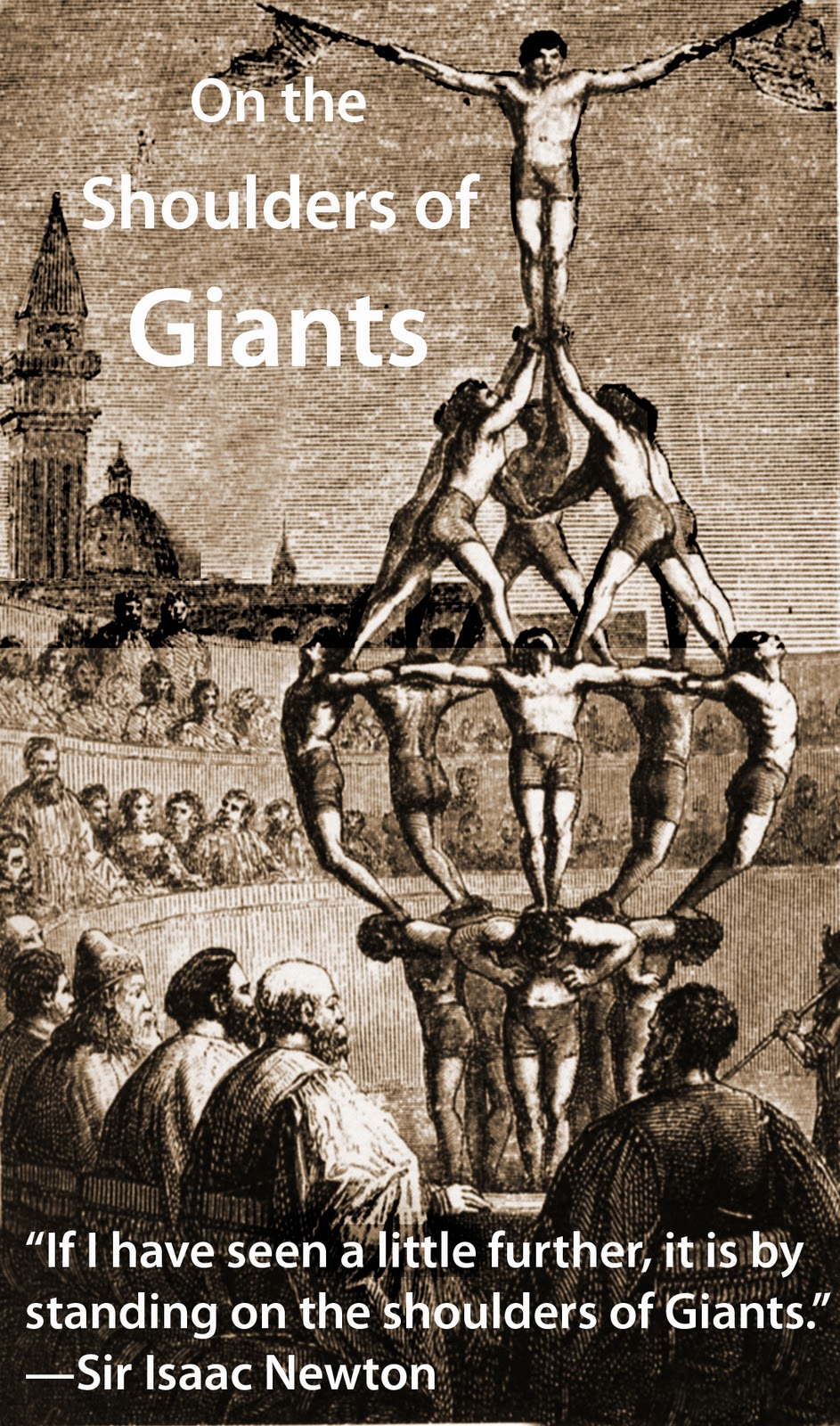
” If I have seen a little further, it is by standing on the shoulders of Giants.” — Sir Isaac Newton (1676) It’s ironic that Newton’s famously modest observation was itself plagiarized from his predecessors. Our good friend Wikipedia traces it back to at least the 12th century. But that’s the whole point: there’s nothing new under the sun, and if a towering scientific genius like Newton could give credit where credit’s due, so should we mere mortals. And besides, the historian in me enjoys making all kinds of connections between our vintage sepia past and our cutting-edge RGB present.
The result is this series, which will be a regular feature of the blog, an exploration of the multiple reincarnations of various physical comedy skills, gags, and concepts. There will be no attempt to chart every manifestation of an idea — I’m not that obsessive and I don’t have that kind of time — but I hope there will be enough examples to keep you and Sir Isaac happy. If you have more, just send them in.
Before I get into my first installment, take a look at “Great Artists Steal,” an interesting montage of Buster Keaton and Jackie Chan clips that was posted to YouTube a few months back. The picture quality ain’t great but it does a good job of showing one of the traditions Chan draws upon. Since many of Chan’s fans have probably never even heard of Buster Keaton (most of my college students haven’t), this in itself is a service. It doesn’t take anything away from Jackie Chan, who is brilliant in his own right, but shows that he is also smart enough to take inspiration from past artists.
So that’s the general idea. Just go to the next post for my first installment…
All those popular entertainments that we associate with physical comedy — circus, pantomime, street performance, to name just a few — have always been the poor cousins of the so-called legitimate theatre. A few centuries back, when ruling royalty wanted to clamp down on public expression, they only granted theatrical licenses to a couple of theatres, relegating everything else to the streets and the fairground.
Conventional theatre history is often just the narrative of what was approved for performance at respectable houses such as Drury Lane and the Comédie Française, everything else a mere footnote. Great dramatic literature was indeed showcased at these theatres, but on the other side of the proverbial tracks an alternative tradition flourished, given the name commercial theatre, popular theatre, or even people’s theatre… all depending on who was doing the giving.
When I was at NYU, I was lucky enough to study with Brooks Mc Namara, a young professor who thought this alternative performance tradition worthy of consideration alongside the greats of drama and the trendy experiments of the post-modernists. His efforts were occasionally derided by colleagues who thought such pursuits trivial, but pursue Brooks did, teaching what I’m pretty damn sure was the first graduate-level course in Popular Entertainment and, over the course of several decades, inspiring countless students to take the field seriously.
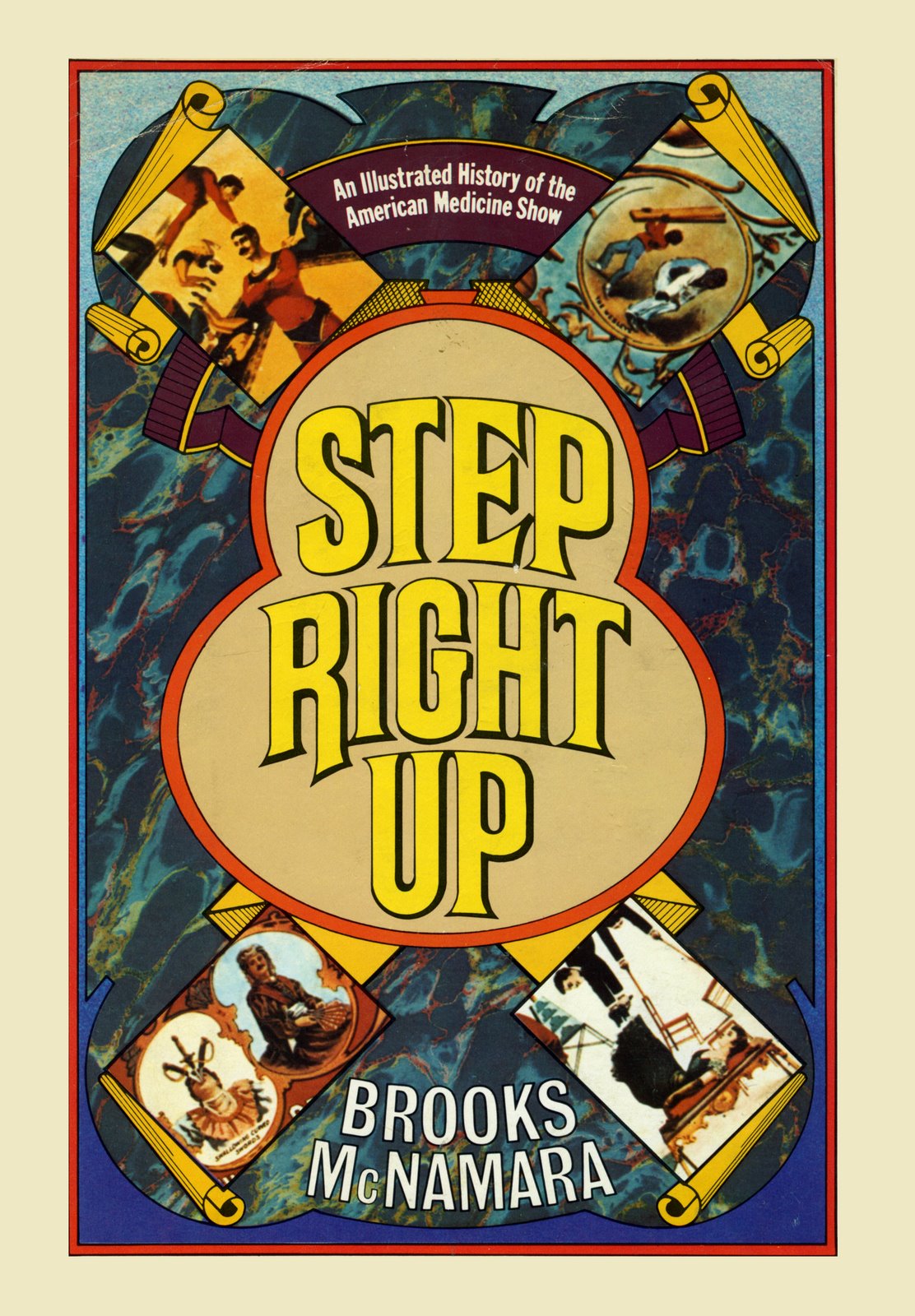
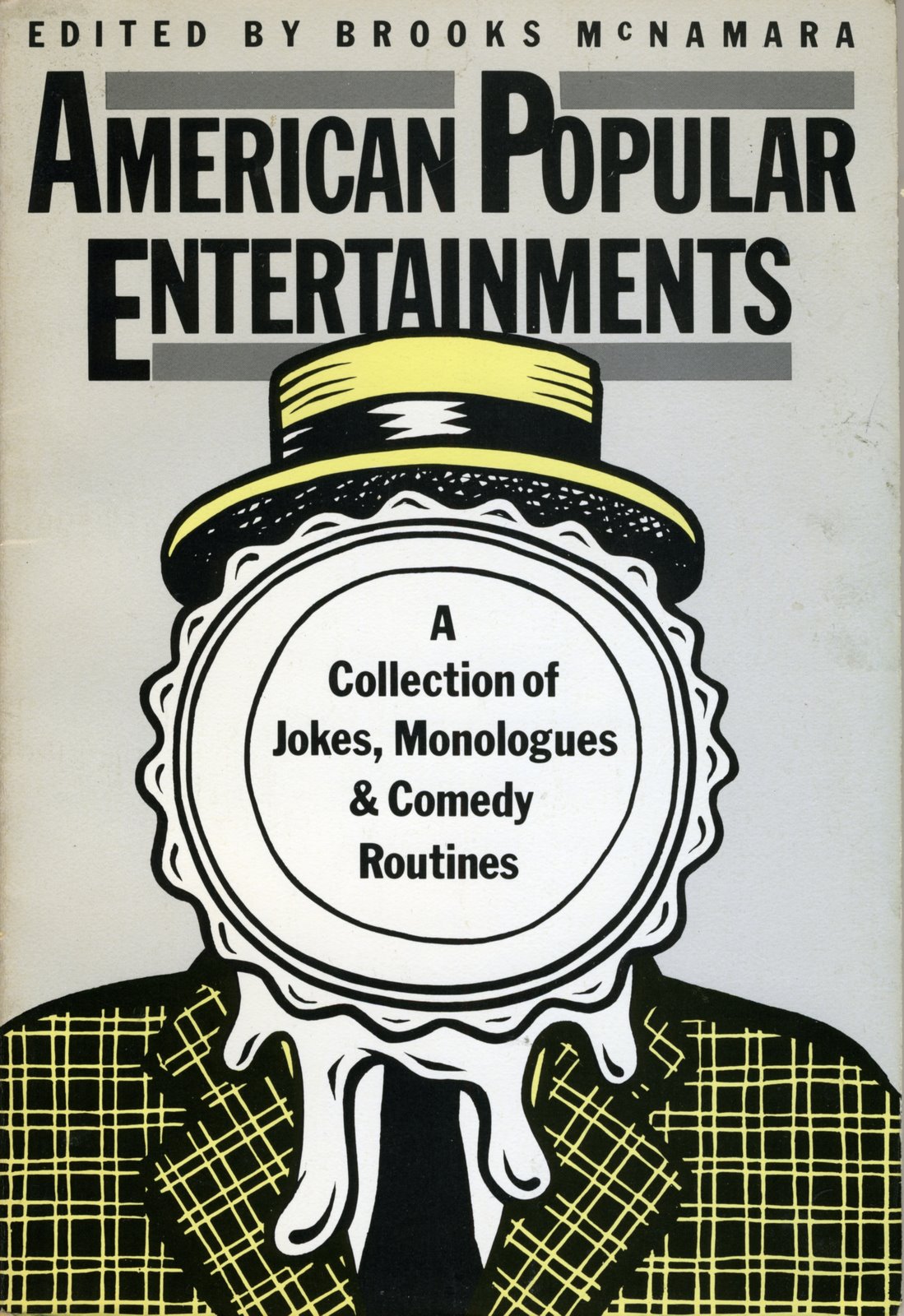
Through his teaching, mentoring, scholarship, stewardship of the Schubert Archives, and a dozen or so excellent books, Brooks was the prime mover in bringing popular performance traditions into the mainstream of theatre scholarship. Readers of this blog would probably find a lot to like in his books, especially Step Right Up! An Illustrated History of the American Medicine Show and American Popular Entertainments: Jokes, Monologues, Bits, and Sketches.
We lost Brooks McNamara earlier this month after a long illness. He was my mentor at NYU, the man who turned me on to all kinds of possibilities, the man who taught me more about writing than anyone else. He was my editor for Clowns and I had looked forward to sharing this blog with him; in fact, this blog’s banner is made from a vintage circus poster Brooks gave me as a wedding present. I know he would have been excited by the blog, but sometimes fate’s timing is downright rotten.
One more word about Brooks, which has nothing to do with physical comedy and everything to do with basic human decency. During my years as a graduate student at NYU, I paid off my tuition by working as an assistant editor on TDR (The Drama Review), an NYU publication where Brooks was an associate editor. It was the early 70s, and everything was political. Vietnam and Watergate dominated the news, but power issues permeated grad school programs and theatre magazines as well. Disputes were common and I was involved in more than my fair share of them (okay, maybe I was a bit of a hothead back then). Brooks usually ended up as the arbitrator, and unfailingly he did what was right while at the same time showing political smarts well beyond my youthful abilities. In other words, when push came to shove, a good man. He will be missed.
___________________
Update: My friend Arnie Aronson has written a very nice tribute to Brooks, with more biographical information, which you can find here.
As I said in my previous post, I have a bunch of additional material relevant to each of the twelve chapters of Clowns. This is especially true of Chapter 5, because it focuses on physical comedy. In fact, you could view this entire blog as Chapter 5 supplemental material! In addition, I’m still a huge fan of the Hanlon-Lees and I could overwhelm you with stuff on them, but I’m going to wait for the publication this fall of Mark Codson’s book (see below) to dive back into their work.
That being said, a few miscellaneous goodies…
__________________
On pages 5-6, I talk about nineteenth-century performers such as Mazurier and Klischnigg, who did remarkable imitations of monkeys, starring in vehicles such as Jocko, or the Monkey of Brazil. You can get some sense of what that might have been like from this comic turn by Buster Keaton in his brilliant short, The Playhouse (1921).
_______________
Baudelaire on clowns: the Vertigo of Hyperbole
When Tom Mathews’ English pantomime troupe visited Paris in 1853, one of the spectators was the French poet, Charles Baudelaire. Despite his well-known interest in the macabre and the grotesque, Baudelaire was somewhat taken aback by the British clown, the “English Pierrot.”
I shall long remember the first English pantomime that I saw. . .It seemed to me that the distinguishing characteristic of this genre of comedy was violence. . . . The English Pierrot was by no means this character pale as the moon, mysterious as silence, supple and mute as the serpent, lean and long as a pole, to which we were accustomed by Deburau. The English Pierrot comes in like a whirlwind, falls like a bale, and when he laughs he makes the room shake; his laughter sounds like joyful thunder. He is a short, thick fellow, who has increased his bulk by a costume filled with ribbons. On his whitened face he has crudely plastered — without gradation or transition — two enormous slabs of pure red. His mouth is made longer by a simulated prolongation of the lips in the form of two carmine strokes, so that when he laughs his mouth seems to open from ear to ear. . . . His moral nature is basically the same as that of the Pierrot we know: insouciance and neutrality, leading to the realization of all the rapacious and gluttonous desires, to the detriment sometimes of Harlequin, and sometimes of Cassandre or Léandre. But where Deburau thrust in the point of his finger so that he might afterwards lick it, the clown thrusts in both hands and both feet, and this may express all that he does: his is the vertigo of hyperbole. This English Pierrot passes by a woman who is washing her doorstep: after emptying her pockets, he seeks to cram into his own the sponge, the broom, the soap, and even the water…. Because of the peculiar talent of the English actors for hyperbole, all these monstrous farces take on a strangely gripping reality.
— De L’Essence du Rire (my translation)
__________________
In the book, I described The Duel Between Two Clowns, a clown act between Boswell and one of the Price Brothers (apparently William) involving an attempted two-high, a ringmaster, a duel, and some quick change. Amazingly there is an actual transcript of this routine from the 1840s in Entrées Clownesques, a collection of clown texts compiled by the great French circus historian, Tristan Rémy. I have no idea what the original source for this document is. Rémy’s book was translated into English by Bernard Sahlins as Clown Scenes (Chicago: Dee, 1997). Unfortunately, for some reason he only includes 48 out of the 60 entrées contained in the original, and Le Duel Entre Deux Clowns ain’t one of them. Thanks, Bernie, for forcing me back into the highly lucrative clown entrée translation business!
Here it is, hot off the press. Please use your imagination to see beyond the dialogue and picture the act performed by two very strong clowns.
[Forthcoming!]
__________________
Another link between 19th-century pantomime and early film: First here’s a poster of the train wreck from Le Voyage en Suisse (1879):
And now here’s a shot from the 1904 Georges Méliès film, The Impossible Voyage, courtesy of the Library of Congress.
Coincidence? I think not. Méliès was, as many of you probably already know, a stage magician who became a pioneer of special effects in early film. And while we’re on the subject, the connections between film effects and circus-style performance is the subject of an intriguing blog that you might want to check out: Circo Méliès.
_______________
And in my first On the Shoulders of Giants installment, I reinforce the obvious connection between the Byrne Brothers’ Eight Bells and Buster Keaton’s Neighbors by showing the Keaton clip that brings the poster to life (and then some).
_______________
Mistakes? What mistakes?
Probably plenty; here’s one…. Mark Codson, whose excellent dissertation on the Hanlons will be published this fall, pointed out that I persisted in translating the title of Le Voyage en Suisse into English, when in fact the show toured to England and the United States with the original French title. I was probably thrown off by a few bi-lingual posters and by a previous commentator or two who also referred to it as A Trip to Switzerland. The correction has been made, so thank you Mark. If anyone has additional corrections, just let me know. UPDATE (11-17-09): Mark’s book is now slated for publication on February 2, 2010. You can order it here.
_______________
UPDATE (11-17-09): You can see a version of Auriol’s bottle-walking act in Cirkus Cirkör’s production, Inside Out. Read all about in in this post.
_______________
So what’s missing?
It’s the second longest chapter in the book, and one of my favorites, but it has at least one glaring omission, the work of American pantomime clown George L. Fox. Yes, I do mention him, but that’s about it. He was wildly popular and a colorful character (he went insane), but I think at the time it was hard to find all that much about his actual performing. Or perhaps I just ran out of time.
A few years later, when Bill Irwin was first considering doing a show based on Fox’s life, I helped him out with some additional research, including uncovering some original pantomime scripts. It was not until 1999 that Laurence Senelick’s excellent study appeared: The Age & Stage of George L. Fox, 1825-1877. Armed with this thorough research, Bill finally did his show, Mr. Fox: A Ruminationin 2004 as part of his season of work for the Signature Theatre.
Finally I get to answer all those questions I’ve been getting for over 30 years!
If Clowns was published back in 1976, aren’t you like 100 years old by now?? I was young then, now I’m 60 (but I still do triathlons).
Why isn’t it still in print? Because my publisher, Hawthorn Books, got bought by Dutton who got swallowed up by Elsevier and, back in those pre-Amazon days, a global conglomerate like Elsevier had no reason to keep a niche book in print if bookstores were no longer stocking it. Counting the hardcover and the paperback, it sold nearly 20,000 copies (no, I didn’t get rich), but at a certain point the Law of Diminishing Returns kicks in.
Can you sell me a copy? Nope. I only have three hardcovers and one paperback to my name, and they’re all falling apart, which is kind of strange since it’s not my favorite reading material. When I prepared chapter five for this blog (see previous post), it was the first time I’d read it since I wrote it.
Couldn’t you have gotten it reprinted by some university press or small publishing house? Maybe, but no one ever made me an offer I couldn’t refuse, and I never had the time to pursue it. Life gets busy, life gets complicated, you develop other interests, you have other matters you have to deal with. Furthermore, I would have wanted to improve it rather than just do a straight reprint, and that meant work I didn’t have time for.
What kind of improvements? First, correcting mistakes. Yes, I wrote the book under a deadline in little more than a year’s time, so there’s stuff to fix. Furthermore, there are sections I would expand upon, and of course plenty has happened in the clown world since 1975.
So why are you suddenly doing this blog? Because I’m entering a full-year sabbatical from my teaching job at Bloomfield College. Because I did a lot of work toward a physical comedy book that I never had time to finish. Because I’m still a big fan.
Will we see more chapters from the Clowns book? Well… no promises, but the plan is to put them all online as pdfs, suitable for printing. It is a lot of work: proofreading the OCR text, scanning pictures, redoing the layout, fixing mistakes. I also want to offer supplemental material on each chapter; I have a ton. For example, there was a 100-page appendix to the book — all sorts of scripts and related documents — that got as far as galley proof stage but then never got printed because Hawthorn realized it would just cost them $ without boosting sales.
And then will you reprint the book? Ideally, yes, but again no promises. It’s more likely to happen if the blog process helps me improve the product, which is why I welcome your corrections, comments, and suggestions.
And since this is a blog and I’m supposed to provide a lot of visual elements so you don’t get bored by too much reading (God forbid!), here’s a pic of what the original Clowns wraparound cover looked like before they opted for the Otto Griebling cover you see above.
Chapter 5 from my book, Clowns: A Panoramic History
One more background piece. This chapter from my 1976 history of clowns dealt in detail with the development of physical comedy in the nineteenth century and, ultimately, its influence on American silent film comedy. Good stuff!
[The usual Scribd note: click on icon in upper-right corner to view document full-screen; click again on same icon to return to blog.]
This article with the overly-cute title, which I wrote for Yale Theater magazine some 22 years ago at the behest of editor Joel Schechter, is still the best intro to where I’m coming from on the subject of physical comedy. This was about 11 years after I wrote Clowns, but this time around I had more fun with the writing and tried to make a wider range of connections between performance and the so-called real world. I still like the article, and I welcome your feedback on it.