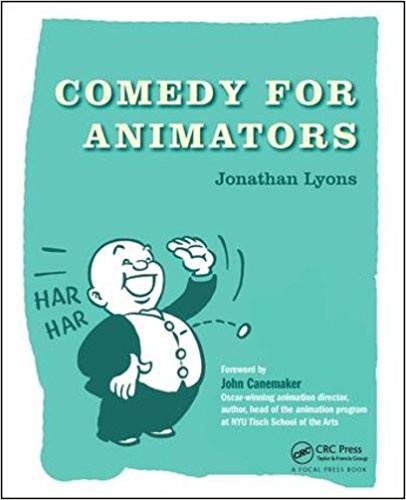
Book Review: Comedy for Animators by Jonathan Lyons
Most clowns I know love cartoons, often having the same reverence for Daffy Duck and Bugs Bunny that they have for Charlie Chaplin and Buster Keaton. Comedy animators have borrowed a lot from the (human) physical comedy tradition, but there’s a lot we can learn from animation. And a good place to start is the creative and historical work of Jonathan Lyons.
Jonathan has worked for over 25 years both in traditional animation and 3D, with an array of impressive credits that include the first four Pirates of the Caribbean films; Pillsbury Dough Boy commercials; two Clio awards while working at Industrial Light & Magic; his own independent films featuring Floyd the Android; and much much more. He has taught animation at the university level and for years has authored a blog, Comedy for Animators, which you should dive into headfirst at your earliest convenience.
________________________
“To get laughs with animation, you have two choices. Gags and jokes. A gag is intended to create laughter with visual humor. A joke uses words for the same purpose. Tex {Avery} was right, gags are hard to come by, requiring considerable time to develop and integrate into the action in a natural way. American television animation has relied on verbal jokes because they are far more efficient in production. A group of writers can sit around in a room and pitch storylines, then fill in some jokes, and before you know it the script is ready and there is only limited expectation on the artist to make it look good. Visual gags require much more time to invent, develop, and work into action. Jokes don’t really affect the storyline, whereas visual stunts will physically change the situation for the characters. Gags need careful timing and acting, which require more time than lip-synching words… One aspect of visual comedy does make it easier, though. A joke heard once is used up, whereas a good sight gag can be successfully recycled.”
________________________
Jonathan’s blog led to the book of the same name, which is targeted for animators who know how to draw funny characters but don’t understand the craft of physical comedy. Thus there are chapters on characterization, comedy teams, context, gags, and storytelling structure. Not all of this is new, but it is pulled together with a unique slant and analyzed with the precision of a creative artist who uses these concepts day to day and not that of an academic on the outside looking in. The book should be an essential source not only for animators trying to tell stories through images, but also for the readers of this blog engaged in live performance. Jonathan offers strong insights for performers telling stories through their own extreme physicality, making very useful connections between live action and animated movement. Highly recommended!
You can buy the book here
and check out his web site here.
And if you want proof that Jonathan knows his stuff, just check out these videos…
his demo reel
one of his Floyd the Android short films
And here are two wonderful video compilations Jonathan has put together analyzing physical comedy:
We continue our series of popular guest posts on eccentric dance by Betsy Baytos with a piece on the multi-talentedRed Skelton. I was actually on his show (in a skit with Jackie Gleason!) a few days after my seventh birthday, and 28 years later he consented to be honorary chairperson of the first NY International Clown-Theatre Festival, but (unlike Betsy) this time around I did not get to meet him. Click here for all of Betsy’s posts on eccentric dance. —jt
_________________________________
Red Skelton had always been a favorite of mine growing up, but I never dreamed I would have the opportunity to meet, let alone interview, the great comic. I had just made the decision to work on the documentary but I had no clue how I, with no financial backing or studio supporting me, could make these great artists sit down and talk intimately about their careers. But I had to try.
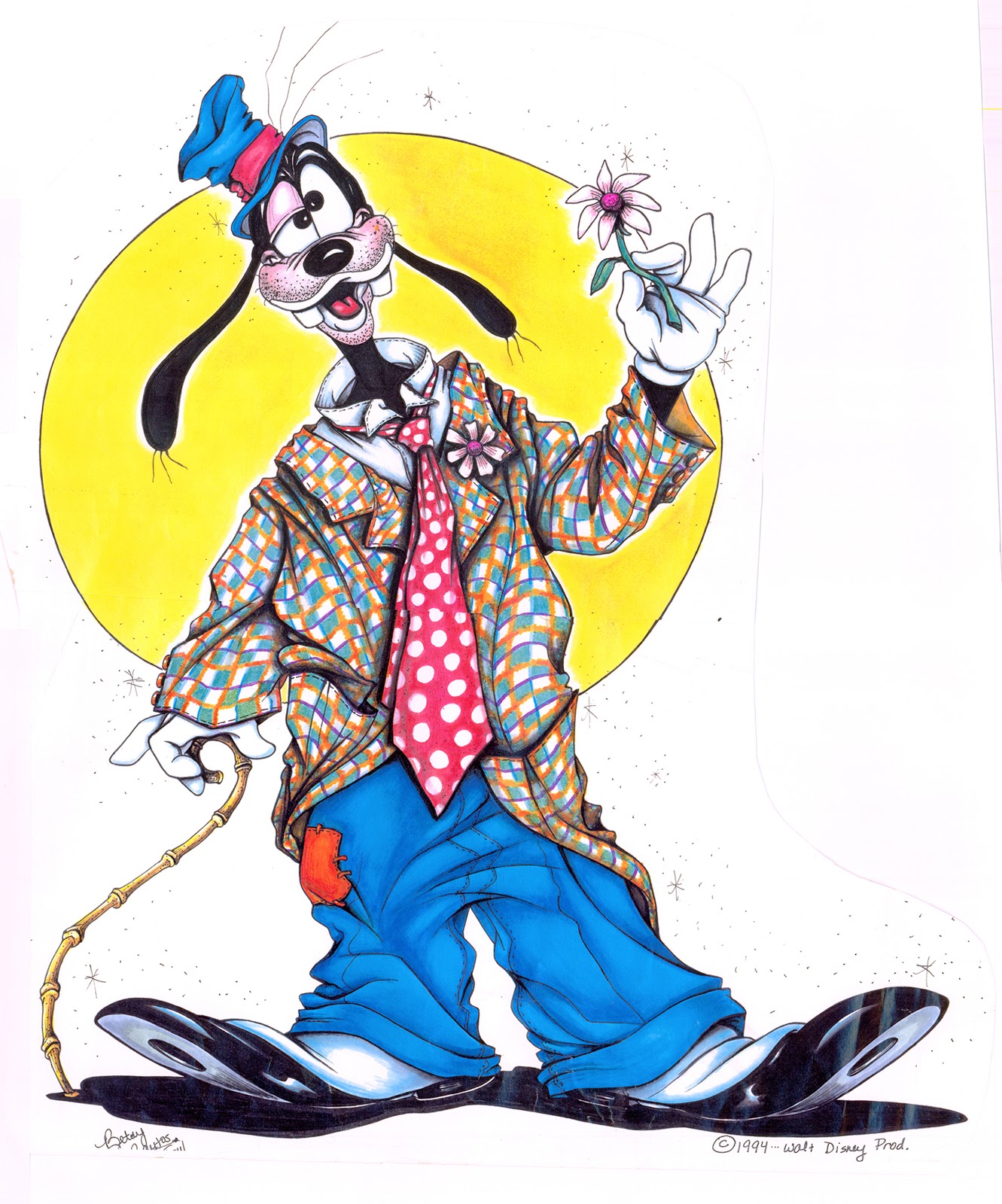
I was living in New York at the time, freelancing and touring for Disney, and somehow managed to get a contact to Red. He was to be my first interview for the film, but how? Aha! I knew of his clown paintings and I worked hard on a full color Goofy as Freddie the Freeloader, sending it off to Rancho Mirage, while hoping for a reaction. When I followed up with a call, an old German woman answered, “Mr. Skelton does not take interviews!” I asked her to verify that the illustration arrived safely, and she was gone a long while. Finally she returned, surprised as I was. “He said YES!” and I jumped, “I’m on my way!”
I flew out the very next day, rented a car, and spent a sleepless night at a motel near Red’s house, as the interview was early in the morning. I was nervous as Red, over six feet tall, opened the door smiling, cane in hand, and chomping on a cigar, ushered me in. His wife, Lothian, daughter of the great cinematographer Gregg Toland, walked in, curious as to my agenda.
He sat down as I babbled about eccentric dancers, and kindly listened, commenting about the dancers he knew, while signing plates depicting his clowns. I had brought footage on a small portable television but needed to somehow divert his attention. I then mentioned Charlotte Greenwood and placed my leg straight up the door frame. Red, taken aback, sat back staring, got up and left the room, leaving me alone with my leg attached to the door frame, aghast as what to do next! Minutes seemed like hours…..
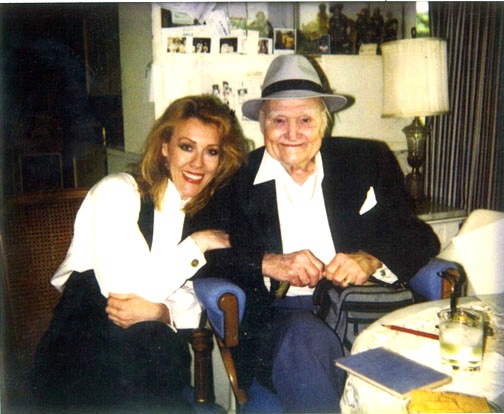
Betsy & Red
Red returned, camera in hand, chuckling heartily. Whew, I did it! I quickly made space in the living room and proceeded to dance eccentric, with Red filming away in delight! He then agreed to do an interview at a later time. With the backing of the New York Performing Arts Library and a grant from Jerome Robbins, I managed to sit him down a few months later, for one of the most extraordinary interviews in Funny Feet. For over two and a half hours, Red graciously made me feel at ease, sharing his incredible background, and regaling me with timeless stories. My focus with this film had always been on a performer’s technique, the process of character development, and setting up a gag, and essentially how to make a step “funny.” Red delivered over and above, with insight on how he studied babies for his drunk act and how you “have to get right up on a pratfall or the audience will think you are hurt!” Pure gold and I was so grateful for this rare opportunity.
Betsy & Lothian
I kept his wife, Lothian, informed, and when Red passed, she reached out, saying how Red had planned to continue touring, and how he considered me as his opening act! What a thrill that would have been! Lothian and I have since become close friends, and that experience and interview compelled me to push on, making me realize how much these great artists have yet to give!
Here are two amazing Red Skelton clips, the classic Guzzler’s Gin, followed by the lesser known dance class sequence from Bathing Beauty (1944). Skelton’s pantomime is pure “eccentric” in how he uses his character and has a specific reason for everything he does, in every gesture, every move. There is action and reaction. His body language as a ballerina, from a slumped position as he enters, to the extreme pulling up as he gets slapped around, is what makes that piece so effective.
The same in animation: it’s all about the extreme pose and how you build a gag. An eccentric dancer doesn’t give away what is about to happen, instead looking just as baffled as we are at the results of their antics. Surprise is the key, and as the music escalates, so does Red. It’s musicality, not just in dance but in his pantomime. Choreography is not steps, but movement; no matter how small, it’s all important to the development of the routine.
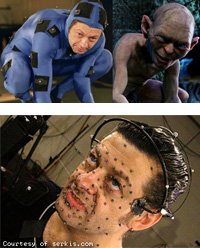
Pop quiz:What do King Kong and eccentric dance have in common? I had no idea, but it turns out the missing link isAndy Serkis,known to millions as Gollum in Lord of the Rings and The Hobbit, as the giant ape in King Kong, as the chimpanzee Caesar in Rise of the Planet of the Apes, and as Captain Haddock in The Adventures of Tintin. Millions except for me, that is, but now thanks to our resident eccentric dance expert,Funny Feetdirector, and guest poster Betsy Baytos, I am being properly schooled. In addition to voicing these characters, Serkis’ body language and facial expressions were digitized by means of motion capture technology and formed the basis for animating each one of them. Not surprisingly, this leading motion capture actor with the circus name is also a student of eccentric dance. Take it away, Betsy! —jt ____________________________________
Many wonder why on earth do I need to reach across the pond for eccentric dancers, but there are several reasons, and here is only one: Andy Serkis, a celebrated actor and director, whose brilliant character work has galvanized motion capture technology! What a surprise when English actor and friend Tim Spalls suggested I seek Andy out for his role in Topsy-Turvy, the highly acclaimed musical drama about Gilbert & Sullivan. I soon came upon this blog post he wrote on studying eccentric dance for the role! He is one of many contemporary actors and physical performers the U.K. who I must include in Funny Feet!
Topsy-Turvy Notes from Andy Serkis
In Topsy-Turvy, Mike Leigh’s award-winning, highly authentic investigation into the lives of Gilbert & Sullivan and the D’Oyly Carte company circa 1885, I play the Savoy choreographer. The character was based on the real life of John D’Auban, an eccentric performer and consummate theatrical. Stepping into his shoes was an immensely pleasurable but physically challenging experience. D’Auban was known in his day as a grotesque pantomimic dancer, a music-hall artist, and a choreographer of ballet, of burlesques, and of practically all Gilbert & Sullivan’s works. He also taught dance and invented the “star-trap,” a rather dangerous piece of stage machinery.
In the six months leading up to filming, I studied ballet, Irish dancing, and (for four hours a day) eccentric dance with choreographer Fran Jaynes. Research on the Internet unearthed an extensive thesis about D’Auban, which revealed where he was born, lived, got married, died and was buried. I visited all these locales. Along with the entire company of actors researching their own roles, I delved deeply into the business of living day-to-day in Victorian London. What trams or buses did one travel on? Where did one eat? What sorts of street food existed, what were the buzzwords of the day? Etiquette, the social and political scene. Nothing that pertained to the lives of these characters was left unresearched, all so that when the actors came together “in character” they had so much ballast to sustain the imagination and keep them completely submerged in the moment, able to improvise freely for hours.
The most memorable times were when we came together to improvise the D’Oyly Carte Company “rehearsal” scenes. The Savoy Theatre (created by reshaping Richmond Theatre) was bustling with sometimes 60 or 70 actors wandering around in character, carrying out their daily business in full Victorian garb. It was extraordinary hurrying to “rehearsal”, greeting members of the chorus, stage managers, principal actors such as Grossman and Temple, and then Gilbert himself would stride in and the rehearsal would commence. D’Auban would inevitably be late, having dashed from some pantomime or dance class, arriving like a whirling dervish. He was a very busy man. Egos would clash, tempers flare, life and death decisions about a particular gesture or dance step were thrashed out. Anyone walking in off the street witnessing these moments would honestly have believed they had traveled in time — it was that potent.
The scene that encapsulates D’Auban’s spirit in the film revolves around a rehearsal for which Gilbert has brought in three genuine Japanese women in an attempt to authenticate the Three Little Maids choreography that D’Auban had lashed together from stock “oriental” pantomime steps. Where Gilbert wants reality, D’Auban wants comedy. It is wonderfully reminiscent of the eternal battle of “art” versus “bums on seats.” D’Auban’s parting shot is “I haven’t laughed so much since my tights caught fire in Harlequin Meets Itchity Witch and the Snitch.”
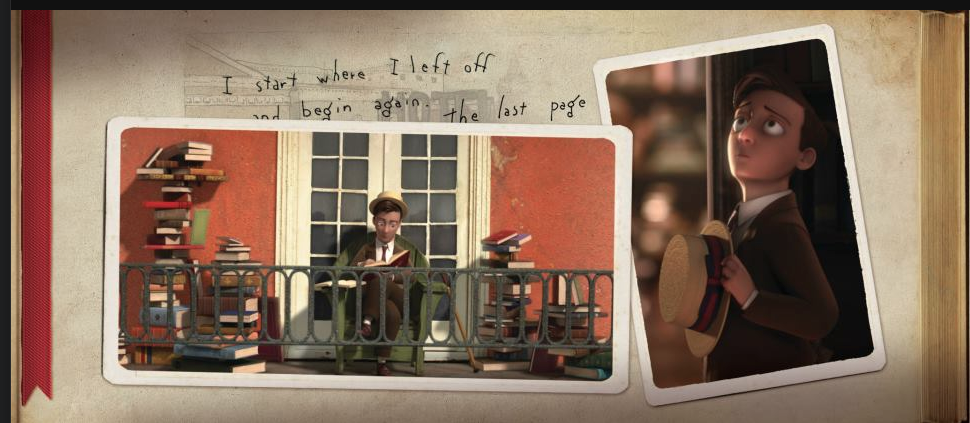
Not only did The Artist score a touchdown for silent films with its five Academy Awards, but the prize for best animated short went to The Fantastic Flying Books of Mr. Morris Lessmore, a movie “inspired, in equal measures, by Hurricane Katrina, Buster Keaton, The Wizard of Oz, and a love for books.” Fans of Buster will recognize the physical resemblance (and the pork-pie hat), but the movie goes further by paying tribute to such stormy Keaton movies as One Week and Steamboat Bill, Jr., as well as to the dance virtuosity of Chaplin’s tramp.
The producers have been so generous as to put the entire 15-minute film online for free viewing. I recommend full screen! Thanks to Tanya Solomon for the link.
This is an amazing split-screen comparison of Jerry Lewis in The Errand Boy (1961) — where Jerry the lackey is miming being the boss — and the “Brian & Stewie” episode of Family Guy (2010), put together by YouTuber MrEthernex. The music is Count Basie’s “Blues in Hoss Flat” and appears in both original versions in lieu of dialogue.
In the lawsuit that followed, Seth MacFarlane claimed the similarities were purely coincidental! Can you believe it? Well you shouldn’t, because I just made that up. No lawsuit, no plagiarism; take it as a sweet tribute to Lewis. Thanks to Tom Etzel for the link!
[Jonathan Lyons is an animator at Imagemovers Digital, and you can see his latest work in Disney’s A Christmas Carol, starring Jim Carrey, in theatres everywhere right now. You can read his other guest posts here and here.]
When I was an adolescent living in New England, I was told that Ringling Brothers Barnum and Bailey Circus ran a clown college in Florida. To me, that sounded like an excellent institution of higher education. Just about my speed.
Alas, one thing leads to another and the decades go by. I never made it to Clown College. I think perhaps it’s a good thing, as I am somewhat injury prone. I probably wouldn’t have lasted many years in the profession. Still, my love of physical comedy, and my curiosity about the art remains undiminished. I practice it in a virtual form, animation. Recently however, I had a chance to sample the real-world training of a physical actor.
I live in Marin County, California, and this past summer a new school opened up in San Fransisco, just across the Golden Gate Bridge. The Flying Actor Studio, operated by James Donlon and Leonard Pitt. They offer “physical theater training with world-class master teachers offering: movement, mime, mask, clown, circus arts, improvisation, voice, new performance.” They have an impressive list of guest instructors, including Geoff Hoyle, John Gilkey, Bill Irwin, Judy Finelli, and Suzanne Santos.
To kick off the opening of the school, they held a special performance with Donlon, Pitt, and Cirque du Soleil alumni, John Gilkey. The show was called “The Zany and the Surreal.” It featured rotating solo performances from the three actors. Donlon delivered some of his deeply felt mime, Pitt introduced some mask techniques and told an entertaining Jewish tale. John Gilkey’s pieces included his signature coat rack juggling routine, which I enjoyed watching in the Cirque du Soleil show Quidam.
The Flying Actor Studio is a full-service training facility offering everything from one-day workshops to a full-time, 28-week conservatory program. They also arrange special guest shows and workshops. This October they welcomed the International Czech Theater Festival, and held a clown workshop with Steve Capko. Among the workshops and classes they had the ideal opportunity for a working family man such as myself. “Meet the Flying Actor Studio Drop In Class”. Held on a Sunday, 10 am to 4pm, it is described like this:
“A survey of the Flying Actor Studio methods including improvisation, imagination, time, movement, mask, and mime. This class is offered on a sliding scale to make our classes accessible.”
I was happy to pay the high end of the $25 to $40 suggested price. It was more than reasonable for the experience. I and a handful of other participants warmed up with stretches in the bright loft space. Some of them were actors, at least one other was just curious like myself. James Donlon ran the morning half of the program. Among Mr. Donlon’s many teaching credits, was the Ringling Brothers Barnum & Bailey Clown College. Finally, I would have my day! We did a variety of basic exercises in movement. He introduced the idea of “neutrality,” which I found intriguing. Neutrality in this case being a way of moving (or being still) that would offer no clues about the person. You wouldn’t be able to determine age, sex, state of mind, state of health, anything. Half of us would wear black hoods, to hide the face, while walking around the room in whatever fashion felt neutral to us, while the others would discuss what they saw. We did the same thing with sitting in a neutral position. While I would have thought that the class would be all about creating character, this exercise in removing character was just as informative. After that we practiced a variety of mime exercises, and by this time, I was beginning to sweat. It was a workout, and I would be sore the next day.
After a lunch break, Leonard Pitt took over the class. During Mr. Pitt’s 40 years of experience he has studied with Etienne Decroux, written several books, and been a movement consultant on major motion pictures. We started with an exercise between pairs of people locking eyes and moving back and forth as though on a rail. Building on that we expanded it to random group movement, quickly switching to pairs. The exercise involved focused attention, and physically grabbing attention from others by just turning towards them. I can see where it would be a useful exercise for the stage movement. Following that, Mr. Pitt introduced us to the basics of using masks. It was interesting to learn that mask work is not so much about movement, but about posture and posing, and also eye direction. This is useful stuff for an animator.
Thanks to James and Leonard for setting up such an accessible, educational and enjoyable program. Good luck to them and their venture.
Click here for more information about the Flying Actor Studio.
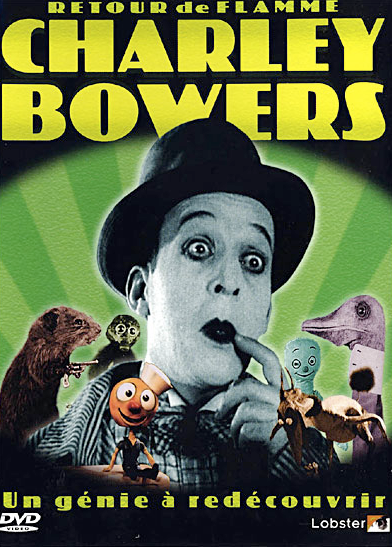
Charley Bowers: The Rediscovery of an American Comic Genius Co-produced by Image Entertainment (USA) and Lobster Films (France) 2-disc DVD; run time 149 mins. 2004
Several DVDs have come out in the past year or two that I should be blogging about, multi-disc sets of the work of Harry Langdon, Douglas Fairbanks, and Charley Chase, for example. Instead, I want to do some catching up and write about a DVD set that came out five years ago on the work of Charley Bowers (1889 – November 26, 1946) . Why? Because it’s exciting stuff, and because today is Thanksgiving and it was on this day 63 years ago that Bowers passed away in almost total obscurity. Let’s see if I can show you why we should be thankful for his life’s work.
I suspect that most of you are saying “who in the hell is Charley Bowers?” In brief, he was a cartoonist, animator, and silent film comedian who, between 1926 and 1931, created a series of short films (no features), sometimes labeled “novelty comedies,” that combined live action with stop-motion animation, and that display a unique comic imagination. While much of silent film comedy exhibits a certain formulaic sameness, Bowers is a refreshingly original thinker whose work I think you’ll love.
Bowers’ name does not even appear in many of the standard books on the silent era, such as Walter Kerr’s The Silent Clowns (1975), and the reason is simply that his films were lost for decades. Even Neil Pettigrew’s more recent authoritative history,The Stop-motion Filmography, does not mention Bowers, but that book came out in 1999, this DVD in 2004. Although Bowers was popular enough in his day to be able to write, animate, and usually star in over twenty movies for R-C Pictures and Educational Pictures, by the time Keaton, Chaplin, et. al. were being appreciated anew in the 60s and 70s, his name had long been forgotten.
The story of his rediscovery is told on a 15-minute documentary on disc 2 of the DVD. Raymond Borde of the Toulouse (France) Cinémathèque was a relentless collector of old films. He knew that traveling carnival acts would often open performances by showing a short American silent film comedy, so he would buy these from them whenever he could, paying for reels by the kilo, sight unseen. He hit the jackpot one day when a rusted cannister of films he bought from a gypsy family turned out to contain three films by Bowers. The only problem was that instead of being attributed to Charley Bowers, the sole credit was to Bricolo, the French name for his movie character. No one knew who this Bricolo was, and years went by without any progress. The films were even shown in a retrospective at the 1976 Annecy (France) film festival, without anyone yet knowing this was the work of Charley Bowers.
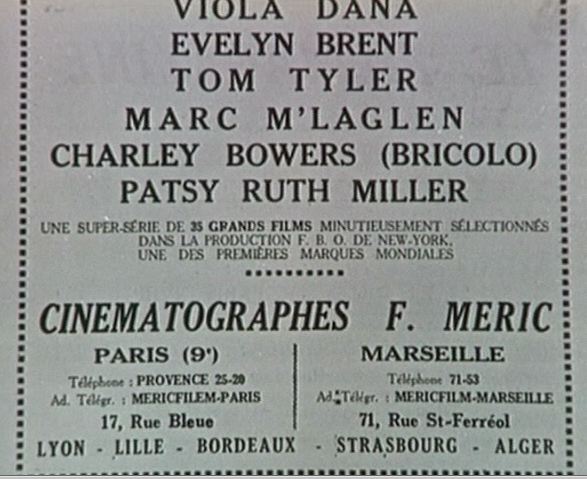
One day this ad in an old film directory was discovered, providing the link between Bricolo and Charley Bowers. This eventually led to a film historian in Montreal who had some slight knowledge of him and to a folder of info buried away at the Library of Congress. More information was uncovered, as were more films, but there are still eleven lost films, and the details of his life are few. The only account of his early years is from a 1928 press bio that seems too colorful to be true: he was born in 1889, the son of a French countess and an Irish doctor. When he was five, a tramp circus clown taught him tightrope. At age six, he was kidnapped by a circus. When he finally made it back home two years later, the shock killed his father.
Hmm..
What we do know is that between 1916 and 1926 he wrote, produced, and directed hundreds of cartoon film shorts based on the Mutt & Jeff comic strips. At some point he made the transition from these hand-drawn cel animations to stop-motion animation, in which you move or manipulate a physical object a small amount, recording a single frame so that when the movie is played back the object appears to move at normal speed. Here are two brief clips about an automated restaurant that show this transition. The first is from one of his Mutt & Jeff cartoons, Grill Room Express (1918, aka The Extra Quick Lunch), the second from He Done His Best (1926).
In 1926, he began combining stop-motion animation with live action, and there are historical references to the “Bowers process” and to a “Bowers camera” that he invented precisely for this purpose, but so far I haven’t uncovered any info on this. Bowers has been credited by some with being the first filmmaker to develop this hybrid form. This may not strictly be true, but the extent to which he did this, and the overall technical level of both the animation and the live action was very likely groundbreaking for 1926. In fact, the story has it that a scene where a herd of elephants seem to enter the Capitol building in Washington, D.C. so fooled people that certain muckety-mucks demanded an official investigation.
Before going any further, let’s get more of a taste of his work. (Both of these next two clips are on YouTube, but there’s not much more of his work up there.) First is a sample of Bowers the silent film comedian from Egged On (1926), the earliest film we have of this hybrid form. The live action star is none other than Charlie Bowers, playing an eccentric, misunderstood outsider whose persona has been compared to that of Keaton. (As a performer he’s no Keaton, but he gets the job done.) Charley the eccentric inventor can’t pay the rent, but he’s on the verge of riches with his invention of the unbreakable egg. His approach to selling his invention is a good example of Bower’s offbeat sense of humor.
The second clip, from his only sound film, the 1931 It’s a Bird, showcases his amazing animation talents. An expedition to deepest, darkest Africa has netted Charley a rare metal-eating bird, which he hopes will prove to be his road to riches:
A Bowers film tends to follow the same general formula. Charley is an eccentric but brilliant inventor, a 1920s Doc Brown, only Bowers is younger and counting on his creations to help him escape poverty and win the girl. To solve the predicament at hand, he typically throws together a Rube Goldberg contraption from spare parts that somehow performs miracles that defy the laws of science. His character’s French name, Bricolo, is from the French verb bricoler, to tinker, and the French noun bricolage, do-it-yourself. Bricolo’s invention always works, but his ultimate success can still be thwarted by unforeseen twists of fate. One aspect of his films I particularly enjoyed is the unpredictability of his endings. The first one I watched did not end well for Charley, so I assumed the stories would always be aiming for Chaplinesque pathos. The next film, however, was the opposite, more along the lines of a Keaton or Lloyd ultimate-vindication finale. He keeps you guessing.
Bowers attracted the attention of André Bréton, leader of the surrealist movement, who wrote of It’s a Bird! that it “took us away, for the first time, our eyes opened to the dull sensory distinction of reality and legend, to the heart of the black star.” (Those surrealists sure had a way with words.) And in his Fifty Year Surrealist Almanac (1950), Bréton listed the one film that had meant the most to him each year, and It’s a Bird! was one of those films, as was Duck Soup for 1933.
Bowers’ movies are uneven affairs, a bit choppy, what with the combination of elements, and at times the storytelling can come to a screeching halt while he shows off with lengthy animation sequences. In his best moments, however, Bowers’ humor is wonderfully quirky and even downright brilliant. At one point his character says “sometimes I nearly ran out of ideas,” but with Bowers the opposite is the case, his head bursting with wild premises. There he is, struggling to invent a non-slippery banana peel, or trying to win a Charleston contest by taking a correspondence course.
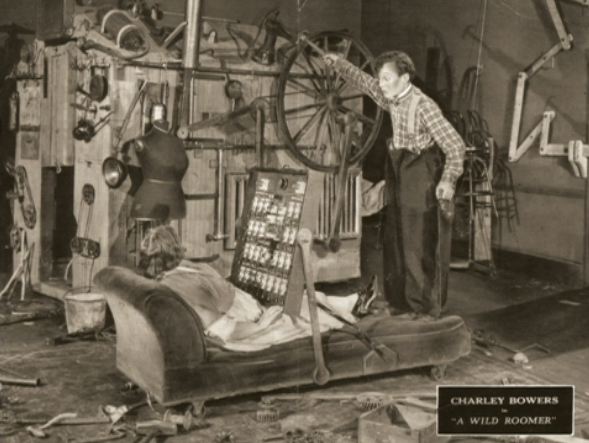
His physical comedy always goes one step further. His sweetheart’s cop father doesn’t throw him out the door, he throws him thru the door. In A Wild Roomer, he tows an entire staircase out of a house — by accident. I’m pretty sure he has the highest WDR (wall destruction ratio) of any silent film comedian.
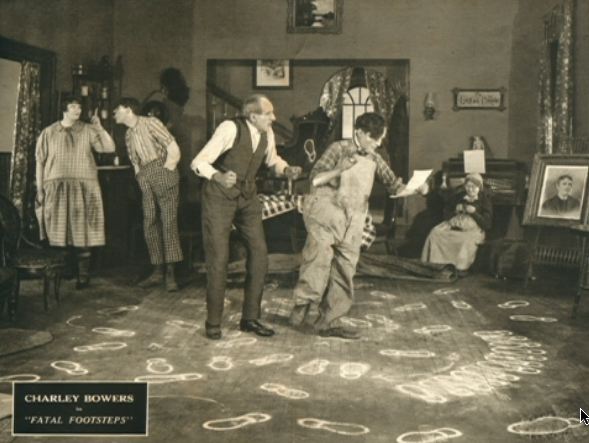
Bowers also does not shy from social commentary. In Fatal Footsteps, he satirizes uptight townspeople who are fighting the popularity of social dancing, and particularly the upcoming charleston contest. The name of the town is not subtle: Dumbville. Sam, the leader of the opposition is exposed as a hypocrite, but even he is eventually converted to the joys of cutting a rug when he accidentally puts on Charley’s latest invention, a pair of automated dancing shoes.
By movie’s end, Sam is getting his fellow old fogies to dance, and the final shot of the film is a fish dancing in its bowl.
Another example is the ending to Now You Tell One, one of my favorite Bowers movies, but I won’t spoil it for you since you can watch it below. It all starts at a meeting of a “Liar’s Club.” The head of the club is disappointed in the stories the members are coming up with. Stumbling on Charley and his story, he brings him to the club to tell it. Beginning of the movie within the movie.
It seems Charley fell for this girl and when he visited her house he discovered a sad picture. The girl’s house is seriously overrun with mice. The woodwork is full of holes and collapsing, the father gone batty from the onslaught. The sole cat is battered and beaten down. Charley moves in and sets to work developing a breed of more robust cats to fight the infestation. Here’s the rest of the movie:
There are a few hours of this on the DVD, so check it out. It looks like it’s on back order from most DVD vendors, but it is available on NetFlix.
Happy Thanksgiving, all!
_______________________
Disc One Egged On (1926; 24:08) He Done His Best (1926; 23:42) A Wild Roomer (1927; 24:27) Fatal Footsteps (1926; 22:20) Now You Tell One (1926; 22:21) Many a Slip (1927; 11:35) Nothing Doing (1927; 21:13) Disc Two Grill Room Express (1918; 5:36) [alternate title: The Extra-Quick Lunch] A.W.O.L. (1918; 5:24 ) Say Ah-h (1928; 14:03 = part 2 only) It’s a Bird (1930; 14:09 ) Believe it or Don’t (1935; 7:55 ) Pete Roleum & his Cousins (1939; 15:38) Wild Oysters (1941; 10:07) A Sleepless Night (1940; 11:00) Special Features Photo Album slideshow (1:45) Looking for Charley Bowers (15:43)
Yep, the start of another new regular feature of the blog:
The Guest Post!
I’m honored to include the thoughts of experts in the field to this blog, so let’s get started with me introducing Jonathan Lyons…
After earning his BFA in film (majoring in animation) from NYU in 1988, Jonathan began a career in the VFX (visual effects) industry, working for ILM for nearly 6 years. He is currently at Imagemovers Digital, finishing up animation on “A Christmas Carol” for Robert Zemeckis and Disney. His research into clowns and cartoons resulted in a paper “Comedy, Clowns, and Cartoons.” which he delivered at the first conference of The Society for Animation Studies, held at UCLA in 1989. In addition to his VFX career, he is working on his own short film which, he says, “is of course a silent comedy.”
Take it away, Jonathan… and my apologies for the delay in getting this up there; this post was written 7 weeks ago right after the movie’s release but was a victim of my forced blog vacation… _________________________________
Always Leave Them Laughing
“When he’s laughing good you know That’s the time to turn and go Always leave then laughing when you say goodbye.”
George M. Cohan wrote the lyrics to Always Leave Them Laughing in 1903, and I assume it’s where the expression began. It’s still great advice today. The title has been reused for films such as the Laurel and Hardy short Leave ‘em Laughing (1926) and Always Leave them Laughing featuring Milton Berle (1949).
One of the most challenging aspects of physical comedy is how to end the show. The stand-up comedian has it easy. He or she can simply save the best material for last, then triumphantly run off stage to the sound of applause. But how does the physical comedian top it off?
A circus or stage clown with skill in acrobatics, juggling or magic, could end the show with the best trick, but what of the character comedian? It seems performers often devise a signature style of closing. Charlie Chaplin’s iconic ending, of him wobbling down the road alone, suited his purposes, but was not in itself funny. The Three Stooges, who I’ve been watching a lot of lately, reach a certain plateau of pandemonium, then whoop whoop themselves out of the scene, escaping to their theme music. Warner Brothers animation created the Porky Pig “That’s All Folks” tag.
In feature films, it’s even more difficult to end with a laugh. The audience has expectations of resolution to the various story lines. Occasionally, films such as Fast Times at Ridgemont High, or Animal House, end with humorous epilogues of what eventually became of the characters. Funny, but not physical.
What inspired me to think about this was the new movie, The Hangover. The surprise hit of summer 2009, the film has a truly remarkable ending. What follows, may or may not constitute spoilers, so make your own choice to continue. The premise of the film is obvious from the trailer. Four friends take a bachelor party trip to Las Vegas to celebrate the impending marriage of one of them. The next morning they wake to find the suite in a shambles, and the groom is missing. They have no memory of what happened. The ensuing action is quite funny, as they follow the few clues they have to find the groom and unravel the mysteries, a considerable portion of the comedy being physical. At the end the foursome is reunited, as would be expected in a comedy, and they find a digital camera containing photos of their lost night. They agree to view the pictures once, then destroy them. They gather around the camera, switch it on, then recoil in horror at what they see. Cut to the credits. During the credits, they show the photos. It is a series of still pictures, and they are everything you fear they might be. It is physical comedy in its rawest form. It’s shockingly funny. I wouldn’t argue if some of the photos were called obscene. The entire movie sets up the jokes in the photos. Many of the clues from the night before are exposed, and whole new alternative storylines flash by in seconds. It totally sends the audience out laughing.