Tag: Guest Post

Guest Post: Ashley Griffin on Physical Comedy in Musical Theater

POST 320
Wednesday, January 16, 2013

I am pleased to be able to introduce a new contributor to this blog who, like my other guest writers, knows a lot of stuff that I don’t. Ashley Griffin is a writer, actor, singer, and dancer whose expertise is in the area of musical theatre, the history of which she has taught at New York University. She has performed on- and off-Broadway as well as in Los Angeles, Chicago, and London. Her plays have been produced off-Broadway, in L.A, and Chicago, and she is most well known as the creator of the pop-culture phenomenon Twilight: The Unauthorized Musical Parody. Ashley has a long-time interest in circus, clowning, and physical comedy, and one of her current projects is a collaboration with Joel Jeske on a physical comedy version of Alice in Wonderland. — jt
_______________________________________
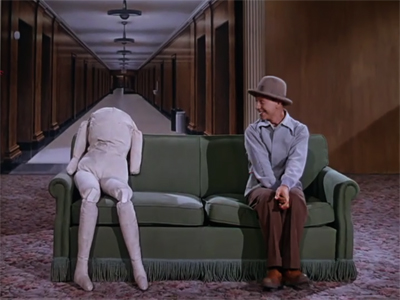
Donald O’Connor in Singing in the Rain

When John asked me to write a guest post about physical comedy in musical theatre, I instantly started brainstorming on all the wonderful performers and shows I would reference, all the great examples I would pull out like….um…well…that one thing in…no…wait…um…uh…shoot. Wait, that’s not right! Musical theater was, at least partly, founded with physical comedy as one of its main elements. It’s a staple, right? Let’s go back a bit….

In essence, the American musical was created out of two very different art forms that were popular in the early 1900s: operetta, and ethnic theatre. As I discussed in my blog entry Changed For Good – or The Famous Thesis, operetta, a lighter version of traditional opera (think Babes in Toyland) was considered sophisticated entertainment.

Operetta was the basis for the traditional musical theatre form – a narrative story told through song, occasionally employing dialogue in between numbers. Ethnic theater – especially Yiddish and Jewish theater — was thriving in America at the same time as operetta, and was hugely popular. It was, however, often looked down upon as “low” theater, and not respected the same way operetta was.

This dichotomy has found its way into contemporary musical theater, where it seems all shows are either delegated to the “high art” category (think The Light in the Piazza, or anything Sondheim) or the “popular, financially successful” category (think Mamma Mia! and Cats.) It seems that as far as the critics are concerned, never the twain shall meet, although there have been some rare “grey area” shows that might fall into both categories.

Though physical comedy was not a huge staple of operetta, it was all but mandatory in ethnic theater, which in general was far more comedy-based. It was this type of theater that eventually developed into vaudeville in the 1920s and 30s. In fact, physical comedy was such a staple that almost all the famous silent movie comedians began their careers in vaudeville. Vaudeville was not what we would currently term “musical theater.” There was not a single narrative — in fact it was made up of a collection of “acts.” Some of these acts, however, did have mini-narratives, and might even use music to tell their story.  Some of these sketches became so popular; they eventually evolved into full-length pieces.

The most famous example of this was the Marx Brothers, who began their career in vaudeville, pairing their natural comic talent with their adept musical skill. They became so famous that in the early 1920s they were asked to create a full length review, I’ll Say She Is, which was followed by The Cocoanuts and then Animal Crackers – both Broadway musicals (with music and lyrics by Irving Berlin, no less) that went on to become classic films.

The physical comedy genius of the Marx brothers has been brilliantly analyzed by writers far more knowledgeable of the subject then me. But what is unusual in terms of the musical form is how much they rely on physicality not for gags (though they do that) but to advance the story, create the world, and develop character. They almost use a comic physicality to replace dance — which traditionally has been the third component of the “integrated musical” — the “physical” component along with singing, and acting.  Harpo, for example, never speaks a word.

After that, the waters get a bit murky. While the “first” musical is generally agreed to have been The Black Crook, it was Show Boat that truly began paving the way to what we now consider the classical musical. Show Boat was every inch an operetta and, indeed, that’s the direction musicals have been heading ever since. In fact, quite a bit of the comedy in the late 20s / early 30s on Broadway was found in review shows like The Garrick Gaieties – the SNL of their day (though there were certainly comic musicals, for example Good News in the 1920s, and Babes in Arms in the 1930s.) But there was a strong trend in the 30s towards verbal comedy, and parody as opposed to physical. While film saw the rise of screwball comedies, in general American entertainment reacted to the Depression with a desire for glamor and escapism.

The 40s and 50s ushered in the “Golden Age of Broadway,” largely heralded by the collaboration of Rodgers and Hammerstein. Although their shows were landmarks, none could really be described as funny, although South Pacific (which won the Pulitzer Prize) does open act two with a holiday performance put on by the nurses and Seabees, which includes a drag performance of “Honey Bun” with nurse Nellie dressed as a sailor, and one of the sailors dressed as the “honey bun” of the song — complete with coconut bra and grass skirt.

Another gender-reversed comic moment occurred around the same time in the musical White Christmas, which was a film musical first, long before it was recently adapted for the stage. In White Christmas, the male leads first encounter the female leads when the two girls perform a song called “Sisters” as part of their nightclub routine. Later, in order to help the girls escape from the police, the guys wind up taking their places in the act — creating comic hilarity when they begrudgingly perform the girl’s number to the “t.”

There is also of course the classic number “Make ‘em Laugh” from Singing in the Rain, which was also a film long before it was on the stage.

“Make ‘em Laugh” was in itself a deliberate reference to “Be a Clown” from The Pirate – also a movie, never a stage musical.

 Are we noticing a pattern here? Film has a great history of physical comedy. Theater…well…kind of stumbled along the way.  Or at least, we don’t have hard evidence to the contrary.

Part of the difficulty of commenting on physical comedy in musical theater, especially during this time period, is in a lack of recorded performance. Most physical comedy is not written down. Even when an entire sketch is nothing but physical comedy, it is usually written as a simple outline meant to help the performers remember the order of actions. A talented physical comedian could turn the stage direction “he goes to the mirror and shaves” into a half-hour, riotous routine.
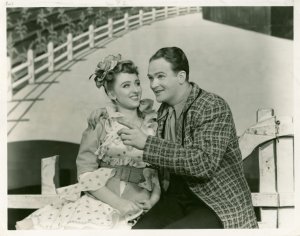
The original Ado Annie (Celeste Holm) from Oklahoma

Film is forever — and we can easily find the physical comedy in films from the beginning of the medium onwards. We have almost no visual record of most live musical theater shows written before the 1970s — and therefore only have the scripts to go by. And the scripts are not much help. For example, “classic” musicals are somewhat characterized by their character structure of having two principle “romantic leads” and the secondary “comic leads.” In Oklahoma, Laurie and Curly are the romantic leads, and Will and Ado Annie are the comic leads. I’ve seen Ado Annie played completely deadpan, and with raucous physicality – and both are hysterical. However, one is physical comedy, and the other is not. It’s up to the performer, and not dictated by the material. And we don’t have records of a lot of performances.

The further we get away from vaudeville, the further the musical gets away from physical comedy. We get comic moments, certainly, but nothing groundbreaking, or revolutionary or, sadly, hardly ever relevant to the plot. Ado Annie can certainly be played by a physical comedian; but if it’s not, it won’t devastate the show. This of course leads me to ask: why is this so? Well, my personal experience leads me to conclude this:

Being a musical theater performer requires an immense amount of training in many different fields. First you have to sing. And especially today, you can’t just sing – if you’re a girl you have to belt, and sing legit. Then you have to act. And you have to dance — that includes at bare minimum tap, jazz, and ballet. Each of those elements could take up a lifetime of study. As it is in most musical theater training programs, acting seems to fall by the wayside. Nowadays you practically have to play an instrument too. (You can’t audition for Once or, well, any John Doyle production if you don’t.) And it helps to know aerial acrobatics and gymnastics. You know, for Spiderman, Wicked, Peter Pan, The Pirate Queen, and every vampire musical. Learning physical comedy is not a casual skill you can just “pick up.” The amount of work required to be really good at it is one reason it’s probably not emphasized, at least in training programs.

Then there’s also the issue of musical theater and “high art.” Physical comedy is a vocabulary in and of itself that, to be truly incorporated into a musical, would not only have to have performers capable of doing it, but writers who are adept at writing it. All musical theater writers have to be incredibly well trained in music theory, composition, etc. Book writers analyze structure. To truly incorporate physical comedy means being fluent in it. That’s much easier in a traditional physical comedy show where the performer almost always has a hand in creating a piece. In musical theater, a team of people write a show, then give it to actors who are expected to, yes, bring themselves to a role, but most importantly translate the vision of the writer(s) and director(s). Either the writers have to write a piece with physical comedy clearly in it, then find performers who can sing, act, dance, and do physical comedy, or else an actor might find one or two small moments to bring in some physical comedy, but it’s never going to completely define the role, or the show.
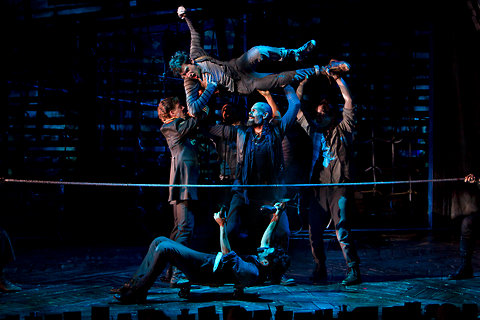
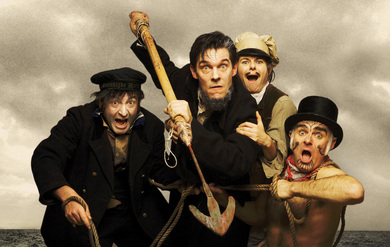
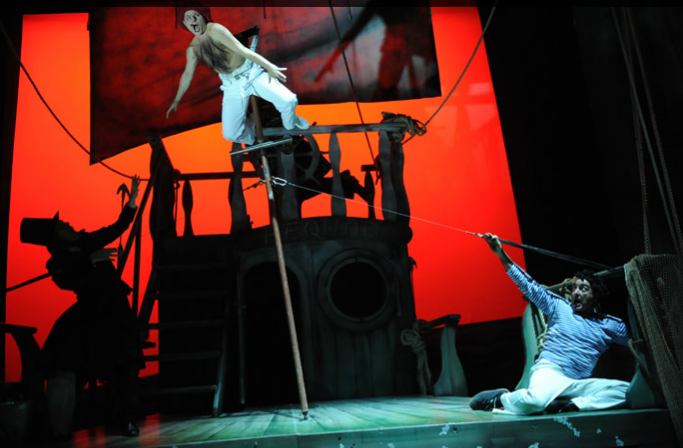
from the original off-Broadway production of Peter and the Starcatcher

This seems to be at least slightly different with plays as opposed to musicals – we all know and love Noises Off – but that was written as a farce. Robin Williams, Steve Martin, and Bill Irwin did a Broadway revival of Waiting for Godot that used quite extensive physical comedy — but those were adept physical comedians who were allowed to reinterpret a text. Most recently, Peter and the Starcatcher on Broadway utilized great physical comedy, and was a rare exception where both the writer and cast understood the vocabulary. But that was also in essence a play, not a musical.

There is of course the amazing Bill Irwin — and his Broadway work — but those were physical comedy plays that happened to go to Broadway. Not to mention the fact that musicals are so expensive to produce now that they must run several years just to make their money back. That means living through far more than the original cast. Can you imagine if they had to hold auditions to recast Bill Irwin in Regard of Flight? I doubt it would continue running for very long. And one of the reasons is that what’s funny on one person may not be funny on another.
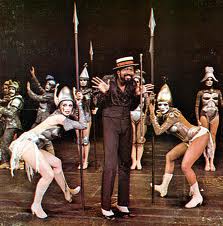
The original production of Pippin

In the 1970s, some experimental theater techniques began to make their way into mainstream musical theater – most notably (and I emphasize him because of his physicality) with Bob Fosse. The 70s, following upon the work of the amazing Jerome Robbins, became a time when physicality began to become more of a storytelling device. Pippin for example, uses an ensemble of highly stylized “players” (complete with white face) who lead an innocent (Pippin) down a path searching for ultimate fulfillment. While this is certainly not a physical comedy show, it is arguably a physical show, and therefore moments of physical comedy do come in to it.

In the early 2000s, Broadway saw a return to the “good old fashioned musical comedy” with The Producers. This was truly a landmark show in many ways, partly because there literally hadn’t been an original, traditional musical comedy in a very long time. The Producers featured great moments of physical comedy, such as this one that was featured on the Tony awards. Notice the use of the walkers, not to mention the beautiful physicality of the performers. Those are guys and  girls playing the little old ladies.

Jeffry Denman

I have to take a moment to reference one of the best resources when it comes to physical comedy in musical theater (and there aren’t a ton.) The wonderful book A Year With The Producers by Jeffry Denman is a must read for anyone interested in theater, comedy, or being entertained/educated in any way. It chronicles Jeffry’s year auditioning for/being cast in/performing with The Producers on Broadway in which he played/created a myriad of hysterical characters His description of both his process, and the inner workings of musical theater (which would be greatly enlightening to any physical comedians who aren’t as familiar with the world of musical theater) are genius.

Here’s Jeffry’s piece “A Drop in the Bucket” from his choreography demo reel.

I also mention Jeffry for another reason – I had the great fortune to get to work with him on Twilight: The Unauthorized Musical Parody and got to see first-hand his genius at creating brilliant characters and comedy moments. We were very fortunate that all of our Twilight cast members were fantastic comedians, and I especially noticed in how many different shows Jeff was able to introduce brilliant elements of physical comedy, so I highly recommend checking out Jeff’s book and looking at his process.

The following year, Broadway and musical theater were shaken up by the truly genius musical Urinetown. Part of what made this show feel so fresh and original was that it was created by the experimental theater group the Neo Futurists — who used many of their experimental conceits and techniques within a traditional musical theater structure. Check out this clip of their Tony awards performance (yes, they were winners that night.)

I particularly love their unusual use of physical humor in this number. The physical comedy “gag” is not the focus of the piece – it is the elephant in the room. Notice the lovely young girl bound up and gagged who proceeds to do all the choreography, even though she is tied up for the whole number. And notice how the fact that there is a dancing hostage is never acknowledged. Brilliance. Even more so when you know the show and realize how much this moment is actually advancing the plot.
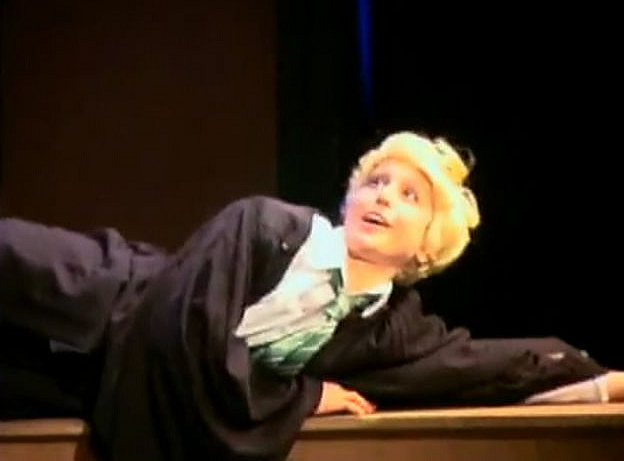
Another shout out also has to go to the incomparable Lauren Lopez, who first gained notoriety for her performance as Draco Malfoy in the youTube sensation, A Very Potter Musical. Though this is not a Broadway show, Ms. Lopez wonderfully created physical comedy moments within the musical as a way to define Draco’s character, and his relationships with other characters. Here’s a highlights reel. It’s a great example of some of the “underground” work being done in musical theater. Physicality really starts around :44

As with Mr. Denman, I’ve seen Ms. Lopez’s work in many projects, and she always brings a unique physical comedy element to whatever she’s doing. I wish everyone reading could watch her live performing as the spastic child Renesmee in Twilight. Her talent as a physical comedian, as well as a musical theater performer is one of the reasons I work with her so often.

Then there are moments of physical comedy in musical theater that don’t relate to a specific show. My favorite is Bill Irwin and Karen Ziemba’s interpretation of Sondheim’s song “Sooner or Later” for “Sondheim: A Celebration at Carnegie Hall.” The song was originally written for the film Dick Tracy.

What is the future of physical comedy in musical theater? It’s hard to say. With the advent of the rock musical (Rent, American Idiot, Next To Normal), original comedies in general on Broadway seem to be diminishing. Then again the recent show Bloody Bloody Andrew Jackson managed to incorporate elements of physical comedy into a rock musical. The 25th Annual Putnam County Spelling Bee was highly physical, but it was more a use of funny physicality than actual physical comedy. The Book of Mormon also has moments of physical comedy; one of my favorites, and one of the most subtle, is at the end of the song “I Believe.” See how hopeful Mormon Elder Price and evil warlord “Butt-Fucking-Naked” (yes, that’s his name) relate to each other. It’s at the very end of the song:

However, and I may get some flack for this, I think most of the humor in Book of Mormon is based on verbal and musical jokes, how people look, and the situations they are put in — which is not true-blue physical comedy, although there are certainly elements of that in the show as well most notably in the song “Turn It Off.”

Truly incorporating physical comedy into musical theater is tricky. Musical theater is by nature narrative-driven, and is largely verbal. It has to be. The performers are singing more than half the show, not to mention the fact that it would be near impossible to perform comic physical moments while singing for purely technical reasons. In film, on the other hand, you have multiple takes, not to mention usually having a playback recording. Physical comedy is by nature episodic and non-verbal. I think in some ways the decline of physical comedy in musical theater can be linked to the decline of dance in musical theater. The fact that almost no new shows use dance to advance the story is a real sore spot in the musical theater community. I think that if there were a way to open a dialogue between the two schools something revolutionary would take place. But there needs to be a sharing of vocabulary. In the words of Elder Price: “I believe!”

_________________________

Click here for Ashley’s blog, visit her on Facebook, follow her on Twitter, view her youTube channel, and read her Guide to Collaboration.

SHARE
EXPLORE FURTHER

Guest Post: “Physical Comedy in Magic—A Sampler” by Tanya Solomon

POST 227
Sunday, January 8, 2012
Photo: Linus Gelber


When I knew that Ben Robinson and Julian Olf would be contributing their writing on magic as guest posts, I asked my friend Tanya Solomon to recommend some good comedy magic to me. I’ve always had some interest in magic, but never pursued it and basically know very little. Tanya on the other hand is a veteran New York variety performer who combines all sorts of clowning, dance, and magic in her performances — plus she even works part-time in a magic store! When she came back to me with a thorough list of recommended videos, I thought it would be great if she would expand it into another guest post for the blogopedia. Take it away, Tanya (but don’t make it vanish)…. —jt

________________________________

Startling transformations. Hubris. Violations of logic and laws of nature. The basic elements of stage magic would seem to make it fertile soil for physical comedy.

And yet most “comedy magic” comes more from the standup comic tradition (Mac King, Harry Anderson, and David Williamson, to name a few funny ones). When physical comedy is used, it usually follows the narrative of the arrogant magician whose tricks fail and expose themselves. The classic act of this type is the late Carl Ballantine’s:


Done well, by performers like Otto Wessely and Kohl & Co., this is great comedy. But when John gave me the chance to pick out some favorite funny magic, I decided to represent a less common type of act: one in which physical comedy is used and the magic (though not necessarily the magician!) is effective.


One of the greatest theatrical challenges in magic is getting around the “I can do something you can’t” presentation. The mystery should be fun, not frustrating, for the audience. With that in mind, please note the variety of characters and situations of the magicians in these videos. Some (Voronin, Gartner) are powerful magi dealing with comeuppance. Buka is unable to predict or control his own magic. Tom Mullica is the victim of bizarre physical occurrences. And Tina Lenert’s character isn’t even a magician — which I find interesting, as she is the only woman in this lineup. (Women in magic are rare; women in comedy magic are almost non-existent.)  Her act is in the tradition of Cardini’s — magical events befalling someone going about non-magical business. (See an analysis and video of Cardini in the previous post.)

And so, a sampler of physical comedy in magic:

 The hilariously diabolical Maestro Voronin will mesmerize you…no matter what befalls him in the process. Yevgeniy Voronin, from Ukraine, is featured in Teatro Zinzanni in San Francisco.


I don’t know anything about this team, Roy Gartner & James, but I love their comedy relationship. And their magic.


Tom Mullica ran the Tom-Foolery, a magic bar in Atlanta, where he developed his famous acts. He had to quit smoking, but he kept the rubber face, and now performs a Red Skelton tribute in Branson.


The use of sound and rhythm by this fellow, Buka, is bizarre and unique, and his manipulations are impeccable. Funny stuff, but unfortunately an ethnic stereotype (Turkish?). Can’t find any info on Buka except that he is Russian and lives in Romania…and that “buka” means “bogeyman” in Russian.


Tina Lenert takes a classic mime/clown bit and adds sleight of hand. This is her signature act, and probably the best-regarded use of mime technique in magic. (Raymond Crowe, the Australian “Unusualist”, has an excellent DVD on the subject.)


Topper Martyn (1923-2004) had a long career as a comedy juggler and magician, including years in ice shows(!). The beginning of this video shows how he opened his “World’s Third Worst Magician” act. In his book Topper’s Mad Mad Magic — the best resource on comedy magic I’ve found so far — he lists the contents of his coat: “200 billiard balls, 1 cannonball, 10 wooden eggs, 8 folding dice, 2 giant rubber dice, 1 spring duck, 1 large spring snake, 6 small spring snakes, 300-500 playing cards, 1 string of flags, 50 coins, 1 rubber dove”. Martyn commented, “Although I love to burlesque magic… there are no exposures in [my act]. The average audience is not interested in magic secrets; they love buffoonery, spectacle, action, and surprise.”


Sylvester the Jester plays a “real live cartoon” character. His humor is a bit “nutty” for my taste, but he’s incredibly inventive, and has created many effects.


Legend has it that Lou Jacobs himself told Charlie Frye to get out of Ringling’s clown alley and hit the variety stage. Frye is a master juggler and magician, known for his “Eccentricks” instructional videos which teach skills with a physical comedy presentation. Here’s a kinetic bit he does with linking rings and a floating bowling ball.


Because this is just a sampler, I’m going to skip over some better-known acts — the Banana Man, Steve Martin’s Flydini, and Penn & Teller are among my favorites — and instead focus on a wonderful obscurity: “The Amazing Dr. Clutterhouse”. No footage of this act is available, though tribute acts have been reported once in a while. My description comes from old magazines and a booklet published by Magic Inc.

In mid-20th century Chicago — then the capital of American magic — audiences were said to have wept and screamed at the antics of Dr. Clutterhouse, played by Elmer Gylleck, a hobbyist magician who created his original, ingenious props. Thunderous circus music played, and a bumbling gentleman in a walrus moustache and derby shuffled onstage. His wand escaped him, and ghosts and snakes flew from his briefcase, followed by revolver shots. Endless chaos ensued: an umbrella appeared in his pocket, an egg broke on him, a handkerchief refused to leave his hands. He tried to adjust his table, which collapsed further the more he tried to fix its rubbery legs. Clutterhouse shot the table dead. He couldn’t control the massive amounts of paper and silk he pulled from his hat, and a rabbit’s head kept popping out to mock his confusion. He put in a final colossal effort, was swallowed by a cloud of feathers, and pulled out a yard-long dead chicken. Finally, he produced two live rabbits, and exited, relieved. 


A final note: this selection is mostly limited to one branch of magic, manipulation (i.e. sleight of hand for stage), which just happens to be my favorite. Other categories, such as mentalism (mindreading) and closeup card tricks, don’t lend themselves to physical comedy. But you might ask, why aren’t large-scale illusions included? Well, it might be my taste (I don’t like the Vegas style that goes with the big boxes by financial necessity).  Or, my perception that “comedy” in big illusion magic is limited to tired one-liners and sight gags might be correct.

At any rate, having scoured YouTube, these are the only illusion-scale performers who got my vote as being true physical comedy. Scott & Muriel, who call their work “slapstick magic,” are currently performing in the Big Apple Circus.


But who knows…perhaps someone somewhere is hammering together a comedy illusion on the scale of the Hanlon Brothers. Maybe there’s funding for it. Maybe there’s even an audience! Vegas, anyone?

SHARE
EXPLORE FURTHER

Guest Post: “The Actor & the Magician” by Julian Olf

POST 226
Tuesday, January 3, 2012

We continue our look at magic technique with this revealing analysis of the performance of the great magician, Cardini, by an old colleague of mine, Julian Olf. This article first appeared in a 1974 popular entertainments issue of The Drama Review (TDR) that I worked on as an editor in my grad school days at NYU. Even back then I realized that Julian’s take on magic as a form of acting offered a fresh perspective, and re-reading it today only reinforces that opinion. So happy to have tracked Julian down, and much thanks to him for kindly granting permission to share his work with readers of this blogopedia.

In his youth, Julian studied sleight-of-hand magic with the vaudeville magician Jack Miller. He later shifted his concentration to a study of theatre history and dramatic literature, receiving graduate degrees in these subjects from Columbia and NYU. He recently retired from the University of Massachusetts, Amherst, where he taught playwriting, dramaturgy, and chaired the department. His plays have been produced in New York, Boston, Amherst, Los Angeles and Vancouver. His comedy, 1-900-Sex-Date, won the Nantucket Short Play Award. His one-character play, People Almost Always Smell Good in the Art Museum, was produced at UMass-Amherst, published in the fall 2008 issue of the Massachusetts Review, and nominated for a national Pushcart Prize.  His screenplay, Anthony, inspired by Shakespeare’s Hamlet, received a Gold Award at WorldFest International Film Festival (Houston) and was given a professional reading by The Drama Garage of Hollywood.  His screen adaptation of Henry James’s short story, The Liar, was a finalist in America’s Best Screenplays. Click here for more information.


I’ve appended the only video footage of Cardini I could find. Julian points out that his article was based on his viewing of a different performance of Cardini, so readers should not attempt to match his narrative with the exact sequence in the video.  The article is in pdf format and can be enlarged or downloaded using the buttons at the bottom of the Scribd window.—jt
_________________________________

Actor Magician

And here’s that footage of Cardini; a big thanks to blog reader Eddie Walsh for alerting me to a higher quality copy of the video than I had originally posted! —jt


Update (2-17-14): Cardini home movie.

SHARE
EXPLORE FURTHER

Guest Post: “Keaton the Conjuror” by Ben Robinson

POST 225
Thursday, December 29, 2011

Ben Robinson is both a master magician and an historian of magic, author of Twelve Have Died: Bullet Catching, The Story & Secrets and of The MagiCIAn: John Mulholland’s Secret Life, as well as numerous articles for major magic publications. Just last month, Ben’s decades-long research into the use of magic in silent films came to fruition with publication of his latest book, Magic and the Silent Clowns — a subject that had received scant attention until Ben’s work. Concurrent with that, Ben helped curate a fascinating show at New York’s Museum of the Moving Image entitled Magicians on Screen, including both a magic performance by Ben and a lecture-demo on the subject of magic and the silent clowns. In fact, Ben had first proposed the idea to the museum back in the 80s. Patience is indeed a virtue — though persistence sure helps! This blogopedia is very pleased to be able to share the first chapter from Magic & the Silent Clowns, and to be able to match Ben’s enthusiastic prose with a few video clips.
_____________________________________

Keaton the Conjuror
Buster Keaton’s education and use of the conjurer’s illusionary techniques. 
by Ben Robinson

“Once Pop accidentally wrecked another act by tossing me into the backdrop curtain. This was the turn of Madame Herrmann, the widow of Herrmann the Great, one of the most popular magicians. She was working some of his simpler tricks. At the finish of her act she had dozens of white doves flying to her from every corner of the stage.” (My Wonderful World of Slapstick, p27)

Buster Keaton was an illusionist.

It is said that the world’s greatest illusionist, or magician, would never be truly known by the public at large. Why?  Because so great a “talent” wouldn’t need the adulation, as the prowess by which the work was deployed would be best praised by not even being seen. In the shadows of show business and art, there would lie success. In the French this is referred to as eminence grise. While Buster is certainly known, his use of illusion is at best appreciated as an auxiliary component to the gag
However, a deeper look into Buster’s upbringing and eventual use of his fantastic vaudeville education clearly expresses itself in his movies, some of his TV appearances and, more notably, when meeting the media. It might be assumed that the Keaton we see is an image he is in total control of. That being said, the controlled image we always saw was one of a surreal world where “magic” was part of the landscape, like air. In the famous Sid Avery photograph of Keaton, titled “What Elephant?” while Keaton looks forward, with his hand on his brow, the elephant’s trunk winds through his other arm, the pachyderm quietly standing behind the comedian.  This is a vanishing elephant only to the person closest to the king of the forest, a good metaphor for Keaton’s “magic.”

While the examples of Keaton’s legerdemain are too numerous for inclusion here, this notion may bear some examination in the following examples. 
Clearly, legend has it that Buster received his nickname from Houdini. While this may be a matter of conjecture, the legend sticks (and most vaudevillians would tell you that when it comes down to printing the myth or the truth, they yowl, “the myth, print that!”). 
That Joe Keaton and Harry Houdini (1874-1926) once appeared before the audiences of the Midwest in a tent show is certainly a fact. It is also a fact that this show, The Keaton-Houdini Medicine Show, was not a great success, and occurred years before Houdini’s triumphant success in Europe in 1900. Of his father Keaton remarks that “he was an eccentric dancer, not an acrobat, but damn near.” The same might be said of Keaton: he wasn’t a magician in the classic sense, but damn near. Like a classic magician, everything that he saw, particularly of the mechanical variety, was always filed away in his memory for future use. His summer home amidst the actor’s colony in Muskegon, Michigan was not far from a little town named Marshall, among its distinctions being the home of the very first electrified house in the US. Called Honolulu House, it doesn’t have the electric staircase (escalator) Buster later used in his movie The Electric House, but it does have many other mechanical wonders, including the sliding bathtub that switches between rooms that Buster used on celluloid. 
Backstage, Buster saw it all. He refers to utilizing some of Houdini’s tricks in his movie Sherlock Junior, and even opens Cops with a line credited to Houdini: “Love laughs at Locksmiths.” He also acknowledges a relatively little-remembered genuine Chinese vaudeville illusionist, Ching Ling Foo — whose grand feats included turning a somersault in mid-air and when he returned to a standing position, he held a bowl of goldfish that 
appeared from nowhere! 
Young Buster grew up learning that magic had to be “justified” or plausible for the introduction of an illusion. He realized in his movie-making career that “cartoon or impossible” gags (and illusions) had to be justified, like his jumping and impossibly disappearing into the briefcase held by a man (dressed as a woman) accomplice on the street (Sherlock Jr.)….

….or appearing as nine individual dancers on stage at the same time (The Playhouse)….

 ….or avoiding the tornado winds by hiding in a magician’s prop (Steamboat Bill Jr.)….

Whenever magic occurred, Keaton might have been justifying his conceit he explained as “I always want  the audience to out guess me, and then I double cross them.”

Keaton’s use of illusion was not always as a trick per se. When the house he moves across the train tracks in One Week narrowly escapes destruction by an oncoming train, another train enters the frame — and his on-screen drama — and demolishes what we only thought, seconds before, was safe. The revelation of the perceptual difference of the first train set the audience up for the wow appearance of the second train.

Similarly a magician will make a scarf appear, only to have the audience relax at that manifestation. When a dove flutters from the folds of that scarf, there comes the “topper.” Buster just played with much larger props. 
This type of drama, albeit small, is as much part of the conjurer’s lexicon as a rabbit and a hat. Magicians refer to this type of presentation as a “sucker gag.” Feigned failure, only to be consummated by winning success, or in the previous example, unexpected total destruction. 
I believe Buster was schooled in such thinking about surprise (both magic and comedy being dependent on surprise) by his vaudeville and mud show upbringing.  The magician’s technique he learned as a child pervaded his work on screen and elsewhere. On stage in France, in the late 1940s, he counseled the clowns in the Cirque Medrano how to get more out of the crowded clown car gag. Multiple large clowns (always ending with the largest of all) simply emerging from a small vehicle was impossible. Once Keaton showed them how the impossibility became surprising, then the illusion became magical, funny and even more surprising. How many times have we all seen this? And how many times have we seen the clowns emerge with beach chairs and finally a clown emerging with a full tray of food including a stuffed turkey?  These were Keaton’s touches he culled from the Hanlon Bros. performance of clowning, magic and illusion that took place in 
Europe and the US prior to 1900. 
And now for the magic that hits you as reality.  This may give you an example of Buster’s eminence grise
Remember the famous scene in Sherlock Junior where Buster is “shadowing” a man walking in front of him?  Now, watch as the man tosses a cigarette behind him which Buster catches, takes a drag of and then discards…or does he?  Given that Buster is the fellow who had a whole side of a building fall around him, missing him by mere inches, I think handling a lighted cigarette in flight was child’s play for him. But slow down the image and you will see a nifty piece of sleight of hand he no doubt executed on many occasions, being an inveterate cigarette smoker.

Other hand magic: in The Cameraman Buster tried to catch the fancy of the photo assignment secretary by making a quarter disappear in his hand, only to be revealed from behind his ear.

 In Steamboat Bill Jr., when attempting to have his father receive a loaf of bread in jail, Buster mimes the contents of the bread and involves another deception of the hands. Effortlessly. Gracefully. As if he yawned.

All magical illusions are understood by the student of the art, firstly through small, hand-held deceptions.  Given Buster’s consummate understanding of the nature of his medium (in this case, film) it is likely Buster combined this understanding with his familiarity with the scene backstage where magicians show each other tricks they carry with them, one time known as “vest pocket magic.” 
The point: Buster understood close-up magic because he was schooled in close-up magic from day one. 
Whether it was dangling from a rope to save his wife from the pitfalls of a raging waterfall (a la Houdini) in Our Hospitality or making it appear as if he simply caught a lighted cigarette from the air, Keaton saw the meshing of illusion and  reality in every situation, and exploited it. While performing off stage for a visiting film crew, in his later years, he created the illusion of catching a train, and bringing a 10-ton locomotive to a halt.  One might say this was a developed version of catching the side of a moving car and being whisked from view, as in one of his short comedies.  
Jack Flosso, the late owner of the world’s oldest magic shop, knew Keaton remotely through his father, the great Al Flosso, veteran of thousands of vaudeville and Coney Island sideshow performances.  Flosso says, “When you do magic and don’t admit it, that’s great. Harpo did that, and where’d ya think he got that…Keaton! Buster had an eye for everything. Remember that.”  That Keaton’s silent, surreal illusions should find a home in the 1930s amidst Harpo’s arsenal of wonders is not surprising to any Keaton scholar. What is delightful is that Keaton’s use of illusion was an integral part of his day-to-day life.

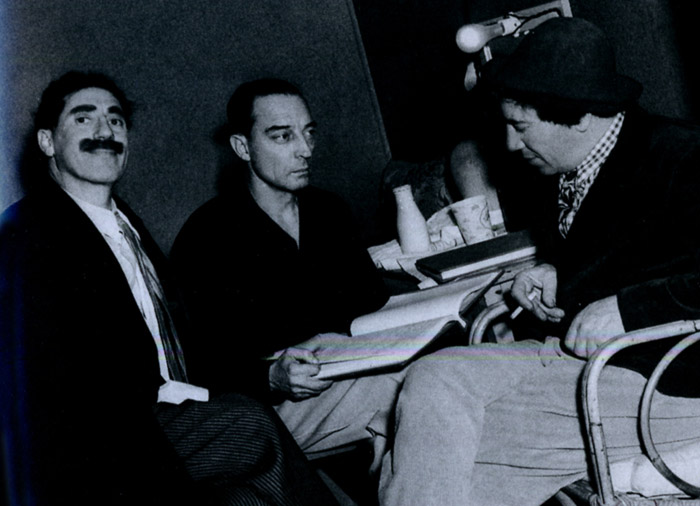
Buster Keaton working as a gag writer for the Marx Brothers

He frequently polished a window near him only to surprise his viewers by putting his head through the glass he had just polished, revealing that his polishing was deft pantomime… the illusionary transparent glass was only perceived as solid by his impromptu audience.  Many remark what a great practical joker he was. Such visual jokes have their roots in illusion. In several newsreels depicting Buster at play one finds Keaton doing something short and sweet like sewing his fingers together (later adopted by Red Skelton) or making a baseball disappear for a dog (but not for the rest of the audience). Anything surprising, anything out of the ordinary from this apparently “ordinary” man made his magic more memorable and surprising. 

We always hear of the “magic of the movies.” Buster Keaton is a master of a special type of  movie magic that, often, you don’t even realize is right in front of you! 
_________________________________________________ 
Sources: 
Beckett, Samuel., FILM, Grove Press, NY 1969. 
Bengtson, John., Silent Echoes  (Discovering Early Hollywood Through the Films of Buster Keaton), Santa Monica Press, CA 2000. 
Blesh, Rudi., Keaton, The Macmillan Company, New York, NY 1966. 
Dardis, Tom., KEATON — The Man Who Wouldn’t Lie Down, Limelight Edition, 1996 
Kerr, Walter., The Silent Clowns, Da Capo Press, NY 1975. 
Keaton, Buster with Charles Samuels., My Wonderful World of SlapstickDoubleday & Co., NY 1960. 
Kline, Jim., The Complete Films of Buster Keaton, Citadel Press, NY 1993. 
Knopf, Robert., The Theater and Cinema of Buster Keaton, Princeton University, Press, NJ 1999. 
Meade, Marion., Buster Keaton Cut to the Chase., Harper Collins, NY 1995. 
Tobias, Patricia Eliot, Ed., The Great Stone Face, The Magazine of the Damfinos, The International Buster Keaton Society, Volume 1, 1996. 
Interview with Jack Flosso in New York City, December, 1999. 
Kevin Brownlow, & David Gill (producers)., Keaton A Hard Act to Follow, Thames TV production, 1987. 
________________________________________

This article was originally published in The Keaton Chronicle, the magazine of the International Buster Keaton Society, The Damfino’s, in the Vol. 10 Issue 4, Autumn, 2002. Reprinted by permission. It is also part of Ben Robinson’s book Magic & The Silent Clowns (2011).

________________________________________


Visit Ben’s web site here, where you can also purchase his book directly via PayPal.

SHARE
EXPLORE FURTHER

Guest Post: Hilary Chaplain Interviews Spy Monkey

POST 218
Wednesday, November 30, 2011


When I run into Hilary Chaplain, an old friend and fellow New Yorker, my usual greeting is “Oh, I didn’t know you were back in the country.” As a popular theatre clown with a one-woman show and as a teacher of clown and physical comedy, Hilary is in demand at festivals and variety theatres all over the world. It was on these travels that she became acquainted with Spy Monkey, and her enthusiasm about their work led not only to this guest post, but also to her bringing them to New York to conduct workshops. You can read more about Hilary here, and if you’re anywhere near New York next weekend (Dec. 8–11), catch her show, A Life in her Day, as part of the Voice 4 Vision Puppet Festival at the Theatre for the New City. —jt
____________________________

Spymonkey was founded by Toby Park, Petra Massey and Aitor Basauri in 1997 and has since been joined by Stephan Kreiss. With their dark, edgy physical comedy rooted “somewhere between Monty Python, the Marx Brothers and Samuel Beckett” (The Houston Chronicle), and a quartet of performers from Spain, Germany and England, Spymonkey has proved to be a truly international phenomenon, enjoyed by and accessible to a wide range of international audiences.

In May 2010, I took a week-long clown workshop with Aitor Basauri, co-founding member and performer with the group in Brighton, England where Spy Monkey is based, and subsequently brought him to NY twice in 2011, assisted by Petra Massey on his second visit. He is a clown teacher at École Philippe Gaulier, Paris, and for Cirque Du Soleil, Montreal, and regularly teaches in London.   I find Aitor to be one of the best clown teachers out there. His teaching method and pedagogy is drawn from his teachers, Phillipe Caulier, Pierre Byland, Mick Barnfarther, and Cal Macrystal.  He has clearly created his own way and his classes are full of joy and fun and laughter. He dedicates himself to helping every student find their way.

During the workshop, I spoke to Aitor about his teaching.

“I think that everybody can be funny, and the way to show ‘your’ funny is by showing your stupidity. We see it when you do something that you know is not done or hasn’t come out in the right way. In order to do that we play lots of games that seem very simple, that the actor thinks they can play well. When they play badly, we see in their faces how stupid they feel. That’s the moment when we all laugh. That’s where we can all be funny. We laugh at stupidity because it’s very human. We like to see human people on the stage. If you see someone having lots of fun on the street — like kids, full of jokes and games — you’re amused at the amount of pleasure that kid is having.

We should have that kind of fun when we’re on the stage. We should have that kind of fun when we’re in the workshop. It should be a party, a playground, a place where you have lots of fun all the time. A place where you don’t have to worry about being funny. If you worry about being funny, you’ll never be funny. It’s great when someone tries to be funny and fails — but then they have to show it to the audience, that it didn’t work. If this doesn’t happen, we, the audience, know that they are not playing for us. And that’s the point — to play for us. If not for us, then who? Why is the audience here?  The clown exists just for the audience.  If there’s not an audience, the clown doesn’t exist. It sounds a little simple to say, but an actor can play when there is no audience. But the clown show is so clearly different every night because of the audience. There’s a clear dialogue.”


“In the clown workshop, we’re trying to see YOU. Once we do, once you’re happy on stage doing nothing, being stupid, you can do anything. We look for your pleasure, your fun and your optimism. We hate you for lying and for being clever. Anything will work – it’s not about what you’re doing. It’s your attempt and your pleasure that we laugh at.  We often don’t even know why we’re laughing. It’s a dangerous place out there on the stage in front of the group not knowing what to do, but being OK in that place and finding something just from being there and in being honest in the immediate situation. When we stay safe and do what we think will work, it will very often fall flat because there’s no honesty in the moment.”

The four members of the Spy Monkey company are Aitor from Bibao, Spain; Stephan Kreiss is German and lives in Vienna; Petra Massey lives in London; and Toby Parks lives in Brighton. The four met about 10 years ago doing a show in Switzerland and, finding an affinity with each other through a common vocabulary stemming from their training with Phillipe Gaulier, they formed this company of clowns who like to act. Aitor says “many people will not call us clowns because we don’t use the classic red nose, but we are always very interested in the stupidity of the clown and in all our shows we try to push that to many places. In all our shows we’re clowns who like to act. That’s what we’re interested in. In our PR blurb we’ve been forced to get rid of the word clown because it’s generally misinterpreted. We’re interested in the stupid situations that the clown’s spirit creates in relationship to the audience and each other and the stories that they play.”

Here’s my interview with Aitor Basauri and Petra Massey, conducted during their recent visit to New York.

Thank you to videographer Jim Moore, of VaudeVisuals fame!

Here are a few Spy Monkey videos. Go to their web site to read about current and past shows and to see more videos. I  have yet to see them live, but I’ve watched their videos over and over and laugh every time!

SHARE
EXPLORE FURTHER

Guest Post: Karen Gersch — Notes on Performing with Le Rire Médecin

POST 211
Sunday, November 13, 2011
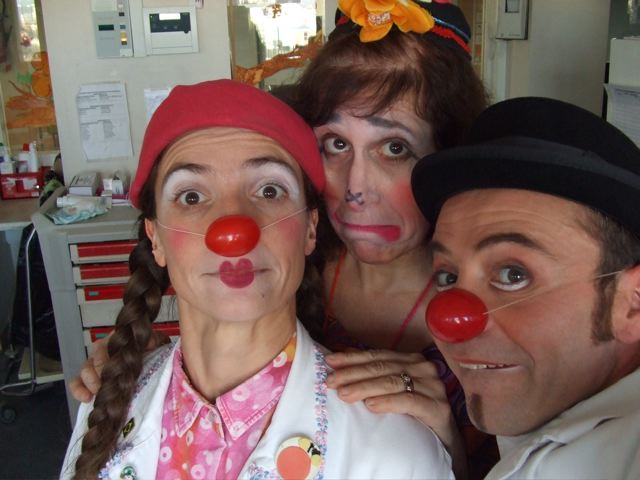
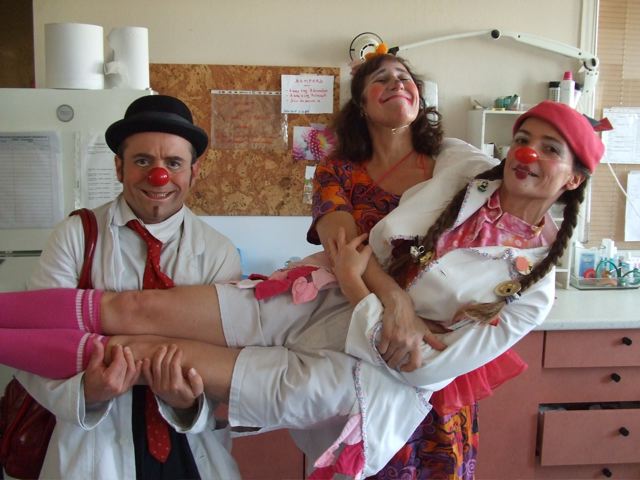
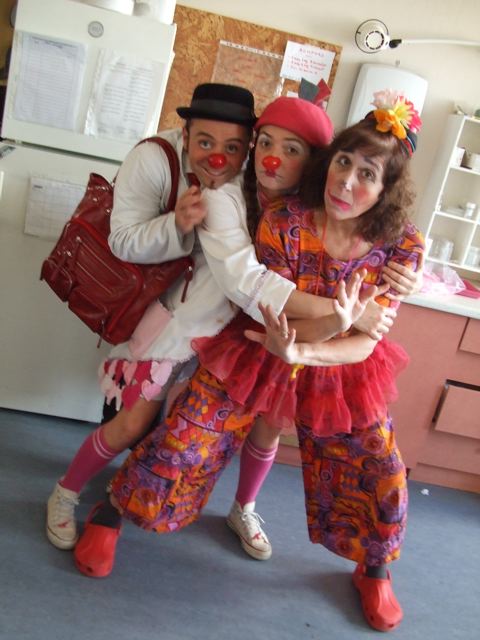
Steffi, Karen and Philippe


Karen Gersch is no stranger to these pages, having favored us with her art work in three previous guest posts (
here, here, and here). This time around, Karen writes movingly about a return visit to hospital clowning while in Paris.  [Click here for a new book on the Nez Rouges.]

_______________________________________

In 1991, Caroline Simonds founded Le Rire Médecin, an association of clowns that performs neither in circuses nor in theatres but in pediatric wards in France. Today, the association employs 85 specially trained clowns and operates in 37 pediatric wards in 14 hospitals throughout Paris, Ile-de-France, Orléans, Marseille, Nantes, Tours, and Nancy.  They are considered a world-wide model for hospiclown projects, and take part in the launching, training and development of new groups in other countries.

I have always held Le Rire’s clowns in great esteem for their emotional eloquence and non-reliance on gags, jokes and props to connect with their audience. What an honor — Caroline’s invite — to come clown for a day. It had been years since I’d clowned in hospitals; not since the death of my longtime New York partner, Jonah Emsig and the demise of the CCU (Clown Care Unit) program’s respect for its senior artists. It was even more welcomed when I heard I’d be working with two performers I’ve long admired: Steffi Liesenfeld and Philippe Aymard.

Many years ago, Steffi came to NY via the then-thriving hospital clown exchange program.  Paired with two very brash CCU clowns, she showed me footage taken during work that day. Despite the boorish shackles of her partners, she remained luminously connected to them. Her humble sensitivity and serenity impressed me.  She embodied clown, they broadcast ego.

I remember Philippe’s arrival in Manhattan;  he was overcome in the streets, weeping and laughing at the sight of the twin towers. The next day, my longtime friend Guto Vasconcelos (a clown with Cirque du Soleil’s Dralion) called and begged me to find him a replacement partner, “someone smaller than me; a strong clown with both a humane and impish side.” (Kismet on a platter!)

That night I invited both Guto and Philippe to the opening of an art exhibit I’d curated at the Waterfront Museum. (It featured physical performers who were also visual artists — among them, Michael Moschen, Philippe Petit and Jacques Lecoq, whose drawings were sent posthumously by his wife.) My two clown invitees arrived, were introduced, and were inseparable for the night. It launched Philippe’s six-year involvement with Dralion as Guto’s partner. Today marked his first day back in a hospital, too.
Steffi drove us in the light snow and heavy traffic to Louis Mourier, a hospital I had last worked in with Serge and Lory at least thirteen years ago. Dressed and rouged, we admired ourselves in the narrow mirror, ruffling each other for the better view. The roles fell into place without speech; Steffi locked the changing room door as Philippe and I rudely lifted her coat tails.  She swirled and glared us into dumb submission. She’s a brilliant white, Steffi.  Calmly controlling, sternly reproaching, yet capable of stumbling backwards from time to time into a clueless Auguste.      
Here, then, are several highlights of trooping as a trio through Mourier:
Steffi cannot find us. With my see-through juggling scarves veiling our heads, we pose like frozen statues – me, Philippe & the 13-year-old Arab boy who has joined our escapades, abandoning his laptop and hospital bed. Philippe has pronounced us as “Les Trois Nuages.”
Steffi, in ernest pursuit, is shadowed by four other children and a mother with toddler in arms.  They approach us and Steffi laments that we have simply disappeared. She turns 360 just in front of us, exclaiming “there are only clouds here – where could they have gone?”

The Pediatric Ward. The friendly nurses are prepping us; Steffi and Philippe write studiously. Directly behind me, a baby is wailing in pure desolation. Loud painful caws that have me trembling to get up and go there alone. As soon as notes are done, Steffi and I wash our hands and head straight to her crib. She is seven weeks old; her tiny fists and face curled in rage. We stroke and sing gibberish to her softly till gradually, the howls subside. Her eyes close, she seems to be asleep.  Steffi and I smile and turn away. Almost out the door when the wails begin again, even louder. The whole routine is repeated twice more. We ask a passing nurse if the baby is really okay or needing something.

“Dat baby’s fine. She just wants to be held all the time.”
  
I sigh, thinking: seven weeks old, no mother in sight, it’s not unreasonable.

After rounds throughout the floor, switching partners now and then, Steffi and I are drawn back to that howling infant. I offer my finger, which she clamps onto, while Steffi gently strokes her head. We begin to hum a wordless tune; Philippe soon sidles in and joins us, as a lullaby no composer would want to claim is created. This time we stay in place; three hands caressing and assuring, until our voices match the quietude of her breath. Her face is less red, her limbs loose in repose. As one, with our eyes whispering, we back off and tiptoe backwards out the door. At last, she remains blissfully asleep and we leave beaming.

SHARE
EXPLORE FURTHER

Guest Post by Hillary De Piano: Adapting Gozzi’s “Love of Three Oranges”

POST 177
Wednesday, August 10, 2011

I’m always on the lookout for news about Carlo Gozzi for reasons that will soon become obvious. When I saw John’s post where he lamented the fact that there was no public domain English version of The Love of Three Oranges for him to post and share with you, I had to jump in. I have one of the more popular modern English versions of Three Oranges and, while it’s not public domain, my publisher actually has 90% of the play online for you to read at your leisure. It’s really only missing the last scene or so.

So, if you wanted to read an English version of this commedia classic, you are welcome to check it out here: http://www.playscripts.com/playview.php3?playid=2276

But while I’m here, I thought I’d share with you a few quick facts about what is probably Carlo Gozzi’s best know play.
• Carlo Gozzi’s L’amore delle tre melarance was published in 1761. It’s 2011. That means that The Love of Three Oranges is celebrating its 250th anniversary this year! (As is Twinkle Twinkle, Little Star, randomly enough.)
• Gozzi’s original scenario was itself based off a (horrifyingly racist) fairy tale by Giambattista Basile which was itself based off of local folklore.
• The Sergei Prokofiev opera, The Love for Three Oranges? With the very famous march? That was also based off Gozzi’s play.

Commedia enthusiasts will be happy to know that The Love of Three Oranges continues to be very popular with high schools, thereby introducing a whole new generation to the material! Thank you to John for letting me stop by the blog and please feel free to read and pass along the preview link for The Love of Three Oranges. If you ever want to ask me anything or just say Hi, I’m online at HillaryDePiano.com and I’m also on Twitter as @HillaryDePiano.
_____________________________

Thank you, Hillary!  Here are a few more links… —jt
• My original Gozzi post
• Adam Gertsacov: Giants of Commedia—Gozzi vs. Goldoni
Gozzi’s memoirs in French
A book in Italian about Gozzi and commedia

SHARE
EXPLORE FURTHER

Guest Post: The Art of Karen Gersch — Classic Clowns

POST 114
Friday, March 25, 2011

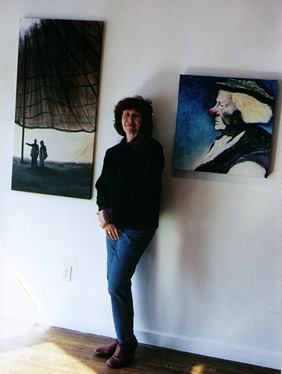
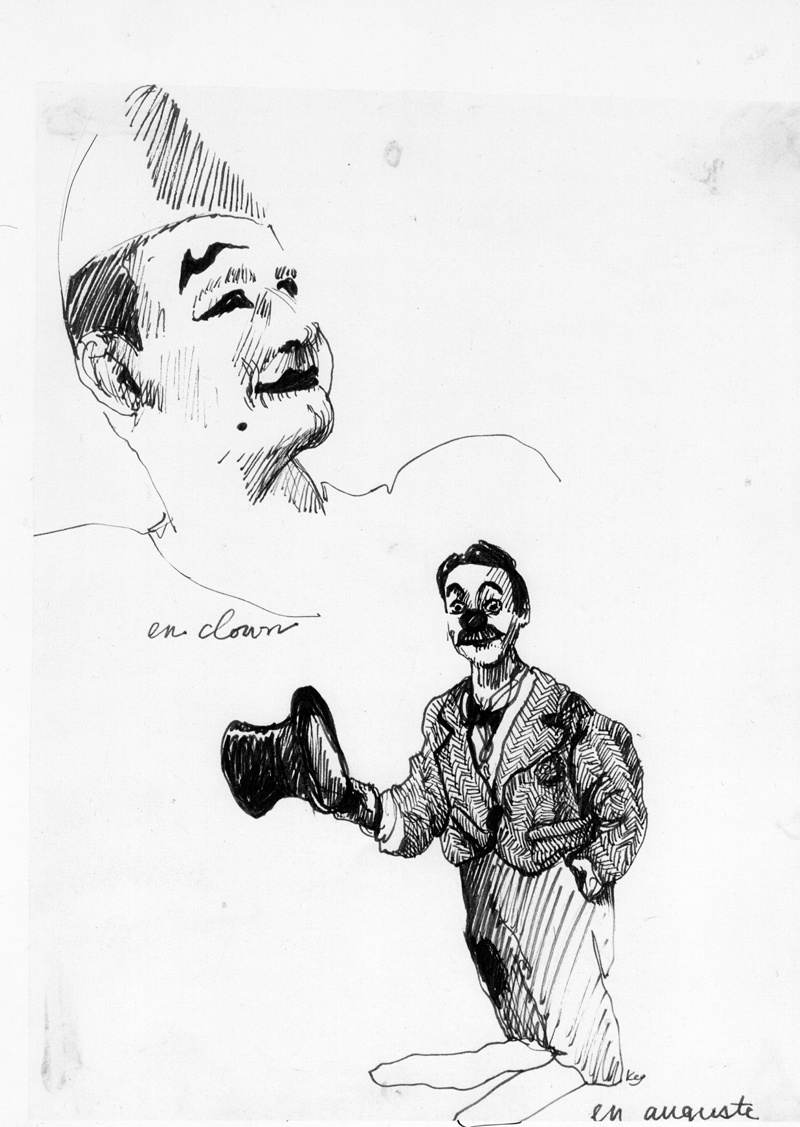
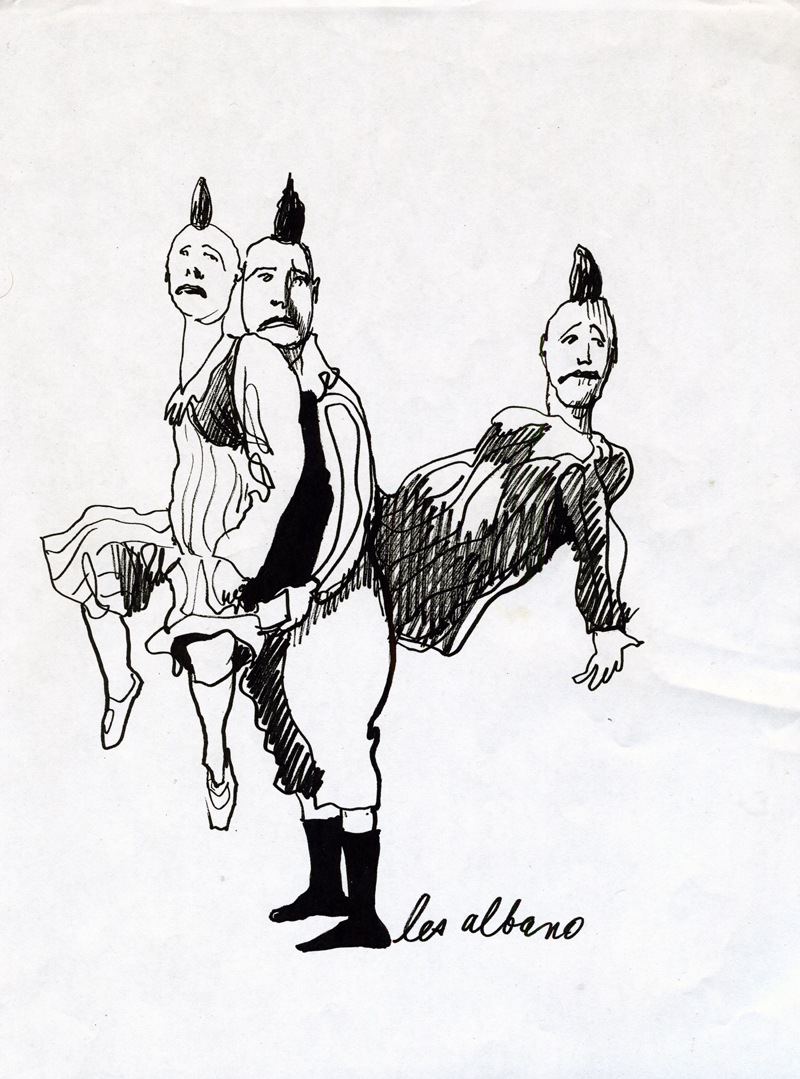
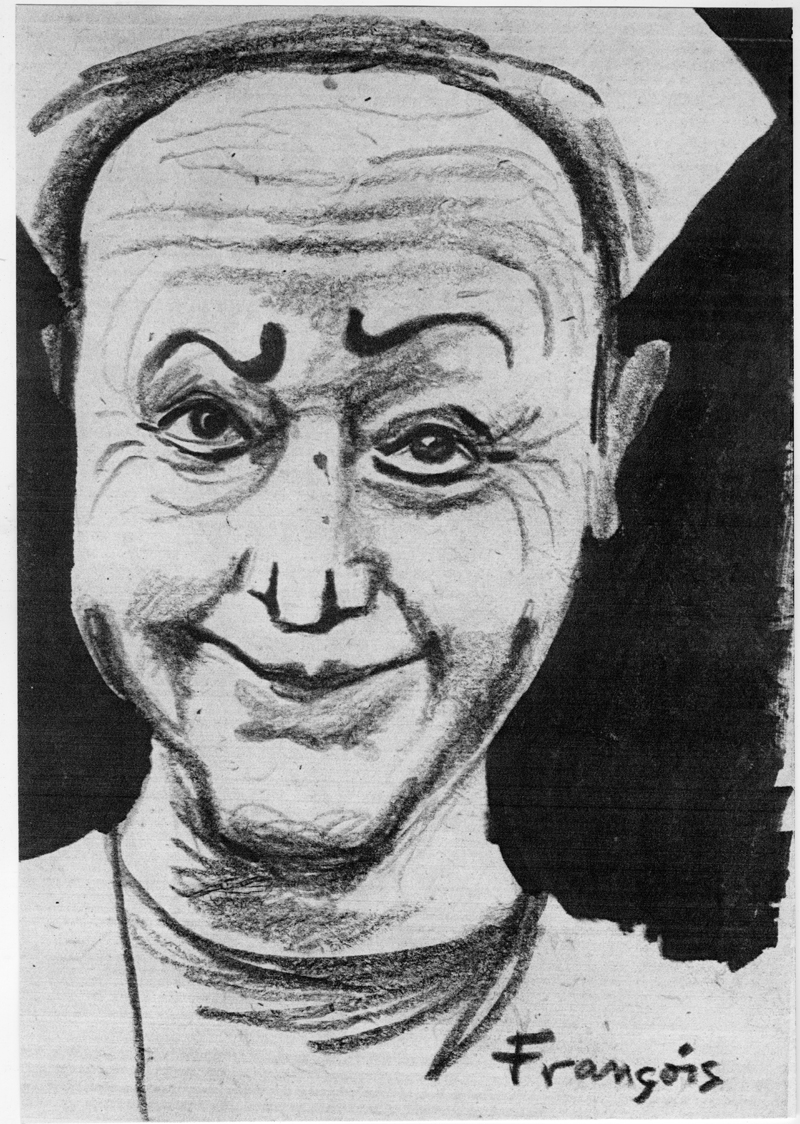
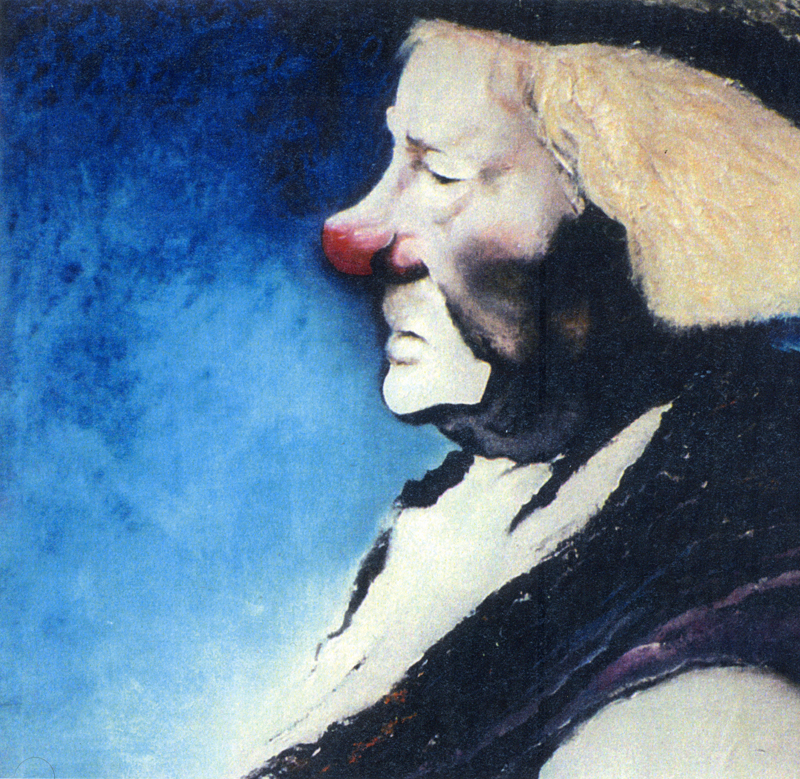
It is a real privilege to be able to present the work of Karen Gersch on this blog.  I’ve known Karen for over three decades (though we’re both 29), and she’s quite the Renaissance woman: clown, acrobat, painter, educator, producer — and for all of those three decades New York City’s hostess to ever so many variety artists visiting from around the globe.  Karen & I even performed in the Hubert Castle Circus together with Fred Yockers in the late 70s, and I want to say in my defense that any stories she may tell about me from those days are nothing more than wine-induced fabrications.  I thought the best way to introduce Karen to the blog was this series of her paintings and drawings of classic clowns.  We’ll follow up in later posts with her look at more contemporary clowns, and some of her own performance writing.  But first some links:
Karen’s current exhibition at the Blueberry Music & Art House in Greenwich, Connecticut
Karen’s art web site.

Karen’s Showboat Shazzam (formerly Circus Sundays) series at the fabuloso Waterfront Museum (this is last year’s schedule, but check back for this June’s events)
Karen’s Acrobrats performance web site.
___________________________________

Little Tich

Les Albano

 François Fratellini


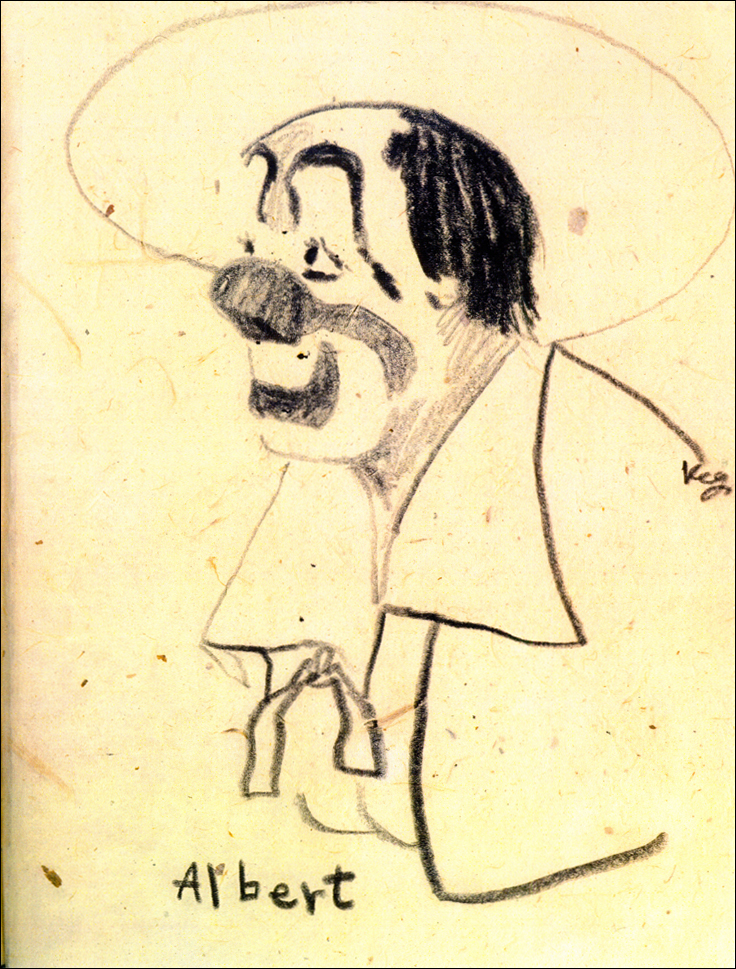
Albert Fratellini

Grock

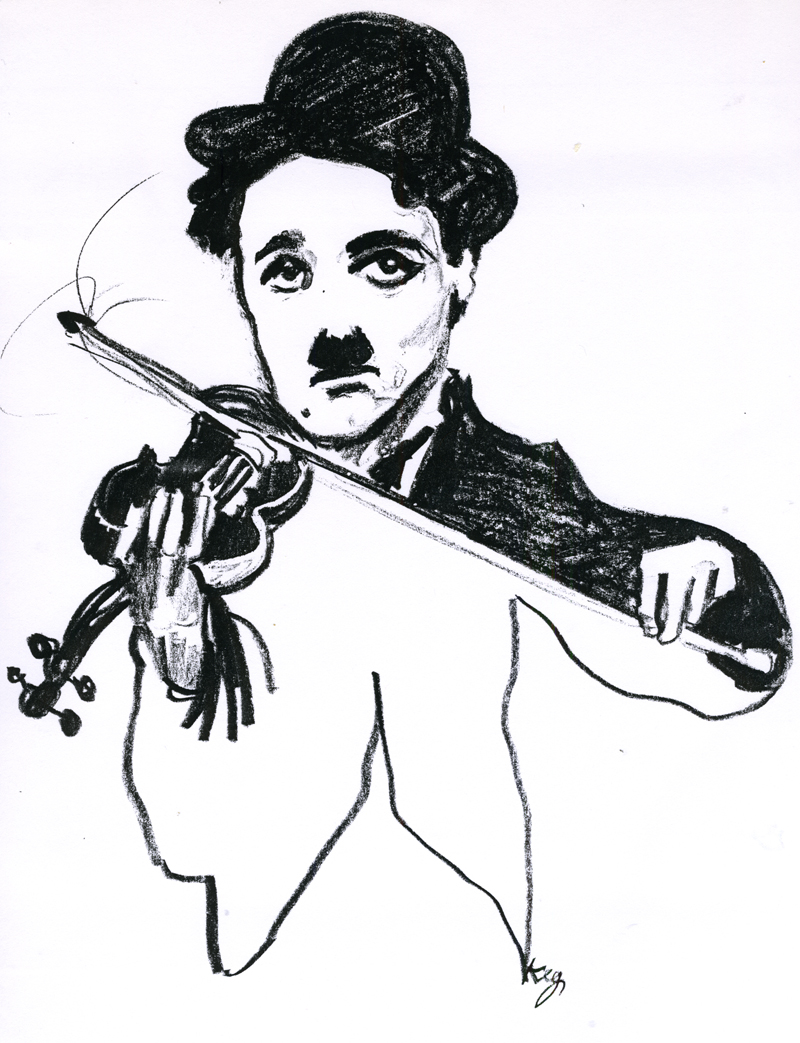
Charlie Chaplin

Buster Keaton

European Clown Trio

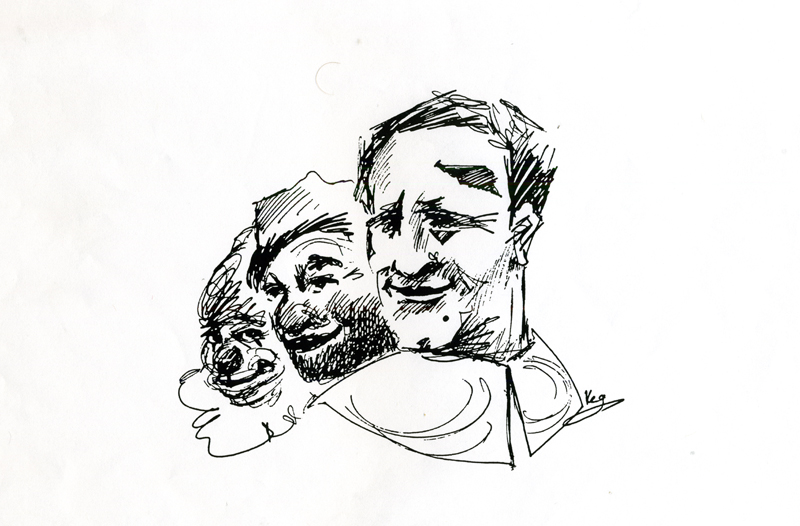
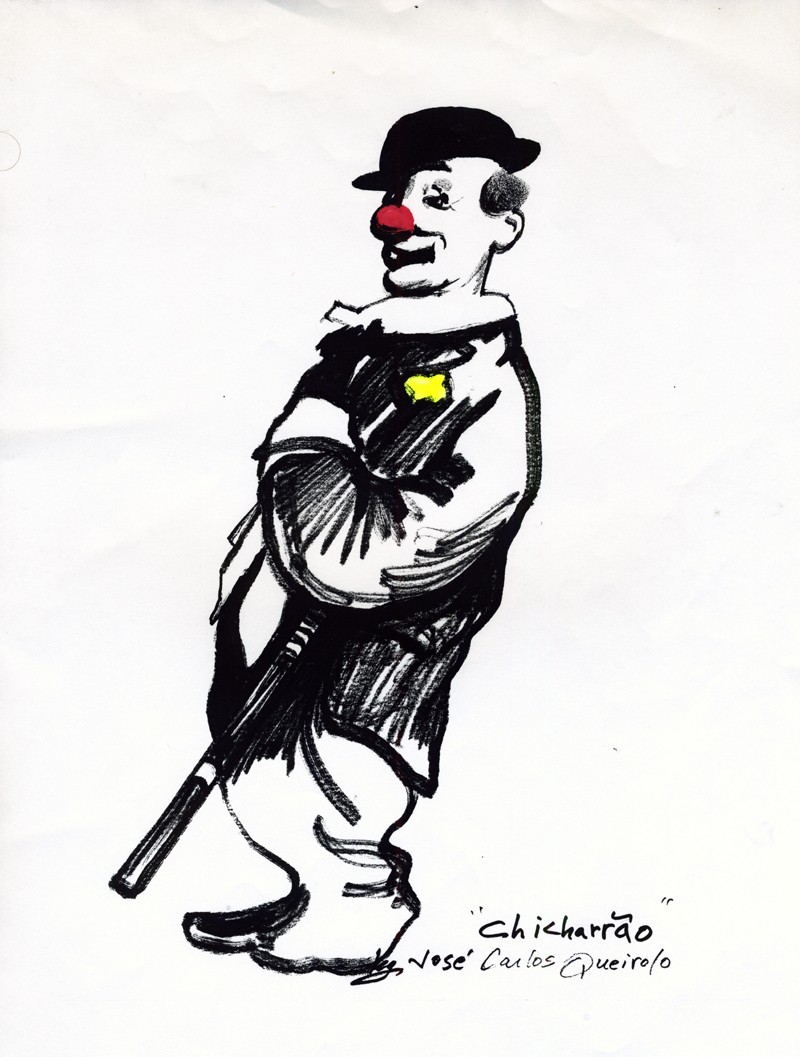
José Carlos Queirolo

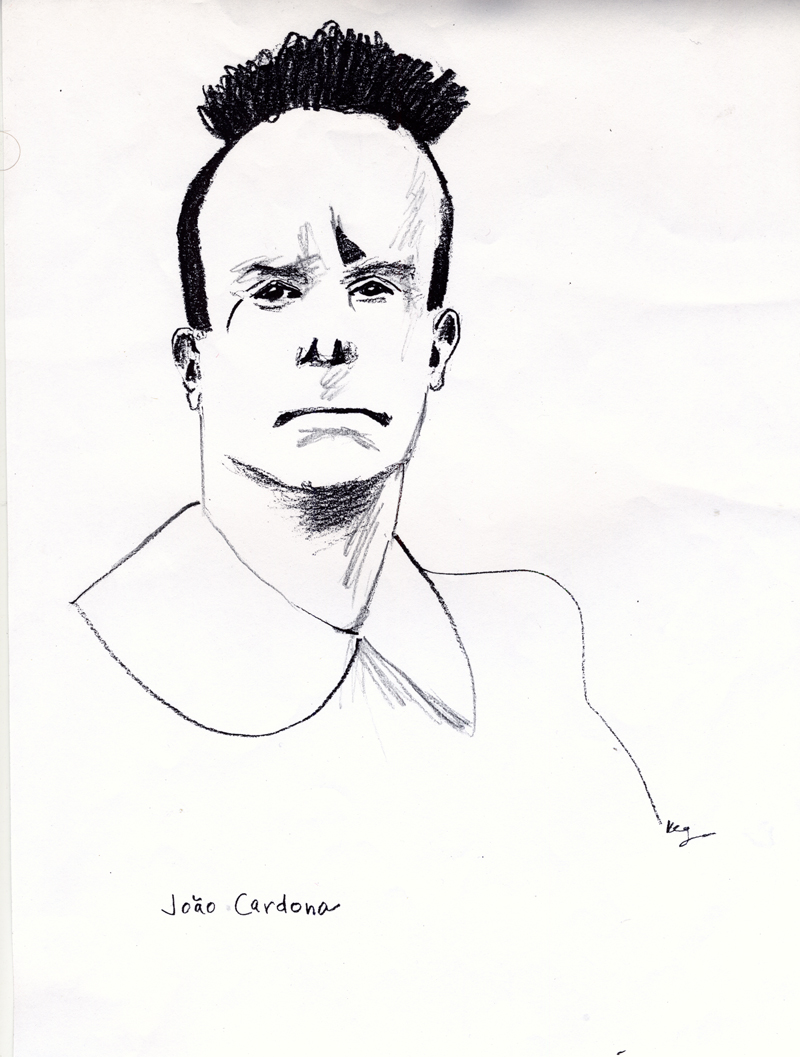
João Cardona

Chicharrão & Pimentão

Otto Griebling

Oleg Popov


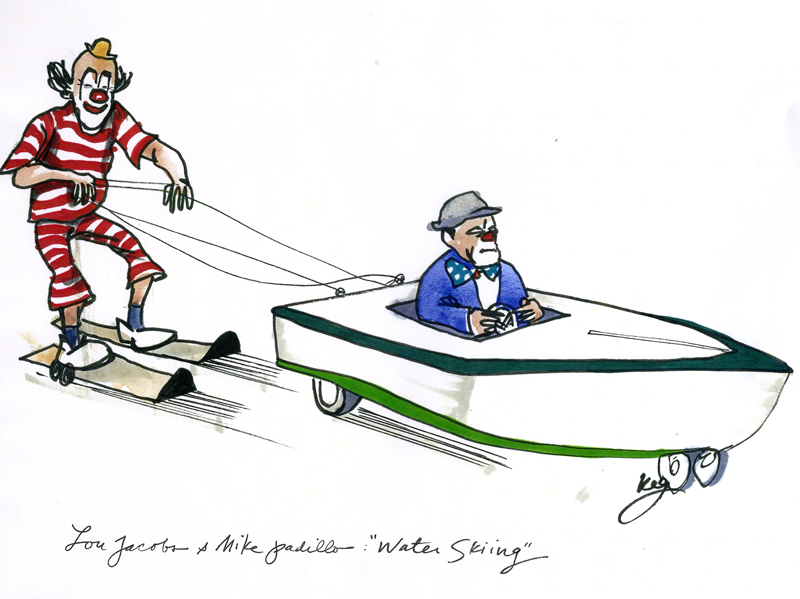
Lou Jacobs & Mike Padillo

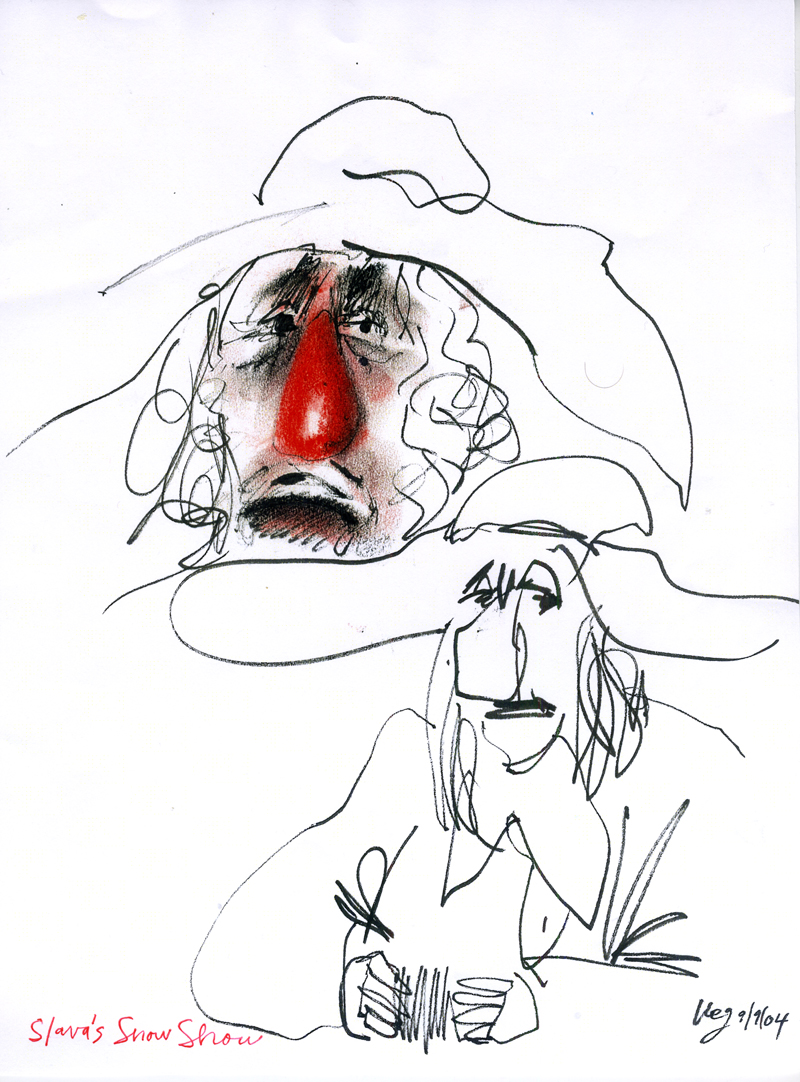
Slava
 
SHARE
EXPLORE FURTHER

Guest Post: Jeff Raz — Butoh Workshop in Tokyo

POST 77
Monday, February 22, 2010

Please welcome guest poster Jeff Raz! This is just the first paragraph of his full and very impressive bio:

Jeff Raz, the Founder and Director of The San Francisco Clown Conservatory, has worked with Cirque du Soleil for the past 5 years, playing the lead role of the dead clown (photo, below) in Corteo in English and in Japanese, training CdS performers in clowning, coaching clown acts, and leading Cirque du Monde (social circus) workshops for at-risk youth in the U.S. and Japan. In addition, Mr. Raz teaches acrobatics at the Tony-award-winning American Conservatory Theater MFA program, and trains clowns in the Big Apple Circus’ Clown Care Unit. He is now the S.F. Bay Area Casting Partner for Cirque du Soleil as well as the Associate Producer of Circus Flora, a 25-year-old classical circus.

I’m honored that Jeff found the time to write the following report for us on a butoh dance workshop he took recently in Tokyo, and certainly look forward to more posts.
_______________________________________

I was recently in Tokyo, performing with Cirque du Soleil’s “Corteo”. Our assistant director organized a workshop in Butoh given by the Dairakudakan Company, the oldest and largest Butoh company in the world. Butoh is a Japanese dance form that grew in the ‘50’s out of a post-war urge to look inward rather than absorb Western forms. I have very little knowledge of Butoh, which looks delicate and grotesque, with bone-thin performers covered in ashy make-up slowly creating shapes that remind me of A-bomb victims.

Our four teachers, all with shaved heads, focused on a basic concept of imagining one’s body as a water balloon, with the flow of water up and down, side to side, as a movement metaphor. Another main concept was that our actions were initiated outside of ourselves, from an imagined puppeteer or from the flow of our imagined water. The work felt wonderful in my body and accessible to my imagination; the primary teacher was charming, supportive and had a lovely sense of humor, not what I expected from someone dedicated to Butoh.

At the end of the workshop, the two thinnest teachers performed a short piece, beginning as we had by simply standing and removing their ‘selves’ from their bodies, leaving empty shells. We could clearly see this happen. The director then gave the performers prompts, leading them eventually to walk over a field of headless corpses, then laugh and, finally, freeze their laughing bodies. It was quite astounding to see these performers interpret the director’s images differently and both with incredible specificity and clarity of movement. It also showed us the pain embedded in the wonderfully flowing, relaxing movements.

After the workshop, a few of us discussed the performance, wondering if we would be as fascinated with a full Butoh show, in the absence of the context of the workshop, the English translation and our personal connection with the artists. Over the years, I have noticed that I am attracted to works of art and artistic disciplines in two ways — because practicing a certain form feels good in my body and heart and/or because I love experiencing that art made by others. At 14, juggling felt so right for my body that I loved practicing many hours a day — it was all I wanted to do. To this day, I love to juggle but am not a particular fan of juggling acts. Shakespeare moves me in similar ways – I love to taste Will’s words in my mouth but don’t seek out productions of the Bard’s work to attend. On the other hand, I love capoeira, Bach cello suites, and really good hand balancing acts without any interest in performing any of these. Clowning is one of the few art forms that I love to do and (often) love to see.

Dairakudakan Company
Our four teachers were:
• Ikko Tamura ( Leader of the workshop)
• Takuya Muramatsu (one of the performers, with more than 10 years experience in Butoh and is one of the Top Officials of Dairakudakan)
• Kumotaro Mukai (the other performer, he also has more than 10 years experience in Butoh and is one of the Top Officials of Dairakudakan)
• Daiichiro Yuyama (Interpreter)

Here is some information we received about Butoh:
• Butoh is a contemporary avant-garde dance-theatre form that originated in Japan. It was pioneered in the early 1960s by Tatsumi Hijikata and Kazuo Ohno and was initiated as a reaction against both traditional Japanese and Western dance styles.
• It has been described as a dance of the senses, of pure emotional states expressed through the body (instead of through words), of universal imagery, of poetry and metaphor. It combines dance, theatre, improvisation, and ritual, crossing cultural borders in its search for the universal.
• At its heart, Butoh aims to reveal the unconscious, inner world of the performer, stripped of his/her social mask.
• Traditionally performed in white body paint, loincloths and shaved heads, Butoh parades a tableau of distorted and grotesque forms, striving to reach the audience at a gut level. It reveals the neglected underbelly of human behaviour, embodying an appealing ambiguity with multiple and conflicting levels of interpretation.
• Butoh develops deep focus and physical awareness, a rich imagination, courage, and the ability to express emotions honestly and openly with the entire body.
• “(Butoh) is a way of life, not an organisation of movements. My art is an art of improvisation. It is dangerous. I try to carry in body all the weight and mystery of life, to follow my memories until I reach my mothers womb.” — Ohno Kazuo (co-founder of Butoh)
• “Butoh breaks through all verbal definitions and snatches the audience’s sensibilities away to a state of nakedness.” — Eguchi Osamu

SHARE
EXPLORE FURTHER

Guest Post: Jonathan Lyons on The Harlem Globetrotters

POST 68
Thursday, February 11, 2010

by Jonathan Lyons

The same weekend I was catching Aurélia’s Oratorio in Berkeley, our intrepid reporter and master animator Jonathan Lyons was in Oakland enjoying a performance by the Harlem Globetrotters, who I am embarrassed to say I have never seen perform live. But talk about physical comedy!

You can click here to read other posts by Jonathan and to view his impressive bio, to which I will add that he is currently working on the film Mars Needs Moms for Disney/Image Movers Digital. — jt
_____________________

Milton Berle is quoted as saying, “If opportunity doesn’t knock, build a door.”

Abe Saperstein loved sports. When he failed to make the basketball team at the University of Chicago, he left school. But he didn’t let that stop him. He just formed his own team. He assembled five African American basketball players and made himself coach. They were hired to play demonstration games at the Savoy Ballroom, in an attempt to lure people to stay and dance after the game. The “Savoy Big Five” weren’t so successful at attracting dancers and the program ended, so Abe took them on the road.


It was 1927, and all sports were segregated. The idea of playing for a professional team was out of the question for all of them. In an effort to make a career out of sports, they went barnstorming around the Midwest. Saperstein had the sense of a showman, and he thought a special name would be more likely to bring in spectators. Harlem was the center of African-American culture, so he appropriated the name, and added “Globetrotters” to give the impression of having traveled great distances before arriving in whatever small town they would play. Vaudeville performers of the day would routinely get booked for a week at a time; the Globetrotters moved on daily. They would take on the local team and show them how the game is played in the big city, for money. Of their first 106 games, they won 100.

Eventually they became so good, they would build up a comfortable lead in the score, and then relax and have fun at the expense of their opponents. The spectators laughed. This would be the ingredient that would make them more popular than they ever dreamed. As the crowds grew, so did the recognition of their tremendous skill in the game of basketball. The comparison to white players was inevitable, and soon the question of who would win in a game became too great to ignore. In 1948, a game was arranged with the champion Minneapolis Lakers. The game ended in classic movie style. A Globetrotter takes one last shot just before the final buzzer goes off, and he wins it. In 1949, they beat them again. In 1950, Chuck Cooper became the first African-American drafted onto a white team. The Globe Trotters now had to compete with the professional teams for the best players.

While Abe Saperstein deserves full credit for founding and building the Harlem Globe Trotters into an internationally renowned group, he is also remembered as a tough business man, who’s treatment of his players was sometimes less than fair. But putting that aside, the greatness of the players eventually overcame his shortcomings, and they are responsible for earning the victories and generating the laughs. Hundreds of great players have played with the team, and these five had had their numbers retired: Wilt Chamberlain, Marques Haynes, Curly Neal, Meadowlark Lemon, and Reece Tatum. In 1993, Mannie Jackson, a former player, became the first black owner of the Harlem Globetrotters.

A fun vintage bit.
Having the honor of a 7-year old basketball player in the family, I recently had the opportunity to see the 2010 Globetrotters. It would be my first time seeing the real thing live. Previously I had only seen video, and the Canadian knock-off version “The Harlem Diplomats.” The Harlem Diplomats had an advance team put up those cheap 1 color posters around my hometown. They were a real traveling novelty act, performing in the high school gymnasium. I was quite young at the time, and what I recall most about the game was feeling rather sorry for the team of sad sacks they brought with them to humiliate.

I knew the Trotters would play against a team of stooges, and I wondered if I would feel the same about their opponents, “The Washington Generals.” But they solved this problem, by making the General’s coach into a sort of villain. The Generals were introduced first, jogging out in house lights and cheesy fanfare music. Then the coach was introduced, and his behavior begged the crowd to dislike him. Dressed in a gaudy yellow suit, and using a bullhorn, he loudly proclaimed he had a “secret weapon” that would allow him to finally defeat the Globetrotters.

I had also wondered what kind of crowds the Globetrotters could attract, and I was surprised to see the Oracle Arena in Oakland nearly filled. And it was the first of two games. By the way, for many years now, the Globetrotters have had multiple teams touring at any one time. You can buy tickets to games on the same night in different cities. Their roster includes enough coaches and players for 4 teams.

When the Trotters enter, the house lights go down, the spotlights shine, and loud hip hop music booms, while they take a lap around the court, and are introduced one by one. When they form up the “magic circle” and begin the warm-up tricks, and the whistling of “Sweet Georgia Brown” is played. It was then that I really felt the history of the show coming to life.


After the lengthy warm up, the game begins. But before the initial tip off, one of the Trotters determines the ball is flat, and goes to the side to get a fresh one. When the new ball is tossed for the tip off, it turns out to be a balloon filled with helium, and floats off to the roof. I love the gag balls. I won’t go into detail about every gag, but I certainly recognized some of the old standards. The splashed water cup that escalates to a bucket of water in the refs face, and ultimately confetti flung at the audience. It wouldn’t be a Globetrotters game without it. Of course somebody got pantsed. I really do wonder if somewhere they have a big book of gags to pull from. The coaches are all former players, so I’m sure they act partly as coaches, partly oral historians, partly as directors. It would be very interesting to interview one of them.

It’s important to remember that the players take great pride in their basketball skills. Like all great clowns, the Globetrotters are highly skilled to the point of being spectacular. Every year, they still hold an exhibition game against the NCAA college all-stars. When the Generals have the ball, they are expected to play to very best of their ability. Except perhaps the General wearing the tear-a-way uniform, who ended up running to the locker room in his boxer shorts. When the Globetrotters have the ball, they just have to play along. Foul shots are only called for to get in the related jokes.

The “secret weapon” the Generals coach used was hypnosis. He brought out an umbrella with a spiral design on it, which he twirled before a Globetrotter. After this, the player would do his bidding. The only way to free him of the spell was to do something “spectacular,” which usually meant one of their fantastic “alley oop” baskets.

Like most clowns, they interact with the audience, bringing children onto the court to spin balls on their fingers, and take successful shots at the hoop while the Trotters kneel and pray. They flirt with moms. They fill out the show with a very funny mascot, “Big G,” a character who is mostly a giant inflated globe head. His antics are available on youtube. My only criticism of the show was that the audio system wasn’t the highest quality. I was only able to understand about half the spoken jokes.

After researching the history and attending a game, I am now seriously impressed with the entire enterprise. They have existed since the latter days of vaudeville, and are going as strong as ever. They have a proud history in integrating American culture and sports. They are an impressive business, with courtside seats selling at a premium, and a very long line at the merchandise stand. They are wholesome family entertainment all decked out in patriotic uniforms. What’s not to like?

This video is a fun compilation piece

A documentary The Harlem Globetrotters: The Team That Changed the World. [Posted in segments to youtube; complete DVD also available for sale and to rent on Netflix.]
A bit of a fluff piece, but it includes Senator Barack Obama.

____________

Editor’s Note: Can’t resist adding this spoof from the Onion to Jonathan’s post; click here for full article. —jt

SHARE
EXPLORE FURTHER
Check out My New Book

Visual and verbal humor for the cognitively and artistically curious!

“A book to treasure!”
—Bill Irwin

Upcoming Events