Tag: Guest Post

Guest Post: Jonathan Lyons on San Francisco’s Flying Actor Studio

POST 41
Thursday, December 3, 2009

by Jonathan Lyons

[Jonathan Lyons is an animator at Imagemovers Digital, and you can see his latest work in Disney’s A Christmas Carol, starring Jim Carrey, in theatres everywhere right now. You can read his other guest posts here and here.]

When I was an adolescent living in New England, I was told that Ringling Brothers Barnum and Bailey Circus ran a clown college in Florida. To me, that sounded like an excellent institution of higher education. Just about my speed.

Alas, one thing leads to another and the decades go by. I never made it to Clown College. I think perhaps it’s a good thing, as I am somewhat injury prone. I probably wouldn’t have lasted many years in the profession. Still, my love of physical comedy, and my curiosity about the art remains undiminished. I practice it in a virtual form, animation. Recently however, I had a chance to sample the real-world training of a physical actor.


I live in Marin County, California, and this past summer a new school opened up in San Fransisco, just across the Golden Gate Bridge. The Flying Actor Studio, operated by James Donlon and Leonard Pitt. They offer “physical theater training with world-class master teachers offering: movement, mime, mask, clown, circus arts, improvisation, voice, new performance.” They have an impressive list of guest instructors, including Geoff Hoyle, John Gilkey, Bill Irwin, Judy Finelli, and Suzanne Santos.

To kick off the opening of the school, they held a special performance with Donlon, Pitt, and Cirque du Soleil alumni, John Gilkey. The show was called “The Zany and the Surreal.” It featured rotating solo performances from the three actors. Donlon delivered some of his deeply felt mime, Pitt introduced some mask techniques and told an entertaining Jewish tale. John Gilkey’s pieces included his signature coat rack juggling routine, which I enjoyed watching in the Cirque du Soleil show Quidam.

The Flying Actor Studio is a full-service training facility offering everything from one-day workshops to a full-time, 28-week conservatory program. They also arrange special guest shows and workshops. This October they welcomed the International Czech Theater Festival, and held a clown workshop with Steve Capko. Among the workshops and classes they had the ideal opportunity for a working family man such as myself. “Meet the Flying Actor Studio Drop In Class”. Held on a Sunday, 10 am to 4pm, it is described like this:

“A survey of the Flying Actor Studio methods including improvisation, imagination, time, movement, mask, and mime. This class is offered on a sliding scale to make our classes accessible.”

I was happy to pay the high end of the $25 to $40 suggested price. It was more than reasonable for the experience. I and a handful of other participants warmed up with stretches in the bright loft space. Some of them were actors, at least one other was just curious like myself. James Donlon ran the morning half of the program. Among Mr. Donlon’s many teaching credits, was the Ringling Brothers Barnum & Bailey Clown College. Finally, I would have my day! We did a variety of basic exercises in movement. He introduced the idea of “neutrality,” which I found intriguing. Neutrality in this case being a way of moving (or being still) that would offer no clues about the person. You wouldn’t be able to determine age, sex, state of mind, state of health, anything. Half of us would wear black hoods, to hide the face, while walking around the room in whatever fashion felt neutral to us, while the others would discuss what they saw. We did the same thing with sitting in a neutral position. While I would have thought that the class would be all about creating character, this exercise in removing character was just as informative. After that we practiced a variety of mime exercises, and by this time, I was beginning to sweat. It was a workout, and I would be sore the next day.

After a lunch break, Leonard Pitt took over the class. During Mr. Pitt’s 40 years of experience he has studied with Etienne Decroux, written several books, and been a movement consultant on major motion pictures. We started with an exercise between pairs of people locking eyes and moving back and forth as though on a rail. Building on that we expanded it to random group movement, quickly switching to pairs. The exercise involved focused attention, and physically grabbing attention from others by just turning towards them. I can see where it would be a useful exercise for the stage movement. Following that, Mr. Pitt introduced us to the basics of using masks. It was interesting to learn that mask work is not so much about movement, but about posture and posing, and also eye direction. This is useful stuff for an animator.

Thanks to James and Leonard for setting up such an accessible, educational and enjoyable program. Good luck to them and their venture.

Click here for more information about the Flying Actor Studio.

SHARE
EXPLORE FURTHER

Guest Post: Jonathan Lyons — The Strange Case of Alice Cooper

POST 30
Sunday, November 8, 2009

A Guest Post by Jonathan Lyons

Back in 1979, while I was stationed at a Navy training center in San Diego, I attended an Alice Cooper concert. For those who don’t know, Alice was known for putting on an elaborate stage show, including simulated hanging and beheading. He’s been called the Godfather of Shock Rock. This show had an electric chair.

To open the show, a full size movie screen hung center stage, and a film of a vodka bottling plant plays to the live warm up music of Alice’s band. In the last shot of the film, a bottle falls over toward camera, with the tip very close. At this point, as though coming out of the bottle, Alice Cooper jumps through the screen. Not tearing it. The screen had slits cut vertically across the entire area. I think the screen material was also elastic, to make it easier to pass through. I have learned that was referred to as the “magic screen.”
Later on the magic screen was an integral part of a remarkable bit of physical comedy. On the screen, they projected something that I remember as a chase film, very Keystone Kops, with Alice escaping from a mental institution, being pursued by men in white coats. But it was the magic screen that made this so special. The performers on the stage synchronized to the movie, so they could literally jump through the screen, and magically appear in the movie! It was like watching “Sherlock Jr.” performed live. I recall there being a bomb, as in a cannonball, with a lit fuse, and the word “BOMB” in block lettering on it, that was tossed into and out of the movie. The effect was fantastic. There was music composed specifically for this event. This song was called “All Strapped Up.”
While looking for references for this blog post, I discovered a concert film was recorded and released on VHS. The tape is no longer available, but it is fully viewable on Youtube, in 8 parts. On youtube I discover, it was the very show I attended! I am somewhere in the front, pressed up against the boards, with only glowering security guards between myself and Alice. Though I’m never visible, it’s a treat to see the show again.
Unfortunately, the magic screen segments were not included in the video. Since it would have been a video of a projected film, it may not have looked good. The opening of the film, the vodka bottling plant, was original footage, not the projected film. When Alice jumped through, they just cut to the live shot In this video, when the cut to the stage happens, you can see the screen recovering from his entrance.
In researching this piece, I have come to the conclusion that Alice Cooper has a little bit of clown in him.
EXHIBIT A. The opening to the concert film “The Strange Case of Alice Cooper.” Alice personally introduces the film, and he says: “In any disastrous situation there’s something funny. I mean, somebody must have slipped on a banana peel right before the bomb hit in Hiroshima.”
EXHIBIT B. During an earlier live show, Alice had a pineapple upside down cake thrown into his face, and he handled it very professionally. Most rockers would have gotten angry at the crowd.


EXHIBIT C. Although the video of the magic screen isn’t available, the music for “All Strapped Up” is available. After about 1 minute it unmistakably develops into silent comedy music.
[NOTE: Unfortunately this link has been removed by YouTube. —jt]
EXHIBIT D: DVD reviewer Dan MacIntosh had this to say:
“Alice Cooper almost ruins a perfectly good concert film with his lowbrow comedy”
Alice Cooper’s show, in addition to the “shock” and “death” effects, were also a bit silly at times. The “All Strapped Up” magic screen comedy was the most lighthearted of all. I think Alice knew he couldn’t be too serious, or the show would be a total downer. I have not seen a Marilyn Manson show, but I don’t believe he has learned that lesson.
SHARE
EXPLORE FURTHER

Guest Post — Jonathan Lyons: Always Leave Them Laughing

POST 24
Thursday, August 20, 2009

Yep, the start of another new regular feature of the blog:

The Guest Post!

I’m honored to include the thoughts of experts in the field to this blog, so let’s get started with me introducing Jonathan Lyons…

After earning his BFA in film (majoring in animation) from NYU in 1988, Jonathan began a career in the VFX (visual effects) industry, working for ILM for nearly 6 years. He is currently at Imagemovers Digital, finishing up animation on “A Christmas Carol” for Robert Zemeckis and Disney. His research into clowns and cartoons resulted in a paper “Comedy, Clowns, and Cartoons.” which he delivered at the first conference of The Society for Animation Studies, held at UCLA in 1989. In addition to his VFX career, he is working on his own short film which, he says, “is of course a silent comedy.”

Take it away, Jonathan… and my apologies for the delay in getting this up there; this post was written 7 weeks ago right after the movie’s release but was a victim of my forced blog vacation
_________________________________

Always Leave Them Laughing


“When he’s laughing good you know
That’s the time to turn and go
Always leave then laughing when you say goodbye.”

George M. Cohan wrote the lyrics to Always Leave Them Laughing in 1903, and I assume it’s where the expression began. It’s still great advice today. The title has been reused for films such as the Laurel and Hardy short Leave ‘em Laughing (1926) and Always Leave them Laughing featuring Milton Berle (1949).

One of the most challenging aspects of physical comedy is how to end the show. The stand-up comedian has it easy. He or she can simply save the best material for last, then triumphantly run off stage to the sound of applause. But how does the physical comedian top it off?

A circus or stage clown with skill in acrobatics, juggling or magic, could end the show with the best trick, but what of the character comedian? It seems performers often devise a signature style of closing. Charlie Chaplin’s iconic ending, of him wobbling down the road alone, suited his purposes, but was not in itself funny. The Three Stooges, who I’ve been watching a lot of lately, reach a certain plateau of pandemonium, then whoop whoop themselves out of the scene, escaping to their theme music. Warner Brothers animation created the Porky Pig “That’s All Folks” tag.

In feature films, it’s even more difficult to end with a laugh. The audience has expectations of resolution to the various story lines. Occasionally, films such as Fast Times at Ridgemont High, or Animal House, end with humorous epilogues of what eventually became of the characters. Funny, but not physical.

What inspired me to think about this was the new movie, The Hangover. The surprise hit of summer 2009, the film has a truly remarkable ending. What follows, may or may not constitute spoilers, so make your own choice to continue. The premise of the film is obvious from the trailer. Four friends take a bachelor party trip to Las Vegas to celebrate the impending marriage of one of them. The next morning they wake to find the suite in a shambles, and the groom is missing. They have no memory of what happened. The ensuing action is quite funny, as they follow the few clues they have to find the groom and unravel the mysteries, a considerable portion of the comedy being physical. At the end the foursome is reunited, as would be expected in a comedy, and they find a digital camera containing photos of their lost night. They agree to view the pictures once, then destroy them. They gather around the camera, switch it on, then recoil in horror at what they see. Cut to the credits. During the credits, they show the photos. It is a series of still pictures, and they are everything you fear they might be. It is physical comedy in its rawest form. It’s shockingly funny. I wouldn’t argue if some of the photos were called obscene. The entire movie sets up the jokes in the photos. Many of the clues from the night before are exposed, and whole new alternative storylines flash by in seconds. It totally sends the audience out laughing.

— Jonathan Lyons (June 29, 2009)

SHARE
EXPLORE FURTHER
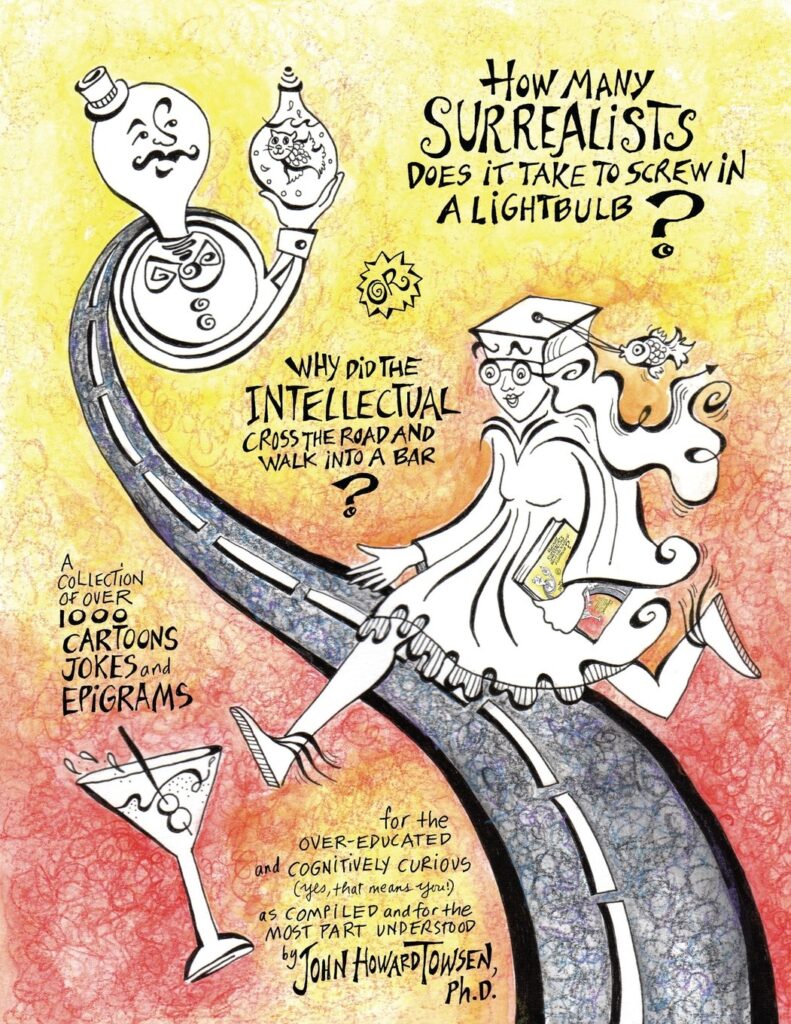
Check out My New Book

Visual and verbal humor for the cognitively and artistically curious!

“A book to treasure!”
—Bill Irwin

Upcoming Events