First we had this post about mimes directing traffic in Caracas, Venezuela, and now by way of my old friend Jim Jackson comes news that the mayor of Paris is employing “nocturnal artistic intervention squads” to help quiet down rowdy late-night partiers.
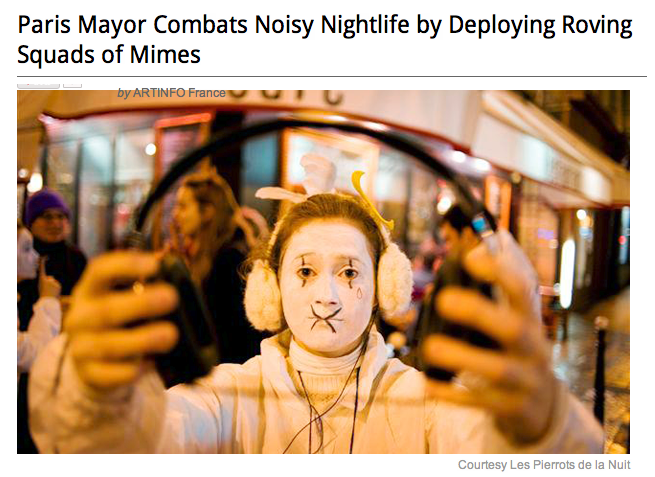
Imagine: You’re out on the town in Paris, perhaps knocking back a few too many glasses of Bordeaux, when, all of a sudden, a sad-eyed clown taps you on the shoulder and starts a mime performance called “The Rite of Sleep.” No, you aren’t dreaming, this person is not the fruit of your (slightly) inebriated imagination, nor even a pickpocket trying to lift your wallet.
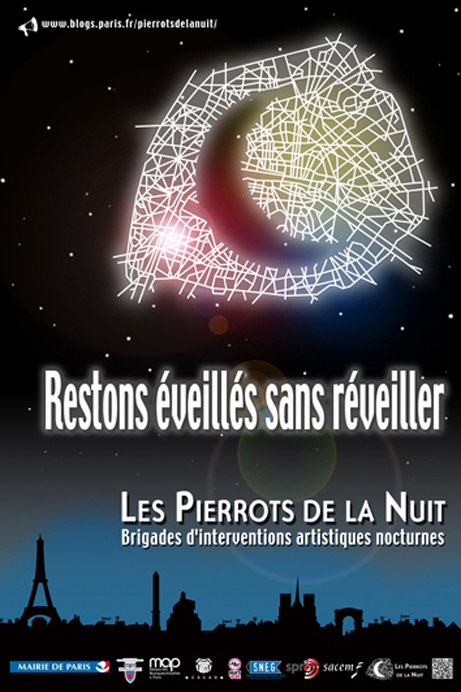
You have encountered a “Pierrot de la Nuit,” or Night Mime. These “nocturnal artistic intervention squads” are officially being launched this weekend in 15 Parisian neighborhoods. It’s an initiative of the Paris mayor’s office, which has adopted a strategy that has already proven effective in Vienna and the Spanish cities of Tarragona and Barcelona. According to a statement from the city of Paris, the aim is to use “language, theater, mime, and dance to raise awareness among residents, bar-owners, and night-owls” about noise pollution.
But how is this going to go over with a Parisian population of inveterate complainers and partiers, who have already been mourning the death of Paris nightlife for several years now? Couldn’t it backfire by activating their rebellious streak? To deal with a reluctant public, the initiative mixes street art and mediation. The 37 mimes work in trios (two performers and a mediator) and employ all their abilities (mime, acrobatics, dance) to encourage people to celebrate without shouting so that everyone can get along. In June — when the warm weather brings out even more revelers — their ranks will increase to 60 performers with 20 much-needed (we’re guessing) mediators.
So are these mimes just cops dressed as jesters? It seems not. Speaking several languages, sporting colorful costumes, their goal is simply to calm everyone down so that the night can be enjoyed by all. The statement from the Paris mayor’s office strikes a reassuring tone: “street performance is not perceived as aggression; on the contrary, it obliges people to listen and be respectful.” As the mimes themselves put it, “silence is not repressive, but a form of sharing.”
The Night Mimes have a blog and Facebook page, which will provide videos, updates, and even announcements of other nighttime performances such as concerts (a bit paradoxical, isn’t it?).
To get a sense of what these performances — part quality-of-life outreach, part happenings — are like, click on the video below:
Here’s a riddle for you: what do the sticky floors of New York City subway cars and dusty, musty books on Elizabethan drama have in common? For the answer, just read on….
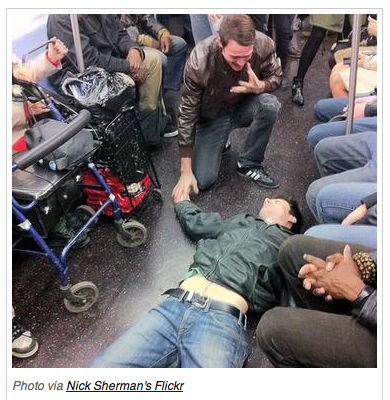
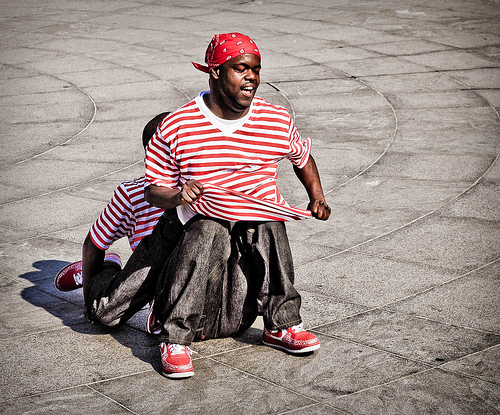
First clue: flash back to last spring. I’m on a crowded E train from JFK airport when a quartet of performers bound onto the train, loudly announcing their act with no little modesty. More hip-hop popping I’m guessing, ho-hum, which is why I don’t bother to whip out my Flip camera. Suddenly these guys burst across the length of the car in a flurry of handsprings and somersaults and some nifty partner moves, all dangerously close to their (truly) captive audience — “if I touch you, I’ll give you a dollar.” I especially like the peanut rolls (double forward roll holding each other’s ankles) because they have to make precise, last-second detours to avoid impaling themselves on the car’s vertical poles.
I really didn’t think you could do any of that on a standing-room-only subway train bolting along at 40 mph. I was wrong. Unfortunately, at under two minutes, by the time I got my camera out, they were gone. A YouTube search turned up nothing, but inspired by the next act in this post, I searched again yesterday, this time successfully. I still don’t know who they are, but this is definitely them.
Because camera angles are a challenge in a subway car, here are two views of the same act:
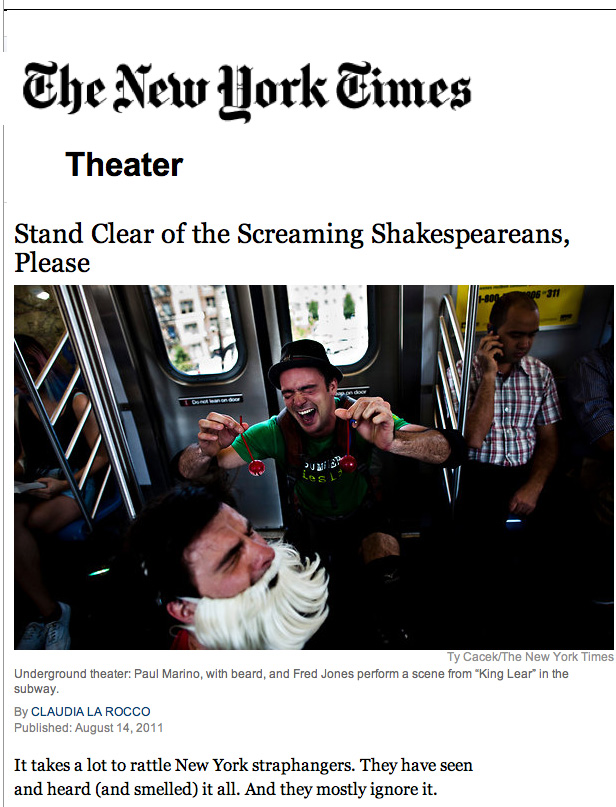
And then yesterday I noticed a NY Times article on two performers, Paul Marino and Fred Jones, who call themselves Popeye & Cloudy and who are no strangers to subway floors. They have been earning a reputation and a fair amount of loot by doing another form of action drama underground, casting the passengers as groundlings as they perform quick renditions of scenes from Shakespeare, favorites being Romeo’s suicide and Macbeth’s decapitation. Not only that, but they also throw in some Abbott & Costello as well; yes, Who’s on First?
“Not all subway lines are well suited to Shakespeare,” writes a reporter for the Wall St. Journal in an earlier article. “The long cars of the N and R trains allow for a bigger audience per scene. And the J,M,Z trains, which cross the Williamsburg Bridge, give riders time to relax for a lengthy performance. Riders who frequent the 4,5 and 6 trains in Manhattan are out of luck: those lines are too crowded for a proper death scene or sword fight, the actors say.”
Here’s the Popeye & Cloudy website.
Here’s that article from the Wall Street Journal and a short WSJ video.
If you want to see more, here’s a 12-minute Vimeo video montage that includes some of the Who’s on First.
So speaking of Shakespeare, and hopefully bringing this post full circle, here’s some more chapter two material, this time two complete public domain books on the fool characters in Shakespeare’s plays.
Studies in the Development of the Fool in the Elizabethan Drama by Olive Mary Busby
Our first dusty, musty book answers that eternal question, “whence came this insistent demand of the English public for the buffooneries of the fool?” Okay, so I exaggerated; it was never published as a book, it’s just a 1923 master’s thesis. Hard to believe, but it cost money to publish books back in what is now known as the Pre-PDF Era. I’m guessing Olive Mary Busby went to her grave not knowing that this blogopedia would make her famous.
The Fools of Shakespeare by Frederick Warde
This 1913 work starts with a chapter on “the fool in life and literature,” followed by individual chapters devoted to each of Shakespeare’s principal fool characters, including: Yorick, Touchstone, Trinculo, Feste, Launcelot Gobbo, the grave-digger in Hamlet, and the fool in King Lear. Fools of Shakespeare
Here I go again with another old-man story (stop rolling your eyes):
In 1973, I had already been living for four years (I stayed 22) in my $68/month crime- and roach-infested apartment on 2nd St., just off the Bowery. In the same building lived Hilly Kristal. Around the corner but on the same block was Hilly’s high-decibel new punk rock club, CBGB — so loud I was sometimes driven to make anonymous, menacing phone calls to them just so I could get some sleep (“Close your fuckin’ back door or I’ll…”) Across the street from me lived a bunch of musicians who went by the name of The Ramones.
None of which, I must confess, interested me in the slightest.
Instead, while Patti Smith, Blondie,Television, the Talking Heads, and the Ramones were making music history less than 100 meters away, square that I was/am I was much more excited to hear about an exciting new French street performer who was becoming a regular in nearby Washington Square Park.
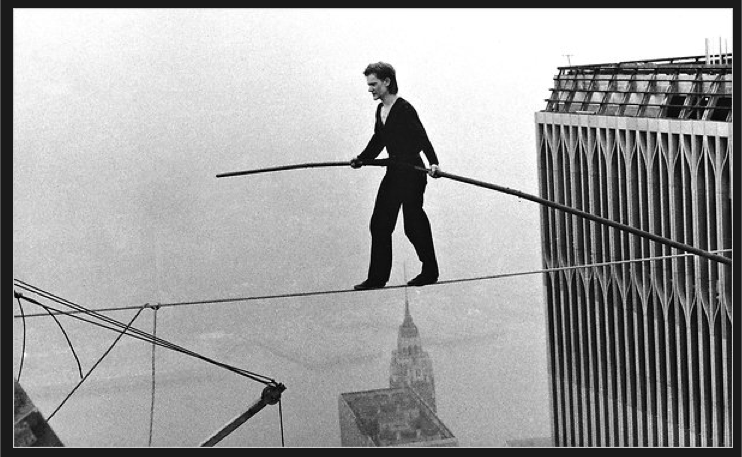
He was, as you have no doubt guessed, none other than a very young, pre-World-Trade-Center, Philippe Petit.
And he was good.
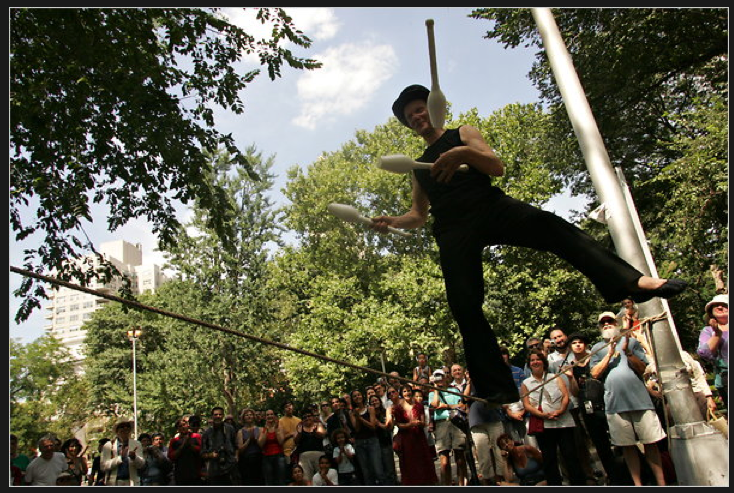
Dressed all in black, adorned with a top hat, speaking nary a word, he had a bit of the Marcel Marceau about him and, above all, a strong presence and an excellent sense of the audience. I don’t have total recall of the act, but it included:
• a perfectly-drawn chalk circle (his “stage”), a perimeter he enforced by circumnavigating it on his unicycle whenever encroachment loomed; pull your toes back or else! • some very nifty three-ball juggling • “teaching” a spectator to juggle, then revealing to the crowd (behind the spectator’s back) that he’d pick-pocketed the guy’s watch (big laughs) • stringing a “tight” rope from a tree to a pole or, better yet, to the shoulders of half a dozen burly guys who between their ton of mass could still not keep the rope totally tight once the slight Philippe put his weight on it (more big laughs) • juggling clubs and then torches while walking barefoot on the rope, warming his feet with the flames • a grand exit on his unicycle, carrying all his props
But this was 1973, a few years before Betamax and VHS, no one had consumer video cameras, much less smart phones, so it’s not surprising that so far I haven’t been able to find any street performance video of Philippe from those early days. All I can offer is a snippet from much later, 2005 to be exact, posted to YouTube by Luke Hannafin (thank you very much). Mostly it just shows the ropewalking, not the comedy, but it’s all we’ve got so far. (Let me know if anyone has more.)
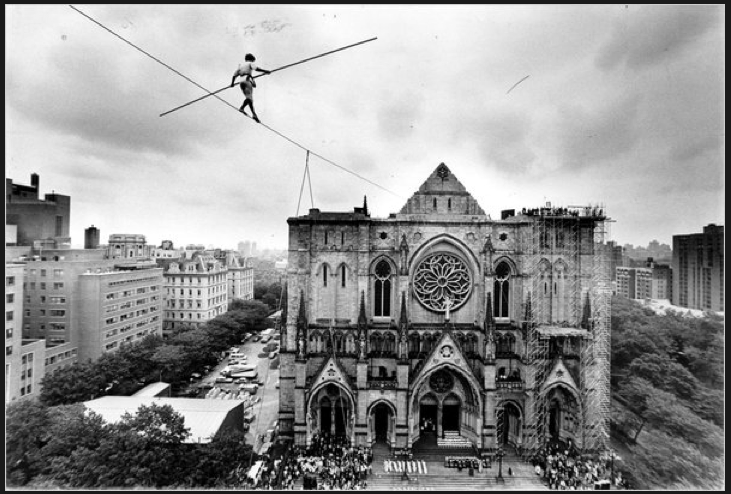
You know what happened next: sneaking into the World Trade Center in 1974 before construction was even finished, using a cross bow to string a wire from tower top to tower top, 1350 ft. high, and then astounding early-morning Manhattan with an extended walk. A father of a friend of mine told me that on his way to work that morning he saw everyone gazing skywards, but just thought to himself, “stupid tourists,” and kept walking, never bothering to look up.
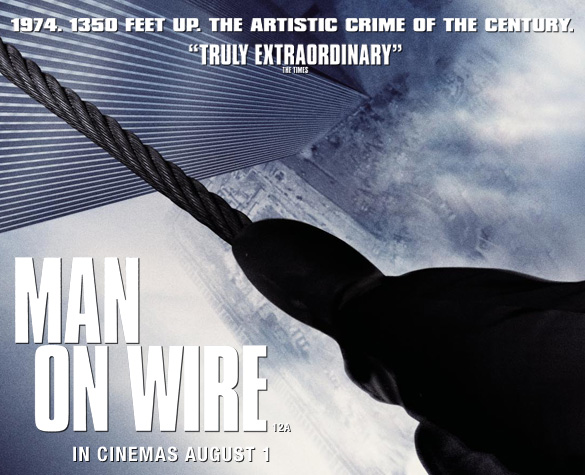
And for those too young to remember, the Academy Award-winning documentary, Man on Wire (2008), kept the legend alive.
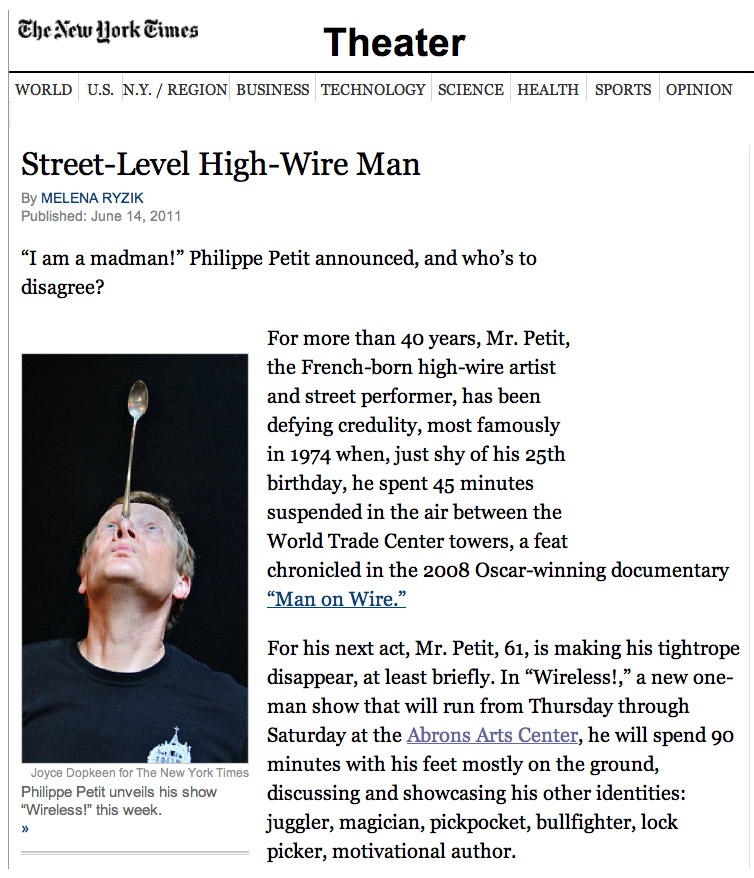
Fast forward to last week when I was pleasantly surprised to see this article in the NY Times about Wireless, a new Philippe Petit one-man show:
And here’s a short video that accompanied the Times article, with footage of the reporter’s visit to Philippe’s studio in the Catskills.
Although I’d love to see Philippe street perform again, I must admit I wasn’t so sure I’d have the patience for a presentation full of motivational lecturing and his philosophy of life. You know how intellectual the French can get about these things! A little bit of that can go a long way for me. But of course I wasn’t going to miss the show, so I snatched up tickets before the weekend run sold out.
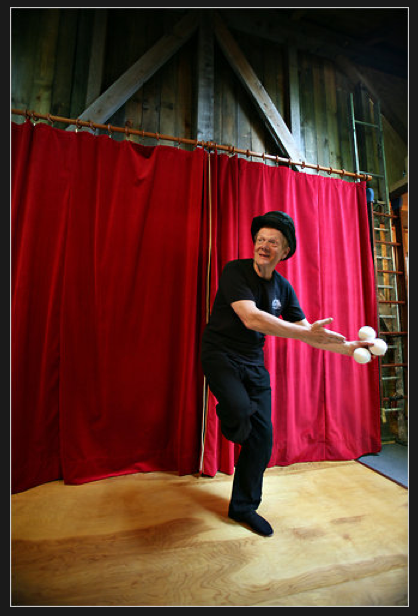
Bottom line, I liked it a lot. Philippe is 61, not so petit around the middle, but still spry and on top of his game. For me at least the evening was just the right blend of thoughtful reflection, storytelling, and show and tell. No, he did not walk on a wire, ride a unicycle, or pick anyone’s pockets, despite a couple of forays into the audience. But he did talk about body language and demonstrate his findings; perform sleight-of-hand and reveal how it was done; and he did do his three-ball juggling act. He drew illustrations on a board for us, told stories, and acted them out.
______________________________
“People ask me if I am afraid on the high wire. I tell them I don’t have time, I’m too busy up there to be scared.”
______________________________
He clearly sees himself as the self-made man, someone who through hard work and ferocious focus has managed to teach himself not only a wide range of skills at a very high level, but who has also integrated his worlds into a broader vision, what he describes as his “territory.” Along the way he touches on such topics as play; overcoming fear; learning from small mistakes so as to avoid larger ones; simplicity through repetition; and the joys of bullfighting and comedy pickpocketing.
He is a dreamer but above all a problem solver. The final symbol of the show is a John Kahn “Easter Island” sculpture, as tall as the proscenium, that descends from above as Philippe tells with relish the story of how they discovered the likely explanation for how they moved these ancient and mammoth statues. What does that have to do with wirewalking? Nothing — and everything.
All of this could be quite ponderous, but it isn’t. He is animated throughout, constantly moving with that puckish energy of his, and very funny. Yes, I laughed a lot. All in all, the show harkened back to the days of the Chautauqua lecture circuit, or the 19th century tours of such great writers as Charles Dickens and Mark Twain. Today most celebrities limit their introspection to canned quips on the Jay Leno Show, so it is refreshing to see an artist choosing to spend 90 minutes explaining what make him tick. Bravo for that.
Philippe’s weekend in New York was labeled a work-in-progress, the stated intention being to take it to a larger venue for an extended run and eventually tour the show. So the good news is that it may be coming to a theatre near you one of these days and, in fact, if you’re anywhere near Hampton, Virginia you only have to wait until July 9th to see Philippe here.
I haven’t found any reviews of the show yet, but here are some interesting links:
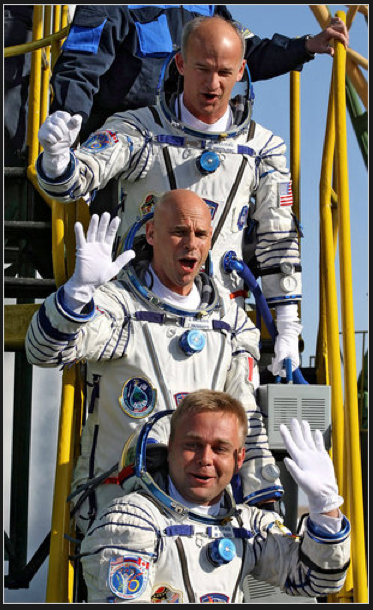
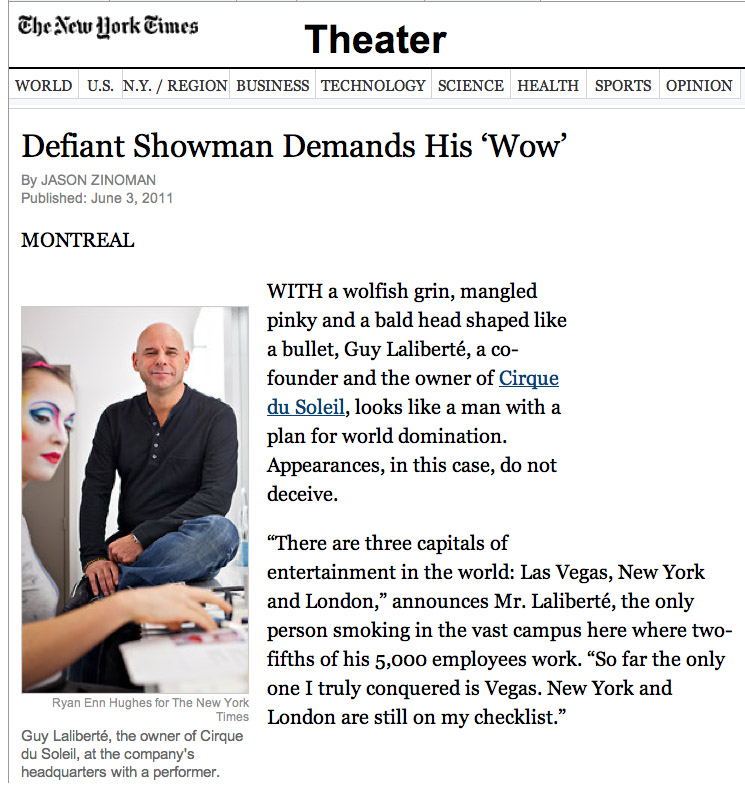
Guy Laliberté, co-founder and owner of Cirque du Soleil, has done well enough for himself to afford to pay $35 million to be a space tourist. Yes, you read that right; yes, out of his own pocket. Not bad for someone who started as an accordion-playing street performer!
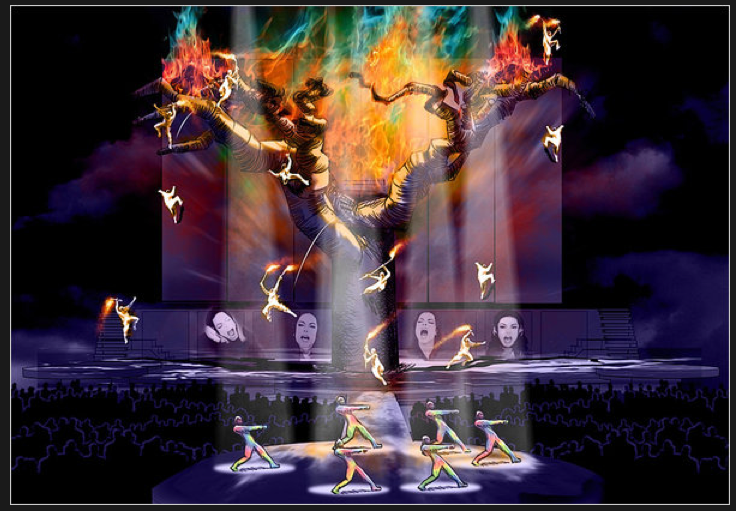
With his latest show, Zarkana, preparing to open in New York at Radio City Music Hall, he and the Cirque are the subject of an interesting enough NY Times profile.
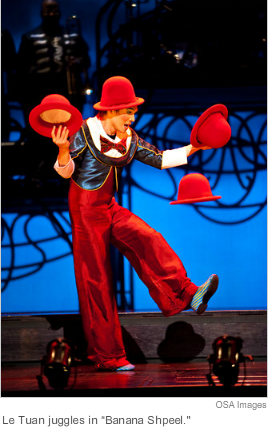
Because the Cirque’s Banana Shpeel, an attempt at a vaudeville stage show, bombed so badly in Chicago and New York, there’s been considerably more criticism of their artistry, and a lot of pressure on them to bounce back with their next show. The article does tackle this head-on:
As Cirque has transformed from an arty alternative to traditional big-top circus into what it is today, some suggest it has become emotionally cold and risk-averse. “If Cirque is going to succeed in New York, they need to understand story — and they don’t,” said Richard Crawford, an actor currently in “War Horse” who was fired from “Banana Shpeel” last year. “They have no idea about Aristotelean plotting or character. It’s not in their heart. They come from street performers, and now they are street performance with laser beams and millions of dollars.”
The problem is that audiences have come to expect a certain scale from Cirque, and when they don’t get it, as in the case of “Shpeel,” they may be disappointed. It’s a nagging worry for Mr. Laliberté too. “Are we condemned to only doing big acrobatic shows?” he says, leaning forward with a grave look. “Creatively we have the capacity to do much more. The answer is we can explore new stuff, but we need to give the public a bone to chew on.”
“Washington Square Park is the entertainment capital of the world.”
— Tic and/or Tac
(Hey, they’re twins, they speak in unison; how am I supposed to know which one said it?)
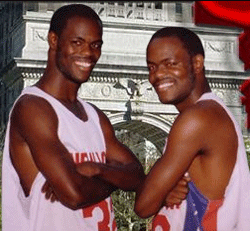
A mere hour ago I was walking home from viewing Werner Herzog’s amazing 3D documentary about the Chauvet caves of southern France, Cave of Forgotten Dreams, when I saw Tic & Tac performing in Washington Square Park. I’d seen them many times before, but I stopped “just for a moment” and ended up staying for the whole show.
What Tic & Tac do isn’t exactly what a purist like me would label physical comedy, but rather a mixture of straight acrobatics and stand-up comedy and audience participation. They are street acrobats who intersperse a few impressive stunts with a lot of verbal comedy, most of it centering around racial stereotyping. Lots of build-up, not that many tricks, but they make it work.
They are smart enough to make more fun of themselves than they do of the spectators, so the audience is comfortable enough to join in the fun. And it is effective — as in they haul in a ton of cash. Or as they say, “thank you for making it possible for us to work two days a week while you work five.”
So I was thinking, these guys are pretty much an institution here in New York, but maybe not to most of my gazillion and one blog readers. You know what I should do? I should go home, grab my handy-dandy Flip camera, come back to their next show (all of 15 minutes later), shoot it, and post it. Luckily, I checked YouTube first and, happily, many people had already beat me to the punch. Which is why I’m sitting here sipping my second glass of chilled white wine, writing this intro, and embedding some html code, instead of kneeling on the hard concrete shooting a show I admire but, alas, also know by heart.
So here’s a two-part clip from 2009, not the show I just saw, but you get the spirit and the m.o. They’ve continued to evolve the act since then and you can see other versions on YouTube. Or, better yet, come visit us in New York for the very latest update!
It’s street theater. People don’t know how difficult it really is to stop people from doing whatever they’re doing and just look at you. Especially New Yorkers. New Yorkers are prone to, even if you go to a comedy club, they’re in there demanding “Make me laugh.” What kind of attitude is that? In street theater, sometimes we get up there and we haven’t even done anything yet and you still have people looking at you like, “You better do something good.” It’s fun to be able to win them over.
This YouTube video announces an upcoming Tic & Tac DVD documentary coming soon, but no specifics. If anyone knows more, drop me a line.
And, finally, a short but good interview with Tic & Tac here.
Greetings from COP 15, the U.N. climate “Conference Of Parties” in Copenhagen, Denmark. In case you don’t get out much, COP 15 is considered a big deal not only because it was designed to forge an environmental treaty to replace the Kyoto Protocol, but because global warming trends have proven to be even worse than what the “alarmist” scientists were predicting just a few years ago. Thus not only do all the nations of the world have delegates at the conference, like it or not they have us “unofficial delegates” in town in the form of environmental activists staging their own Klimaforum, and taking to the streets with a variety of theatrics and actions intended to pressure the politicians and hopefully grab some international media attention. Truth be told, it’s a madhouse here, with so much going on at any given time that, like the parable of the six blind men and the elephant, it’s impossible to ever get much of an overview. Saturday’s big 6-kilometer march from Parliament Square to the Bella Conference Center attracted somewhere between 60,000 people (police estimate) and 100,000 (organizers’ estimate). The march — I almost wrote “parade” — was quite theatrical, with the clear intention of engaging onlookers and attracting major media. Of course most of the headlines focused on the arrest of a very small number of violent protesters, even in newspapers you would think more attuned to the actual issues and to the not insignificant fact that this was the largest and most international climate change protest ever.
Of course the problem with political theatre is that you are mostly preaching to the choir, but I guess if that choir is empowered and goes on to preach to others, picking up a few tricks along the way, then all is not in vain.
So how do you visualize the politics of climate change? Here’s what I saw:
• Depictions of the rich and powerful as puppets, robots or clowns.
• Images of imminent extinction, with the earth’s most vulnerable inhabitants dying a grim death. Our 350.org contingent included a boat (“we’re all in the same boat”), plus a dinosaur on poles created by a couple of Bread & Puppet Theatre vets.
• Masks, puppets, floats giving voice to the powerless, including endangered species — polar bears, penguins, and assorted wildlife.
• Personifying the positive: the wholesome qualities of the environmental movement (organic, natural, green, warm, fuzzy, etc.). Clowns, bright costumes, and green noses were part of this joyous branding of the movement.The motto for Mr. Green’s Circus (see below) is “We are gonna save the planet — and we will have fun doing it.” • Imagery centered on the desirable number 350 (target for safe number of carbon particles per million in the atmosphere).
Here are some images and video of the spectacle. I don’t have time for everything while I’m here, but will add some more to this post later, so check back!
Here’s my friend Adnan Saabi, from IndyAct in Lebanon, in action inside the Bella Center, in clown nose and glasses unsympathetically portraying a member of the oil lobby. The 850 refers to the amount of carbon in the atmosphere this character is apparently willing to tolerate, and the “recruiting e-mail hackers” refers to the recent brouhaha in England. So in this case the clown persona is basically saying the guy’s a bozo.
The Greenpeace puppet of a rich cigar-chomping industrialist manipulating the world’s political leaders (including Obama) on marionette strings; all of the “puppets” were in fact human performers.
Mr. Penguin and Mr. Dinosaur.
Clowns on a mission.
Frosty the Snowman says: “I fell down and I can’t get up!”
Three puppets (about 35′ tall) swaying in the wind, from Seven Meters, whose poster you see toward the top of this post. Seven meters is the height water will rise if all the ice in Greenland melts.
Partial view of our “We’re all in the same boat” contingent.
And here they are at the mall. Not sure what they’re doing there, but at least you get to see the whole group in action.
Okay, I admit it, this last one isn’t from Copenhagen, but I figured I could sneak it in while we’re on the subject of climate change. Besides, it is visual and I did learn about it in Copenhagen. If you like 3D street art, I think you’ll love this ice-age video of the summer 2008 work of German street painting artist Edgar Müller .
Physical Comedy in the 21st-Century One way for physical comedy to break new ground is to move it outside of your standard performance structures and into a remix with everyday life. The work of Improv Everywhere (motto: “we make scenes’) offers some good examples of this, as does the history of street theatre. But with street theatre, we’re usually talking about a band of outsiders trying to shake up the complacent and the powerful. Think Abbie Hoffman throwing dollar bills onto the floor of the NY Stock Exchange.
You may be pleasantly surprised, therefore, to see similar shock tactics being employed by an actual government, though one that itself is very much on the outside of world power. I am talking about the Maldives, whose president, Mohamed Nasheed, I will in fact be hearing speak later today. The Maldives are an island nation in the Indian Ocean and because of global warming they are literally sinking. Here are the text and the image from an excellent Daily Beast slide show, Our Sinking Earth:
What does it take for a small country like the Maldives to get noticed on the world stage? The nation’s cabinet recently held a meeting underwater, in scuba gear, to call attention to the state — the lowest-lying country on earth. Using hand signals and white boards 20 feet underwater, the cabinet produced a document calling for all countries to cut their carbon dioxide emissions before the Copenhagen meeting.
Joshua Allen Harris is a very clever guy. This may or may not be physical comedy, but I’m guessing you’ll like it. This is a New York Magazine video, and here’s their intro:
Call us boring and simple-minded, but before we saw the work of street artist Joshua Allen Harris we never once considered the artistic possibilities of subway exhaust. Using only tape and garbage bags, Harris creates giant inflatable animals that become animated when fastened to a sidewalk grate. Steven Psyllos caught up with Harris recently to discuss his older works (including a bear and a giraffe) and unveil a new beast that looks not unlike the Cloverfield monster. Video by Jonah Green
I guess it’s a generational thing, but when I mention parkour to anyone over 40, I usually get a blank stare, which if nothing else makes me feel young and in the know. If you too are going “huh?” just think of those videos you’ve probably seen of ridiculously agile teenage daredevils — Spidermen without the web — jumping on, over and off walls, railings and other structures that get in their way. They are called traceurs presumably because they trace a path through space while leaving only a faint imprint.
The Wikipedia definition is pretty good: “a physical discipline of French origin in which participants run along a route, attempting to negotiate obstacles in the most efficient way possible, as if moving in an emergency situation, using skills such as jumping and climbing, or the more specific parkour moves. The object is to get from one place to another using only the human body and the objects in the environment around you. The obstacles can be anything in one’s environment, but parkour is often seen practiced in urban areas because of the many suitable public structures that are accessible to most people, such as buildings and rails.”
If you still don’t know what I’m talking about, here’s one of those videos:
This summer in London I actually had the opportunity to participate in a parkour workshop and performance at the National Theatre, meet some of the original practitioners, and grow some thoughts about connections between parkour and physical comedy. I would have written this sooner, but there’s so much to cover!
Parkour is essentially a street art form like graffiti or skateboarding, but with its own unique philosophy and history. The word parkour comes from the original French term, parcours, meaning course, as in obstacle course. Parkour seems to have become the accepted international spelling because it’s phonetic and therefore less likely to confuse. Depending on who you’re listening to, free running and l’art du déplacement are either synonyms for or variations on parkour. (Wikipedia translates l’art du déplacement as the art of moving, though it also contains the more exact sense of displacement orshifting.)
Origins
If there is an inventor of parkour, it would have to be David Belle , the guy in the video above. Belle developed parkour with friends in Lisse (just south of Paris) in the 1990s, and has since become an international celebrity as an actor and stuntman in films and commercials. He was also the subject of a New Yorker profile piece, which you can read here.
The story of parkour, however, goes back way before Belle and, in fact, shares roots with modern movement theatre. Belle’s father Raymond — a French soldier, fitness enthusiast, and firefighter — was a legend in his own right. Raymond Belle’s training in the French military had brought him into contact with the teachings of Georges Hébert, which he passed onto his son, and which played a key role in formulating the basic tenets of parkour.
And who was Georges Hébert? He was a French military officer who traveled all over the world before World War I and later became a teacher of physical education. Hébert came to the conclusion that the weight training regimen used by the military was building muscle without promoting dexterity and speed. In its place he developed laméthode naturelle, which he based on the movement skills of indigenous peoples he had observed in his travels, especially in Africa. “Their bodies were splendid, flexible, nimble, skillful, enduring, resistant and yet they had no other tutor in Gymnastics but their lives in Nature.”
Hébert’s natural method, also known as hébertisme, promoted “the qualities of organic resistance, muscularity and speed, towards being able to walk, run, jump, move quadrupedally, to climb, to keep balance, to throw, lift, defend yourself and to swim.” One of Hébert’s top tools for achieving this was the obstacle course — le parcours du combattant — which was to become integral to French military training. So if you ever hated being forced to run an obstacle course back in high school or in army basic training, you have Hébert to blame. On the other hand, if you ever did an Outward Bound program and loved it or you’re into adventure racing, how about a tip of the hat to uncle Georges?
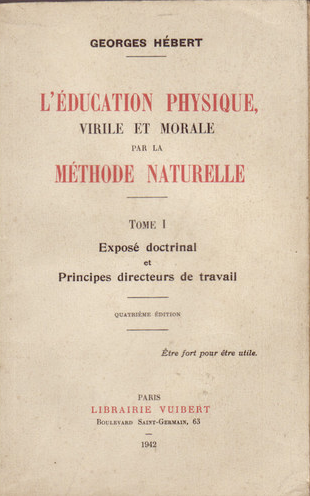
Although his teachings were already widely accepted by the ’40s, the publication of his multi-volume work, L’éducation physique et morale par la méthode naturelle (1941–43) no doubt cemented his reputation. Here are some scans from the book, courtesy of Hovey Burgess.
Hébert’s work was also a strong influence on French theatre, and specifically on movement training for actors. Jacques Copeau, whose work in the 1920s at the Théâtre du Vieux-Colombier in Paris was strong on improvisation and physical training, adopted Hébert’s natural approach to movement as an antidote to the artificial stylings of the staid establishment theatres. He created the Vieux-Colombier theatre school, whose instructors included the Fratellini clowns and one M. Moine, an Hébert-trained teacher.
Lecoq writes about his debt to Hébert in his book Le Théâtre du Geste and in The Moving Body, describing him as one of the significant influences on the transition from artificial mime styles to a more scientific study of the body in motion. Mark Evans, in Movement Training for the Actor, points out that “Lecoq’s Paris school was to find its final home in a disused gymnasium, a symbolic return he himself noted with approval… Lecoq’s meticulous approach to the analysis of movement owes much to the French tradition of scientific, anthropological, and philosophical movement analysis…”
Silent Film The film world offers more direct connections between parkour and physical comedy, the most obvious being the reverence parkour practitioners have for such silent film stars as Douglas Fairbanks and Buster Keaton. When Fairbanks first went to work in Hollywood in 1915, his boss was the legendary director, D.W. Griffith, whose Birth of a Nation had just changed the course of film history, and who immediately locked horns with the acrobatic young actor. “D.W. didn’t like my athletic tendencies,” Fairbanks recalled. “Or my spontaneous habit of jumping a fence or scaling a church at unexpected moments which were not in the script. Griffith told me to go to Keystone comedies.” This parkour-like spontaneity was part of his creative process, prompting Alistair Cooke to comment that his collaborators needed “a willingness to let Fairbanks’ own restlessness set the pace of the shooting and his gymnastics be the true improvisations on a simple scenario.” The Mark of Zorro (1920) is just one of many examples of Fairbanks in parkour mode.
The following archival clip, which has appeared on some parkour sites, is from the movie Gizmo! (1977) and has also been identified on YouTubeas from 1930, but is actually German stuntman Arnim Dahl (1922–1998), and is probably from the 50s.
Monkeys!
Another movement source for parkour is even more ancient: the animal kingdom. Or as they say on the Mumbai parkour web site: Q: What do you get when you combine a monkey, a cat, and a frog together? A: A Traceur!
In that New Yorkerprofile, David Belle talks about a trip to India and an encounter with a tribe of monkeys: “I was at a waterfall one day, and there were huge trees all around, and in the trees were monkeys. There were fences and barriers around them, so they couldn’t get out, but I went around the barriers and played with the monkeys. After that, I watched them all the time, learning how they climbed. All the techniques in parkour are from watching the monkeys.” Belle then showed the New Yorker reporter segments from the BBC documentary, Monkey Warriors. Here’s a clip that shows exactly what he means:
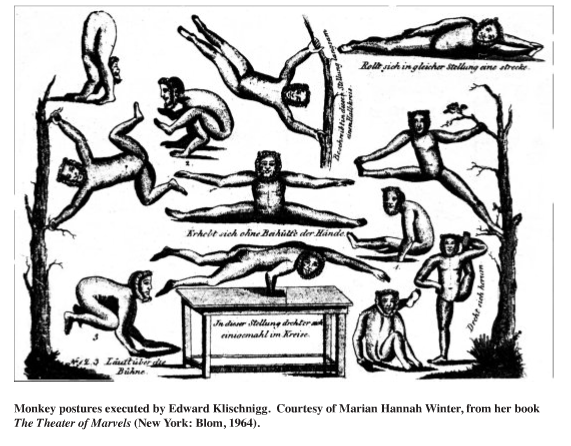
Monkeys and physical comedy also have a shared heritage that can be traced back to popular animal impersonations by such 18th and 19th-century physical comedians as Grimaldi, Mazurier, Gouffé, Perrot, and Klischnigg , which you can read all about in chapter five of my book Clowns. You can get a good sense of what these performances might have been like from Buster Keaton’s 1921 turn as a monkey in his short The Playhouse, which you can watch in the supplemental material for chapter five.
Philosophy
While the origins of parkour go way back, its rapid dissemination throughout the world came in the form of videos that were uploaded to the internet and quickly went viral. In fact, it has been said that parkour is the first art form whose growth into a movement has been totally dependent upon the internet. In the process, however, parkour has become a case of different strokes for different folks. For some, it is trick-based, the idea being to pull off the most spectacular stunt, and YouTube videos certainly lend themselves to showcasing these feats of derring-do. The founders and many subsequent practitioners have, however, framed it in far broader terms. Here are some of the concepts that have been put forward:
• Civilization has made people lazy, but parkour trains one to get along in nature and with one’s physical environment. This hearkens back not only to Hébert, but also to Jean-Jacques Rousseau and his writings on nature and the education of the whole person.
• Hébert’s maxim “be strong in order to be useful” is often cited in parkour writing. Both David Belle’s father and Hébert were “superheroes” who had won considerable acclaim for dramatic rescues made possible by their physical prowess.
• Parkour is a discipline, as much as any martial art. One must overcome mental obstacles to overcome physical obstacles. For example, the philosophy section of the American Parkour site reads: “Many people take the principles they learn through parkour and apply them to their lives. By challenging themselves in parkour both mentally and physically, it becomes easier to deal with problems and obstacles in everyday life. When a difficult situation comes up in daily life, a parkour practitioner can see this as any other obstacle which they’ve learned to overcome quickly, efficiently, and without disruption to their intended path.”
• Parkour is play, and play is essential to creativity.
• The essence of parkour is the attainment of efficiency, moving efficiently through a space rather than around it. “If you run through a pedestrian zone without losing speed and without touching any person, you do good Parkour although you probably don’t use any techniques like saut de bras or saut de chat.” (Benedikt Bast) • It is a fresh way of looking at one’s physical world, viewing architecture as function rather than form. Parkour teaches pkvision, the ability to look at the environment and see the potential for movement within it.
• Parkour is self-expression, not performance. Once you start drawing attention to it, creating crowd-pleasing movements, is it still parkour?
• Instead of society discouraging parkour because of liability and insurance issues, parkour should be recognized as a valuable form of self-expression for youth, an alternative to over-indulgence in alcohol, drugs, or video games, and as an activity that does not require equipment or the formation of teams. Older practitioners of parkour send a message to youth that it is still okay to play.
The Urban Playground
So there we were in London in July, taking advantage of all the good productions offered at affordable prices (£10 and up) at the National Theatre, when we discovered that their outdoors series, Watch this Space, was sponsoring the performance troupe Urban Playground (an offshoot of the Prodigal Theatre in Brighton), in five days of parkour workshops, forums, and performances.
UPG (Urban Playground) performers come from backgrounds in contemporary dance and in Eastern European theatre labs, and specifically Grotowski’s system of physical actions. They are older (thirty-somethings) and approach parkour less from a daring stunt angle and more from that of actor training, movement, and theatrical exploration. Their literature favors the term l’art du déplacement, and this definition of the term from Parkourpedia fits them nicely: “The spirit is still the same as Parkour, there is still the aim of being strong, to be useful and the need to overcome fears, but the movement is less concerned with speed and efficiency and more to do with the aesthetic of the movement.”
UPG subverts traditional parkour use of found space by traveling with their own mobile playground, and this summer they even opened a permanent facility as well, the “UK’s first permanent, free, outdoor Parkour Training Area” in Crawley (West Sussex). They brought the mobile version to the National with them, and used it for their workshops and performances.
The Old Man & the Seesaw
Sorry about the pun, which at any rate may be wasted on those of you unschooled in the writings of Ernest Hemingway or Karen Gersch. I’m sure parkour has been done on a seesaw, but not by me. In fact, you could certainly argue that parkour has never been done by me, despite my decades of climbing trees, rocks, and man-made objects, not to mention hugging parking meters. But here’s the story:
UPG’s residency at the National included a series of short (free) workshops, including one just for kids, one just for women, and one just for brave souls over the age of 50. I somehow managed to qualify for the last one and, egged on by my sweetheart Riley, joined her in this afternoon adventure, wondering how my bad hip would feel after diving off rooftops and all that. Could I become the George Plimpton of parkour… and live to tell about it?
As it turned out, the workshop was not really challenging physically, but the process was quite interesting and worthwhile. Though it was taught from a dance and movement theatre perspective and certainly not from a physical comedy angle, it did give me a feel for the potential discoveries possible when one art form “samples” another.
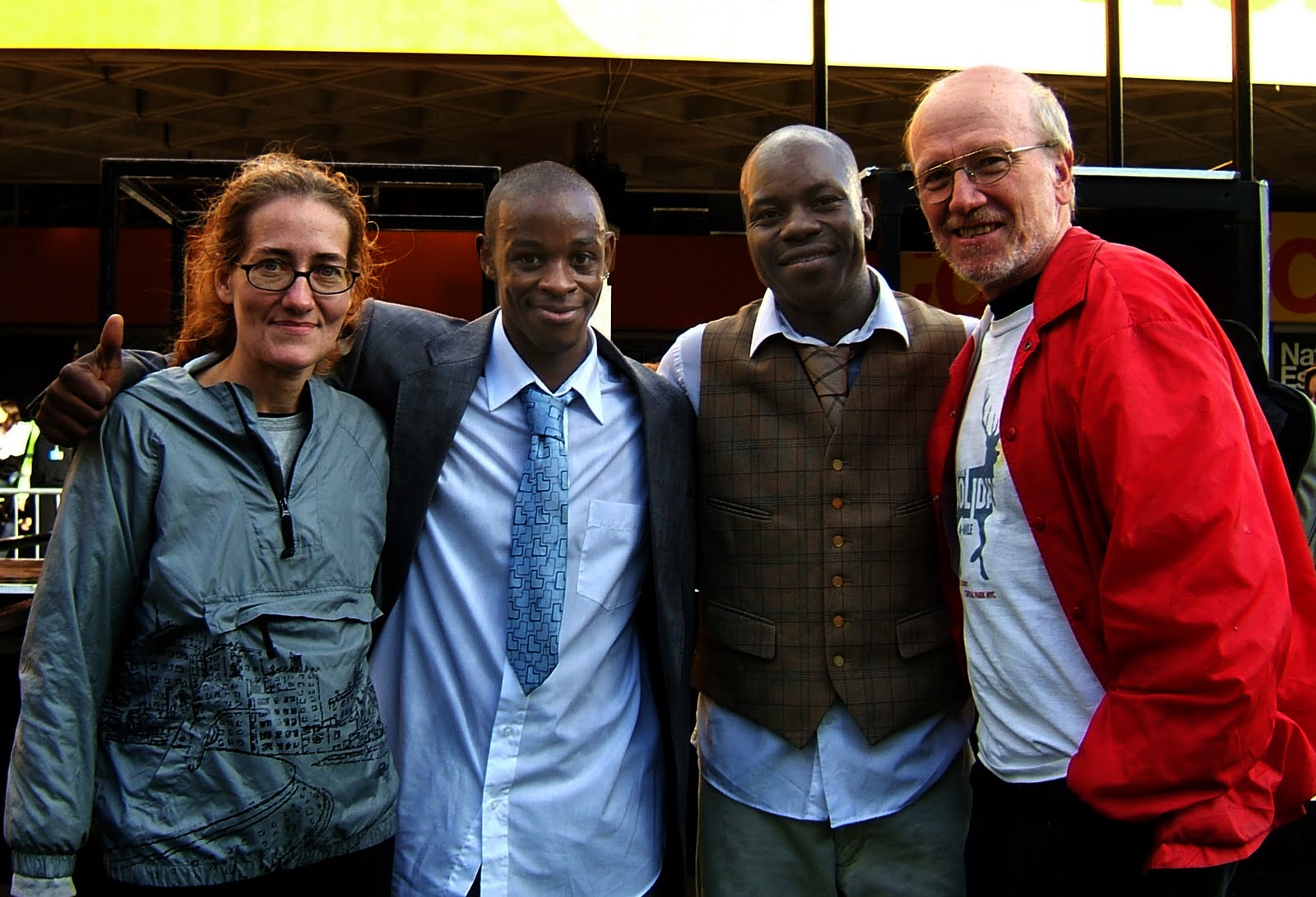
Because of light rain, the workshop began in an upstairs lobby space. There were just eight of us: four students and all four UPG performers as teachers: Alister “Buster” O’Loughlin, Miranda Henderson, JP Omari, and Janine Fletcher. Not a bad faculty–student ratio, eh? Led by Buster, the workshop was first framed by a discussion of the history of parkour and of UPG’s involvement. The warm-up began with follow-the-leader movement throughout the lobby space, with the kinds of walks and stretches that I’m sure many of you have experienced in workshops you’ve taken. The difference here was in the more deliberate use of the physical environment, from simply making contact with various surfaces (walls, steps, railings, furniture, etc.) as we passed near them, to pushing off and rolling off of walls as you ran, to engaging with obstacles rather than simply detouring around them.
Next was floor work, where we did some basic shoulder rolls, with the usual emphasis on smoothness, spreading out the contact with the floor, and controlling one’s center of gravity well enough to roll in slow motion. Maintaining the line of attack of the roll was emphasized, and to work on our orientation in space we did them in pairs side by side, holding our partner with our free hand, trying to stay in unison as much as possible.
By then the rain had let up so we got to move outdoors to the “jungle gym.” The first exercise was simply to move “through” one of the structure’s horizontal bars on our own, either going over or under it, while our workshop leaders observed our choices. While it was not a question so much of right or wrong technique, there were some good suggestions for increasing efficiency and awareness of the space. One was to touch the apparatus as we went through even when we didn’t need it for support, the idea being that this would aid our proprioceptive awareness of where our body parts were. The second was a specific technique for gripping the bar as we passed under it that involved crossing one wrist over the other so as to provide a smooth transition as our orientation rotated 180º.
We repeated these simple movements many times, focusing on efficiency and spatial awareness, and then built on them with a series of variations. We passed through one bar and then immediately through another at a 90º angle. We played with grips and positioning for maneuvering over the bar. We developed more complex paths through the structure and had one person begin when the person in front of them was only part way through, adjusting the timing to avoid collisions. By the end of this segment all eight of us were exploring the cubes and railings, as many as four at a time, moving in and out at will, developing awareness of the structure and of one another’s movements.
Our Micro-Choreography
After a break for lunch, we were ready to start putting together what UPG terms a micro-choreography, a very short piece to be performed then and there for whatever public we could muster in the middle of a rainy afternoon. For yes, it had indeed started raining again, and we had a dilemma on our hands. All of the open-air structures were getting soaked, but what audience there was to be found would have to be outdoors. There was, however, an overhang just outside the National’s coffee shop with a row of tables under it. Ever resourceful, UPG chose to commandeer the last table and its four plastic chairs and throw together some minimalist parkour.
The entire piece, three minutes plus, was put together in under an hour, with Miranda as choreographer. The process was clearly from the world of dance, with the vocabulary borrowing from parkour basics. We began in our chairs, and we each came up with our own three to five movements involving the chair, which we then stitched into our own movement phrases. Here and throughout, Miranda’s role was not to give us any specific movement, but rather to help us make choices from what we’d come up with and to structure it in a dynamic way. She focused on building on moments that worked best; when she saw a dynamic relationship developing she sought to bring focus to it.
Next we tackled the table, some of us literally. Again we came up with a variety of movements, picked our favorites, and sequenced them, but since there were four of us and only one table, we also had to work out the timing of our movement in coordination with the whole group.
The final stage of our magnum opus involved descending two short nearby stairs, finding different ways to get down them. Clearly this was an example not of moving efficiently through the stairs space, but of transforming them into a plaything. Again, we had to coordinate this with one another and eventually work toward an ending of sorts.
The modernist performance philosophy behind all this is that dramatic relationships and moments arise from the dynamics of these structured improvisations without any specific intention being imposed. Performers interact, patterns emerge. Rather than the piece telling a story, the audience is free to take whatever narrative from it they like. For me as a participant this went against my clown and actor instincts. I had to fight the urge to seek out eye contact and grow it into a psychological relationship with another character. It was hard not to think in terms of status and control, hard not to want to transform a physical movement into a physical comedy bit. (Yeah, yeah, that’s also the story of my life, but we’ll save that for another post…)
While the end result (below) was clearly a “process piece,” I liked the process and can see its potential for developing all kinds of material. And yes, the rain did let up and we did get an audience of 30 to 40 people, all of whom gave us a standing ovation because it was still too wet to sit down. All I could think of was the storied tradition of the National Theatre: Gielgud, Richardson, Olivier and now Towsen.
In Performance with the French duo Gravity Style:Quartet
For the weekend performances of Quartet, UPG was joined by
two leaders of France’s Gravity Style, Charles Perrière, and Malik Diouf, original members with David Belle in the group Yamakasi, back in Lisse in the 90s. They’ve been collaborating with UPG for several years and on the weekend put together several semi-improvised performances.
UPG’s interest in mixing genres is echoed in Gravity Style’s concept of gravity art: “Around the art of dispalcement (parkour), the sportive and artistic discipline popularized by the Luc Besson Film, Yamakasi, it brings together a wide range of physical performance such as acrobatics and urban dance and integrates them into different artistic contexts.”
The performance of Quartet they did later that night was scaled back somewhat because everything was still quite wet, but it went over very well with the audience. The video below, shot with a handy-dandy Flip camera, is from far enough back to take in the whole space, so you lose some detail. To remedy that, here are some photos of the performance taken by Riley that help balance things out.
And here’s the video (about 11 minutes):
Parkour and Physical Comedy
If UPG’s choreography eschews character and plot, and other manifestations of parkour are self-expression, what does it all have to do with physical comedy? Physical comedy as a specific genre is usually based on meticulously planned out characters, stories, and blocking. Still, I do see some useful connections:
• Movement vocabulary
The most obvious link is between the acrobatics seen in a lot of parkour and that robust branch of physical comedy that emulates the daredevil antics of Lloyd and Keaton and likes large spaces and big movement.
• Intention, or, why did the chicken cross the road?
The parkour traceur’s intention is a given, the desire to get from point A to point B as efficiently as possible. The physical comedian is more likely to be running from someone. Speed is an issue, the intention is survival.
• Obstacles and Inventiveness
The obstacles are what make parkour and physical comedy interesting. Both the traceur and the physical comedian are creative in their solutions to overcoming these obstacles. While these solutions are efficient and “simple,” they would not be the obvious choice for most people, which just reinforces the eccentric nature of the physical comedian’s character. Likewise, it is usually the clown’s m.o. to overcome obstacles in an inventive way, even when not working in a physical mode.
A textbook example of parkour-style physical comedy is the climactic scene in Keaton’s College (1927), where Buster — an abject failure as a college athlete — must make a mad dash to his girlfriend’s dormitory room, where she is being held captive by an overly-insistent male rival. The intention is clear, the obstacles many. In the course of his rescue mission, he successfully makes use of many of the sports techniques that had eluded him on the playing field.
It should be noted that the pole vault was the only time in his silent-film career that Keaton used a stunt double.
Not only can physical comedy make use of parkour-style leaping and bounding, it can also make fun of it. Here’s a sharp parody of Douglas Fairbanks by Will Rogers. You may think of Rogers as primarily a verbal comedian and political satirist, but he had a long career in silent movies as well, making fifty of them! In this excerpt from Big Moments from Little Pictures (1924), Rogers channels his inner clown as he offers us a rather fey Robin Hood showing his very merry men the fine art of jumping.
And then there’s this parkour parody from the current season of the tv sitcom The Office:
Good ending, but I gotta admit it, overall I thought Rogers was a lot funnier.
Physical Comedy in the 21st Century??
Since we’re doing some genre-bending here, I’ll close with a cool video by Vidéo El Dorado that combines Mayan ruins, parkour, visual effects (time remapping ), and of course more monkeys. Not sure if it fits my “physical comedy in the 21st century” category because it’s not exactly comedy, but it is cool. Did I mention that it has monkeys?
Well, that’s a lot of stuff to throw at you. I hope it makes sense to all you old folks! I know I’m a novice here and just scratching the surface, so here’s some more info for the insatiable:
Links
• Jump Four — a 2003 BBC documentary about parkour that features French free runners leaving their trace on London’s landscape. This is available on YouTube, segmented into five parts.
• Parkour-Videos.com— “all the best videos of parkour”
• Parkourpedia — a reference source compiled by the Australian Parkour Association
• American Parkour— site for AMK
• Training Videos — also from the AMK site
• New York Parkour — site for NYPK, parkour group for NYC / New Jersey area
• Sandbag — parkour events staged all over the world to promote the fight against climate change
• Point B— a 2009 documentary about parkour
• Parkour in Casino Royale — James Bond chases Sebastian Foucan. I’d like this a lot better if there weren’t so many cuts undermining the believability of the leaps. I want to see the take-off, flight, and landing all in the same shot, thank you very much!
• Update (3-15-2010):Parkour Motion Reel — from Vimeo, a short but cool hand-animated flip book about parkour.
Amsterdam is known more for its street performance than its variety theatres, or as Charlie Frye forewarned me,”not too much Variete, except in the windows.” I loved the city, loved biking all over the place, but in my four days there this June I didn’t find much street performance either. Maybe I went at the wrong time or to the wrong place, but several trips through Dam Square netted me only one street performer, a British juggler/contortionist.
Can you name this street performer? His show was not elaborate, his big tricks being to pass his entire body through a narrow hoop while balancing a ball on his forehead and to roll a juggling fireball all over his body, including down his pants. But it all worked well because he was quite funny. Unfortunately you’ll have to take my word for it because my hard drive crash this summer deprives us not only of footage of his routine, which he said he was happy to have presented on this blog, but also his exact name. I’m thinking it was something like “The Impossible Paul.” And there are a few seconds of his act on YouTube, but they don’t really do him justice.
But before moving on to greener pastures in Berlin, here’s something even more random, an Amsterdam street poster (left) that reminded me of an old Hanlon-Lees poster (right).
And here’s a cool parkour mural outside the Amsterdam train station:
On to Berlin The train ride from Amsterdam to Berlin is quite pleasant, and it’s nice to see all those northern Europe wind turbines at work! And it’s not surprising to see a lot more in the way of performance in Berlin, a city of nearly 3.5 million people, whereas Amsterdam is actually quite small: 740,000. There’s variety theatre, circus (old & nouveau), street performance, big commercial theatres (Mel Brooks’ The Producers has brought the Führer back to Berlin), and of course the ubiquitous Blue Man Group.
As my (good) luck would have it, I was just in time for the…
The acts here are international and there’s enough going on to schedule a Berlin trip around it. Unlike the Antibes street festival, this one is all in the same neighborhood, usually with acts performing on four stages at the same time, as well as juggling workshops for the non-juggler. This creates a more festive atmosphere, especially with all the great food, including one bakery that actually brought their own oven to the park!Alas, my video footage and some of my notes fell victim to my infamous hard drive crash, but let me at least single out my favorite show of the day I visited, Che Cirque, a solo act by Juan Cersosimo, an Argentinian currently living in Brussels.
Cersosimo is multi-talented, but his claim to fame is as a trick cyclist; he was the BMX national champion of Argentina in 1996 and of all of South America in 1997. Yeah, he’s got himself some skills.
He also works quite well with audience volunteers, quite gently, making them look good rather than embarrassing them for cheap laughs. Here’s his promo video from his web site, which offers some snippets though I wouldn’t say it really captures the spirit of the live performance:
Is that a circus hiding behind those bushes? You know what’s really cool? Walking or driving down a street and discovering a circus by accident, that’s what. This happened to me in Berlin, so of course I walked in, and when I saw a small one-ring set-up with a solo trapeze suspended overhead, I asked when the circus would be performing. I was told that thevariety show would be putting on shows the next two evenings. I had stumbled upon the Shake circus tent, home for circus, Shakespeare, and all sorts of variety entertainment. Unlike the United States, where live variety shows are not a big part of mainstream theatre outside of Vegas, the word still has meaning in Europe.
The next night we headed back to the tent and took in the show — variety indeed —a mixture of professional and student performances serving up a smorgasbord of circus, clowning, magic, poetry, and dramatic readings. The poetry and the readings were of course in German — and the functionality of mine is intentionally limited to the beer hall — so a certain longueur set in during those segments, but the rest had some real rewards to offer, including a magician duo, several solo trapeze acts, and a nice physical comedy act performed by two guys ostensibly horsing around at the beach. A pleasant two hours.
Un Horizonte Cuadrado Another happy find was a troupe of six Chilean trapeze artists who performed their show, Un Horizonte Cuadrado, at a Berlin beer garden. Google tells me their name means “One Horizon Square,” though I’m betting there’s a lot better English translation lurking out there. I can’t claim this show was physical comedy, but it was highly physical and it was not without some genuinely comic moments. Before it started, I was worried that there’d be no way for these six performers suspended from as many trapezes to keep our interest for an hour, but I was happy to be wrong. That they did, and much of it was exquisite.
Here’s a minute of YouTube promo:
They actually have more substantial footage on their Flickr page. (Just click on the thumbnails that have a video PLAY button icon.) Here’s one selection that shows more of the duet interactions:
In addition to the beautiful movement, what I especially liked were the relationships that developed between these “characters” as they moved from trapeze to trapeze, one moment sharing, another moment vying for power, sometimes antagonistic, other times flirtatious. All in all, highly original and creative.
Soap After an eye-opening side-trip to Poznan (Poland) to visit both the Academy of Music and the Academy of Fine Arts on college business, we returned to Berlin and caught the heavily promoted production, Soap, presented in a cabaret setting at the historic variety theatre, Chamäleon. This was variety theatre in the form of a revue, all of it revolving around bathtubs and scantily-clad but highly skilled bathers.
Here’s a 35-second commercial advertising the show:
And here’s a longer (three-and-a-half minute) preview of it that appeared in France on the television network Arte:
I might say the show is Vegas-style, though that doesn’t prove anything since I’ve never been to Vegas. It’s slick, a little bit naughty but not too much, and the performers are exceptional acrobats and jugglers. One woman who does all kinds of foot juggling from within one of the tubs was nothing short of amazing — there are glimpses of her in the Arte video above — as was one of the male acrobats. Another act I had never seen before (though that doesn’t prove anything either) was a juggler who did a sort of strip tease while continuing to juggle three balls flawlessly. The only weak link in the show, unfortunately, was the clown, who was muggy and predictable, though in fairness the audience liked her a lot more than I did.
Is it a good show? Not really. It’s the kind of show that looks better on the promo video, rather than vice-versa. None of it makes much sense, the soap and tubs are a gimmick that is used very inconsistently, the semi-operatic singer seems to be there just to give it the pretense of art, and it’s all a little too calculatingly cutesy-commercial for my jaded tastes. Did the audience like it? Very much so. Was I glad I saw it. Yep, but for the individual acts, not so much the overall presentation.
From Thursday’s NY Times. To read the article below, just click on the icon in upper-right-hand corner to open pdf, then on magnifying glass icon within Scribd to enlarge.