Tag: Cirque du Soleil

Pratfalls at Super Bowl 2012

POST 239
Tuesday, February 7, 2012

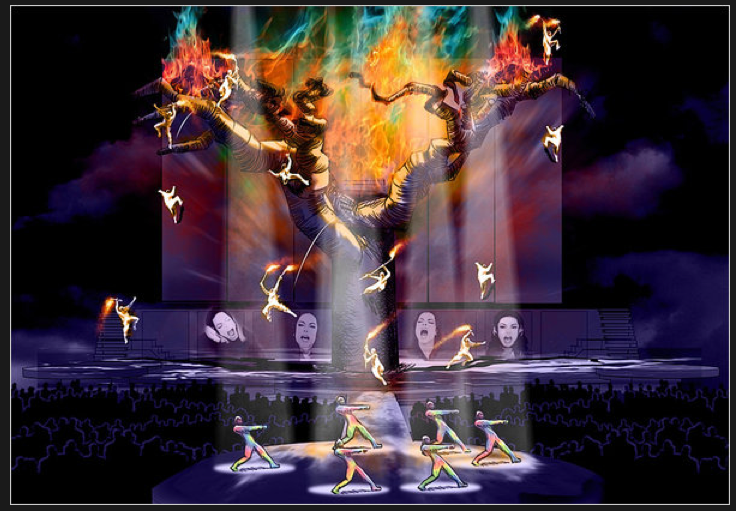
Sunday’s Super Bowl had a couple of moments of unintentional physical comedy, which of course is the best kind, at least if it’s happening to someone else. First we had Madonna’s near-pratfall, as she stumbles during her half-time show extravaganza:

To her credit, she did recover smoothly and — performing alongside acrobats from the Cirque du Soleil — did execute three partner acrobatic tricks; relatively easy moves, but then she is 53.

Far more amusing was running back Ahmad Bradshaw trying not to score the winning touchdown for the Giants. I was watching this with a large gathering of clown types on the Waterfront Museum barge who found his ass-first drop into the end zone hysterical. This one was funny on two counts. It looked funny, as if he were doing it that way on purpose, which if you didn’t understand the intricacies of the game (and some clowns don’t!) that’s exactly what you would think. After all, no one was near him, so why suddenly come to a screeching halt, turn around, and sit on your prat in the end zone?
The answer — and I think it’s much funnier if you understand what he was trying to do —was that the Giants wanted to run out the clock. Since they were pretty assured of scoring at least a field goal, enough of a winning margin, it was more important to use up time before doing so rather than give the Patriots almost a full minute to come back. So Bradshaw barrels full-throttle up the middle, only to discover the defense has no interest in tackling him. He’s not dumb, he knows what’s going on, but he’s a big guy with a lot of momentum, and try though he does, he can’t quite stop short. Pratfall!

The good news is that though Tom Brady did get his chance, the Patriots failed to score and the Giants won. Had the Patriots pulled it out, we Giants fans might be finding this more tragic than comic, eh?
You can read more about it here.
SHARE
EXPLORE FURTHER

Not Exactly Physical Comedy: Wall Trampolining

POST 238
Sunday, February 5, 2012

Apparatus such as unicycles and trampolines are built for stunts. They’re cool and all, and excellent comedy has certainly been done with both, but I’ve always been more drawn to physical comedy that uses objects commonly found in the real world — chairs, tables, doors, stairs, etc. Maybe that’s why I also like parkour and flair bartending, living proof of the appeal of circus techniques applied to everyday life.

So all things being equal, I prefer a comedy bicycle act to a comedy unicycle act, and I’ve most enjoyed trampolining that has incorporated other scenic elements into the act. One such element is a wall (and platform),  transforming trampolining into — you guessed it — wall trampolining. Cirque du Soleil has been doing some version of this for a couple of decades, but now it is is attracting participation by dedicated amateurs and is being touted as the latest, greatest extreme sport, as evidenced by this video piece in last week’s NY Times:

Here’s the Julien Roberge routine mentioned above.

More theatrical was the wall trampoline act I saw almost two years ago in Cirque de Soleil’s Ovo. The sheer number of acrobats and the use of a customized climbing wall, with all its nooks and crannies to hold and step onto, creates a multitude of variations. Here’s a one-minute excerpt:

Not exactly physical comedy, but you can see the potential, and I do seem to recall there being a few “king-of-the-mountain” comic moments as rival leapers struggled to supplant one another atop the wall. Likewise, actors (or their stunt doubles) and physical comedians have for centuries been using springboards (usually concealed) to catapult them to heights and distances they could not otherwise reach — what you might call “augmented reality.”
Click here for the 2008 showreel for trampolinist, stuntman, and freerunner Damien Walters. This one’s all wall trampolining.
SHARE
EXPLORE FURTHER

Blog Readers Sound Off on Cirque du Soleil

POST 153
Wednesday, June 15, 2011

My recent two posts on the Cirque du Soleil, which you can read here and here, elicited some debate on Facebook as well as comments to this blog. Since most of you probably missed this, I thought they might be worth excerpting here.  Nothing like a little controversy!

Is Cirque du Soleil bad for clowning?  Can you do clowning in a large space? Has the Cirque lost its soul? Everyone has an opinion, so feel free to add yours via the comment link at the bottom of this post!

From Facebook:


    • Mandy Dalton Wow, yet another piece of crap from NYT regarding circus. Gee I’m so surprised. It’s been a long time since “We Reinvent The Circus.” The most compelling part of the show was the clowning. Varekai had some great clowning with Mookie. It’s a shame to see cirque turn its back on clown. In the first show it made them.

      June 9 at 8:43pm 
    • John Towsen Hmmm… but that sounds like you agree with the Times!?

      June 9 at 9:23pm 
    • Mandy Dalton I tried to follow the link with to the article to see the rest.

      June 9 at 9:24pm 
    • Mandy Dalton The link seems to be broken–gonna look it up. I just don’t like the comments that you captured about “painted on smiles” the usual cliche stuff.

      June 9 at 9:26pm 
    • John Towsen Fixed the link. Thanks.

      June 9 at 9:27pm
    • Mandy Dalton Now that I have seen the rest of the article I do agree that clowns built Cirque. I had my usual knee jerk reaction to cliche characterizations of clown. “Painted on smile” “Crying on the inside”. But the article is interesting and it is a shame that Cirque is turning its back on clown.

      June 9 at 9:47pm 
    • Mandy Dalton I am trying to figure out what editor in her right mind would allow the word “twee” in NYT. “Rather, it is because developing a clown act requires more experimentation and spontaneity that the Machine allows time for. And Cirque was built on arty, sometimes twee clowning that can’t fill up a large space like Radio City.” How did that end up in a newspaper? Much less a Newspaper like the NYT?

      June 9 at 9:49pm 
    • Pat Cashin Didn’t Slivers Oakley, Marceline Orbes, Poodles Hanneford, Joe Jackson, Toto, Otto Griebling, Emmett Kelly and A. Robins ALL play the New York Hippodrome? Wasn’t the Hippodrome stage LARGER than that of Radio City?

      June 9 at 10:03pm 
    • John Towsen Yep. and didn’t Shiner himself play a sizable Broadway theatre with Bill Irwin in “Full Moon”?

      June 9 at 10:41pm 
    • Mandy Dalton I hate it that the answer in Cirque is that “clown is bad for the space” instead of “Banana Shpeel just didn’t work, let’s figure out another way to incorporate clown in the show.”

      June 9 at 10:46pm 
    • Jango Edwards 

      JOHN LETS PUT THE CARDS ON THE TABLE AND BE HONEST FOR ONCE, WHEN IT COMES TO CLOWNS THERE ARE NO REAL CLOWNS IN THIS SUCKUS. OHH THE ALL HIGH AND MIGHTY SOILEIL. THESE GUYS WERE MY STUDENTS YEARS AGO AND IN THE BEGINNING LIKE IN GENISIS AT CREATION IT WAS A GARDEN OF EDEN FOR THE CLOWN ARTIST BUT NOW ITS A MAN MADE HELL BUT TO QUOTE THE ORIGONATORS THEMSELF-WE WANT TO BE THE MC DONALDS OF CIRCUS….WELL CONGRATULATIONS YOU ARE. LOST IN SPACE. PAT ITS NOT ABOUT THE SIZE BIG OR SMALL STAGE ITS ABOUT THE HEART. I’VE PLAYED FOR 150,000 AND FOR ONE AND THAT WAS AS A CLOWN. YOU KNOW WHAT I’M TALKING ABOUT FELLAS YOU BEEN THERE DONE THAT RIGHT GREG. THATS WHAT THE NOUVEAU CLOWN INSTITUTE WAS CREATED FOR BUT JUST THINK WHAT WE COULD HAVE DONE FOR THE PRICE OF THAT FLIGHT TICKET. NOW THAT WAS AN EXPENSIVE BONER. PUT THAT IN YOUR PIPE AND SMOKE IT.

      June 9 at 11:05pm 
    • John Towsen So it is possible to be a clown for 150,000!?!?

      June 9 at 11:17pm 
    • Jango Edwards YES BUT NOT ON THE MOON. AND YOU HAVE TO SHOW A LITTLE MORE THEN USUAL,.

      June 9 at 11:18pm 
    • John Towsen Most clowning works better close-up, but of course it all depends on your meaning of clowning. It takes all kinds, blah blah blah. A clown in a cabaret or theatre isn’t necessarily better than one in the circus, or vice-versa. All depends.

      June 9 at 11:20pm 
    • Jango Edwards JOHN FOR ME THE STAGE IS THE LEAST IMPORTANT PLACE MAYBE THATS WHY I’M HAPPY BUT BROKE. BLAH BLAH BLAH ENOUGH TALK JUST DO IT….NIKE

      June 9 at 11:24pm
    • Pat Cashin 

      The nature of a clown always changes based on the size of the venue and audience. Things that are perfect for hospital clowning are useless in an arena and vice versa. It doesn’t make one style better, just more appropriate to the scale of the venue.

      The fact that there were once clowns that COULD successfully work a venue LARGER than Radio City Music Hall means that it CAN be done.

      It is just done differently.

      Banana Shpeel failed for many reasons. Not least of which was that it WASN’T an actual vaudeville show. A variety show format might have gone over huge in New York if it weren’t drowned in Cirque’s patented formula of fairy dust and unicorn farts.

      Maybe they need to drop their preciousness and pretensions this time, stop trying to reinvent the wheel and instead think about what that wheel really is… and what size tire it needs to work correctly for them; )

      June 10 at 7:33am · 
    • Jango Edwards Captain Cashin, this discourse demands such an open forum between all of us to share our experience and knowledge with those who will follow and go further. One thought I try to live by is a clown by true definition adapts to his public and not expects his public to adapt to him. Miss ya brother. Keep keepin on.

      June 10 at 8:02am 
    • Sue Morrison I agree with that, Jango ..

      June 10 at 10:48pm 

And a couple of interesting blog comments:

Blogger David Lichtenstein said…
Rene Bazinet is the most talented clown I ever spent close time with, a truly brilliant performer. (And although he has a German side to him, he’s basically Canadian from Winnipeg.) David Shiner is not exactly a slouch in the clown department. All power to them trying to keep some theatrical clown in Cirque de Soleil. Shiner’s comment is odd, since he, Bazinet, Geoff Hoyle (who I saw in Cirque years ago) and the famous clowns of the past did make the big arena intimate. 
I am envious of the New York worldview being able to underplay the influence of Cirque de Soleil. Out here in the provincial capitals (Portland, Oregon) Cirque de Soleil brings a show for 6 weeks every two years and outgrosses all Portland theaters by a mile. In the popular American conscious all live theater is small, but within that slice Cirque de Soleil is huge and dominant.


I recently saw the Cirque Beatles Show Love, after not seeing them for 18 years. 20 years ago when I saw Cirque shows in Quebec I used to tell non-circus people that Cirque was bringing the one-ring circus intimacy, the theatricality of circus back to America. Well no more. In Love, there was almost always 4-12 things going on at a time. I had a great time, there was so many interesting characters and costumes to check out but the artistic choices were terrible. Any focus on character, or Beatles themes (There’s a lot in those songs after all.) was infantile and always abandoned within two measures of 8 in favor of the next splash of images. It seemed to me an end of live theater, it will be difficult for theater to reach even shorter attention spans with even fast crashing of big imagery. There are physical limits live.


The problem for the USA is that we never had the full small circus, physical theater boom that birthed Cirque de Soleil. Although the 1970’s 1980’s American juggler-street theater wave helped spark the European Street Theater wave, the much larger European Tsunami of Circus and physical theater never made it back here.


Rene Bazinet and Shiner come from an important generation. Rene studied intensively for years with Decroux and did 3 years at Lecoq with Lecoq and Guallier and other studies. They spread it out with brilliance to the world. Is there no room for theatrical clowning descendants in America? So many forces in America squeeze off small theater. Our Wanderlust Circus http://www.wanderlustcircus.com/ puts on original productions with live bands for $10,000 total production budgets and then there’s Cirque de Soleil, where is the midsize physical theater?


The European Street Theater Festival Circuit is driving the European, Australian, and South American new circus/physical theater scenes. Out of the European Street Theater Festivals come the most theatrical new circus work like El Grito. http://www.youtube.com/watch?v=3orrsDJe2AU


On the West Coast of the USA I think the leadership of the post-hippie generation (Oregon Country Fair, Moisture Festival) is perhaps past it’s peak. I think the new generation of leaders is developing at the second generation Burning Man type festivals that are proliferating. But perhaps their style will be too loud, fast, and rock and roll for the Rene Bazinet/David Shiner brilliant clowns that we love.


Thanks,
David Lichtenstein
Leapin’ Louie Comedy Shows
david@comedytricks.com
http://www.comedytricks.com
June 11, 2011 2:07 PM

Blogger Noah Mickens said…
Hey Leapin’. Noah Mickens here, co-director/producer/ringmaster of The Wanderlust Circus (and Bogville, Queen of Knives, Societas Insomnia, et al.)
I only wish I had the resources available to these fortunate gentlemen who are producing the new Cirque du Soleil shows – what fun we could have. For that matter, I wish that I more frequently had access to the $10,000 mentioned in your comment here.


For better or for worse, the microbudget DIY conditions under which the independent theater troupe labors in the United States has necessitated a more inventive approach. How to do something great using only the limited resources available? “Availabism”, as the peerless Kembra Pfahler used to call it in New York.


I’ve heard that, in most European countries, one is eligible for significant government grants without having to prove that one’s artistic efforts are worthy of 501C3 status. The problem with the old 501C3 is that a given troupe simply does not qualify unless they can prove that their work has an educational or charitable component. So you get plenty of money for the Ballet, the Symphony, the Opera; and small troupes must split their time and energy between their actual shows and whatever classes and workshops they have to tack on in order to qualify for the big bucks. I look at current European krewes like Grand Royal and think how much I could do with their budgets too.


But for now, and likely for good, the US just doesn’t run that way. To be an artist here, one must find ways of squeezing magic from the everyday. Maybe it’s always been like that? And maybe it lends to the hardscrabble spirit of experimentation that brought jazz and vaudeville (and Burning Man) to the world in the first place?


Anyway, back to work. Thanks for drawing my attention to this article.


All you naysayers in the Big Apple listen up – Cirque du Soleil is an amazing organization, capable of inspiring levels of wonder and majesty that Broadway doesn’t even comprehend right now. When you stop inflicting garbage like Mama Mia on the world, then you can judge the Cirque.
______________________
Well, I plead not guilty to inflicting Mama Mia on the world — I barely know what it is — but thank you all for your comments.  More welcome below…..
SHARE
EXPLORE FURTHER

“At Cirque du Soleil no one is more depressed than the clowns.”

POST 151
Thursday, June 9, 2011

Or so says the New York Times.  A mere five days after a lengthy profile of Cirque du Soleil co-founder and owner Guy Laliberté, which I wrote about in this post, the Times is back with a three-page preview of Cirque’s upcoming debut at Radio City Music Hall, the stage show Zarkana.  And though their previews tend to be fluff pieces, the Times is again raising questions about the Cirque’s artistic direction, comparing Zarkana to Spider-Man: Turn Off the Dark and wondering out loud about the caliber of the theatre and clowning components.

Here are a few quotes:

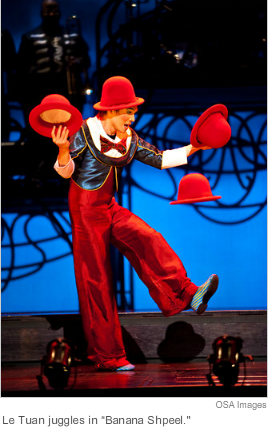
In an effort to rebound from the rare failure of the intimate “Banana Shpeel” in New York last year, the one thing everyone agrees on is that this will be a very big show. There will be daredevil feats, bold images and high-flying acrobatic spectacle. As Mr. Girard put it: “No theater. No vaudeville. We want to be more Cirque than Cirque.”


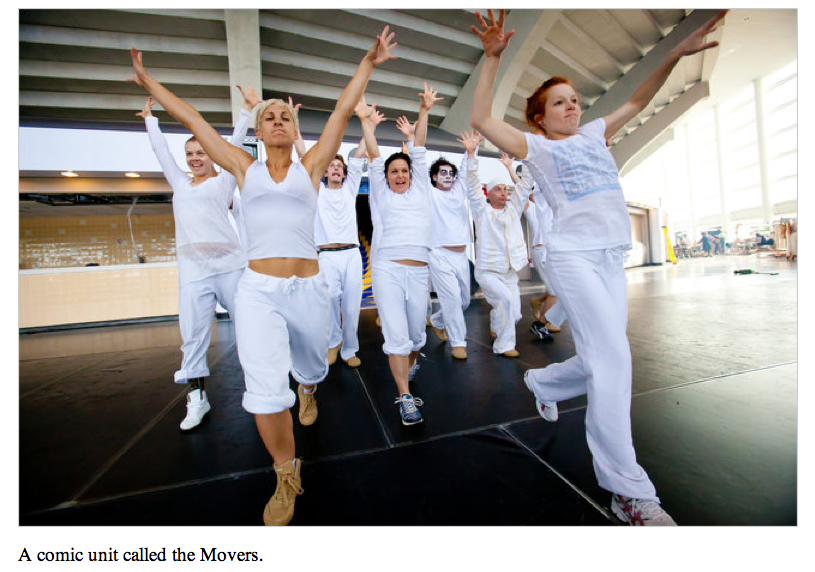
Mr. Bazinet’s job is to help guide 15 performers of diverse backgrounds into a comic unit called the Movers. Less than a week earlier he had spoken to his friend David Shiner, the director of “Banana Shpeel,” who told him what he already knew: that clowning at a theater the size of Radio City is impossible. “The clowns are going to die,” Mr. Shiner says. “You need an intimate space for clowning, otherwise you have nothing.”


At Cirque du Soleil no one is more depressed than the clowns. That’s not just because the painted smiles hide a deep-seated sadness, although there is some truth to that stereotype. (“You can’t imagine the number of clowns I’ve seen cry in my life,” Mr. Laliberté says.) Rather, it is because developing a clown act requires more experimentation and spontaneity than the Machine allows time for. And Cirque was built on arty, sometimes twee clowning that can’t fill up a large space like Radio City.

[Okay, I admit it, I thought “twee” was a typo, but it turns out it means “excessively or affectedly quaint, pretty, or sentimental.” —jt]

The story is, if anything, more impenetrable. When asked about it, Mr. Girard answers abruptly, Cirque “is not a good place to tell a story, period.”

You can read the whole article here.

And here’s a video preview that’ll give you some idea of the look of the show; there are more on YouTube.

SHARE
EXPLORE FURTHER

NY Times: Defiant Showman Demands His ‘Wow’

POST 148
Saturday, June 4, 2011

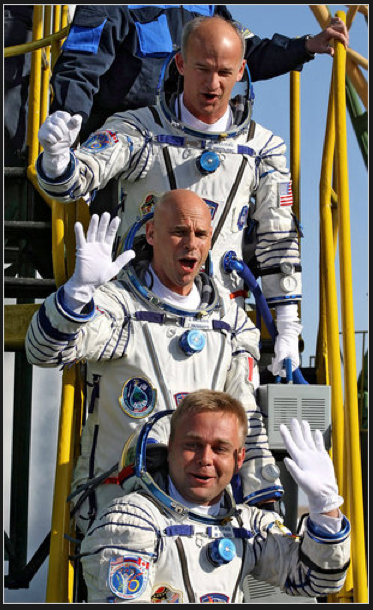
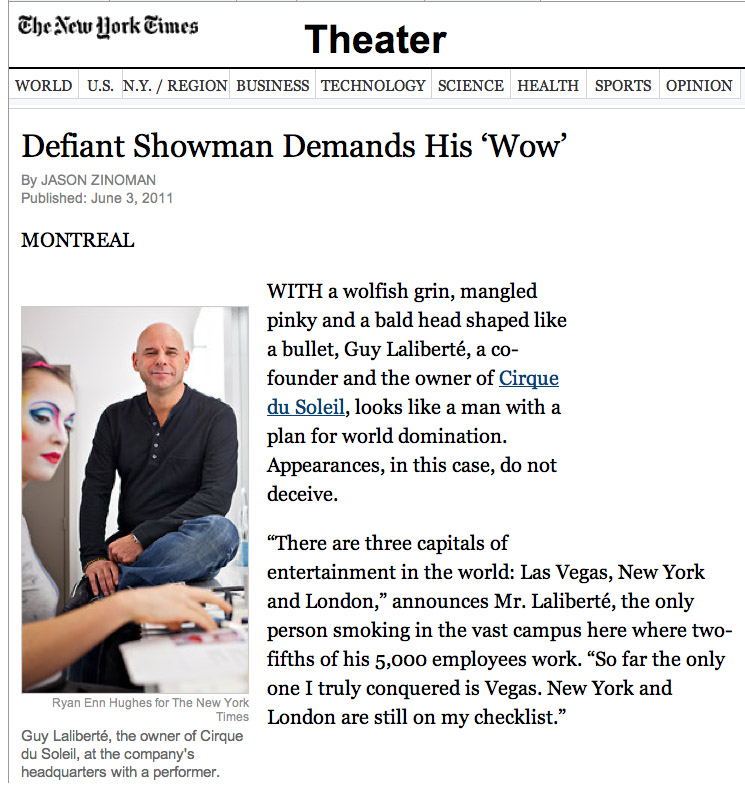
Guy Laliberté, co-founder and owner of Cirque du Soleil, has done well enough for himself to afford to pay $35 million to be a space tourist. Yes, you read that right; yes, out of his own pocket. Not bad for someone who started as an accordion-playing street performer!

With his latest show, Zarkana, preparing to open in New York at Radio City Music Hall, he and the Cirque are the subject of an interesting enough NY Times profile.

Because the Cirque’s Banana Shpeel, an attempt at a vaudeville stage show, bombed so badly in Chicago and New York, there’s been considerably more criticism of their artistry, and a lot of pressure on them to bounce back with their next show.  The article does tackle this head-on:

As Cirque has transformed from an arty alternative to traditional big-top circus into what it is today, some suggest it has become emotionally cold and risk-averse. “If Cirque is going to succeed in New York, they need to understand story — and they don’t,” said Richard Crawford, an actor currently in “War Horse” who was fired from “Banana Shpeel” last year. “They have no idea about Aristotelean plotting or character. It’s not in their heart. They come from street performers, and now they are street performance with laser beams and millions of dollars.”

The problem is that audiences have come to expect a certain scale from Cirque, and when they don’t get it, as in the case of “Shpeel,” they may be disappointed. It’s a nagging worry for Mr. Laliberté too. “Are we condemned to only doing big acrobatic shows?” he says, leaning forward with a grave look. “Creatively we have the capacity to do much more. The answer is we can explore new stuff, but we need to give the public a bone to chew on.”
You can read the whole article here.


SHARE
EXPLORE FURTHER

From Meyerhold to Cirque Mechanics’ “Birdhouse Factory”

POST 92
Monday, March 29, 2010

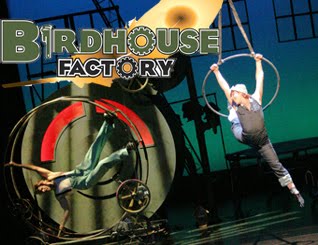
This post was supposed to be almost as easy as my last one. Surely I could knock it off in an hour or two. I’d caught Birdhouse Factory a while back in Newark, found it more than a little interesting, figured I’d write a paragraph or two of observations, throw in some pics and a promo video and be done with it.

As usual, one thing led to another, and I started making all these links between this and that — this being Cirque Mechanics and that being Russian constructivism, biomechanics, and eccentric acting — and before long I was spending days trying to connect all these dots. At this rate I’ll never get those other ten chapters of my Clowns book up here before I have to return to my other lives two months from now, much less keep up with Pat Cashin! Oh well, you can’t fight your own DNA, can ya? But no, je ne regrette rien; some good stuff here.

Acrobatics + Machines + Theatre + Circus = ??

Cast of characters:
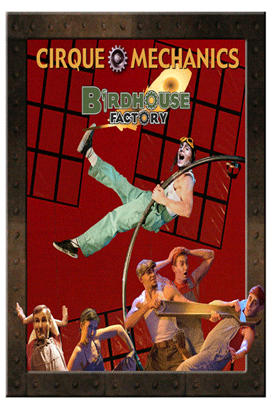
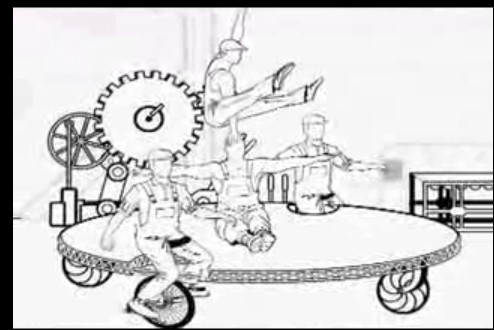
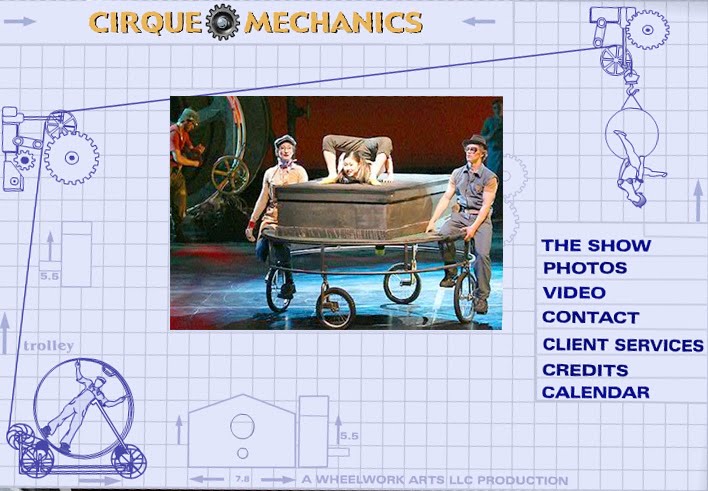
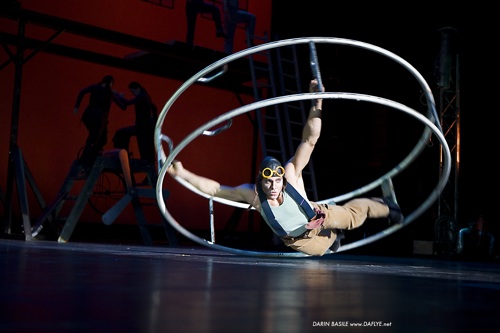
• “Birdhouse Factory,” cirque nouveau production by the Las Vegas-based group Cirque Mechanics. The show had its premiere at San Francisco’s Circus Center in December, 2004 and has been touring North America pretty extensively ever since.

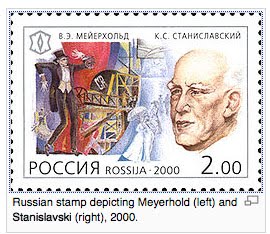
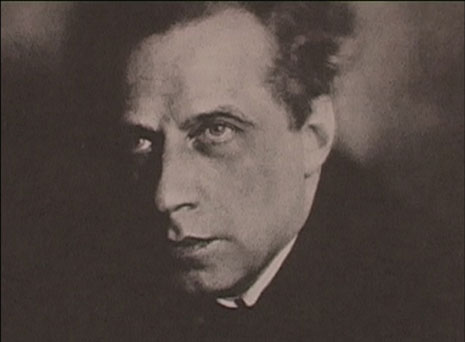
The Russian constructivist art movement of the 1920s, and specifically the work of the Russian director, Vsevolod Meyerhold, whose (anti-Stanislavsky) productions and “biomechanical” movement for actors borrowed a lot from commedia, circus, and the variety stage. Meyerhold was the darling of the avant-garde in the early days of the Russian Revolution, but ended up being executed by Stalin for not towing the party line.

The Story:
The creators of Birdhouse Factory are performers with experience with Cirque du Soleil, Pickle Family Circus, and even the Moscow Circus, and its program lists such influences as “the Detroit industrial murals of Diego Rivera, the outrageous illustrations of cartoonist Rube Goldberg, and the gentle political slapstick of Charlie Chaplin in Modern Times.” Their work aims to make connections between the functionality of industrial machinery and the pure physics of circus acrobatics. Founder Chris Lashua explains that “we want to see every gear, every cog, every relationship between chain and sprocket, every gear ratio and mix with people flipping and doing acrobatics in the air and utilizing the machines or the factory setting.”

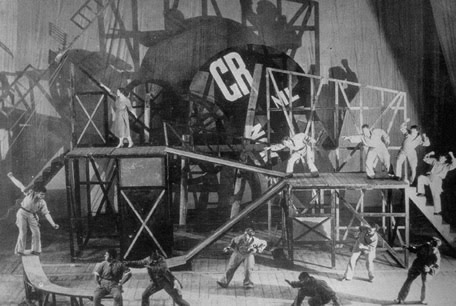
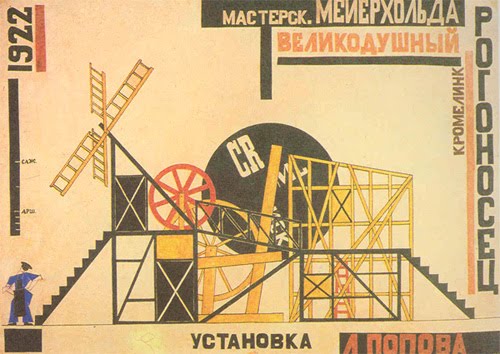
In a landmark 1922 constructivist production, Meyerhold took Fernand Crommelynck’s dark bedroom farce, The Magnanimous Cuckold, and physicalized the abstract concept of “farce machinery” with a set that was part machine, part jungle gym, and performed upon by actors trained in what he called “biomechanical” movement.

Here’s a performance photo showing Lyubov Popova‘s original set in action:


And a poster for the production…


Before you knew it, constructivist artists were in demand as theatre set designers. Here’s Alexander Vesin’s set for Alexander Tairov‘s 1924 production of The Man who was Thursday.

Fast-forward 80+ years:


In his book The Theatre of Meyerhold: Revolution on the Modern Stage, Edward Braun explained that Popova’s set functioned both as a dynamic playground for the actors and scenery for the storyline:

“At his invitation Popova joined the teaching staff of the Theatre Workshop and agreed to build a construction for The Magnanimous Cuckold. It consisted of the frames of conventional theatre flats and platforms joined by steps, chutes, and catwalks; there were two wheels, a large disc bearing the letters ‘CR-ML-NCK’, and vestigial windmill sails, which all revolved at varying speeds as a kinetic accompaniment to the fluctuating passions of the characters. Blank panels hinged to the framework served as doors and windows. As Rudnitsky says, the aim was simply ‘to organize scenic space in the way most convenient for the actors, to create for them a ‘working area.’

But despite the skeletal austerity, the grimy damp-stained brickwork of the exposed back wall, and the absence of wings to hide either stage-crew or cast, Popoya’s contraption evoked inevitable associations with the windmill in which the play was supposed to be set, suggesting now a bedroom, now a balcony, now the grinding mechanism, now a chute for the discharging of the sacks of flour. Only in the isolated moments when it enhanced the synchronized movements of the complete ensemble did it work simply as a functional machine. In the theatre, whose whole allure depends on the associative power of the imagination, every venture by the Constructivists led to an unavoidable compromise of their utilitarian dogma and each time demonstrated the inherent contradiction in the term Theatrical Constructivism.”

Alas, there’s no film record of Meyerhold’s production, but here are two promo videos of Birdhouse Factory that provide glimpses of this interaction between set and performer.

The plot, such as it is, is set in a gloomy, gray factory run by an unfeeling boss. That begins to change when a stray bird gets loose inside, and by the second act the factory has been transformed into a joyous playground. The setting gives free rein to all kinds of experimentation mixing machines and acrobatics. The message, according to Lashua, has to do with finding the spirit of joy:

“Even though it takes place in a 1940s setting, Birdhouse Factory speaks to audiences of the twenty-first century. There’s a timeliness to what we’re doing in the sense that here are people that are lined up to work in a factory, and it’s the harsh kind of working environment. And as a result of things that happen in that place, people will find the spirit or the joy in what they’re doing, and it’s as important a message today as any other time.”

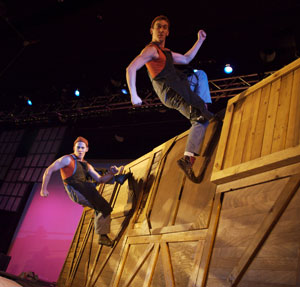
In some cases the circus acts and the factory environment really work together well, while with others it’s pretty much a case of traditional circus acts being performed against a factory background. The trampoline act, which you can see glimpses of in the first video, above, makes brilliant use of a wall at the back of the tramp in the shape of a stack of boxes. The act becomes about scaling the wall and strutting atop the boxes. The ground below (trampoline bed) exists only as a launching pad. The boxes not only multiply the number of tricks possible, they add dynamic possibilities for attitude and posturing and interaction, all of which the performers make the most of. It’s one of those acts that you just don’t want to end.

__________
Update (4-9-10): Saw Cirque du Soleil’s Ovo last night, and its crowd-rousing finale is a trampoline and tumbling act where three tramp beds are used to help propel the acrobats up a rock climbing wall.
__________
But even when Birdhouse Factory really isn’t working 100% as theatre, it’s damn good circus simply because of the caliber, presentation, and originality of the individual acts.

Comedy

But I know what you’re saying: this is a physical comedy blog; what does any of this have to do with comedy? A lot, as it turns out. The main character in the piece is a worker-clown, played very nicely by Jesse Dryden, who by the second act has taken over as factory boss and is instrumental in the transformation of the workplace. The new-found joy and exuberance herald the triumph of the clown spirit, as the downtrodden, slumping workers rediscover their bodies and take flight.

Dryden also does a sweet audience participation piece involving a very old radio that mostly emits static — unless you’re touching it, in which case it plays “It’s Only a Paper Moon.” He brings a woman up to dance with him but of course as soon as his hand loses contact with the radio, the static takes over, end of dance. So he brings her significant other up on stage as well and gets him to keep his hand on the radio. Predictably, the guy sabotages their dance by removing his hand and Dryden is forced to be the radio holder while the couple get to dance romantically without him. As a final twist, this being 2010 even if the radio’s from 1930, Dryden dances with the man while the woman holds the radio. I have a real problem with clowns who use audience participation to make fun of spectators instead of making fun of themselves, but this was just the opposite. Bravo!

My favorite piece of physical comedy had to be a tightly-choreographed tango performed atop a giant industrial spool. I’m not sure who the performers were and I can’t find any video, but it was full of character and some sharp partner acrobatic moves. The flavor was combative, somewhere between tango and apache dance, with many delicious moments.

Movement & Choreography
Back in the heady days of the Russian Revolution, choreographers were drawing inspiration from the industrial age for human movement. One such project was the Factory of the Eccentric Actor, whose 1921 manifesto begins “Wear Clown Plants and be Saved.” Meyerhold introduced a system of “biomechanical” training for actors, meant to harness the findings of Taylorism as to efficient physical movement, though in reality most of the biomechanical exercises were directly derived from the physical comedy tradition.

Birdhouse choreographer and co-director Aloysia Gavre took much of the show’s body language straight from Rivera’s industrial paintings—clear body positions, sharp angles, and deep motion. But the twist is including the “kookiness” of moves from Chaplin’s world. “It’s that juxtaposition of everything,” Gavre says. “It’s not dance choreography, it’s movement choreography.” (interview with Jennifer Pencek)

More on the Factory of the Eccentric Actor and on biomechanics in two future posts, but meanwhile some useful links:
Meyerhold Museum
Video documentaries about Meyerhold and the Russian Avant-Garde by Michael Craig
Cirque Mechanics website
Chris Lashua interview with Jennifer Pencek
NY Times review of Birdhouse Factory

SHARE
EXPLORE FURTHER
Check out My New Book

Visual and verbal humor for the cognitively and artistically curious!

“A book to treasure!”
—Bill Irwin

Upcoming Events