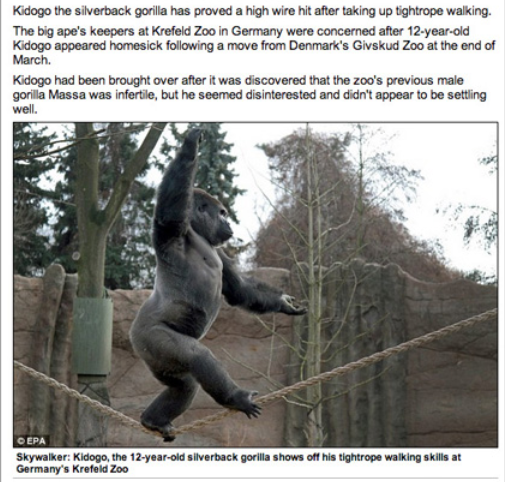
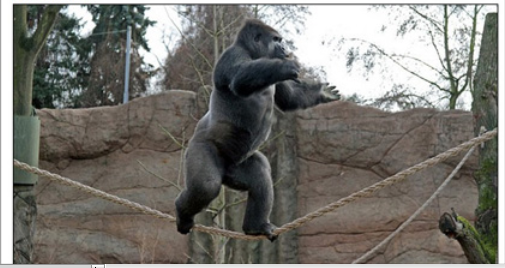
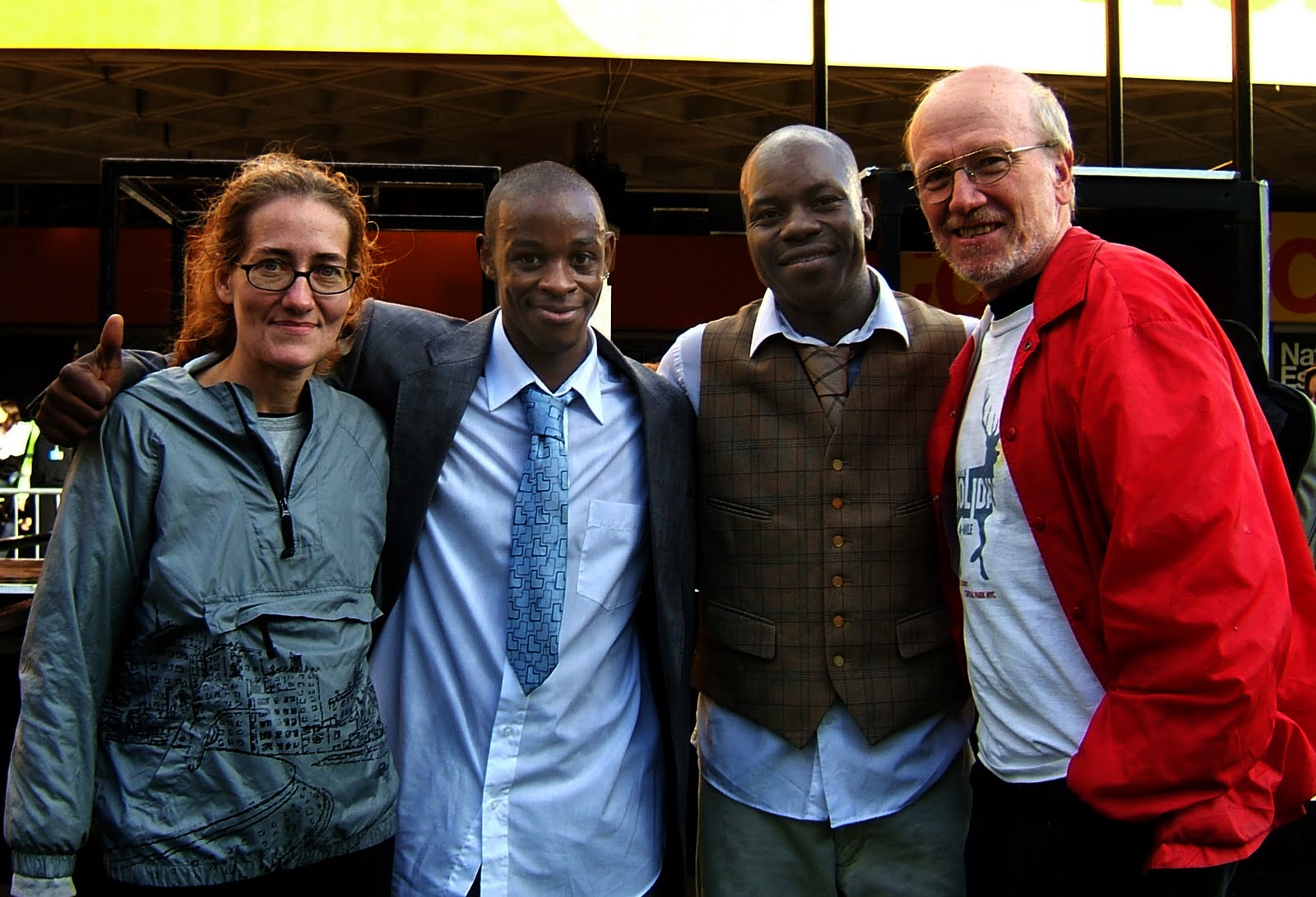
Assuming this article is true, and that these photos aren’t just me in a gorilla suit, I can’t think of a better way to wish you all a happy new year. May it be full of Daring Adventures and, as Karen Gersch(who sent me this) wrote, Unexpected Grace. A happy and well balanced new year to all!
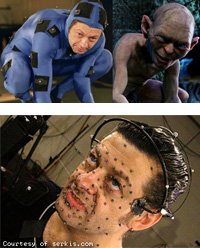
Pop quiz:What do King Kong and eccentric dance have in common? I had no idea, but it turns out the missing link isAndy Serkis,known to millions as Gollum in Lord of the Rings and The Hobbit, as the giant ape in King Kong, as the chimpanzee Caesar in Rise of the Planet of the Apes, and as Captain Haddock in The Adventures of Tintin. Millions except for me, that is, but now thanks to our resident eccentric dance expert,Funny Feetdirector, and guest poster Betsy Baytos, I am being properly schooled. In addition to voicing these characters, Serkis’ body language and facial expressions were digitized by means of motion capture technology and formed the basis for animating each one of them. Not surprisingly, this leading motion capture actor with the circus name is also a student of eccentric dance. Take it away, Betsy! —jt ____________________________________
Many wonder why on earth do I need to reach across the pond for eccentric dancers, but there are several reasons, and here is only one: Andy Serkis, a celebrated actor and director, whose brilliant character work has galvanized motion capture technology! What a surprise when English actor and friend Tim Spalls suggested I seek Andy out for his role in Topsy-Turvy, the highly acclaimed musical drama about Gilbert & Sullivan. I soon came upon this blog post he wrote on studying eccentric dance for the role! He is one of many contemporary actors and physical performers the U.K. who I must include in Funny Feet!
Topsy-Turvy Notes from Andy Serkis
In Topsy-Turvy, Mike Leigh’s award-winning, highly authentic investigation into the lives of Gilbert & Sullivan and the D’Oyly Carte company circa 1885, I play the Savoy choreographer. The character was based on the real life of John D’Auban, an eccentric performer and consummate theatrical. Stepping into his shoes was an immensely pleasurable but physically challenging experience. D’Auban was known in his day as a grotesque pantomimic dancer, a music-hall artist, and a choreographer of ballet, of burlesques, and of practically all Gilbert & Sullivan’s works. He also taught dance and invented the “star-trap,” a rather dangerous piece of stage machinery.
In the six months leading up to filming, I studied ballet, Irish dancing, and (for four hours a day) eccentric dance with choreographer Fran Jaynes. Research on the Internet unearthed an extensive thesis about D’Auban, which revealed where he was born, lived, got married, died and was buried. I visited all these locales. Along with the entire company of actors researching their own roles, I delved deeply into the business of living day-to-day in Victorian London. What trams or buses did one travel on? Where did one eat? What sorts of street food existed, what were the buzzwords of the day? Etiquette, the social and political scene. Nothing that pertained to the lives of these characters was left unresearched, all so that when the actors came together “in character” they had so much ballast to sustain the imagination and keep them completely submerged in the moment, able to improvise freely for hours.
The most memorable times were when we came together to improvise the D’Oyly Carte Company “rehearsal” scenes. The Savoy Theatre (created by reshaping Richmond Theatre) was bustling with sometimes 60 or 70 actors wandering around in character, carrying out their daily business in full Victorian garb. It was extraordinary hurrying to “rehearsal”, greeting members of the chorus, stage managers, principal actors such as Grossman and Temple, and then Gilbert himself would stride in and the rehearsal would commence. D’Auban would inevitably be late, having dashed from some pantomime or dance class, arriving like a whirling dervish. He was a very busy man. Egos would clash, tempers flare, life and death decisions about a particular gesture or dance step were thrashed out. Anyone walking in off the street witnessing these moments would honestly have believed they had traveled in time — it was that potent.
The scene that encapsulates D’Auban’s spirit in the film revolves around a rehearsal for which Gilbert has brought in three genuine Japanese women in an attempt to authenticate the Three Little Maids choreography that D’Auban had lashed together from stock “oriental” pantomime steps. Where Gilbert wants reality, D’Auban wants comedy. It is wonderfully reminiscent of the eternal battle of “art” versus “bums on seats.” D’Auban’s parting shot is “I haven’t laughed so much since my tights caught fire in Harlequin Meets Itchity Witch and the Snitch.”
I’m not in Thailand for physical comedy, but I do keep my eyes open. I like to believe that clowning is universal, as natural as human error, but that doesn’t mean every place you visit is a hotbed of variety theatre, much less of inspired foolishness. Here in Chiang Mai, “cultural capital of northern Thailand,” physical comedy has proven to be an elusive commodity.
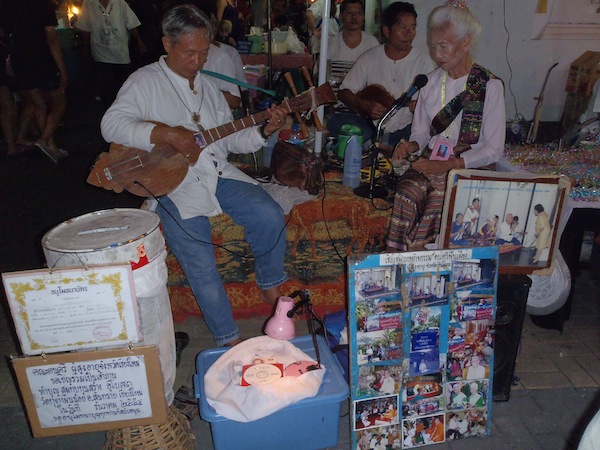
My first foray was to the famed Sunday Market, said to be full of amazing crafts and street performers. The crafts were in abundance, but the only buskers carving out space on its nearly impassable streets were musicians soulfully strumming and drumming on traditional Thai instruments, ultimately bumming for tourist tips; lovely, but hardly physical comedy.
Then there are the cabarets; the place is teeming with them. Surely I’d find something old or new vaudevillian there….
Nope.
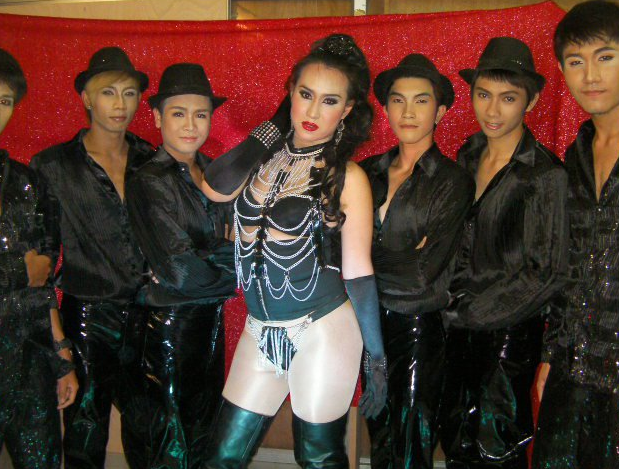
It turns out that they owe their popularity to lady boy transvestite / transgender revues, not to slapstick shenanigans. (See this recent BBC News piece on the lady boys’ runaway popularity at the Edinburgh Fringe Festival!) An interesting enough phenomenon, but was this the kind of variety I was looking for?
After exhaustive research sitting at a bar for over a half hour, I did find one lady boy cabaret numéro that was borderline blog-worthy: a two-faced interpretation of the song One-Man Woman. I’m guessing you’ve seen this bit before: the performer plays two roles simultaneously, swiveling 180˚ from profile to profile, a different makeup and costume on each side, now a woman, now a man. It does go with the lyrics and is certainly a good fit for a drag show, but as a visual gimmick it wears thin quickly if you don’t do anything original with it. Admittedly I’m not a huge fan of lip synching, especially here: if you’re going to play two characters, actually do something different with them, starting with the voice!
But there I was at the bar, concealed Flip camera in hand, cleverly sitting right next to the much overused spotlight and right where all the waiters had to cross in front of me to pick up their drink orders, the ideal spot to grab some footage. You might dismiss the results as bad cinematography, but I know better. This is merely my genius at rendering a complete 4-D environmental experience. So what if you can barely see the main performer! It’s only 17 seconds, enough to get the idea.
Okay, so that was the worst quality video ever posted to this blog!
The rest of the show was all glitter and no substance, physical comedy or otherwise. So…. no street performance, no cabaret, but as it turned out there were hearty physical comedy laughs to be found amongst Thailand’s most celebrated citizens. Yes, I’m talking about its talented elephants and monkeys. I’ve seen a bunch of circuses in my day, even been in a few, ridden an elephant bareback (bareneck?) and know enough not to come near a chimpanzee while wearing clown makeup. But in Thailand I still found myself saying, “I didn’t know they could do that!”
The pachyderms at the Maesa Elephant Campdance, play harmonica, kick and block a soccer ball, dunk basketballs, and beat human beings at dart throwing.
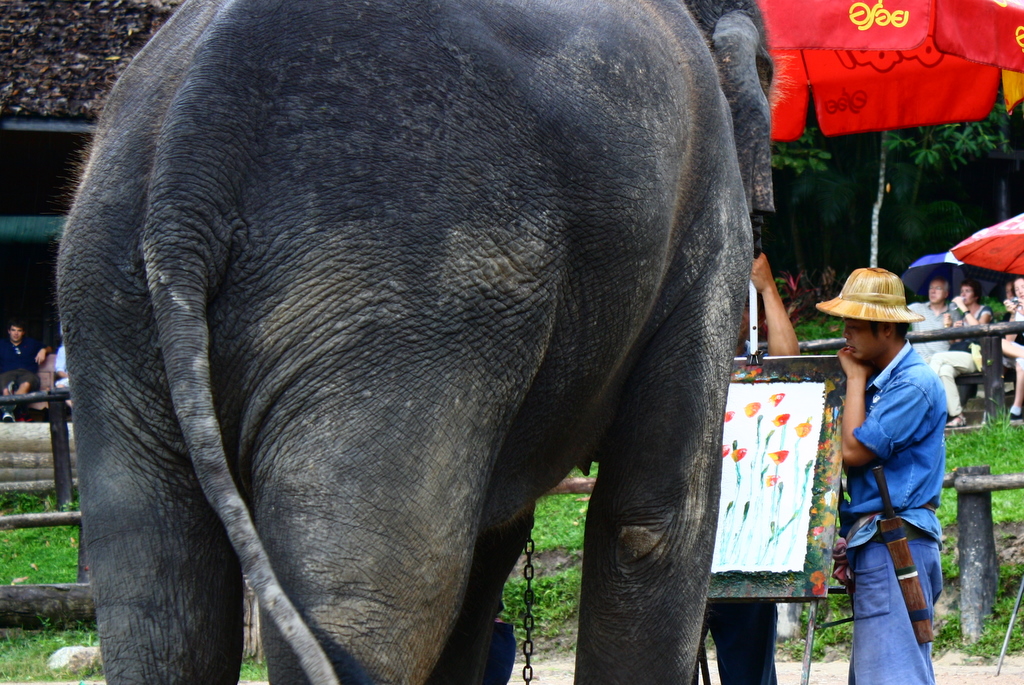
Here are a couple of elephants playing with me; to all appearances, toying with me. At first a sniff of danger, realizing those powerful trunks enveloping my puny body could flick me clear across the Burmese border. On the one hand threatening, on the other comic release from their docile behavior. They tease me, bestowing a safari hat on my head, giving it a few pats for good luck, then take it away. Feed them a bunch of bananas or a piece of sugar cane and they scarf it down. Give them a 20-baht tip and they pass it back overhead to their mahout.
And they even paint better than me! That top photo is of an elephant making “art“ before my very eyes and the image below shows the standard work churned out by these four-legged Rembrandts three times a day. (I wanted to buy one to hang on my refrigerator back home so guests would think my kids were more artsy, but they were too expensive.)
But all this brings up the question: does the elephant actually know what it’s painting? When it paints an elephant, does it see it as a self-portrait? When it throws a dart, it understands the goal, but does it even know that it’s in competition with the human, much less that we find it very funny if it wins? And above all does it get the basic reversal joke? — the “inferior” animal getting the best of the human.
Groucho Marx liked to claim that his comic foil Margaret DuMont rarely understood the humor of their scenes together and would ask why the audience was laughing. Highly unlikely, given her long career as a comedienne, but of course from the audience’s perspective it does not matter whether or not elephants or Margaret Dumont think their routines are funny.
Still, I am curious. The elephants perform actions, endlessly repeated without any trace of boredom on their part. The work is easy, they get rewards, plenty of attention and positive reinforcement, but do they enjoy the event for its own sake? And if so, do they have a sense of humor about it all? The obvious answer is, no, there’s no way they understand what humor is, the irony of the situation, or even that the humans are laughing.
Many animals do, however, have a clearly documented sense of play that is not so different from what we might call a sense of humor. For example: monkeys. I do love me some monkeys. Like cats, they have a highly developed sense of play, and like cats they are natural acrobats, only ten times more so. Is it possible they have a sense of humor too? In your typical Chiang Mai monkey show — I saw two, very similar — they pose, they strut, they interact with the audience in carefully scripted routines. They outsmart humans, for example by (apparently) performing feats of memory (a numbers game) better than an audience volunteer.
_______________________
“When I play with my cat, who knows whether she is not amusing herself with me more than I with her.”
— Michel de Montaigne, French essayist (1533–1592)
_____________________________
Here’s a video of me needing a monkey to escape from bondage: the joke of the monkey’s superiority, with a sweet touch of trans-species bonding thrown in, complete with kisses.
But in this video, my all-too-human pride wouldn’t let me go along with the joke. No monkey was going to beat me at shooting foul shots! I wisely adapted to the low net by choosing Wilt Chamberlain’s underhand style, sunk the first two but, suffering from all-too-human overconfidence, rushed the last one. Still, two out of three was good enough to beat a fellow homo sapien and a monkey who can dunk but chokes at the free throw line. The crowd may have been disappointed, but a man’s a man, when all is said and done.
_________________________________
Okay, okay, this post has obviously been more full of questions than answers, but this is a blog so I’m allowed to think out loud and to free associate, right?
So while I’m still chuckling about monkeys, here are some related videos which recently crossed my desk here at AFD Central. The first is a remarkable BBC piece on drunken monkeys courtesy of NYC clown Billy Schultz.
We all wish we could climb like monkeys. Well, at least I do, and it’s a fact that the founders of parkour studied monkey behavior, as I discussed in this previous blog post, which just happens to be one of my favorites. But I doubt anyone can beat this guy in India, who climbs walls as well as any primate I ever saw:
And finally, speaking of wall climbing, from Brazil comes this cool Nextel commercial, courtesy of clown, artist, and All Fall Down guest blogger Karen Gersch:
I don’t know much about this, but was able to track down one of the performers, Guto Vasconcelos, who was a clown with Cirque du Soleil for ten years and who writes: “This was a corporate gig for Nextel; the company’s name is Ares, my friend is the director. I don’t believe the the website is up yet, but you can google or youtube and for sure you will find some more clips.”
_________________________________
That’s it for now. Goodbye to Thailand (and India and Brazil) and my jungle-inspired ramblings. As one monkey said to the other, “We’re not laughing with you, we’re laughing at you.”
I guess it’s a generational thing, but when I mention parkour to anyone over 40, I usually get a blank stare, which if nothing else makes me feel young and in the know. If you too are going “huh?” just think of those videos you’ve probably seen of ridiculously agile teenage daredevils — Spidermen without the web — jumping on, over and off walls, railings and other structures that get in their way. They are called traceurs presumably because they trace a path through space while leaving only a faint imprint.
The Wikipedia definition is pretty good: “a physical discipline of French origin in which participants run along a route, attempting to negotiate obstacles in the most efficient way possible, as if moving in an emergency situation, using skills such as jumping and climbing, or the more specific parkour moves. The object is to get from one place to another using only the human body and the objects in the environment around you. The obstacles can be anything in one’s environment, but parkour is often seen practiced in urban areas because of the many suitable public structures that are accessible to most people, such as buildings and rails.”
If you still don’t know what I’m talking about, here’s one of those videos:
This summer in London I actually had the opportunity to participate in a parkour workshop and performance at the National Theatre, meet some of the original practitioners, and grow some thoughts about connections between parkour and physical comedy. I would have written this sooner, but there’s so much to cover!
Parkour is essentially a street art form like graffiti or skateboarding, but with its own unique philosophy and history. The word parkour comes from the original French term, parcours, meaning course, as in obstacle course. Parkour seems to have become the accepted international spelling because it’s phonetic and therefore less likely to confuse. Depending on who you’re listening to, free running and l’art du déplacement are either synonyms for or variations on parkour. (Wikipedia translates l’art du déplacement as the art of moving, though it also contains the more exact sense of displacement orshifting.)
Origins
If there is an inventor of parkour, it would have to be David Belle , the guy in the video above. Belle developed parkour with friends in Lisse (just south of Paris) in the 1990s, and has since become an international celebrity as an actor and stuntman in films and commercials. He was also the subject of a New Yorker profile piece, which you can read here.
The story of parkour, however, goes back way before Belle and, in fact, shares roots with modern movement theatre. Belle’s father Raymond — a French soldier, fitness enthusiast, and firefighter — was a legend in his own right. Raymond Belle’s training in the French military had brought him into contact with the teachings of Georges Hébert, which he passed onto his son, and which played a key role in formulating the basic tenets of parkour.
And who was Georges Hébert? He was a French military officer who traveled all over the world before World War I and later became a teacher of physical education. Hébert came to the conclusion that the weight training regimen used by the military was building muscle without promoting dexterity and speed. In its place he developed laméthode naturelle, which he based on the movement skills of indigenous peoples he had observed in his travels, especially in Africa. “Their bodies were splendid, flexible, nimble, skillful, enduring, resistant and yet they had no other tutor in Gymnastics but their lives in Nature.”
Hébert’s natural method, also known as hébertisme, promoted “the qualities of organic resistance, muscularity and speed, towards being able to walk, run, jump, move quadrupedally, to climb, to keep balance, to throw, lift, defend yourself and to swim.” One of Hébert’s top tools for achieving this was the obstacle course — le parcours du combattant — which was to become integral to French military training. So if you ever hated being forced to run an obstacle course back in high school or in army basic training, you have Hébert to blame. On the other hand, if you ever did an Outward Bound program and loved it or you’re into adventure racing, how about a tip of the hat to uncle Georges?
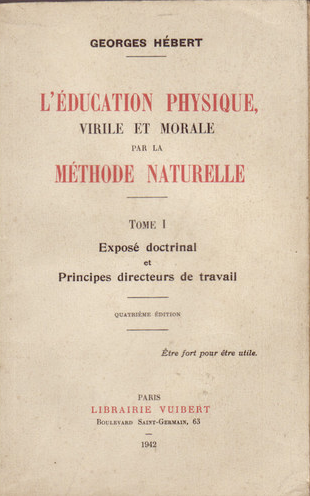
Although his teachings were already widely accepted by the ’40s, the publication of his multi-volume work, L’éducation physique et morale par la méthode naturelle (1941–43) no doubt cemented his reputation. Here are some scans from the book, courtesy of Hovey Burgess.
Hébert’s work was also a strong influence on French theatre, and specifically on movement training for actors. Jacques Copeau, whose work in the 1920s at the Théâtre du Vieux-Colombier in Paris was strong on improvisation and physical training, adopted Hébert’s natural approach to movement as an antidote to the artificial stylings of the staid establishment theatres. He created the Vieux-Colombier theatre school, whose instructors included the Fratellini clowns and one M. Moine, an Hébert-trained teacher.
Lecoq writes about his debt to Hébert in his book Le Théâtre du Geste and in The Moving Body, describing him as one of the significant influences on the transition from artificial mime styles to a more scientific study of the body in motion. Mark Evans, in Movement Training for the Actor, points out that “Lecoq’s Paris school was to find its final home in a disused gymnasium, a symbolic return he himself noted with approval… Lecoq’s meticulous approach to the analysis of movement owes much to the French tradition of scientific, anthropological, and philosophical movement analysis…”
Silent Film The film world offers more direct connections between parkour and physical comedy, the most obvious being the reverence parkour practitioners have for such silent film stars as Douglas Fairbanks and Buster Keaton. When Fairbanks first went to work in Hollywood in 1915, his boss was the legendary director, D.W. Griffith, whose Birth of a Nation had just changed the course of film history, and who immediately locked horns with the acrobatic young actor. “D.W. didn’t like my athletic tendencies,” Fairbanks recalled. “Or my spontaneous habit of jumping a fence or scaling a church at unexpected moments which were not in the script. Griffith told me to go to Keystone comedies.” This parkour-like spontaneity was part of his creative process, prompting Alistair Cooke to comment that his collaborators needed “a willingness to let Fairbanks’ own restlessness set the pace of the shooting and his gymnastics be the true improvisations on a simple scenario.” The Mark of Zorro (1920) is just one of many examples of Fairbanks in parkour mode.
The following archival clip, which has appeared on some parkour sites, is from the movie Gizmo! (1977) and has also been identified on YouTubeas from 1930, but is actually German stuntman Arnim Dahl (1922–1998), and is probably from the 50s.
Monkeys!
Another movement source for parkour is even more ancient: the animal kingdom. Or as they say on the Mumbai parkour web site: Q: What do you get when you combine a monkey, a cat, and a frog together? A: A Traceur!
In that New Yorkerprofile, David Belle talks about a trip to India and an encounter with a tribe of monkeys: “I was at a waterfall one day, and there were huge trees all around, and in the trees were monkeys. There were fences and barriers around them, so they couldn’t get out, but I went around the barriers and played with the monkeys. After that, I watched them all the time, learning how they climbed. All the techniques in parkour are from watching the monkeys.” Belle then showed the New Yorker reporter segments from the BBC documentary, Monkey Warriors. Here’s a clip that shows exactly what he means:
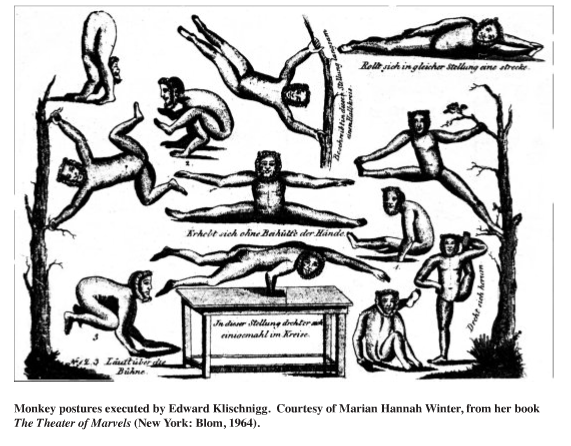
Monkeys and physical comedy also have a shared heritage that can be traced back to popular animal impersonations by such 18th and 19th-century physical comedians as Grimaldi, Mazurier, Gouffé, Perrot, and Klischnigg , which you can read all about in chapter five of my book Clowns. You can get a good sense of what these performances might have been like from Buster Keaton’s 1921 turn as a monkey in his short The Playhouse, which you can watch in the supplemental material for chapter five.
Philosophy
While the origins of parkour go way back, its rapid dissemination throughout the world came in the form of videos that were uploaded to the internet and quickly went viral. In fact, it has been said that parkour is the first art form whose growth into a movement has been totally dependent upon the internet. In the process, however, parkour has become a case of different strokes for different folks. For some, it is trick-based, the idea being to pull off the most spectacular stunt, and YouTube videos certainly lend themselves to showcasing these feats of derring-do. The founders and many subsequent practitioners have, however, framed it in far broader terms. Here are some of the concepts that have been put forward:
• Civilization has made people lazy, but parkour trains one to get along in nature and with one’s physical environment. This hearkens back not only to Hébert, but also to Jean-Jacques Rousseau and his writings on nature and the education of the whole person.
• Hébert’s maxim “be strong in order to be useful” is often cited in parkour writing. Both David Belle’s father and Hébert were “superheroes” who had won considerable acclaim for dramatic rescues made possible by their physical prowess.
• Parkour is a discipline, as much as any martial art. One must overcome mental obstacles to overcome physical obstacles. For example, the philosophy section of the American Parkour site reads: “Many people take the principles they learn through parkour and apply them to their lives. By challenging themselves in parkour both mentally and physically, it becomes easier to deal with problems and obstacles in everyday life. When a difficult situation comes up in daily life, a parkour practitioner can see this as any other obstacle which they’ve learned to overcome quickly, efficiently, and without disruption to their intended path.”
• Parkour is play, and play is essential to creativity.
• The essence of parkour is the attainment of efficiency, moving efficiently through a space rather than around it. “If you run through a pedestrian zone without losing speed and without touching any person, you do good Parkour although you probably don’t use any techniques like saut de bras or saut de chat.” (Benedikt Bast) • It is a fresh way of looking at one’s physical world, viewing architecture as function rather than form. Parkour teaches pkvision, the ability to look at the environment and see the potential for movement within it.
• Parkour is self-expression, not performance. Once you start drawing attention to it, creating crowd-pleasing movements, is it still parkour?
• Instead of society discouraging parkour because of liability and insurance issues, parkour should be recognized as a valuable form of self-expression for youth, an alternative to over-indulgence in alcohol, drugs, or video games, and as an activity that does not require equipment or the formation of teams. Older practitioners of parkour send a message to youth that it is still okay to play.
The Urban Playground
So there we were in London in July, taking advantage of all the good productions offered at affordable prices (£10 and up) at the National Theatre, when we discovered that their outdoors series, Watch this Space, was sponsoring the performance troupe Urban Playground (an offshoot of the Prodigal Theatre in Brighton), in five days of parkour workshops, forums, and performances.
UPG (Urban Playground) performers come from backgrounds in contemporary dance and in Eastern European theatre labs, and specifically Grotowski’s system of physical actions. They are older (thirty-somethings) and approach parkour less from a daring stunt angle and more from that of actor training, movement, and theatrical exploration. Their literature favors the term l’art du déplacement, and this definition of the term from Parkourpedia fits them nicely: “The spirit is still the same as Parkour, there is still the aim of being strong, to be useful and the need to overcome fears, but the movement is less concerned with speed and efficiency and more to do with the aesthetic of the movement.”
UPG subverts traditional parkour use of found space by traveling with their own mobile playground, and this summer they even opened a permanent facility as well, the “UK’s first permanent, free, outdoor Parkour Training Area” in Crawley (West Sussex). They brought the mobile version to the National with them, and used it for their workshops and performances.
The Old Man & the Seesaw
Sorry about the pun, which at any rate may be wasted on those of you unschooled in the writings of Ernest Hemingway or Karen Gersch. I’m sure parkour has been done on a seesaw, but not by me. In fact, you could certainly argue that parkour has never been done by me, despite my decades of climbing trees, rocks, and man-made objects, not to mention hugging parking meters. But here’s the story:
UPG’s residency at the National included a series of short (free) workshops, including one just for kids, one just for women, and one just for brave souls over the age of 50. I somehow managed to qualify for the last one and, egged on by my sweetheart Riley, joined her in this afternoon adventure, wondering how my bad hip would feel after diving off rooftops and all that. Could I become the George Plimpton of parkour… and live to tell about it?
As it turned out, the workshop was not really challenging physically, but the process was quite interesting and worthwhile. Though it was taught from a dance and movement theatre perspective and certainly not from a physical comedy angle, it did give me a feel for the potential discoveries possible when one art form “samples” another.
Because of light rain, the workshop began in an upstairs lobby space. There were just eight of us: four students and all four UPG performers as teachers: Alister “Buster” O’Loughlin, Miranda Henderson, JP Omari, and Janine Fletcher. Not a bad faculty–student ratio, eh? Led by Buster, the workshop was first framed by a discussion of the history of parkour and of UPG’s involvement. The warm-up began with follow-the-leader movement throughout the lobby space, with the kinds of walks and stretches that I’m sure many of you have experienced in workshops you’ve taken. The difference here was in the more deliberate use of the physical environment, from simply making contact with various surfaces (walls, steps, railings, furniture, etc.) as we passed near them, to pushing off and rolling off of walls as you ran, to engaging with obstacles rather than simply detouring around them.
Next was floor work, where we did some basic shoulder rolls, with the usual emphasis on smoothness, spreading out the contact with the floor, and controlling one’s center of gravity well enough to roll in slow motion. Maintaining the line of attack of the roll was emphasized, and to work on our orientation in space we did them in pairs side by side, holding our partner with our free hand, trying to stay in unison as much as possible.
By then the rain had let up so we got to move outdoors to the “jungle gym.” The first exercise was simply to move “through” one of the structure’s horizontal bars on our own, either going over or under it, while our workshop leaders observed our choices. While it was not a question so much of right or wrong technique, there were some good suggestions for increasing efficiency and awareness of the space. One was to touch the apparatus as we went through even when we didn’t need it for support, the idea being that this would aid our proprioceptive awareness of where our body parts were. The second was a specific technique for gripping the bar as we passed under it that involved crossing one wrist over the other so as to provide a smooth transition as our orientation rotated 180º.
We repeated these simple movements many times, focusing on efficiency and spatial awareness, and then built on them with a series of variations. We passed through one bar and then immediately through another at a 90º angle. We played with grips and positioning for maneuvering over the bar. We developed more complex paths through the structure and had one person begin when the person in front of them was only part way through, adjusting the timing to avoid collisions. By the end of this segment all eight of us were exploring the cubes and railings, as many as four at a time, moving in and out at will, developing awareness of the structure and of one another’s movements.
Our Micro-Choreography
After a break for lunch, we were ready to start putting together what UPG terms a micro-choreography, a very short piece to be performed then and there for whatever public we could muster in the middle of a rainy afternoon. For yes, it had indeed started raining again, and we had a dilemma on our hands. All of the open-air structures were getting soaked, but what audience there was to be found would have to be outdoors. There was, however, an overhang just outside the National’s coffee shop with a row of tables under it. Ever resourceful, UPG chose to commandeer the last table and its four plastic chairs and throw together some minimalist parkour.
The entire piece, three minutes plus, was put together in under an hour, with Miranda as choreographer. The process was clearly from the world of dance, with the vocabulary borrowing from parkour basics. We began in our chairs, and we each came up with our own three to five movements involving the chair, which we then stitched into our own movement phrases. Here and throughout, Miranda’s role was not to give us any specific movement, but rather to help us make choices from what we’d come up with and to structure it in a dynamic way. She focused on building on moments that worked best; when she saw a dynamic relationship developing she sought to bring focus to it.
Next we tackled the table, some of us literally. Again we came up with a variety of movements, picked our favorites, and sequenced them, but since there were four of us and only one table, we also had to work out the timing of our movement in coordination with the whole group.
The final stage of our magnum opus involved descending two short nearby stairs, finding different ways to get down them. Clearly this was an example not of moving efficiently through the stairs space, but of transforming them into a plaything. Again, we had to coordinate this with one another and eventually work toward an ending of sorts.
The modernist performance philosophy behind all this is that dramatic relationships and moments arise from the dynamics of these structured improvisations without any specific intention being imposed. Performers interact, patterns emerge. Rather than the piece telling a story, the audience is free to take whatever narrative from it they like. For me as a participant this went against my clown and actor instincts. I had to fight the urge to seek out eye contact and grow it into a psychological relationship with another character. It was hard not to think in terms of status and control, hard not to want to transform a physical movement into a physical comedy bit. (Yeah, yeah, that’s also the story of my life, but we’ll save that for another post…)
While the end result (below) was clearly a “process piece,” I liked the process and can see its potential for developing all kinds of material. And yes, the rain did let up and we did get an audience of 30 to 40 people, all of whom gave us a standing ovation because it was still too wet to sit down. All I could think of was the storied tradition of the National Theatre: Gielgud, Richardson, Olivier and now Towsen.
In Performance with the French duo Gravity Style:Quartet
For the weekend performances of Quartet, UPG was joined by
two leaders of France’s Gravity Style, Charles Perrière, and Malik Diouf, original members with David Belle in the group Yamakasi, back in Lisse in the 90s. They’ve been collaborating with UPG for several years and on the weekend put together several semi-improvised performances.
UPG’s interest in mixing genres is echoed in Gravity Style’s concept of gravity art: “Around the art of dispalcement (parkour), the sportive and artistic discipline popularized by the Luc Besson Film, Yamakasi, it brings together a wide range of physical performance such as acrobatics and urban dance and integrates them into different artistic contexts.”
The performance of Quartet they did later that night was scaled back somewhat because everything was still quite wet, but it went over very well with the audience. The video below, shot with a handy-dandy Flip camera, is from far enough back to take in the whole space, so you lose some detail. To remedy that, here are some photos of the performance taken by Riley that help balance things out.
And here’s the video (about 11 minutes):
Parkour and Physical Comedy
If UPG’s choreography eschews character and plot, and other manifestations of parkour are self-expression, what does it all have to do with physical comedy? Physical comedy as a specific genre is usually based on meticulously planned out characters, stories, and blocking. Still, I do see some useful connections:
• Movement vocabulary
The most obvious link is between the acrobatics seen in a lot of parkour and that robust branch of physical comedy that emulates the daredevil antics of Lloyd and Keaton and likes large spaces and big movement.
• Intention, or, why did the chicken cross the road?
The parkour traceur’s intention is a given, the desire to get from point A to point B as efficiently as possible. The physical comedian is more likely to be running from someone. Speed is an issue, the intention is survival.
• Obstacles and Inventiveness
The obstacles are what make parkour and physical comedy interesting. Both the traceur and the physical comedian are creative in their solutions to overcoming these obstacles. While these solutions are efficient and “simple,” they would not be the obvious choice for most people, which just reinforces the eccentric nature of the physical comedian’s character. Likewise, it is usually the clown’s m.o. to overcome obstacles in an inventive way, even when not working in a physical mode.
A textbook example of parkour-style physical comedy is the climactic scene in Keaton’s College (1927), where Buster — an abject failure as a college athlete — must make a mad dash to his girlfriend’s dormitory room, where she is being held captive by an overly-insistent male rival. The intention is clear, the obstacles many. In the course of his rescue mission, he successfully makes use of many of the sports techniques that had eluded him on the playing field.
It should be noted that the pole vault was the only time in his silent-film career that Keaton used a stunt double.
Not only can physical comedy make use of parkour-style leaping and bounding, it can also make fun of it. Here’s a sharp parody of Douglas Fairbanks by Will Rogers. You may think of Rogers as primarily a verbal comedian and political satirist, but he had a long career in silent movies as well, making fifty of them! In this excerpt from Big Moments from Little Pictures (1924), Rogers channels his inner clown as he offers us a rather fey Robin Hood showing his very merry men the fine art of jumping.
And then there’s this parkour parody from the current season of the tv sitcom The Office:
Good ending, but I gotta admit it, overall I thought Rogers was a lot funnier.
Physical Comedy in the 21st Century??
Since we’re doing some genre-bending here, I’ll close with a cool video by Vidéo El Dorado that combines Mayan ruins, parkour, visual effects (time remapping ), and of course more monkeys. Not sure if it fits my “physical comedy in the 21st century” category because it’s not exactly comedy, but it is cool. Did I mention that it has monkeys?
Well, that’s a lot of stuff to throw at you. I hope it makes sense to all you old folks! I know I’m a novice here and just scratching the surface, so here’s some more info for the insatiable:
Links
• Jump Four — a 2003 BBC documentary about parkour that features French free runners leaving their trace on London’s landscape. This is available on YouTube, segmented into five parts.
• Parkour-Videos.com— “all the best videos of parkour”
• Parkourpedia — a reference source compiled by the Australian Parkour Association
• American Parkour— site for AMK
• Training Videos — also from the AMK site
• New York Parkour — site for NYPK, parkour group for NYC / New Jersey area
• Sandbag — parkour events staged all over the world to promote the fight against climate change
• Point B— a 2009 documentary about parkour
• Parkour in Casino Royale — James Bond chases Sebastian Foucan. I’d like this a lot better if there weren’t so many cuts undermining the believability of the leaps. I want to see the take-off, flight, and landing all in the same shot, thank you very much!
• Update (3-15-2010):Parkour Motion Reel — from Vimeo, a short but cool hand-animated flip book about parkour.
As I said in my previous post, I have a bunch of additional material relevant to each of the twelve chapters of Clowns. This is especially true of Chapter 5, because it focuses on physical comedy. In fact, you could view this entire blog as Chapter 5 supplemental material! In addition, I’m still a huge fan of the Hanlon-Lees and I could overwhelm you with stuff on them, but I’m going to wait for the publication this fall of Mark Codson’s book (see below) to dive back into their work.
That being said, a few miscellaneous goodies…
__________________
On pages 5-6, I talk about nineteenth-century performers such as Mazurier and Klischnigg, who did remarkable imitations of monkeys, starring in vehicles such as Jocko, or the Monkey of Brazil. You can get some sense of what that might have been like from this comic turn by Buster Keaton in his brilliant short, The Playhouse (1921).
_______________
Baudelaire on clowns: the Vertigo of Hyperbole
When Tom Mathews’ English pantomime troupe visited Paris in 1853, one of the spectators was the French poet, Charles Baudelaire. Despite his well-known interest in the macabre and the grotesque, Baudelaire was somewhat taken aback by the British clown, the “English Pierrot.”
I shall long remember the first English pantomime that I saw. . .It seemed to me that the distinguishing characteristic of this genre of comedy was violence. . . . The English Pierrot was by no means this character pale as the moon, mysterious as silence, supple and mute as the serpent, lean and long as a pole, to which we were accustomed by Deburau. The English Pierrot comes in like a whirlwind, falls like a bale, and when he laughs he makes the room shake; his laughter sounds like joyful thunder. He is a short, thick fellow, who has increased his bulk by a costume filled with ribbons. On his whitened face he has crudely plastered — without gradation or transition — two enormous slabs of pure red. His mouth is made longer by a simulated prolongation of the lips in the form of two carmine strokes, so that when he laughs his mouth seems to open from ear to ear. . . . His moral nature is basically the same as that of the Pierrot we know: insouciance and neutrality, leading to the realization of all the rapacious and gluttonous desires, to the detriment sometimes of Harlequin, and sometimes of Cassandre or Léandre. But where Deburau thrust in the point of his finger so that he might afterwards lick it, the clown thrusts in both hands and both feet, and this may express all that he does: his is the vertigo of hyperbole. This English Pierrot passes by a woman who is washing her doorstep: after emptying her pockets, he seeks to cram into his own the sponge, the broom, the soap, and even the water…. Because of the peculiar talent of the English actors for hyperbole, all these monstrous farces take on a strangely gripping reality.
— De L’Essence du Rire (my translation)
__________________
In the book, I described The Duel Between Two Clowns, a clown act between Boswell and one of the Price Brothers (apparently William) involving an attempted two-high, a ringmaster, a duel, and some quick change. Amazingly there is an actual transcript of this routine from the 1840s in Entrées Clownesques, a collection of clown texts compiled by the great French circus historian, Tristan Rémy. I have no idea what the original source for this document is. Rémy’s book was translated into English by Bernard Sahlins as Clown Scenes (Chicago: Dee, 1997). Unfortunately, for some reason he only includes 48 out of the 60 entrées contained in the original, and Le Duel Entre Deux Clowns ain’t one of them. Thanks, Bernie, for forcing me back into the highly lucrative clown entrée translation business!
Here it is, hot off the press. Please use your imagination to see beyond the dialogue and picture the act performed by two very strong clowns.
[Forthcoming!]
__________________
Another link between 19th-century pantomime and early film: First here’s a poster of the train wreck from Le Voyage en Suisse (1879):
And now here’s a shot from the 1904 Georges Méliès film, The Impossible Voyage, courtesy of the Library of Congress.
Coincidence? I think not. Méliès was, as many of you probably already know, a stage magician who became a pioneer of special effects in early film. And while we’re on the subject, the connections between film effects and circus-style performance is the subject of an intriguing blog that you might want to check out: Circo Méliès.
_______________
And in my first On the Shoulders of Giants installment, I reinforce the obvious connection between the Byrne Brothers’ Eight Bells and Buster Keaton’s Neighbors by showing the Keaton clip that brings the poster to life (and then some).
_______________
Mistakes? What mistakes?
Probably plenty; here’s one…. Mark Codson, whose excellent dissertation on the Hanlons will be published this fall, pointed out that I persisted in translating the title of Le Voyage en Suisse into English, when in fact the show toured to England and the United States with the original French title. I was probably thrown off by a few bi-lingual posters and by a previous commentator or two who also referred to it as A Trip to Switzerland. The correction has been made, so thank you Mark. If anyone has additional corrections, just let me know. UPDATE (11-17-09): Mark’s book is now slated for publication on February 2, 2010. You can order it here.
_______________
UPDATE (11-17-09): You can see a version of Auriol’s bottle-walking act in Cirkus Cirkör’s production, Inside Out. Read all about in in this post.
_______________
So what’s missing?
It’s the second longest chapter in the book, and one of my favorites, but it has at least one glaring omission, the work of American pantomime clown George L. Fox. Yes, I do mention him, but that’s about it. He was wildly popular and a colorful character (he went insane), but I think at the time it was hard to find all that much about his actual performing. Or perhaps I just ran out of time.
A few years later, when Bill Irwin was first considering doing a show based on Fox’s life, I helped him out with some additional research, including uncovering some original pantomime scripts. It was not until 1999 that Laurence Senelick’s excellent study appeared: The Age & Stage of George L. Fox, 1825-1877. Armed with this thorough research, Bill finally did his show, Mr. Fox: A Ruminationin 2004 as part of his season of work for the Signature Theatre.
Chapter 5 from my book, Clowns: A Panoramic History
One more background piece. This chapter from my 1976 history of clowns dealt in detail with the development of physical comedy in the nineteenth century and, ultimately, its influence on American silent film comedy. Good stuff!
[The usual Scribd note: click on icon in upper-right corner to view document full-screen; click again on same icon to return to blog.]