Search Results for: label/Jonathan Lyons

Guest Post: Jonathan Lyons on Cantinflas & Bullfighting

POST 113
Monday, March 21, 2011


Jonathan Lyons is a top-notch 3D animator, with major credits working for, amongst others, ILM and Imagemovers Digital. Yes, you’ve seen his work, and you can see his demo reels here.  Most recently he worked on Pirates of the Caribbean 4 — On Stranger Tides and, better yet, just finished his own short film, Floyd the Android, already entered into several film festivals. Jonathan is an aficionado of physical comedy who has graciously shared his insights and enthusiasms with this blog’s readers on several occasions.  And to top it off, he has recently launched his own blog, Comedy for Animators, which I can’t recommend highly enough.  Great stuff, with very specific and valuable analysis of the movement details essential to understanding physical comedy.  Definitely check it out!  — jt
_________________________________________________

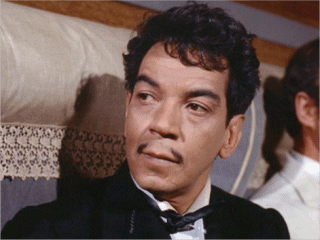
I’m sure that some time ago I must have seen the 1956 version of Around the World in 80 Days.   But when I recently watched it on Netflix, I recalled virtually nothing about it.   Although it features numerous cameos by famous actors, for me it was primarily an opportunity to sample the work of Cantinflas, the legendary Mexican dancer, actor, and comedian.  He plays Passepartout, the gentleman’s gentleman to Phileas Fogg (David Niven).   Passepartout is French for “goes everywhere.”

Cantinflas was the stage name of Fortino Mario Alfonso Moreno Reyes (1911-1993).  He began his entertainment career as a dancer, performing with Mexican carpa (traveling tent) shows.  He made his film debut in 1936, in No te engañes corazón .  His 1941 bullfighting film Ni sangre, ni arena (Neither Blood nor Sand) broke box office records.  The title is a play on the gladiator phrase “Blood and Sand.”   His work in “Around the World in 80 Days” was nominated for an Academy Award, but it was followed by Pepe, a box office flop.
He admitted the language barrier was too much to overcome.  It is a shame his work is not more accessible.   The DVD of the film included a commentary track by a film historian, who had nothing much to say about Cantinflas, unfortunately.
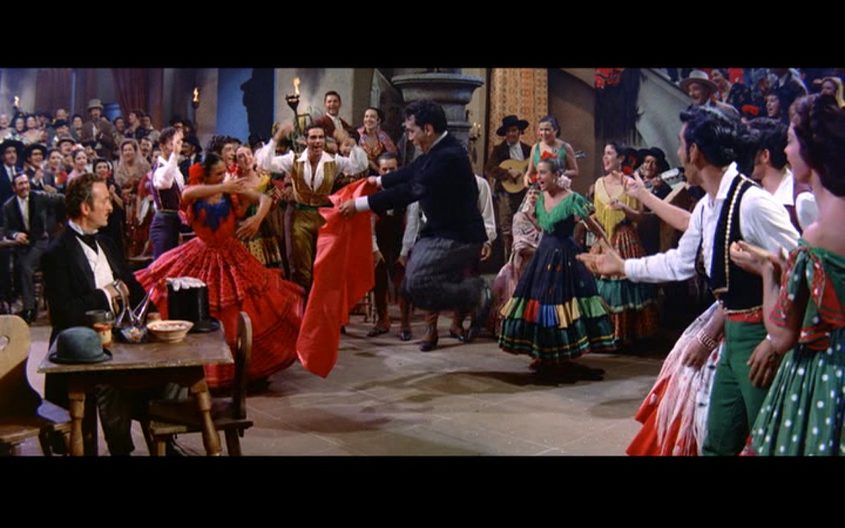
Charles Chaplin once called Cantinflas “the world’s greatest comedian.”   From my viewing of Around the World in 80 Days, I must say that he stands well in the company of great film comedians. His appearance simulates Chaplin, but he chases women like Harpo Marx.  It is during the visit to Spain that he really shines.   Visiting a flamenco club, he can’t help but take the dance floor with a beautiful Senorita.  His dance is quite skilled, and just a touch eccentric.   Despite his shabby clothing and small stature, he becomes quite a powerful and sensual partner.  He snatches the red tablecloth from the local strongman’s table, and performs some matador moves with the woman acting as the bull.

The strongman is so impressed he insists Passepartout take on a real bull in the arena the next day.
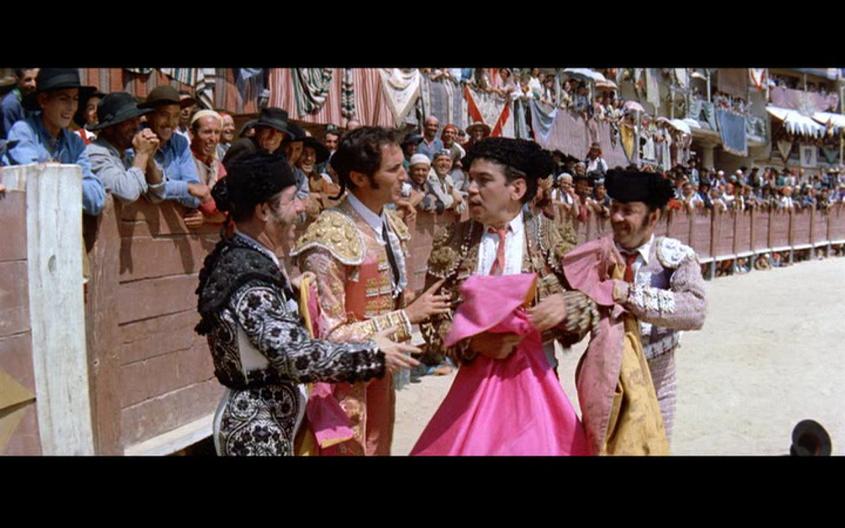
The bullfight was the very first sequence shot for the film, and it was given lavish attention.  Of the many set pieces created to bring the world into the theater with the very wide angle Todd AO lenses, this is the best.  Filmed in the town of Chinchon, it features all the 6500 inhabitants, plus 3500 extras.  All fully costumed.  While many scenes feature long shots of beautiful landscapes, this scene also stands out for Passepartout and his interaction with the locals.
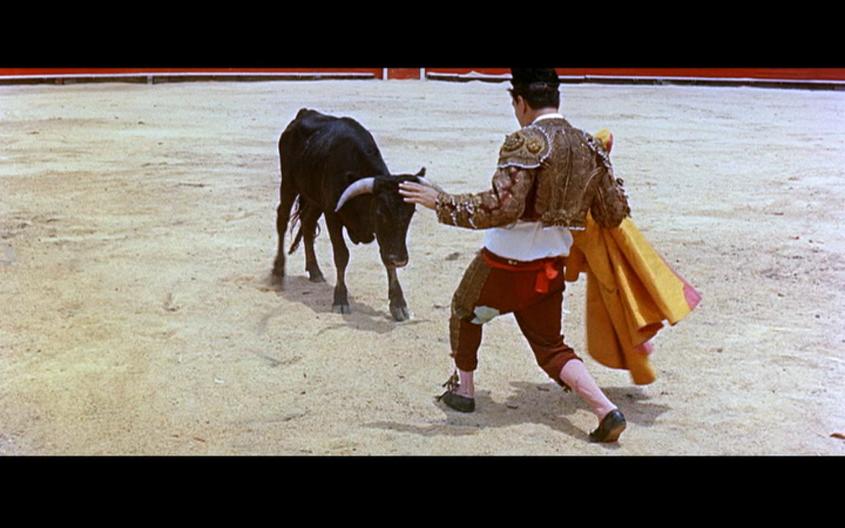
The bullfighters parade in, with Cantinflas scurrying along at the end, doing his best imitation of the toreadors proud stride.   A famous matador takes his bow before the Mayor and his wife, and they release the bull.  The excellent footage of the bullfight shows the audience how this should look.  It becomes clear that once a bullfighter can fool the bull with the cape, it becomes a matter of style.  Finally, turning his back on the bull is the ultimate act of courage. 

The frightened Passepartout is then pushed into the ring, claiming this is the first time he’s seen a real bull.  (Cantinflas was actually a bullfighting aficionado).  His first tremulous steps sideways before the bull, and the first passes of the animal, eventually lead to moments of flare.  When the bull steps on the cape and Passepartout loses it, the other bullfighters step forward, like rodeo clowns to help, but  Passepartout doesn’t back down, and it is now clear that despite the comedy, this is a real bull, and this is a real bullfight. 

The danger of a wild animal makes this a unique piece of comedy.   If Chaplin wanted a bullfight, it would probably involve a pantomime bull and 60 takes to rehearse.  In Buster Keaton’s “Go West” when he wanted a bull to charge at him, they mounted the camera on a fake bull, and ran it toward him while he casually walked out of the way unaware of the “danger.”  Of course it’s hard to top Bugs Bunny’s bullfighting turn in “Bully for Bugs.”

In my superficial research on this topic, I checked out Wikipedia for “Bullfighting.”  In among all the information I found this:

Comic bullfighting
This section requires expansion.
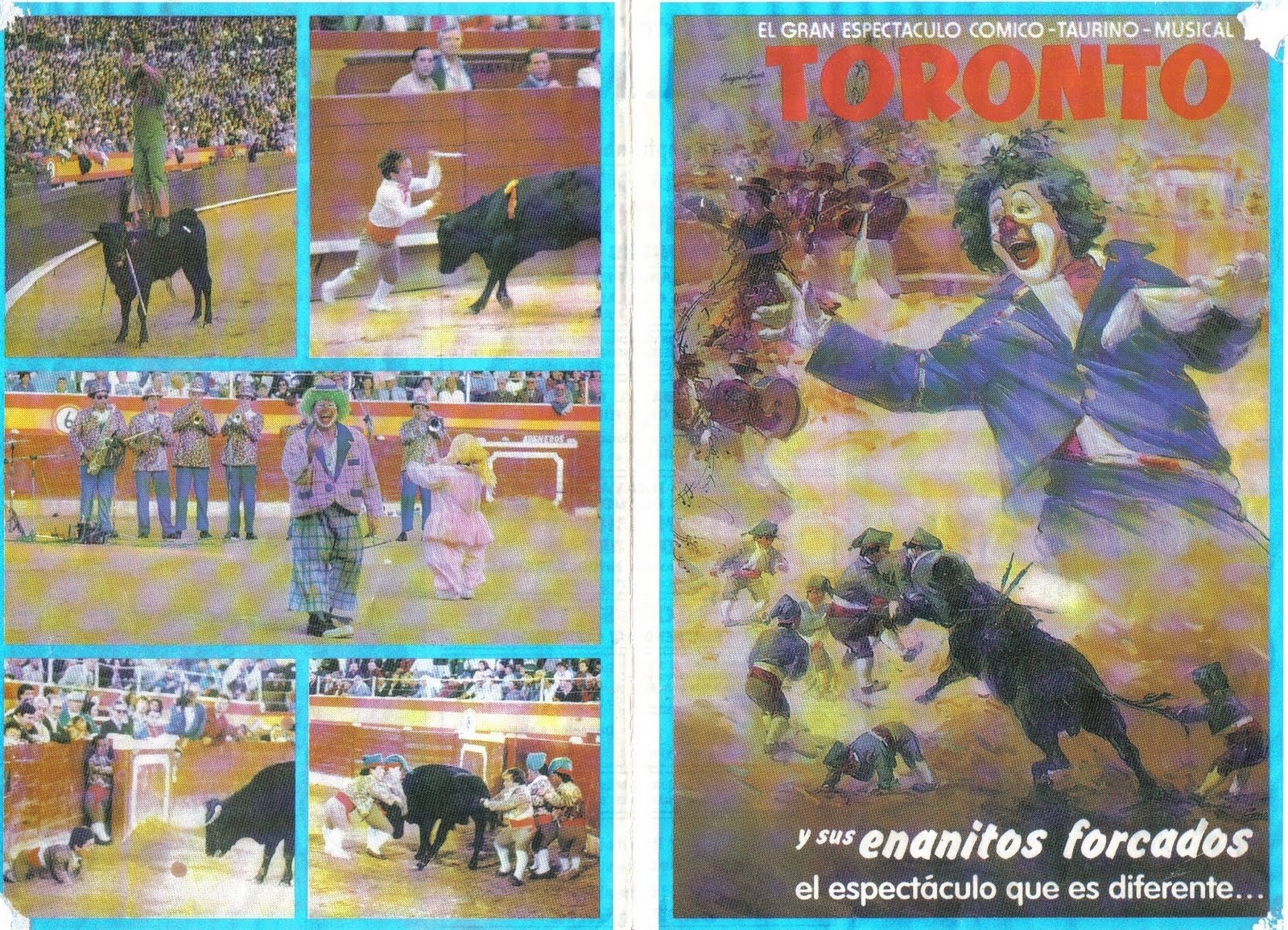
Comical spectacles based on bullfighting, called espectáculos cómico-taurinos or charlotadas, are still popular in Spain and Mexico, with troupes like El empastre or El bombero torero.[14]

Ay Caramba! That sounds like fun.   As the explorer of the fringes of physical comedy, this is right up my alley.

SHARE
EXPLORE FURTHER

Guest Post: Jonathan Lyons on The Harlem Globetrotters

POST 68
Thursday, February 11, 2010

by Jonathan Lyons

The same weekend I was catching Aurélia’s Oratorio in Berkeley, our intrepid reporter and master animator Jonathan Lyons was in Oakland enjoying a performance by the Harlem Globetrotters, who I am embarrassed to say I have never seen perform live. But talk about physical comedy!

You can click here to read other posts by Jonathan and to view his impressive bio, to which I will add that he is currently working on the film Mars Needs Moms for Disney/Image Movers Digital. — jt
_____________________

Milton Berle is quoted as saying, “If opportunity doesn’t knock, build a door.”

Abe Saperstein loved sports. When he failed to make the basketball team at the University of Chicago, he left school. But he didn’t let that stop him. He just formed his own team. He assembled five African American basketball players and made himself coach. They were hired to play demonstration games at the Savoy Ballroom, in an attempt to lure people to stay and dance after the game. The “Savoy Big Five” weren’t so successful at attracting dancers and the program ended, so Abe took them on the road.


It was 1927, and all sports were segregated. The idea of playing for a professional team was out of the question for all of them. In an effort to make a career out of sports, they went barnstorming around the Midwest. Saperstein had the sense of a showman, and he thought a special name would be more likely to bring in spectators. Harlem was the center of African-American culture, so he appropriated the name, and added “Globetrotters” to give the impression of having traveled great distances before arriving in whatever small town they would play. Vaudeville performers of the day would routinely get booked for a week at a time; the Globetrotters moved on daily. They would take on the local team and show them how the game is played in the big city, for money. Of their first 106 games, they won 100.

Eventually they became so good, they would build up a comfortable lead in the score, and then relax and have fun at the expense of their opponents. The spectators laughed. This would be the ingredient that would make them more popular than they ever dreamed. As the crowds grew, so did the recognition of their tremendous skill in the game of basketball. The comparison to white players was inevitable, and soon the question of who would win in a game became too great to ignore. In 1948, a game was arranged with the champion Minneapolis Lakers. The game ended in classic movie style. A Globetrotter takes one last shot just before the final buzzer goes off, and he wins it. In 1949, they beat them again. In 1950, Chuck Cooper became the first African-American drafted onto a white team. The Globe Trotters now had to compete with the professional teams for the best players.

While Abe Saperstein deserves full credit for founding and building the Harlem Globe Trotters into an internationally renowned group, he is also remembered as a tough business man, who’s treatment of his players was sometimes less than fair. But putting that aside, the greatness of the players eventually overcame his shortcomings, and they are responsible for earning the victories and generating the laughs. Hundreds of great players have played with the team, and these five had had their numbers retired: Wilt Chamberlain, Marques Haynes, Curly Neal, Meadowlark Lemon, and Reece Tatum. In 1993, Mannie Jackson, a former player, became the first black owner of the Harlem Globetrotters.

A fun vintage bit.
Having the honor of a 7-year old basketball player in the family, I recently had the opportunity to see the 2010 Globetrotters. It would be my first time seeing the real thing live. Previously I had only seen video, and the Canadian knock-off version “The Harlem Diplomats.” The Harlem Diplomats had an advance team put up those cheap 1 color posters around my hometown. They were a real traveling novelty act, performing in the high school gymnasium. I was quite young at the time, and what I recall most about the game was feeling rather sorry for the team of sad sacks they brought with them to humiliate.

I knew the Trotters would play against a team of stooges, and I wondered if I would feel the same about their opponents, “The Washington Generals.” But they solved this problem, by making the General’s coach into a sort of villain. The Generals were introduced first, jogging out in house lights and cheesy fanfare music. Then the coach was introduced, and his behavior begged the crowd to dislike him. Dressed in a gaudy yellow suit, and using a bullhorn, he loudly proclaimed he had a “secret weapon” that would allow him to finally defeat the Globetrotters.

I had also wondered what kind of crowds the Globetrotters could attract, and I was surprised to see the Oracle Arena in Oakland nearly filled. And it was the first of two games. By the way, for many years now, the Globetrotters have had multiple teams touring at any one time. You can buy tickets to games on the same night in different cities. Their roster includes enough coaches and players for 4 teams.

When the Trotters enter, the house lights go down, the spotlights shine, and loud hip hop music booms, while they take a lap around the court, and are introduced one by one. When they form up the “magic circle” and begin the warm-up tricks, and the whistling of “Sweet Georgia Brown” is played. It was then that I really felt the history of the show coming to life.


After the lengthy warm up, the game begins. But before the initial tip off, one of the Trotters determines the ball is flat, and goes to the side to get a fresh one. When the new ball is tossed for the tip off, it turns out to be a balloon filled with helium, and floats off to the roof. I love the gag balls. I won’t go into detail about every gag, but I certainly recognized some of the old standards. The splashed water cup that escalates to a bucket of water in the refs face, and ultimately confetti flung at the audience. It wouldn’t be a Globetrotters game without it. Of course somebody got pantsed. I really do wonder if somewhere they have a big book of gags to pull from. The coaches are all former players, so I’m sure they act partly as coaches, partly oral historians, partly as directors. It would be very interesting to interview one of them.

It’s important to remember that the players take great pride in their basketball skills. Like all great clowns, the Globetrotters are highly skilled to the point of being spectacular. Every year, they still hold an exhibition game against the NCAA college all-stars. When the Generals have the ball, they are expected to play to very best of their ability. Except perhaps the General wearing the tear-a-way uniform, who ended up running to the locker room in his boxer shorts. When the Globetrotters have the ball, they just have to play along. Foul shots are only called for to get in the related jokes.

The “secret weapon” the Generals coach used was hypnosis. He brought out an umbrella with a spiral design on it, which he twirled before a Globetrotter. After this, the player would do his bidding. The only way to free him of the spell was to do something “spectacular,” which usually meant one of their fantastic “alley oop” baskets.

Like most clowns, they interact with the audience, bringing children onto the court to spin balls on their fingers, and take successful shots at the hoop while the Trotters kneel and pray. They flirt with moms. They fill out the show with a very funny mascot, “Big G,” a character who is mostly a giant inflated globe head. His antics are available on youtube. My only criticism of the show was that the audio system wasn’t the highest quality. I was only able to understand about half the spoken jokes.

After researching the history and attending a game, I am now seriously impressed with the entire enterprise. They have existed since the latter days of vaudeville, and are going as strong as ever. They have a proud history in integrating American culture and sports. They are an impressive business, with courtside seats selling at a premium, and a very long line at the merchandise stand. They are wholesome family entertainment all decked out in patriotic uniforms. What’s not to like?

This video is a fun compilation piece

A documentary The Harlem Globetrotters: The Team That Changed the World. [Posted in segments to youtube; complete DVD also available for sale and to rent on Netflix.]
A bit of a fluff piece, but it includes Senator Barack Obama.

____________

Editor’s Note: Can’t resist adding this spoof from the Onion to Jonathan’s post; click here for full article. —jt

SHARE
EXPLORE FURTHER

Wacky Japanese Commercials

POST 55
Friday, January 15, 2010

We all know how hard it can be for a Hollywood star to make ends meet these days, what with the economy and all, which is why so many famous actors and directors have to choose between waiting tables and doing Japanese commercials. These commercials are so demanding that only a select few choose to go this route. Thanks to guest poster Jonathan Lyons for alerting me to a practice that recalls the slave trade of centuries past.

If you think I’m exaggerating, just look at Brad Pitt being forced to lift a 600-pound sumo wrestler in this Softbank commercial directed by none other than Spike Jonze.


Serving you any way necessary, indeed! Apparently Brad did have some help from wires, but I suspect that was meant to protect Mr. Sumo and not our beloved Brad.

And as if that weren’t enough, Brad was forced into a second humiliation, humbling himself as the wrestler’s nursemaid in plain view of the clientele at a fine dining establishment.

I know what you’re saying: what’s next, changing his diapers?

Well, they do say bad luck comes in threes. Big-Shot director Wes Anderson, who happens to be a Big Fan of Jacques Tati, filmed another one of these Softbank commercials, this time forcing Pitt to wear a hideous yellow outfit and do a weak imitation of Tati’s Monsieur Hulot character. Bad idea. If you read internet comments — and they are like The Bible to me — no one knew who Pitt was imitating or why he was stiffly bending his torso like that.

I should stop there, but as it turns out Brad Pitt isn’t the only inglourious basterd being forced to make a fool of himself on the other side of the globe. Even Quentin Tarantino needs to rake in some occasional chump change.

I told you we shouldn’t have let SONY buy MGM.

SHARE
EXPLORE FURTHER
Check out My New Book

Visual and verbal humor for the cognitively and artistically curious!

“A book to treasure!”
—Bill Irwin

Upcoming Events