When I was setting upThe (Very) Physical Comedy Institute in 2014, I heard from a prospective student who said he was a kinetic artist who had been building Rube Goldberg machines for many years and was now trying to integrate human performance into his work —thus his interest in physical comedy. It was Joseph Herscher, a New Zealander living in Brooklyn, and though I didn’t know Joseph personally, I’d actually read about his work (which has millions of hits on YouTube) and had even done a blog poston him way back in 2012.
I already loved his stuff, and especially the idea of integrating it more with physical comedy, so my immediate reaction was “yes, come as a student, but also come as a teacher!” Which he did, but more on that later…
Rube Goldberg (1883–1970) was an inventor and cartoonist who drew popular cartoons of elaborate gadgets that performed simple tasks in the most convoluted way imaginable. His influence on such silent film comedians as Charley Bowers and Buster Keaton was unmistakeable.
To give you an idea of what I’m talking about, here’s “The Page Turner,” an absolutely insane machine that saves Joseph from going to all that trouble of having to use his own hands to turn the page of his morning newspaper. I can’t for the life of me understand why every home doesn’t have one of these.
Hah!
You can see the introduction of the human character in that one, but his first big foray into human physical comedy was “The Dresser.”
You won’t be surprised to learn that “The Dresser” was a year in the making! Well, we didn’t have a year at The (Very) Physical Comedy Institute, so what Joseph did in his class was to hang some ropes on pulleys from the Celebration Barn rafters and then add in some objects with kinetic potential. From there we developed our own chain reactions and tried to create sequences involving human behavior.
Before we got to play with the toys, however, we did a variation on the old Viola Spolin building-a-human-machine improv. This one, a “slapping machine,” was pretty funny. It was half over before I thought to whip out my phone camera and start recording, but you’ll get the idea. (Left to right: Shane Baker, Sara Ski, Drew Richardson, Michael Trautman, and Leland Faulkner)
It was a giant leap forward to next be playing with all kinds of moving objects. All you’re going to see in the next clip are the beginnings of some rough ideas being sketched out. We didn’t have a year, we had an hour or two! (With Shane Baker, Angela Delfini, Sara Ski, Hank Smith, Michael Trautman, Bronwyn Sims, and yes, that’s me at the end patiently awaiting my fate.)
In another class at the institute, DIY Silent Filmmaking, co-taught by Lee Faulkner and Drew Richardson, Joseph was in a group with three other students —Adina Valerio, Steven Koehler, and Bronwyn Sims. Not surprisingly, their film wasn’t exactly prop-free:
Fast-forward to summer 2015, when Joseph returned to New Zealand to create a four-part web series, “Jiwi’s Machines.” These pieces are actual comedy sketches revolving around three characters: Jiwi, the mad, messy inventor (played by Joseph); Jiwi’s compulsively tidy sister Jane; and whatever guy Jane is foolish enough to try to impress when Jiwi is within striking distance. I was honored to consult on some of this work, as did my NYC clown colleague, Hilary Chaplain.
Here’s the first in the series, “Crumbs”:
Joseph has also been a participant in our weekly NYC Physical Comedy Lab in Williamsburgh, Brooklyn. (Check out our page on Facebook!) One day last spring we played with a sequence he wanted to use in the web series. The idea was for a chair to shoot backwards, then stop suddenly and catapult its occupant back and up, to be caught by her romantic partner. This is us trying it out, with Mik Kuhlman doing the pushing.
And here’s that same scene in Jiwi espisode 4, “Recipe for Disaster.”
Not the height hoped for, but at least Jane got her happy ending! You can see the full Jiwi series, as well as the marvelous work that came before it simply by clickinghere. Enjoy!!
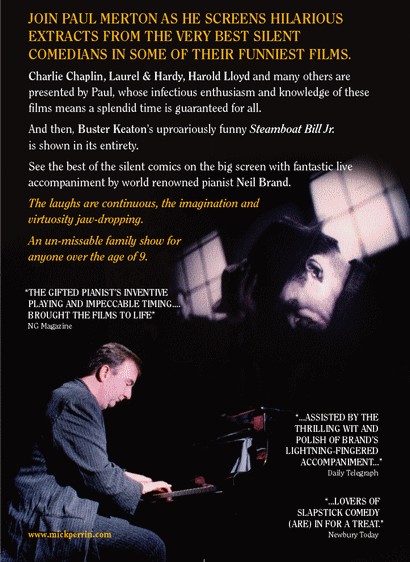
There are a ton of books about silent film comedy, many of them excellent, but they’re not written by performers. Paul Merton, author of Silent Comedy, is on the other hand a popular British comedian — mostly improv and stand-up, rarely silent —with a love for the heyday of slapstick. He has even done several lecture tours on the subject, bringing screenings with live music to theatre festivals and other venues throughout the U.K. In the past two years he has produced two documentaries on early film (not just comedy) for television: Paul Merton’s Weird and Wonderful World of Early Cinema (BBC Bristol, 2010) and The Birth of Hollywood (BBC2, 2011). He has also done an interactive presentation on early British film comedy for the British Film Institute, which you can view online here.
Merton is, first of all, a good writer! The problem I have with most historical works is that they’re too thorough. I know the impulse: you’ve done all that research, naturally you don’t want it to go to waste — “I suffered for my art; now it’s your turn!” — but the result is more info than the reader needs. You can’t see the forest for the trees. Merton’s chronicle is full of fascinating tidbits and anecdotes, but he marshalls those facts to make a point. They all contribute juice to the narrative flow and actually tell us something significant about the performer. The result is a rich and entertaining read, 329 mass-paperback pages, though obviously you’ll get a lot more out of it if you can view some of the films he’s talking about, easy enough with YouTube and a basic DVD collection. Think of it as a companion volume to the actual movies.
Merton chooses to limit his study to Chaplin, Keaton, Lloyd, and Laurel & Hardy. He is dismissive of Harry Langdon; other comedians such as Fatty Arbuckle and Charley Chase play only minor roles, and there’s no mention at all of Lupino Lane or Charley Bowers. Instead of separate sections on each comedian, the approach is chronological, which might sound boring and unimaginative, but isn’t because he switches back and forth between these powerhouses every year or two to show how they continually tried to outdo one another. This works very well, bringing fresh insights into their working methods; for example, how Lloyd’s success with the thrill comedy Safety Last spurred Keaton and Chaplin to create similar moments in Three Ages and The Gold Rush, respectively.
As a performer, Merton is always thinking from a performer’s point of view, getting inside their heads better than most silent film historians. To his credit, he notices what stunts are real, and very much appreciates the virtuoso skill and hours and hours of practice required. However, not being a physical performer, he’s not as sharply attuned to physical comedy vocabulary. It does not occur to him, for example, that the topmounter in the running 4-high in the elopement scene from Keaton’s Neighbors is — in most of the shots — very likely a rag-doll dummy, and not Virginia Fox.
________________________
“Slapstick comedy has a format, but it is hard to detect in its early stages unless you are one of those who can create it. The unexpected was our staple product, the unusual our object, and the unique was the ideal we were always hoping to achieve.” — Buster Keaton
________________________
As much as he admires the creativity of this golden age of cinema, Merton is not afraid to address its uglier aspects, specifically negative racial and gender stereotypes widely prevalent in those days. But he is also quick to point out progress made during the 20s in both areas, for example in Keaton ‘s ThePaleface (1922) and The Cameraman (1928).
Keaton and Chaplin in Limelight (1952)
With his successful silent film tours offering solid evidence, Merton is bully on the appeal of silent film comedy when presented in the right circumstances, a point I was emphasizing in my recent Revenge of the Silents post. Here are just a couple of examples Merton offers:
In January 2007 at the Colston Hall, Bristol, I presented Steamboat Bill Junior to over 1,500 people on a big screen with superb musical accompaniment from Neil Brand and Gunther Buchwald. The house front falling towards Buster is a tiny moment in a cyclone sequence that runs for nearly fifteen minutes, but when the stunt happened the audience cheered and applauded spontaneously. A few days after this ecstatic response I heard the playwright Mark Ravenhill extolling the virtues of Steamboat Bill Junior on a BBC Radio 4 arts programme. I seem to remember that he had seen the film on a big screen at an open-air festival many years before.
The other people in the studio, who sounded like professional critics, had each been given a DVD of the film to take home and watch. Their verdict was unanimous: it simply wasn’t funny because in their view humour dates very quickly, and black and white silent comedy couldn’t be more dated if it tried. How could they get it so wrong? Well, watching a silent film on a small television screen with inappropriate music as accompaniment can destroy the magic. It’s easy to see nothing….
Laurel and Hardy’s last silent film release before their first talkie has often been considered their best ever. I’ve watched Big Business more than thirty times with a live audience, and the responses have been remarkably uniform. They always laugh in the same places with the same regular rhythm. Stan and Leo [Mc Carey] previewed their films in exactly the same way as Harold, Buster and Charlie, and the films were recut according to the audiences’ reactions. That’s one of the reasons they still work so well today.
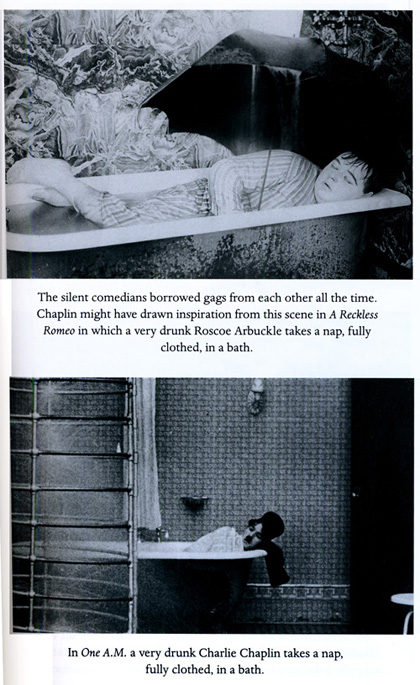
A page from Merton’s book, above, and a few more short selections below….
He [Keaton] was always proud that he didn’t use a stuntman. Larry Semon’s films are chockfull of stuntmen all pretending to be him, but it was Buster’s belief that stuntmen didn’t fall in a comical way. [NOTE: Keaton did have a stuntman pole-vault into the dorm window for him in College, which I believe was the only time he was doubled, at least in the silent era. —jt]
The tiresomely idiotic debate on Keaton versus Chaplin is, in my experience, overwhelmingly used by proponents of Buster to attempt to rubbish Charlie… It’s an appealing mind-set for some people, who say: “We’ve all heard that Charlie Chaplin was meant to be the greatest comedian in the world, but my preference for Buster Keaton demonstrates my ability to think for myself. Chaplin was overly sentimental, but Keaton’s coolness and cynical eye chime exactly with our Modern Times….” Well, the good news is that they are both fantastic. There’s no need to choose between them. Enjoy them both! That’s one of the main aims in my book. I shall examine the films of Charlie Chaplin and Buster Keaton, not in isolation, as has been the usual practice, but showing how they influenced each other in a creative rivalry that also featured Harold Lloyd. This rivalry and desire to make better and better comedies ensured a stream of high-quality pictures. Great works of art were created.
As much as he [Keaton] liked Roscoe [Arbuckle], he was trying to get away from unmotivated slapstick. In all the years they worked together, the only disagreement Buster had with Roscoe was over Roscoe’s assertion that the average mental age of an audience was twelve and that you should pitch your comedy at that level.
_______________________________
As for Paul Merton the comic, he is hardly silent, known instead for his surreal rants, often delivered dead pan, though he denies mimicking the Great Stone Face, Buster Keaton: “It comes from one of the first things I did as a stand-up in the early 80s called A Policeman on Acid, which was basically this policeman recounting in court the time someone gave him some acid and describing his trip. And I realized then it was much funnier if the policeman himself didn’t find anything he was saying funny, so the deadpan approach came from there, and I suppose that kind of set a style. I wasn’t deliberately copying Keaton at that point.”
Here’s the clip:
Merton is returning to touring his own comedy in 2012 in a “night of sketches, music, magic, variety, and dancing girls (two of them aren’t girls).” Click here for more information.
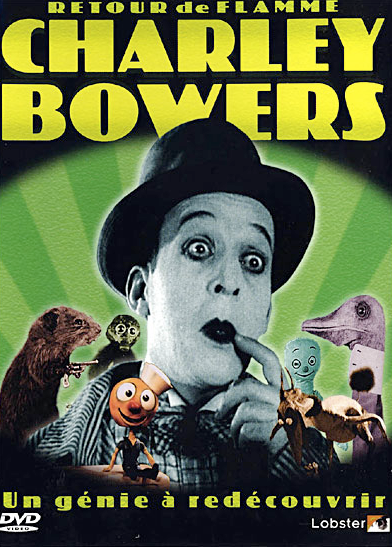
Charley Bowers: The Rediscovery of an American Comic Genius Co-produced by Image Entertainment (USA) and Lobster Films (France) 2-disc DVD; run time 149 mins. 2004
Several DVDs have come out in the past year or two that I should be blogging about, multi-disc sets of the work of Harry Langdon, Douglas Fairbanks, and Charley Chase, for example. Instead, I want to do some catching up and write about a DVD set that came out five years ago on the work of Charley Bowers (1889 – November 26, 1946) . Why? Because it’s exciting stuff, and because today is Thanksgiving and it was on this day 63 years ago that Bowers passed away in almost total obscurity. Let’s see if I can show you why we should be thankful for his life’s work.
I suspect that most of you are saying “who in the hell is Charley Bowers?” In brief, he was a cartoonist, animator, and silent film comedian who, between 1926 and 1931, created a series of short films (no features), sometimes labeled “novelty comedies,” that combined live action with stop-motion animation, and that display a unique comic imagination. While much of silent film comedy exhibits a certain formulaic sameness, Bowers is a refreshingly original thinker whose work I think you’ll love.
Bowers’ name does not even appear in many of the standard books on the silent era, such as Walter Kerr’s The Silent Clowns (1975), and the reason is simply that his films were lost for decades. Even Neil Pettigrew’s more recent authoritative history,The Stop-motion Filmography, does not mention Bowers, but that book came out in 1999, this DVD in 2004. Although Bowers was popular enough in his day to be able to write, animate, and usually star in over twenty movies for R-C Pictures and Educational Pictures, by the time Keaton, Chaplin, et. al. were being appreciated anew in the 60s and 70s, his name had long been forgotten.
The story of his rediscovery is told on a 15-minute documentary on disc 2 of the DVD. Raymond Borde of the Toulouse (France) Cinémathèque was a relentless collector of old films. He knew that traveling carnival acts would often open performances by showing a short American silent film comedy, so he would buy these from them whenever he could, paying for reels by the kilo, sight unseen. He hit the jackpot one day when a rusted cannister of films he bought from a gypsy family turned out to contain three films by Bowers. The only problem was that instead of being attributed to Charley Bowers, the sole credit was to Bricolo, the French name for his movie character. No one knew who this Bricolo was, and years went by without any progress. The films were even shown in a retrospective at the 1976 Annecy (France) film festival, without anyone yet knowing this was the work of Charley Bowers.
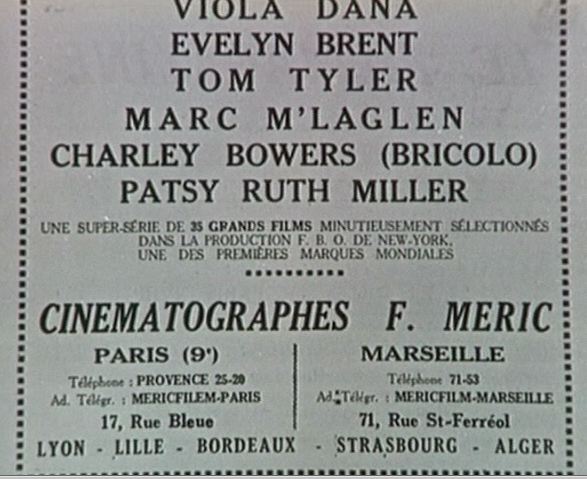
One day this ad in an old film directory was discovered, providing the link between Bricolo and Charley Bowers. This eventually led to a film historian in Montreal who had some slight knowledge of him and to a folder of info buried away at the Library of Congress. More information was uncovered, as were more films, but there are still eleven lost films, and the details of his life are few. The only account of his early years is from a 1928 press bio that seems too colorful to be true: he was born in 1889, the son of a French countess and an Irish doctor. When he was five, a tramp circus clown taught him tightrope. At age six, he was kidnapped by a circus. When he finally made it back home two years later, the shock killed his father.
Hmm..
What we do know is that between 1916 and 1926 he wrote, produced, and directed hundreds of cartoon film shorts based on the Mutt & Jeff comic strips. At some point he made the transition from these hand-drawn cel animations to stop-motion animation, in which you move or manipulate a physical object a small amount, recording a single frame so that when the movie is played back the object appears to move at normal speed. Here are two brief clips about an automated restaurant that show this transition. The first is from one of his Mutt & Jeff cartoons, Grill Room Express (1918, aka The Extra Quick Lunch), the second from He Done His Best (1926).
In 1926, he began combining stop-motion animation with live action, and there are historical references to the “Bowers process” and to a “Bowers camera” that he invented precisely for this purpose, but so far I haven’t uncovered any info on this. Bowers has been credited by some with being the first filmmaker to develop this hybrid form. This may not strictly be true, but the extent to which he did this, and the overall technical level of both the animation and the live action was very likely groundbreaking for 1926. In fact, the story has it that a scene where a herd of elephants seem to enter the Capitol building in Washington, D.C. so fooled people that certain muckety-mucks demanded an official investigation.
Before going any further, let’s get more of a taste of his work. (Both of these next two clips are on YouTube, but there’s not much more of his work up there.) First is a sample of Bowers the silent film comedian from Egged On (1926), the earliest film we have of this hybrid form. The live action star is none other than Charlie Bowers, playing an eccentric, misunderstood outsider whose persona has been compared to that of Keaton. (As a performer he’s no Keaton, but he gets the job done.) Charley the eccentric inventor can’t pay the rent, but he’s on the verge of riches with his invention of the unbreakable egg. His approach to selling his invention is a good example of Bower’s offbeat sense of humor.
The second clip, from his only sound film, the 1931 It’s a Bird, showcases his amazing animation talents. An expedition to deepest, darkest Africa has netted Charley a rare metal-eating bird, which he hopes will prove to be his road to riches:
A Bowers film tends to follow the same general formula. Charley is an eccentric but brilliant inventor, a 1920s Doc Brown, only Bowers is younger and counting on his creations to help him escape poverty and win the girl. To solve the predicament at hand, he typically throws together a Rube Goldberg contraption from spare parts that somehow performs miracles that defy the laws of science. His character’s French name, Bricolo, is from the French verb bricoler, to tinker, and the French noun bricolage, do-it-yourself. Bricolo’s invention always works, but his ultimate success can still be thwarted by unforeseen twists of fate. One aspect of his films I particularly enjoyed is the unpredictability of his endings. The first one I watched did not end well for Charley, so I assumed the stories would always be aiming for Chaplinesque pathos. The next film, however, was the opposite, more along the lines of a Keaton or Lloyd ultimate-vindication finale. He keeps you guessing.
Bowers attracted the attention of André Bréton, leader of the surrealist movement, who wrote of It’s a Bird! that it “took us away, for the first time, our eyes opened to the dull sensory distinction of reality and legend, to the heart of the black star.” (Those surrealists sure had a way with words.) And in his Fifty Year Surrealist Almanac (1950), Bréton listed the one film that had meant the most to him each year, and It’s a Bird! was one of those films, as was Duck Soup for 1933.
Bowers’ movies are uneven affairs, a bit choppy, what with the combination of elements, and at times the storytelling can come to a screeching halt while he shows off with lengthy animation sequences. In his best moments, however, Bowers’ humor is wonderfully quirky and even downright brilliant. At one point his character says “sometimes I nearly ran out of ideas,” but with Bowers the opposite is the case, his head bursting with wild premises. There he is, struggling to invent a non-slippery banana peel, or trying to win a Charleston contest by taking a correspondence course.
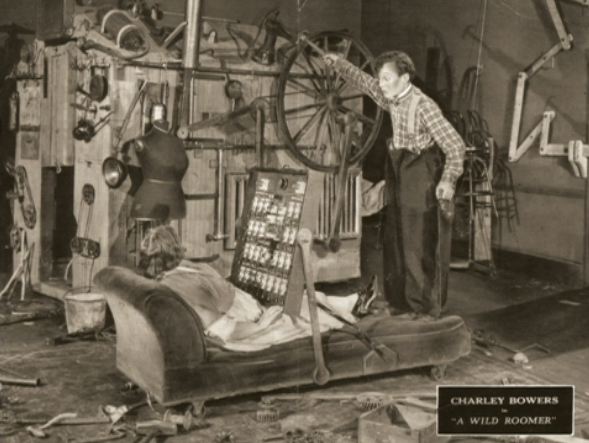
His physical comedy always goes one step further. His sweetheart’s cop father doesn’t throw him out the door, he throws him thru the door. In A Wild Roomer, he tows an entire staircase out of a house — by accident. I’m pretty sure he has the highest WDR (wall destruction ratio) of any silent film comedian.
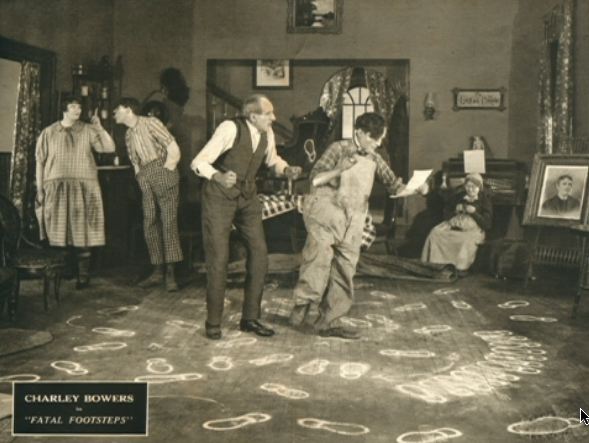
Bowers also does not shy from social commentary. In Fatal Footsteps, he satirizes uptight townspeople who are fighting the popularity of social dancing, and particularly the upcoming charleston contest. The name of the town is not subtle: Dumbville. Sam, the leader of the opposition is exposed as a hypocrite, but even he is eventually converted to the joys of cutting a rug when he accidentally puts on Charley’s latest invention, a pair of automated dancing shoes.
By movie’s end, Sam is getting his fellow old fogies to dance, and the final shot of the film is a fish dancing in its bowl.
Another example is the ending to Now You Tell One, one of my favorite Bowers movies, but I won’t spoil it for you since you can watch it below. It all starts at a meeting of a “Liar’s Club.” The head of the club is disappointed in the stories the members are coming up with. Stumbling on Charley and his story, he brings him to the club to tell it. Beginning of the movie within the movie.
It seems Charley fell for this girl and when he visited her house he discovered a sad picture. The girl’s house is seriously overrun with mice. The woodwork is full of holes and collapsing, the father gone batty from the onslaught. The sole cat is battered and beaten down. Charley moves in and sets to work developing a breed of more robust cats to fight the infestation. Here’s the rest of the movie:
There are a few hours of this on the DVD, so check it out. It looks like it’s on back order from most DVD vendors, but it is available on NetFlix.
Happy Thanksgiving, all!
_______________________
Disc One Egged On (1926; 24:08) He Done His Best (1926; 23:42) A Wild Roomer (1927; 24:27) Fatal Footsteps (1926; 22:20) Now You Tell One (1926; 22:21) Many a Slip (1927; 11:35) Nothing Doing (1927; 21:13) Disc Two Grill Room Express (1918; 5:36) [alternate title: The Extra-Quick Lunch] A.W.O.L. (1918; 5:24 ) Say Ah-h (1928; 14:03 = part 2 only) It’s a Bird (1930; 14:09 ) Believe it or Don’t (1935; 7:55 ) Pete Roleum & his Cousins (1939; 15:38) Wild Oysters (1941; 10:07) A Sleepless Night (1940; 11:00) Special Features Photo Album slideshow (1:45) Looking for Charley Bowers (15:43)