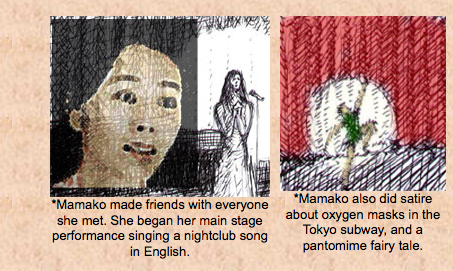
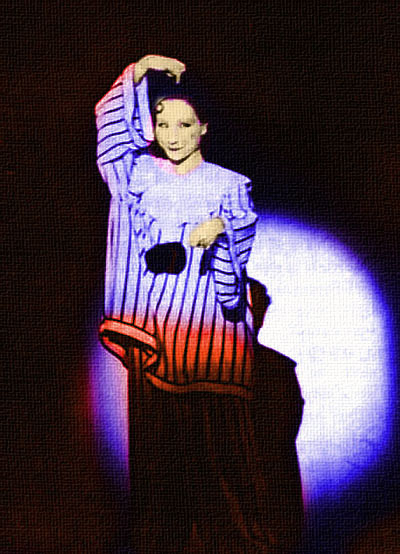
“Live from Paris” last April, that is, where I was already undercover on the Linder and Etaix capers when I got a coded message from one Michael Evans, an operative unknown to me but apparently a go-between for a character from the 70s who at that time went by the unassuming name of Lou Campbell. I was in Paris, I had nothing better to do (hah!), and before I could say fromage I’d been given the assignment to track down legendary Japanese pantomimist Mamako Yoneyama, rumored to be hiding out in that City of Light Mimes. Evans (if that’s his real name) had first met Yoneyama — code name Mamako— at the 1974 International Mime Festival at Viterbo College in Lacrosse, Wisconsin, organized by yet another “Lou Campbell.” Or was he in fact the same person?? Evans’ rambling confession about that festival — an event whose foreign ideas about movement theatre forever corrupted the minds of a whole generation of impressionable Americans in tights —has finally been released thanks to the Freedom of Information Act, and now the general public can view it here, including incriminating sketches and notes such as these:
I had never seen this Mamako character perform. I knew she had a glowing reputation, but biographical data was suspiciously sketchy. The only background info on the perp was from a book called Mime and Pantomime in the 20th Century, but for reasons unknown not published until 2008:
Born in 1935, Mamako began dancing at a very early age. Her father, a schoolteacher, was a dancer by choice, performing for a local ballet company. Mamako naturally being exposed to her father’s talent, became involved in dance. By the time she was a teenager, Mamako was the acclaimed best dancer in school. She attended Tokyo University where she studied physical education. In addition, she studied modern dance under the aegis of Egichi-Miya, the famous Japanese choreographer/dancer. She rose quickly to stardom in Japan.
She attended the debut performance of Marcel Marceau in Tokyo and immediately made up her mind to study with him in Paris. Once she acquired the foundation of style mime technique, she returned to become a curiosity in her own culture.
Because pantomime was so new in Japan, it offended her to read that her mime was regarded as “twisted dance.” She came to the United States and did well in Hollywood, but she was lonely there. Dr. Lou Campbell first met Mamako at San Francisco State University in a Stage Movement Master Class that he developed through the American Educational Theatre Association pre-convention sessions in 1972. She performed at the First International Mime Institute and Festival in 1974 and at subsequent other mime festivals around the U.S. where she received great accolades. After a long stay in Japan, she decided to move to Paris. Only recently did she decide to return to her home country.
The form of mime for which Mamako is most noted is called Zen Meditation Mime. She claims that “It is the same as that which a Buddhist Monk experiences while meditating on a particular environment.” It is not literal pantomime but a collection of impressions derived from an environment.
That Campbell character again! Just to be thorough, I checked to see who the purported author of this book might be, and it was none other than… Lou Campbell! Campbell writing about Campbell. Coincidence? I think not. This plot was thickening as surely as a bouillabaisse going into its third hour on the stovetop. But where to start? Like Dick Tracy before me, I turned to my wristwatch for an internet search, my eagle eye uncovering an obscure reference to Mamako on a blog by Tokyo writer Yuri Kageyama.
Moi to Yuri: Mamako? Still alive? Living where?
My wristwatch soon beeped with a reply, which it dutifully translated from the Japanese as “I’ve read about her performance as recent as a couple of years ago. They were in Japan, but I only learned about them on the Web afterward and so I couldn’t go check it out. Her death would make news here for sure. And I have not seen any such reports.”
She was alive but apparently living in Japan. Me, I was stuck in Paris, volcanic ash shutting down every airport west of Kiev. My pockets stuffed with cash, just a small portion of the enormous profits from this blog, and yet no way to hop a quick flight to Tokyo. Curse you, Iceland! One door had opened, but another had been slammed right in my kisser.
A little secret: a good detective makes his own luck… and his own contacts. Checking my Rolodex for Franco-Japanese go-betweens, my finger landed on the tattered card of one Bernard Collins (code name Compagnie BP Zoom), an American in Paris frequently back and forth to Japan, with “clowning” as his cover for other activities I have sworn not to disclose. Would he fess up to having seen Mamako?
Paris–Tokyo–Paris. Hmm… might they not be toiling for the same cartel? Turns out Collins’ “agent” had in fact introduced him to our suspect on a previous occasion. Bingo! Not only was she alive and well, but said “agent” knew exactly how to reach her. End of search! All that remained was the judicious application of a certain amount of pressure — long distance yet oddly effective — for our new agent friend to turn over the necessary contact info, now safely in the hands of the entity or conglomerate known as Lou Campbell.
My reward? I’m not talking, but you can be sure it won’t appear on my 2010 IRS return.
If you spend your days in the United States, chances are you’ve never heard of the Catalonian physical comedy trio, Tricicle. In Europe, however, they’re a well-known brand name, almost a small industry, having performed extensively in major theatres and festivals for over thirty years, as well as on tv and in movies, and even as part of the opening ceremonies for the 1992 Olympics here in Barcelona. Founded by Joan Gracia, Paco Mir and Carles Sans in 1979, they expanded their international reach in 1988 by adding a second 3-man company (photo, right), known as Tricicle-2 or Clownic, which performs pieces from the by-now large Tricicle sketch repertory, and which is who I saw last night.
Here they are (almost) winning racewalking gold at the Olympics. Very funny.
Their theatre work is minimally verbal and can easily be followed by an audience not speaking the language, so I’m sure it travels well. It would be accurate to describe what they do as physical comedy, but it comes more from the world of mime than that of the knockabout comedian and has the feel of sketch comedy without the words. This explanation from their website gets to the point pretty well:
Tricicle’s style is the fruit of an era in which visual humor was rising in popularity. Performers such as Comediants, Jango Edwards, and Albert Vidal were an undeniable point of reference for those wishing to devote their lives to the world of theatre and this was why Joan, Paco and Carles (each one separately) decided to give up their free mornings and enroll at Barcelona’s Institute of Drama with the aim of steeping themselves in all the various types of drama techniques. But how they really learned the bases of their unique style was by memorizing the Lubitsch, Wilder and Keaton films they would see at Barcelona’s Filmoteca and, especially, by dissecting and analysing the performances of humorists appearing in Barcelona, which was then a city thirsty for refreshing entertainment. Gags are the basis of the company’s theatrical technique. All Tricicle shows are replete with gags and have a seemingly incredible average of one gag per ten seconds. The company’s shows are never considered as finished products and are constantly open to the inclusion of new gags as each production progresses, although they do have their limits. Tricicle draws the line at humor based on bad taste. From the outset, Tricicle avoided conventional mime techniques and opted for a “realistic” acting style based on day-to-day gesture; Action Theatre, the company calls it, thus comparing it to action cinema in which the characters, who often have very little to say to each other, simply spring into “action.” The company’s style is mainly characterized by its dynamic nature, short scenes, frequent changes of character, natural onomatopoeia (with a very occasional spoken word), the dramatic use of stage props and constant surprises. Their concept is that the audience should leave the theatre without even realizing they have attended a “silent” show. There is nothing worse than hearing someone utter “Why are they not speaking?” during a performance.
The performance I saw was energetic, finely tuned, and very well received by the audience. I found much of it inventive and quite funny — for example, the “if men were pregnant” piece, photo above — but there were also sections and entire pieces where it was all a bit too light and safe, too much like television in its choice of humorous topics and how far it would go with them. I started to want more substance for my 18 euros. And despite the name Clownic and a performance style that could loosely be termed clownesque, do not go expecting to see strong clown characters. Their focus is more on the everyday, on naturalistic behavior, albeit exaggerated, and less on the psychology of memorable individuals.
Their last piece, The Waiting Room, was their strongest in terms of sustained gags and creativity, and you payasos out there will appreciate that it ends with a variation on the classic clown entrée, Dead or Alive. Today I found it on YouTube, though performed by the main company rather than Clownic. See for yourself…
There are a lot more videos on YouTube, but definitely check them out live if they ever come to a theatre near you. Click here for their touring schedule.
In writing about San Francisco on my last post, I mentioned the influence the San Francisco Mime Troupe had on the popular-arts performance scene there. If you’ve seen their work, you’ve probably wondered why they label themselves a mime troupe. The answer lies in their early years under the direction of their founder, R.G. Davis (photo, right). This manifesto on mime and pantomime, written by Davis in 1962, shows the troupe’s roots and still raises some interesting questions today.
What I liked about this when I first read it sometime back in the 70s were the clear distinctions Davis was able to make between a broad commedia style of physical performance and the more precious tradition of the white-faced pantomime artist. Now that I’m older and wiser (oh yeah, sez who?), I’m a bit more wary of dialectic reasoning where things are either this or that with no wiggle room. People who think like that can be very difficult to deal with! Still, I think it’s a useful argument, a provocative read, at least if seasoned with a grain or two of salt. And although Davis was eventually replaced by a collective leadership and the troupe’s performance style became less “mime-y,” their work has in fact retained an essential commedia feel and flavor.
Anyway, it’s only three pages, well worth your time, just be sure to click on “Fullscreen.”
Today I introduce yet another new feature to this blog, a complete book in the form of a pdf file suitable for reading online, downloading, or printing. Because of legal issues, most if not all books presented here will be from the pre-copyright era, roughly a century or more ago, and therefore of a historical nature.
We start off with a classic, the Memoirs of Joseph Grimaldi, edited by none other than Charles Dickens (pseudonym Boz). Grimaldi (1779–1837) was perhaps the most celebrated clown who ever lived, the clown credited with elevating the craft to an art form, the man from whom latter-day clowns derived the nickname “joey.” If you want a quick introduction to Grimaldi, go to post 002 on this blog and take a look at chapter five (pp.8–14) from my book Clowns.
How these memoirs apparently came about is its own story, here summed up by our good friend Dr. Wikipedia:
The book’s accuracy is not entirely clear, since it went through a number of revisions, not all with Grimaldi’s input. Grimaldi’s original manuscript, which he mostly dictated, was about 400 pages; he completed it in December 1836. The original “excessively voluminous” version was apparently not good enough for publication, and in early 1837 he signed a contract with a collaborator, the obscure Grub Street writer Thomas Egerton Wilks, to “rewrite, revise, and correct” the manuscript. However, two months after signing the contract, Grimaldi died, and Wilks finished the job on his own, not only cutting and condensing the original but introducing extra material based on his conversations with Grimaldi. Wilks made no indication which parts of his production were actually written by Grimaldi and which parts were original to Wilks. He also chose to change Grimaldi’s first-person narration to the third person.
In September 1837, Wilks offered the Memoirs to Richard Bentley, publisher of the magazine Bentley’s Miscellany. Bentley bought it, after securing the copyright from Grimaldi’s estate, but he thought it was still too long and also badly edited, so he asked one of his favorite young writers, the novelist Charles Dickens, then twenty-five years old, to re-edit and re-write it. At first Dickens was not inclined to take the job, and he wrote to Bentley in October 1837:
“I have thought the matter over, and looked it over, too. It is very badly done, and is so redolent of twaddle that I fear I cannot take it up on any conditions to which you would be disposed to accede. I should require to be assured three hundred pounds in the first instance without any reference to the sale — and as I should be bound to stipulate in addition that the book should not be published in numbers I think it would scarcely serve your purpose.”
However, Bentley agreed to Dickens’ terms (a guarantee of three hundred pounds and an agreement to publish the book all at once, and not in monthly numbers.) Dickens signed a contract in November 1837, and completed the job in January 1838, mostly by dictation. Dickens seems never to have seen Grimaldi’s original manuscript (which remained in the hands of the executor), but only worked from Wilks’ version, which he heavily edited and re-wrote. Bentley published it in two octavo volumes in February 1838.
How faithful this twice-edited, twice-rewritten version is to the original cannot now be determined, since the original manuscript was sold at an estate sale in 1874 and has never been seen since.
Tech Note: The scan of this book is by Google, which you may have heard is ruffling a lot of feathers by trying to digitize every book they can get their hands on, copyright be damned. As far as I can tell, what they do is scan the book as an image, that’s all, nothing but a bunch of dumb pixels that don’t even know they’re banding together to form language. Google makes no attempt to perform OCR (optical character recognition), which would translate the image of text into individual letters and words a computer can recognize separate from one another, thus allowing for searching topics, copying & pasting, editing, etc. The reason they don’t do this is that OCR software is not 100% accurate, especially when applied to old books, so for it to come out right someone would have to spend hours…. and hours… and hours of proofreading the entire book. Unfortunately, an old scanned book is harder on the eyes than one converted to crisp, clear text but — you know what they say — you get what you pay for.
[Jonathan Lyons is an animator at Imagemovers Digital, and you can see his latest work in Disney’s A Christmas Carol, starring Jim Carrey, in theatres everywhere right now. You can read his other guest posts here and here.]
When I was an adolescent living in New England, I was told that Ringling Brothers Barnum and Bailey Circus ran a clown college in Florida. To me, that sounded like an excellent institution of higher education. Just about my speed.
Alas, one thing leads to another and the decades go by. I never made it to Clown College. I think perhaps it’s a good thing, as I am somewhat injury prone. I probably wouldn’t have lasted many years in the profession. Still, my love of physical comedy, and my curiosity about the art remains undiminished. I practice it in a virtual form, animation. Recently however, I had a chance to sample the real-world training of a physical actor.
I live in Marin County, California, and this past summer a new school opened up in San Fransisco, just across the Golden Gate Bridge. The Flying Actor Studio, operated by James Donlon and Leonard Pitt. They offer “physical theater training with world-class master teachers offering: movement, mime, mask, clown, circus arts, improvisation, voice, new performance.” They have an impressive list of guest instructors, including Geoff Hoyle, John Gilkey, Bill Irwin, Judy Finelli, and Suzanne Santos.
To kick off the opening of the school, they held a special performance with Donlon, Pitt, and Cirque du Soleil alumni, John Gilkey. The show was called “The Zany and the Surreal.” It featured rotating solo performances from the three actors. Donlon delivered some of his deeply felt mime, Pitt introduced some mask techniques and told an entertaining Jewish tale. John Gilkey’s pieces included his signature coat rack juggling routine, which I enjoyed watching in the Cirque du Soleil show Quidam.
The Flying Actor Studio is a full-service training facility offering everything from one-day workshops to a full-time, 28-week conservatory program. They also arrange special guest shows and workshops. This October they welcomed the International Czech Theater Festival, and held a clown workshop with Steve Capko. Among the workshops and classes they had the ideal opportunity for a working family man such as myself. “Meet the Flying Actor Studio Drop In Class”. Held on a Sunday, 10 am to 4pm, it is described like this:
“A survey of the Flying Actor Studio methods including improvisation, imagination, time, movement, mask, and mime. This class is offered on a sliding scale to make our classes accessible.”
I was happy to pay the high end of the $25 to $40 suggested price. It was more than reasonable for the experience. I and a handful of other participants warmed up with stretches in the bright loft space. Some of them were actors, at least one other was just curious like myself. James Donlon ran the morning half of the program. Among Mr. Donlon’s many teaching credits, was the Ringling Brothers Barnum & Bailey Clown College. Finally, I would have my day! We did a variety of basic exercises in movement. He introduced the idea of “neutrality,” which I found intriguing. Neutrality in this case being a way of moving (or being still) that would offer no clues about the person. You wouldn’t be able to determine age, sex, state of mind, state of health, anything. Half of us would wear black hoods, to hide the face, while walking around the room in whatever fashion felt neutral to us, while the others would discuss what they saw. We did the same thing with sitting in a neutral position. While I would have thought that the class would be all about creating character, this exercise in removing character was just as informative. After that we practiced a variety of mime exercises, and by this time, I was beginning to sweat. It was a workout, and I would be sore the next day.
After a lunch break, Leonard Pitt took over the class. During Mr. Pitt’s 40 years of experience he has studied with Etienne Decroux, written several books, and been a movement consultant on major motion pictures. We started with an exercise between pairs of people locking eyes and moving back and forth as though on a rail. Building on that we expanded it to random group movement, quickly switching to pairs. The exercise involved focused attention, and physically grabbing attention from others by just turning towards them. I can see where it would be a useful exercise for the stage movement. Following that, Mr. Pitt introduced us to the basics of using masks. It was interesting to learn that mask work is not so much about movement, but about posture and posing, and also eye direction. This is useful stuff for an animator.
Thanks to James and Leonard for setting up such an accessible, educational and enjoyable program. Good luck to them and their venture.
Click here for more information about the Flying Actor Studio.
And now for something completely silly. It’s Mookie the Mimegician, who combines illusion mime with magic tricks. Think about it: now you don’t see it, and now you still don’t see it.
This is from my son Nathaniel’s variety show, The Moon, presented bi-weekly at the Royal Oak in Williamsburg — Brooklyn, not Virginia. About time I plugged it. Mookie is the talented Michael Blaiklock, who you can see more of on Comedy Central’s Secret Girlfriend.
The first movie comedy I saw starred Danny Kaye. I might have been 6 or 7 and I laughed so hard that I still remember thinking, gee, I didn’t know anything could make you laugh that hard. My first Jacques Tati movie was Playtime. I was 19 and in Europe for the first time and, despite a show biz childhood, I had seen little if any silent film comedy. I was amazed. I remember thinking, zut alors, I didn’t know you could do that! It was as if I had discovered a new art form.
Although Playtime lost a lot of money, Tati’s legacy is in very good shape. His stature has grown, his movies are finding a new international audience on DVD, and this summer he is the subject of a retrospective in France housed at the Cinemathèque Française (through August 2nd), but with events outside of Paris as well. Here’s a very short promo for the Tati exposition:
Authorized Digression: Did you see Tati’s trademark pipe in that short animation? Well, believe it or not, they had to remove it from the print posters in the Paris métro:
Yep, I find that amazingly stupid (and I’m fairly anti-tobacco). What’s next, Chaplin’s cane? But what do you think? I think it’s about time this blog had a Raging Controversy! Don’t be shy — cast your vote in the poll (Raging Controversy #1) in the sidebar to the right.
There are a ton of Tati clips on YouTube, but you might want to avoid them. Better to see the whole movie to really get the whole picture. Tati weaves a complete tapestry with each movie, and what makes him unique is the overall world he creates, far more than just the isolated gag. [See the André Bazin article link below.] Furthermore, his cinematographic style and his sense of detail are best appreciated on the widest screen available; he even shot Playtime in 70 mm. Monsieur Hulot’s Holiday and Playtime are good starting points, though others will certainly argue for Mon Oncle, which won an Academy Award for Best Foreign Film of 1958.
What is singular about Tati is his ability to find physical comedy in everyday life. He is the master of observational visual humor; one critic labeled him “an entomologist of the material world.” Despite some big gags such as the fireworks scene in Hulot’s Holiday, most of his stuff is subtle and quirky. Often the main event happens off-camera, and our imagination is left to fill in the blank. “I want the film to start when you leave the theatre,” Tait explained.
Although he has a great eye for social interaction, we know very little about Tati’s characters, his alter ego Hulot included, and there is nothing that you could call a plot. People come together, they interact. Hulot, usually too old-fashioned for this modern world, struggles mightily with his environment, with the world of things, but nevertheless exudes a contagious joie de vivre, most appreciated by the very young and the very old. Before long the characters go their merry ways with tales to tell and fond memories of that odd man. End of story.
Tati is not the only director to attempt to revitalize the silent film form after The Jazz Singer (1927) precipitated its fall from public favor. To my mind, however, he may be the only one who truly succeeds, and he does so by finding his own style rather than by imitating the classics. I believe it was the Czech clown Bolek Polivka who said something to the effect that if you’re going to be silent, there needs to be a reason. Rather than choose silence, Tati relegates actual dialogue to background chatter. Environmental sounds and human speech are part of a broader soundscape that works seamlessly with the visual humor. Buster Keaton, who commented that “Tati started where we left off,” is said to have been so impressed that he asked Tati about working on new soundtracks for Keaton’s silent films.
Just as it’s hard to capture the essence of Tati in a YouTube clip, one might also wonder what a museum exhibit can add to the actual films. At least I wondered that. Here’s what the expo has to offer in Paris:
• A museum exhibit at the Cinemathèque with props, costumes, and dozens of screens with clips from the movies and from his life.
Good job here. Tons of costumes and props, some original, some reconstructed. Models of sets. Dozens of monitors showing not just clips but also some nice thematic compilations of Tati’s work juxtaposed with that of other directors.
A life-sized reconstruction of the set for Mon Oncle.
I didn’t get to see this, but you can see a video of it going up here.
A screening of a fully restored “director’s cut” version of Monsieur Hulot’s Holiday.
This was wonderful. The movie is 87 minutes long, but it felt like 50. If this comes to a movie theatre near you, don’t miss it! Like I said, a large screen does make a difference.
A commemorative book, Jacques Tati : Deux temps, trois mouvements.
I bought it, I like it, but not necessarily a must-have. Tons of images and documents and about 75 pages of short pieces on Tati, mostly by other artists. You can buy it here from the French Amazon.com
______________
Finally, I know I said that YouTube wasn’t necessarily a good way to get to know Tati, but here are a few unusual clips you might miss. The first is said to be Tati’s first screen appearance (he speaks!) dating from 1935:
The next is Tati dancing, again from an early short, The School for Postmen(1947). You can see the whole movie here. (In two parts.)
And you can even sing “the Jacques Tati”:
Update: Alert reader Jonathan Lyons has alerted me to another Tati song, Jacques Tati by the El Caminos. It’s available on iTunes, but I also found it here.
Other Perspectives:
David Kehr on Playtime:
Jacques Tati’s Playtime is perhaps the only epic achievement of the modernist cinema, a film that not only accomplishes the standard modernist goals of breaking away from closed classical narration and discovering a new, open form of story-telling, but also uses that form to produce an image of an entire society. After building a solid international audience through the 1950s with his comedies Jour de fête, Mr. Hulot’s Holiday, and Mon Oncle, Tati spent ten years on the planning and execution of what was to be his masterpiece, selling the rights to all his old films to raise the money he needed to construct the immense glass and steel set—nicknamed “Tativille”—that was his vision of modern Paris. The film—two hours and 35 minutes long, in 70mm and stereophonic sound—opened in France in 1967, and was an instant failure. It was quickly reduced, under Tati’s supervision, to a 108-minute version, and further reduced, to 93 minutes and 35 monaural, when it was released in the United States in 1972. Even in its truncated form, it remains a film of tremendous scope, density, and inventiveness.
Playtime is what its title suggests—an idyll for the audience, in which Tati asks us to relax and enjoy ourselves in the open space his film creates, a space cleared of the plot-line tyranny of “what happens next?,” of enforced audience identification with star performers, and of the rhetorical tricks of mise-en-scène and montage meant to keep the audience in the grip of pre-ordained emotions. Tati leaves us free to invent our own movie from the multitude of material he offers.
One of the ways in which Tati creates the free space of Playtime is by completely disregarding conventional notions of comic timing and cutting. There is no emphasis in the montage to tell us when to laugh, no separation in the mise-en-scène of the gag from the world around it. Instead of using his camera to break down a comic situation—to analyze it into individual shots and isolated movement—he uses deep-focus images to preserve the physical wholeness of the event and long takes to preserve its temporal integrity. Other gags and bits of business are placed in the foreground and background; small patterns, of gestures echoed and shapes reduplicated, ripple across the surface of the image. We can’t look at Playtime as we look at an ordinary film, which is to say, passively, through the eyes of the director. We have to roam the image—search it, work it, play with it.
With its universe of Mies van der Rohe boxes, Playtime is often described as a satire on the horrors of modern architecture. But the glass and steel of Playtime is also a metaphor for all rigid structures, from the sterile environments that divide city dwellers to the inflexible patterns of thought that divide and compartmentalize experience, separating comedy from drama, work from play. The architecture of Playtime is also an image for the rhetorical structures of classical filmmaking: the hard, straight lines are the lines of plot, and the plate glass windows are the shots that divide the world into digested, inert fragments. At one point in Playtime, M. Hulot stands on a balcony looking down on a network of office cubicles, seeing and hearing a beehive of human activity. As an escalator slowly carries him to the ground floor, the camera maintains his point of view, and the change in perspective gradually eclipses the human figures and turns the sound to silence. It is one of the most profound images of death ever seen in a film, yet it is a death caused by nothing more than a change in camera placement. Tati’s implication is that life can be restored to the empty urban desert simply by putting the camera in the right position, by finding the philosophical overview that integrates all of life’s contradictory emotions, events, and movements into a seamless whole. His film is proof that such a point of view is possible.