Search Results for: label/Pierre Etaix

Pierre Etaix is at the Film Forum… and Jim Moore is There!

POST 296
Sunday, October 21, 2012

And I wasn’t. After a few years of following the re-emergence of Pierre Etaix, my plans of seeing him live were derailed by a Friday night bike repair class. Priorities, priorities. (Yes, we were actually working on derailleurs.) Luckily, intrepid blogger / photographer / videographer Jim Moore was playing Superman to my Clark Kent and covering the event for his required-reading blog, vaudevisuals.com. Here’s the video he shot.


Pierre Etaix – Excerpt from Q & A at FIlm Forum, NYC from Jim Moore on Vimeo.

The collaborator M. Etaix praises so effusively is screenwriter Jean-Claude Carrière, who also worked with Jacques Tati, Luis Buñuel, and Peter Brook.

Thanks again to Jim! You can read the whole post here.

See all of my Pierre Etaix posts here.

SHARE
EXPLORE FURTHER

Movie Preview: “The Artist” — New Silent Film Rocks Cannes Festival

POST 142
Monday, May 23, 2011


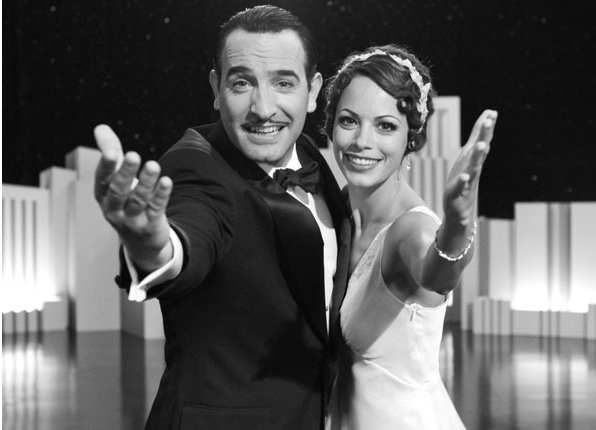
French directors Pierre Etaix and Jacques Tati made solid reputations for themselves creating modern-era silent-style movies four and more decades after the dawn of the talkies.  Now another French director, Michel Hazanavicius (OSS 117) has followed in their footsteps with The Artist, a silent, black-and-white movie about the transition from the silent era to sound.  It was announced yesterday that Terrence Malick’s The Tree of Life had won the Palme d’Or, the top prize at the Cannes Film Festival, but according to several reports The Artist gave it a real run for its money.

Hélas, for some stupid reason I am not currently on the French Riviera so I haven’t seen the film yet, but here’s a trailer and a few (rave) reviews.


_____________________________________


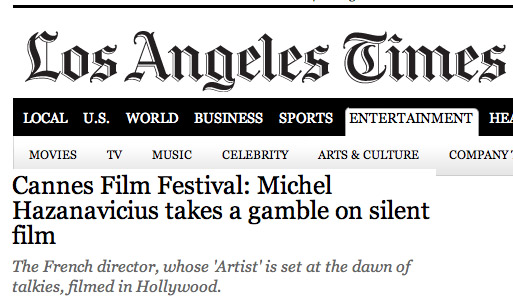
“The Artist” manages the seemingly impossible: It’s a new silent film that pays thoughtful tribute to the traditions of the past while creating great fun for modern audiences. Which is just what French director Michel Hazanavicius had in mind. 

“A silent film is a very special experience. … It’s not intellectual, it’s emotional. You take it in the way you take in music,” Hazanavicius explains, tired but still engaging at the end of a day spent coping with a deluge of media requests. “There are times when language reduces communication, when you feel you are losing something when you start talking.”

[Read the whole review here.]


_____________________________________


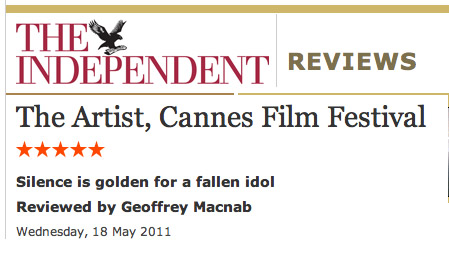
Michel Hazanavicius’s The Artist, added to the Cannes competition at the last minute, is both a surefire crowd pleaser and a magnificent piece of film-making. Whatever else, this is also surely the most enjoyable contender for the Palme d’Or this year.


It’s a silent movie set in the Hollywood of the late 1920s. The story of a Douglas Fairbanks-like movie star (Jean Dujardin) fallen on hard times, it evokes memories of everything from A Star Is Born to Citizen Kane, from Scott Fitzgerald’s Pat Hobby Stories to Kenneth Anger’s Hollywood Babylon and even Charlie Chaplin’s Limelight. French director Hazanavicius (best known for spy spoof OSS 117) isn’t the first film-maker in recent years to make a silent movie but he is doing it on a far grander scale than any of his predecessors.

[Read the whole review here.]

_____________________________________

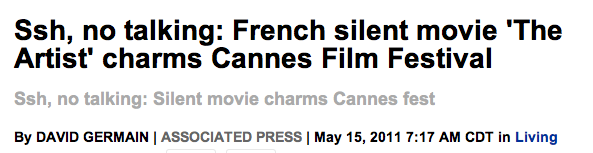
The talk Sunday at the Cannes Film Festival was about the movie that doesn’t talk: a silent film about a 1920s Hollywood star toppled by the age of talkies.  
French director Michel Hazanavicius’ “The Artist” employs lush music, well-chosen but restrained sound effects and no spoken words save in one brief scene.
The result is an old-timey comic melodrama about the pitfalls of artistic pride and the power of romantic redemption that earned sustained applause at its first press screening, a rarity for notoriously snooty Cannes critics.
A last-minute addition to the lineup of 20 films competing for the festival’s top honor, the Palme d’Or, “The Artist” is shot in black and white, conveys its limited dialogue through silent-movie title cards and is presented in the boxy format of early cinema instead of today’s widescreen panoramas.

[Read the whole review here.]

_____________________________________

It is a relief to turn to the great movies, of which there were a fair few. French director Michel Hazanavicius’s The Artist is my favourite, by a whisker, of the competition films. It’s a piece about Hollywood’s silent black-and-white age, and is itself silent and in black-and-white. That may sound rather mannered and plenty of people out here, particularly the American critics – who might take a rather coolly proprietorial attitude to this subject – thought it a pleasant pastiche and nothing more. Actually, it is a lovely film with a sublime and swooningly romantic story, taking its inspiration from Singin’ in the Rain, from Welles and from Lang. I can’t wait for the film to come to Britain so I can see it again.

[Read the whole review here.]

Update (5-29-11):  I just watched Hazanavicius’s OSS 117 on Netflix Instant Play. Not much physical comedy, but pretty funny.  It’s a spy spoof, but with more mature social and political satire than, for example, the Naked Gun movies.

SHARE
EXPLORE FURTHER

Live from Paris: In Search of Max Linder

POST 106
Saturday, December 4, 2010

Supposedly I’m a big expert on all this clown and physical comedy stuff. Yeah, like I actually have the time to watch all those DVDs overcrowding my shelves.

Sad to admit, but this time last year I knew very little about the French silent film comedian, Max Linder (1883–1925).  I knew he was the first international comic film superstar and that Chaplin revered him. I even knew he died young in what was labeled a double suicide with his 21-year-old wife, Ninette Peters.  All I had seen of him in action, however, were very brief snippets from his surviving films (about 130 out of 400+) included on various anthologies of silent film history. Usually they got passed over quickly as the narration turned to everyone’s all-American favorites,  Chaplin & Keaton, Lloyd & Langdon.

I was not terribly impressed by those few glimpses of Linder, not surprising considering that some of them dated all the way back to 1905, a full dozen years before Keaton’s first film with Arbuckle.  But when I saw his 1921 film Seven Years Bad Luck, I thought it was clearly one of the best silent film features ever made. Well acted, ingeniously written, and with the best use of the mirror gag ever.  But more on that later!

Shortly thereafter I came across a New Theatre Quarterly article about Linder that was so fascinating that I immediately wrote the magazine’s editor, Simon Trussler, to help me get in contact with the author, Frank Bren, whose web site you can reach by clicking here.  (And so good that I begged Mr. Trussler and Mr. Bren to allow me to reprint it on this blog. They very kindly agreed, and you will find it as the very next post.)  Reaching Frank Bren has proved to be a gold mine, for it was he who turned me on to the Pierre Etaix comeback story (see previous Etaix posts) and introduced me to the remarkable Maud Linder, daughter and biographer of Max.

And what a story!

Maud Linder was orphaned at the age of 15 months by her parents’ death, and did not realize who her real father was until some twenty years later.  She came to know him only through his films, coming to hate the man who had abandoned his baby daughter, taking her mother with him, and yet very much admiring the artist.  Somehow she was able to separate the two in her mind, and she made it her mission to revive the reputation of the comedian who had once been the most famous entertainer in the world.  I was understandably thrilled when Frank told me that Maud was alive and well and living in Paris and would very likely be quite receptive to meeting me during my April sojourn in Paris.  And so it came to pass!


More than 80 years later, a vibrant and energetic Maud Linder still lives in that same house Linder had built for his family on a gated street in Neuilly, an upscale suburb of Paris.  Though Max never got to live there, he would no doubt be thrilled to see that his daughter has survived and thrived despite all odds and that she has worked so hard to perpetuate his legacy.

In this first segment from my interview with Mme. Linder, she explains her personal mission:

Some thoughts on Linder’s legacy and the struggle to keep his work alive in the 21st century:

And here Mme. Linder muses about the difference between a clown and a film comedian:

I may have been 85 years late in my search for the living, breathing Max Linder, but meeting his daughter was both an honor and an inspiration for the posts that follow this one.

SHARE
EXPLORE FURTHER

Live from Paris: In Search of Mamako

POST 105
Monday, November 22, 2010

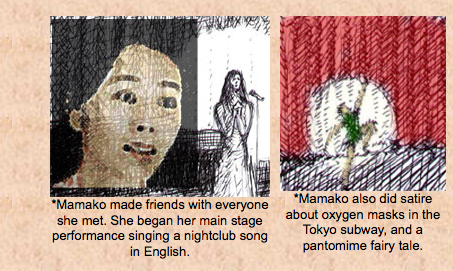
“Live from Paris” last April, that is, where I was already undercover on the Linder and Etaix capers when I got a coded message from one Michael Evans, an operative unknown to me but apparently a go-between for a character from the 70s who at that time went by the unassuming name of Lou Campbell.  I was in Paris, I had nothing better to do (hah!), and before I could say fromage I’d been given the assignment to track down legendary Japanese pantomimist Mamako Yoneyama, rumored to be hiding out in that City of Light Mimes.  Evans (if that’s his real name) had first met Yoneyama — code name Mamako— at the 1974 International Mime Festival at Viterbo College in Lacrosse, Wisconsin, organized by yet another “Lou Campbell.”  Or was he in fact the same person??  Evans’ rambling confession about that festival — an event whose foreign ideas about movement theatre forever corrupted the minds of a whole generation of impressionable Americans in tights —has finally been released thanks to the Freedom of Information Act,  and now the general public can view it here, including incriminating sketches and notes such as these:
I had never seen this Mamako character perform. I knew she had a glowing reputation, but biographical data was suspiciously sketchy. The only background info on the perp was from a book called Mime and Pantomime in the 20th Century, but for reasons unknown not published until 2008:

Born in 1935, Mamako began dancing at a very early age. Her father, a schoolteacher, was a dancer by choice, performing for a local ballet company. Mamako naturally being exposed to her father’s talent, became involved in dance. By the time she was a teenager, Mamako was the acclaimed best dancer in school. She attended Tokyo University where she studied physical education. In addition, she studied modern dance under the aegis of Egichi-Miya, the famous Japanese choreographer/dancer. She rose quickly to stardom in Japan.


She attended the debut performance of Marcel Marceau in Tokyo and immediately made up her mind to study with him in Paris. Once she acquired the foundation of style mime technique, she returned to become a curiosity in her own culture.
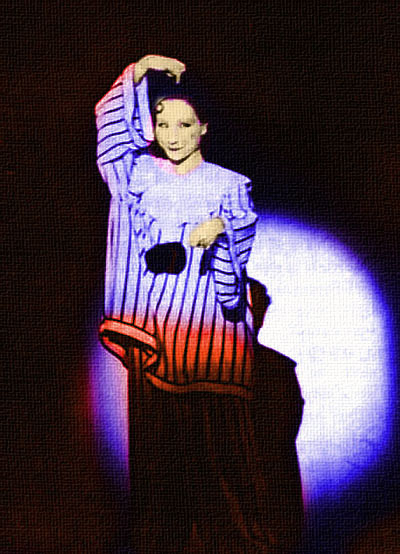
Because pantomime was so new in Japan, it offended her to read that her mime was regarded as “twisted dance.” She came to the United States and did well in Hollywood, but she was lonely there. Dr. Lou Campbell first met Mamako at San Francisco State University in a Stage Movement Master Class that he developed through the American Educational Theatre Association pre-convention sessions in 1972. She performed at the First International Mime Institute and Festival in 1974 and at subsequent other mime festivals around the U.S. where she received great accolades. After a long stay in Japan, she decided to move to Paris.  Only recently did she decide to return to her home country.


The form of mime for which Mamako is most noted is called Zen Meditation Mime. She claims that “It is the same as that which a Buddhist Monk experiences while meditating on a particular environment.”  It is not literal pantomime but a collection of impressions derived from an environment.

That Campbell character again! Just to be thorough, I checked to see who the purported author of this book might be, and it was none other than… Lou Campbell!  Campbell writing about Campbell. Coincidence? I think not. This plot was thickening as surely as a bouillabaisse going into its third hour on the stovetop.  But where to start?  Like Dick Tracy before me, I turned to my wristwatch for an internet search, my eagle eye uncovering an obscure reference to Mamako on a blog by Tokyo writer Yuri Kageyama.

Moi to YuriMamako? Still alive? Living where?

My wristwatch soon beeped with a reply, which it dutifully translated from the Japanese as “I’ve read about her performance as recent as a couple of years ago. They were in Japan, but I only learned about them on the Web afterward and so I couldn’t go check it out. Her death would make news here for sure. And I have not seen any such reports.”

She was alive but apparently living in Japan. Me, I was stuck in Paris, volcanic ash shutting down every airport west of Kiev.  My pockets stuffed with cash, just a small portion of the enormous profits from this blog, and yet no way to hop a quick flight to Tokyo.  Curse you, Iceland! One door had opened, but another had been slammed right in my kisser.

A little secret: a good detective makes his own luck… and his own contacts.  Checking my Rolodex for Franco-Japanese go-betweens, my finger landed on the tattered card of  one Bernard Collins (code name Compagnie BP Zoom), an American in Paris frequently back and forth to Japan, with “clowning” as his cover for other activities I have sworn not to disclose.  Would he fess up to having seen Mamako?

Paris–Tokyo–Paris. Hmm… might they not be toiling for the same cartel?  Turns out Collins’ “agent” had in fact introduced him to our suspect on a previous occasion. Bingo! Not only was she alive and well, but said “agent” knew exactly how to reach her.  End of search! All that remained was the judicious application of a certain amount of pressure — long distance yet oddly effective — for our new agent friend to turn over the necessary contact info, now safely in the hands of the entity or conglomerate known as Lou Campbell.

My reward?  I’m not talking, but you can be sure it won’t appear on my 2010 IRS return.
SHARE
EXPLORE FURTHER
Check out My New Book

Visual and verbal humor for the cognitively and artistically curious!

“A book to treasure!”
—Bill Irwin

Upcoming Events