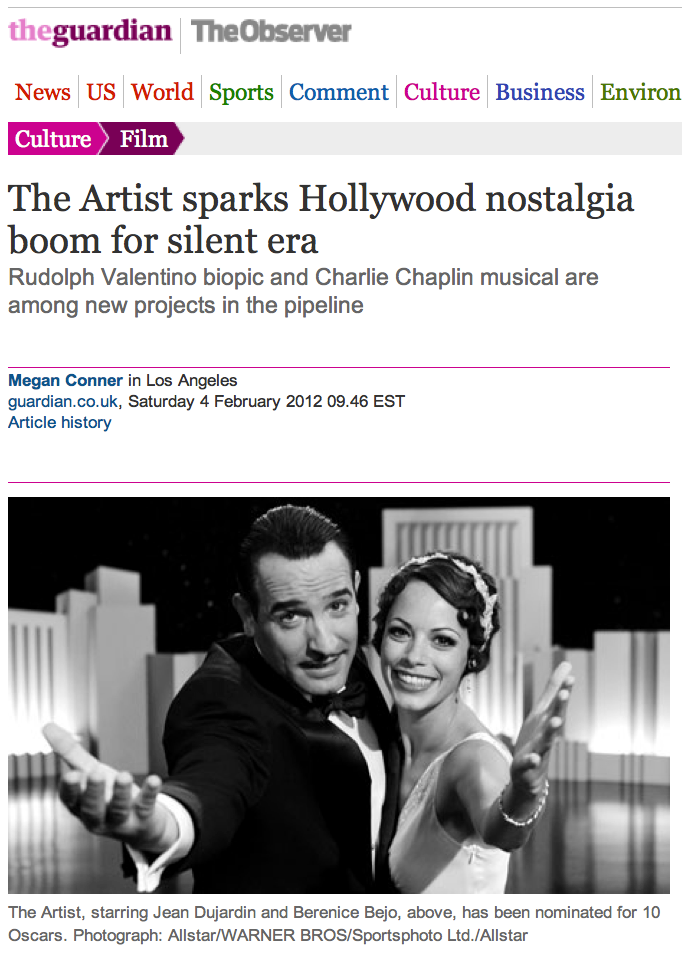
I know, I know, yet another post on The Artist — but this article from London’s Guardian newspaper is actually about some new film and stage projects that now have a better chance of success thanks to all this new interest in silent movies.
The surprise success of the silent film The Artist, tipped to make a clean sweep at the Academy awards, has inspired a series of stage and screen projects celebrating the early years of Hollywood.
This wave of nostalgia has prompted not only more silent movies, but plays and films paying homage to the stars of the time. One of the biggest projects is a musical based on the life of Charlie Chaplin, which will open on Broadway this year. It was first staged in California and had mixed reviews, but is being reworked and recast for New York. The script, by Thomas Meehan, who wrote the hit stage productions Hairspray and The Producers, delves into Chaplin’s controversial private life while tracing his journey from modest beginnings in London to the heights of Hollywood.
The producers of a film based on the silent era’s smouldering romantic lead Rudolph Valentino, star of The Sheik and The Eagle, also hope their movie will make it to the screen soon. Silent Life, an American film made by and starring Vlad Kozlov, a first-time director who has been successfully treated for a speech disorder so debilitating he could barely talk for almost 20 years, is being prepared for release after four years in production. Co-starring Isabella Rossellini as Valentino’s wife, it centres on the Italian actor’s untimely death at 31 after he slipped into a coma while being treated for peritonitis. Unaware of his fate, he understands his life through a dreamlike silent sequence in which he has fame and glory but the dearest things in his life have been taken from him.
Tim Gray, editor-in-chief of Variety, said it hardly came as a surprise that these silent-era-inspired stage and screen projects were now emerging. “When a surprise success story like The Artist comes along, you are always going to get imitators – it’s natural. Having said that, I do think The Artist is a one-off. The reason The Artist is a hit is not because it’s silent, it’s because it’s so clever and unusual. I’d be stunned if a large number of silent films popped up.”
He argues that while The Artist has spawned nostalgia for the period, if these projects are successful it will be because they tell a more personal story. “Perhaps the biggest trend in film-making now is biographies. People always want to make them and audiences always want to see them. Over the last few years we’ve seen people competing to make stories based on famous people’s lives – there were two Truman Capote movies in competition and three Janis Joplin films that never got made over the last few years.
“Right now, there’s a film being shot about a 1970s porn star nobody really knew anything about, Linda Lovelace. I wouldn’t be surprised if a lot of film-makers now have an interest in making a Chaplin biopic.”
To date, there has only been one film based on Chaplin’s life, the 1992 drama Chaplin, directed by Richard Attenborough and starring Robert Downey Jr. It received great acclaim, with Downey picking up a Bafta award and an Oscar nomination for best actor, but critics deemed Chaplin’s life too vast to be immortalised in film. Enjoying a career as an actor, producer, director and composer that spanned more than 75 years, Chaplin lived until the age of 88 and had a colourful personal life that saw him dating actresses as young as 15, embarking on several marriages and affairs and producing 12 children.
Other stars from the era whose lives could be retold in film include Greta Garbo, Buster Keaton and Harold Lloyd. But Gray argues that the moment will be fleeting.
“I don’t think you’re ever going to see a complete resurgence in silent movies,” he says. “The Artist’s greatest influence on Hollywood is in liberating film-makers to try something completely original, to push the envelope at a time when the investment is largely in ‘safe bets’ like comic book franchises and sequels.”
Maybe you’re getting tired of my obsessive enthusiasm for these two movies about the silent film era currently competing for best-picture Oscar, but I figure I better enjoy it while I can, just in case neither of them wins. (Personally I’m rooting for The Artist.)
Here’s a video debate between advocates for the two movies from the (web) pages of London’s Guardian:
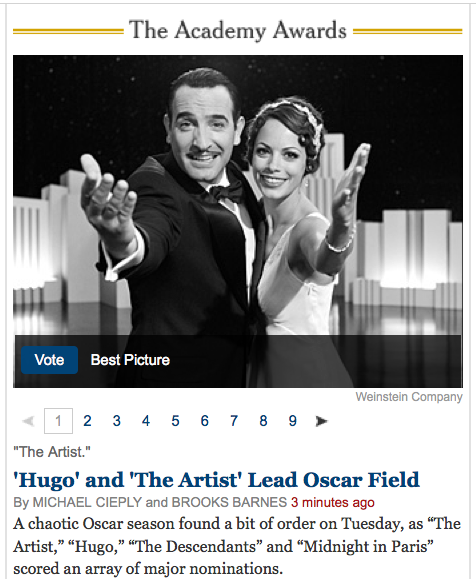
I first previewed the new silent movie, The Artist, when it surfaced at the Cannes Film Festival in May, and then reviewed it when it opened in New York on Thanksgiving weekend, but now folks who know about these things are saying it might actually snatch the best-picture Oscar. We’ll have to wait until January 24th for the nominations, but meanwhile The Artist has won best picture in Boston and San Francisco, copped six Golden Globe nominations, garnered four nominations from the Vancouver Film Critics Circle, and was named by the Producers Guild of America and the Houston Film Critics Society as one of the year’s top 10 movies. As we get closer to the February 26th Academy Awards, money, reputations, and artistic correctness will all be at stake, so of course the opinions are flying!
The main criticism of The Artist is that it’s sentimental fluff, a lot of fun if you like that sort of thing, but not a film of any significance. And of course the question then arises — and it is a fair question — can a silent movie ever really plumb the depths of our complex world without the use of words? Isn’t Tree of Life profound and The Artist superficial?
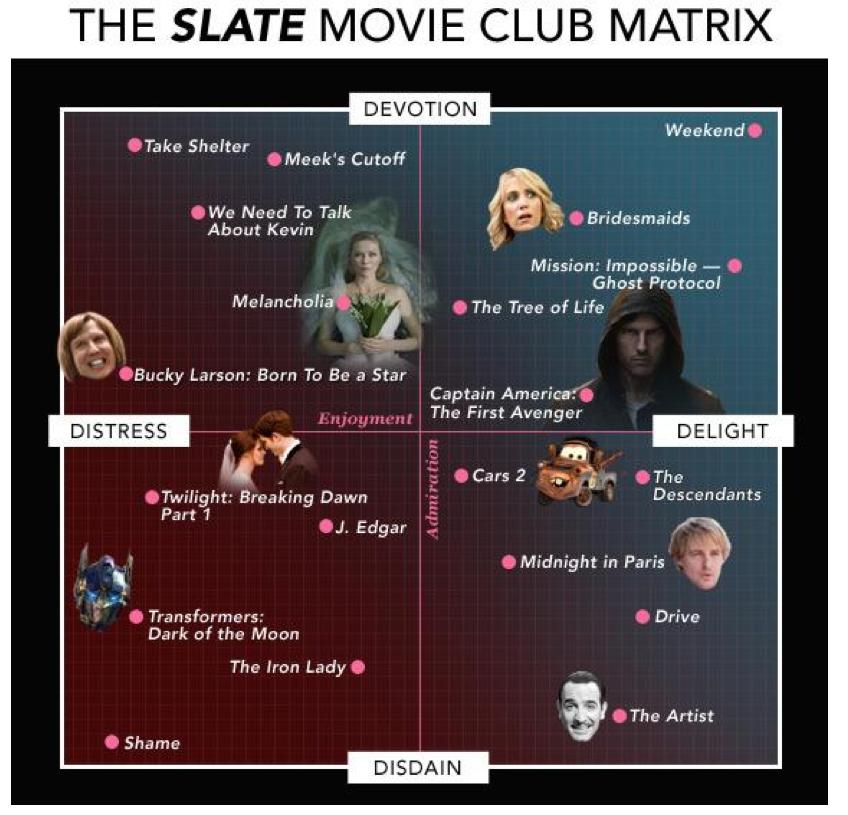
Here’s an exchange from the Movie Club section of the online magazine, Slate, which I found interesting enough to pass on to you. First up is a criticism by Dan Kois, talking about movies (see chart, below) that are difficult to watch but that you later find meaningful vs. enjoyable but forgettable flics:
Are there films that work in the reverse? Films that offer enjoyable viewing experiences, but then afterward provoke disdain? Of course! How about apparent Oscar front-runner The Artist, a charming piece of work that never tires, never bores, never in its 100 minutes stops tap-dancing for your smiles? As soon as it was over I was angry at myself for each chuckle I’d given the movie, and now, weeks later, it only provokes a shrug. This is what everyone is so crazy about? I don’t even mind that it’s a trifle—I like trifles! —but did it always have to go for the easiest joke, the simplest twist, the most obvious turn?
Coming right back at him is another Slate critic, Stephanie Zacharek, who said it better than I could have:
I think, as just the first round of Movie Club proves—as every full year of moviegoing proves—there are an infinite number of ways for movies to reach us, to sneak in through cracks we didn’t even know existed. If you have a house with cracks, you’ve got to seal them up. But for moviegoing, don’t seal the cracks! It’s how the light gets in, as Leonard Cohen said. Which leads me to something you said, Michael, about how both Melancholia and The Tree of Life were both made by directors who think cinematically, and my lack of warmth for TOL notwithstanding, you’re right. As you said, “Directors who don’t think cinematically sadly account for most of the movies we see all year.”
Which is why I really need to talk about The Artist, allegedly the Philistine’s choice for movie of the year. Because it’s not nearly as good as the great silents—it’s not Keaton, it’s not Murnau, it’s not Griffith. Because it’s a crowd-pleaser, a trifle, a soufflé of a movie with no overarching theme or purpose. Because it’s not as great as the buildup from Cannes led us to believe. Because Harvey Weinstein saw it and immediately thought, “I can make money off this.”
I’m afraid there are lots of reasons for not liking The Artist that actually have little or nothing to do with The Artist, and though that happens with lots of movies, I still find it troublesome. I love The Artist, as Dana said, “without disclaimers or shame.” I think shame is a useless construct when it comes to movies. (Disclaimers—well, we all need those once in a while.) In terms of cinematic thinking in 2011, Michel Hazanavicius trumps Terrence Malick. For one thing, he doesn’t need any “Oh, mother! Oh, father!” voice-overs, no shots of the sun peeping through tree branches, to make sure we’re feeling what we’re supposed to be feeling. And he’s relying on the grace of his actors, their way of moving, their subtle shifts in expression, to tell a story in purely visual terms. Not only is there no dialogue; there’s no expository dialogue, no overt explanation of why the lead character, Jean Dujardin’s George Valentin, is so resistant to talking pictures, which some of the movie’s detractors see as a flaw. For me, George Valentin lives in a mirror-universe where he foresees an actor in another universe (the real one), John Gilbert, drinking himself to death in 1936: The problem wasn’t that Gilbert’s voice wasn’t good enough for talkies (it was), but that filmmakers’ awkwardness in the new medium ended up reflecting badly on him, through little or no fault of his own. In other words, the fictional George Valentin had a premonition of something that happened in real life. Why wouldn’t he be afraid?
I love the economy and discipline of The Artist. Hazanavicius finds all he needs in the faces of his actors, Dujardin and Berenice Bejo. And I’m astonished by the effect the movie has had on audiences. I’ve seen it three times now, twice with a “real” audience (the first time, at Cannes, doesn’t count), and both times I’ve been amazed at how restless the audience is at the beginning—there’s that point where you expect the talking to kick in, and it just doesn’t—and how wrapped up they are by the end. I know, I know—just because lots of people love a movie doesn’t make it good. (The Dark Knight, anyone?) But I do think Hazanavicius and his actors have helped unlock the code of silent-film acting for many people, people who have always thought it was overdone or, at least, just too weird to understand. Film critics know all about silent film and silent-film acting, but who cares about us? As the writer Eileen Whitfield observed in her wonderful biography of Mary Pickford, Pickford: The Woman Who Made Hollywood, modern audiences often view silent movies as if they’re trying to be talkies and failing, whereas they’re really much closer to dance, a symbolic re-enactment. The Artist is all about faces and movement and the emotion that can be drawn out of those things together. To me, it’s elemental.
Here, here!
And two more morsels for you. That cool web site, Chaplin-Keaton-Lloyd Film Locations, has an excellent new post up about the shooting of The Artist. Check it out here. And here’s wonderdog Uggie visiting the offices of the London Guardian newspaper:
[post 221] Despite frequent tributes to the stars of the 1920s, despite all those beautifully remastered DVD sets, despite your enthusiasm and mine, our modern world has pretty much relegated silent film comedy to the nostalgia bin. Most of the younger generation has only vaguely heard of Chaplin or Keaton, much less seen any of their films, and names like Charley Chase, Harry Langdon, or Fatty Arbuckle mean nothing to them. I know; I teach college.
There are both good and bad reasons for this. Admittedly, the quality of these early films can vary drastically — not unlike television today. Many are formulaic, with minimal character or story development. Other than the action sequences, the pace must seem slow to a visual generation used to shots lasting only a couple of seconds. And did I mention — horrors! — they’re in black and white?
But presentation is also a major problem. Before you’d plunk down cash to buy a silent film comedy on DVD, you’re more likely to go to YouTube to watch one of the comedian’s movies, or more likely just an out-of-context clip. You’re going to be sitting at your desk, probably surfing the net at warp speed, seeking instant gratification. The video and audio quality is likely to be poor, depending on the source and the amount of compression for the web. Frustrated with the small size, you enlarge it to full screen, but now it’s all blurry and pixelated. The sound track, coming out of your computer’s sole speaker, is likely to be generic, just some ragtime tune slapped on top. If the clip doesn’t grab you in twenty seconds or less, you’re gone.
Ben Model
Contrast that with sitting in a crowded audience watching a restored print (film!) on a large screen. The music has been composed specifically for this movie and is being performed live by a talented and enthusiastic pianist, perhaps by an entire band. The audience is laughing loudly (they always do) and probably cheering and jeering as well. Soon you forget that it’s not in color, you forget that you can’t hear any dialogue. Instead you’re marveling at all that creativity, wondering why they can’t make movies like that any more. Silent film as a live performing art! But…. I’m guessing the number of people who’ve had this experience is way under 1%.
Is it at all possible, however, that the tide may be turning?
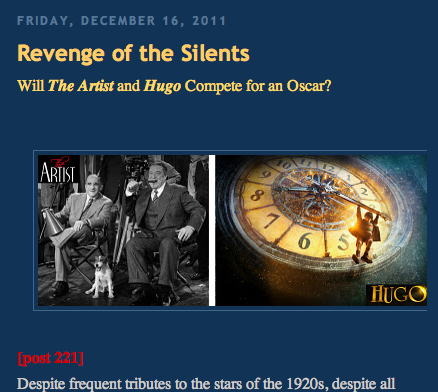
Not only are live performances of silent films growing in popularity, but two major commercial films about the silent era have just opened to rave reviews and serious talk of awards for best film of 2011. The first is The Artist, an actual black & white silent movie, which I previewed in this earlier post, when it almost won the Cannes Film Festival.The second is Martin Scorcese’s Hugo, based on the novel The Invention of Hugo Cabret, a book I wrote about in this earlier post on Georges Mélies. Hugo’s not silent, it’s color, and it’s even available in 3D, but much of it as a tribute to Mélies and the inventiveness of early cinema.
More on both of these shortly, but first honorable mentions to some of the silent film series that have paved the way. In New York, there are at least two ongoing series that you should know about, both of which have the imprint of Ben Model, silent film historian, composer, and pianist. The Silent Clowns Film Series, ongoing since 1997, presents about ten events a year, all free, and all featuring Ben on piano, with programming by Bruce Lawton and film notes by Steve Massa. Many of the films screened are not available anywhere else and are usually seen on newly restored prints. Always a fun time, full of revelations, and after the movies are over, Ben, Bruce, and Steve hold court, fielding questions from an audience of fellow fans.
Ben has also done a lot of similar work for the Museum of Modern Art, including the current film series Cruel and Unusual Comedy, focusing on social commentary in American slapstick, which he curates with Ron Magliozzi and Steve Massa. The most recent installment, however, focused on some marvelous rare early European comedy shorts from the Desmet Collection of the EYE Institute (Amsterdam). This was billed as “a sort of highlights reel of a complete 5-program series that will be presented at MoMA during 2012.” Judging by what I saw in October, this collection is a significant find. And while I hope it eventually ends up on DVD, that won’t be as cool as having seen the movies accompanied by a live band, with my Bloomfield College colleague Peter Gordon on saxophone!
Another place in NYC to learn more about the silent era is The Museum of the Moving Image in Astoria, Queens, which houses exhibits on movie history, but also has a steady stream of screenings and lectures. If you’re in town December 17th, don’t miss master magician Ben Robinson’s lecture, Magic and the Silent Clowns: There is a strong link between some of cinema’s great comedians and magic. Performers such as Buster Keaton, Charlie Chaplin, Harold Lloyd, and Harpo Marx started out in the world of vaudeville; many of their finest gags grew directly out of their love of magic. Magician and author Ben Robinson will show scenes from such movies as Grandma’s Boy, Sherlock Jr., The Circus, and Duck Soup to examine this important connection between magic, comedy, and cinema.
Also in New York, the Film Forum provides another home for screenings of silent movies with live musical accompaniment. They are currently in the midst of a Monday night series, The Silent Roar, featuring MGM films from 1924 to 1929, with Steve Sterner on the piano. Buster Keaton’s The Cameraman plays the day after Christmas.
Enough tooting the Big Apple’s horn…. don’t want to make all those New Yorkers blush! Back to our regularly scheduled programming…
Bérénice Bejo & Malcolm McDowell in The Artist
The Artist
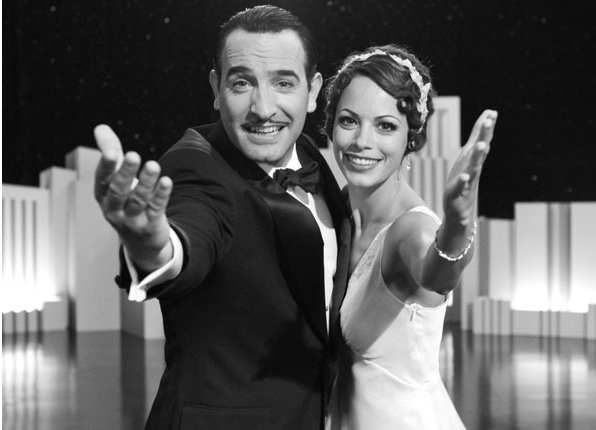
This is a French film directed by Michel Hazanavicius, most recently known for his OSS 117 spy spoofs, and starring Jean Dujardin and Bérénice Bejo (real-life wife of Hazanavicius). Other than its bland title, I was utterly won over by The Artist, whose story unfolds against the backdrop of the transition from silent films to sound. There are obvious parallels with Singing in the Rain, except The Artist actually is a silent movie, and a black and white one at that. It’s also stylish and sweet, quite funny, and very well acted. Dujardin and Bejo are easy to fall in love with, and John Goodman as the cigar-chomping Hollywood mogul and Uggie as the dog Uggie are both hilarious.
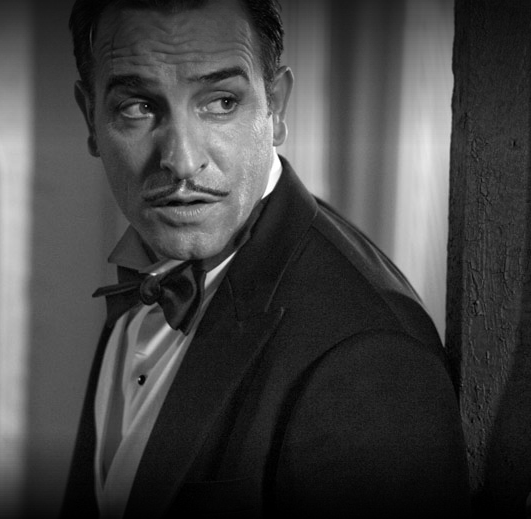
Jean Dujardin as George Valentin
Although the male lead, one George Valentin, is dashing, athletic, and comic, very much in the style of Douglas Fairbanks, The Artist does not attempt to recapture the world of the great physical comedians. “It wasn’t the slapstick that meant so much to me. It was the melodramas,” explained Hazanavicius. “The point was to share that sensual experience I felt sitting in the cinema watching Murnau’s Sunrise.” Be that as it may, the style is sumptuously visual and the acting ultimately physical. And did I mention that it’s very well done?
Bérénice Bejo as Pepe Miller
At the risk of sounding mushy and sentimental, I was also pleased to see characters that were not total jerks. Yes, self-serving jerks exist, but that can also be too easy of a writing choice. The George Valentin character could have been an arrogant womanizer and a bitter loser. Peppy Miller’s stardom could have made her totally full of herself. Goodman’s Al Zimmer could have been a ruthless producer. Instead, they all have their positive side, which (spoiler alert) makes a happy ending possible. Yes, you could argue that this is phony and manipulative. After all, Hollywood comes off very well in this French valentine to America, which is no doubt one reason The Artist is creating Academy Award buzz. But not the only reason. It’s an exceptional film, and has already won Best Film of the Year from the San Francisco Film Critics Circle and the Boston Society of Film Critics, and has six Golden Globe nominations, including Best Comedy.
Here’s the trailer:
Better yet, here’s a short scene from the movie with the director’s commentary:
Hugo Martin Scorcese’s Hugo is another valentine to the movies, but in this case an American director returns the compliment, reminding us all of France’s contribution to early film history, specifically the effects-laden work of magician-turned-director Georges Mélies. Hugo is quite the contrast, a full-color, all-talking, big-budget Hollywood movie with major stars (Ben Kingsley, Jude Law, Sacha Baron Cohen) and serious technology, including a cool secret world concealed within Paris’ Montparnasse train station, which for a price ($17.50 in Manhattan!) we get to explore in 3D.
But what on earth does this have to do with silent film comedy?
A lot, as it turns out, because [spoiler alert] that crotchety old man winding down his life selling wind-up toys in the train station is — true story — none other than silent film pioneer Georges Mélies, long since forgotten by the public, his early special effects movies all thought to have been destroyed. Not to worry: it is his fate to be rediscovered by an orphaned boy who secretly lives in the station, following in his father’s and uncle’s footsteps by caring for the clocks, one of which he of course ends up hanging from in the climactic chase scene, à la Harold Lloyd in Safety Last.
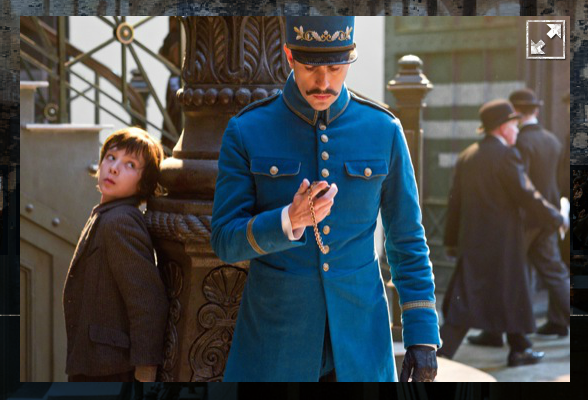
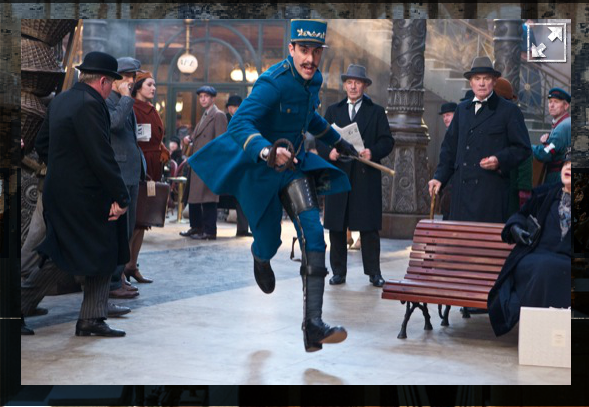
Speaking of chase scenes, Sacha Baron Cohen of Borat fame plays a nasty Keystone Kop with a leg brace who is intent on nabbing vagrant kids and packing them off to the orphanage, and therefore much chasing ensues. Unfortunately, Cohen’s comic genius does not get full rein here, and the potential for physical comedy is squandered. What is special, and to my mind well worth the price of admission, is the loving recreation of Mélies’ Paris studio and working methods — with Scorcese as a cameraman! — which constitutes the final section of the movie. Very cool. Indeed, the whole movie can be seen as a tribute to film preservation, with the film archivist (played by my former student, Michael Stuhlbarg) clearly modeled on Henri Langlois, founder of the Cinémathèque Française.
Here’s the official trailer:
A good movie, not necessarily perfect, but its heart is in the right place, and it has an important story to tell. Two weeks ago, when I first saw both of these, I would have thought American judges would be favoring Hugo over The Artist, but the opposite seems to be happening. We’ll have to wait and see but, either way, silent film is the winner.
French directors Pierre Etaix and Jacques Tati made solid reputations for themselves creating modern-era silent-style movies four and more decades after the dawn of the talkies. Now another French director, Michel Hazanavicius(OSS 117) has followed in their footsteps with The Artist, a silent, black-and-white movie about the transition from the silent era to sound. It was announced yesterday that Terrence Malick’s The Tree of Life had won the Palme d’Or, the top prize at the Cannes Film Festival, but according to several reports The Artist gave it a real run for its money. Hélas, for some stupid reason I am not currently on the French Riviera so I haven’t seen the film yet, but here’s a trailer and a few (rave) reviews.
_____________________________________
“The Artist” manages the seemingly impossible: It’s a new silent film that pays thoughtful tribute to the traditions of the past while creating great fun for modern audiences. Which is just what French director Michel Hazanavicius had in mind.
“A silent film is a very special experience. … It’s not intellectual, it’s emotional. You take it in the way you take in music,” Hazanavicius explains, tired but still engaging at the end of a day spent coping with a deluge of media requests. “There are times when language reduces communication, when you feel you are losing something when you start talking.”
Michel Hazanavicius’s The Artist, added to the Cannes competition at the last minute, is both a surefire crowd pleaser and a magnificent piece of film-making. Whatever else, this is also surely the most enjoyable contender for the Palme d’Or this year.
It’s a silent movie set in the Hollywood of the late 1920s. The story of a Douglas Fairbanks-like movie star (Jean Dujardin) fallen on hard times, it evokes memories of everything from A Star Is Born to Citizen Kane, from Scott Fitzgerald’s Pat Hobby Stories to Kenneth Anger’s Hollywood Babylon and even Charlie Chaplin’s Limelight. French director Hazanavicius (best known for spy spoof OSS 117) isn’t the first film-maker in recent years to make a silent movie but he is doing it on a far grander scale than any of his predecessors.
The talk Sunday at the Cannes Film Festival was about the movie that doesn’t talk: a silent film about a 1920s Hollywood star toppled by the age of talkies.
French director Michel Hazanavicius’ “The Artist” employs lush music, well-chosen but restrained sound effects and no spoken words save in one brief scene.
The result is an old-timey comic melodrama about the pitfalls of artistic pride and the power of romantic redemption that earned sustained applause at its first press screening, a rarity for notoriously snooty Cannes critics.
A last-minute addition to the lineup of 20 films competing for the festival’s top honor, the Palme d’Or, “The Artist” is shot in black and white, conveys its limited dialogue through silent-movie title cards and is presented in the boxy format of early cinema instead of today’s widescreen panoramas.
It is a relief to turn to the great movies, of which there were a fair few. French director Michel Hazanavicius’s The Artist is my favourite, by a whisker, of the competition films. It’s a piece about Hollywood’s silent black-and-white age, and is itself silent and in black-and-white. That may sound rather mannered and plenty of people out here, particularly the American critics – who might take a rather coolly proprietorial attitude to this subject – thought it a pleasant pastiche and nothing more. Actually, it is a lovely film with a sublime and swooningly romantic story, taking its inspiration from Singin’ in the Rain, from Welles and from Lang. I can’t wait for the film to come to Britain so I can see it again.
Update (5-29-11): I just watched Hazanavicius’s OSS 117 on Netflix Instant Play. Not much physical comedy, but pretty funny. It’s a spy spoof, but with more mature social and political satire than, for example, the Naked Gun movies.