Will The Artist and Hugo Compete for an Oscar?

[post 221]
Despite frequent tributes to the stars of the 1920s, despite all those beautifully remastered DVD sets, despite your enthusiasm and mine, our modern world has pretty much relegated silent film comedy to the nostalgia bin. Most of the younger generation has only vaguely heard of Chaplin or Keaton, much less seen any of their films, and names like Charley Chase, Harry Langdon, or Fatty Arbuckle mean nothing to them. I know; I teach college.
There are both good and bad reasons for this. Admittedly, the quality of these early films can vary drastically — not unlike television today. Many are formulaic, with minimal character or story development. Other than the action sequences, the pace must seem slow to a visual generation used to shots lasting only a couple of seconds. And did I mention — horrors! — they’re in black and white?

But presentation is also a major problem. Before you’d plunk down cash to buy a silent film comedy on DVD, you’re more likely to go to YouTube to watch one of the comedian’s movies, or more likely just an out-of-context clip. You’re going to be sitting at your desk, probably surfing the net at warp speed, seeking instant gratification. The video and audio quality is likely to be poor, depending on the source and the amount of compression for the web. Frustrated with the small size, you enlarge it to full screen, but now it’s all blurry and pixelated. The sound track, coming out of your computer’s sole speaker, is likely to be generic, just some ragtime tune slapped on top. If the clip doesn’t grab you in twenty seconds or less, you’re gone.
 |
| Ben Model |
Contrast that with sitting in a crowded audience watching a restored print (film!) on a large screen. The music has been composed specifically for this movie and is being performed live by a talented and enthusiastic pianist, perhaps by an entire band. The audience is laughing loudly (they always do) and probably cheering and jeering as well. Soon you forget that it’s not in color, you forget that you can’t hear any dialogue. Instead you’re marveling at all that creativity, wondering why they can’t make movies like that any more. Silent film as a live performing art! But…. I’m guessing the number of people who’ve had this experience is way under 1%.
Is it at all possible, however, that the tide may be turning?
Not only are live performances of silent films growing in popularity, but two major commercial films about the silent era have just opened to rave reviews and serious talk of awards for best film of 2011. The first is The Artist, an actual black & white silent movie, which I previewed in this earlier post, when it almost won the Cannes Film Festival. The second is Martin Scorcese’s Hugo, based on the novel The Invention of Hugo Cabret, a book I wrote about in this earlier post on Georges Mélies. Hugo’s not silent, it’s color, and it’s even available in 3D, but much of it as a tribute to Mélies and the inventiveness of early cinema.

More on both of these shortly, but first honorable mentions to some of the silent film series that have paved the way. In New York, there are at least two ongoing series that you should know about, both of which have the imprint of Ben Model, silent film historian, composer, and pianist. The Silent Clowns Film Series, ongoing since 1997, presents about ten events a year, all free, and all featuring Ben on piano, with programming by Bruce Lawton and film notes by Steve Massa. Many of the films screened are not available anywhere else and are usually seen on newly restored prints. Always a fun time, full of revelations, and after the movies are over, Ben, Bruce, and Steve hold court, fielding questions from an audience of fellow fans.

Ben has also done a lot of similar work for the Museum of Modern Art, including the current film series Cruel and Unusual Comedy, focusing on social commentary in American slapstick, which he curates with Ron Magliozzi and Steve Massa. The most recent installment, however, focused on some marvelous rare early European comedy shorts from the Desmet Collection of the EYE Institute (Amsterdam). This was billed as “a sort of highlights reel of a complete 5-program series that will be presented at MoMA during 2012.” Judging by what I saw in October, this collection is a significant find. And while I hope it eventually ends up on DVD, that won’t be as cool as having seen the movies accompanied by a live band, with my Bloomfield College colleague Peter Gordon on saxophone!
Another place in NYC to learn more about the silent era is The Museum of the Moving Image in Astoria, Queens, which houses exhibits on movie history, but also has a steady stream of screenings and lectures. If you’re in town December 17th, don’t miss master magician Ben Robinson’s lecture, Magic and the Silent Clowns: There is a strong link between some of cinema’s great comedians and magic. Performers such as Buster Keaton, Charlie Chaplin, Harold Lloyd, and Harpo Marx started out in the world of vaudeville; many of their finest gags grew directly out of their love of magic. Magician and author Ben Robinson will show scenes from such movies as Grandma’s Boy, Sherlock Jr., The Circus, and Duck Soup to examine this important connection between magic, comedy, and cinema.
Also in New York, the Film Forum provides another home for screenings of silent movies with live musical accompaniment. They are currently in the midst of a Monday night series, The Silent Roar, featuring MGM films from 1924 to 1929, with Steve Sterner on the piano. Buster Keaton’s The Cameraman plays the day after Christmas.
Enough tooting the Big Apple’s horn…. don’t want to make all those New Yorkers blush! Back to our regularly scheduled programming…
 |
| Bérénice Bejo & Malcolm McDowell in The Artist |
The Artist
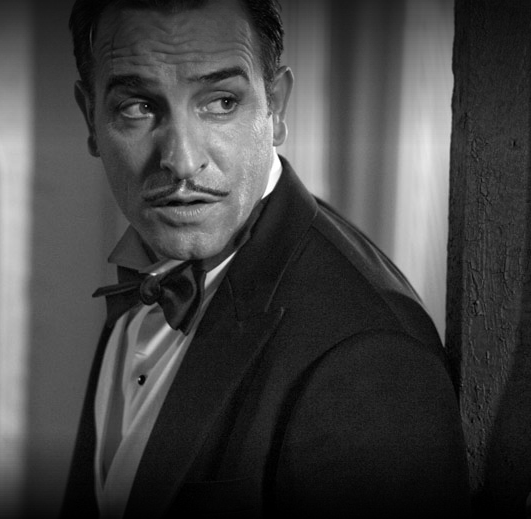
This is a French film directed by Michel Hazanavicius, most recently known for his OSS 117 spy spoofs, and starring Jean Dujardin and Bérénice Bejo (real-life wife of Hazanavicius). Other than its bland title, I was utterly won over by The Artist, whose story unfolds against the backdrop of the transition from silent films to sound. There are obvious parallels with Singing in the Rain, except The Artist actually is a silent movie, and a black and white one at that. It’s also stylish and sweet, quite funny, and very well acted. Dujardin and Bejo are easy to fall in love with, and John Goodman as the cigar-chomping Hollywood mogul and Uggie as the dog Uggie are both hilarious.
 |
| Jean Dujardin as George Valentin |
Although the male lead, one George Valentin, is dashing, athletic, and comic, very much in the style of Douglas Fairbanks, The Artist does not attempt to recapture the world of the great physical comedians. “It wasn’t the slapstick that meant so much to me. It was the melodramas,” explained Hazanavicius. “The point was to share that sensual experience I felt sitting in the cinema watching Murnau’s Sunrise.” Be that as it may, the style is sumptuously visual and the acting ultimately physical. And did I mention that it’s very well done?
 |
| Bérénice Bejo as Pepe Miller |
At the risk of sounding mushy and sentimental, I was also pleased to see characters that were not total jerks. Yes, self-serving jerks exist, but that can also be too easy of a writing choice. The George Valentin character could have been an arrogant womanizer and a bitter loser. Peppy Miller’s stardom could have made her totally full of herself. Goodman’s Al Zimmer could have been a ruthless producer. Instead, they all have their positive side, which (spoiler alert) makes a happy ending possible. Yes, you could argue that this is phony and manipulative. After all, Hollywood comes off very well in this French valentine to America, which is no doubt one reason The Artist is creating Academy Award buzz. But not the only reason. It’s an exceptional film, and has already won Best Film of the Year from the San Francisco Film Critics Circle and the Boston Society of Film Critics, and has six Golden Globe nominations, including Best Comedy.
Here’s the trailer:
Better yet, here’s a short scene from the movie with the director’s commentary:
And here’s the press kit:
The ARTIST Production Notes
 |
| Ben Kingsley as Georges Mélies |
Hugo
Martin Scorcese’s Hugo is another valentine to the movies, but in this case an American director returns the compliment, reminding us all of France’s contribution to early film history, specifically the effects-laden work of magician-turned-director Georges Mélies. Hugo is quite the contrast, a full-color, all-talking, big-budget Hollywood movie with major stars (Ben Kingsley, Jude Law, Sacha Baron Cohen) and serious technology, including a cool secret world concealed within Paris’ Montparnasse train station, which for a price ($17.50 in Manhattan!) we get to explore in 3D.
But what on earth does this have to do with silent film comedy?
A lot, as it turns out, because [spoiler alert] that crotchety old man winding down his life selling wind-up toys in the train station is — true story — none other than silent film pioneer Georges Mélies, long since forgotten by the public, his early special effects movies all thought to have been destroyed. Not to worry: it is his fate to be rediscovered by an orphaned boy who secretly lives in the station, following in his father’s and uncle’s footsteps by caring for the clocks, one of which he of course ends up hanging from in the climactic chase scene, à la Harold Lloyd in Safety Last.
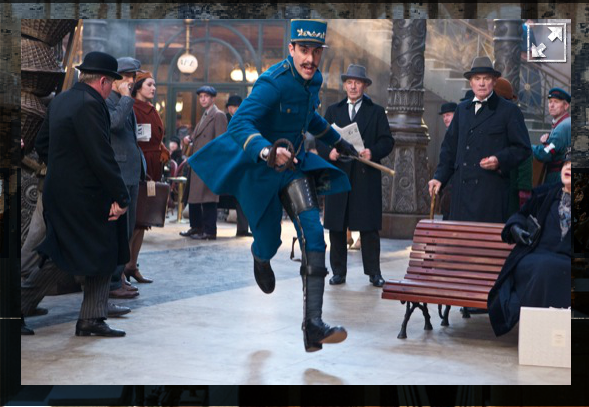
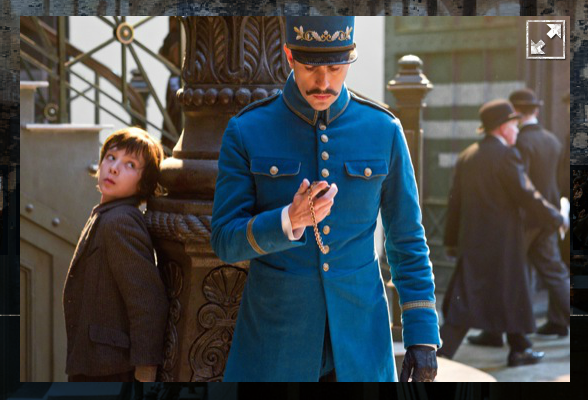
Speaking of chase scenes, Sacha Baron Cohen of Borat fame plays a nasty Keystone Kop with a leg brace who is intent on nabbing vagrant kids and packing them off to the orphanage, and therefore much chasing ensues. Unfortunately, Cohen’s comic genius does not get full rein here, and the potential for physical comedy is squandered. What is special, and to my mind well worth the price of admission, is the loving recreation of Mélies’ Paris studio and working methods — with Scorcese as a cameraman! — which constitutes the final section of the movie. Very cool. Indeed, the whole movie can be seen as a tribute to film preservation, with the film archivist (played by my former student, Michael Stuhlbarg) clearly modeled on Henri Langlois, founder of the Cinémathèque Française.
A good movie, not necessarily perfect, but its heart is in the right place, and it has an important story to tell. Two weeks ago, when I first saw both of these, I would have thought American judges would be favoring Hugo over The Artist, but the opposite seems to be happening. We’ll have to wait and see but, either way, silent film is the winner.
Some More Links:
Ben Model’s website
Entertainment Weekly: The Awesomeness of Silent Movies
Wall St. Journal review; they like The Artist; Hugo, not so much
NY Times review of Hugo
NY Times review of The Artist
Silent Comedy Mafia (forum)
Films Muet, French silent film blog
Lobbying for an Oscar (NY Times)
New Yorker review of Hugo by David Denby
New Yorker review of Hugo by Richard Brody