Tag: Buster Keaton

Buster Keaton is Alive and Well and Living in Chicago

POST 311
Thursday, November 29, 2012
Steve McQueen in Deadpan

I’ve returned from a long weekend in Chicago with ample evidence that Buster Keaton is alive and well. Or at least his ghost.

First, one for you conceptual art fans….

Deadpan
Video Installation by Steve McQueen

One of the most iconic images of the silent film era has to be that of  Keaton in Steamboat Bill, Jr. (1928) surviving the facade of a house falling around him as his body is framed by an upstairs window. The “great stoneface” is as unflinching and stoic as ever..

Not long ago in this post I revisited this sequence and showed its reprise in a season two episode of Arrested Development.

__________________________________________________

UPDATE (12-7-12): Just came across this (much safer) two-person version by Olsen & Johnson from their movie All Over Town (1937):

__________________________________________________

But then in Chicago I spent an afternoon at the Arts Institute, which is currently hosting a special exhibition of installations by the British video artist, Steve McQueen (not to be confused with the American action hero of yesteryear). And lo and behold, one of his more popular pieces turns out to be Deadpan (1997), a 4-minute, continuous-loop film shot in 8mm consisting of variations on the house falling on, but miraculously missing, a solitary figure obliviously standing in its path, in this case Mc Queen himself.

I thought all the multiple camera angles were kind of cool but didn’t necessarily add up to all that much profundity, so in fairness here’s an actual art critic (Françoise Parfait) to argue otherwise:

The word “deadpan” originally described a game, then a person with an impassive wit and irony. The reference to Buster Keaton partly explains this term, because, in this installation, Steve McQueen draws inspiration from and uses part of the storm sequence in Steamboat Bill Jr., (1928) in which the façade of a wooden house falls onto the actor who is “miraculously” saved by the aperture of a window that happens to be open. The video is projected onto a vast screen measuring 3 x 4 metres, filling the entire wall of a darkened room, where the shiny floor reflects the image, thus creating a symmetrical fold. As is often the case in Steve McQueen’s work, the viewer is literally made to walk into the image and become immersed in it. A dozen shots with different merits and angles are edited using a cinematographic aesthetic (black-and-white, light, rigorous construction of image and frame) and a cinematographic rhetoric, alternating establishing shots, waist shots and close-ups of the motionless artist, subjected to the repeated collapse of the expanse of wood with the hole made by the window which he fits into. The head-on face, where the eyes stare into the viewer’s eyes, remains impassive, but is permeated by a slight flinch when the façade violently frames it. The gag of the original is swiftly defused and diverted; the reference to silent movies and entertainment films (often found in McQueen’s work, for he also has film training under his belt) is duplicated by a reference to the anthropometric portrait conjured up by the close-up of the face and its specific lighting, reinforced by the streaked lighting of the background. Steve McQueen’s black male body, reframed in relation to Buster Keaton’s white male body, relates back to depictions of black identity, which are often not included in prevailing models. So the issue is raised thus: at what risk can one be in the frame and, above all, remain in it? At the risk of elimination, exclusion and disappearance…. In Steve McQueen’s work, the frame defines the space of the body, the space of private life, the space of social representation and thereby the place of identity. It is never a foregone conclusion. The last shot shows the wooden wall falling onto the screen and making it completely dark; it gives the impression of burying onlookers in their own space, which is also the space of the image’s reflection. The screen wall of the exhibition room thus merges with the wall in the fiction film. The installation’s arrangement here enjoys its full ironical sense, by directly involving the viewer in the representation.  

I guess you could read all that into it, or maybe not… though it would be nice if she had a fuller understanding of the term “deadpan.”

I can’t show you the whole piece because there’s nothing on the web except the “trailer” below, and they don’t allow cameras in the installation. This restriction would make more sense if the installation were truly the “immersive” piece described above, but it wasn’t. While the video did fill up an entire wall, it was not reflected on a shiny floor, so you never felt like you were actually inside the experience. You were just watching a video on a wall. Here’s the slimmest of excerpts:

Unfortunately, that doesn’t give you any idea of McQueen’s variations on the theme, but if you get to Chicago by January 6, 2013, you can see for yourself.

500 Clown Frankenstein
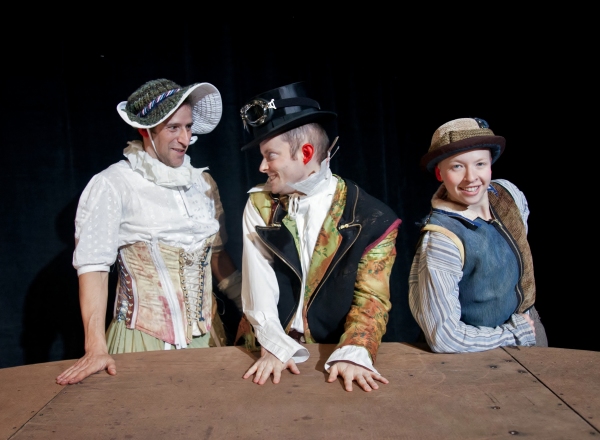
Adrian Danzig, Dean Evans & Leah Urzendowski

The next day brought another visitation from Keaton’s ghost when I finally got a chance to catch a performance by Chicago’s long-standing company, 500 Clown, their three-clown reenactment of Frankenstein, which has been in their repertoire for a decade or so. Here’s the program description:

Three Clowns embark on a madcap journey to construct Dr. Frankenstein’s laboratory. Bound in elaborate Edwardian costumes, they struggle through acrobatic feats in an extended battle with an unruly table. The Clowns stitch together the tale of the Doctor and the Monster from scraps of the classic novel and various Hollywood versions, inviting audience involvement throughout. Comic mayhem takes a sharp turn towards a devastating climax when one clown, forced into the tragic role of Shelley’s Creature, suffers abuse and abandonment.

This is one of those clown parodies that is less a satire of the original material than it is a saga of the valiant attempt of clowns to work together to coherently present a story. But being clowns, they will thankfully take us on many detours, which of course is the whole point. This they do quite well and the audience I sat in was merrily involved the whole way.
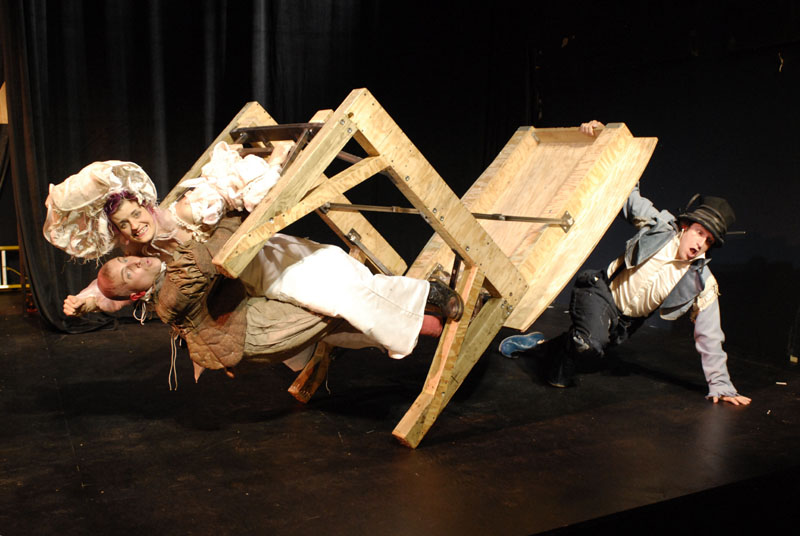
Now you all know my physical comedy radar is on 24/7, and some of you may even remember I did a long post dedicated to table tricks, so you won’t be surprised to learn that I was happy to see 500 Clown‘s extensive use of the table pictured above as a major prop; apparently it has appeared in at least one of their other productions as well. This is a heavy, sturdy wooden table with a hinged top and leaves that can be added to each side, features that allow it to be configured in countless ways, including operating table and guillotine. Only some of those ways involve it being in a “normal” position.
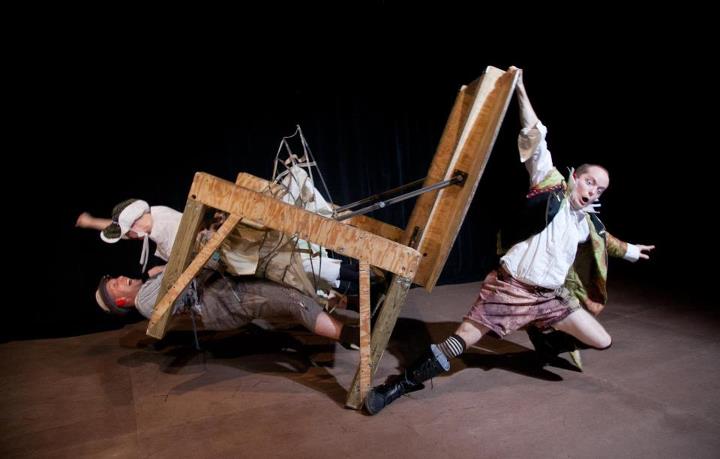
This hit home with me not just because of the many uses they find for the table — what Time Out Chicago called “outrageous humor and apeshit acrobatics” — but because you can tell that a lot of their material grew out of just playing with all these possibilities. And that’s my point. Comedy material can originate with anything — an improvisation, a character, a silly premise — but there are also riches to be found by starting with an exploration of the physical world. As I said in that earlier table post, “when I teach physical comedy, I like to play with this material world as much as possible, with oddball characters at odds with one another, and with all kinds of man-made stuff — chairs and tables, stairs and doors, walls and windows, and with every object that dares challenge our pride with the label unbreakable.” In the case of 500 Clown Frankenstein, this one prop becomes the anchor for an entire show.
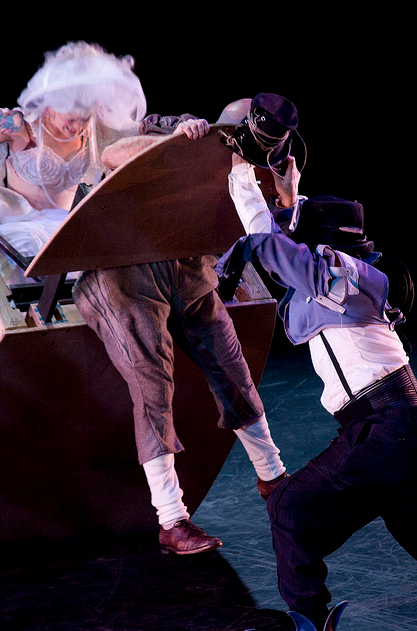
First a promo video for the show with some table action, and then I promise to bring this back around to Buster Keaton.

Once again you don’t see it in the video, but then I told you these were appearances by Keaton’s ghost. Somewhere in the middle of all the mayhem, 500 Clown does Keaton’s house collapse with the table! The extended table is on end and topples over so that the opening passes over the head of one of the clowns, just like in Steamboat Bill, Jr. True it’s not as spectacular nor nearly as dangerous as Keaton’s stunt, but it’s imaginative, visually stunning, and a nice homage to the great master.

And after a weekend of wholesome physical comedy fun in Chicago, an erotic footnote. (Knew that’d get your attention!) Back in New York, I caught the intense South African production of Mies Julie at St. Ann’s Warehouse. There were no ghosts of Buster Keaton in sight, but there sure was another table, though the only acrobatics on this one were sexual.

And if you know Strindberg’s original play, you can imagine how oh-so-serious and emotionally charged it all was. And me, I couldn’t help hoping the table would tip over at the height of passion and introduce the barely clad characters into fresh possibilities, thereby ushering in a new era of sexual physical comedy. Send in the clowns!
SHARE
EXPLORE FURTHER

Guest Post: Betsy Baytos on Eccentric Dance & Animation

POST 302
Thursday, November 8, 2012

I am excited to be continuing with our series of guest posts by eccentric dancer Betsy Baytos, whose Kickstarter campaign to complete a fabulous documentary film, Funny Feet: the Art of Eccentric I hope you will join me in supporting.
As you can see from the article below, Betsy truly knows her stuff. In fact, I doubt there’s anyone else out there who comes close to matching her personal work experience in eccentric dance and in animation, combined with years of thorough historical research and tireless dedication to the project. In this installment, you will read how the comic moves of eccentric dancers were directly translated into famous animation characters. Amazing stuff! —jt

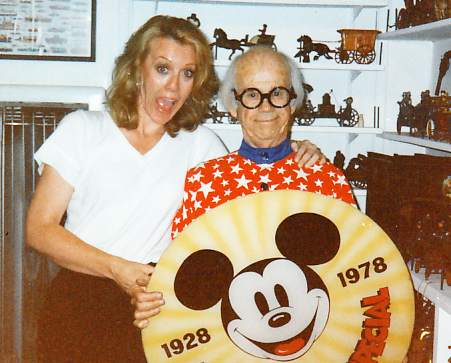
When I was first hired as a trainee at the Disney Studios at age 18, I had no idea how animation worked. But my early background in dance proved to be a bonus while working with my mentor, the great Eric Larson, one of Disney’s “nine old men.” Not knowing any better, I would physically work out the movement (always dance), for the required personal tests. This instinctive ability to translate my extreme flexibility into cartoon characters was a match made in heaven, and I was soon hired as a full-time in-betweener on The Rescuers while assigned to a veteran animator who best suited my style, the amazing Cliff Nordberg (Three Little Pigs, alligators in Peter Pan, Evinrude in The Rescuers, etc.), renown for his over-the-top, character-driven animation.

I had just discovered and was studying eccentric dance and immediately saw a powerful connection. What astonished me most was that the process in creating character, building a gag, and making a step funny was virtually the same between the eccentric dancer and the animator. Their language was identical! I could not wait to get back to Disney and tell Eric, who only chuckled and mentioned that these dancers had been a staple of inspiration for many animated characters from the early beginnings of animation.

It made perfect sense. Windsor McCay, an early pioneer in animation, toured the vaudeville circuit in 1906 as an animated chalk talk act, and followed in 1914 with a stage performance teamed with his Gertie the Dinosaur, at that time breaking ground as one of the first developed personalities in a cartoon. Sharing the bill with the top eccentric dancers and witnessing their cartoonesque, exaggerated movement must have ignited character ideas as it had for many other aspiring animators.

Ichabod Crane

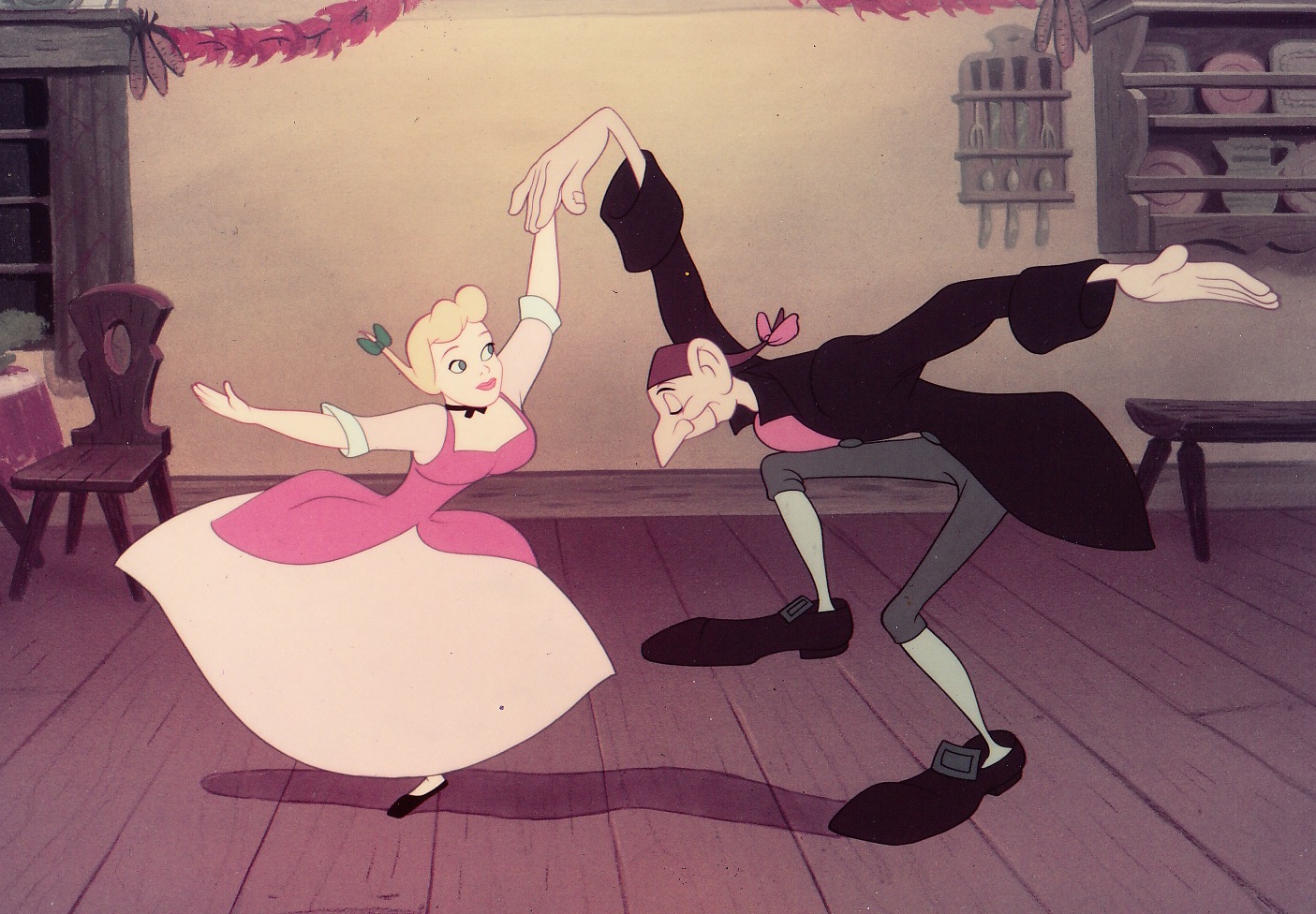
I had to learn more and was stunned when learning that my eccentric mentor, Gil Lamb, turned out to be the spot-on model for Disney’s Ichabod Crane in Legend of Sleepy Hollow, as was Buddy Ebsen for Disneyland’s Country Bears. The link was getting stronger, as Disney artists Ken Anderson and Joe Grant spoke of the tremendous influence Chaplin had on animation. Grant himself began his career as a Keystone Cop and had used Eddie Cantor and Charlotte Greenwood often as models. The prolific animation historian and writer, John Canemaker, clarified this analogy with his great documentary short of Otto Messmer, who first translated Charlie Chaplin into an animated character.

With Ward Kimball

As animation reflects our times, Chaplin’s “tramp” character was introduced the same time as the animated personality was evolving, and much of Chaplin’s movement was soon emulated by Messmer’s early Felix the Cat character. Vaudeville was a treasure chest of eccentric dancers and visual comedians and a bounty for animators to use as reference in their character work and still is.

I was still processing all this when the amazing Dixieland Band, the Firehouse Five, comprised of animators Frank Thomas, Ward Kimball and other visiting musicians, began playing outside the commissary during lunchtime. I could not help myself and began executing a rip-roaring charleston on the black-top. At first a shock to the Disney employees trying to eat lunch as well as to the animation staff, it opened up a life-changing opportunity — animation choreography! I was soon working with Don Bluthe on Pete’s Dragon, and dancing as the dragon Elliott in the parking lot, while tapping into the eccentric character process with a foam tail pinned to my arse. I worked again with Bluthe in Banjo soon afterwards. It was here that Disney allowed me to take an unprecedented leave to tour in Will B. Able‘s Baggy Pants & Co. vaudeville/burlesque show, followed by Jim Henson‘s Muppet Show, upon pleading how this rare opportunity would only strengthen my animation, which it certainly did!

Upon returning to Disney, I was thrilled to work on my alter-ego and hero, Goofy, the consummate eccentric dancer, in Mickey’s Christmas Carol, and then, again teamed with animator Cliff Nordberg, began work on The Fox and the Hound, animating the owl, Big Mama, and using the broadest character movement we could possibly conjure. It wasn’t long before the great animator Andreas Dejas called me in New York to stage the character movement in The Emperor’s New Groove. I was one step closer to bringing the eccentric style back into the animated cartoon.

I continued to animate and illustrate, while researching and studying eccentric dance, and when I made the decision to make this documentary, it was vital to film the animators themselves, discussing the eccentric dancer’s role in the evolution of animation.

Charlotte Greenwood

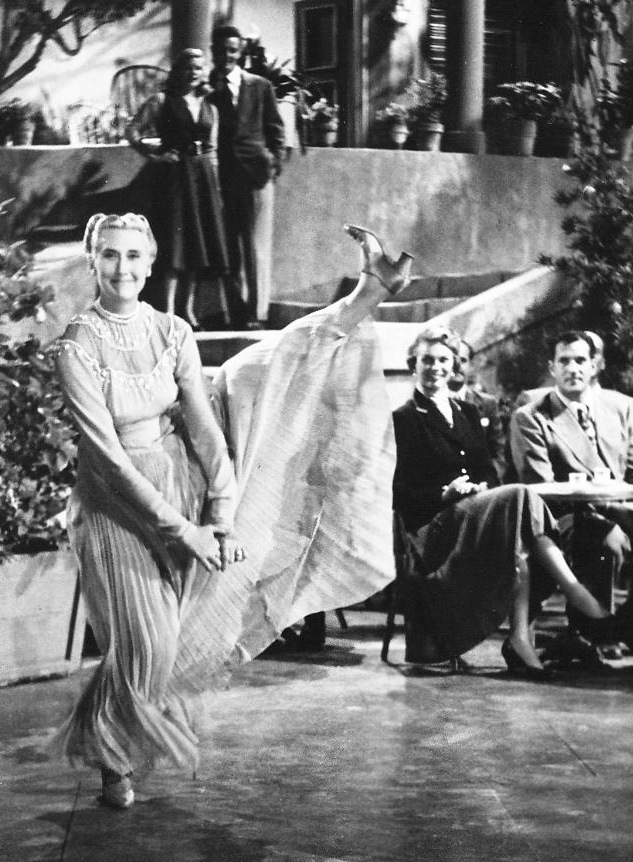
Many are represented well in Funny Feet: Richard Fleischer, son of Max Fleisher and a renown Director (20,000 Leagues Under the Sea; Dr. Doolittle) spoke of his uncle Dave Fleischer, a great comic dancer in his own right, as the model for the first rotoscoped character (1915), Koko the Clown. Richard spoke of his sister (then dating a young Ray Bolger), and her eccentric dance act where she popped on and off the screen, and how his father, who loved eccentric dance, most likely modeled Olive Oyl from legmania dancer Charlotte Greenwood.

Steppin Fetchit

Animator Myron Waldman‘s interview details watching vaudeville/burlesque shows while creating Betty Boop and Popeye, and how Cab Calloway was the model for the “old man in the mountain” and other characters. Chuck Jones‘ interview was wonderful, detailing how he studied Chaplin, Laurel & Hardy and Keaton, but professed how Groucho’s walk became a signature in creating Bugs Bunny!

Buster Keaton

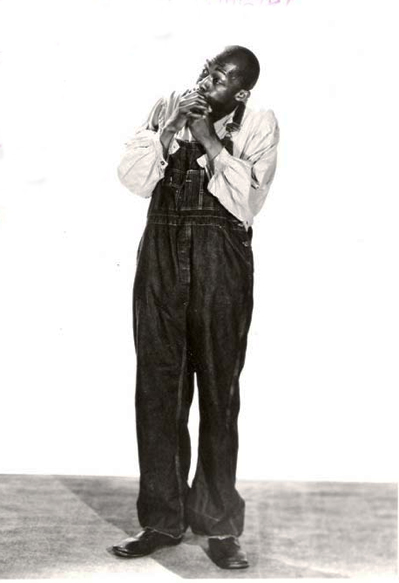
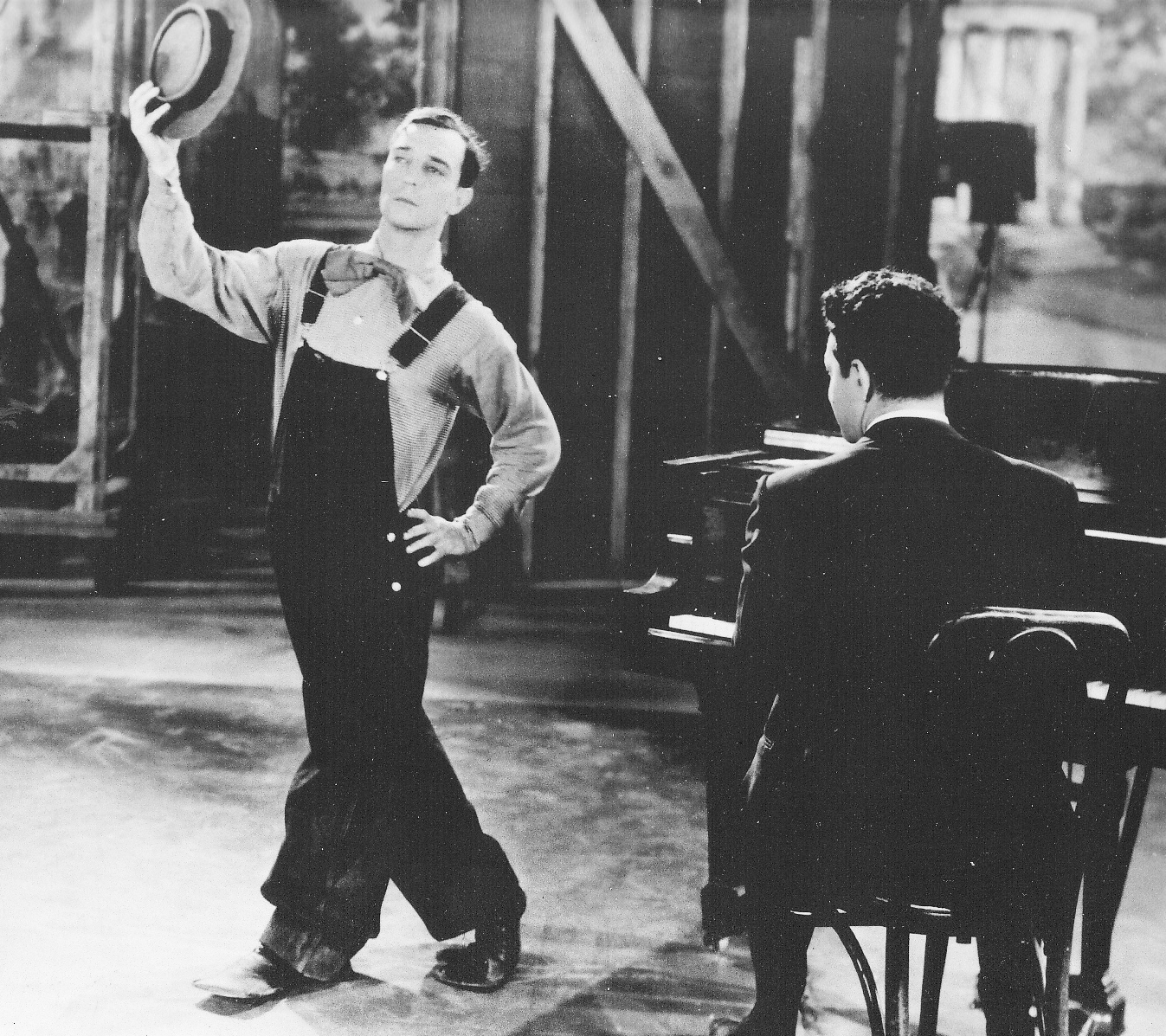
Frank Thomas & Ollie Johnston spoke a great deal about the physical comedians’ influence on their own work, specifically citing Chaplin, Laurel & Hardy, Red Skelton, and Buddy Ebsen. Ward Kimball elaborated on always searching for new walks, and how animator Art Babbitt‘s defining 360-degree walk for Goofy made him a star, and how Steppin’ Fetchitt and Keaton played an enormous role in the development of Goofy’s character movement and personality.

Joe Barbera

Joe Barbera, of Hannah Barbara provided incredible details on teaming Gene Kelly with Tom & Jerry, and later, on their ground-breaking collaboration for Invitation To The Dance. Al Hirschfeld, the renown NY Times caricaturist, eloquently spoke of observing, then capturing in line art, all the great eccentrics that graced the NY stage, and how Bolger specifically was inspired in his own movement by Hirschfeld’s illustrations.

And the tradition continues, as the next generation of animators (Andreas Dejas, Eric Goldberg and others) understand the importance of observing and tapping into these great ‘cartoon’ eccentric dancers.

The Princess and the Frog

It all came full circle when the talented animation directors John Musker and Ron Clements (Aladdin, Little Mermaid) approached me to bring the eccentric tradition into their next animated feature, The Princess and the Frog. I was thrilled to have the opportunity to again work with a wonderful animation team, and especially, to introduce this history, a pre-cursor to their own work, to the next generation of incredible hip-hop break dancers. The surprise was instantaneous and I pushed them hard to capture the extreme movement necessary for animation.

The result was the “reference” video below, This was the “Mama Odie” number (the 200-year-old blind sorceress), with two spoonbill birds in the background, which eventually they multiplied to make it look like a flock of birds in a choir. (It was a gospel-type number.) She pantomimes her sidekick, a boa snake which I staged like a boa feather. The key for me was to hire matching body types for the animated characters….so I was very specific on the audition call. I staged seven musical numbers and six dialogue sequences over all.

Buddy Ebsen and the animation grid

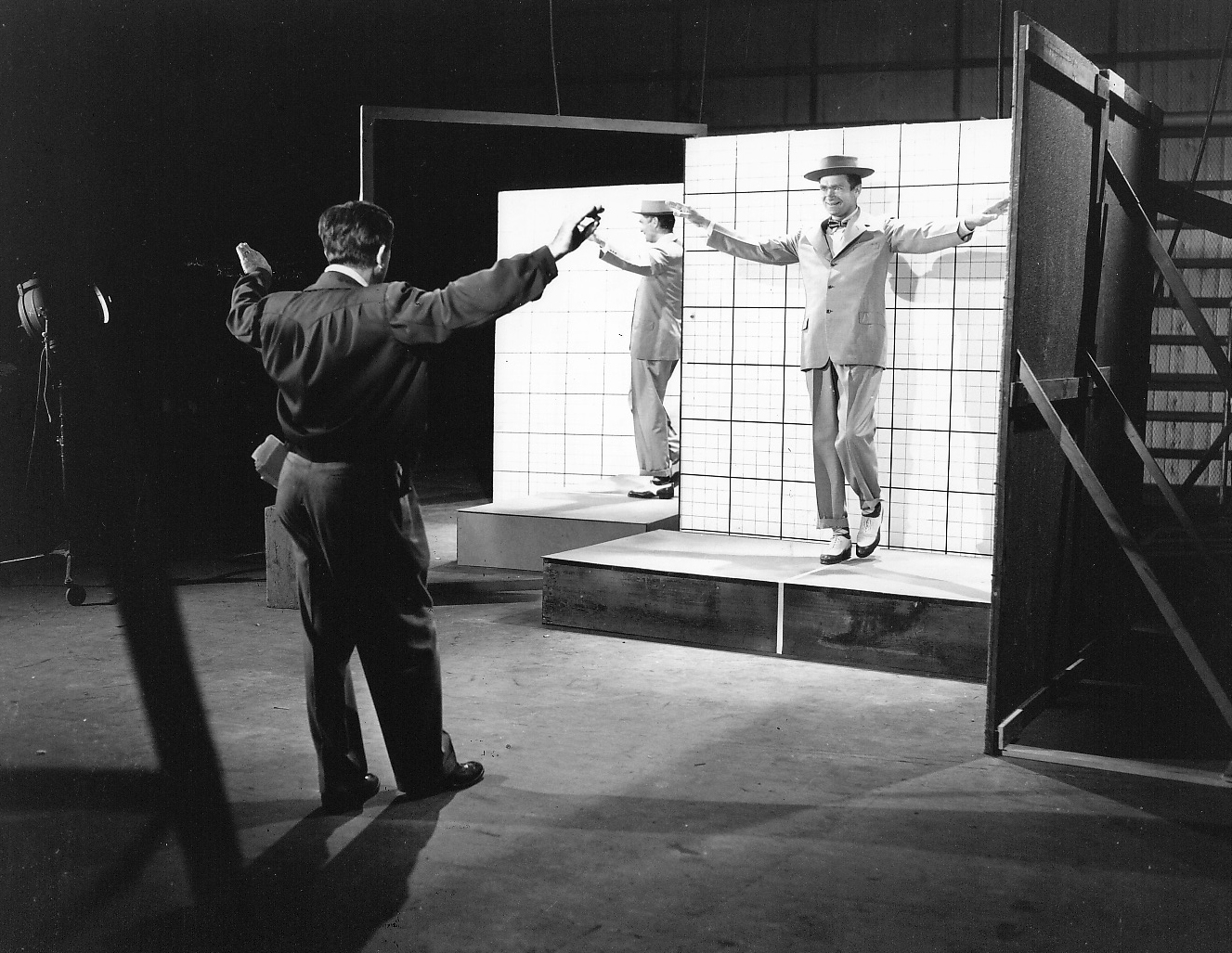
Before I even began, I sat with the directors and went over an animatic storyboard, frame by frame, so I could match precisely the sound effects, dialogue and musical punctuation. (As it is all recorded prior to any animation beginning). As you see here, every gesture (head tilt, arm swing, etc….) was broken down frame by frame, (24 drawings a second for feature quality) No motion capture or rotoscope — I staged each number per frame, then one as a looser version, and then a couple of variations on walks (very important) and then one with total improv (in case the performer had an idea, so just let them do what they do best!). They used all as reference only….so they would have the freedom to play with the choreography. Everything was shot against a grid, exactly as with Buddy Ebsen in this photo. It is also filmed in every variation….(overhead, below, side views, etc….)


Choreography to me is not just dance…..it is ‘character’…..it’s how a character sits, walks, gestures, and even more importantly….not moves, which is sometimes more powerful. It is the art of pantomime…and I make my characters think….why do you walk over there….why do you sigh and slump….why are you jubilant. There must be a reason for the movement. It’s all about action and reaction.

What the animators taught me, I heard directly from Ray Bolger when we talked about Once In Love With Amy. He said I had to have a reason for every move I made. It’s all the same process, fascinating to me, between an animator and an eccentric dancer. When I worked with the clowns at Cirque, it’s something I saw quite a bit. They walk out and do their schtick, but I made them think about character. How your walk on stage is different than another….how your body language defines who you are from the moment you step out onto that stage. Add to that a unique twist that becomes identifiable to your character, which your audience will identify you with. For example, for Dopey the animator Frank Thomas added a “hitch-kick” to his walk, which at first was an accident but became his trademark. All this is important: character, story, body language, and believability to your audience, so they can empathize with you. In animation and eccentric dance, the rules are the same!

Funny Feet can help me imagine a dream to strengthen the relationship between dance and animation, training the two genres to inspire each other once again!

Click here for Betsy’s web site.

Click here for all of her guest posts to this blog.

And stay tuned. More to come!

SHARE
EXPLORE FURTHER

“Arrested Development” Channels Buster Keaton

POST 285
Wednesday, October 10, 2012

One of Buster Keaton’s most famous (and dangerous) gags was standing obliviously in the path of a falling side of a house in Steamboat Bill, Jr. (1928).

Yes, the stunt was real and was based on precise measurements. The wall could have killed him.

Fast forward to season 2, episode 2 of the tv show Arrested Development, where a character named Buster tries to have a house fall on him to get out of going into the army, but again a (larger) window saves him.

Buster’s one of the regular characters on the show, so the name wasn’t created for this episode. In fact, maybe the character’s name gave them the idea.

Thanks to Riley Kellogg for the link!

UPDATE (Nov. 29, 2012): Click here for a new post on more revivals of this classic Keaton stunt!

SHARE
EXPLORE FURTHER

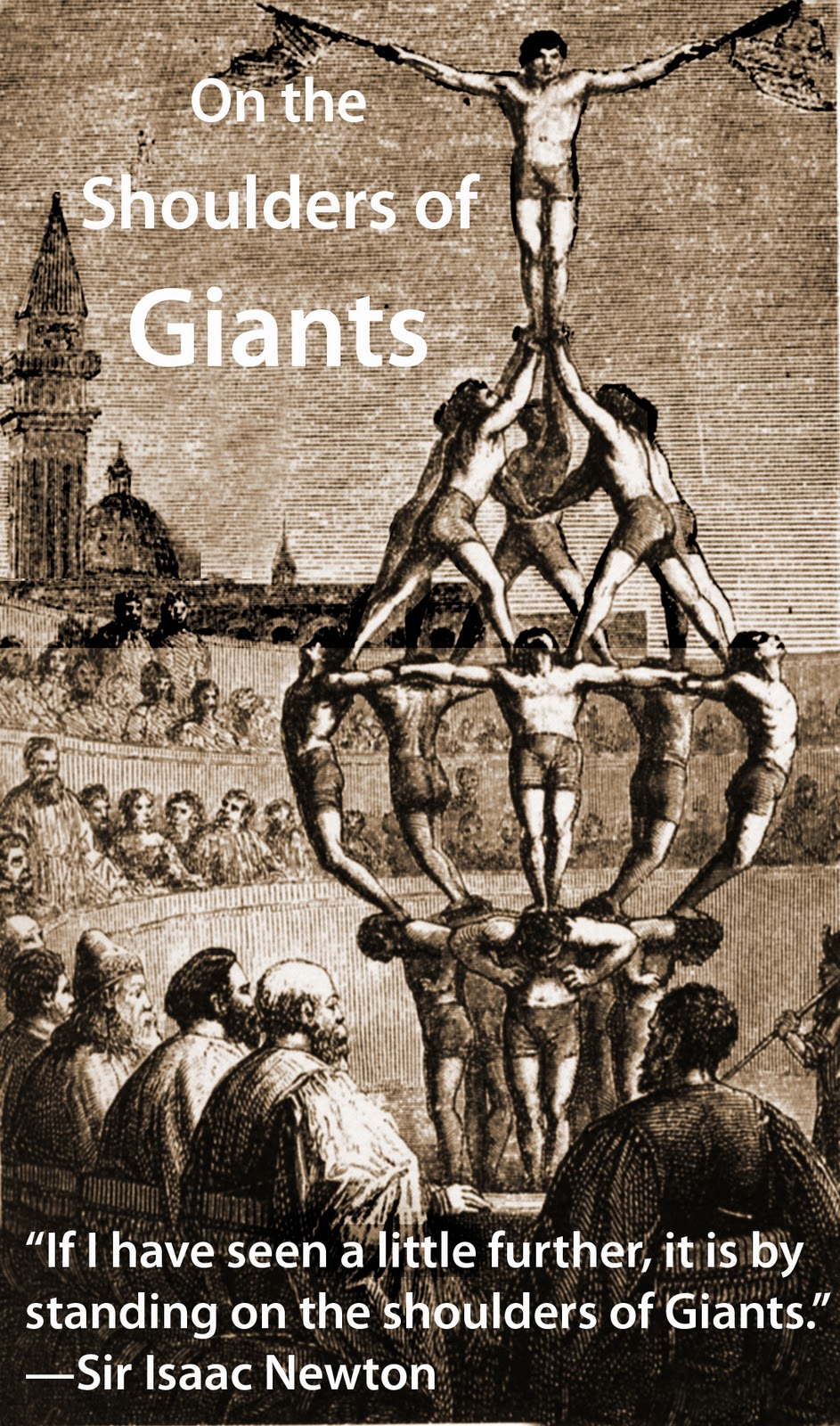
On the Shoulders of Giants: The Oblivious Gag (or, Channeling Harold Lloyd)

POST 260
Monday, April 9, 2012


Installment #2

Picasso once said, “good artists borrow, great artists steal.”

No he didn’t. Or if he did, he probably stole it from T.S. Elliot, who supposedly said the same thing about poets.


Supposedly, because what he really wrote was: “One of the surest tests is the way in which a poet borrows. Immature poets imitate; mature poets steal; bad poets deface what they take, and good poets make it into something better, or at least something different. The good poet welds his theft into a whole of feeling which is unique, utterly different than that from which it is torn; the bad poet throws it into something which has no cohesion.”

Ditto physical comedians. Depending on how you look at it, they either avail themselves of a time-honored tradition of gags and techniques — or they “steal” like crazy. As Joe Killian and I used to joke about a bit we liked: “Consider it stolen!”

But as the two Toms (Stearns and Leabhart) said, it tain’t what ya do, it’s da way dat ya do it. Wit dat in mind, we get to have a little fun standing on the shoulders of that physical comedy giant, Harold Lloyd…. and in this case those shoulders are high off the ground.

While many of the gags seen in silent film comedy can be traced to the variety stage, taking a movie camera outdoors and letting it follow the action opened up new possibilities, the car chase being an obvious example. But the camera could also track vertically, taking advantage of that era’s skyscraper boom to create thrills formerly reserved to displays of high-wire walking in the town square.

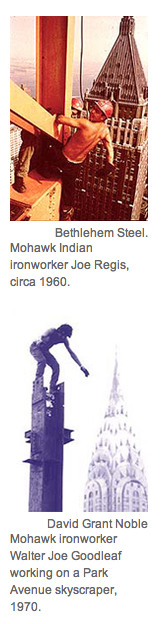
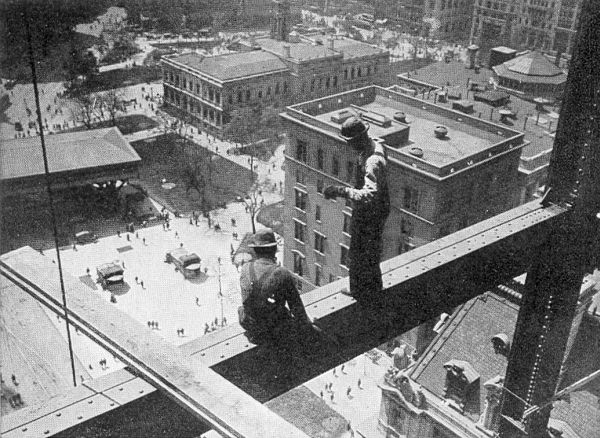
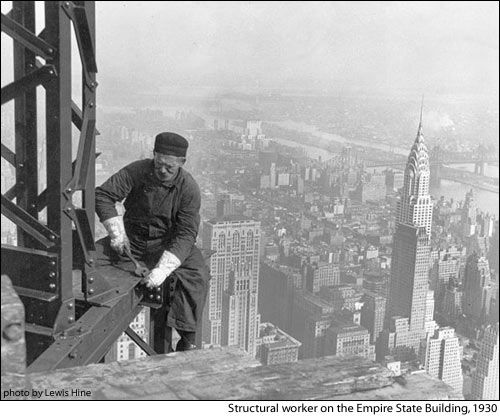
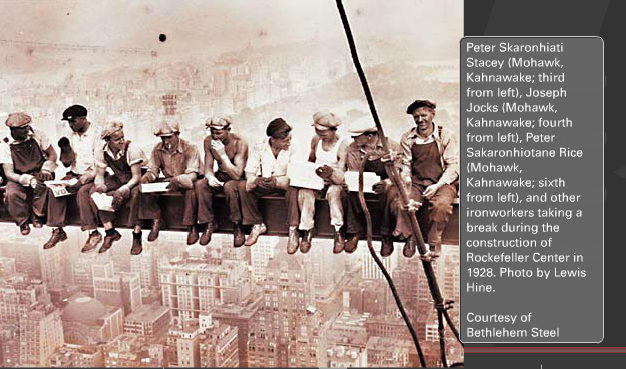
[ASIDE #1: Native Americans, specifically Mohawks, were used in large numbers in the building of the early skyscrapers. They gained a reputation for “walking iron” and were credited with superior balance and no fear of heights. Likewise, my friend Pat Judd, who like me has a bit of Cherokee blood, comments “let’s hear it for my Cherokee / Choctaw ancestors who stood on top of the Mackinac Bridge arches when no one else wanted to go up there to finish that expansion project!” In more modern times, Mohawks were heavily involved in the construction of the World Trade Center. Go here and here and here for more on this cultural phenomenon and listen to this NPR All Things Considered report.]

[ASIDE #2:  Georges Mélies did a 74-second rooftop action film more than two decades earlier in 1897, Sur les Toits (On the Roof), but it’s shot on a stage set and is pretty lame. Likewise Alice Guy’s rooftop chase, Les Cambrioleurs (The Burglars) from 1898.]

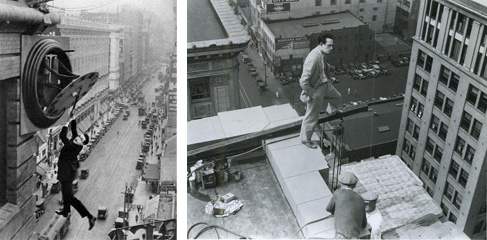
Camera angles and other tricks ensured that enough of these stunts were less dangerous than they seemed. Note, for example, the absence of high-angle shots that would reveal any safety precautions. All this made possible a whole new genre of thrill comedy, with Harold Lloyd climbing to and dangling from that clock in Safety Last being the most iconic example. But this piece is not about Safety Last, but rather another Lloyd skyscraper sequence — and above all his refinement of what I am hereby dubbing the “oblivious gag.”

Left: Lloyd in Safety Last;
Right: Safety mattress for Lloyd’s Feet First 

First, however, a few popular photographs showing the public’s fascination with this dangerous new world being created in the skies above them.

The Waldorf (1930)

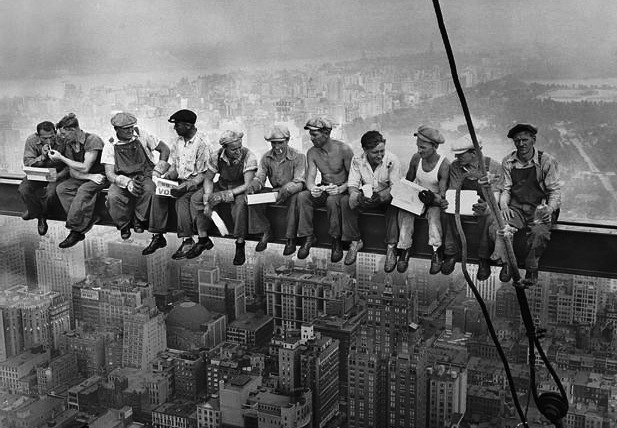
You’ve probably seen this well-known Lunch Atop A Skyscraper by Charles Ebbets, taken in 1932:

But this Smithsonian exhibit on the Mohawk says the year is 1928 and that the photo was taken by Lewis Hine. Hmm… anyway, the caption does identify several Mohawk ironworkers.

And a current photo from the One World Trade Center construction:

Back in the day, they didn’t just pose for pictures up there, they did entire acrobatic acts. Here’s a video of the same guys from the photo above:

Even more spectacular is this clip of the vaudeville acrobat Joseph Späh, who performed his daredevil drunk act under the name of “Ben Dova” (get it?). This is from 1933, a bit after Lloyd’s heyday, but I suspect Späh was not the first to be doing stunts like this.

Lloyd didn’t invent aerial movie thrills, but he had the foresight to see the comic potential and the talent to take advantage of it. As one Lloyd title card reads, “In a Certain City, each crowded skyscraper holds a budding romance.” An early example of this is in High and Dizzy, his 1920 short. [Note that this is a decade before the above photos.] Harold, a new doctor in love with a new sleepwalking patient, somehow manages to find himself on the same hotel ledge as her. At this point in the story, she has already taken one oblivious stroll on the ledge.

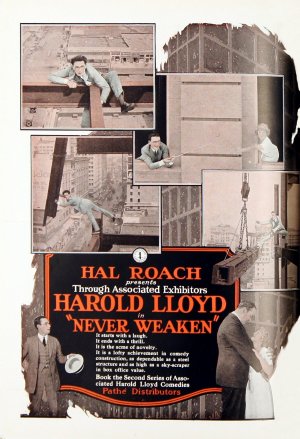
Notice that the sleepwalking mindset even carries over to Harold, who is so concerned with the girl that he is out the window and walking along the ledge before he realizes where he is and can even register fear. He continues this theme a year later in Never Weakenhis last short film and favorite 3-reeler. In this one, Harold has of course gotten his facts wrong, mistakenly assuming he’s lost the love of his life to a tall, handsome stranger. Suicide is the only option. Blindfolded, he soon finds himself skywalking without realizing it, and again gets his facts wrong, thinking he’s in heaven.

Lloyd sure knew how to get the most out of a gag. I love that the oblivious theme is reprised at the end of the sequence, with him on the ground, frightened out of his mind.

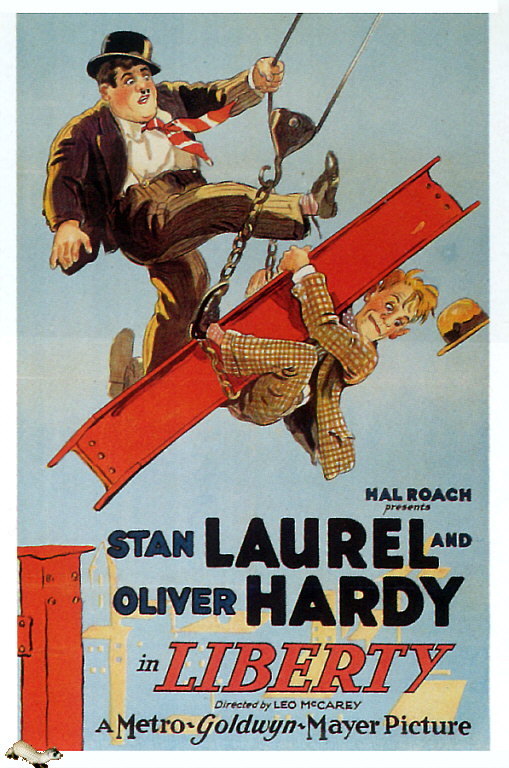
If this skywalking sequence looks familiar to you, that’s because it’s been replicated many times, with and without the “oblivious” aspect. An early case in point is from Liberty (1929), a late silent film by Laurel & Hardy. This is not bad, but they don’t do anything new with it, so please don’t feel obligated to watch all 11 minutes. I just include it to make my point!

Not surprisingly, this comic business shows up in numerous cartoons — much easier to draw than to stage! — but of course the thrill is not quite the same. First up is A Dream Walking, a Popeye cartoon from 1934.

And then there’s this sequence from Bugs Bunny’s Homeless Hare (1950).

A character who was totally unmindful became the trademark of Mr. Magoo (voiced by Jim Backus), star of animated movies and a long-running tv show. Near-sighted in the extreme, Magoo stumbles through a hostile environment unaware of the perils he is skirting. The opening titles to his Saturday morning tv series capture this m.o. pretty well, and include the kind of high-elevation gags popularized by Lloyd:

Babies are also liable to be unaware of grave dangers, thus Tot Watchers, a Tom & Jerry cartoon in which our heroes save a baby from — you guessed it — yet another construction site.

And we come full circle, from cartoon back to live action, with the otherwise forgettable Baby’s Day Out (1994), in which the incompetent bad guys learn that kidnapping is not as easy as it’s cracked up to be. Again with the construction site!

The Oblivious Gag
So we actually have two things going on here. One is simply the thrill comedy of the skyscraper, interesting enough in its own right. But more significant because it’s more useful to your average feet-on-the-ground comedy creator is this particular genre of gag that could take place anywhere and only depends on our comic hero being spectacularly unaware and even more spectacularly lucky. And for my money, it’s usually funnier if the unawareness is more of a (comic) character flaw than being simply caused by sleepwalking or blindness.

While your classic gag structure relies on some initial unawareness on the character’s part, he or she usually pays the price and we get to see their reaction to the outcome. We see the banana peel, they don’t. They slip, they fall, they react, we laugh. Conventional wisdom has it that this is funnier if the character is wearing a top hat, or at least acting haughty, because the greater the assumed dignity, the more satisfying the fall.

With the oblivious gag, there is no price to pay and the joke is that such characters have no idea how close they have come to harm. With no payoff required, structurally it’s more likely to be a running gag rather than a three-parter.

Sometimes they eventually learn — cue the double-take — but sometimes they are never the wiser. Peter Handke wrote a play called The Ride Across Lake Constance and, if memory serves, the title references a folk expression meaning “you just escaped great danger without even knowing it.” A man walks across frozen Lake Constance. When he successfully reaches the other side he is informed that the ice is too thin to support human weight. He immediately dies of a heart attack. Thus the saying, “you took a ride across Lake Constance.”

Another expression tells us it’s better to be lucky than good, and that’s certainly true of our old friend Harold Lloyd in the aptly titled Why Worry? (1923). A hypochondriac millionaire, he is seeking peace and quiet in what he thinks is a quaint island paradise, only to find himself in the middle of a revolution — not that he notices:


Buster Keaton’s The General (1926) features an army reject who becomes a war hero through a combination of courage, resourcefulness, and plain luck. The intertwining of several oblivious gags over the course of the movie makes the sum greater than the parts and shows why Keaton’s storytelling so often rose to the level of art. Here’s a short example in which Keaton, infiltrating behind enemy lines, is so busy with firewood that he fails to notice two entire armies passing by. If you’re going to be oblivious, might as well go big with it!

And here his inability to get control over his pesky sword pays off big time:

In some of these scenarios, we do eventually get to see the character’s reaction to a rather perplexing reality. In another short sequence from The General, Keaton is trying to derail a box car that is impeding his progress. His first reaction comes when he discovers that it has somehow gotten back on the track; his second, when it magically disappears. Both are to be savored!

In more recent times, the Peter Sellers character of Inspector Clouseau in the Pink Panther movies solves every crime thanks to incredible luck and despite being oblivious to pretty much everything going on around him. In this selection from A Shot in the Dark (1964), our inspector’s charmed life is not even mildly ruffled by multiple assassination attempts. [Spoiler Alert: the would-be assassin turns out to be his boss, Chief Inspector Dreyfus, seen berating him at the end.]

And of course we love Clouseau and root for him no matter what!


Thanks to Ben Model, Drew Richardson, Riley Kellogg, and Jeff Seal for their suggestions for this article.

SHARE
EXPLORE FURTHER

The Fantastic Flying Books of Mr. Morris Lessmore

POST 246
Thursday, March 1, 2012


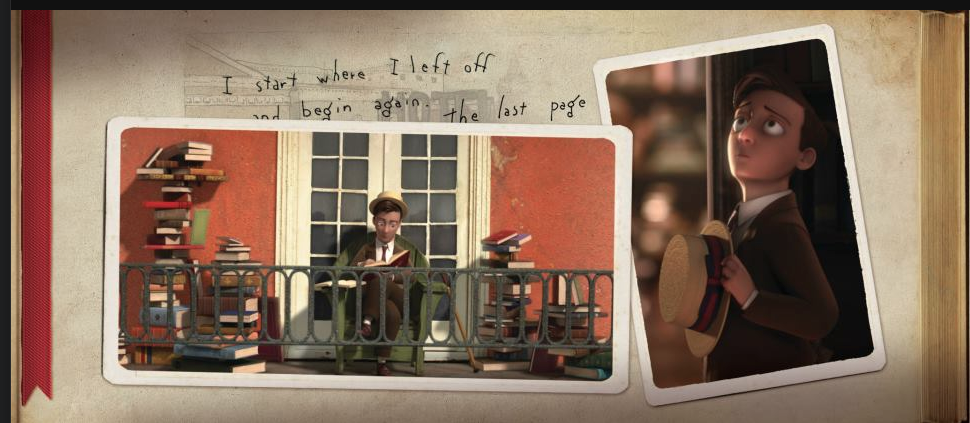
Not only did The Artist score a touchdown for silent films with its five Academy Awards, but the prize for best animated short went to The Fantastic Flying Books of Mr. Morris Lessmore, a movie “inspired, in equal measures, by Hurricane Katrina, Buster Keaton, The Wizard of Oz, and a love for books.” Fans of Buster will recognize the physical resemblance (and the pork-pie hat), but the movie goes further by paying tribute to such stormy Keaton movies as One Week and Steamboat Bill, Jr., as well as to the dance virtuosity of Chaplin’s tramp.

The producers have been so generous as to put the entire 15-minute film online for free viewing. I recommend full screen! Thanks to Tanya Solomon for the link.

Click here for a review in the New Yorker.

SHARE
EXPLORE FURTHER

Brooklyn’s Rube Goldberg

POST 230
Saturday, January 14, 2012

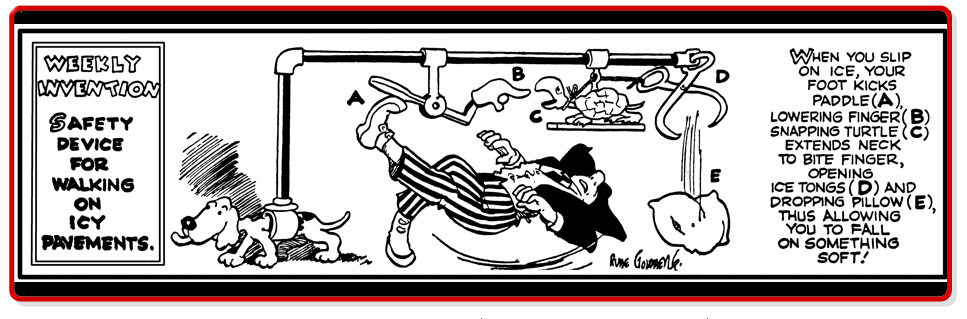
Rube Goldberg was an inventor and cartoonist born the same year as Max Linder (1883), which is to say a few years after Mack Sennett and a few years before Charlie Chaplin and Stan Laurel. He drew popular cartoons of elaborate gadgets that performed simple tasks in the most convoluted way imaginable.

Goldberg’s eccentric approach to tackling life’s everyday obstacles makes him a spiritual cousin to many of the silent film comedians, especially Buster Keaton. “Rube Goldberg machines” have continued to capture our imagination a century later, but I for one have never seen anything nearly as fantastic as the work of kinetic artist Joseph Herscher, as profiled in this cool video from the NY Times:

Although Herscher only makes himself a minor player in this machine drama, physical comedians do not hesitate to throw themselves into the action. Buster Keaton’s movies are full of oddball inventions, such as these from The Electric House (1922):

But this is a comedy, so every invention of Keaton’s must of course backfire in the second half of the movie. You can see for yourself by watching the whole movie online here, though I of course recommend treating yourself to a high-quality DVD. You deserve it!

SHARE
EXPLORE FURTHER

Guest Post: “Keaton the Conjuror” by Ben Robinson

POST 225
Thursday, December 29, 2011

Ben Robinson is both a master magician and an historian of magic, author of Twelve Have Died: Bullet Catching, The Story & Secrets and of The MagiCIAn: John Mulholland’s Secret Life, as well as numerous articles for major magic publications. Just last month, Ben’s decades-long research into the use of magic in silent films came to fruition with publication of his latest book, Magic and the Silent Clowns — a subject that had received scant attention until Ben’s work. Concurrent with that, Ben helped curate a fascinating show at New York’s Museum of the Moving Image entitled Magicians on Screen, including both a magic performance by Ben and a lecture-demo on the subject of magic and the silent clowns. In fact, Ben had first proposed the idea to the museum back in the 80s. Patience is indeed a virtue — though persistence sure helps! This blogopedia is very pleased to be able to share the first chapter from Magic & the Silent Clowns, and to be able to match Ben’s enthusiastic prose with a few video clips.
_____________________________________

Keaton the Conjuror
Buster Keaton’s education and use of the conjurer’s illusionary techniques. 
by Ben Robinson

“Once Pop accidentally wrecked another act by tossing me into the backdrop curtain. This was the turn of Madame Herrmann, the widow of Herrmann the Great, one of the most popular magicians. She was working some of his simpler tricks. At the finish of her act she had dozens of white doves flying to her from every corner of the stage.” (My Wonderful World of Slapstick, p27)

Buster Keaton was an illusionist.

It is said that the world’s greatest illusionist, or magician, would never be truly known by the public at large. Why?  Because so great a “talent” wouldn’t need the adulation, as the prowess by which the work was deployed would be best praised by not even being seen. In the shadows of show business and art, there would lie success. In the French this is referred to as eminence grise. While Buster is certainly known, his use of illusion is at best appreciated as an auxiliary component to the gag
However, a deeper look into Buster’s upbringing and eventual use of his fantastic vaudeville education clearly expresses itself in his movies, some of his TV appearances and, more notably, when meeting the media. It might be assumed that the Keaton we see is an image he is in total control of. That being said, the controlled image we always saw was one of a surreal world where “magic” was part of the landscape, like air. In the famous Sid Avery photograph of Keaton, titled “What Elephant?” while Keaton looks forward, with his hand on his brow, the elephant’s trunk winds through his other arm, the pachyderm quietly standing behind the comedian.  This is a vanishing elephant only to the person closest to the king of the forest, a good metaphor for Keaton’s “magic.”

While the examples of Keaton’s legerdemain are too numerous for inclusion here, this notion may bear some examination in the following examples. 
Clearly, legend has it that Buster received his nickname from Houdini. While this may be a matter of conjecture, the legend sticks (and most vaudevillians would tell you that when it comes down to printing the myth or the truth, they yowl, “the myth, print that!”). 
That Joe Keaton and Harry Houdini (1874-1926) once appeared before the audiences of the Midwest in a tent show is certainly a fact. It is also a fact that this show, The Keaton-Houdini Medicine Show, was not a great success, and occurred years before Houdini’s triumphant success in Europe in 1900. Of his father Keaton remarks that “he was an eccentric dancer, not an acrobat, but damn near.” The same might be said of Keaton: he wasn’t a magician in the classic sense, but damn near. Like a classic magician, everything that he saw, particularly of the mechanical variety, was always filed away in his memory for future use. His summer home amidst the actor’s colony in Muskegon, Michigan was not far from a little town named Marshall, among its distinctions being the home of the very first electrified house in the US. Called Honolulu House, it doesn’t have the electric staircase (escalator) Buster later used in his movie The Electric House, but it does have many other mechanical wonders, including the sliding bathtub that switches between rooms that Buster used on celluloid. 
Backstage, Buster saw it all. He refers to utilizing some of Houdini’s tricks in his movie Sherlock Junior, and even opens Cops with a line credited to Houdini: “Love laughs at Locksmiths.” He also acknowledges a relatively little-remembered genuine Chinese vaudeville illusionist, Ching Ling Foo — whose grand feats included turning a somersault in mid-air and when he returned to a standing position, he held a bowl of goldfish that 
appeared from nowhere! 
Young Buster grew up learning that magic had to be “justified” or plausible for the introduction of an illusion. He realized in his movie-making career that “cartoon or impossible” gags (and illusions) had to be justified, like his jumping and impossibly disappearing into the briefcase held by a man (dressed as a woman) accomplice on the street (Sherlock Jr.)….

….or appearing as nine individual dancers on stage at the same time (The Playhouse)….

 ….or avoiding the tornado winds by hiding in a magician’s prop (Steamboat Bill Jr.)….

Whenever magic occurred, Keaton might have been justifying his conceit he explained as “I always want  the audience to out guess me, and then I double cross them.”

Keaton’s use of illusion was not always as a trick per se. When the house he moves across the train tracks in One Week narrowly escapes destruction by an oncoming train, another train enters the frame — and his on-screen drama — and demolishes what we only thought, seconds before, was safe. The revelation of the perceptual difference of the first train set the audience up for the wow appearance of the second train.

Similarly a magician will make a scarf appear, only to have the audience relax at that manifestation. When a dove flutters from the folds of that scarf, there comes the “topper.” Buster just played with much larger props. 
This type of drama, albeit small, is as much part of the conjurer’s lexicon as a rabbit and a hat. Magicians refer to this type of presentation as a “sucker gag.” Feigned failure, only to be consummated by winning success, or in the previous example, unexpected total destruction. 
I believe Buster was schooled in such thinking about surprise (both magic and comedy being dependent on surprise) by his vaudeville and mud show upbringing.  The magician’s technique he learned as a child pervaded his work on screen and elsewhere. On stage in France, in the late 1940s, he counseled the clowns in the Cirque Medrano how to get more out of the crowded clown car gag. Multiple large clowns (always ending with the largest of all) simply emerging from a small vehicle was impossible. Once Keaton showed them how the impossibility became surprising, then the illusion became magical, funny and even more surprising. How many times have we all seen this? And how many times have we seen the clowns emerge with beach chairs and finally a clown emerging with a full tray of food including a stuffed turkey?  These were Keaton’s touches he culled from the Hanlon Bros. performance of clowning, magic and illusion that took place in 
Europe and the US prior to 1900. 
And now for the magic that hits you as reality.  This may give you an example of Buster’s eminence grise
Remember the famous scene in Sherlock Junior where Buster is “shadowing” a man walking in front of him?  Now, watch as the man tosses a cigarette behind him which Buster catches, takes a drag of and then discards…or does he?  Given that Buster is the fellow who had a whole side of a building fall around him, missing him by mere inches, I think handling a lighted cigarette in flight was child’s play for him. But slow down the image and you will see a nifty piece of sleight of hand he no doubt executed on many occasions, being an inveterate cigarette smoker.

Other hand magic: in The Cameraman Buster tried to catch the fancy of the photo assignment secretary by making a quarter disappear in his hand, only to be revealed from behind his ear.

 In Steamboat Bill Jr., when attempting to have his father receive a loaf of bread in jail, Buster mimes the contents of the bread and involves another deception of the hands. Effortlessly. Gracefully. As if he yawned.

All magical illusions are understood by the student of the art, firstly through small, hand-held deceptions.  Given Buster’s consummate understanding of the nature of his medium (in this case, film) it is likely Buster combined this understanding with his familiarity with the scene backstage where magicians show each other tricks they carry with them, one time known as “vest pocket magic.” 
The point: Buster understood close-up magic because he was schooled in close-up magic from day one. 
Whether it was dangling from a rope to save his wife from the pitfalls of a raging waterfall (a la Houdini) in Our Hospitality or making it appear as if he simply caught a lighted cigarette from the air, Keaton saw the meshing of illusion and  reality in every situation, and exploited it. While performing off stage for a visiting film crew, in his later years, he created the illusion of catching a train, and bringing a 10-ton locomotive to a halt.  One might say this was a developed version of catching the side of a moving car and being whisked from view, as in one of his short comedies.  
Jack Flosso, the late owner of the world’s oldest magic shop, knew Keaton remotely through his father, the great Al Flosso, veteran of thousands of vaudeville and Coney Island sideshow performances.  Flosso says, “When you do magic and don’t admit it, that’s great. Harpo did that, and where’d ya think he got that…Keaton! Buster had an eye for everything. Remember that.”  That Keaton’s silent, surreal illusions should find a home in the 1930s amidst Harpo’s arsenal of wonders is not surprising to any Keaton scholar. What is delightful is that Keaton’s use of illusion was an integral part of his day-to-day life.

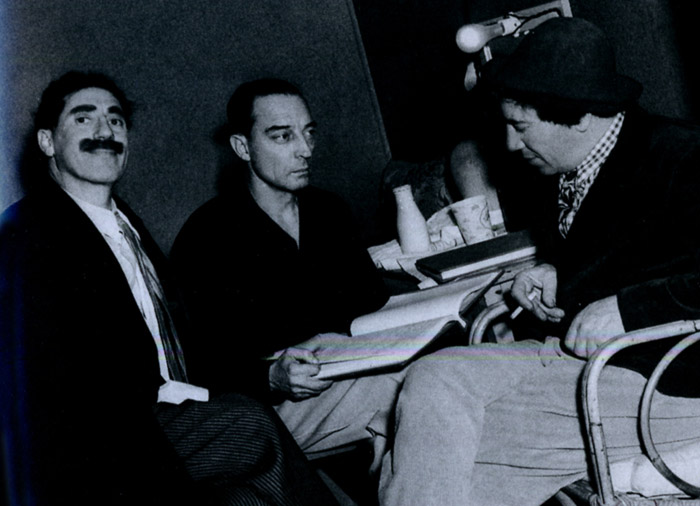
Buster Keaton working as a gag writer for the Marx Brothers

He frequently polished a window near him only to surprise his viewers by putting his head through the glass he had just polished, revealing that his polishing was deft pantomime… the illusionary transparent glass was only perceived as solid by his impromptu audience.  Many remark what a great practical joker he was. Such visual jokes have their roots in illusion. In several newsreels depicting Buster at play one finds Keaton doing something short and sweet like sewing his fingers together (later adopted by Red Skelton) or making a baseball disappear for a dog (but not for the rest of the audience). Anything surprising, anything out of the ordinary from this apparently “ordinary” man made his magic more memorable and surprising. 

We always hear of the “magic of the movies.” Buster Keaton is a master of a special type of  movie magic that, often, you don’t even realize is right in front of you! 
_________________________________________________ 
Sources: 
Beckett, Samuel., FILM, Grove Press, NY 1969. 
Bengtson, John., Silent Echoes  (Discovering Early Hollywood Through the Films of Buster Keaton), Santa Monica Press, CA 2000. 
Blesh, Rudi., Keaton, The Macmillan Company, New York, NY 1966. 
Dardis, Tom., KEATON — The Man Who Wouldn’t Lie Down, Limelight Edition, 1996 
Kerr, Walter., The Silent Clowns, Da Capo Press, NY 1975. 
Keaton, Buster with Charles Samuels., My Wonderful World of SlapstickDoubleday & Co., NY 1960. 
Kline, Jim., The Complete Films of Buster Keaton, Citadel Press, NY 1993. 
Knopf, Robert., The Theater and Cinema of Buster Keaton, Princeton University, Press, NJ 1999. 
Meade, Marion., Buster Keaton Cut to the Chase., Harper Collins, NY 1995. 
Tobias, Patricia Eliot, Ed., The Great Stone Face, The Magazine of the Damfinos, The International Buster Keaton Society, Volume 1, 1996. 
Interview with Jack Flosso in New York City, December, 1999. 
Kevin Brownlow, & David Gill (producers)., Keaton A Hard Act to Follow, Thames TV production, 1987. 
________________________________________

This article was originally published in The Keaton Chronicle, the magazine of the International Buster Keaton Society, The Damfino’s, in the Vol. 10 Issue 4, Autumn, 2002. Reprinted by permission. It is also part of Ben Robinson’s book Magic & The Silent Clowns (2011).

________________________________________


Visit Ben’s web site here, where you can also purchase his book directly via PayPal.

SHARE
EXPLORE FURTHER

Book Report: “Silent Comedy” by Paul Merton

POST 224
Tuesday, December 27, 2011

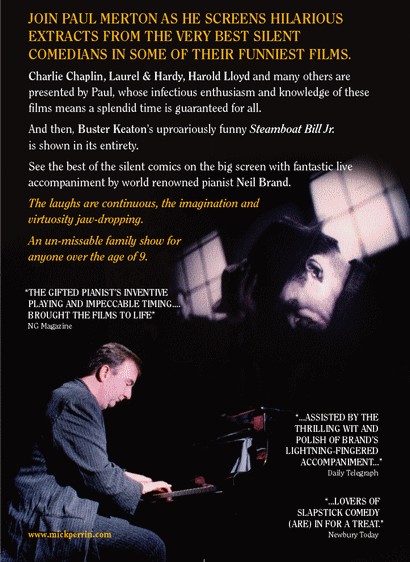
There are a ton of books about silent film comedy, many of them excellent, but they’re not written by performers. Paul Merton, author of Silent Comedy, is on the other hand a popular British comedian — mostly improv and stand-up, rarely silent  —with a love for the heyday of slapstick. He has even done several lecture tours on the subject, bringing screenings with live music to theatre festivals and other venues throughout the U.K. In the past two years he has produced two documentaries on early film (not just comedy) for television: Paul Merton’s Weird and Wonderful World of Early Cinema (BBC Bristol, 2010) and The Birth of Hollywood (BBC2, 2011). He has also done an interactive presentation on early British film comedy for the British Film Institute, which you can view online here.

Merton is, first of all, a good writer! The problem I have with most historical works is that they’re too thorough. I know the impulse: you’ve done all that research, naturally you don’t want it to go to waste — “I suffered for my art; now it’s your turn!” — but the result is more info than the reader needs. You can’t see the forest for the trees. Merton’s chronicle is full of fascinating tidbits and anecdotes, but he marshalls those facts to make a point. They all contribute juice to the narrative flow and actually tell us something significant about the performer. The result is a rich and entertaining read, 329 mass-paperback pages, though obviously you’ll get a lot more out of it if you can view some of the films he’s talking about, easy enough with YouTube and a basic DVD collection. Think of it as a companion volume to the actual movies.

Merton chooses to limit his study to Chaplin, Keaton, Lloyd, and Laurel & Hardy. He is dismissive of Harry Langdon; other comedians such as Fatty Arbuckle and Charley Chase play only minor roles, and there’s no mention at all of Lupino Lane or Charley BowersInstead of separate sections on each comedian, the approach is chronological, which might sound boring and unimaginative, but isn’t because he switches back and forth between these powerhouses every year or two to show how they continually tried to outdo one another. This works very well, bringing fresh insights into their working methods; for example, how Lloyd’s success with the thrill comedy Safety Last spurred Keaton and Chaplin to create similar moments in Three Ages and The Gold Rush, respectively.

As a performer, Merton is always thinking from a performer’s point of view, getting inside their heads better than most silent film historians. To his credit, he notices what stunts are real, and very much appreciates the virtuoso skill and hours and hours of practice required. However, not being a physical performer, he’s not as sharply attuned to physical comedy vocabulary. It does not occur to him, for example, that the topmounter in the running 4-high in the elopement scene from Keaton’s Neighbors is — in most of the shots — very likely a rag-doll dummy, and not Virginia Fox.

________________________

“Slapstick comedy has a format, but it is hard to detect in its early stages unless you are one of those who can create it. The unexpected was our staple product, the unusual our object, and the unique was the ideal we were always hoping to achieve.” — Buster Keaton

________________________

As much as he admires the creativity of this golden age of cinema, Merton is not afraid to address its uglier aspects, specifically negative racial and gender stereotypes widely prevalent in those days. But he is also quick to point out progress made during the 20s in both areas, for example in Keaton ‘s The Paleface (1922) and The Cameraman (1928).

Keaton and Chaplin in Limelight (1952)

With his successful silent film tours offering solid evidence, Merton is bully on the appeal of silent film comedy when presented in the right circumstances, a point I was emphasizing in my recent Revenge of the Silents post.  Here are just a couple of examples Merton offers:

In January 2007 at the Colston Hall, Bristol, I presented Steamboat Bill Junior to over 1,500 people on a big screen with superb musical accompaniment from Neil Brand and Gunther Buchwald. The house front falling towards Buster is a tiny moment in a cyclone sequence that runs for nearly fifteen minutes, but when the stunt happened the audience cheered and applauded spontaneously. A few days after this ecstatic response I heard the playwright Mark Ravenhill extolling the virtues of Steamboat Bill Junior on a BBC Radio 4 arts programme. I seem to remember that he had seen the film on a big screen at an open-air festival many years before. 


The other people in the studio, who sounded like professional critics, had each been given a DVD of the film to take home and watch. Their verdict was unanimous: it simply wasn’t funny because in their view humour dates very quickly, and black and white silent comedy couldn’t be more dated if it tried. How could they get it so wrong? Well, watching a silent film on a small television screen with inappropriate music as accompaniment can destroy the magic. It’s easy to see nothing….

Laurel and Hardy’s last silent film release before their first talkie has often been considered their best ever. I’ve watched Big Business more than thirty times with a live audience, and the responses have been remarkably uniform. They always laugh in the same places with the same regular rhythm. Stan and Leo [Mc Carey] previewed their films in exactly the same way as Harold, Buster and Charlie, and the films were recut according to the audiences’ reactions. That’s one of the reasons they still work so well today.

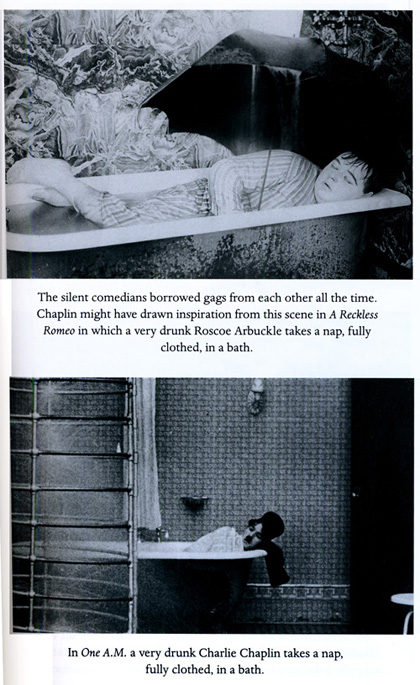
A page from Merton’s book, above, and a few more short selections below….

He [Keaton] was always proud that he didn’t use a stuntman. Larry Semon’s films are chockfull of stuntmen all pretending to be him, but it was Buster’s belief that stuntmen didn’t fall in a comical way.
[NOTE: Keaton did have a stuntman pole-vault into the dorm window for him in College, which I believe was the only time he was doubled, at least in the silent era. —jt]


The tiresomely idiotic debate on Keaton versus Chaplin is, in my experience, overwhelmingly used by proponents of Buster to attempt to rubbish Charlie… It’s an appealing mind-set for some people, who say: “We’ve all heard that Charlie Chaplin was meant to be the greatest comedian in the world, but my preference for Buster Keaton demonstrates my ability to think for myself. Chaplin was overly sentimental, but Keaton’s coolness and cynical eye chime exactly with our Modern Times….” Well, the good news is that they are both fantastic. There’s no need to choose between them. Enjoy them both! That’s one of the main aims in my book. I shall examine the films of Charlie Chaplin and Buster Keaton, not in isolation, as has been the usual practice, but showing how they influenced each other in a creative rivalry that also featured Harold Lloyd. This rivalry and desire to make better and better comedies ensured a stream of high-quality pictures. Great works of art were created.

As much as he [Keaton] liked Roscoe [Arbuckle], he was trying to get away from unmotivated slapstick. In all the years they worked together, the only disagreement Buster had with Roscoe was over Roscoe’s assertion that the average mental age of an audience was twelve and that you should pitch your comedy at that level.

_______________________________

As for Paul Merton the comic, he is hardly silent, known instead for his surreal rants, often delivered dead pan, though he denies mimicking the Great Stone Face, Buster Keaton: “It comes from one of the first things I did as a stand-up in the early 80s called A Policeman on Acid, which was basically this policeman recounting in court the time someone gave him some acid and describing his trip. And I realized then it was much funnier if the policeman himself didn’t find anything he was saying funny, so the deadpan approach came from there, and I suppose that kind of set a style. I wasn’t deliberately copying Keaton at that point.”

Here’s the clip:

Merton is returning to touring his own comedy in 2012 in a “night of sketches, music, magic, variety, and dancing girls (two of them aren’t girls).” Click here for more information.

SHARE
EXPLORE FURTHER

Happy Birthday, Buster Keaton!

POST 197
Tuesday, October 4, 2011

Well, maybe it’s his birthday. The year was 1895 and the day was probably today.

It’s fitting that a blogopedia by the name of “All Fall Down” should celebrate Buster’s birthday by featuring a compilation of Keaton clips set to a song named “Don’t Bring Me Down” (Electric Light Orchestra, 1979). Thanks to YouTuber ebhiggins90 for the edit, which came my way by way of Riley Kellogg by way of Drew Richardson.

SHARE
EXPLORE FURTHER

Wired Magazine Discovers Buster Keaton

POST 159
Wednesday, July 6, 2011

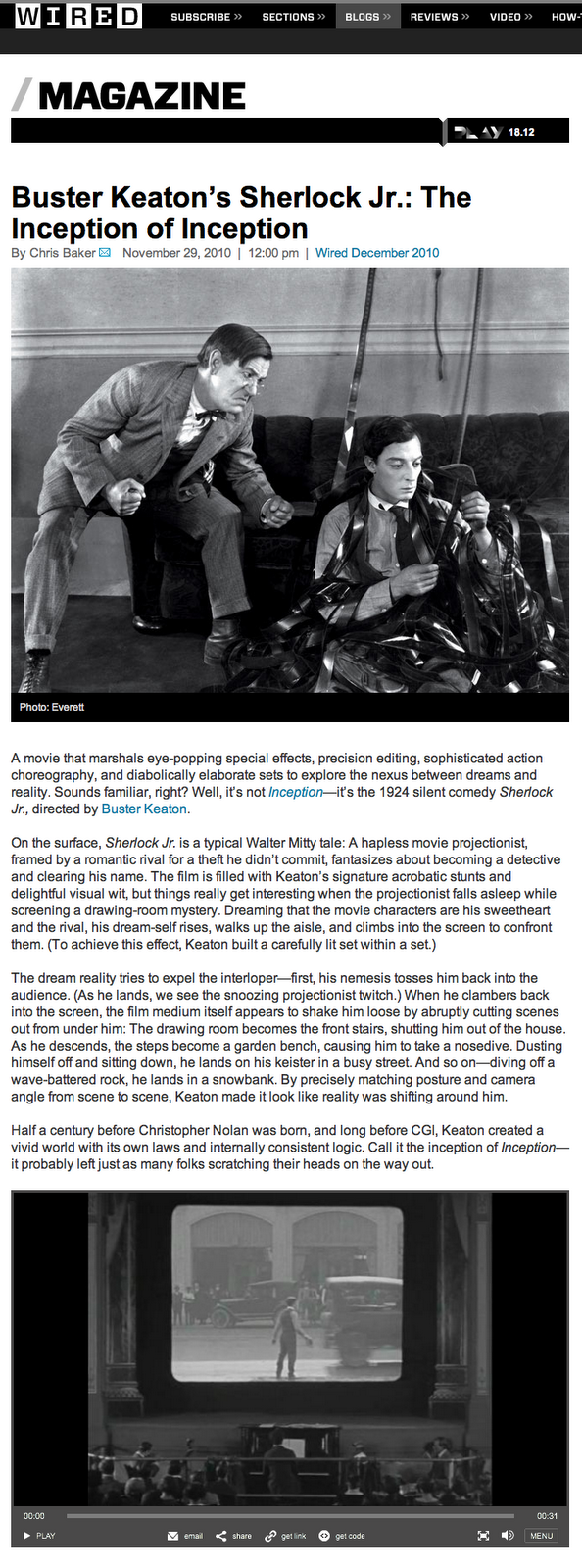
A minor post this one, just a curiosity, but I was pleased to see that Wired magazine, in a discussion of the 2010 dream-catching movie, Inception, discovered a connection with Buster Keaton’s innovative Sherlock, Jr. (1924) — enough of a connection that they did this short piece:

Sorry, Blogger has a problem reproducing very vertical images without blurring them, but you can read the whole article here and view their video clip below.

SHARE
EXPLORE FURTHER
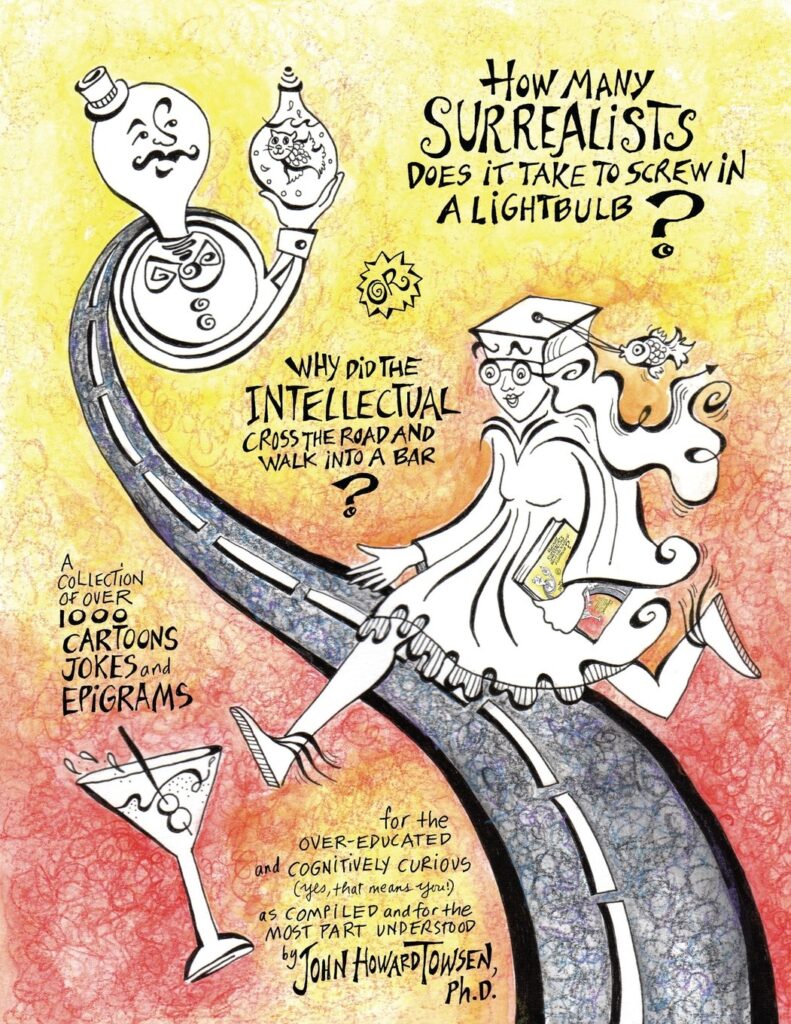
Check out My New Book

Visual and verbal humor for the cognitively and artistically curious!

“A book to treasure!”
—Bill Irwin

Upcoming Events