One of these days I’m going to find time to write at some length about my hero Buster Keaton, but meanwhile the Keaton industry is doing just fine without me, thank you very much. There’s a new DVD collection, a new book, and a Monday nights retrospective this summer at the Film Forum here in New York. This outpouring is the inspiration for a lengthy (re-) appraisal of Keaton’s life achievement by Jana Prikryl entitled “The Genius of Buster.” Despite its being written for The New York Review of Books, the article does not over-intellectualize its subject. It’s cogent, informative, and down to earth.
Here are a few short excerpts followed by a link to the entire article:
The logic in his first pictures, the two-reel shorts, resembles the logic of dreams. It was an alternate reality that freed him from narrative obligations—one thing simply followed another—and allowed him to pack a staggering quantity of life’s particulars into each twenty-minute film.
For several years Keaton had been playing with the comic payoff of situations that aren’t actually funny at all, in some cases hiring codirectors known for making dramas in hopes of deepening the realism. He brought in a protégé of D.W.Griffith, Donald Crisp, to help lend gravity to some scenes in The Navigator(1924), in which a rich young couple are set adrift on an abandoned ocean liner and run into cannibals on a desert island. At first their pampered helplessness leads to a long folly of slapstick (she can’t brew coffee; he can’t boil an egg), and after they adjust, it’s the gags of their triumph over circumstance (a Rube Goldberg machine prepares their breakfast; their bunks are cozily ensconced in the ship’s boiler room) that yield laughs. But Keaton went back and reshot the dramatic dockside scenes that got the pair trapped in the first place because he didn’t find Crisp’s version convincing enough.
Keaton always retained a vaudevillian’s appreciation for blackface routines and ethnic comedians of all kinds—the single way his films have grown dated. In several he walks up to someone from behind thinking he knows them, only to find that the person is black. That’s the joke. Later in life he declared that audiences would never laugh at a Civil War comedy whose villains are Southern: “They lost the war anyhow, so the audience resents it.” In The General he reversed his source material so that the film was about the heroic plight of a Southern railroad engineer rather than of the Northern hijackers (who in real life wound up not very comically hanged); the film itself is free of racist gags.
Chaplin is thought of as the socially and politically aware comedian (e.g., Shoulder Arms, Modern Times, The Great Dictator) but Keaton’s most coherent feature-length comedies—also including Go West and The Navigator and arguably The Cameraman—can’t stop playing with the immigrant nature of American identity: each of us is far from home, and the natives aren’t friendly.
“Half of our scenes, for God’s sakes, we only just talked over. We didn’t actually get out there and rehearse ‘em. We just walk through it and talk about it. We crank that first rehearsal. Because anything can happen—and generally did…. We used the rehearsal scenes instead of the second take.”
Keaton wanted stories of a certain kind of innocence, and aspiration, and even mulish indifference to what might make people laugh (a hilarious film about the Civil War, for instance). His humor wasn’t a blank face that could be transferred willy-nilly to any kind of satire that might prove timely. This meant temporarily ignoring what the audience expected, and having the freedom to keep on inventing. “Anesthesia of the heart,” as Henri Bergson called it. That, after all, is the real soul of deadpan: such deep absorption in a task, or a way of being, that the audience thinks it alone can see that the whole thing’s going to hell.
Thanks to the well-read Noel Selegzi for the link! Read the whole article here.
All IMDB says is that she was “a child celebrity known for having a perfect sense of balance,” and was the daughter of Sid Goldy, who it identifies only as the father of Helen Sue Goldy. Hmm….
The piece was included in a 1946 Pete Smith behind-the-scenes one-reeler, Studio Visit, which was released in conjunction with the Ethel Waters — Lena Horne musical, Cabin in the Sky. The narrator claims they’re practicing their act for a movie, but the piece apparently never made it into any other film.
In my previous post, The Fine Art of Impaling Oneself on Heavy Metal Objects, we saw knockabout artists from the past six decades knock into poles, pedestals, platforms, ladders, wire cable and, of course, the ground. This time we take a gentler approach, with a sampling of “quick-change” comedians who have found ingenious ways to get dressed in public and, in the case of a chap named Keaton, an actual reason to do so.
Let’s start with the basic move…
On that very same last post, we looked at Walter Galetti’s bounding rope numéro. The whole act is 11½ minutes long, but he frames it with the classic clown-rolling-into-his-coat bit. Here he is, nonchalantly setting his coat down before he tackles the rope walking:
And here he is, almost 10 minutes later, donning the coat for his exit.
I’d seen this bit done by the great Tommy Hanneford in the Hanneford Circus back in the 70s, and I’m pretty sure I’ve seen it done with a coat (or vest), a hat and a newspaper — though I’m not sure if that was by Hanneford.
Speaking of hats, here’s Bill Irwin in Regard of Flight putting on his chapeau the old-fashioned way:
And here’s a unique sequence by the legendary Russian-Armenian clown Leonid Yengibarov, who says why dive into clothes when you can bring the clothes to you?
Of course I still like Buster Keaton’s costume change from Sherlock, Jr. best. He dives through what I’m going to call a “quick-change” hoop, emerging dressed as a woman, and follows it up with an equally outrageous clothing trick. The hoop move was a standard of circus equestrians, but Keaton’s carries more weight because he uses it to escape from the bad guys.
Yes, one might ask why the hoop didn’t just fall off the window sill when he dove through, seeing as how it was just leaning there — but let’s not quibble!
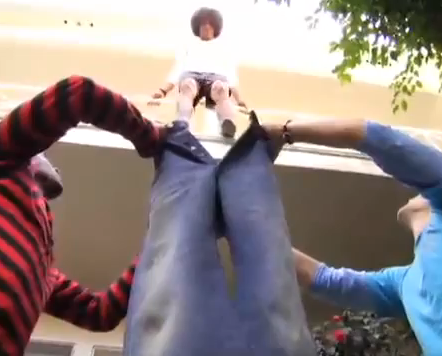
Finally, it’s fascinating how esoteric techniques from the performing arts can get adapted by our popular culture and go viral — witness parkour — as this cool YouTube video of jumping into trousers so aptly demonstrates.
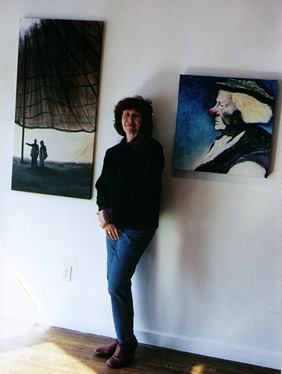
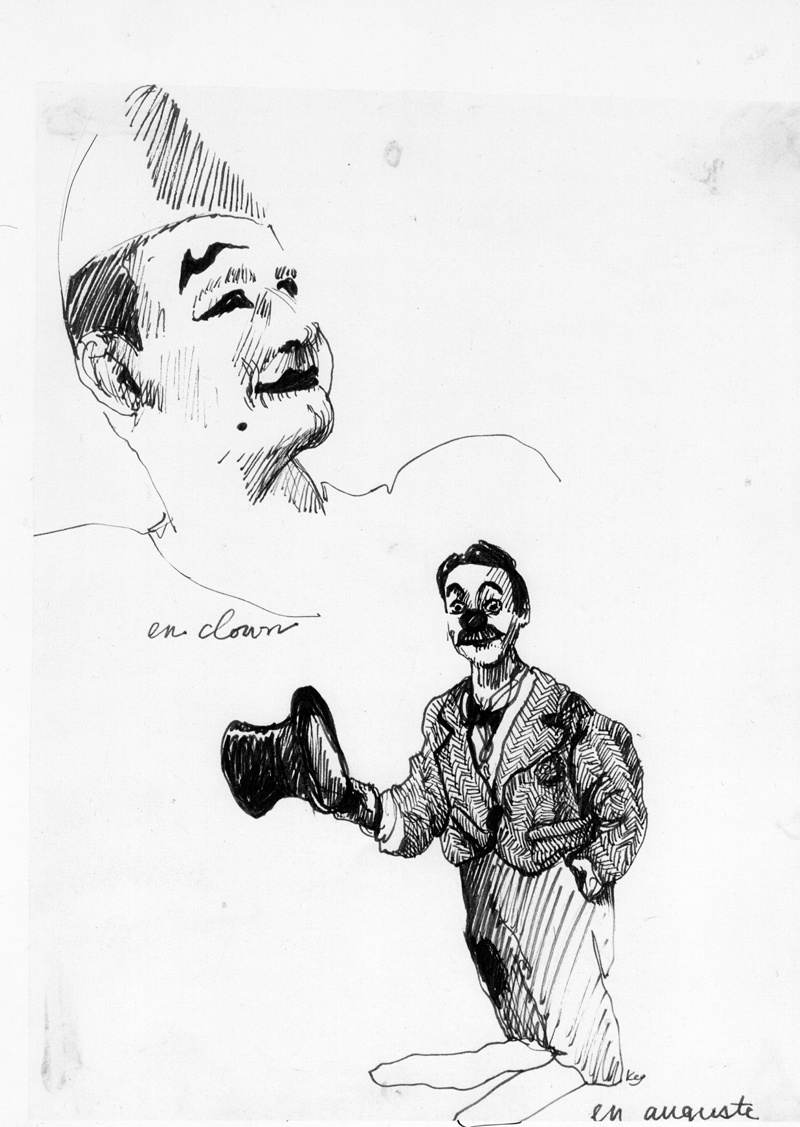
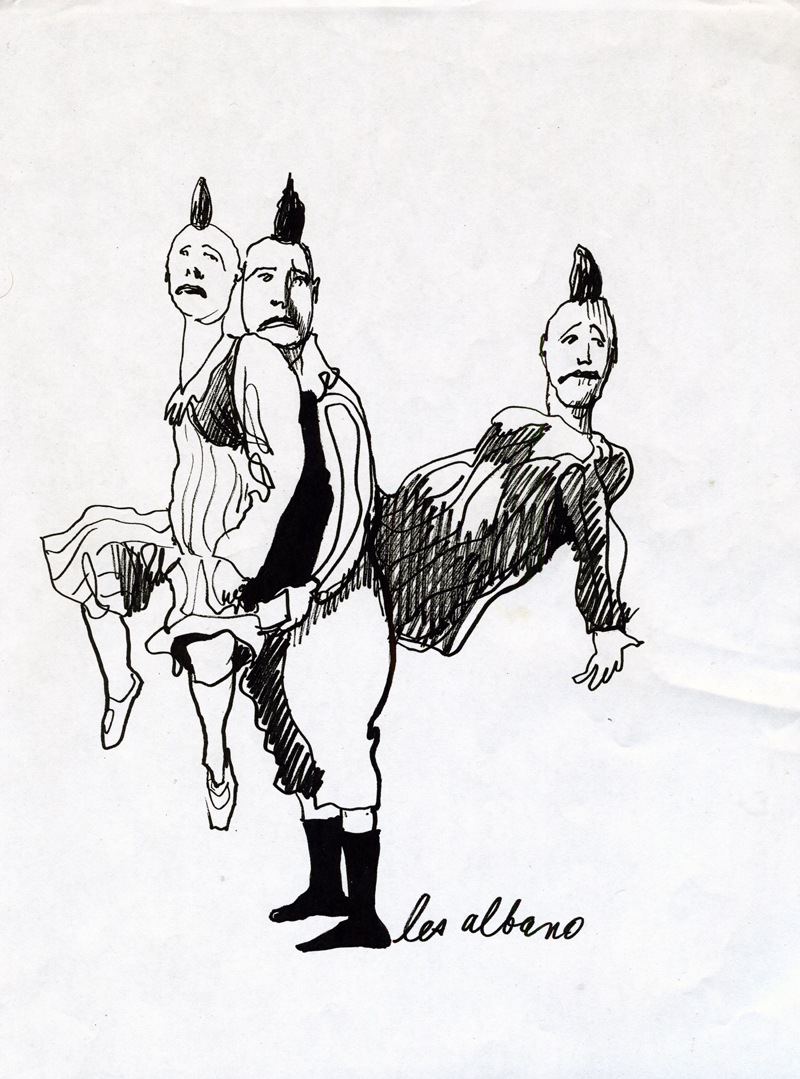
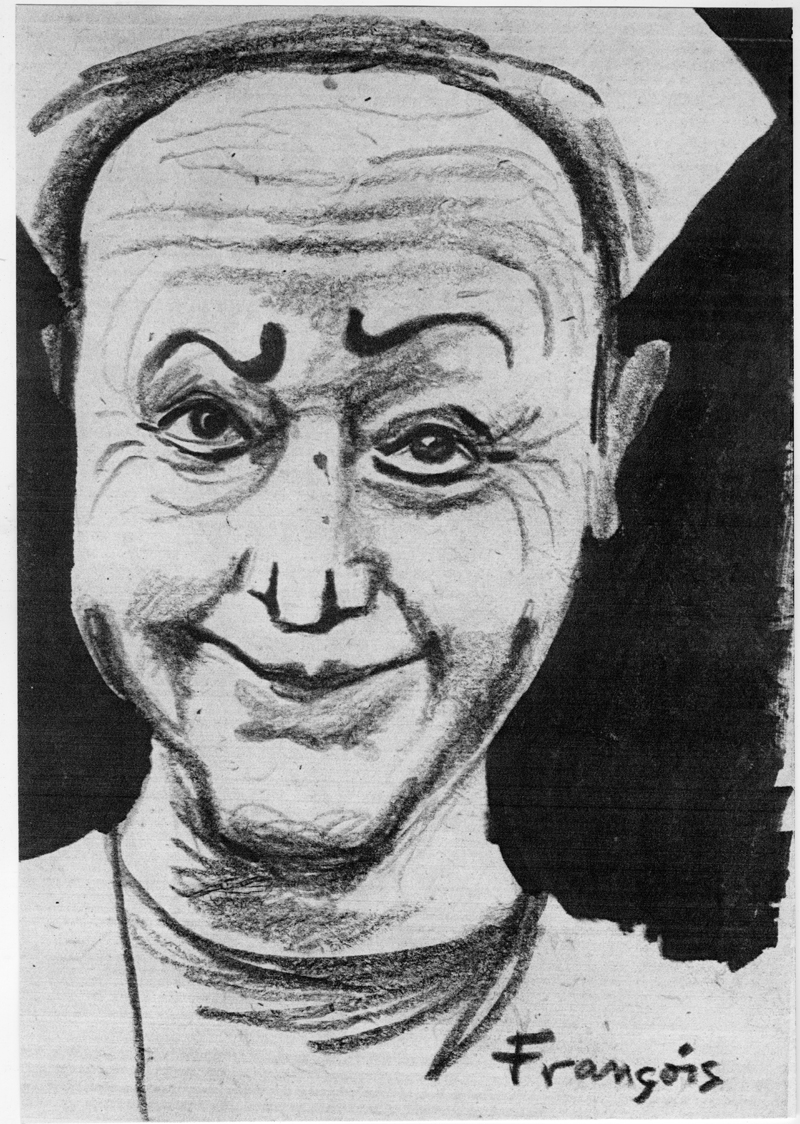
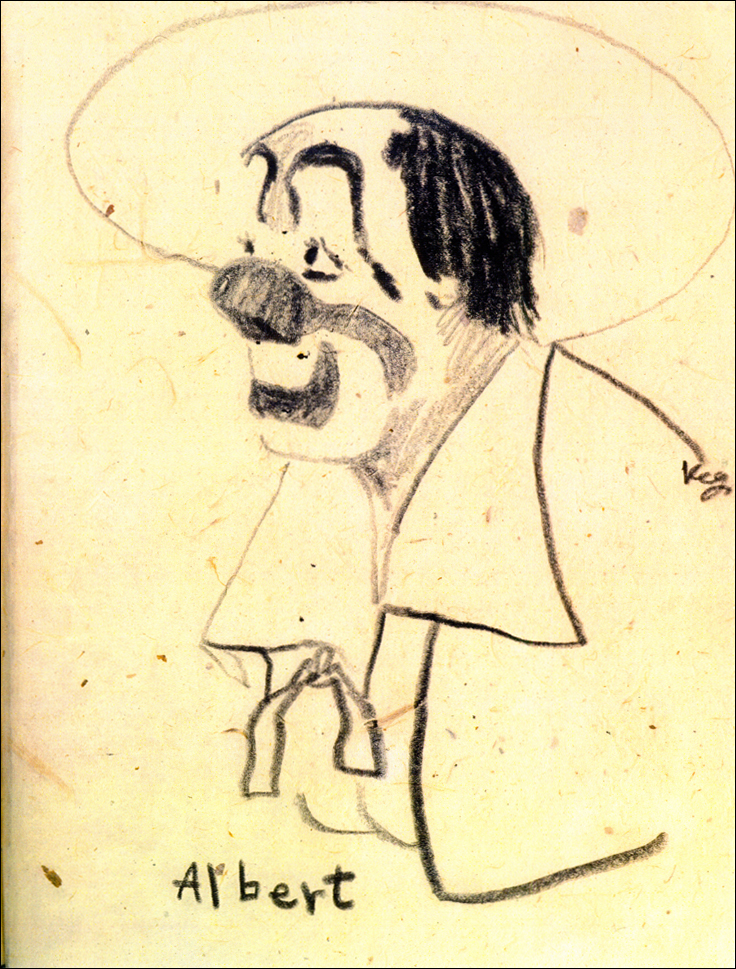
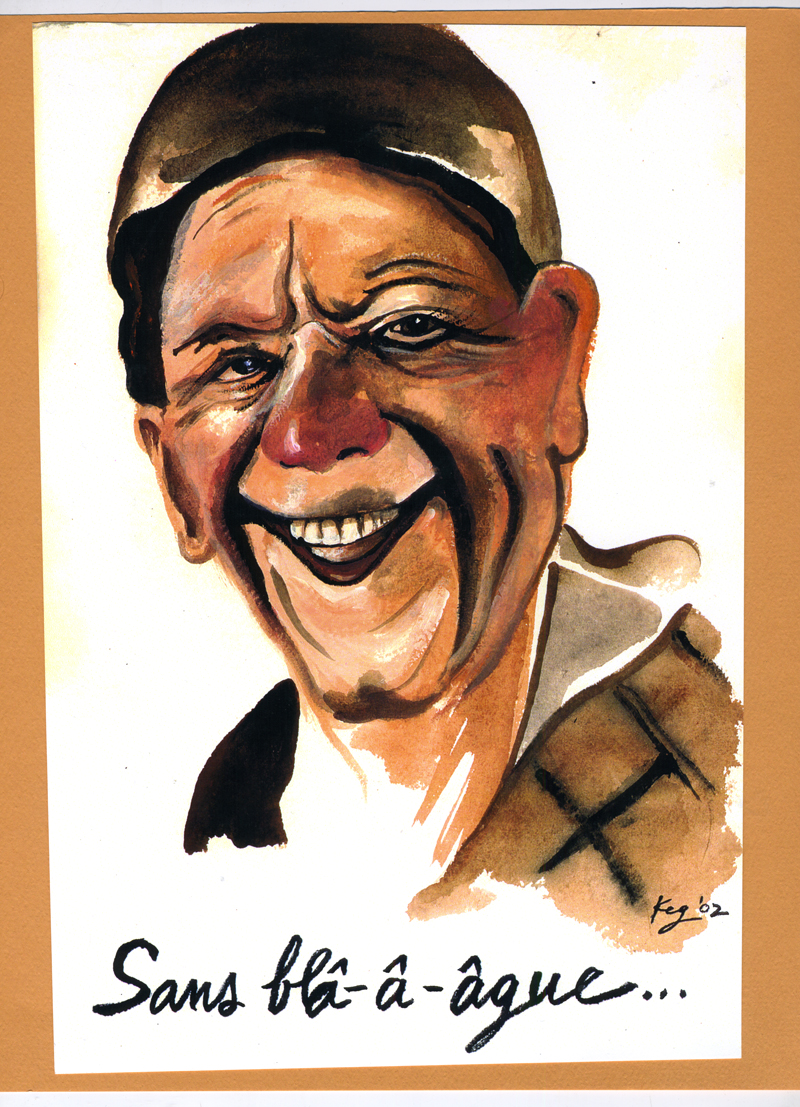
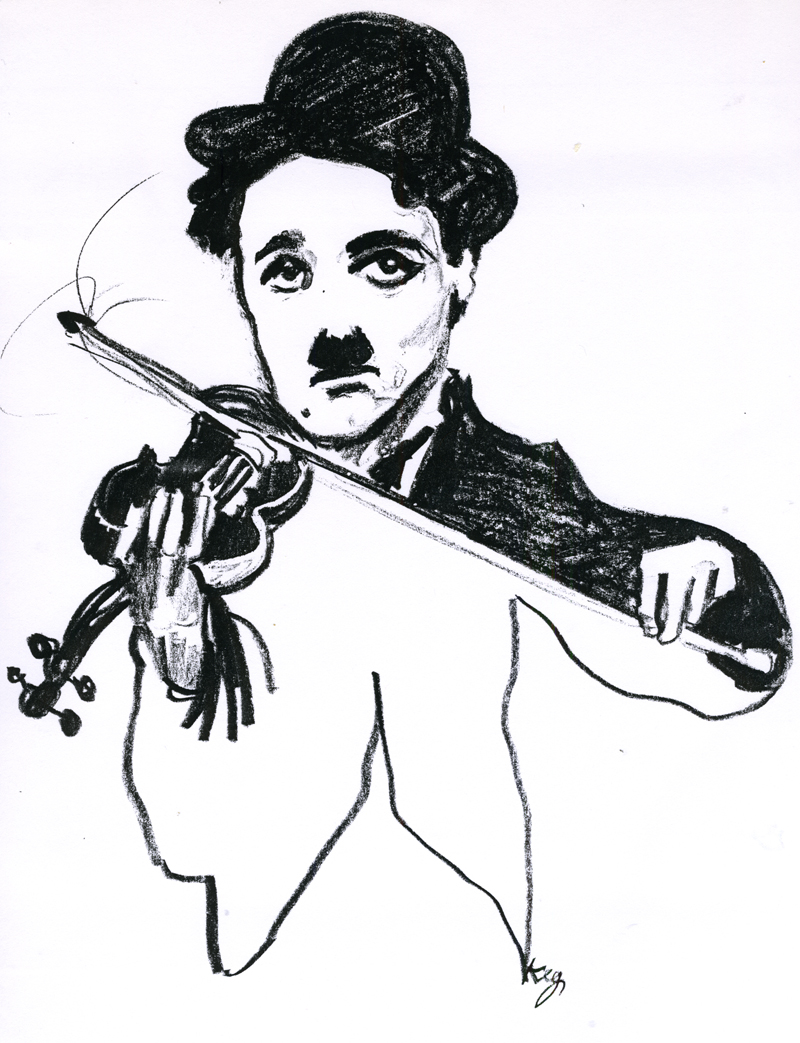
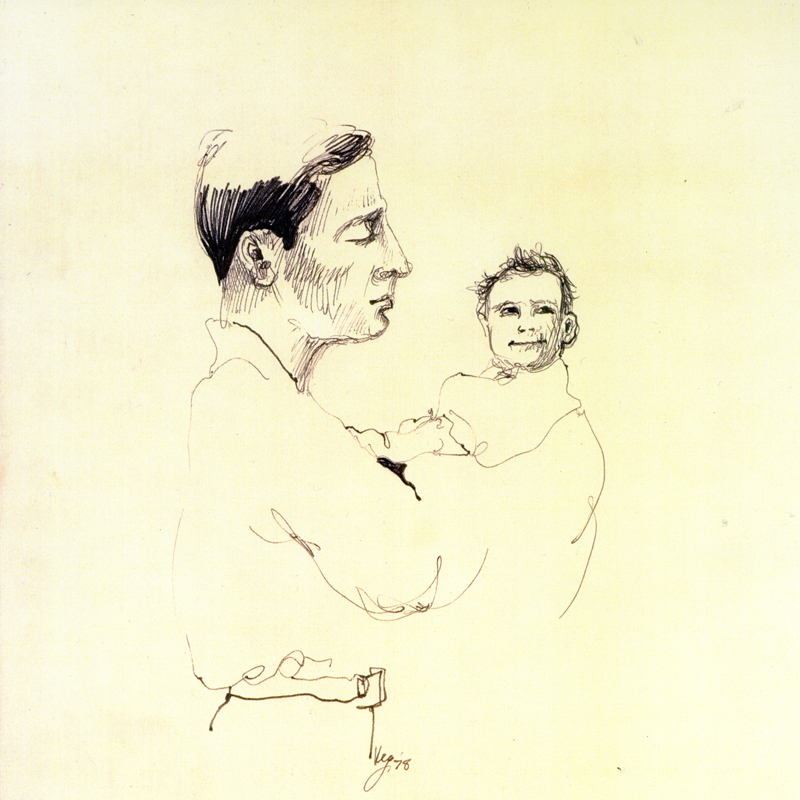
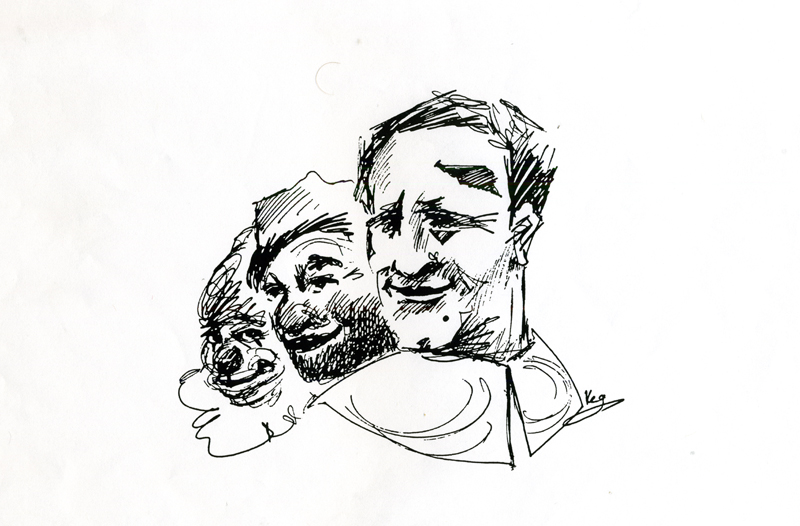
It is a real privilege to be able to present the work of Karen Gersch on this blog. I’ve known Karen for over three decades (though we’re both 29), and she’s quite the Renaissance woman: clown, acrobat, painter, educator, producer — and for all of those three decades New York City’s hostess to ever so many variety artists visiting from around the globe. Karen & I even performed in the Hubert Castle Circus together with Fred Yockers in the late 70s, and I want to say in my defense that any stories she may tell about me from those days are nothing more than wine-induced fabrications. I thought the best way to introduce Karen to the blog was this series of her paintings and drawings of classic clowns. We’ll follow up in later posts with her look at more contemporary clowns, and some of her own performance writing. But first some links: Karen’s current exhibition at the Blueberry Music & Art House in Greenwich, Connecticut
Karen’s art web site. Karen’s Showboat Shazzam (formerly Circus Sundays) series at the fabuloso Waterfront Museum (this is last year’s schedule, but check back for this June’s events) Karen’s Acrobrats performance web site.
___________________________________
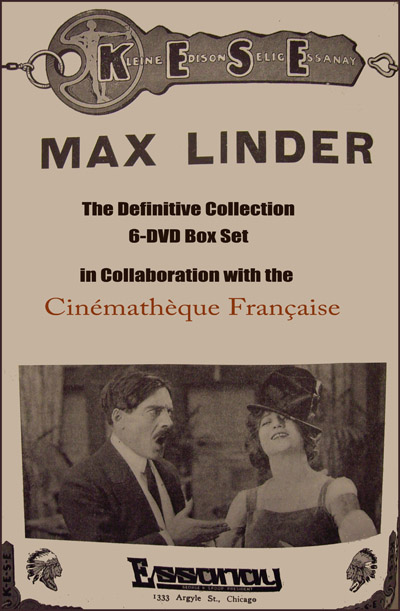
The rediscovery and remastering of silent film classics, reintroducing these artists to the public by way of annotated DVD box sets, has been a great gift to the physical comedy fan. First it was Chaplin and Keaton, then Lloyd and Langdon, followed by Charley Chase, Douglas Fairbanks and, most recently, that modern silent clown, Pierre Etaix. And now finally the father of silent film comedy, Max Linder, is being justly celebrated for his pioneering career that spanned over 400 films, about 130 of which have survived, in a handsome 6-disc DVD set complete with historical commentaries and new musical scores by New York’s own Ben Model.
Okay, I just made all that up. Yep, the DVD cover picture too. (Blame Photoshop.) Sorry about that, but there’s no Max Linder box set, no definitive collection, no historical retrospective. Which is a shame, not only because his work is so deserving of it, but because the passage of time means no one is still alive who worked with him (he died in 1925) to answer all our questions. (Yes, I have questions.) Keaton and Chaplin were rediscovered in the 60s when they and many of their collaborators were still kicking, resulting in a treasure trove of material on their incredible body of work. No such luck here.
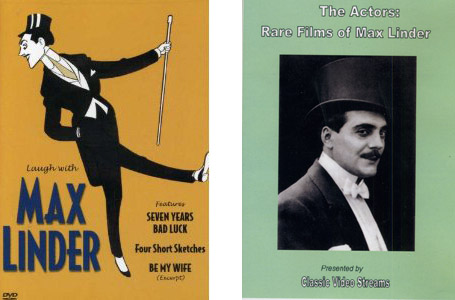
What we do have are two DVDs showcasing some of Linder’s work, and it is these I will review here:
Laugh with Max Linder was compiled by his daughter Maud and is most valuable for containing his wonderful feature film, Seven Years Bad Luck. It also has a musical score composed to go with the actual films, whereas the Rare Films DVD uses some generic Dixieland music as a background throughout, which does more harm than good. Oh well, just wait for that definitive DVD box set!
The Rare Films of Max Linder DVD is more recent but contains mostly early films from 1905 to 1912. To give this some chronological perspective, keep in mind that by the time Mack Sennett founded Keystone Studios in 1912, Linder had already made a couple of hundred films. In 1913, Sennett hired Chaplin, who did not debut his tramp character until the following year. As for Keaton, his first film appearance wasn’t until 1917, when he had a role in Fatty Arbuckle’s The Butcher Boy.
So Linder was pretty much on his own, ahead of his time and far from Hollywood, in the beginning grinding out a film a day for Pathé in Paris. In the process, he pretty much invented the comic narrative film. While early filmmakers often used gags as their subject matter (see these previous posts), it was Linder who developed a recognizable character — that of an often inebriated Paris dandy — and began to develop stories around him. The first movies were nothing more than simple gag ideas, but over time Linder developed his foppish character, his storytelling skills, and his use of film language.
By the time you get to Linder’s “feature-length” films (about an hour long), the artistic progress is very much in evidence. Now working in Hollywood and Paris, his fame eclipsed by Chaplin, Linder is still somewhat ahead of his time in shooting features. Here are the dates of his four features:
The Little Cafe (1919) Seven Years Bad Luck (1921) Be My Wife (1921) The Three Must Get-Theres (1922)
And the dates of the very first features made by Hollywood’s fearsome foursome:
• Chaplin — The Kid, 1921
• Lloyd — A Sailor-Made Man, 1921
• Keaton — The Three Ages, 1923
• Langdon — Tramp. Tramp, Tramp, 1926
Max Linder: Character Actor
Max Linder the actor (né Gabriel-Maximilien Leuvielle) always played the character Max Linder, a well-to-do Parisian with a knack for getting himself into trouble, usually with women, often from too much drinking. Here’s a sequence from the opening of Seven Years Bad Luck:
Later in that movie, disguising himself to hide from the train conductors after having lost his ticket money, Linder shows his versatility as a comic actor:
Max Linder: Gag Meister
Most gags are older than the hills and were not invented by the famous performers who usually get all the credit. Linder’s broken mirror routine predates the Marx Brothers by more than a decade, but of course he was hardly the first. But you know me, I do get my jollies pointing out earlier versions of gags, so here are a couple from Linder’s films that you may have seen elsewhere — and many years later.
Ye olde getting your coat caught around a pole routine, from Linder’s Max and the Quinquina (1911):
In case you were wondering about the card bit at the end: nice plot device. In the first half of the movie, a drunken Linder insults every big shot in town, inciting each of them to challenge him to a duel at dawn, for which they each hand him their business card. In the second half, every time he gets into trouble he produces one of these cards, is immediately mistaken for the big shot, and is given preferential treatment.
And here’s Buster Keaton ten years later in The Goat (1921):
And as Hovey Burgess reminds me, Soviet clown Oleg Popov did the same thing in his slack wire routine, “accidentally” wrapping his coat around the wire. (I haven’t been able to find a clip of him doing that exact bit, but probably have it somewhere and will add it here if I do locate it.)
Here’s another classic bit from Be My Wife, his 1921 feature film of which only 13 minutes survive. Max is disguised as a piano teacher so he can get closer to his beloved. When he discovers the piano is too far from the bench, he tries to move the piano rather than the bench. His girlfriend’s aunt Agatha shows him the easier way:
And now here’s the legendary Swiss clown Grock doing the same gag:
Grock started working with his first partner in 1903, so for all we know he may have beaten Linder to the punch with this one. In any case, it’s Grock who gets the most comedy out of it, fleshing out the gag with his clown’s dumb determination and then allowing us to share in the joy this naive character experiences at the revelation that there is indeed a better way. With Linder it doesn’t really work because his far more clever character would never do that, unless as an intentional joke.
Also from Be My Wife is this extended sequence in which Linder stages a mock fight (with himself!) to impress his beloved Mary and especially her aunt that he is the better potential husband, and not Simon, the cowardly milquetoast rival that Aunt Agatha is promoting for the position.
And a similar sequence from Charley Chase’s classic Mighty Like a Moose (1926). Here’s the wild situation: Charley and his wife both find themselves unattractive and both secretly undergo medical procedures to improve their looks. They meet outside the home, fail to recognize each other, and start flirting. Charley is the first to realize the truth of the situation and, as a firm believer in the male’s innate right to the double standard, schemes to punish his wife for cheating on him with himself. Yes, wacky! So Charley the husband beats up Charley the lover.
Although I hope to get around to writing in more depth about the variations on the broken mirror routine, any introduction to Linder would not be complete without his superb version of it from Seven Years Bad Luck. In this clip, two amorous servants have just accidentally broken the mirror, and one of them enlists a buddy to hide the misdeed from Max.
What I most like about Linder’s gag work, however, is how he learned to develop and integrate gags into his story. His broken mirror routine can certainly stand on its own,but it is also integral to the plot because the seven years of bad luck that Max spends the whole movie hoping to avoid is triggered by the second breaking of the mirror. Likewise in the same movie, you’ll find a nifty gag wherein an imprisoned Max is cowered into scratching the back of his tough and bullying cellmate. The reprise of this in the courtroom scene totally works… but you’ll just have to see the movie to know what I’m talking about!
Max Linder: Cinematographer
Coming from the theatre and making his first film in 1905, Linder was an early adapter to the form, no doubt learning through trial and error what worked in the new medium, how to use time, space, and special effects to create comedy beyond what he could do on stage. In my interview with her, Maud Linder singled out the 1906 short, Max Takes a Bath, as a good example of her father’s early use of film.
Fast forward to 1921’s Be My Wife, whose opening scene is a cute visual gag where an overprotective Aunt Agatha is fooled by an optical illusion.
Linder’s success and the parallel progress of the art of film allowed him to work with other talented artists who brought greater production values to his movies. One of these was Charles Van Enger, whose cinematographic talents are very much in evidence in the framing and lighting for Seven Years Bad Luck. Here’s his bio from the Turner Classic Movies site.
Charles Van Enger (1890-1980), a leading cinematographer of the silent era, worked with Maurice Tourneur on films such as The Last of the Mohicans (1920) and with Ernst Lubitsch on The Marriage Circle (1924) and Lady Windermere’s Fan (1925). Although credited as an assistant cameraman on The Phantom of the Opera (1925), he reputedly set up many important shots in that film. He spent much of his later career at Universal, working on everything from Never Give a Sucker an Even Break (1941) to Abbott and Costello Meet Frankenstein (1948). By the late 1950s, he was working mainly in television on shows such as Gilligan’s Island.
Wow! From Max Linder to Gilligan’s Island — now there’s a career span.
____________________
Here’s a rundown of what you’ll find on each DVD:
Rare Films of Max Linder
A Skater’s Debut (1905) = 4:21 His First Cigar (1906) = 5:05 Max Gets Stuck Up (1906) = 3:01 Max Takes a Bath (1906) = 4:38 Legend of Ponchinella (1906) = 7:32 Max’s Hat (1908) = 8:55 Troubles of a Grass Widower (1908) = 9:48 Max and the Lady Doctor (1909) = 5:59 Max Fears the Dogs (1909) = 2:44 Max and the Quinquina (1911) = 16:44 Max Plays at Drama (1911) = 7:01 Max Juggling for Love (1912) 6:42 Max and his Dog (1912) — 6:33 Max and the Statue (1912) = 9:58 Max and his Mother-in-Law (1912) = 24:12 (!!) Be My Wife (1921) = 13:33
Laugh with Max Linder Boxing with Maurice Tourneur (1912) = 2:40 Love’s Surprises (1913) = 6:13 Max Takes a Picture (1913) = 13:06
Max Sets the Style (1914) = 8:53 Seven Years Bad Luck (1921) = 61:52 Be My Wife (1921) = 13:33
Both of these DVDs are available from Amazon. Laugh with Max Linder is also available from Netflix and on Amazon video on demand.
As you’ve probably noticed, the special features that come with DVDs these days are not necessarily all that special. Even when they get into performance issues, editing technique, or visual effects, the information is usually pretty basic. There are, however, some juicy enough tidbits out there for the nibbling, which I was reminded of when I recently chanced to give Benny & Joon (1993) a second look.
If you’ve seen the movie, and I suspect most of you have, you can skip this paragraph… Benny is a sweet guy, an auto mechanic who spends most of his spare time taking care of his sister Joon, who is bright and paints but has some real mental health issues, never specified but probably schizophrenia. A young eccentric comes into their lives in the person of Sam, a barely literate outsider with a heart of gold, a movie buff who reveals considerable hidden talent whenever he’s channeling Buster Keaton or Charlie Chaplin. Sam turns out to be good for Joon and vice-versa and, after a crisis, all ends happily, or at least with hope for all the major characters. A sentimental tale, what the director labeled a fairy tale, but it’s quite well done and worth checking out.
The movie makes a strong, positive argument for the role of clown wisdom in everyday life. One reviewer described Sam as a “clown savant.” Not surprisingly, the screenplay is by a former clown, Barry Berman, who used to perform for Ringling. As played by the great Johnny Depp, Sam is childlike, timid, insightful, generous, imaginative, and creative — the fool who turns out to be the wise man. Nice job, all.
The movie is also noteworthy for its physical comedy sequences — rare in Hollywood movies — choreographed by Dan Kamin and performed quite adeptly by Depp. Dan is a mime and movement performer, teacher, author, and coach. He has written extensively on Chaplin’s movement technique and was Robert Downey’s coach for the movie Chaplin (1992). Click hereto check out Dan’s web site and all his many offerings; there are also some videos of Dan’s own work on YouTube. Maybe someday we can get him to tell our blog readers about his experiences working on these movies!
So here are the specially featured morsels I have for you.; nothing earth-shattering, but interesting enough. In this first one, cinematographer John Schwartzman has some interesting things to say about experiments with camera speed. You might want to skip the second part because he’s rambling on about other stuff while we watch Depp practice with his dinner rolls.
The next four are from the commentary track by the director, Jeremiah S. Chechik
1. The diner scene, with those dancing rolls in action:
In case you missed it, Chechik points out that Dan Kamin is the customer sitting to our right in the three-plate sequence. BTW, I love Depp’s slide to catch the tray at the end of the counter. I am, however, a stickler for physical truth in performance, so I can’t help noticing that there’s no way he would have gotten there on time. Still, close and clever enough to sell it.
2. A very short rolling chair bit that Chechik likens to Tati.
3. Hat technique used to sneak into the high-security wing of the psychiatric hospital. Too bad it wasn’t done in a single shot!
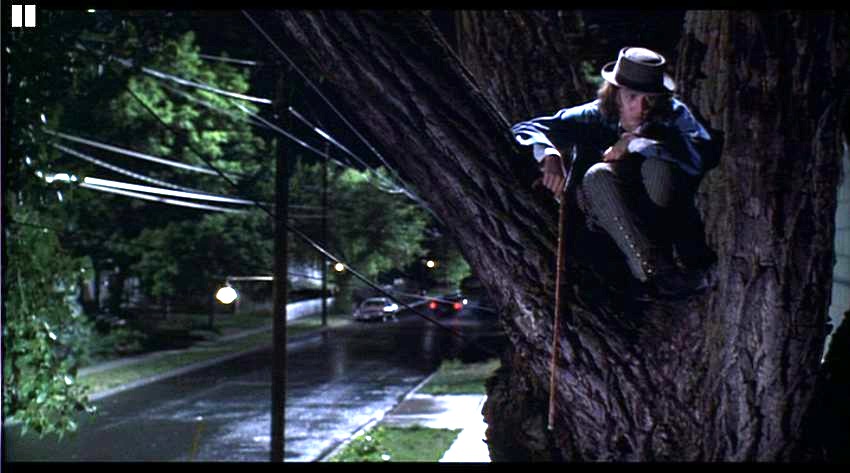
4. Depps’s climb up the side of the hospital building à la Harold Lloyd, which also turns out to be the movie’s climactic scene:
—the character Georgy (played by Lynn Redgrave) in the movie Georgy Girl
Okay, so I’m not really in Barcelona any more and I’m no expert on the art or history of pie throwing, but these photos really are from Tuesday afternoon at the Nouveau Clown Institute and I knew you’d all enjoy seeing a photo of me with pie on my face, shot by Rich Potter with much joy in his heart.
The occasion was a workshop by Pat Cashin and Greg DeSanto in — yep, you guessed it — the making and launching of pies. Despite a career that has not been without its unique experiences, I had never been on either end of an airborne pie, so I found myself actually eager to volunteer my mug for target practice. It was totally stupid and very funny. Sometimes we (yeah, me) get too analytical about clowning and forget the power of pure silliness. Well, this was silly.
A very short action video of Daniela ConTe on the receiving end:
Update (3-17-10): Some more pie photos from the Facebook album,N.C.I. -Second Class- March 2010, courtesy of Mandy Dalton, and featuring Pat Cashin making a batch of pies and then delivering one up in top balletic form.
Like I said, I’m no pie historian, but it was fun unearthing a few famous scenes for you….
The first pie in the movies was apparently received, not by Fatty Arbuckle or Mabel Normand, as is often said, but by Ben Turpin in Mr. Flip (1909). The annoyingly flirtatious Mr. Flip gets his pie comeuppance in the final scene of this 3:45 short. (You can see or download the whole movie here.)
But to give Arbuckle his due, here he is wrecking the general store in The Butcher Boy (1917) with Buster Keaton (in his first film) and Al St. John. They start with flour but work their way up to pies. Pies in the kisser must be funny because you can actually see Keaton smile for a brief moment. (You can see or download the whole movie for free here.)
Here’s Keaton on This is Your Life in 1957 talking about getting hit by Arbuckle’s sack of flour.
In his autobiography, Keaton commented: “When we turned to the making of features we found a whole set of new problems facing us. One of the first decisions I made was to cut out custard-pie throwing. It seemed to me that the public — by that time it was 1923 — had had enough of that. The pies looked messy on the screen anyway. So no pie was ever thrown in a Buster Keaton feature.” (My Wonderful World of Slapstick, pp.173–4) However, when Keaton made somewhat of a comeback on television in the 50s and 60s, it was pies they wanted to hear about. Here he is demonstrating the technique in 1962:
______________________________________
Update (4-13-10): This just in from 1916! Less than two years after leaving Keystone, Charlie Chaplin was already making fun of Mack Sennett’s studio in Behind the Screen, in which pie throwing is sarcastically referred to as “a new idea.” But while Chaplin may be spoofing Sennett, he still puts together a pretty good pie fight. Most of the throws in this are done in two shots, but just past the 3-minute mark you can see Chaplin get off two accurate long-distance tosses, accomplished without any editing.
The Great Race (1965) features a take-no-prisoners, multi-colored pie battle. It was directed by Blake Edwards, of Pink Panther fame, is dedicated to Laurel & Hardy, and stars Tony Curtis, Jack Lemmon, and Natalie Wood, but is still a pretty disappointing movie. I do like the joke of Curtis strolling through the mayhem unscathed, though the payoff could be stronger. I didn’t like the fact that 99% of the pie tosses are done in two shots so you never get to see a pie fly any real distance. This film is available on Netflix Instant Play.
And in more recent times, click here or on the image to see Greg DeSanto shaking it like a modern-day Arbuckle in the soap entrée with Barry Lubin. (Big Apple Circus, The Medicine Show, 1996) .
Finally, for the serious pie scholar: • Thanks to alert reader Hank Smith (see comment to this post) for pointing out that the original ending to the classic satirical film, Dr. Strangelove, was a pie fight (photo, right) in the War Room! Director Stanley Kubrick cut it because “I decided it was farce and not consistent with the satiric tone of the rest of the film.” • The flying flour in The Butcher Boy reminds me of one story, which may or may not be apocryphal, about the origins of the clown’s whiteface makeup. The practice is usually attributed to French Pierrots of the 1600s, who were said to have powdered their faces white, inspired by the laughs they got from a comic combat with bags of flour. • The Keystone Cops, popularizers of pie throwing in the early days of silent film comedy. •Soupy Sales, who brought pie throwing to television in a big way starting in the 1950s. • Pieing, the controversial practice of embarrassing political opponents with a pie in the face. • And did you know that Sunday (3-14) was Pi Day?
The first movie comedy I saw starred Danny Kaye. I might have been 6 or 7 and I laughed so hard that I still remember thinking, gee, I didn’t know anything could make you laugh that hard. My first Jacques Tati movie was Playtime. I was 19 and in Europe for the first time and, despite a show biz childhood, I had seen little if any silent film comedy. I was amazed. I remember thinking, zut alors, I didn’t know you could do that! It was as if I had discovered a new art form.
Although Playtime lost a lot of money, Tati’s legacy is in very good shape. His stature has grown, his movies are finding a new international audience on DVD, and this summer he is the subject of a retrospective in France housed at the Cinemathèque Française (through August 2nd), but with events outside of Paris as well. Here’s a very short promo for the Tati exposition:
Authorized Digression: Did you see Tati’s trademark pipe in that short animation? Well, believe it or not, they had to remove it from the print posters in the Paris métro:
Yep, I find that amazingly stupid (and I’m fairly anti-tobacco). What’s next, Chaplin’s cane? But what do you think? I think it’s about time this blog had a Raging Controversy! Don’t be shy — cast your vote in the poll (Raging Controversy #1) in the sidebar to the right.
There are a ton of Tati clips on YouTube, but you might want to avoid them. Better to see the whole movie to really get the whole picture. Tati weaves a complete tapestry with each movie, and what makes him unique is the overall world he creates, far more than just the isolated gag. [See the André Bazin article link below.] Furthermore, his cinematographic style and his sense of detail are best appreciated on the widest screen available; he even shot Playtime in 70 mm. Monsieur Hulot’s Holiday and Playtime are good starting points, though others will certainly argue for Mon Oncle, which won an Academy Award for Best Foreign Film of 1958.
What is singular about Tati is his ability to find physical comedy in everyday life. He is the master of observational visual humor; one critic labeled him “an entomologist of the material world.” Despite some big gags such as the fireworks scene in Hulot’s Holiday, most of his stuff is subtle and quirky. Often the main event happens off-camera, and our imagination is left to fill in the blank. “I want the film to start when you leave the theatre,” Tait explained.
Although he has a great eye for social interaction, we know very little about Tati’s characters, his alter ego Hulot included, and there is nothing that you could call a plot. People come together, they interact. Hulot, usually too old-fashioned for this modern world, struggles mightily with his environment, with the world of things, but nevertheless exudes a contagious joie de vivre, most appreciated by the very young and the very old. Before long the characters go their merry ways with tales to tell and fond memories of that odd man. End of story.
Tati is not the only director to attempt to revitalize the silent film form after The Jazz Singer (1927) precipitated its fall from public favor. To my mind, however, he may be the only one who truly succeeds, and he does so by finding his own style rather than by imitating the classics. I believe it was the Czech clown Bolek Polivka who said something to the effect that if you’re going to be silent, there needs to be a reason. Rather than choose silence, Tati relegates actual dialogue to background chatter. Environmental sounds and human speech are part of a broader soundscape that works seamlessly with the visual humor. Buster Keaton, who commented that “Tati started where we left off,” is said to have been so impressed that he asked Tati about working on new soundtracks for Keaton’s silent films.
Just as it’s hard to capture the essence of Tati in a YouTube clip, one might also wonder what a museum exhibit can add to the actual films. At least I wondered that. Here’s what the expo has to offer in Paris:
• A museum exhibit at the Cinemathèque with props, costumes, and dozens of screens with clips from the movies and from his life.
Good job here. Tons of costumes and props, some original, some reconstructed. Models of sets. Dozens of monitors showing not just clips but also some nice thematic compilations of Tati’s work juxtaposed with that of other directors.
A life-sized reconstruction of the set for Mon Oncle.
I didn’t get to see this, but you can see a video of it going up here.
A screening of a fully restored “director’s cut” version of Monsieur Hulot’s Holiday.
This was wonderful. The movie is 87 minutes long, but it felt like 50. If this comes to a movie theatre near you, don’t miss it! Like I said, a large screen does make a difference.
A commemorative book, Jacques Tati : Deux temps, trois mouvements.
I bought it, I like it, but not necessarily a must-have. Tons of images and documents and about 75 pages of short pieces on Tati, mostly by other artists. You can buy it here from the French Amazon.com
______________
Finally, I know I said that YouTube wasn’t necessarily a good way to get to know Tati, but here are a few unusual clips you might miss. The first is said to be Tati’s first screen appearance (he speaks!) dating from 1935:
The next is Tati dancing, again from an early short, The School for Postmen(1947). You can see the whole movie here. (In two parts.)
And you can even sing “the Jacques Tati”:
Update: Alert reader Jonathan Lyons has alerted me to another Tati song, Jacques Tati by the El Caminos. It’s available on iTunes, but I also found it here.
Other Perspectives:
David Kehr on Playtime:
Jacques Tati’s Playtime is perhaps the only epic achievement of the modernist cinema, a film that not only accomplishes the standard modernist goals of breaking away from closed classical narration and discovering a new, open form of story-telling, but also uses that form to produce an image of an entire society. After building a solid international audience through the 1950s with his comedies Jour de fête, Mr. Hulot’s Holiday, and Mon Oncle, Tati spent ten years on the planning and execution of what was to be his masterpiece, selling the rights to all his old films to raise the money he needed to construct the immense glass and steel set—nicknamed “Tativille”—that was his vision of modern Paris. The film—two hours and 35 minutes long, in 70mm and stereophonic sound—opened in France in 1967, and was an instant failure. It was quickly reduced, under Tati’s supervision, to a 108-minute version, and further reduced, to 93 minutes and 35 monaural, when it was released in the United States in 1972. Even in its truncated form, it remains a film of tremendous scope, density, and inventiveness.
Playtime is what its title suggests—an idyll for the audience, in which Tati asks us to relax and enjoy ourselves in the open space his film creates, a space cleared of the plot-line tyranny of “what happens next?,” of enforced audience identification with star performers, and of the rhetorical tricks of mise-en-scène and montage meant to keep the audience in the grip of pre-ordained emotions. Tati leaves us free to invent our own movie from the multitude of material he offers.
One of the ways in which Tati creates the free space of Playtime is by completely disregarding conventional notions of comic timing and cutting. There is no emphasis in the montage to tell us when to laugh, no separation in the mise-en-scène of the gag from the world around it. Instead of using his camera to break down a comic situation—to analyze it into individual shots and isolated movement—he uses deep-focus images to preserve the physical wholeness of the event and long takes to preserve its temporal integrity. Other gags and bits of business are placed in the foreground and background; small patterns, of gestures echoed and shapes reduplicated, ripple across the surface of the image. We can’t look at Playtime as we look at an ordinary film, which is to say, passively, through the eyes of the director. We have to roam the image—search it, work it, play with it.
With its universe of Mies van der Rohe boxes, Playtime is often described as a satire on the horrors of modern architecture. But the glass and steel of Playtime is also a metaphor for all rigid structures, from the sterile environments that divide city dwellers to the inflexible patterns of thought that divide and compartmentalize experience, separating comedy from drama, work from play. The architecture of Playtime is also an image for the rhetorical structures of classical filmmaking: the hard, straight lines are the lines of plot, and the plate glass windows are the shots that divide the world into digested, inert fragments. At one point in Playtime, M. Hulot stands on a balcony looking down on a network of office cubicles, seeing and hearing a beehive of human activity. As an escalator slowly carries him to the ground floor, the camera maintains his point of view, and the change in perspective gradually eclipses the human figures and turns the sound to silence. It is one of the most profound images of death ever seen in a film, yet it is a death caused by nothing more than a change in camera placement. Tati’s implication is that life can be restored to the empty urban desert simply by putting the camera in the right position, by finding the philosophical overview that integrates all of life’s contradictory emotions, events, and movements into a seamless whole. His film is proof that such a point of view is possible.
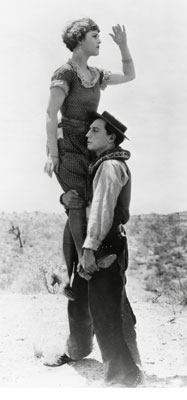
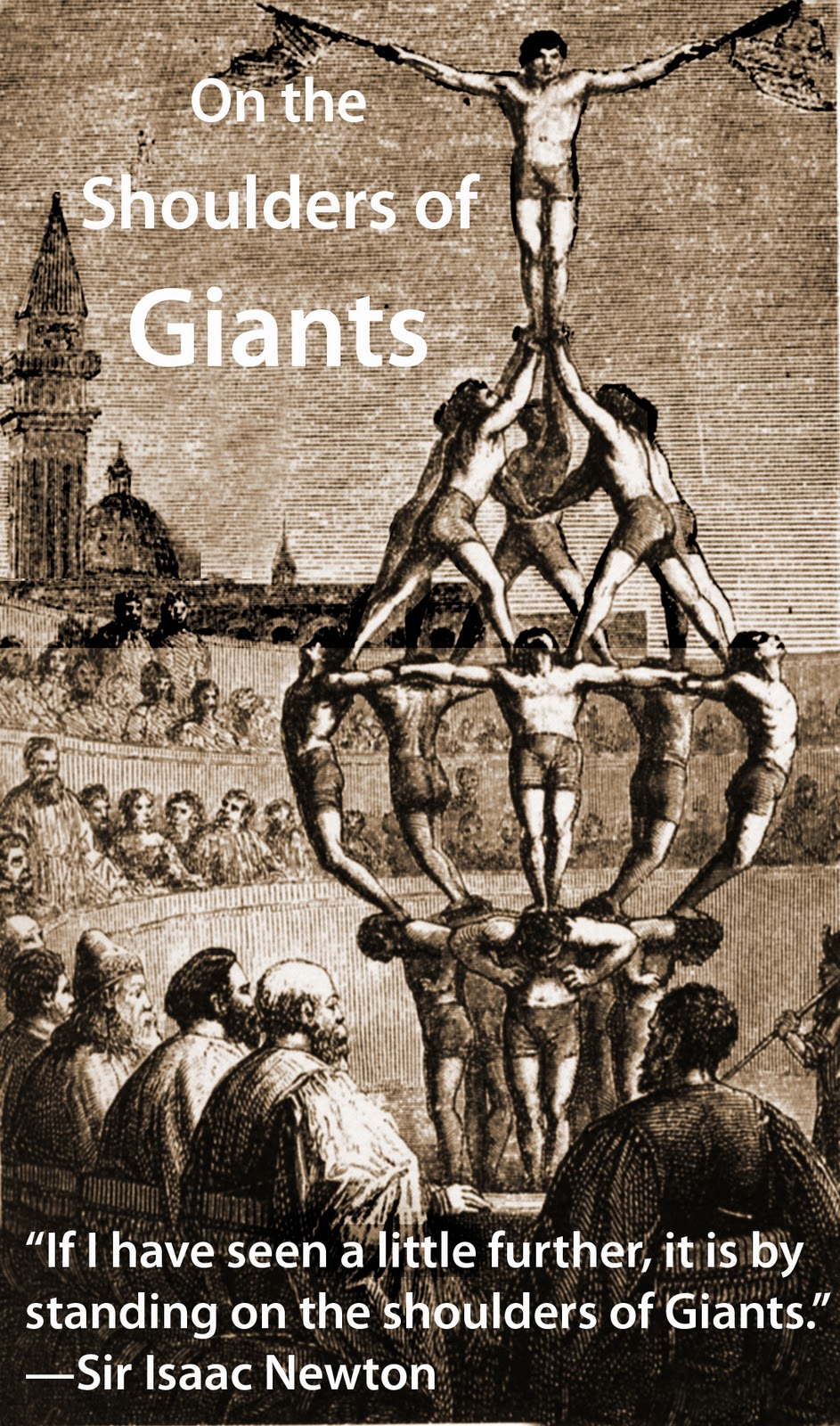
I thought it would be cute to begin a series entitled “On the Shoulders of Giants” by talking literally about standing on shoulders, what is commonly referred to as the “2-high.” Pile on more bodies, perhaps flying off a teeterboard, and you get a 3-high, a 4-high, etc., but I sure am the wrong person to ask about this. I was pretty good at your basic 2-high, but that was it. I can still see Fred Garbo, somersaulting at me off a teeterboard some thirty years ago in a Gregory Fedin – Nina Krasavina circus class in Hoboken, NJ. Garbo was wearing a mechanic, maybe even coming in at reduced speed, probably weighed all of 135 pounds, but all I wanted to do was duck. I think he landed on my shoulders once or twice, and I managed to grab him, sortakinda, but I doubt I actually saw much of this.
Update: See post 013 for some fantabuloso partner acrobatics from 1902-03 by the Julians Acrobats, with a lot of two-high variations.
The proper technique for the 2-high has been laid out quite thoroughly in Circus Techniques (pp. 68-72) by Hovey Burgess. [Full disclosure: I was an editor on this book, and Hovey was my first understander back in my NYU days, back when the Delaware Indians still ruled Manhattan.]
And yes, the 2-high is indeed executed by performers known as the understander and the topmounter. Karen Gersch, a skilled understander herself who once bravely had me on her shoulders as the middleman in a 3-high, remarked that understander was one of her favorite words in the English language because of its double meaning. Likewise, Corky Plunkett, father and understander in a family acrobatic troupe that was featured in a couple of circuses I was in, liked to say that “in acrobatics, you put the brains on the bottom of the pile.” This may not be what Shakespeare had in mind when he penned this bit of repartee for Two Gentlemen of Verona, but I’ve always liked to pretend it was: SPEED: Why, then, how stands the matter with them?
LAUNCE: Marry, thus: when it stands well with him, it stands well with her.
SPEED: What an ass art thou! I understand thee not.
LAUNCE: What a block art thou, that thou canst not! My staff understands me.
SPEED: What thou sayest?
LAUNCE: Ay, and what I do too: look thee, I’ll but lean, and my staff understands me.
SPEED: It stands under thee, indeed.
LAUNCE: Why, stand-under and under-stand is all one.
___________________
So let’s see where the laughs might come from with a 2- or 3-high — or for that matter a 31-high. I see two kinds of possibilities, because it seems to me that it might be useful to divide physical comedy into two categories. Now don’t you go frettin’ that I’m getting all intellectual on you here. Hey, I made it through grad school without understanding semiotics (though I did teach it once). But there are two types, and yes, this will be on the exam. (TOTAL DIGRESSION: one of my favorite quotes is “The world is divided into two kinds of people: those who believe the world is divided into two kinds of people, and those who don’t.”)
Did I mention there are two types of physical comedy? One is presentational, and in this case would take the form of comedy acrobatics, though of course there’s also comedy juggling, comedy magic, etc.. The performers present (attempt) an act of skill in the here and now, but get laughs along the way, usually through a series of mishaps that are eventually overcome. The other approach uses physical comedy within a storytelling structure, featuring characters in a real-life situation. The characters and the situation are often exaggerated, but there is a narrative that does not take place in the here and now. Just think of your typical silent film comedy. As you will find, I am a big fan of both (you want me in your audience) but my deepest interest lies in the use of physical comedy within a narrative framework. What can I say? I like stories, I like content and context, and I like what physical comedy can say about the life we live. You don’t have to share this bias… just letting you know.
Comedy Acrobatics & the 2-High Most of the comedy acrobatics I’ve seen centering around the 2-high involves the topmounter’s clumsiness in getting up there, slipping and falling on the way, and causing the understander to grimace pretty much non-stop. If the topmounter is female and wearing a dress, she might even falter and end up with the understander’s head under her dress. It’s been known to happen. In public.
I don’t have the perfect comedy acrobatic clip for you, but here are a few brief seconds of such clumsiness from a routine by two unnamed acrobats on the old Colgate Comedy Hour. [Anyone know who they are?] Notice the foot on the face.
In The Playhouse, Buster Keaton’s spoof of Vaudeville, a Zouave acrobatic act has to be replaced at the last moment by some ditch diggers from down the block, with the inevitable clumsiness.
The “broken column” dismount from the 2- or 3-high, as seen in this drawing from Georges Strehly’s 1903 classic, L’Acrobatie et les Acrobates, also usually gets a laugh. I’m guessing the laughter comes from the relief of tension, but you might have to ask Freud to be sure. The whole column tilts forward, staying in a straight line until the last split-second, when they all bail out into some variation of a forward roll. This can be done with two people but is much more visually arresting with three. I even saw three Taiwanese women acrobats go directly from a 3-high into a 3-person peanut roll and then roll backwards right back up into a 3-high. Wow! indeed. [Note: a peanut roll is what the “Colgate” acrobats do at the end of that video above.]
Just to prove I can still translate French, this is what Strehly wrote about it: One of the most original and unexpected moves is the broken column. The performers, balanced in a 3-high, let themselves fall forward and, at the moment when they are about to hit the ground, detach themselves from one another and complete the fall with a saut de nuque.
And what exactly is a saut de nuque? Translated literally it’s a neck dive, and is explained by Strehly as follows:
The saut de nuque, uniquely reserved for clowns, at first resembles the saut de lion, but instead of having the arms in front of the body, they are left glued to the body and, at the moment when it seems that the head is about to smash into the ground, the chin is brought to the chest so that it is the neck or, to be more precise, the muscles in the cervical region that break the fall.
Here’s a video clip of the acrobatic team Quatour Stomp doing a broken column from a 2-high, atop a table no less, though with a fairly early break and with a conventional forward roll.
And Strehly adds a variation I’d never heard of:
One increases the difficulty, but not the effect, of this cascade by falling backwards. At the moment when it seems that the three performers are about to land flat on their backs, they disengage from one another, execute a half-pirouette, place their hands en parade, and complete the movement with a saut de nuque.
I don’t know, I’ve never seen this done, but I’m betting it would increase the effect for me big time. [And no, I’m not positive what en parade means, though I could guess. Neither Harrap’s nor the internet are any help, but I’d be happy to hear from any of the 90 million francophones out there, most of whom I assume read this blog.]
Storytelling If you’re telling a story and one character is standing on another’s shoulders, there’s got to be a reason. You can’t just stand there and shout “Ta-Da!” Maybe you’re trying to reach somewhere you shouldn’t be. If so, you might need to make a quick escape. The classic example of this is from Buster Keaton’s1920 silent short, Neighbors. Keaton is in love with the girl next door but can’t marry her because the families are arch enemies, so elopement is the only answer. Unlike Romeo and Juliet, this one has a happy ending thanks to some, er, understanding friends.
Even given that the bride-to-be topmounter is replaced by a dummy in most of the shots, the dexterity with which the three-high disassembles and reunites to make its way through the neighborhood obstacle course is amazing and transforms what is usually a static stunt into a refreshingly original chase scene. Skill, story, and comedy merge perfectly.
Keaton was an incredibly creative comedian and filmmaker, so it would not be surprising for him to have concocted all this on his own, but he was also a Vaudeville veteran who had not only performed with his family’s knockabout troupe since the age of three, but had no doubt worked on the same bill with hundreds of other physical performers along the way. So I was not all that surprised to come across this poster of the Byrne Brothers’ Eight Bells while doing research for my Clowns book.
Notice the sneaky three-high off to the left, carrying off a trunk, not to mention the ladder pivoting on the fence, which also is a major physical gag in Neighbors. Eight Bells was performed by the Byrne Brothers from 1890 to 1914, when it was replaced by a similar piece, An Aerial Honeymoon. Keaton had begun performing in Vaudeville before the turn of the century, so I’d say the similarities are hardly coincidental.
Human Pyramids in a CGI World Fast forward to the 21st century (aka, now), where big budgets and CGI (computer-generated imagery) have resulted in some amazing television commercials that mine the physical comedy tradition to hawk such essentials as $100 sneakers and watered-down beer. But give credit where credit is due: some of these spots are highly creative and quite funny, though little or no physical skill may be involved. Here’s Kevin Garnett, in real life an immensely talented basketball player, in the Adidas “Carry” ad, backed up by Etta James singing “He’s Got the Whole World in His Hands.” The visual effects are by Method Studios (Santa Monica, Ca.).
And you thought I was joking about a 31-high! [Okay, 31 is an approximation, but you get the idea.]
Viewed as physical comedy, this commercial raises two obvious questions: is it physical and is it comedy?
You are of course right in assuming that Kevin Garnett did not walk around town with all those people on his back. Instead, he wore a rig that was used to collect position data for motion tracking so that performers hanging from a rig in a green screen studio could be composited into the shot. You can get a more thorough explanation from artist Andrew Bell, but meanwhile here are some pics showing how Street Shot w/ Rig + Greenscreen Shot = Final Composite:
There’s some physical work here — the guy diving off the building is probably a stunt man — but otherwise it’s pretty much an illusion. If this gets your dander up about truth and live vs. digital performance, I’m glad because I have every intention of fomenting controversy on this issue in later posts! Still, because this pyramid is such an obvious exaggeration, it doesn’t bother me as much as other faked physicality. It’s all done with a wink. And the joke itself isn’t bad, the gag of repetition leading to the “impossible” pyramid, nicely contrasting with the nonchalance of Garnett. I admit to liking it.
Here’s another video snippet of a wild human pyramid (this one dances!). I don’t even know what this is from, but you’ll find it on the Method Studios demo reel.
Okay, a 31-high is fine and all, but the Miller Lite “Break from the Crowd” commercial creates a 1200-body human pyramid that is a rampaging monster of conformity. (And you thought I was kidding about a 1200-high!) So what if 99.9% of the bodies aren’t real?
Yep, that was also done by Method Studios under the direction of Alex Frisch; they seem to have a thing about pyramids. Effects like these are accomplished with specialized crowd-creation AI software such as Massive. Here are some pics showing how they put together the shot at the end that combines these CGI bodies with a few real humans.
For those of you out there with a serious interest in visual effects, you can learn more about how this was done from an interview with Frisch at fxguideTV: there’s a high-bandwidth version and a low-bandwidth version. The discussion of this commercial starts at the 3–minute mark.
It looks like even less actual physicality went into the making of this one, but the visual idea of the monster pyramid representing the conformity of the crowd is a striking one, and our hero’s escape from it funny enough. Too bad it wasn’t for a better brand of beer.
Human Pyramids: Sacred Cultural Tradition? Widen the base of your three-high and you can add a lot more bodies, creating what’s called a human pyramid because of its inverted-V shape. We all did these in high school — you can probably still feel those knees in your shoulder blades — and YouTube is full of such stunts. They are supposed to teach teamwork, and with all those understanders there should be one huge heap of understanding.
In Catalonia (Spain), this is carried several steps further — oops, I mean higher — by the castell folk tradition dating back several centuries. “Castle-building” competitions pit large teams (650 members, all living, breathing sentient beings) against one another. One pyramid goes ten stories high and, according to this video, has a base of 400. Talk about community building!
And Now It’s Silly Time: A Three-High in Outer Space Eat your heart out, earthbound Catalans! This brief segment from Howard Smith’s odd documentary film Gizmo shows astronauts on the Skylab space station taking advantage of weightlessness to do a three high at the very beginning of the clip and, later on, a triple-decker, no-hands push-up.
__________________________________
As Sir Isaac Newton once said, “Th, th, that’s all folks.” Comments and additions welcome!
As I said in my previous post, I have a bunch of additional material relevant to each of the twelve chapters of Clowns. This is especially true of Chapter 5, because it focuses on physical comedy. In fact, you could view this entire blog as Chapter 5 supplemental material! In addition, I’m still a huge fan of the Hanlon-Lees and I could overwhelm you with stuff on them, but I’m going to wait for the publication this fall of Mark Codson’s book (see below) to dive back into their work.
That being said, a few miscellaneous goodies…
__________________
On pages 5-6, I talk about nineteenth-century performers such as Mazurier and Klischnigg, who did remarkable imitations of monkeys, starring in vehicles such as Jocko, or the Monkey of Brazil. You can get some sense of what that might have been like from this comic turn by Buster Keaton in his brilliant short, The Playhouse (1921).
_______________
Baudelaire on clowns: the Vertigo of Hyperbole
When Tom Mathews’ English pantomime troupe visited Paris in 1853, one of the spectators was the French poet, Charles Baudelaire. Despite his well-known interest in the macabre and the grotesque, Baudelaire was somewhat taken aback by the British clown, the “English Pierrot.”
I shall long remember the first English pantomime that I saw. . .It seemed to me that the distinguishing characteristic of this genre of comedy was violence. . . . The English Pierrot was by no means this character pale as the moon, mysterious as silence, supple and mute as the serpent, lean and long as a pole, to which we were accustomed by Deburau. The English Pierrot comes in like a whirlwind, falls like a bale, and when he laughs he makes the room shake; his laughter sounds like joyful thunder. He is a short, thick fellow, who has increased his bulk by a costume filled with ribbons. On his whitened face he has crudely plastered — without gradation or transition — two enormous slabs of pure red. His mouth is made longer by a simulated prolongation of the lips in the form of two carmine strokes, so that when he laughs his mouth seems to open from ear to ear. . . . His moral nature is basically the same as that of the Pierrot we know: insouciance and neutrality, leading to the realization of all the rapacious and gluttonous desires, to the detriment sometimes of Harlequin, and sometimes of Cassandre or Léandre. But where Deburau thrust in the point of his finger so that he might afterwards lick it, the clown thrusts in both hands and both feet, and this may express all that he does: his is the vertigo of hyperbole. This English Pierrot passes by a woman who is washing her doorstep: after emptying her pockets, he seeks to cram into his own the sponge, the broom, the soap, and even the water…. Because of the peculiar talent of the English actors for hyperbole, all these monstrous farces take on a strangely gripping reality.
— De L’Essence du Rire (my translation)
__________________
In the book, I described The Duel Between Two Clowns, a clown act between Boswell and one of the Price Brothers (apparently William) involving an attempted two-high, a ringmaster, a duel, and some quick change. Amazingly there is an actual transcript of this routine from the 1840s in Entrées Clownesques, a collection of clown texts compiled by the great French circus historian, Tristan Rémy. I have no idea what the original source for this document is. Rémy’s book was translated into English by Bernard Sahlins as Clown Scenes (Chicago: Dee, 1997). Unfortunately, for some reason he only includes 48 out of the 60 entrées contained in the original, and Le Duel Entre Deux Clowns ain’t one of them. Thanks, Bernie, for forcing me back into the highly lucrative clown entrée translation business!
Here it is, hot off the press. Please use your imagination to see beyond the dialogue and picture the act performed by two very strong clowns.
[Forthcoming!]
__________________
Another link between 19th-century pantomime and early film: First here’s a poster of the train wreck from Le Voyage en Suisse (1879):
And now here’s a shot from the 1904 Georges Méliès film, The Impossible Voyage, courtesy of the Library of Congress.
Coincidence? I think not. Méliès was, as many of you probably already know, a stage magician who became a pioneer of special effects in early film. And while we’re on the subject, the connections between film effects and circus-style performance is the subject of an intriguing blog that you might want to check out: Circo Méliès.
_______________
And in my first On the Shoulders of Giants installment, I reinforce the obvious connection between the Byrne Brothers’ Eight Bells and Buster Keaton’s Neighbors by showing the Keaton clip that brings the poster to life (and then some).
_______________
Mistakes? What mistakes?
Probably plenty; here’s one…. Mark Codson, whose excellent dissertation on the Hanlons will be published this fall, pointed out that I persisted in translating the title of Le Voyage en Suisse into English, when in fact the show toured to England and the United States with the original French title. I was probably thrown off by a few bi-lingual posters and by a previous commentator or two who also referred to it as A Trip to Switzerland. The correction has been made, so thank you Mark. If anyone has additional corrections, just let me know. UPDATE (11-17-09): Mark’s book is now slated for publication on February 2, 2010. You can order it here.
_______________
UPDATE (11-17-09): You can see a version of Auriol’s bottle-walking act in Cirkus Cirkör’s production, Inside Out. Read all about in in this post.
_______________
So what’s missing?
It’s the second longest chapter in the book, and one of my favorites, but it has at least one glaring omission, the work of American pantomime clown George L. Fox. Yes, I do mention him, but that’s about it. He was wildly popular and a colorful character (he went insane), but I think at the time it was hard to find all that much about his actual performing. Or perhaps I just ran out of time.
A few years later, when Bill Irwin was first considering doing a show based on Fox’s life, I helped him out with some additional research, including uncovering some original pantomime scripts. It was not until 1999 that Laurence Senelick’s excellent study appeared: The Age & Stage of George L. Fox, 1825-1877. Armed with this thorough research, Bill finally did his show, Mr. Fox: A Ruminationin 2004 as part of his season of work for the Signature Theatre.