As promised, here’s the second installment of Karen Gersch drawings and paintings of contemporary clowns. If you missed part one, check it out here. If you missed her series of classic clowns, click here.
________________________________
Clownesse, “Samovar”, France
Clown, Cirque Gruss
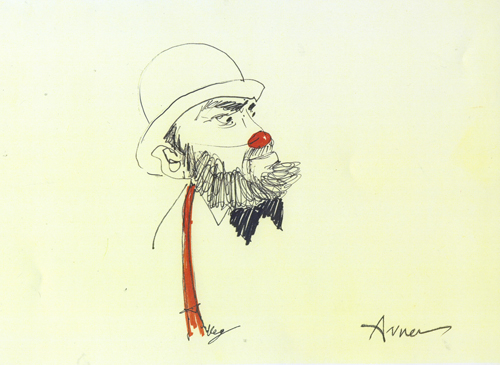
Avner, USA
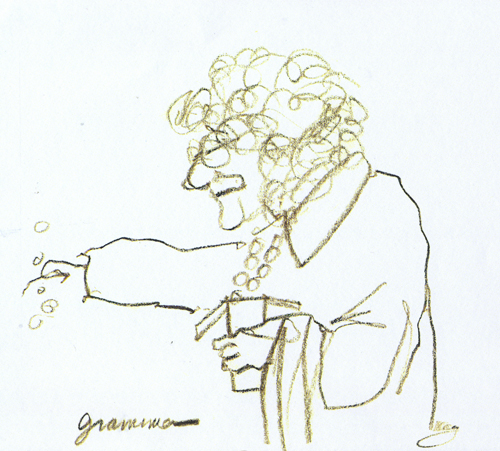
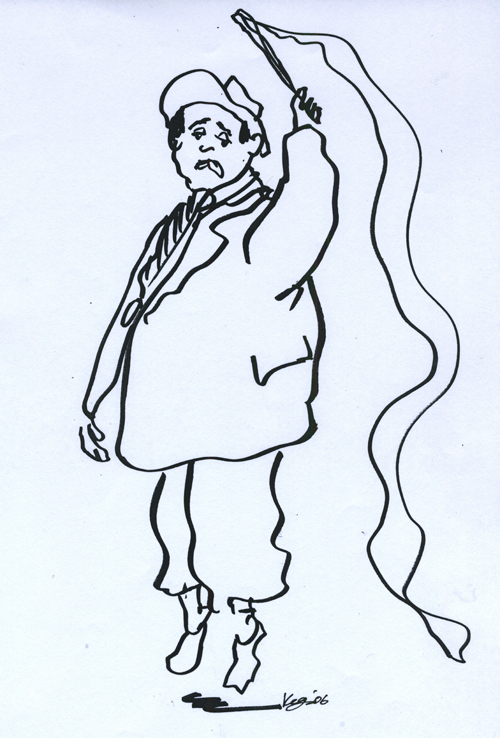
Barry Lubin’s Gramma, Big Apple Circus
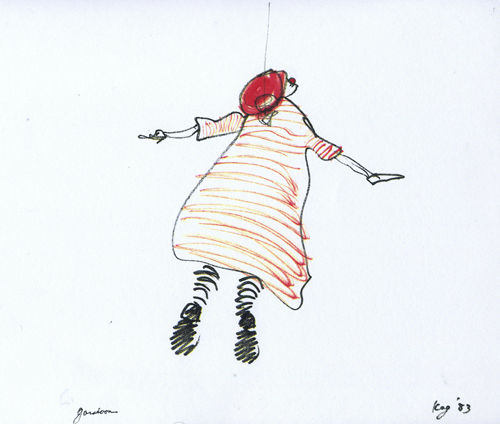
Jeff Gordon’s “Gordoon in Flight,” Big Apple Circus
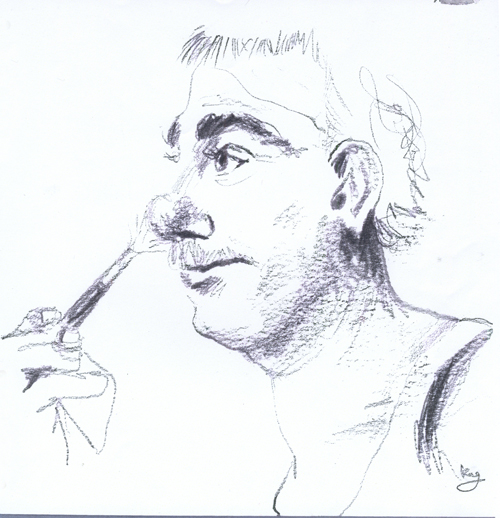
French clown applying makeup
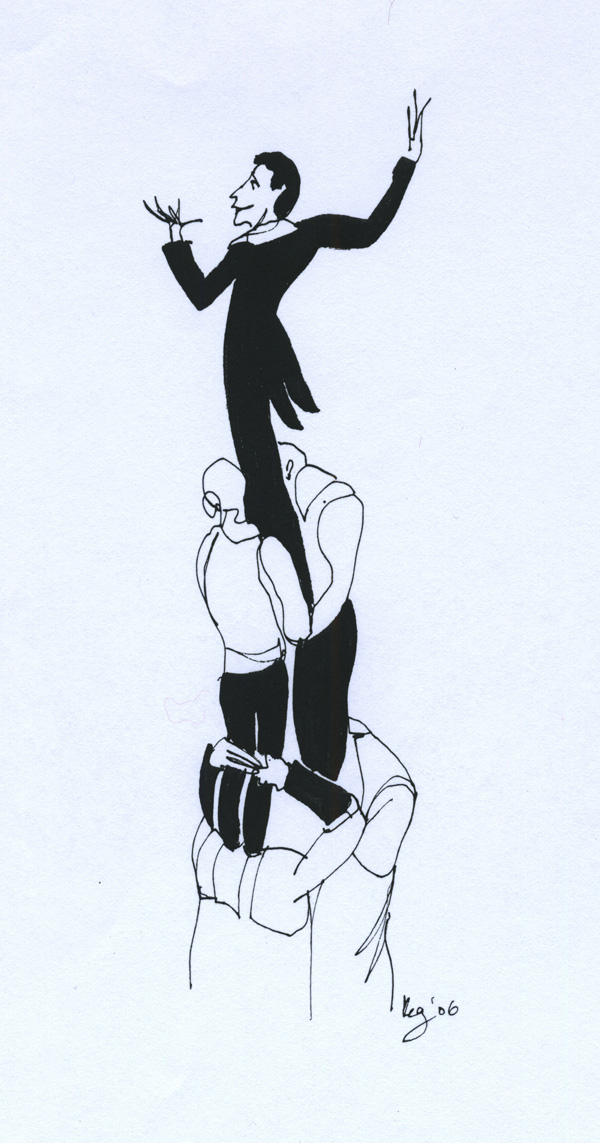
“Cabaret”, Ukrainian Acrobatic Troupe at Cirque de Demain Festival (Paris)
“Cabaret”
Clown, Cirque de Demain Festival (Paris): “Fever”
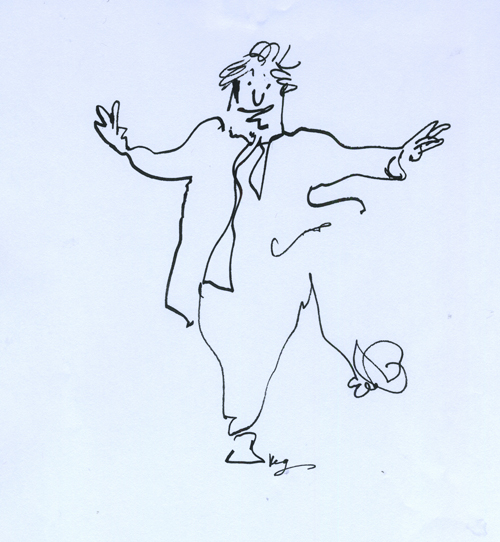
Clown, Cirque de Demain Festival (Paris)
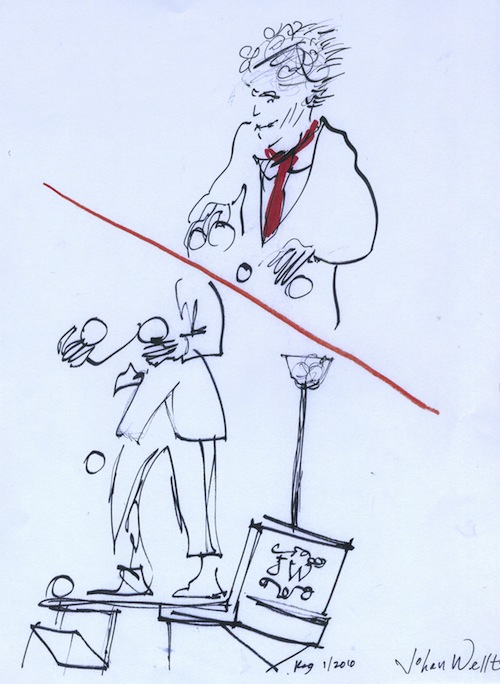
John Wellt, Eccentric Juggler
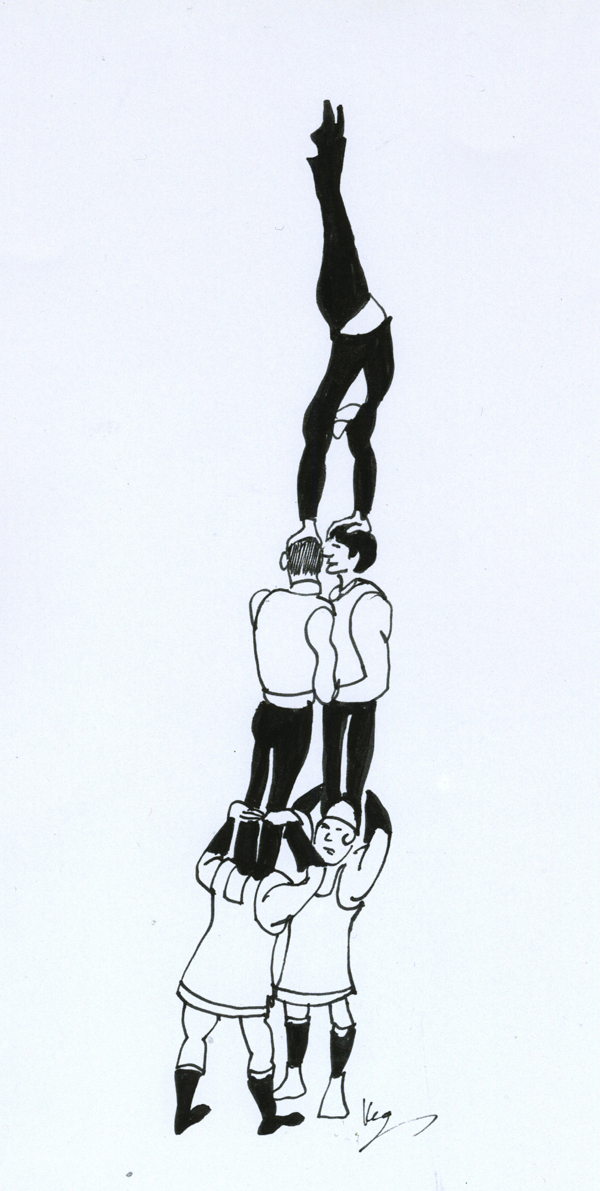
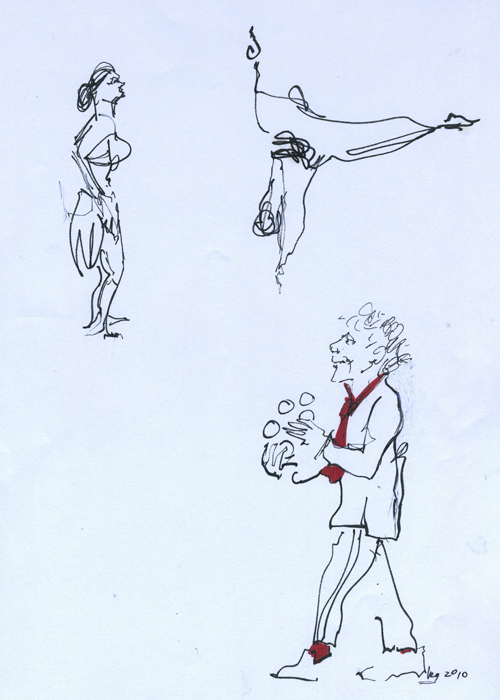
3 Artists, Cirque de Demain Festival (Paris)
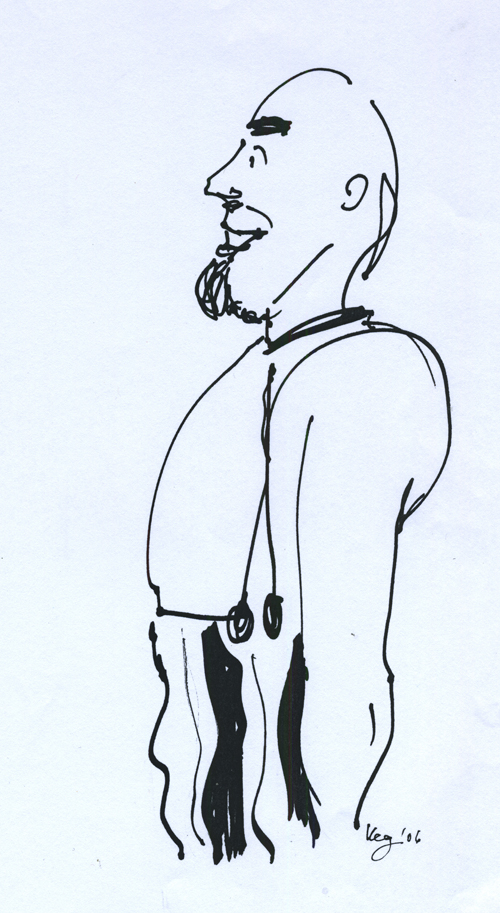
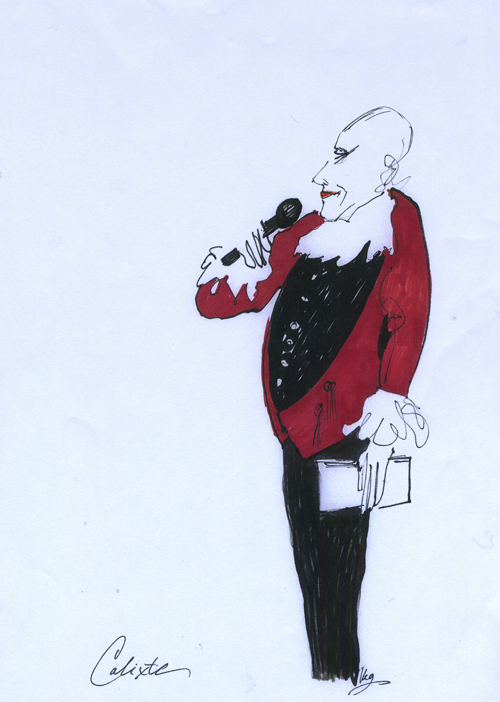
Calixte de Nigremont, Maître de Cérémonie
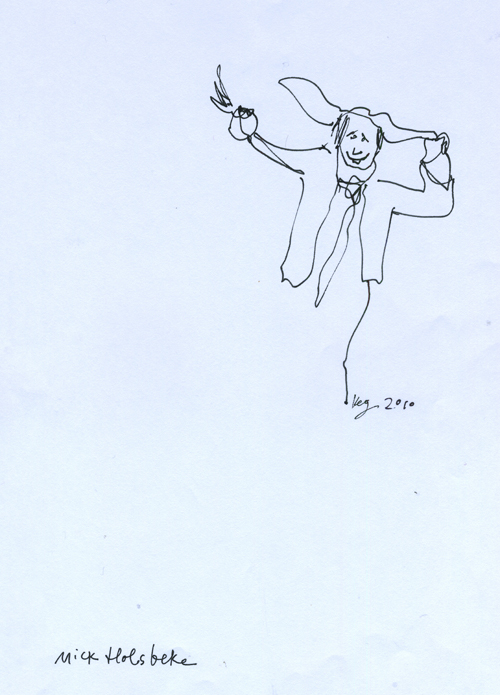
Clown — Mick Holsbeke
Clown – Mick Holsbeke
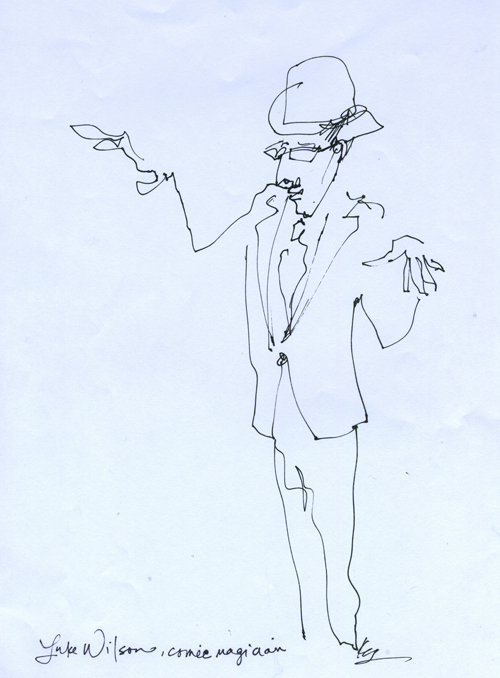
Luke Wilson, Leipzig’s Krystalpalast
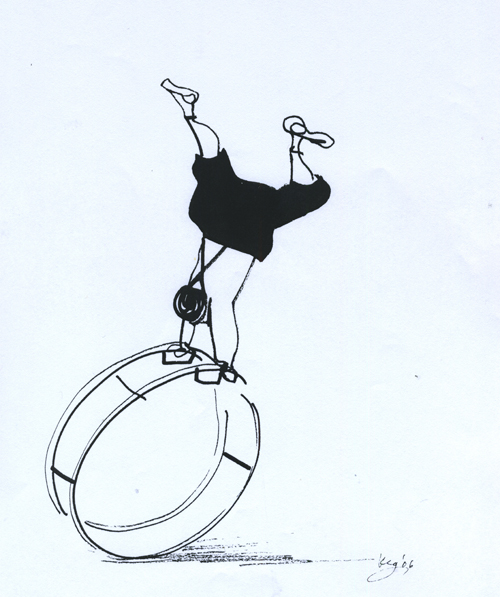
“Fever”, clown acrobatics on German Wheel
For more of Karen’s work, check out her web site here (yes, some drawings and paintings are for sale), and check out her exhibit and live circus show the next four Sundays on the Waterfront Museum barge in Red Hook, Brooklyn. I hope to see you all there. Every single one of you!
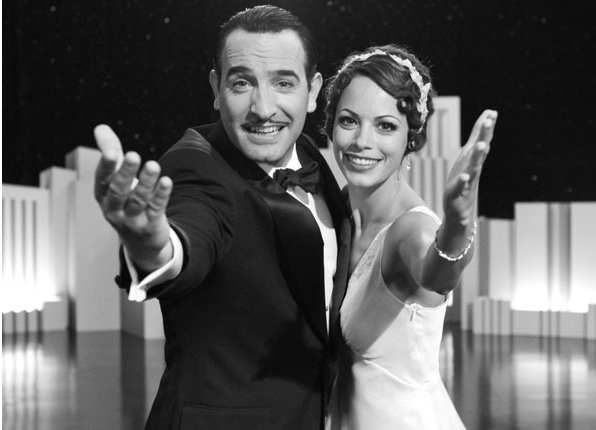
French directors Pierre Etaix and Jacques Tati made solid reputations for themselves creating modern-era silent-style movies four and more decades after the dawn of the talkies. Now another French director, Michel Hazanavicius(OSS 117) has followed in their footsteps with The Artist, a silent, black-and-white movie about the transition from the silent era to sound. It was announced yesterday that Terrence Malick’s The Tree of Life had won the Palme d’Or, the top prize at the Cannes Film Festival, but according to several reports The Artist gave it a real run for its money. Hélas, for some stupid reason I am not currently on the French Riviera so I haven’t seen the film yet, but here’s a trailer and a few (rave) reviews.
_____________________________________
“The Artist” manages the seemingly impossible: It’s a new silent film that pays thoughtful tribute to the traditions of the past while creating great fun for modern audiences. Which is just what French director Michel Hazanavicius had in mind.
“A silent film is a very special experience. … It’s not intellectual, it’s emotional. You take it in the way you take in music,” Hazanavicius explains, tired but still engaging at the end of a day spent coping with a deluge of media requests. “There are times when language reduces communication, when you feel you are losing something when you start talking.”
Michel Hazanavicius’s The Artist, added to the Cannes competition at the last minute, is both a surefire crowd pleaser and a magnificent piece of film-making. Whatever else, this is also surely the most enjoyable contender for the Palme d’Or this year.
It’s a silent movie set in the Hollywood of the late 1920s. The story of a Douglas Fairbanks-like movie star (Jean Dujardin) fallen on hard times, it evokes memories of everything from A Star Is Born to Citizen Kane, from Scott Fitzgerald’s Pat Hobby Stories to Kenneth Anger’s Hollywood Babylon and even Charlie Chaplin’s Limelight. French director Hazanavicius (best known for spy spoof OSS 117) isn’t the first film-maker in recent years to make a silent movie but he is doing it on a far grander scale than any of his predecessors.
The talk Sunday at the Cannes Film Festival was about the movie that doesn’t talk: a silent film about a 1920s Hollywood star toppled by the age of talkies.
French director Michel Hazanavicius’ “The Artist” employs lush music, well-chosen but restrained sound effects and no spoken words save in one brief scene.
The result is an old-timey comic melodrama about the pitfalls of artistic pride and the power of romantic redemption that earned sustained applause at its first press screening, a rarity for notoriously snooty Cannes critics.
A last-minute addition to the lineup of 20 films competing for the festival’s top honor, the Palme d’Or, “The Artist” is shot in black and white, conveys its limited dialogue through silent-movie title cards and is presented in the boxy format of early cinema instead of today’s widescreen panoramas.
It is a relief to turn to the great movies, of which there were a fair few. French director Michel Hazanavicius’s The Artist is my favourite, by a whisker, of the competition films. It’s a piece about Hollywood’s silent black-and-white age, and is itself silent and in black-and-white. That may sound rather mannered and plenty of people out here, particularly the American critics – who might take a rather coolly proprietorial attitude to this subject – thought it a pleasant pastiche and nothing more. Actually, it is a lovely film with a sublime and swooningly romantic story, taking its inspiration from Singin’ in the Rain, from Welles and from Lang. I can’t wait for the film to come to Britain so I can see it again.
Update (5-29-11): I just watched Hazanavicius’s OSS 117 on Netflix Instant Play. Not much physical comedy, but pretty funny. It’s a spy spoof, but with more mature social and political satire than, for example, the Naked Gun movies.
I don’t know much about Compagnie Ieto, another product of the French circus school system. I’ve never seen them perform, but based on this video — thank you to Jeff Seal for the link — I like, I like. Strictly speaking this is more nouveau cirque than physical comedy, but there’s a strong kinship in terms of partner acrobatic work, engagement with the material world, and sheer creativity.
Click here for a review in English.
Click here for a review in French.
Click here for their web site.
INSPIRATIONS
« If your friend limps to the right then limp to the left. »
Renard J, Journal, 1906
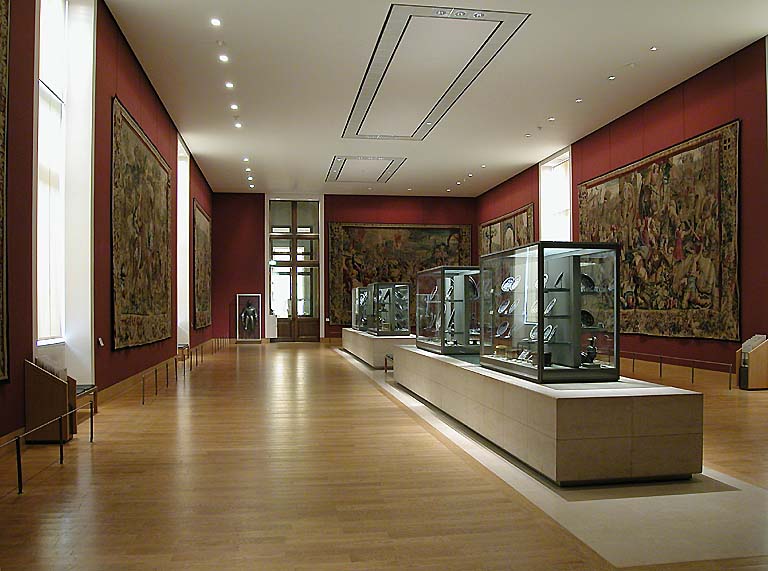
During my March visit to Paris, the Louvre was hosting various groups doing performances and other events around the art work each Friday night. The evening I visited, there were about half a dozen groups of students from the École Jacques Lecoq doing movement pieces in the Richelieu wing in front of glorious Renaissance tapestries and related art work. I thought the evening a great success, bringing new life to a museum that, though indisputably great, can still benefit from more dynamic ways of engaging art.
Special thanks to old friend and Lecoq alumnus Bernie Collins for turning me on to this. And it was great meeting Lecoq teacher and acclaimed physical comedy performer Jos Houben, who had worked with these students, and to get to see Mme. Fay Lecoq again — who was in fine spirits and did not seem to have aged since I last saw her in 1990!
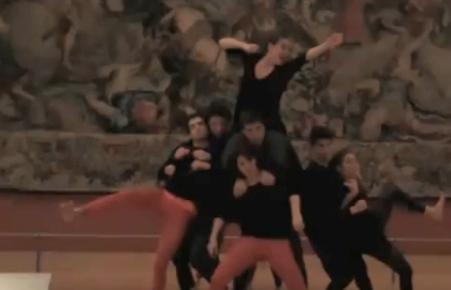
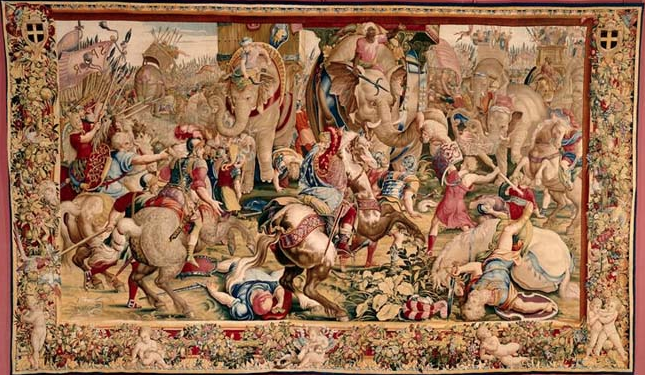
Here are two of the short pieces. The first is a group scene in The Scipio Gallery(right), the tenth tapestry from the set The Hunts of Maximilian. The tapestry they performed in front of is attributed as follows:
Battle of Zama
After Giulio ROMANO
OA 5394: a tapestry depicting a hunting scene. Tapestry, wool and silk Copy made at the Manufacture des Gobelins for Louis XIV in 1688–89, after the tapestry woven in Brussels, c. 1558, for the Maréchal de Saint-André.
Here’s the tapestry:
And here’s their piece:
The second piece in a neighboring room is an “eternal triangle” with some nifty partnering. This room had smaller art works, mostly bronzes. Not sure if this piece is specifically based on one of these.
When famed film director Federico Fellini produced I Clowns for Italian television in 1970, he created a pseudo-documentary, part nostalgia, part fantasy that seduced much of the public but offended many in the world of European clowning. Fellini’s premise was that clowning was dead, a conclusion he apparently came to before doing any serious research.
Somehow Fellini with all his resources could not even find any footage of classic clowns. Instead we get a futile visit to an archive to see a short clip of the great clown Rhum, only to have the film reel start to burn up in the projector. Clearly the past was lost.
He either did not know or it did not fit his preconceived notions to mention that there was lots of footage of Charlie Rivel, that Grock’s entire one-man show had been caught on film more than once, and that this very same Rhum had co-starred in a series of short films with Jacques Tati in the 30s!
Enuf said, but if you want more on the controversy, here’s the reaction the Fellini film got from the writers of the publication, Cirque dans l’Univers (#81): Fellini’sClowns
Now comes along a new film that attempts to update clown history by covering performers in Europe who it credits with saving a lost art. Here’s their synopsis:
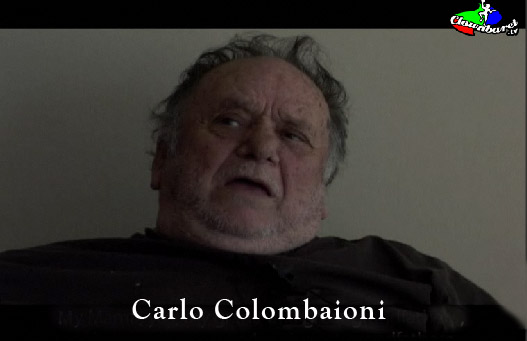
New Shoes: Today’s Clowns in Europe is a unique and original documentary about clowns of the turn of the century, from Carlo Colombaioni up to the present. It offers a vision of the contemporary clown from the point of view of the most renowned figures of the genre, who show us how they think and act, onstage and off. Through the play of two young clowns, we discover how these actors and the clowns they incarnate face the different aspects of life.
And here’s their trailer for it:
The good news is that you can now see a short (54-minute) segment of the documentary on the web. Fundraising is continuing so as to release a full-length, 84-minute version on DVD, complete with special features.
Based on what I’ve seen, this is a substantial piece of work. Although I might question the premise that just a few decades ago clowning was dead, only to be rescued by this film’s featured performers, what it does do is provide insight into a significant development in the history of clowning: the migration of the clown not only from the circus to the theatre, but into our political and social fabric, as evidenced by such welcome phenomena as hospital clowning, more women in clowning, and Clowns without Borders.
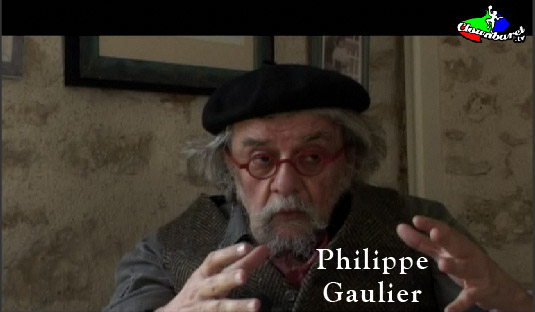
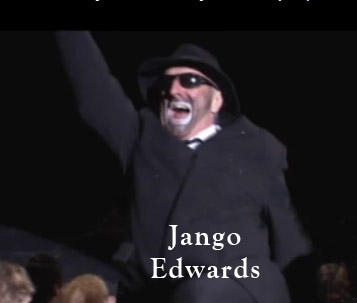
What I like most about the film is that it lets the clowns speak for themselves — performers and teachers such as Philippe Gaulier, Jango Edwards, Leo Bassi, Johnny Melville, Gardi Hutter, Peter Shub, Slava Polunin, Carlo Colombaioni, and many more — and they are all quite eloquent on issues of creativity, career, gender, and the essence of being a clown. What seems missing in this shorter version and I would hope to see in the final movie are more and longer performance clips. I’ve seen a lot of these artists perform, but many potential viewers haven’t. I think there’s a need for more evidence of what this new movement in clowning looks like, even granted that the best clowning can not be fully captured on video.
Though a documentary such as this only scratches the surface of a complex subject, I’m pretty sure you will find this work well worth your time. And now you can view the 54-minute version at the clownbaret.tv web site by clicking here.
TECH NOTE: I had problems getting the movie to stream when using the Firefox browser, but it worked fine with the Chrome browser. It may have been network traffic rather than the browser, but if you have problems, try Chrome.
Like the movie, appreciate the great effort, want to help them complete the final version? Then consider making a donation at the clownbaret web site.
Max Linder produced, wrote, and directed three feature films for his own company: Seven Years Bad Luck (released Feb. 1921), Be My Wife (Dec. 1921), and The Three Must-Get-Theres (Aug. 1922). I’ve already written about Seven Years Bad Luck, and I guess I really do have some readers because I learned shortly thereafter that there was a short wait to rent it on Netflix. The pen is indeed mightier than the sword.
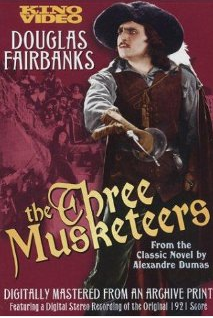
Speaking of the sword, in 1921 Douglas Fairbanks released one of his popular swashbucklers, The Three Musketeers, based on the classic French novel by Alexandre Dumas père. A year later, Max Linder released the above-mentioned The Three Must-Get-Theres — get it?— his 55-minute parody of the Fairbanks two-hour epic. The French title, L’Étroit Mousquetaire, is also a pun, but with the less satisfactory literal meaning of “the narrow musketeer,” though apparently étroit can also mean petty.
[AN ASIDE: Dumas père is not to be confused with his son, Alexandre Dumas fils, the playwright who wrote Camille, the basis for Verdi’s opera La Traviata. You can download the original Dumas père novel for free from Project Gutenberg by clicking here.]
Douglas Fairbanks was Hollywood’s first big action hero and co-founder in 1919 of United Artists with D.W. Griffith, Charlie Chaplin and Mary Pickford. Though no clown, he was a comic action hero, more Johnny Depp than Mel Gibson, with an eye for physical comedy. If you haven’t seen his work, check out his acrobatic prowess in the video of him on my parkour post.
[AN ASIDE: Douglas Fairbanks, Sr. is not to be confused with his son, Douglas Fairbanks, Jr., also a movie star, though in the 1930s and 1940s, and not so much the action hero.]
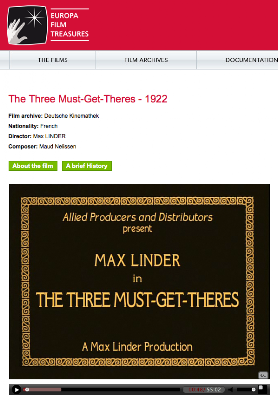
Here’s the entry on the Linder film from Europa Film Treasures, penned by no less an authority than David Robinson, author of the definitive Chaplin biography and other notable works: Linder is said to have considered The Three Must-Get-Theres the best film of his career. It came out almost exactly one year after the release of The Three Musketeers, but the success and furore of Douglas Fairbanks’s opulent spectacle were still fresh enough in the audience’s memory to justify Linder’s parody.
With his wig always a little awry, Max parodies Fairbanks’s elegance, athleticism, and beaming self-satisfaction. The story and characters are directly caricatured from the original: Richelieu becomes Rich-Lou, and Buckingham, Bunkumin, while Max becomes Dart-in-Again, and Athos, Porthos, and Aramis are whimsically renamed Walrus, Porpoise, and Octopus.
The best-remembered moment of Max’s emulation of Fairbanks’s balletic athleticism is his deft and lethal stratagem when surrounded by a ring of swords. Much of the humour depends on surreal anachronism, so that Max is inclined to change his faithful donkey for a motorcycle, or cross the channel on a sailing horse. Fairbanks clearly appreciated the parody, and is said to have sent Linder a gracious congratulatory telegram.
The first time I watched The Three Must-Get-Theres, Ididn’t find it as funny as I had hoped to. Then I watched Fairbanks’ movie, followed by a second viewing of the Linder parody, and enjoyed it much more. Likewise, audiences viewing Linder’s comedy would likely have been very familiar with the Fairbanks blockbuster.
So here are a few clips, showing you Fairbanks scenes followed by the Linder version.
Here’s Fairbanks as D’Artagnan, tearfully leaving his small village and his dear papa to seek fame and fortune in Paris:
Romantic, sentimental, and noble, n’est-ce pas? And now here’s Linder’s extended exit, with the father-son affection being mirrored by the cow-horse farewell.
Next up is a Fairbanks sword fight:
And here are two slightly less gallant sword scenes from Linder:
So you get the idea.
Since this is a physical comedy blogopedia, I have to include one of my favorite Linder moves from this film, a nifty pass-through maneuver:
Finally, to switch gears, a quick comparison of a Linder 3-high elopement and a parallel scene in Keaton’s Neighbors.
Just for the record, Neighbors was released December 22, 1920; The Three Must-Get-Theres in August, 1922. For more on physical comedy involving 3-highs and other assorted human pyramids, check out this On the Shoulders of Giantsblog post. One of my personal favorites.
After all this, I’m hoping you’ll want to see The Three Must-Get-Theres movie for yourself, and now you can thanks to the good folks at Europa Film Treasures. Just click here — and enjoy the whole movie, with original music composed by Maud Nelissen in 2009, performed by The Sprockets.
Finally, for a review in Spanish from the excellent Circo Méliès blog, click here.
Keaton got Donald O’Connor, Chaplin got Robert Downey, Jr., and if screenwriter Samantha Husik has her way, Max Linder would be brought to life by the mega-talented Depp. Husik, a graduate of NYU’s Tisch School of the Arts film program, is the author of a new screenplay about Linder’s life and career that she is currently shopping around. I put Linder and Depp into my handy-dandy Morphomatic™ and this is what I got:
Hey, not bad. You’re hired!
I caught up with Samantha in the neighborhood, and asked her a few questions.
What first got you interested in Linder?
I had never heard of or seen Max before I saw Laugh with Max Linder on Netflix Watch Instantly. I thought, “Who is this guy and why haven’t I seen any of his films?” So I looked him up on the internet. I was fascinated by his life story. I also fell in love with his films. It’s a shame that Max and his wonderful films have largely been forgotten. I decided to write a screenplay about him as a way to introduce him to a new audience/generation.
Why do you think he’s important?
Linder was a pioneer of early cinema, one of the first and one of the best — unique, multi-talented and influential. A biopic would showcase his talents, why he and his clever, charming films were once so popular. Linder’s personal life is fascinating to me, particularly his relationship with his wife and their tragic deaths. I suppose my script is a character study: how manic depression drove this talented, charismatic man (and his wife) to suicide. There is an episode of the Dick Cavett Show where Cavett interviews Alfred Hitchcock. Hitchcock talks about the fine line between comedy and tragedy. He says, “How often have you seen the old fashioned scene of the man walking toward the open manhole cover. Of course he has to wear a top hat, cause that’s dignity, you see…You watch him and he walks, he’s reading a paper, and he suddenly disappears down the hole. And everybody roars with laughter. But suppose you took a second look and looked down the hole. His head is cut, he’s bleeding. They send for an ambulance…Think how ashamed that audience is that they laughed in the first place.” Hitchcock’s statement describes how I think of Max. To the world, Max was a clown – the guy we laugh at when he falls through the open manhole – but in his private life, Max was tortured and depressed – the guy we would see if we looked in the manhole. Max was a comedic genius, but a troubled man. That’s what most interests me about him and what I hope to show in this biopic.
How do you bring to life artistic genius? I ask this because a lot of biopics emphasize the lurid — usually drug abuse — but don’t necessarily provide insight into artistic genius — not that that’s an easy thing to do!
Honestly, I’m not sure. That’s something I’ve been working on; one of the focuses of my rewrites is to capture more of Max’s artistic genius. I want to show his lighter, creative side as much as I show his darker, manic-depressive side.
Can you tell us a little bit about your screenplay?
My script focuses on Max’s life/career from 1912 to his death in 1925. The story follows him from the height of his fame, through his war years and his time in America to the last few years of his life with Helene and his descent into manic depression. I’ve taken some artistic liberties, but I’ve tried to make my script as factual/accurate as possible. Most of the events in the script are based on real events that I learned from Maud Linder’s book and from other research on Max’s life. I’ve also included reenactments of Max’s films so an audience can see examples of Max’s talent – which will hopefully inspire them to watch more of Max’s films. I’m currently looking for representation that can help me get my script into the right hands!
________________
Well, with or without Johnny D., we wish Samantha luck! Any big-time agents or film producers out there? You can contact Samantha at: sbh281@gmail.com
OK, this one’s no more than a curiosity, but since we’re still on the subject of Linder….
Tarantino & Linder, an odd coupling, indeed, but no one knows his film history like our man Quentin, so this brief exchange from Inglourious Basterds should not come as a surprise. In it, two of the four main characters in the movie meet for the first time. Shosanna (Mélanie Laurent) has escaped the massacre of her Jewish family and now, under an assumed identity, is operating this movie theatre in Paris. Fredrick Zoller (Daniel Brühl) is a boyish German soldier who falls for her.
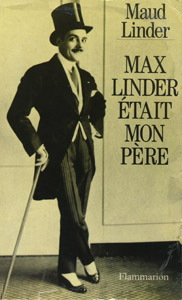
If I’ve convinced you in my recent posts that Max Linder is worth knowing about, then you might want to read more, no? But when it comes to books (you remember books) there’s still nothing in English devoted entirely to Linder, and the two books in French are both by his daughter, Maud Linder. Luckily, they’re excellent and it would be great to see them translated into English.
Max Linder Était Mon Père [Max Linder Was My Father]
by Maud Linder
Paris: Flammarion: 1992
So if you missed or forgot my unforgettable first post on Maud Linder, you may not know that in 1925, still in his early forties, Max Linder — the biggest pre-Chaplin international star — died in a double-suicide with his 21-year-old wife, callously leaving behind a 15-month-old daughter, Maud, who grew up not even knowing who her father was until the age of 20. This book is less a bio of Linder père and more an account of Maud’s rediscovery of her father and her subsequent efforts to rediscover his work and revive his artistic reputation. It’s a unique tale of a highly intelligent and motivated woman who somehow managed to separate her deep personal pain from her respect for her father’s artistic genius. No easy thing, and quite admirable.
Les Dieux du Cinéma Muet: Max Linder
[The gods of silent film: Max Linder]
by Maud Linder
Paris: Editions Atlas, 1992
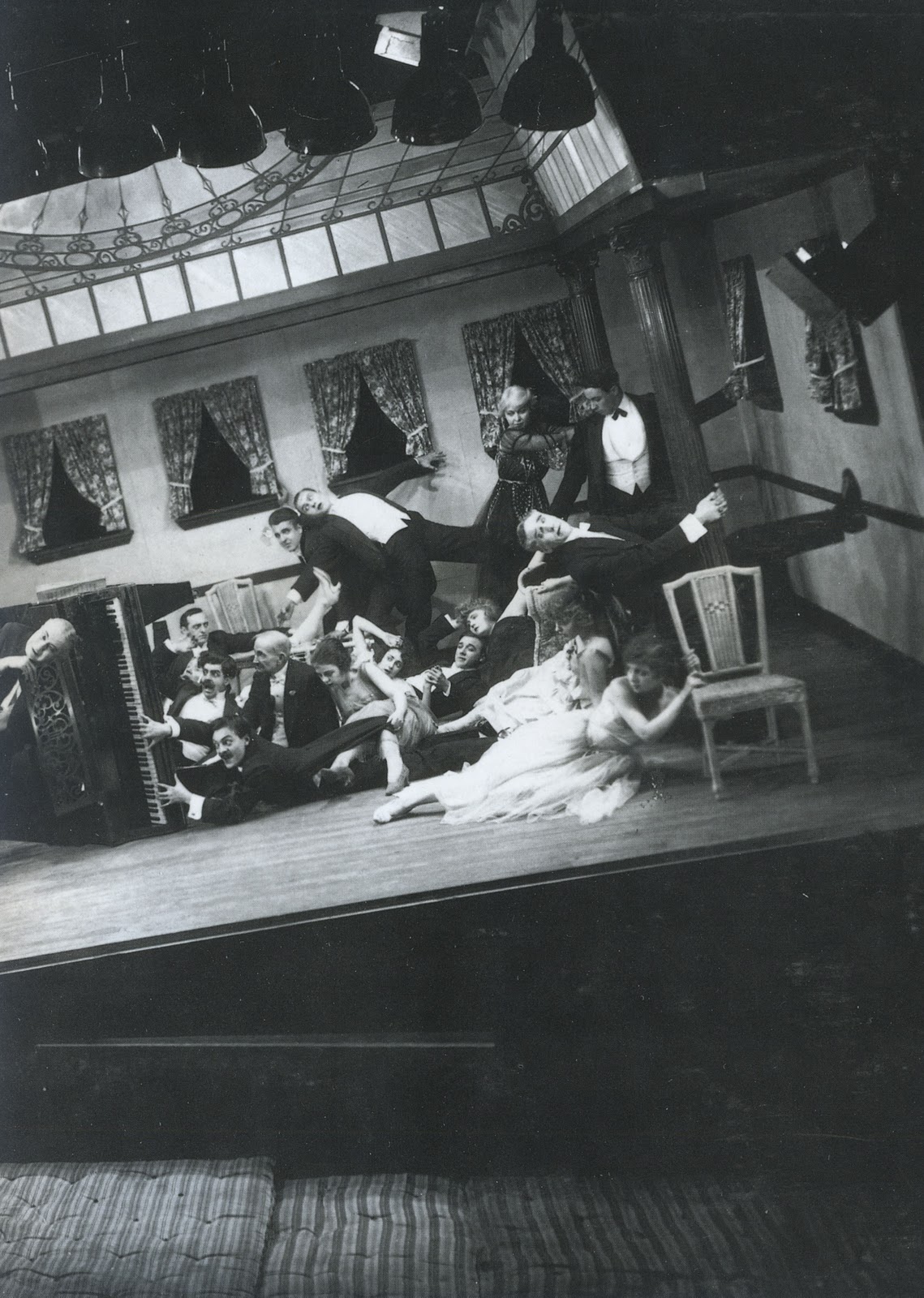
This is a gorgeous book that every Max Linder fan should own, whether you read French or not. It’s designed for the coffee-table at 11½’ x 14″, with144 glossy pages — 36 pages of text, the rest filled with well captioned, high-quality photographs, including 16 pages of color plates: Linder on set, Linder on stage, Linder in newspapers and magazines, Linder in real life, Linder on film. Especially tantalizing are publicity stills of Linder from lost films, films whose names we no longer know.
Here are a few shots to whet your appetite:
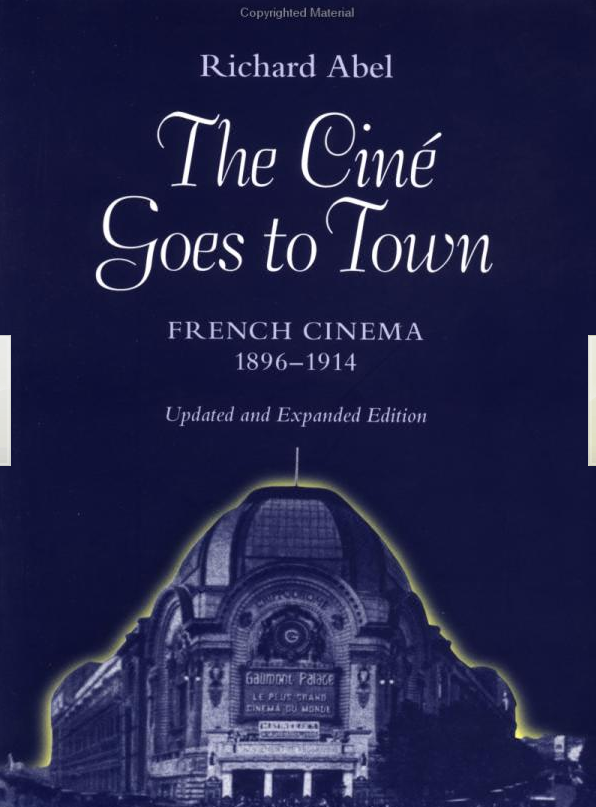
The Ciné Goes to Town
French Cinema, 1896–1914
byRichard Abel (University of California Press, 1998)
Last but not least at a hefty 568 pages is this exhaustively researched and insightful academic study of early French cinema, in which Max Linder is a key player. I have yet to read all of it, but enough to trust Abel’s thorough knowledge of the subject. He is especially strong at tying together the growth of film technique, the social forces in France at the time, and the artistic geniuses involved in forging this new art form. While the French are often criticized for claiming they invented everything, they were in fact the main innovators in early cinema.
Although written before the release of the two Linder DVDs reviewed in my previous post, and only taking us through 1914, Abel did manage to see pretty much every early Linder film available at the time, many of which are still unavailable to the public outside of various European film archives. It’s a bit frustrating to read about films you can’t see. Hopefully some day we’ll be able to plow through this history with instant access to all of the films covered.
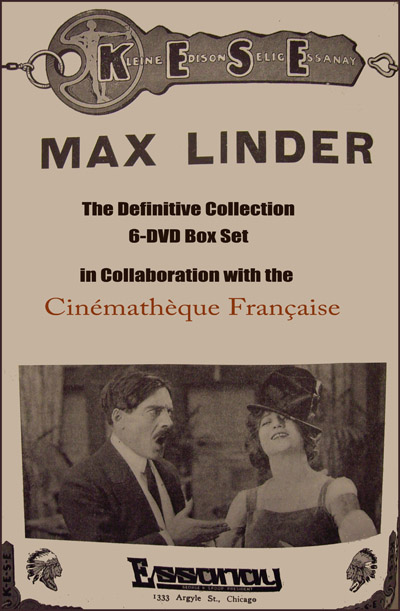
The rediscovery and remastering of silent film classics, reintroducing these artists to the public by way of annotated DVD box sets, has been a great gift to the physical comedy fan. First it was Chaplin and Keaton, then Lloyd and Langdon, followed by Charley Chase, Douglas Fairbanks and, most recently, that modern silent clown, Pierre Etaix. And now finally the father of silent film comedy, Max Linder, is being justly celebrated for his pioneering career that spanned over 400 films, about 130 of which have survived, in a handsome 6-disc DVD set complete with historical commentaries and new musical scores by New York’s own Ben Model.
Okay, I just made all that up. Yep, the DVD cover picture too. (Blame Photoshop.) Sorry about that, but there’s no Max Linder box set, no definitive collection, no historical retrospective. Which is a shame, not only because his work is so deserving of it, but because the passage of time means no one is still alive who worked with him (he died in 1925) to answer all our questions. (Yes, I have questions.) Keaton and Chaplin were rediscovered in the 60s when they and many of their collaborators were still kicking, resulting in a treasure trove of material on their incredible body of work. No such luck here.
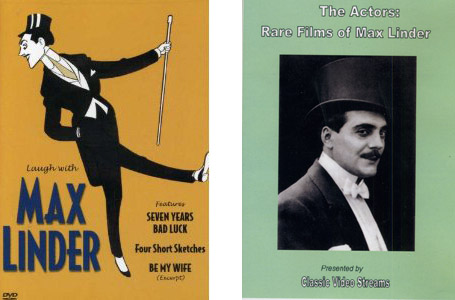
What we do have are two DVDs showcasing some of Linder’s work, and it is these I will review here:
Laugh with Max Linder was compiled by his daughter Maud and is most valuable for containing his wonderful feature film, Seven Years Bad Luck. It also has a musical score composed to go with the actual films, whereas the Rare Films DVD uses some generic Dixieland music as a background throughout, which does more harm than good. Oh well, just wait for that definitive DVD box set!
The Rare Films of Max Linder DVD is more recent but contains mostly early films from 1905 to 1912. To give this some chronological perspective, keep in mind that by the time Mack Sennett founded Keystone Studios in 1912, Linder had already made a couple of hundred films. In 1913, Sennett hired Chaplin, who did not debut his tramp character until the following year. As for Keaton, his first film appearance wasn’t until 1917, when he had a role in Fatty Arbuckle’s The Butcher Boy.
So Linder was pretty much on his own, ahead of his time and far from Hollywood, in the beginning grinding out a film a day for Pathé in Paris. In the process, he pretty much invented the comic narrative film. While early filmmakers often used gags as their subject matter (see these previous posts), it was Linder who developed a recognizable character — that of an often inebriated Paris dandy — and began to develop stories around him. The first movies were nothing more than simple gag ideas, but over time Linder developed his foppish character, his storytelling skills, and his use of film language.
By the time you get to Linder’s “feature-length” films (about an hour long), the artistic progress is very much in evidence. Now working in Hollywood and Paris, his fame eclipsed by Chaplin, Linder is still somewhat ahead of his time in shooting features. Here are the dates of his four features:
The Little Cafe (1919) Seven Years Bad Luck (1921) Be My Wife (1921) The Three Must Get-Theres (1922)
And the dates of the very first features made by Hollywood’s fearsome foursome:
• Chaplin — The Kid, 1921
• Lloyd — A Sailor-Made Man, 1921
• Keaton — The Three Ages, 1923
• Langdon — Tramp. Tramp, Tramp, 1926
Max Linder: Character Actor
Max Linder the actor (né Gabriel-Maximilien Leuvielle) always played the character Max Linder, a well-to-do Parisian with a knack for getting himself into trouble, usually with women, often from too much drinking. Here’s a sequence from the opening of Seven Years Bad Luck:
Later in that movie, disguising himself to hide from the train conductors after having lost his ticket money, Linder shows his versatility as a comic actor:
Max Linder: Gag Meister
Most gags are older than the hills and were not invented by the famous performers who usually get all the credit. Linder’s broken mirror routine predates the Marx Brothers by more than a decade, but of course he was hardly the first. But you know me, I do get my jollies pointing out earlier versions of gags, so here are a couple from Linder’s films that you may have seen elsewhere — and many years later.
Ye olde getting your coat caught around a pole routine, from Linder’s Max and the Quinquina (1911):
In case you were wondering about the card bit at the end: nice plot device. In the first half of the movie, a drunken Linder insults every big shot in town, inciting each of them to challenge him to a duel at dawn, for which they each hand him their business card. In the second half, every time he gets into trouble he produces one of these cards, is immediately mistaken for the big shot, and is given preferential treatment.
And here’s Buster Keaton ten years later in The Goat (1921):
And as Hovey Burgess reminds me, Soviet clown Oleg Popov did the same thing in his slack wire routine, “accidentally” wrapping his coat around the wire. (I haven’t been able to find a clip of him doing that exact bit, but probably have it somewhere and will add it here if I do locate it.)
Here’s another classic bit from Be My Wife, his 1921 feature film of which only 13 minutes survive. Max is disguised as a piano teacher so he can get closer to his beloved. When he discovers the piano is too far from the bench, he tries to move the piano rather than the bench. His girlfriend’s aunt Agatha shows him the easier way:
And now here’s the legendary Swiss clown Grock doing the same gag:
Grock started working with his first partner in 1903, so for all we know he may have beaten Linder to the punch with this one. In any case, it’s Grock who gets the most comedy out of it, fleshing out the gag with his clown’s dumb determination and then allowing us to share in the joy this naive character experiences at the revelation that there is indeed a better way. With Linder it doesn’t really work because his far more clever character would never do that, unless as an intentional joke.
Also from Be My Wife is this extended sequence in which Linder stages a mock fight (with himself!) to impress his beloved Mary and especially her aunt that he is the better potential husband, and not Simon, the cowardly milquetoast rival that Aunt Agatha is promoting for the position.
And a similar sequence from Charley Chase’s classic Mighty Like a Moose (1926). Here’s the wild situation: Charley and his wife both find themselves unattractive and both secretly undergo medical procedures to improve their looks. They meet outside the home, fail to recognize each other, and start flirting. Charley is the first to realize the truth of the situation and, as a firm believer in the male’s innate right to the double standard, schemes to punish his wife for cheating on him with himself. Yes, wacky! So Charley the husband beats up Charley the lover.
Although I hope to get around to writing in more depth about the variations on the broken mirror routine, any introduction to Linder would not be complete without his superb version of it from Seven Years Bad Luck. In this clip, two amorous servants have just accidentally broken the mirror, and one of them enlists a buddy to hide the misdeed from Max.
What I most like about Linder’s gag work, however, is how he learned to develop and integrate gags into his story. His broken mirror routine can certainly stand on its own,but it is also integral to the plot because the seven years of bad luck that Max spends the whole movie hoping to avoid is triggered by the second breaking of the mirror. Likewise in the same movie, you’ll find a nifty gag wherein an imprisoned Max is cowered into scratching the back of his tough and bullying cellmate. The reprise of this in the courtroom scene totally works… but you’ll just have to see the movie to know what I’m talking about!
Max Linder: Cinematographer
Coming from the theatre and making his first film in 1905, Linder was an early adapter to the form, no doubt learning through trial and error what worked in the new medium, how to use time, space, and special effects to create comedy beyond what he could do on stage. In my interview with her, Maud Linder singled out the 1906 short, Max Takes a Bath, as a good example of her father’s early use of film.
Fast forward to 1921’s Be My Wife, whose opening scene is a cute visual gag where an overprotective Aunt Agatha is fooled by an optical illusion.
Linder’s success and the parallel progress of the art of film allowed him to work with other talented artists who brought greater production values to his movies. One of these was Charles Van Enger, whose cinematographic talents are very much in evidence in the framing and lighting for Seven Years Bad Luck. Here’s his bio from the Turner Classic Movies site.
Charles Van Enger (1890-1980), a leading cinematographer of the silent era, worked with Maurice Tourneur on films such as The Last of the Mohicans (1920) and with Ernst Lubitsch on The Marriage Circle (1924) and Lady Windermere’s Fan (1925). Although credited as an assistant cameraman on The Phantom of the Opera (1925), he reputedly set up many important shots in that film. He spent much of his later career at Universal, working on everything from Never Give a Sucker an Even Break (1941) to Abbott and Costello Meet Frankenstein (1948). By the late 1950s, he was working mainly in television on shows such as Gilligan’s Island.
Wow! From Max Linder to Gilligan’s Island — now there’s a career span.
____________________
Here’s a rundown of what you’ll find on each DVD:
Rare Films of Max Linder
A Skater’s Debut (1905) = 4:21 His First Cigar (1906) = 5:05 Max Gets Stuck Up (1906) = 3:01 Max Takes a Bath (1906) = 4:38 Legend of Ponchinella (1906) = 7:32 Max’s Hat (1908) = 8:55 Troubles of a Grass Widower (1908) = 9:48 Max and the Lady Doctor (1909) = 5:59 Max Fears the Dogs (1909) = 2:44 Max and the Quinquina (1911) = 16:44 Max Plays at Drama (1911) = 7:01 Max Juggling for Love (1912) 6:42 Max and his Dog (1912) — 6:33 Max and the Statue (1912) = 9:58 Max and his Mother-in-Law (1912) = 24:12 (!!) Be My Wife (1921) = 13:33
Laugh with Max Linder Boxing with Maurice Tourneur (1912) = 2:40 Love’s Surprises (1913) = 6:13 Max Takes a Picture (1913) = 13:06
Max Sets the Style (1914) = 8:53 Seven Years Bad Luck (1921) = 61:52 Be My Wife (1921) = 13:33
Both of these DVDs are available from Amazon. Laugh with Max Linder is also available from Netflix and on Amazon video on demand.