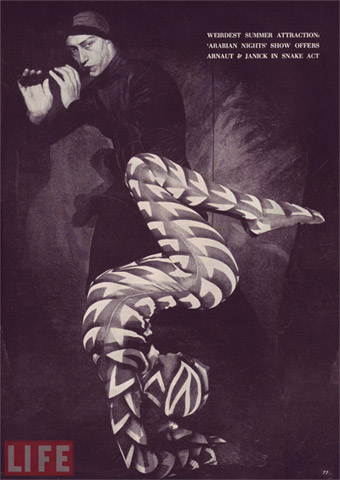
The typical contortion act — you know, with the platform and the mouthpiece and the 13-year-old girl doing a Marinelli bend — puts me to sleep. And then there’s the snake dance of French performers Janik & Arnaut— Janine Janik (1931 – 1985) & Christian Arnaut (1912 – 2003). This isn’t exactly physical comedy since they’re not going for the laughs, but the partnering work is amazing: not just the unique positions, but the sinuous flow of the snake around the charmer’s body. In most partner acrobatics, the base is muscling a lot of the moves; here, much of it is accomplished with little or no use of Arnaut’s hands, much less his biceps; he guides more than he lifts.
Maybe it’s all those magicians writing for my blogopedia, but I couldn’t help think there could be a sharper ending, an illusion with Janik morphing back into the fake snake….
I first previewed the new silent movie, The Artist, when it surfaced at the Cannes Film Festival in May, and then reviewed it when it opened in New York on Thanksgiving weekend, but now folks who know about these things are saying it might actually snatch the best-picture Oscar. We’ll have to wait until January 24th for the nominations, but meanwhile The Artist has won best picture in Boston and San Francisco, copped six Golden Globe nominations, garnered four nominations from the Vancouver Film Critics Circle, and was named by the Producers Guild of America and the Houston Film Critics Society as one of the year’s top 10 movies. As we get closer to the February 26th Academy Awards, money, reputations, and artistic correctness will all be at stake, so of course the opinions are flying!
The main criticism of The Artist is that it’s sentimental fluff, a lot of fun if you like that sort of thing, but not a film of any significance. And of course the question then arises — and it is a fair question — can a silent movie ever really plumb the depths of our complex world without the use of words? Isn’t Tree of Life profound and The Artist superficial?
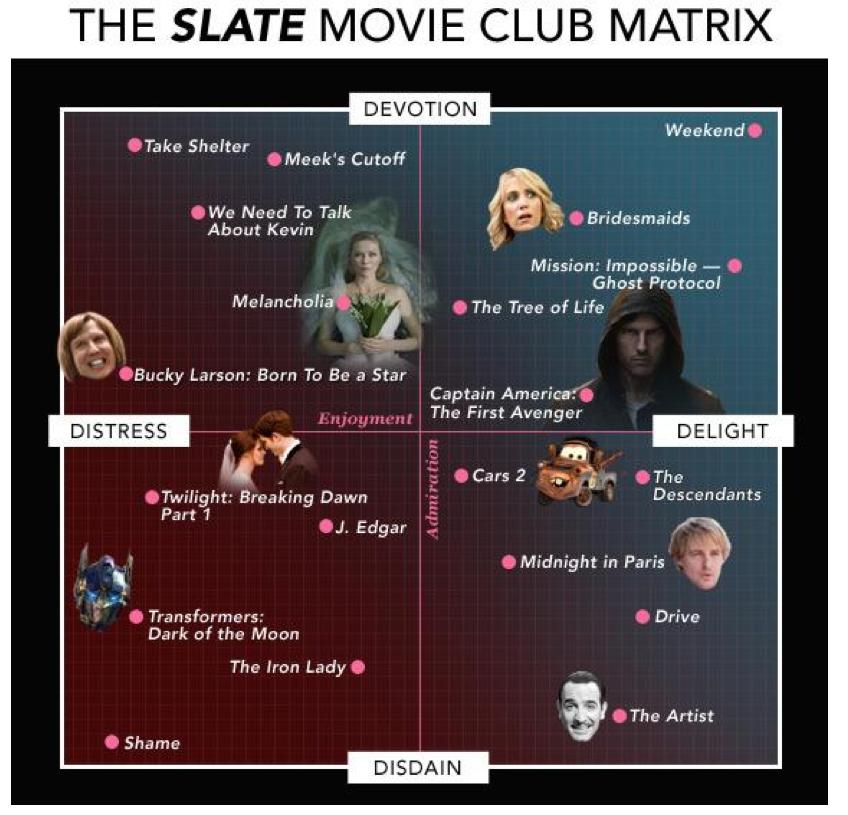
Here’s an exchange from the Movie Club section of the online magazine, Slate, which I found interesting enough to pass on to you. First up is a criticism by Dan Kois, talking about movies (see chart, below) that are difficult to watch but that you later find meaningful vs. enjoyable but forgettable flics:
Are there films that work in the reverse? Films that offer enjoyable viewing experiences, but then afterward provoke disdain? Of course! How about apparent Oscar front-runner The Artist, a charming piece of work that never tires, never bores, never in its 100 minutes stops tap-dancing for your smiles? As soon as it was over I was angry at myself for each chuckle I’d given the movie, and now, weeks later, it only provokes a shrug. This is what everyone is so crazy about? I don’t even mind that it’s a trifle—I like trifles! —but did it always have to go for the easiest joke, the simplest twist, the most obvious turn?
Coming right back at him is another Slate critic, Stephanie Zacharek, who said it better than I could have:
I think, as just the first round of Movie Club proves—as every full year of moviegoing proves—there are an infinite number of ways for movies to reach us, to sneak in through cracks we didn’t even know existed. If you have a house with cracks, you’ve got to seal them up. But for moviegoing, don’t seal the cracks! It’s how the light gets in, as Leonard Cohen said. Which leads me to something you said, Michael, about how both Melancholia and The Tree of Life were both made by directors who think cinematically, and my lack of warmth for TOL notwithstanding, you’re right. As you said, “Directors who don’t think cinematically sadly account for most of the movies we see all year.”
Which is why I really need to talk about The Artist, allegedly the Philistine’s choice for movie of the year. Because it’s not nearly as good as the great silents—it’s not Keaton, it’s not Murnau, it’s not Griffith. Because it’s a crowd-pleaser, a trifle, a soufflé of a movie with no overarching theme or purpose. Because it’s not as great as the buildup from Cannes led us to believe. Because Harvey Weinstein saw it and immediately thought, “I can make money off this.”
I’m afraid there are lots of reasons for not liking The Artist that actually have little or nothing to do with The Artist, and though that happens with lots of movies, I still find it troublesome. I love The Artist, as Dana said, “without disclaimers or shame.” I think shame is a useless construct when it comes to movies. (Disclaimers—well, we all need those once in a while.) In terms of cinematic thinking in 2011, Michel Hazanavicius trumps Terrence Malick. For one thing, he doesn’t need any “Oh, mother! Oh, father!” voice-overs, no shots of the sun peeping through tree branches, to make sure we’re feeling what we’re supposed to be feeling. And he’s relying on the grace of his actors, their way of moving, their subtle shifts in expression, to tell a story in purely visual terms. Not only is there no dialogue; there’s no expository dialogue, no overt explanation of why the lead character, Jean Dujardin’s George Valentin, is so resistant to talking pictures, which some of the movie’s detractors see as a flaw. For me, George Valentin lives in a mirror-universe where he foresees an actor in another universe (the real one), John Gilbert, drinking himself to death in 1936: The problem wasn’t that Gilbert’s voice wasn’t good enough for talkies (it was), but that filmmakers’ awkwardness in the new medium ended up reflecting badly on him, through little or no fault of his own. In other words, the fictional George Valentin had a premonition of something that happened in real life. Why wouldn’t he be afraid?
I love the economy and discipline of The Artist. Hazanavicius finds all he needs in the faces of his actors, Dujardin and Berenice Bejo. And I’m astonished by the effect the movie has had on audiences. I’ve seen it three times now, twice with a “real” audience (the first time, at Cannes, doesn’t count), and both times I’ve been amazed at how restless the audience is at the beginning—there’s that point where you expect the talking to kick in, and it just doesn’t—and how wrapped up they are by the end. I know, I know—just because lots of people love a movie doesn’t make it good. (The Dark Knight, anyone?) But I do think Hazanavicius and his actors have helped unlock the code of silent-film acting for many people, people who have always thought it was overdone or, at least, just too weird to understand. Film critics know all about silent film and silent-film acting, but who cares about us? As the writer Eileen Whitfield observed in her wonderful biography of Mary Pickford, Pickford: The Woman Who Made Hollywood, modern audiences often view silent movies as if they’re trying to be talkies and failing, whereas they’re really much closer to dance, a symbolic re-enactment. The Artist is all about faces and movement and the emotion that can be drawn out of those things together. To me, it’s elemental.
Here, here!
And two more morsels for you. That cool web site, Chaplin-Keaton-Lloyd Film Locations, has an excellent new post up about the shooting of The Artist. Check it out here. And here’s wonderdog Uggie visiting the offices of the London Guardian newspaper:
[post 221] Despite frequent tributes to the stars of the 1920s, despite all those beautifully remastered DVD sets, despite your enthusiasm and mine, our modern world has pretty much relegated silent film comedy to the nostalgia bin. Most of the younger generation has only vaguely heard of Chaplin or Keaton, much less seen any of their films, and names like Charley Chase, Harry Langdon, or Fatty Arbuckle mean nothing to them. I know; I teach college.
There are both good and bad reasons for this. Admittedly, the quality of these early films can vary drastically — not unlike television today. Many are formulaic, with minimal character or story development. Other than the action sequences, the pace must seem slow to a visual generation used to shots lasting only a couple of seconds. And did I mention — horrors! — they’re in black and white?
But presentation is also a major problem. Before you’d plunk down cash to buy a silent film comedy on DVD, you’re more likely to go to YouTube to watch one of the comedian’s movies, or more likely just an out-of-context clip. You’re going to be sitting at your desk, probably surfing the net at warp speed, seeking instant gratification. The video and audio quality is likely to be poor, depending on the source and the amount of compression for the web. Frustrated with the small size, you enlarge it to full screen, but now it’s all blurry and pixelated. The sound track, coming out of your computer’s sole speaker, is likely to be generic, just some ragtime tune slapped on top. If the clip doesn’t grab you in twenty seconds or less, you’re gone.
Ben Model
Contrast that with sitting in a crowded audience watching a restored print (film!) on a large screen. The music has been composed specifically for this movie and is being performed live by a talented and enthusiastic pianist, perhaps by an entire band. The audience is laughing loudly (they always do) and probably cheering and jeering as well. Soon you forget that it’s not in color, you forget that you can’t hear any dialogue. Instead you’re marveling at all that creativity, wondering why they can’t make movies like that any more. Silent film as a live performing art! But…. I’m guessing the number of people who’ve had this experience is way under 1%.
Is it at all possible, however, that the tide may be turning?
Not only are live performances of silent films growing in popularity, but two major commercial films about the silent era have just opened to rave reviews and serious talk of awards for best film of 2011. The first is The Artist, an actual black & white silent movie, which I previewed in this earlier post, when it almost won the Cannes Film Festival.The second is Martin Scorcese’s Hugo, based on the novel The Invention of Hugo Cabret, a book I wrote about in this earlier post on Georges Mélies. Hugo’s not silent, it’s color, and it’s even available in 3D, but much of it as a tribute to Mélies and the inventiveness of early cinema.
More on both of these shortly, but first honorable mentions to some of the silent film series that have paved the way. In New York, there are at least two ongoing series that you should know about, both of which have the imprint of Ben Model, silent film historian, composer, and pianist. The Silent Clowns Film Series, ongoing since 1997, presents about ten events a year, all free, and all featuring Ben on piano, with programming by Bruce Lawton and film notes by Steve Massa. Many of the films screened are not available anywhere else and are usually seen on newly restored prints. Always a fun time, full of revelations, and after the movies are over, Ben, Bruce, and Steve hold court, fielding questions from an audience of fellow fans.
Ben has also done a lot of similar work for the Museum of Modern Art, including the current film series Cruel and Unusual Comedy, focusing on social commentary in American slapstick, which he curates with Ron Magliozzi and Steve Massa. The most recent installment, however, focused on some marvelous rare early European comedy shorts from the Desmet Collection of the EYE Institute (Amsterdam). This was billed as “a sort of highlights reel of a complete 5-program series that will be presented at MoMA during 2012.” Judging by what I saw in October, this collection is a significant find. And while I hope it eventually ends up on DVD, that won’t be as cool as having seen the movies accompanied by a live band, with my Bloomfield College colleague Peter Gordon on saxophone!
Another place in NYC to learn more about the silent era is The Museum of the Moving Image in Astoria, Queens, which houses exhibits on movie history, but also has a steady stream of screenings and lectures. If you’re in town December 17th, don’t miss master magician Ben Robinson’s lecture, Magic and the Silent Clowns: There is a strong link between some of cinema’s great comedians and magic. Performers such as Buster Keaton, Charlie Chaplin, Harold Lloyd, and Harpo Marx started out in the world of vaudeville; many of their finest gags grew directly out of their love of magic. Magician and author Ben Robinson will show scenes from such movies as Grandma’s Boy, Sherlock Jr., The Circus, and Duck Soup to examine this important connection between magic, comedy, and cinema.
Also in New York, the Film Forum provides another home for screenings of silent movies with live musical accompaniment. They are currently in the midst of a Monday night series, The Silent Roar, featuring MGM films from 1924 to 1929, with Steve Sterner on the piano. Buster Keaton’s The Cameraman plays the day after Christmas.
Enough tooting the Big Apple’s horn…. don’t want to make all those New Yorkers blush! Back to our regularly scheduled programming…
Bérénice Bejo & Malcolm McDowell in The Artist
The Artist
This is a French film directed by Michel Hazanavicius, most recently known for his OSS 117 spy spoofs, and starring Jean Dujardin and Bérénice Bejo (real-life wife of Hazanavicius). Other than its bland title, I was utterly won over by The Artist, whose story unfolds against the backdrop of the transition from silent films to sound. There are obvious parallels with Singing in the Rain, except The Artist actually is a silent movie, and a black and white one at that. It’s also stylish and sweet, quite funny, and very well acted. Dujardin and Bejo are easy to fall in love with, and John Goodman as the cigar-chomping Hollywood mogul and Uggie as the dog Uggie are both hilarious.
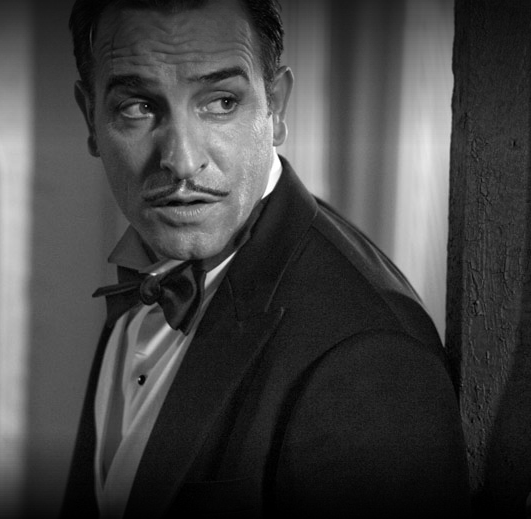
Jean Dujardin as George Valentin
Although the male lead, one George Valentin, is dashing, athletic, and comic, very much in the style of Douglas Fairbanks, The Artist does not attempt to recapture the world of the great physical comedians. “It wasn’t the slapstick that meant so much to me. It was the melodramas,” explained Hazanavicius. “The point was to share that sensual experience I felt sitting in the cinema watching Murnau’s Sunrise.” Be that as it may, the style is sumptuously visual and the acting ultimately physical. And did I mention that it’s very well done?
Bérénice Bejo as Pepe Miller
At the risk of sounding mushy and sentimental, I was also pleased to see characters that were not total jerks. Yes, self-serving jerks exist, but that can also be too easy of a writing choice. The George Valentin character could have been an arrogant womanizer and a bitter loser. Peppy Miller’s stardom could have made her totally full of herself. Goodman’s Al Zimmer could have been a ruthless producer. Instead, they all have their positive side, which (spoiler alert) makes a happy ending possible. Yes, you could argue that this is phony and manipulative. After all, Hollywood comes off very well in this French valentine to America, which is no doubt one reason The Artist is creating Academy Award buzz. But not the only reason. It’s an exceptional film, and has already won Best Film of the Year from the San Francisco Film Critics Circle and the Boston Society of Film Critics, and has six Golden Globe nominations, including Best Comedy.
Here’s the trailer:
Better yet, here’s a short scene from the movie with the director’s commentary:
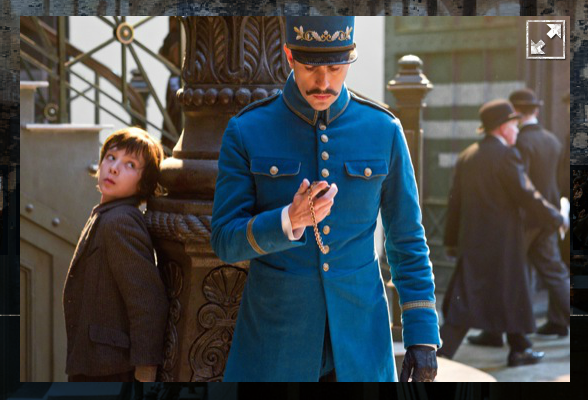
Hugo Martin Scorcese’s Hugo is another valentine to the movies, but in this case an American director returns the compliment, reminding us all of France’s contribution to early film history, specifically the effects-laden work of magician-turned-director Georges Mélies. Hugo is quite the contrast, a full-color, all-talking, big-budget Hollywood movie with major stars (Ben Kingsley, Jude Law, Sacha Baron Cohen) and serious technology, including a cool secret world concealed within Paris’ Montparnasse train station, which for a price ($17.50 in Manhattan!) we get to explore in 3D.
But what on earth does this have to do with silent film comedy?
A lot, as it turns out, because [spoiler alert] that crotchety old man winding down his life selling wind-up toys in the train station is — true story — none other than silent film pioneer Georges Mélies, long since forgotten by the public, his early special effects movies all thought to have been destroyed. Not to worry: it is his fate to be rediscovered by an orphaned boy who secretly lives in the station, following in his father’s and uncle’s footsteps by caring for the clocks, one of which he of course ends up hanging from in the climactic chase scene, à la Harold Lloyd in Safety Last.
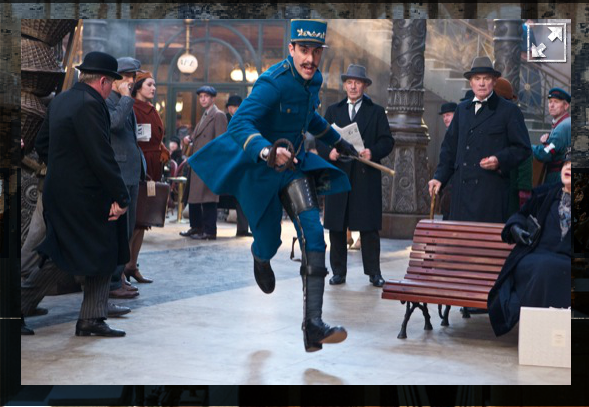
Speaking of chase scenes, Sacha Baron Cohen of Borat fame plays a nasty Keystone Kop with a leg brace who is intent on nabbing vagrant kids and packing them off to the orphanage, and therefore much chasing ensues. Unfortunately, Cohen’s comic genius does not get full rein here, and the potential for physical comedy is squandered. What is special, and to my mind well worth the price of admission, is the loving recreation of Mélies’ Paris studio and working methods — with Scorcese as a cameraman! — which constitutes the final section of the movie. Very cool. Indeed, the whole movie can be seen as a tribute to film preservation, with the film archivist (played by my former student, Michael Stuhlbarg) clearly modeled on Henri Langlois, founder of the Cinémathèque Française.
Here’s the official trailer:
A good movie, not necessarily perfect, but its heart is in the right place, and it has an important story to tell. Two weeks ago, when I first saw both of these, I would have thought American judges would be favoring Hugo over The Artist, but the opposite seems to be happening. We’ll have to wait and see but, either way, silent film is the winner.
Pop Quiz: Name the famous Nobel-Prize winning author who wrote the following in his most celebrated work:
“Who farted?”
No, I am not kidding. And the answer is…. (drum roll, please) ….that’s right, Samuel Beckett in Waiting for Godot. Which just goes to show that the gap between high and low art is not always as wide as we may think.
Which brings us to The Fartiste, which opened off-Broadway last week five years after winning Best Musical at the New York International Fringe Festival. It’s based on the life of one Joseph Pujol, known to the French public as “Le Pétomane,” literally the “farting maniac.” Not only was Pujol a real person, but he was the hottest act in Paris circa 1900, launching his singular career at the world-famous Moulin Rouge. A bit of history from the show’s program:
One summer’s day in the mid-1860′s, a young French boy named Joseph Pujol had a frightening experience at the seashore. Swimming out alone, he held his breath and dove underwater. Suddenly an icy cold feeling penetrated his gut. Frightened, he ran ashore, but then received a second shock when he noticed seawater streaming from his anus. The boy didn’t know it at the time, but this unsettling experience foretold of a gift that would later make him the toast of Paris and one of the most popular and successful performers of his generation.
Soon he discovered that by contracting his abdomen muscles, he could intentionally take up as much water as he liked and eject it in a powerful stream. Demonstrating this ability back at the barracks later provided the soldiers with no end of amusement, and soon Pujol started to practice with air instead of water, giving him the ability to produce a variety of sounds. It was in the army, that Pujol invented a nickname for himself that would later become a stage name synonymous throughout Europe: Le Petomane
In 1892 Pujol became a headliner at The Moulin Rouge. Pujol dressed formally and presented his routine with an unrelentingly deadpan delivery. He performed imitations, using the simple format of announcing and then demonstrating. He displayed his wide sonic range with tenor, baritone, and bass fart sounds. He imitated the farts of a little girl, a mother-in-law, a bride on her wedding night (tiny), the same bride the day after (loud), and a mason (dry– “no cement”). He imitated thunder, cannons and even the sound of a dressmaker tearing two yards of calico (a full 10-second rip). After the imitations, Le Petomane popped backstage to put one end of a yard-long rubber tube into his anus. He returned and smoked a cigarette from this tube, after which he used it to play a couple of tunes on a song flute. For his finale he removed the rubber tube, blew out some of the gas-jet footlights from a safe distance away, and then led the audience in a rousing sing-along.
No, they are not making that up. And if the act seems freakish and gross to you, keep in mind that Le Pétomane played for many of the crown heads of Europe, including King Leopold of Belgium, not to mention Sigmund Freud, though the latter’s interest may have been more clinical.
The only surviving film clip of Pujol is this (silent) half-minute Edison Studios clip from 1900:
So what we have here is a very odd story or, as some reviewers have complained, a too ordinary story about a man with a very odd talent. Admittedly the plot is thin, the story more anecdotal than dramatic, so there’s little suspense — “what’s going to happen next?” — which makes the dynamics kind of flat. At a certain point, yet another song starts to feel like more of the same thing.
And it is light entertainment, a fact which seems to have escaped one dour critic, who made a point of comparing it unfavorably with Sondheim’s Sunday in the Park with George. Give me a break! Did you really go to a show about a master farter expecting to pierce the artistic soul of another Georges Seurat?
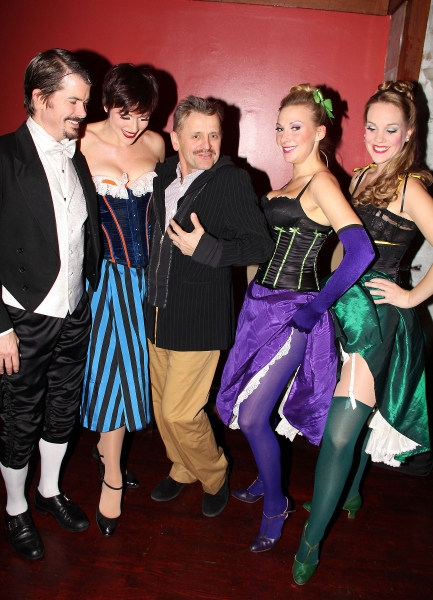
Mikhail Baryshnikov poses
with Kevin Kraft; Rachel Kopf;
Analisa Leaming; Lindsay Roginski
I didn’t, which is probably why I had such a good time. I got to share a table with Adam (clownlink.com) Gertsacov, Nat (themoonshow.com) Towsen, and the cast of the Reduced Shakespeare Company, and was flanked by two other tables where sat those legendary Mikhail B’s. (I refer of course to Bongar and Baryshnikov.) I had two beers, laughed a lot, and enjoyed some strong comic performances.
______________________________________
“Kids enjoy farts. Farts are as funny as hell. Farts are shit without the mess. Look at it that way.” — George Carlin
______________________________________
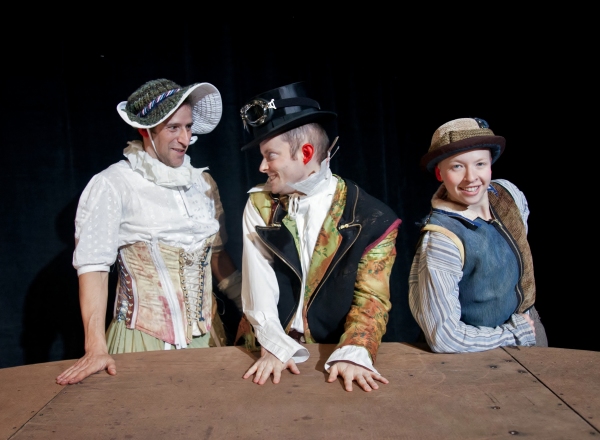
Kevin Kraft, a former Ringling clown and an actor with impressive credentials, brings Pujol to life with high energy and admirable physical dexterity, coordinating beautifully with “vocal sound effects artist” Steven Scott, who stands downstage right and provides all of the melodious flatulence. It is amazing what this man can do with a microphone! When Pujol performs his masterpiece, a symphony of instruments, the result is a marvelous Kraft-Scott physical comedy duet. The rest of the cast, aided by some witty lyrics, keeps those laughs coming. Character actor Nick Wyman (who is also the president of the Actors Equity union) is very funny as the singing narrator, and Herndon Lackey does a nice double as the producer of the Moulin Rouge and as Toulouse Lautrec. Also effortlessly doubling roles were the three singin’, dancin’ can-can girls; my favorite was the one who sat on my lap.
Here’s some video related to the show.
First, the making of The Fartiste:
Here’s the song The Great Pujol, against a background of Pétomane posters:
And here’s Steven Scott showing off his remarkable audio talents as part of his stand-up comedy act act:
Some Links:
• The web site for the show
• Sample excerpts from the Fartistescore
• Le Pétomane, a short movie about Pujol, available in five parts on YouTube
• Adam Gertsacov’s review on clownlink.com • New York Post review
• BroadwayWorld.comreview
Amazing — I made it through this entire post without making a single pun about farting, gas, wind, or asses. A rare display of maturity!
It takes more than a little bravery to tell an audience outright that you are going to explain to them how comedy works and that you intend to make them laugh a lot in the process, even suggesting that they don’t have much choice in the matter. But if they don’t laugh, you lose on two counts. And it takes a lot of talent, training, and practice to pull it off as well as Jos Houben did Tuesday night in New York at an evening hosted by the Alliance Française as part of their Crossing the Line performance series. Yes, lots of laughs and a standing ovation.
Jos is one part vintage vaudevillian and one part Lecoq-trained movement specialist, a dynamic combination that infuses The Art of Laughter with a whole lot of fun and just as much insight. With only a chair, table, bottle, glass, hat, and napkin as props, this “master class” breaks physical comedy down into manageable chunks, building both the gags and the theory as he goes.
The bottom line for Jos is the human body — “none of you showed up here tonight without yours” — and especially the significance of our verticality, which our egos so readily equate with dignity. Some of this reminds me of a Tom Leabhart lecture-demo on the inner experience / physical manifestation work of François Delsarte, which certainly influenced modern mime, but with Jos the backbone is clearly connected to the funny bone. Many of the comic moments that arise, from the simplest trip to disastrously awkward encounters with the opposite sex, are funny because of our deviance from this vertical ideal.
Jos starts with the simplest physical comedy moves: a trip, a hand fumbling an object, a shoe flying off. How do we react to these? What if others are watching?? He builds these blunders into various combinations and then lets them occur in simple situations with the other. What happens between a man and a woman? Between two guys?
There are a few clips on YouTube, and I offer four below to give you a taste, but they fail to convey the overarching narrative that makes the whole of this presentation far greater than its (excellent) parts. If you have the opportunity to see this show live — and Jos does perform it in English and in French all over the world — do not miss it!
Preview, in French:
Again in French, two more sustained sequences. The first selection focuses on body parts, starting with the pelvis.
The second clip demonstrates creating “an accident” and building it into a sequence.
Some Links: • Read Jos’s impressive bio here. • See the work of Jos’s students from the École Jacques Lecoq, performing at the Louvre, in this previous post. • Web site for the École Jacques Lecoq, where Jos currently teaches. • See Jos in New York, November 9th thru December 4th, in Fragments, short pieces by Samuel Beckett, directed by Peter Brook.
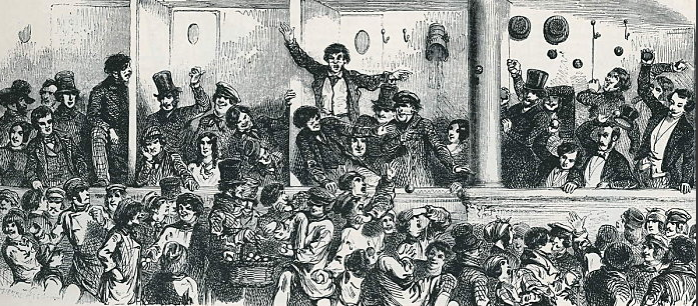
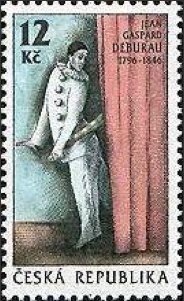
Jean-Gaspard Deburau! Jean-Louis Barrault! Le Théâtre des Funambules! Children of Paradise! The Boulevard du Crime! Cool stuff, but been there, done that in this previous post, so I won’t repeat myself here except to say that Children of Paradise is a must-see movie, especially for readers of this blog.
But just in case there are some readers out there who might want to go deeper into this rich subject, here are five — count ’em, five — complete public domain books on the subject. Four out of five of these books are, however, in French. I’ve processed them all with OCR (optical character recognition) software to create searchable text, which is more than the Bibliothèque Nationale or Google do, but then again they don’t have my infinite resources.
Pantomimes de Gaspard et Ch. Deburau (1889)
If you ever wondered if the pantomime pieces performed by Jean-Louis Barrault in Children of Paradise were historically accurate, or if you wanted to learn about other pieces Deburau père and fils performed, this is the book for you. PantomimesOfDeburau
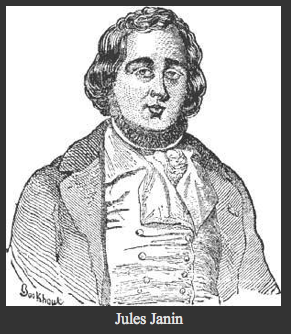
Deburau: Histoire du Théâtre à Quatre Sous par Jules Janin (1833)
This two-volume biography of Jean-Gaspard Deburau came early in his career and is credited with transforming him into a Paris celebrity.
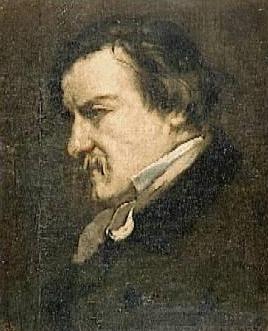
Souvenir des Funambules par Jules Champfleury (1859)
Reminiscences by the journalist, art critic, playwright, novelist, short story writer, and friend of Victor Hugo and Gustave Flaubert.
Le Théâtre des Funambules: Ses Mimes, Ses Acteurs et Ses Pantomimes Depuis Sa Fondation, Jusqu’à Sa Démolition par Louis Péricaud (1897)
A 508-page end-of-the-century retrospective of the Funambules, with thorough descriptions of the pantomimes. Péricaud was a true man of the theatre, a prolific actor, songwriter, playwright, director, and theater historian.
Deburau: A Comedy by Sacha Guitry (1918)
Sacha Guitry (1885–1957), was a successful and ridiculously prolific French actor, director, playwright, and filmmaker. He is credited with having written 124 plays, some in as little as three days. This is one of them, translated in 1921 by the influential British director and playwright Harley Granville-Barker. Guitry is also author of one of my favorite quotes: “Our wisdom comes from our experience, and our experience comes from our foolishness.”
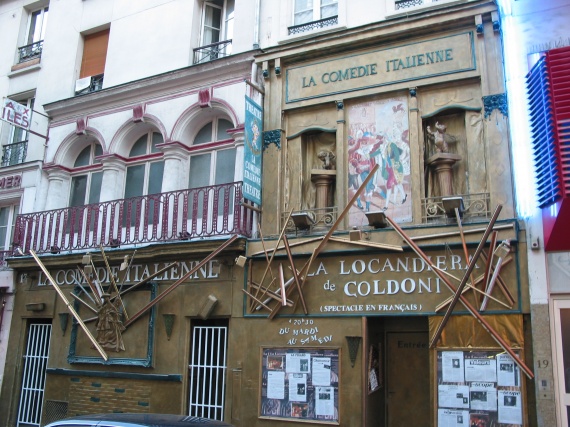
They may tend to over-intellectualize, but historically they have been enthusiastic fans and loyal supporters of clowns, mime, and circus. Commedia troupes — la Comédie-Italienne — made their homes in Paris, and while the best clowns may have been from England, Italy, or Spain, often they had to come to the French capital to be fully appreciated.
The French also write (and even read!) books, so it’s not surprising that some of the best works on this whole physical comedy tradition were written in French. My own Clowns book would have been significantly diminished had I not been able to read Rémy, Thétard, Strehly, Perrodil, Adrian, and many others. And if I’m a bit of a francophile, you’ll have to forgive me, because the truth is I’ve been bought: in 1990 I had a Fulbright fellowship to France to study physical comedy, half of which was funded by the French government. I have, however, been dutifully repaying them ever since (with interest) in the form of regularly scheduled purchases of French wine, with a marked preference for the earthier Bordeaux reds.
But enough about moi. Google tells me a lot of my blog fans come from la France, and je sais for a fact that more than a few of my Anglophone readers also lisent French. The least I can do is include a few free books en français.
Holy vache, I see que this blog post se transforme progressivement into français…. ça is becoming vachement dif. Tant pis, car maintenant vous devez souffrir mon français maladroit!
Okay, eau quais…. allons-y!
Masques et Bouffonsde Maurice Sand (1860)
Commençons par Masques et Bouffons de Maurice Sand, mon introduction et la traduction anglaise de laquelle j’ai déjà publié dans ce précédent post.
Mimes et Pierrots: Notes et Documents de Paul Hugounet (1889)
Le dernier, mais non le moindre, c’est le plus tôt importante étude scientifique de la pantomime, celle de Paul Hugounet (né 1859), un contemporain de Charles Deburau. Après les trois premiers chapitres, ce livre se concentre sur la pantomime française du 19ème siècle.
We finally finish our saga of public domain books in English about the commediadell’arte with these two offerings.
Memoirs of Count Carlo Gozzi
Count Carlo Gozzi (1720–1806) was, like Carlo Goldoni, a prominent eighteenth-century Venetian playwright who sought to improve upon what he saw as a declining commedia dell’arte through his own scripts. He was, however, a bitter rival of Goldoni, who he delighted in attacking in print. His most famous play, The Love of Three Oranges (1761), is a satirical fairy tale perhaps best known by way of Sergey Prokofiev’s popular opera adaptation; likewise, Gozzi’s Turandot became the basis for a Puccini opera of the same name. In the twentieth centrury, innovative Russian revolutionary director Vsevolod Meyerhold turned to commedia, and specifically to Gozzi, for inspiration, mounting a production of Love of Three Oranges and editing a provocative theatre journal that he named “The Love of Three Oranges.” In 1996, Julie Taymor, of Lion King fame and Spiderman infamy, made a splash with her highly visual productionof Gozzi’s The Green Bird.
Although I have yet to find a public domain translation of Gozzi’s plays into English, I do have his memoirs (1797) for you, which the Encyclopædia Britannica describes as “vivid, if immodest.”
The History of the Harlequinade by Maurice Sand
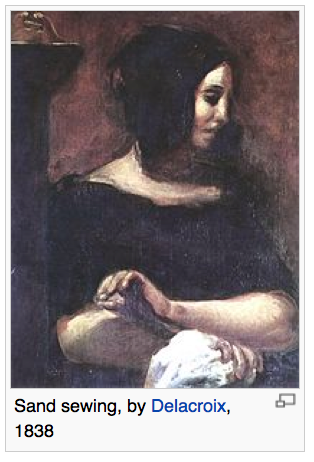
Once upon a time, the early 1800s to be exact, there lived a prominent French novelist and celebrity by the name of George Sand, who had many scandalous affairs with both men and women, including Prosper Mérimée, Marie Dorval, Alfred de Musset and, most famously, Frédéric Chopin. The funny thing about George was that he was a she. No, not a transsexual or transvestite, just a dynamic woman and staunch feminist who used George Sand as a pen name, presumably so her works would be treated more seriously, just like that other George, the female author of Silas Marner, “George Eliot.”
______________
“The world will know and understand me someday. But if that day does not arrive, it does not greatly matter. I shall have opened the way for other women.” — George Sand
______________
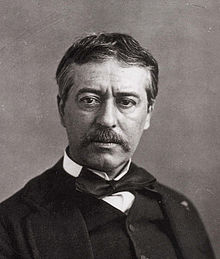
All of which has nothing to do with commedia dell’arte, except that at the age of 20, long before her fame, George Sand married a baron and gave birth to Maurice Sand. Sand mère soon ditched the boring baron and ran off, two kids in tow, to do her Lady Gaga thing. Sand fils grew up in a heady artistic milieu and not surprisingly became a successful novelist and illustrator in his own right, studying under the French romantic artist, Eugène Delacroix. And finally to our point: he also wrote and illustrated one of the earliest (1860) and most encyclopedic commedia histories, Masques et Bouffons.
I’ll supply the original French text in a future post; meanwhile here’s the 1915 English translation, published under the misleading title The History of the Harlequinade. Misleading because the harlequinade was actually a very specific segment in 19th-century English pantomime (read more here), whereas Sand’s book traces the evolution of the commedia stock characters over the centuries and in different cultures, one chapter for each character.
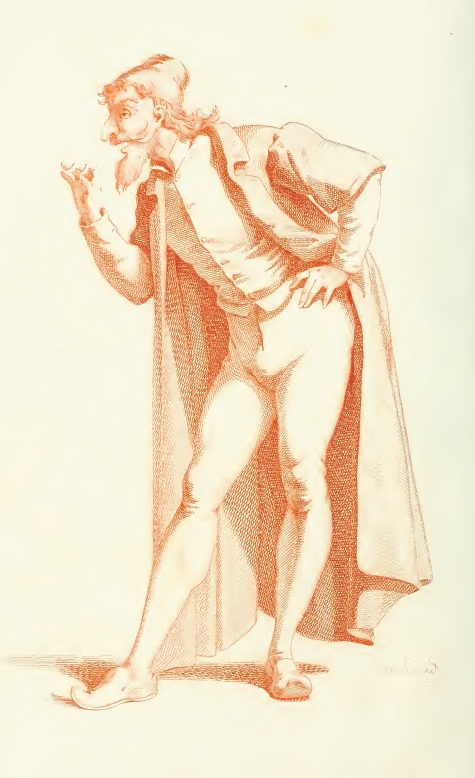
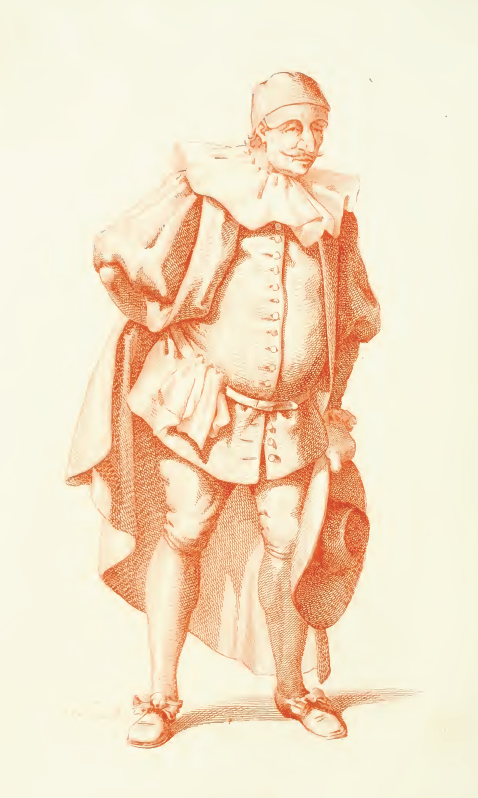
First a few of the exquisite illustrations by Sand from the original French work; I’m not so sure the color plates in the English version are his. After that, the complete English translation in two volumes.
Chapter two (previous post)covered a lot of ground — about twenty centuries and at least four continents — so there’s a ton of potential supplementary material. I’ll just throw a few at you here, and then follow up in my next posts with some free books.
The first comes from the 18th-century tradition of French fairground theatre, which thrived outside the censorship laws imposed on the royally-sanctioned “serious” theatres in Paris. The most popular form of fairground comedy was a short farcical sketch known as a parade. Popular, that is, until they were closed down by the police in 1777.
Below is a quite humorous example by Thomas-Simon Gueullette (1683–1766), a lawyer and scholar who wrote over sixty pieces for the commedia actors of the Théâtre-Italien. Rather than inventing much that was new, I suspect that Gueullette, like Goldoni and Gozzi, took much of the comic business made popular by the improvisatory commedia actors and repackaged it in a more tightly structured, written form. The good news is that he did a nice job of it.
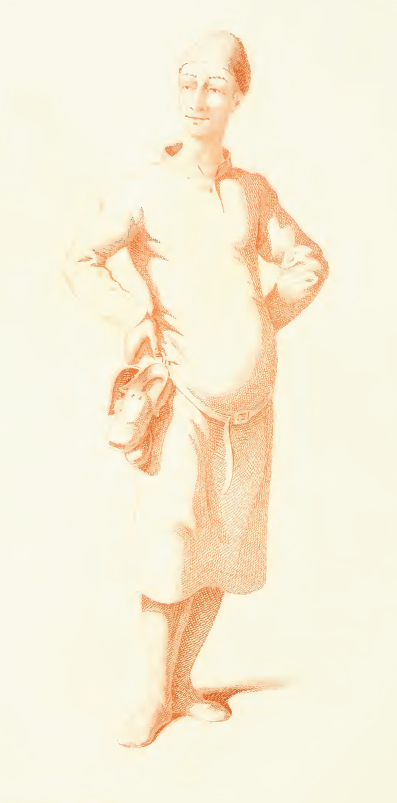
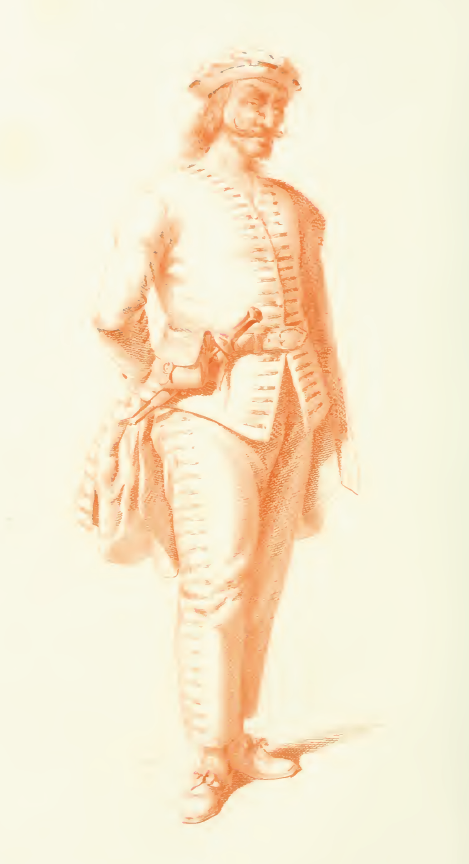
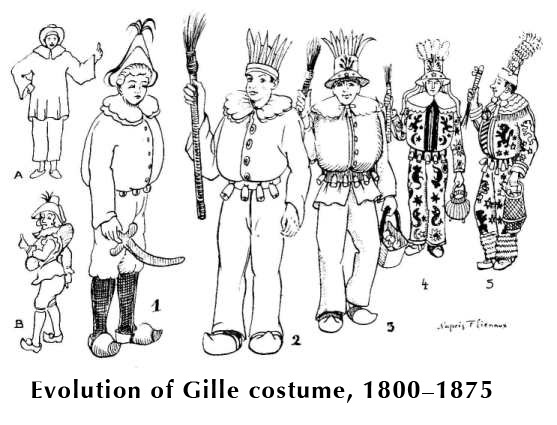
Here’s what that dumb comic servant Gille may have looked like:
And click here for a recent Ph.D. dissertation on the work of Gueullette.
If you’ve seen my favorite movie ever, Children of Paradise (1945), you already have some sense of the fairground theatre atmosphere, but transported half a century later from Gueullette’s time to the heyday of the Boulevard du Crime in Paris. If you haven’t seen Children of Paradise, you are hereby ordered to do so. Soon! It’s on DVD and it’s available on Netflix, though if you can actually see it in a movie theatre, it’s worth the money to take it all in on a big screen. Much of the action takes place at the Théâtre des Funambules (theatre of the wirewalkers) and centers around the legendary mime, Jean-Gaspard Deburau (1796–1846), immortalized in the performance of Jean-Louis Barrault.
Here’s a scene that did a lot to popularize pantomime. This is Barrault as a not-yet-famous Deburau, dismissed as the family idiot, forced to work the platform in front of the Funambules to help draw in paying customers.
There are no subtitles, but you won’t need them. When the master criminal Lacenaire picks the pocket of a bourgeois gentleman, his accomplice Garance gets the blame. The police ask if there are any witnesses, and the silent mime suddenly speaks, saying he saw it all. Once he acts it out, Garance goes free, and her show of gratitude triggers a romance that is one of the movie’s central plot lines.
___________________________________
“Act! Act! You have the wrong place. We are not allowed to act here. We walk on our hands! And you know why? They bully us. If we put on plays, they’d have to close their great, noble theaters! Their public is bored to death by museum pieces, dusty tragedies and declaiming mummies who never move! But the Funambules is full of life, movement! Extravaganzas! Appearances, disappearances, like in real life! And then, BOOM, the kick in the pants!” — the director of the Funambules
___________________________________
A mime piece performed by Barrault as Deburau at the Funambules:
Stay tuned: I will be posting a complete book (in French) of Deburau’s mime pieces in a week or two.
Now here’s a real curiosity: Etienne Decroux, the father of French mime, teacher of Marceau and Barrault, and later the creator of the more abstract corporeal mime style carried on by his students Tom Leabhart, Daniel Stein, and Steve Wasson, amongst others. Yes, that Etienne Decroux. Here he is, eye lashes fluttering, jabbering away, hamming it up like crazy as Deburau’s very verbose father!
________________________________
“A kick in the ass, if well delivered, is a sure laugh. It’s true. There’s an entire order, a science, a style of kicks in the ass.” — Anselme Debureau (played by Etienne Decroux)
________________________________
Did I mention this is a great movie? Not only that, but once you’ve seen it, you’ll want to know more about this whole theatrical era. Well, you’ve come to the right place, and I’m referring to our final supplemental item, “The Golden Age of the Boulevard” by Marvin Carlson.
When I was in graduate school at NYU and working as an assistant editor for TDR (The Drama Review), I commissioned this article from the distinguished theatre scholar Dr. Marvin Carlson for an issue on popular entertainments I was putting together. It gives me great satisfaction, almost forty years later, to have been back in touch with Professor Carlson, who kindly consented to have his article reprinted on this blog so it could reach a new and wider audience. It’s an excellent article, and I once again thank Mr. Carlson for this and his many other contributions to theatre scholarship, which you can check out here.
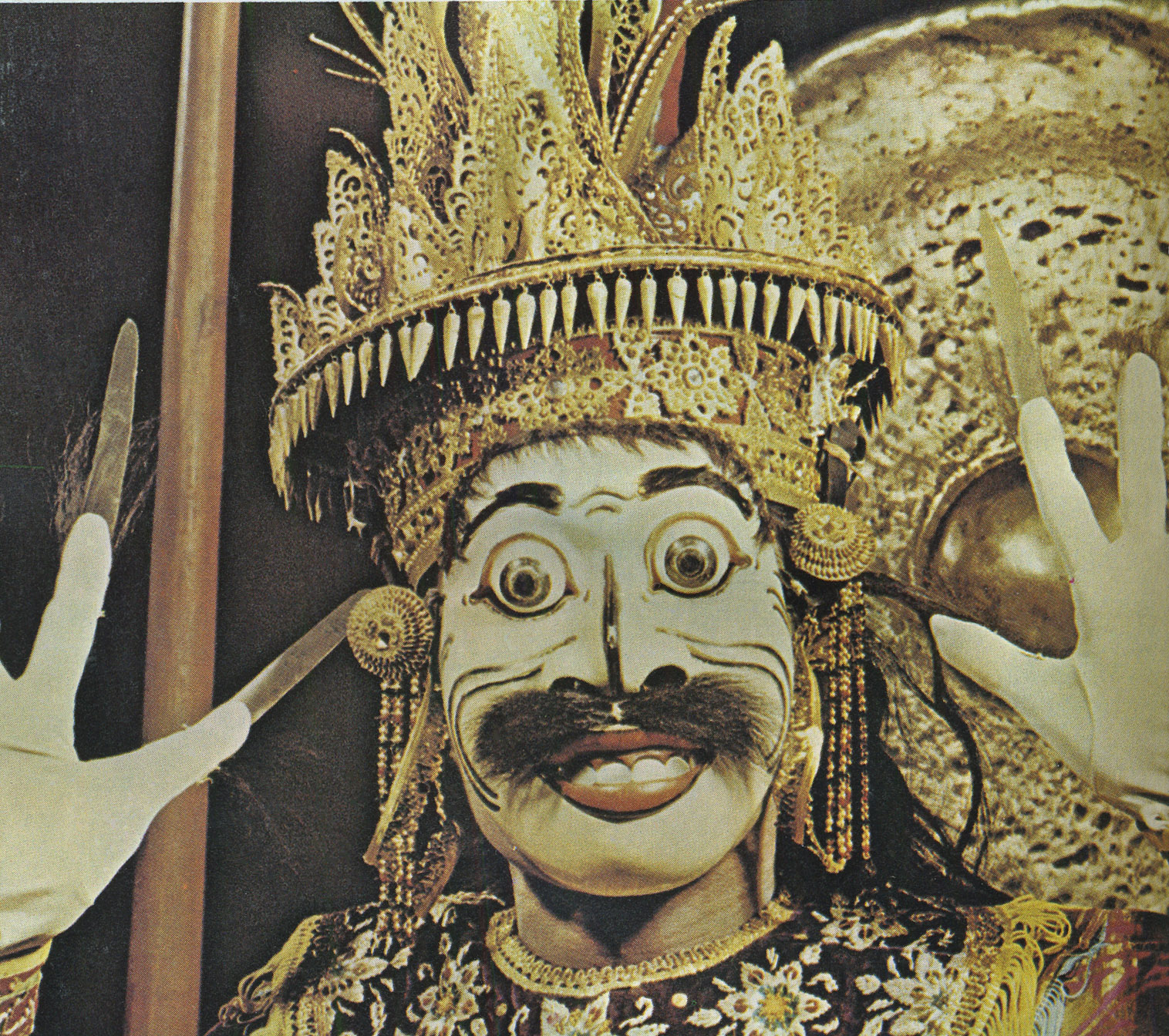
And, last but not least, an important correction. The following photo, from a Columbia Records lp of gamelan music, appeared in the color plate section of my book with the caption “Clown character from the wajang wong, the Balinese dance-drama.”
Well, it turns out that was wayway wrong. After the book was published, I received a note from Leonard Pitt — mime, maskmaker, student of the above-mentioned Etienne Decroux, and expert on Balinese theatre — advising me that this photo was mislabeled. My bad for not having double-checked this. But I did save the note, and when I visited Leonard last year at his Flying Actor Studio in San Francisco, I was able to show it to him (35 years later!) and promise to finally make amends. I wanted to scan the note for this post, but it is lost somewhere here in my office. If instead I showed you a picture of my office, you’d see why it might take me a while to retrieve the note! Anyway, correction made, photo removed, and thank you again Leonard!
___________________________
Coming next, the following complete books, all related to Chapter Two material:
• The Mimes of Herodas
• The Commedia dell’Arte by Winifred Smith
• Masques et Bouffons by Maurice Sand
• Mimes et Pierrots by Paul Hugounet
• Memoirs of Carlo Goldoni • Goldoni: A Biography by H.C. Chatfield-Taylor
• The Memoirs of Count Carlo Gozzi • The Life of Moliere by Henry M. Trollope
• Le Théâtre des Funambules by Louis Péricaud
• Pantomimes de Gaspard et Charles Deburau
Here I go again with another old-man story (stop rolling your eyes):
In 1973, I had already been living for four years (I stayed 22) in my $68/month crime- and roach-infested apartment on 2nd St., just off the Bowery. In the same building lived Hilly Kristal. Around the corner but on the same block was Hilly’s high-decibel new punk rock club, CBGB — so loud I was sometimes driven to make anonymous, menacing phone calls to them just so I could get some sleep (“Close your fuckin’ back door or I’ll…”) Across the street from me lived a bunch of musicians who went by the name of The Ramones.
None of which, I must confess, interested me in the slightest.
Instead, while Patti Smith, Blondie,Television, the Talking Heads, and the Ramones were making music history less than 100 meters away, square that I was/am I was much more excited to hear about an exciting new French street performer who was becoming a regular in nearby Washington Square Park.
He was, as you have no doubt guessed, none other than a very young, pre-World-Trade-Center, Philippe Petit.
And he was good.
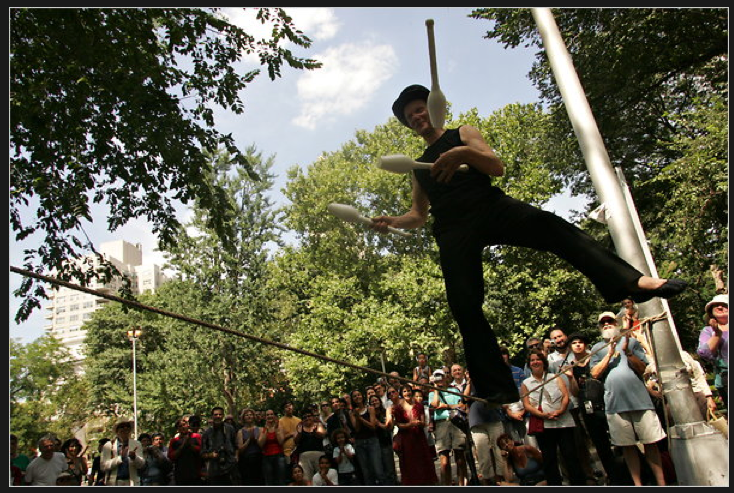
Dressed all in black, adorned with a top hat, speaking nary a word, he had a bit of the Marcel Marceau about him and, above all, a strong presence and an excellent sense of the audience. I don’t have total recall of the act, but it included:
• a perfectly-drawn chalk circle (his “stage”), a perimeter he enforced by circumnavigating it on his unicycle whenever encroachment loomed; pull your toes back or else! • some very nifty three-ball juggling • “teaching” a spectator to juggle, then revealing to the crowd (behind the spectator’s back) that he’d pick-pocketed the guy’s watch (big laughs) • stringing a “tight” rope from a tree to a pole or, better yet, to the shoulders of half a dozen burly guys who between their ton of mass could still not keep the rope totally tight once the slight Philippe put his weight on it (more big laughs) • juggling clubs and then torches while walking barefoot on the rope, warming his feet with the flames • a grand exit on his unicycle, carrying all his props
But this was 1973, a few years before Betamax and VHS, no one had consumer video cameras, much less smart phones, so it’s not surprising that so far I haven’t been able to find any street performance video of Philippe from those early days. All I can offer is a snippet from much later, 2005 to be exact, posted to YouTube by Luke Hannafin (thank you very much). Mostly it just shows the ropewalking, not the comedy, but it’s all we’ve got so far. (Let me know if anyone has more.)
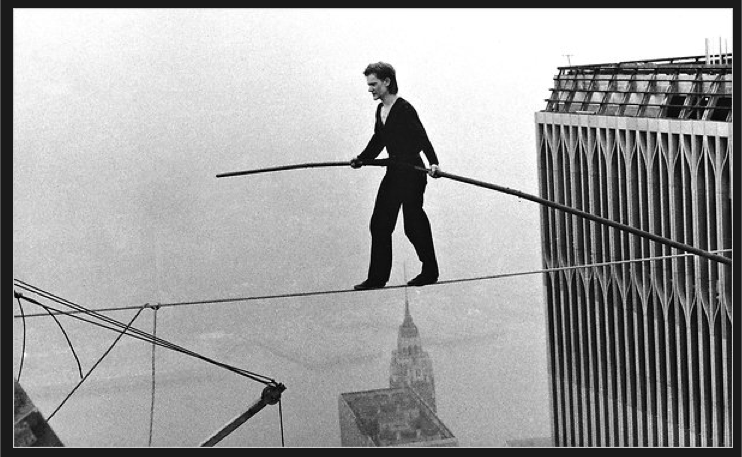
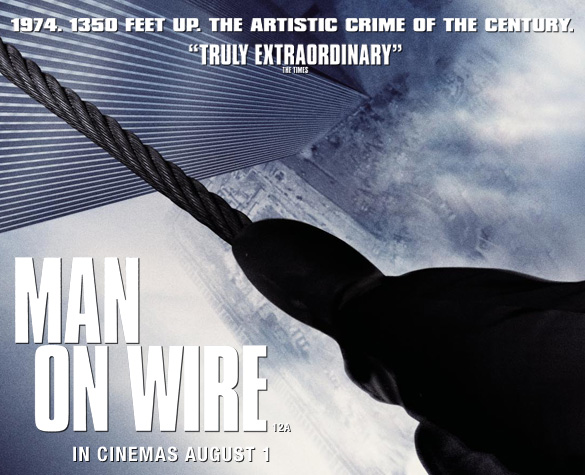
You know what happened next: sneaking into the World Trade Center in 1974 before construction was even finished, using a cross bow to string a wire from tower top to tower top, 1350 ft. high, and then astounding early-morning Manhattan with an extended walk. A father of a friend of mine told me that on his way to work that morning he saw everyone gazing skywards, but just thought to himself, “stupid tourists,” and kept walking, never bothering to look up.
And for those too young to remember, the Academy Award-winning documentary, Man on Wire (2008), kept the legend alive.
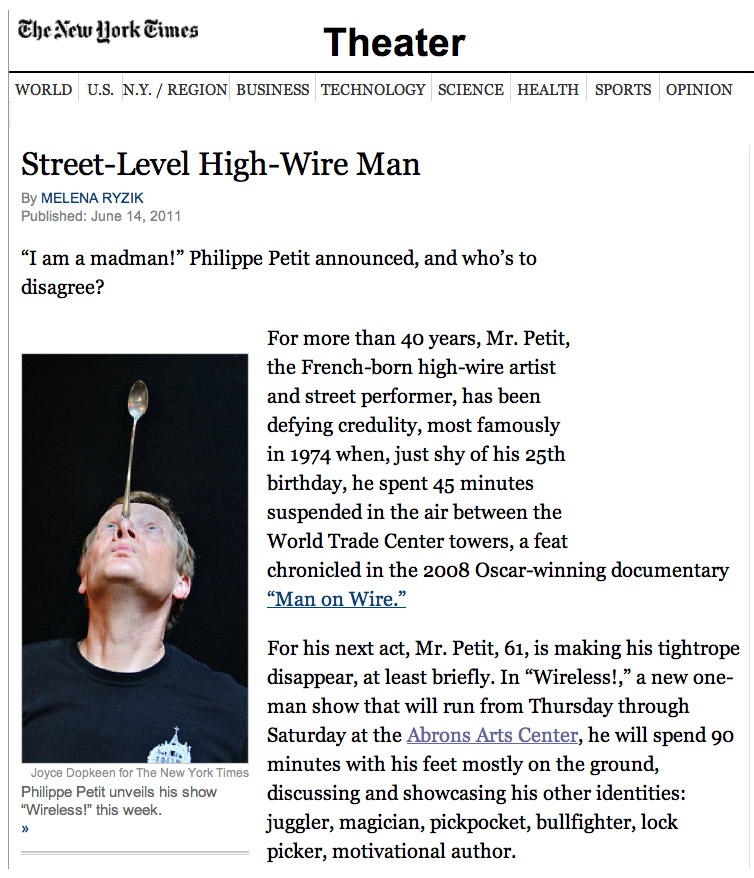
Fast forward to last week when I was pleasantly surprised to see this article in the NY Times about Wireless, a new Philippe Petit one-man show:
And here’s a short video that accompanied the Times article, with footage of the reporter’s visit to Philippe’s studio in the Catskills.
Although I’d love to see Philippe street perform again, I must admit I wasn’t so sure I’d have the patience for a presentation full of motivational lecturing and his philosophy of life. You know how intellectual the French can get about these things! A little bit of that can go a long way for me. But of course I wasn’t going to miss the show, so I snatched up tickets before the weekend run sold out.
Bottom line, I liked it a lot. Philippe is 61, not so petit around the middle, but still spry and on top of his game. For me at least the evening was just the right blend of thoughtful reflection, storytelling, and show and tell. No, he did not walk on a wire, ride a unicycle, or pick anyone’s pockets, despite a couple of forays into the audience. But he did talk about body language and demonstrate his findings; perform sleight-of-hand and reveal how it was done; and he did do his three-ball juggling act. He drew illustrations on a board for us, told stories, and acted them out.
______________________________
“People ask me if I am afraid on the high wire. I tell them I don’t have time, I’m too busy up there to be scared.”
______________________________
He clearly sees himself as the self-made man, someone who through hard work and ferocious focus has managed to teach himself not only a wide range of skills at a very high level, but who has also integrated his worlds into a broader vision, what he describes as his “territory.” Along the way he touches on such topics as play; overcoming fear; learning from small mistakes so as to avoid larger ones; simplicity through repetition; and the joys of bullfighting and comedy pickpocketing.
He is a dreamer but above all a problem solver. The final symbol of the show is a John Kahn “Easter Island” sculpture, as tall as the proscenium, that descends from above as Philippe tells with relish the story of how they discovered the likely explanation for how they moved these ancient and mammoth statues. What does that have to do with wirewalking? Nothing — and everything.
All of this could be quite ponderous, but it isn’t. He is animated throughout, constantly moving with that puckish energy of his, and very funny. Yes, I laughed a lot. All in all, the show harkened back to the days of the Chautauqua lecture circuit, or the 19th century tours of such great writers as Charles Dickens and Mark Twain. Today most celebrities limit their introspection to canned quips on the Jay Leno Show, so it is refreshing to see an artist choosing to spend 90 minutes explaining what make him tick. Bravo for that.
Philippe’s weekend in New York was labeled a work-in-progress, the stated intention being to take it to a larger venue for an extended run and eventually tour the show. So the good news is that it may be coming to a theatre near you one of these days and, in fact, if you’re anywhere near Hampton, Virginia you only have to wait until July 9th to see Philippe here.
I haven’t found any reviews of the show yet, but here are some interesting links: