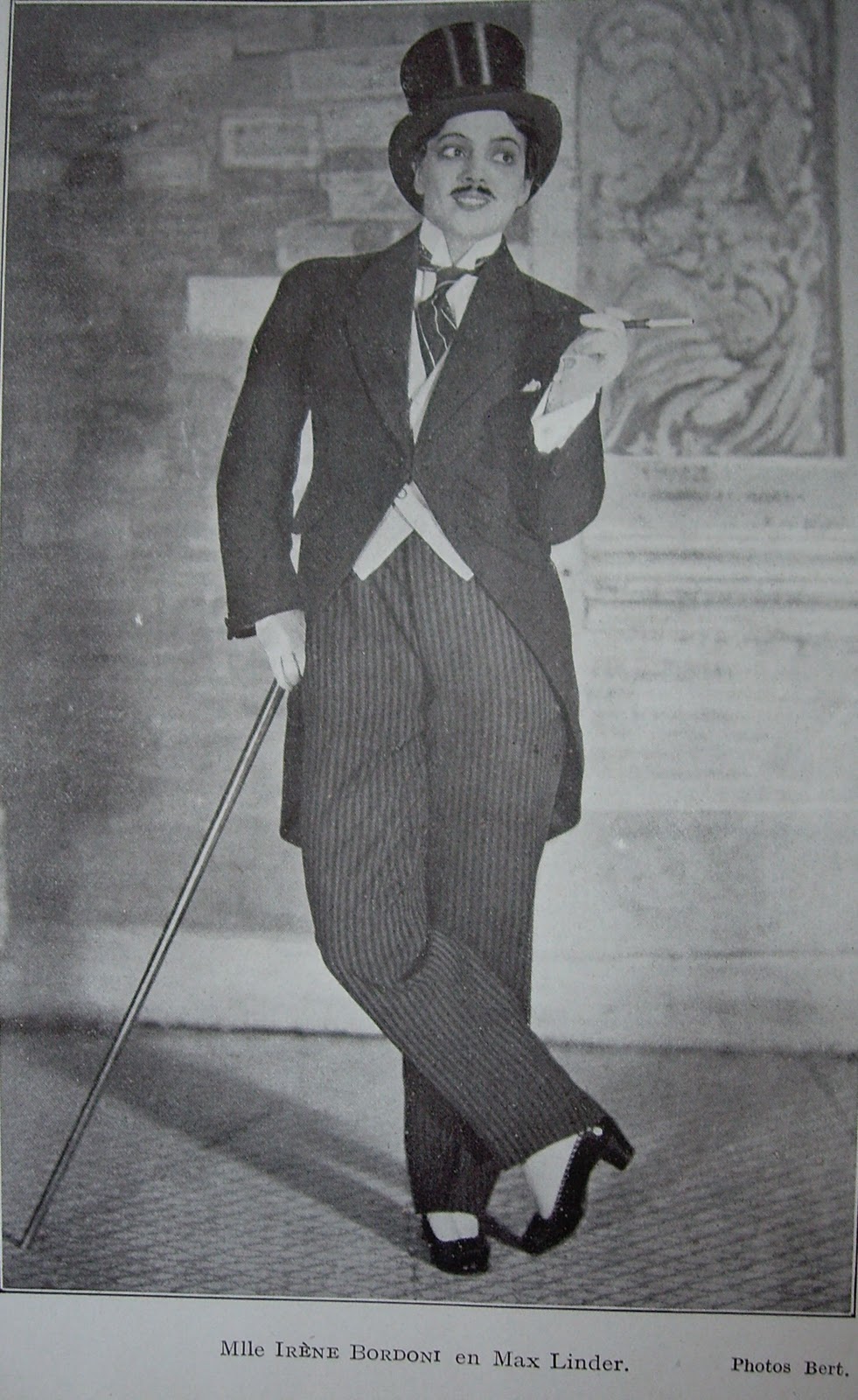
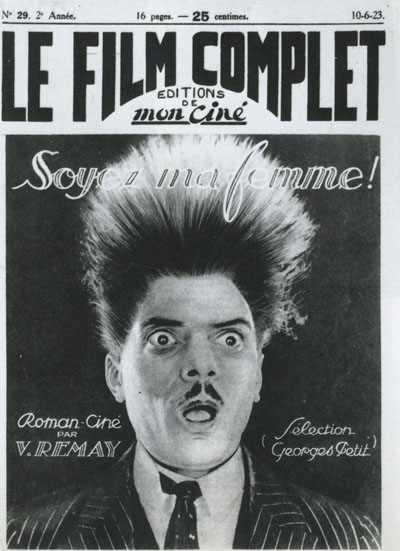
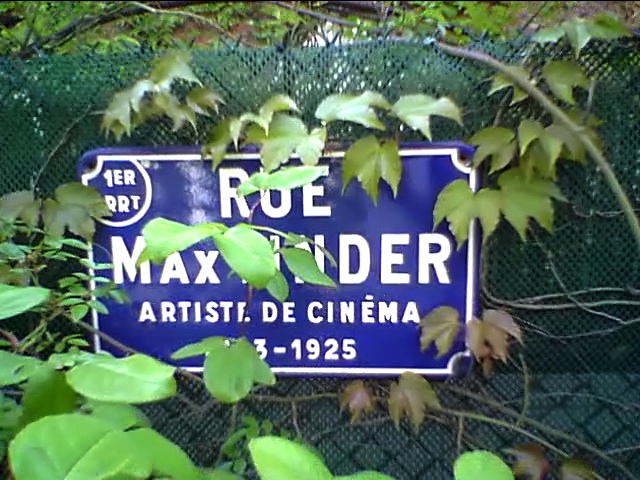
We may know Max Linder as the first truly international film star, the father of silent film comedy, but he was also a playwright and stage comedian whose live performances drew mobs every bit as frenzied as those that later greeted Chaplin, Sinatra, and the Beatles. What is most compelling about his stage work, however, is his innovative combination of film and live performance, the details of which you’ll have to read Mr. Bren’s article to discover! And click here to visit Mr. Bren’s web site.
Frank Bren’s article first appeared in the excellent journal New Theatre Quarterly. My warmest thanks to New Theatre Quarterly editor Simon Trussler for kindly granting permission to share this valuable article with my blog readers.
Supposedly I’m a big expert on all this clown and physical comedy stuff. Yeah, like I actually have the time to watch all those DVDs overcrowding my shelves.
Sad to admit, but this time last year I knew very little about the French silent film comedian, Max Linder (1883–1925). I knew he was the first international comic film superstar and that Chaplin revered him. I even knew he died young in what was labeled a double suicide with his 21-year-old wife, Ninette Peters. All I had seen of him in action, however, were very brief snippets from his surviving films (about 130 out of 400+) included on various anthologies of silent film history. Usually they got passed over quickly as the narration turned to everyone’s all-American favorites, Chaplin & Keaton, Lloyd & Langdon.
I was not terribly impressed by those few glimpses of Linder, not surprising considering that some of them dated all the way back to 1905, a full dozen years before Keaton’s first film with Arbuckle. But when I saw his 1921 film Seven Years Bad Luck, I thought it was clearly one of the best silent film features ever made. Well acted, ingeniously written, and with the best use of the mirror gag ever. But more on that later!
Shortly thereafter I came across a New Theatre Quarterly article about Linder that was so fascinating that I immediately wrote the magazine’s editor, Simon Trussler, to help me get in contact with the author, Frank Bren, whose web site you can reach by clicking here. (And so good that I begged Mr. Trussler and Mr. Bren to allow me to reprint it on this blog. They very kindly agreed, and you will find it as the very next post.) Reaching Frank Bren has proved to be a gold mine, for it was he who turned me on to the Pierre Etaix comeback story (see previous Etaix posts) and introduced me to the remarkable Maud Linder, daughter and biographer of Max.
And what a story!
Maud Linder was orphaned at the age of 15 months by her parents’ death, and did not realize who her real father was until some twenty years later. She came to know him only through his films, coming to hate the man who had abandoned his baby daughter, taking her mother with him, and yet very much admiring the artist. Somehow she was able to separate the two in her mind, and she made it her mission to revive the reputation of the comedian who had once been the most famous entertainer in the world. I was understandably thrilled when Frank told me that Maud was alive and well and living in Paris and would very likely be quite receptive to meeting me during my April sojourn in Paris. And so it came to pass!
More than 80 years later, a vibrant and energetic Maud Linder still lives in that same house Linder had built for his family on a gated street in Neuilly, an upscale suburb of Paris. Though Max never got to live there, he would no doubt be thrilled to see that his daughter has survived and thrived despite all odds and that she has worked so hard to perpetuate his legacy.
In this first segment from my interview with Mme. Linder, she explains her personal mission:
Some thoughts on Linder’s legacy and the struggle to keep his work alive in the 21st century:
And here Mme. Linder muses about the difference between a clown and a film comedian:
I may have been 85 years late in my search for the living, breathing Max Linder, but meeting his daughter was both an honor and an inspiration for the posts that follow this one.
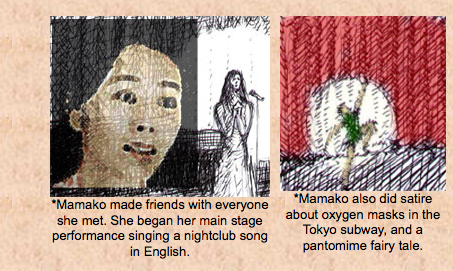
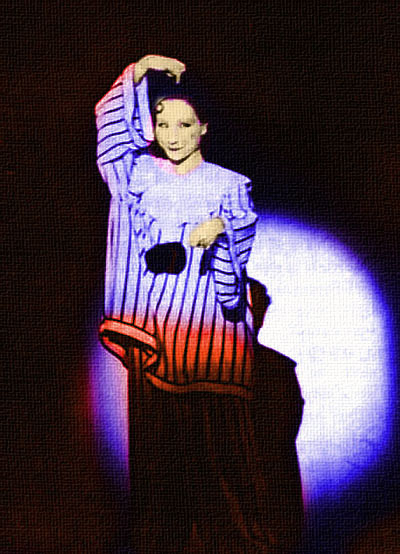
“Live from Paris” last April, that is, where I was already undercover on the Linder and Etaix capers when I got a coded message from one Michael Evans, an operative unknown to me but apparently a go-between for a character from the 70s who at that time went by the unassuming name of Lou Campbell. I was in Paris, I had nothing better to do (hah!), and before I could say fromage I’d been given the assignment to track down legendary Japanese pantomimist Mamako Yoneyama, rumored to be hiding out in that City of Light Mimes. Evans (if that’s his real name) had first met Yoneyama — code name Mamako— at the 1974 International Mime Festival at Viterbo College in Lacrosse, Wisconsin, organized by yet another “Lou Campbell.” Or was he in fact the same person?? Evans’ rambling confession about that festival — an event whose foreign ideas about movement theatre forever corrupted the minds of a whole generation of impressionable Americans in tights —has finally been released thanks to the Freedom of Information Act, and now the general public can view it here, including incriminating sketches and notes such as these:
I had never seen this Mamako character perform. I knew she had a glowing reputation, but biographical data was suspiciously sketchy. The only background info on the perp was from a book called Mime and Pantomime in the 20th Century, but for reasons unknown not published until 2008:
Born in 1935, Mamako began dancing at a very early age. Her father, a schoolteacher, was a dancer by choice, performing for a local ballet company. Mamako naturally being exposed to her father’s talent, became involved in dance. By the time she was a teenager, Mamako was the acclaimed best dancer in school. She attended Tokyo University where she studied physical education. In addition, she studied modern dance under the aegis of Egichi-Miya, the famous Japanese choreographer/dancer. She rose quickly to stardom in Japan.
She attended the debut performance of Marcel Marceau in Tokyo and immediately made up her mind to study with him in Paris. Once she acquired the foundation of style mime technique, she returned to become a curiosity in her own culture.
Because pantomime was so new in Japan, it offended her to read that her mime was regarded as “twisted dance.” She came to the United States and did well in Hollywood, but she was lonely there. Dr. Lou Campbell first met Mamako at San Francisco State University in a Stage Movement Master Class that he developed through the American Educational Theatre Association pre-convention sessions in 1972. She performed at the First International Mime Institute and Festival in 1974 and at subsequent other mime festivals around the U.S. where she received great accolades. After a long stay in Japan, she decided to move to Paris. Only recently did she decide to return to her home country.
The form of mime for which Mamako is most noted is called Zen Meditation Mime. She claims that “It is the same as that which a Buddhist Monk experiences while meditating on a particular environment.” It is not literal pantomime but a collection of impressions derived from an environment.
That Campbell character again! Just to be thorough, I checked to see who the purported author of this book might be, and it was none other than… Lou Campbell! Campbell writing about Campbell. Coincidence? I think not. This plot was thickening as surely as a bouillabaisse going into its third hour on the stovetop. But where to start? Like Dick Tracy before me, I turned to my wristwatch for an internet search, my eagle eye uncovering an obscure reference to Mamako on a blog by Tokyo writer Yuri Kageyama.
Moi to Yuri: Mamako? Still alive? Living where?
My wristwatch soon beeped with a reply, which it dutifully translated from the Japanese as “I’ve read about her performance as recent as a couple of years ago. They were in Japan, but I only learned about them on the Web afterward and so I couldn’t go check it out. Her death would make news here for sure. And I have not seen any such reports.”
She was alive but apparently living in Japan. Me, I was stuck in Paris, volcanic ash shutting down every airport west of Kiev. My pockets stuffed with cash, just a small portion of the enormous profits from this blog, and yet no way to hop a quick flight to Tokyo. Curse you, Iceland! One door had opened, but another had been slammed right in my kisser.
A little secret: a good detective makes his own luck… and his own contacts. Checking my Rolodex for Franco-Japanese go-betweens, my finger landed on the tattered card of one Bernard Collins (code name Compagnie BP Zoom), an American in Paris frequently back and forth to Japan, with “clowning” as his cover for other activities I have sworn not to disclose. Would he fess up to having seen Mamako?
Paris–Tokyo–Paris. Hmm… might they not be toiling for the same cartel? Turns out Collins’ “agent” had in fact introduced him to our suspect on a previous occasion. Bingo! Not only was she alive and well, but said “agent” knew exactly how to reach her. End of search! All that remained was the judicious application of a certain amount of pressure — long distance yet oddly effective — for our new agent friend to turn over the necessary contact info, now safely in the hands of the entity or conglomerate known as Lou Campbell.
My reward? I’m not talking, but you can be sure it won’t appear on my 2010 IRS return.
As the lights went down at the end of the final performance of James Thiérrée’s Raoul at the Brooklyn Academy of Music this afternoon, the entire audience immediately jumped to its feet to give him a rousing standing ovation. And yet the New York Times review argued that “the charms of Raoul the show quickly wear thin.”
What gives?
I’ll tell you what we’ve got here. On the one hand there’s the performer’s skill and magnetism, the world he creates, its impact on the audience. On the other hand there’s the MEANING of the piece, so dear to critics, the overarching themes that connect everything and hopefully add up to a whole greater than its parts. Call it plot, structure, choreography, playwrighting, whatever….
So let’s start with the performer, James Thiérrée, in what is essentially a one-man show. Great-grandson of playwright Eugene O’Neill, grandson of Charlie Chaplin, son of Jean-Baptiste Thiérrée and Victoria Chaplin (Cirque Imaginaire), kid brother of Aurélia Thiérrée (see my post #67) — well obviously he has a lot to live up to. Lucky for him, luckier for us, he manages quite nicely, thank you very much. Thus the standing ovation, which Jim Moore, Jan Greenfield, and I had no hesitation in joining.
Thiérrée’s movement is a stunning, fluid, and seamless blend of mime, circus, physical comedy, and dance. His routines are inspired and at times so complexly layered that you can only compare him to physical comedians such as George Carl or Bill Irwin at their best, or to a comic like Reggie Watts at his wildest. There were many moments during the show when I felt as if I had been privileged to see Charlie Chaplin live. Yes, there is a family resemblance (he’s not adopted!), and Thiérrée’s physical virtuosity reminds one of why W.C. Fields paid Chaplin the supreme compliment of saying “He’s a goddamn ballet dancer. I’d like to strangle him with my bare hands.” If you’re really interested in physical comedy, and not just reading this blog to impress me, do not miss a chance to see Thiérrée live.
But what is the show about and why was the Times so dismissive? Well, you can read the review here, but the argument in a nutshell is that the world Thiérrée creates ultimately doesn’t add up to much of anything and doesn’t go anywhere. This is not necessarily an unfair argument, though certainly harsh. There’s no clear linear narrative, and the character is not anchored in naturalistic detail. We gather that this is a tale of a man whose home is gradually destroyed, but we know not why. We see his fight to survive and make sense of his existence, but again it is not always clear what’s going on. In those moments when Thiérrée isn’t wowing us, the piece tends to sag because we lack the conventional hooks of story and character.
What we get instead is more of a surrealistic dream world. Raoul is in essence an abstract piece, open to multiple interpretations, pretty much like 90% of the dance pieces I see these days… though somehow they don’t meet with the same scorn from the press. Ditto opera, though I must admit I don’t see much of that. The reality is that some shows are more performer-based and others more literary-based, and an ideal melding of the two usually proves pretty elusive. I think Bill Irwin pulled it off for most of Regard of Flight, but at least 95% of the time we have to accept an imperfect universe.
Note to publicist: Don’t evoke Beckett in your press release. Too much to live up to; a strategy pretty much guaranteed to backfire with your more high-toned critics.
But here’s another thing I like: our star’s formidable talents, which the Times haughtily disparages as “Mr. Thiérrée’s shtick,” are not merely technical. His interaction with the physical world has one foot in the inventions of Buster Keaton and the other firmly in a futuristic mindscape — thus my placing this show in my coveted category, Physical Comedy in the 21st Century — a designation reserved for performances that point the art form in new directions. It is Thiérrée’s genius to transform all of the physical world, everything on stage, curtains and all. As surely as Dali painting a landscape, Thiérrée’s body and imagination interact with a dynamic theatrical set that itself becomes another character in the show. What the hell am I talking about?? Hey, you gotta see the show, but take it from me that nothing on that stage is nailed down; nothing remains what it was. Dali, Bréton, Magritte, Miro and the gang would be proud.
Hey, I’d love to show you some representative video to back up my enthusiasms, but not doing too well there. I continue to be unimpressed (shocked, actually) as to how so many strong shows have such poor promo videos. And why is it that funny shows have to have these artsy, lyrical trailers that don’t even hint at comedy? For example:
But like I said, try to see the show. Meanwhile, here are a few good links for you, courtesy of Jim Moore.
We last left Pierre Etaix (post 99) with the happy news of the legal triumph that restored his rights to his own films, paving the way for their reappearance in film festivals and, ultimately, their DVD debut. Now that I’m back on the case, I thought I should try to find out how much of that has actually come to pass since my May 19th post. Here’s the scoop:
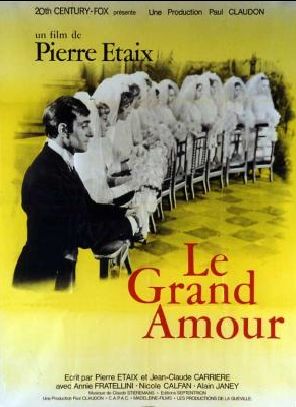
• A restored version of Etaix’s LeGrand Amourwas shown at this year’s Cannes Film Festival.
• Restoration of the entire Etaix ouevre was completed this July by the Technicolor Foundation and the Groupama Gan Foundation. Click here for details.
• At least four of his films are being screened this week at the Cinémathèque Québécois in Montreal. Click here for an article from the Montreal Gazette.
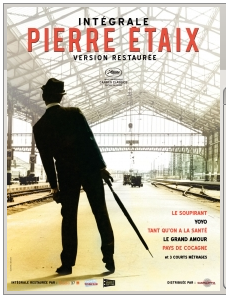
• A September DVD release of the collected works, Intégral Pierre Etaix, was said to be forthcoming from Carlotta, but their web site was only promoting live screenings and video on demand, and the VOD was only available in France • So I wrote Carlotta and this morning heard back from them that it is Arte, not Carlotta, that is releasing the entire collection — and it’s due out next week! Click here to link to Arte’s Etaix page. As of today, they are not yet taking orders, but the release date is set for November 2nd. So, yes, I will get my order in and try to post a review to your favorite physical comedy blog as soon as I can work my way through the nine hours (!) of material.
Meanwhile, here are a few tidbits for you:
• A new article by Frank Wren on the re-emergence of Etaix, with some interesting connections to Chinese cinema.
• There’s now an Etaix Facebook page. Search for Intégrale PIERRE ÉTAIX.
• And here’s a podcast of an interview (in French) with Etaix. Just click here to go the podcast.
One day after posting my In Search of Pierre Etaix piece, I was at Jeff Seal’s “Dead Herring” Williamsburgh loft, attending a fundraiser (image, right) for Jeff’s own quite exciting silent film comedy project, A Day’s Messing. The star attraction was Ben Model, the deservedly celebrated silent film accompanist, playing live piano to a nifty 1912 short, new to me, Robinet Cycliste, andtoChaplin’s The Rink (1916) and Keaton’s Neighbors (1920). (In my next life, I want to play piano like Ben does.)
While we waited for the sun to go down over the Williamsburgh Bridge, I had a chance to chat with Ben, and I was of course telling him the latest news on Etaix. It turns out that Ben had seen a 16mm copy of Etaix’s short Happy Anniversary for sale and snatched it up. He has since digitized it and generously uploaded it to YouTube. Here it is, in two parts:
You can visit Ben’s web site here and his blog here.
Postscript (pun intended):
So……. congratulations to me (he said modestly) on reaching post 100 on this blog. If nothing else, it justifies labeling my posts 023, 024, etc.; in fact, that served as inspiration to reach 100. Along the way, I sometimes wondered what post 100 would be, hoping it would somehow prove brilliant and marvelously repersentative of the blog. Forget the brilliant part, but I very much like that this one spans work from 1912, 1916, 1920, 1965, and 2010 — all linked by Ben’s piano chops. Good enough!
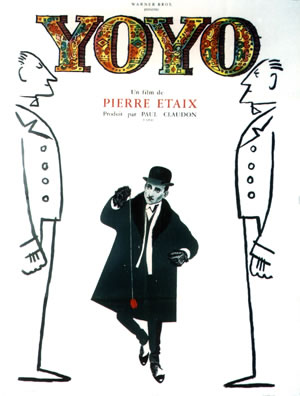
The year was 1973 and I was a student at Ringling’s Clown College where, as part of the training, dean Bill Ballantine screened comedy films. Yes, this was the Dark Ages, still several years before the first VHS tapes and a full two decades before DVDs. I fondly remember sitting with the likes of Penn Jillette, Michael Davis, and Mike Bongar, devouring the works of W.C. Fields, the Marx Brothers, and other classics. One delightful oddity that caught my attention was a modern-day silent film comedy, Yoyo (1965), directed by and starring the French renaissance man, Pierre Etaix. Although Jacques Tati — another French master of the modern silent film — was to complete his last feature film the next year (Parade, 1974), neither he nor Etaix were exactly household names in the United States.
Fast-forward to 2010, a mere 37 years later, and through correspondence with writer Frank Bren — more on whom later — I learned that Etaix was alive and well and on the comeback trail. Now a young 81, he had recently mounted and starred in a stage production in Bordeaux — Miousik Papillon — that he hoped to bring to Paris, and was involved in an intense legal and public relations battle to regain rights to his films, which he had sold to a company that then decided not to release them. That’s right, nearly four decades later and still no theatrical releases, no VHS tapes, no DVDs. [You can read a London Guardian article about this long battle by clicking here.]
Clearly something had to be done. A web publicity campaign was launched, petitions circulated, donations solicited. Major film artists lent their support. Here’s a clever promo video (in French) in which Etaix does some sleight-of-hand with five coins that disappear just like his movies did. Ultimately all he and co-creator Jean-Claude Carrière can do is pray to St. Anthony of Padua.
Hmm… since I was going to be in Paris for two weeks, perhaps I could connect with the Etaix campaign, maybe even with the old master himself, at least for an interview. In Search of Pierre Etaix. I had a mission! It was almost like being a real journalist.
So I signed the petition. I even made a donation. And I wrote to the friend of Etaix who was running the campaign. And no one answered. Being a crack investigative reporter, I took the next step. I wrote again, and I waited. I drank some Bordeaux, munched on my pain au levain and roquefort, and when that didn’t work, I showed great determination, consuming yet more wine, bread and cheese. And meanwhile waited some more. And then I had to leave Paris. Bummère, as they say along the banks of the Seine.
I thought this was the end of the story, but back in New York just a few days later I was greeted by a barrage of late-breaking Etaix news. There had been a victory in the film rights battle! Not only would the movies be released this summer, but Le Grand Amour was to be screened May 19th at the prestigious Cannes Film Festival. Here’s the Cannes press release:
The Cannes Classics programming of LeGrand Amour by Pierre Etaix is a major event. It was only recently, after a long legal battle, that the director succeeded in recovering the rights to his own films. Eight films by Pierre Etaix have now been restored and prepared for re-release. In Competition at Cannes in 1969, Le Grand Amour, which was the first colour film by Jacques Tati’s collaborator and assistant director, has been selected to open this special retrospective. A comic and poetic film, where Pierre (played by Pierre Etaix), though happily married, falls in love with his pretty young secretary and starts dreaming, Le Grand Amourwill be screened this evening in the presence of the director.
So even if my personal Etaix quest was a failure, here he is about to be rediscovered by the wider world, and at least I can help spread the word. To prime the pump, here’s some stuff you might want to know about this creative clown genius: • He won an Academy Award in 1963 for his short, Heureux anniversaire. • His writing partner was and is the prolific and talented Jean-Claude Carrière, who won much acclaim for his work with film director Luis Bunuel and stage director Peter Brook. • He worked as an illustrator and created designs and gags for Jacques Tati, serving as an assistant director on Mon Oncle. • He made five features between 1962 and 1971:The Suitor (1962),Yoyo (1964), So Long as You’re Healthy (1966), The Great Love (1969), and Land of Milk and Honey (1971). • He was cast by Jerry Lewis in his unreleased film The Day the Clown Cried. Lewis said of Etaix: “Twice in my life I understood what genius was. The first time was looking at the definition in the dictionary. The second was encountering Pierre Etaix.” •He returned to cabaret and circus performing in the the 70s and was married to the celebrated French circus clown Annie Fratellini, grand-daughter of the legendary Paul Fratellini; Annie played Etaix’s wife in Le Grand Amour and in the circus was the auguste to his whiteface clown. • Together they founded the first French national circus school, l’Ecole Nationale du Cirque Annie Fratellini, which pioneered the growth of circus as an art form in France and the emergence of “nouveau cirque.”
But all of this is just an introduction to the following excellent 2008 retrospective on Etaix’s career by the aforementioned Australian writer, Frank Bren. This is a “work in progress” from Mr. Bren’s forthcoming book, which currently has the working title, ETAIX — adventures in cinema. It is reprinted here from Film Ink magazine with the generous permission of Film Ink and Mr. Bren. Frank Bren: Pierre Etaix—France’s Forgotten Comic Genius
Life is a cabaret, old chum, so willkommen-bienvenu-welcome to La Clique, an intimate cabaret of burlesque comedy and circus, delivered in a mix of French and English, and performed mostly on a tiny circular stage set in the midst of an audience that is never more than about ten meters away. The show has roots in Australia but was first seen as a fringe offering at the 2004 Edinburgh festival. It has since enjoyed extended runs in the capitals of the world, with many of the same acts intact. I finally caught up with it at the Théâtre Bobino in Paris, and found a lot to like.
Here’s their YouTube promo clip, the usual few seconds from each act, but it gives you some sense of the show.
In Paris, my notes scribbled in the dark list these acts, more or less in this order:
1. Mario, Queen of the Circus — 3-ball juggling as Freddie Mercury
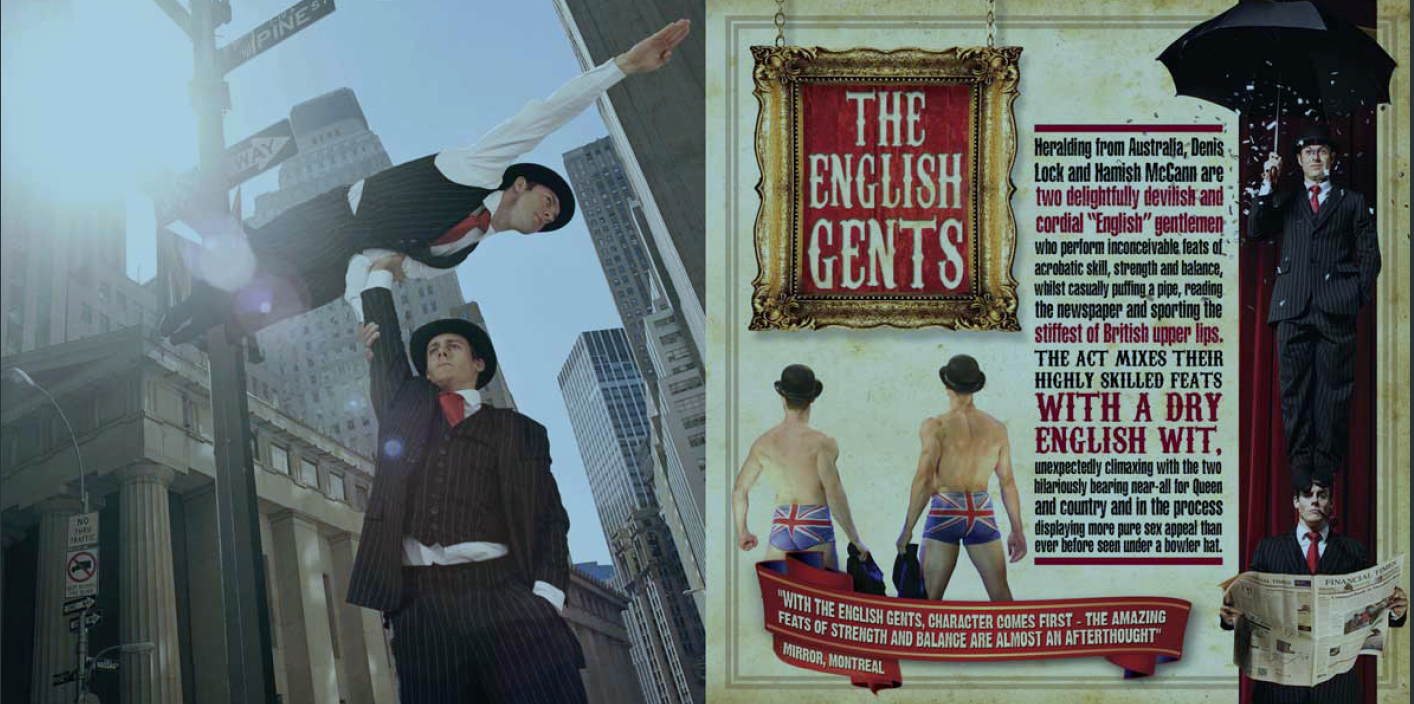
2. The English Gents — comedy partner acrobatics
3. Amy G — comedy roller blading
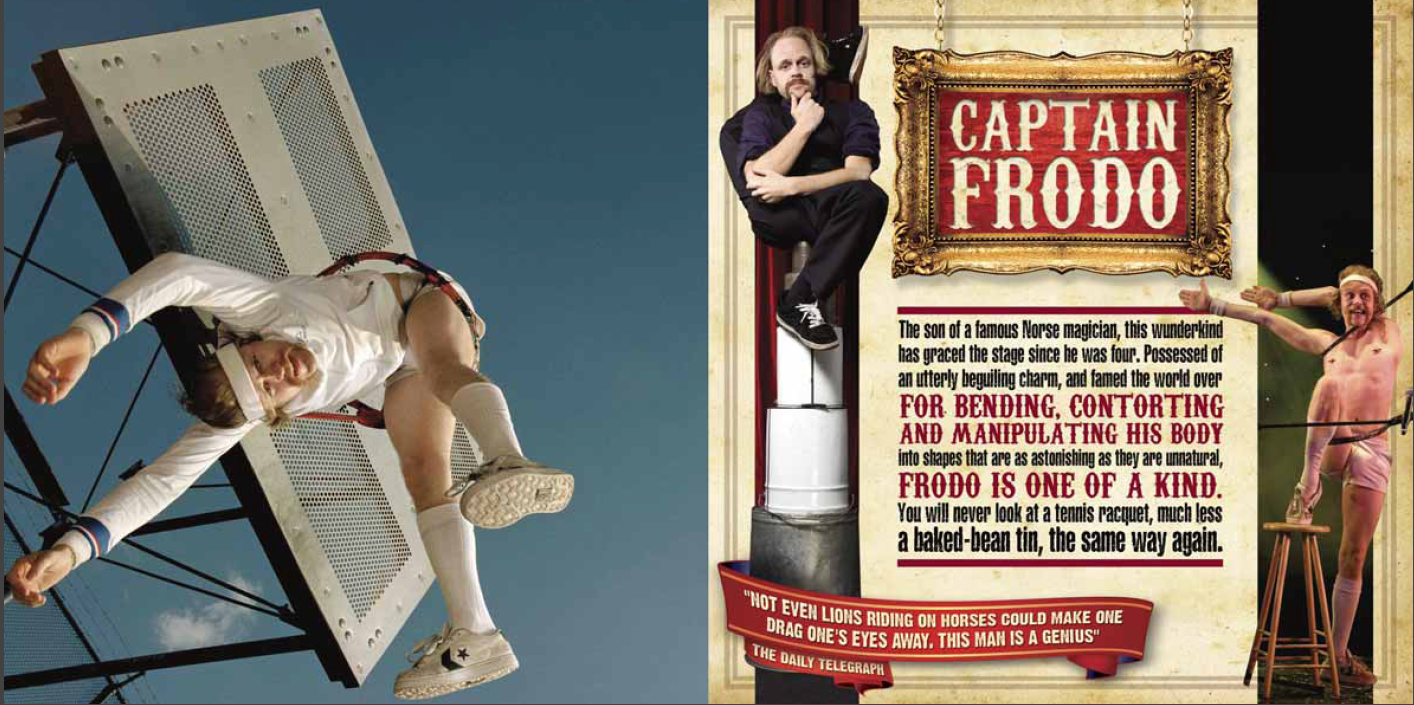
4. Captain Frodo — tennis racket contortion
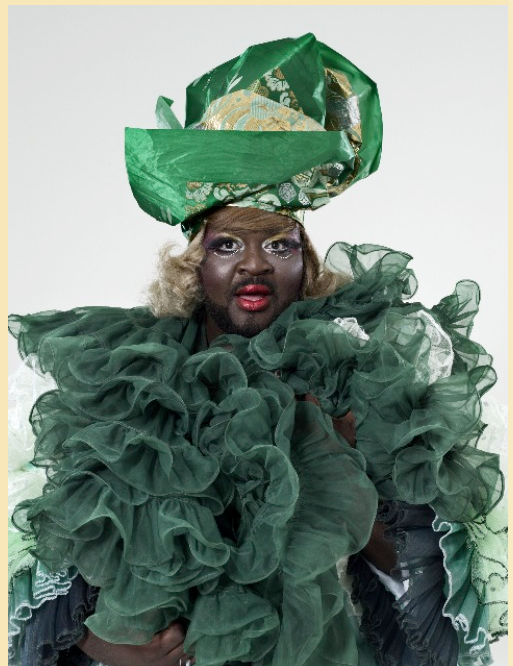
5. Le Gateau Chocolat — opera / audience participation
6. Susannah Martinez — strip-tease magic
7. Yulia Pikhtina — hula-hoops
8. Bret Pfister — aerial hoop
9. Amy G — highly unusual Salute to America
10. Captain Frodo — balancing and contortion
11. David O’Mer — bathtub acrobatics
My favorite act, a very nice piece of physical comedy indeed, was the 10-minute contortion routine by the Norwegian “Captain Frodo.” Most contortion acts bore me to tears, but this one was hilarious, with our good captain delivering non-stop bi-lingual patter as he attempted to pass his body through two tennis rackets, all the while falling off a chair and contending with an uncooperative microphone right out of George Carl. The choreography and timing were superb, which makes me hesitant to even show you the following video of his act from a performance in a far less intimate setting. It doesn’t even show the whole act and it’s missing a lot of the physical and verbal business that was so effective in the Clique environment. But, hey, we’re all professionals here; I’m sure you know not all performances and settings are the same. So here’s the video, but pretty please do try to catch him live.
Likewise nicely combining character and physical skill were the English Gents, who begin their partner acrobatic act dressed as dignified bankers, but for an encore strip to their Union Jack underpants.
The skill was there and the deadpan delivery worked nicely. Here’s a short clip of their cabaret work, followed by a clip of them doing street performance, already stripped to their shorts:
Another crowd pleaser was the lip-synching juggler and unicyclist Clark McFarlane, “Mario, Queen of the Circus,” so billed because of his emulation of rock star Freddie Mercury.
Your enjoyment of La Clique will, however, depend upon your sensibilities. The acts are mostly at a high level, several with a refreshing degree of originality — David O’Mer’s water acrobatics in the bathtub is a joy — but the show bizzy glitz, glam, and sexual posturing were all a bit too forced and Vegas-y for my tastes. Le Gateau Chocolat, a flamboyant opera-singing queen who describes himself as an African homosexual zebra, gets a lot of easy laughs sitting on the laps of the front row of spectators. Amy G plays “God Bless America” on the kazoo, apparently from her vagina. Susannah Martinez vanishes a red silk scarf using ye olde thumb tip trick, each time”finding it” in an article of her own clothing, which she then of course must remove before repeating the trick… and repeating it and repeating it…. until she is finally out of hiding places. Yes, oh my gawd, naked! And you’ll never guess what part of her anatomy she finds it in as her big finale! (Speaking of which, did you know that the French word for vagina is masculine? — le vagin. Go figure.) Clever enough for most of the audience to love it, but I found it predictable and nowhere near as skilled as the other acts.
I’m hardly a prude, and I even have a decadent fondness for cheap theatrics, but let’s just say that the borderline between schlock and a parody of schlock can be a fine one.
La Clique continues its Paris run through June 26th. Go during the week and buy standing room and you may end up sitting in the first row of the balcony; we sure did.
I’ve always been a big circus fan, but I have to admit that somewhere along the way I began to tire of the same old acts done the same old way. Tradition is fine and to be seriously respected, but watching performers — be it a hand balancer, a solo trapeze artist, or a clown — do what everyone else is doing, time after time, proved downright dispiriting. Did “classical circus” have to be devoid of creativity? And if a true believer like me often found himself bored at ringside, I suspect many a secular spectator was left with the feeling that “if you’ve seen one, you’ve seen them all.”
And then along came nouveau cirque, with its rejection of animal acts and Barnum-esque hokum, championing instead an aesthetics derived from sources as varied as Chinese acrobatic troupes, post-modern dance, and visual theatre. We immediately think of Montreal’s Cirque du Soleil, but it is in France — aided by generous government funding — that circus arts have been stretched the furthest. My annual visits hardly qualify me as an expert, but the shows I have seen have all been strikingly different from one another, each with its own unique vision and execution. In my last post, I wrote about seeing France’s Compagnie XY in London. Just a few days later I was in Paris, where I caught Du Goudron et Des Plumes (Tar & Feathers) by Compagnie MPTA out at Parc de la Villette, home for many a nouveau cirque production.
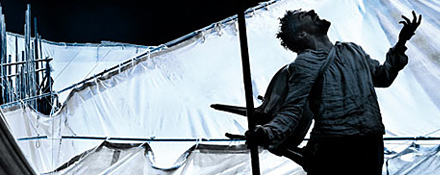
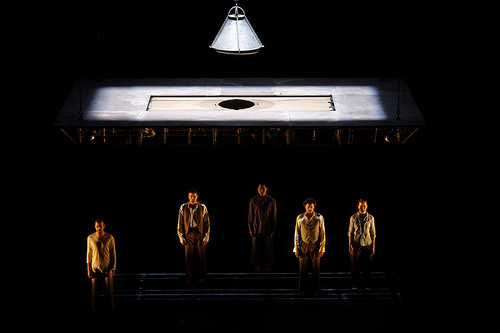
While Compagnie XY presented traditional circus skills in a new way, Du Goudron et Des Plumes is more of a dance-theatre piece, weaving acrobatics into a theatrical narrative that, although abstract, was about something. Five performers (four men and a woman) cohabit the area on and around a suspended platform that rocks their world as it rises and lowers, tilts and sways; alternately a floor; a roof; a ship at sea, swept away by a perfect storm. To survive, they are forced to adapt to a topsy-turvy existence. Dynamics shift, relationships form and dissolve, cooperation gives way to competition, and chaos always looms. Sometimes life is as light as a feather; other times, it weighs them down like a heavy coat of tar.
As with Cirque Mechanics (see my earlier post), the platform and its extensions become a sort of constructivist jungle gym. Its parts are even miked so that we hear it breathe as it moves. And not only does the platform move, but its wooden planks can be reconfigured by humans to create new playing surfaces. As the reviewer for La Terrasse put it, the living confront a machine that binds them and yet inspires creativity, “a metaphor for our world in a state of constant displacement.”
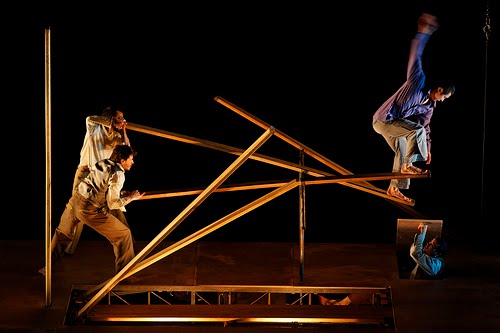
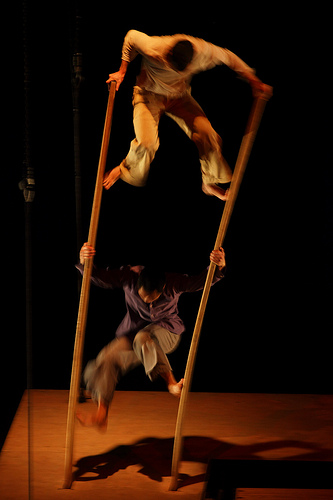
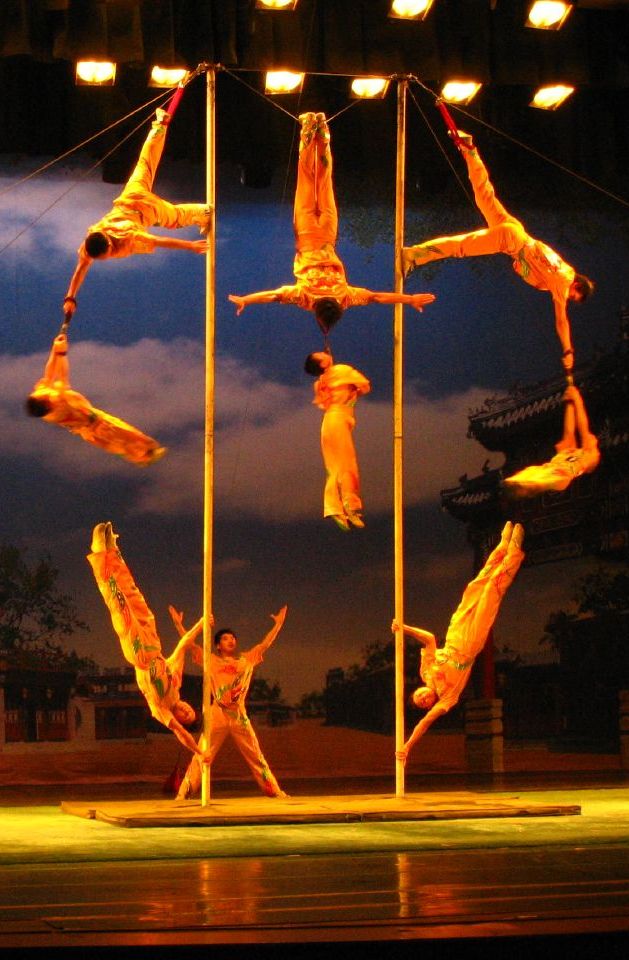
If you’re thinking this is all very esoteric, maybe even intellectual, you are — I am happy to report — quite mistaken. Not only is the movement a joy to behold, but the show is full of original circus technique and physical comedy. My favorite was the pole act. Look at these two pictures: the one on the left of Chinese acrobats doing a traditional pole act; the one on the right showing two characters interacting on poles temporarily wedged into the platform.
The Chinese act is spectacular, and any attempt to duplicate it risks being a pale imitation. In Du Goudron et des Plumes, however, the poles were the setting for a two-person scene, with one character manipulating the other like a marionette, up, down and around the poles. The technical skill is certainly there, but the interplay between characters gives it a whole other life that you just don’t get with straight presentation. If there were one segment that I could show you on video, this would be it.
[Total Aside: It’s amazing where clicking on a web link can take you. Not being a frequenter of strip clubs (no, really…), I had no idea that strippers had gotten into serious acrobatic training to enhance their pole dancing acts till I stumbled upon this blog post. And did you know there’s even a U.S. Pole Dance Federation? Stranger still, it turns out their 2009 championships were held all of four blocks from my NYC apartment building. Man, nobody tells me nuttin’!]
Also quite imaginative was an upside-down mirror scene. We’ve all seen mirror gags, and you’ve probably seen acts where the aerialist performs everyday acts suspended upside-down; there’s been one featured in Circus Oz for like forever. Here, however, two performers mirror each other vertically, one standing on the platform, the other suspended by his feet from it so they are feet-to-feet. Quite nifty.
I haven’t found even a promo video for the show, just this little slide show:
Here’s a YouTube video of another piece by director Mathurin-Bolze, just to give you some idea of his style; unfortunately, the camera operator seems to have fallen asleep after the first minute and a half.
The program notes, like most French writing on culture, are full of metaphors and allusions that are either evocatively poetic or ridiculously pretentious — all depending on your point of view. Steinbeck’s Of Mice and Men is listed as an inspiration, as are other texts, but they are ultimately irrelevant to the final product, which speaks for itself.
Compagnie MPTA’s motto is Les Mains, les Pieds et la Tête Aussi. They have indeed succeeded admirably with their hands, their feet, and also with their head.
You can read a collection of reviews (in French) here.
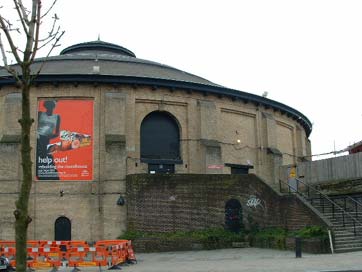
I blazed through London for three jet-lagged days on my way to Paris, and managed to catch part of a circus festival (ongoing through May 16th) at the Roundhouse Theatre in fashionable Camden Town.
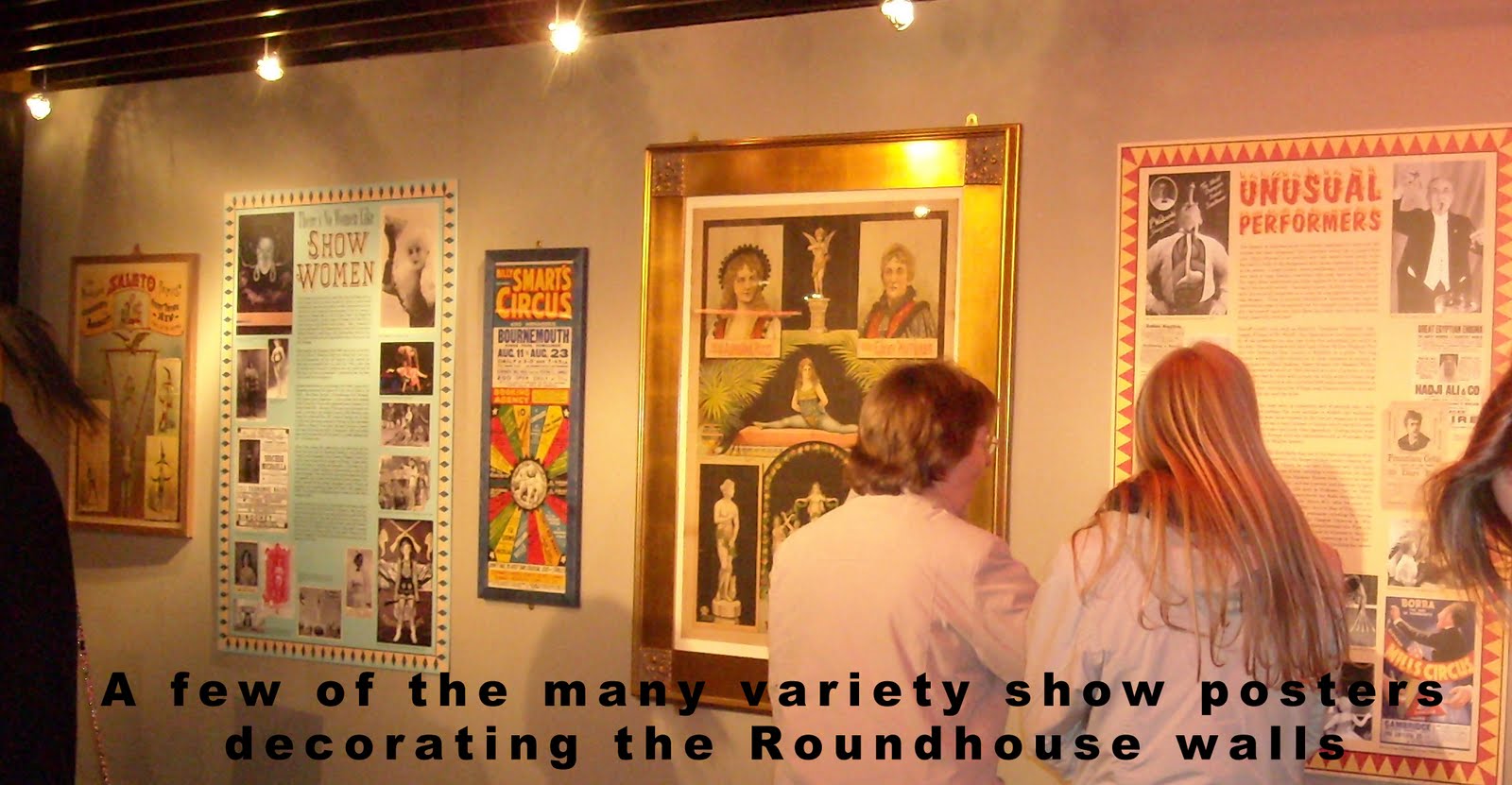
The Roundhouse is a great space. Originally a steam engine repair shed, it was first used as a performance venue in the 60s by political playwright Arnold Wesker, and soon was hosting such attractions as Jimi Hendrix, Pink Floyd, Peter Brook, the Living Theatre, and the Doors. When funding dried up in 1983, the space went dark until 1996. In 2004 it closed again, but this time for some big-time (and handsome) renovations, reopening in 2006. It is indeed round and quite impressive — its main space can house 1,800 people seated or 3,300 standing — and reminds you of such permanent circus buildings as the Cirque d’Hiver in Paris. The similarities don’t end there: circus and variety arts constitute a major portion of their programming.
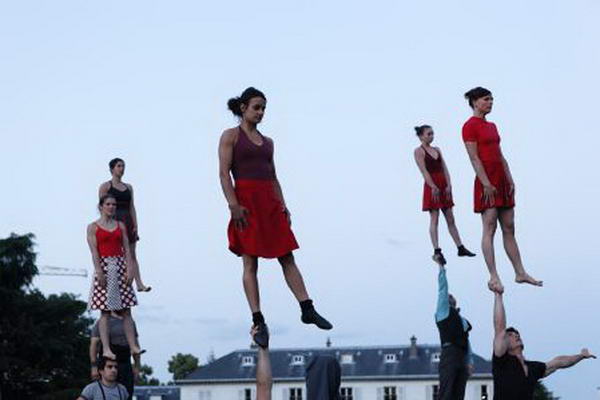
The show that impressed me mostwas a nouveau cirque production from France, Compagnie XY. One trademark of nouveau cirque is its choice to not use animal acts. Compagnie XY went much further: they chose to perform without circus hoopla: no applause cues, no “Ta-Da’s!” no glitzy costumes, hardly any props (three, to be exact), and no dramatic music — not even a drum roll — just some charming Parisian melodies, full of accordions, and more reminiscent of the world of Edith Piaf than of the world of the circus.
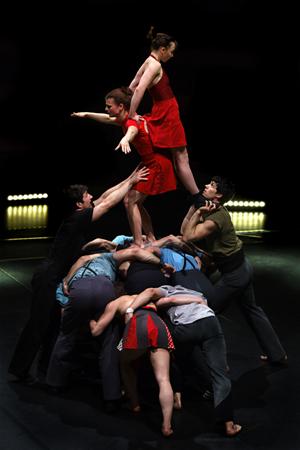
It begins in the semi-dark. Very slowlythe performers wander into the ring, eventually gathering themselves into a shadowy pyramid, after which they casually disperse. It of course picks up steam from there, but throughout retains a matter-of-fact manner; intense focus, of course, but calm nonetheless.
What we get instead of over-the-top pizazz is an ensemble of performers — all of them in the ring 90% of the time — working together to explore the countless possibilities of group acrobatics; more specifically, throwing each other every which way and constructing a dazzling array of pyramids. That’s it. No jugglers, no wirewalkers, no clowns, no daredevils on motorcycles. Just group acrobatics. The only human cannonballs are launched by human hands and human feet.
The technical level is high, with many a 4-high in the mix, but what impresses is the inventiveness and the contagious joy of all these group creations. . As always, you had to be there, but this two-minute video shows the kind of work they do, though not the effect of the whole evening.
And some more photos:
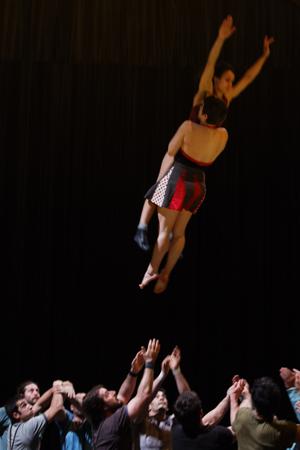
Partner work this strong and inventive is at least a second cousin to physical comedy partner work, but I think it’s more difficult to do actual comedy as part of a show like this. What do you play off of? There’s less suspense, not much in the way of defined roles. There are no stars and no star turns. The (warm) message is one of mutual trust and cooperation. The few comic bits they tried work quite well, however, especially the attempts of the one rather heavy member of the troupe to perform feats usually associated with a light and lithe acrobat. Of course he ultimately succeeds as a topmounter, much to everyone’s astonishment and delight. I also liked the flying “trust” leaps into the hands of about 10 catchers, all of whom collapse upon impact while the flyer walks nonchalantly away.
All in all, a sweet and terrific show. We were there opening night, and they got lots of applause without signaling for it, and a final ovation that was foot-stompingly loud and enthusiastically sustained.