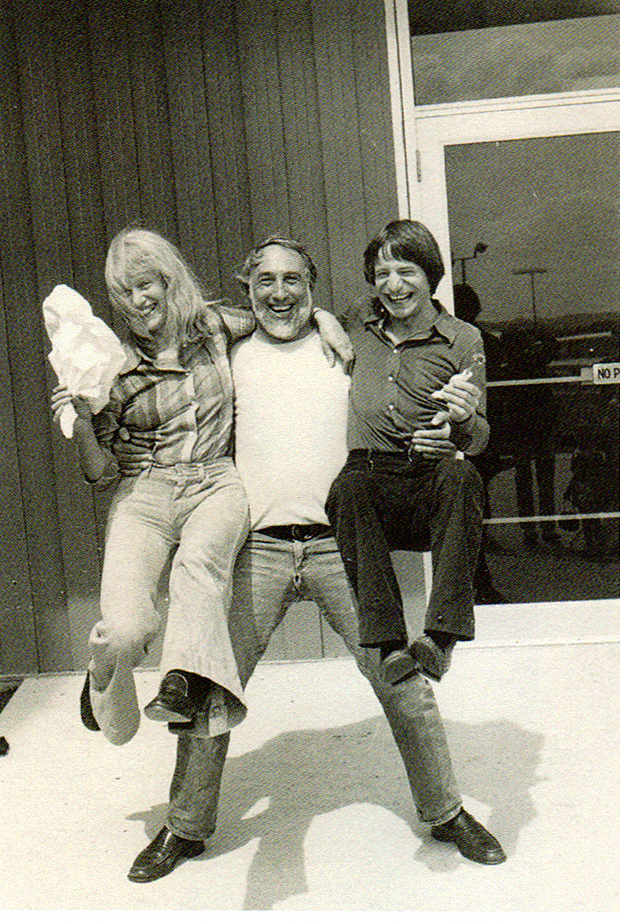
Your 3 Santas: Hovey Burgess (left), Mr. Clown (center), and yours truly
Here’s a Winter Solstice-Chanukah-Christmas-Kwanza-New Year’s present for you, a compilation of Santa’s favorite physical comedy acts. This year you’re being gifted self-contained acts, not physical comedy that’s part of a narrative, which is why there are no movie clips from Keaton, Chaplin, Lloyd, and the rest of the gang in your stocking. Sure, some of these 13 acts are from movies, but they were just snuck in there like whiskey in the eggnog to punch things up. So off we go, in no particular order. Happier holidays!
Larraine & Rognan
Her name is often listed as “Lorraine” but her actual name was Jean Larraine. Either way, she’s fabulous. If you’ve never heard of them, that’s because their career ended tragically in an airplane crash that killed him and left her with injuries too severe to continue dancing. You can read more about them in this previous blog post.
Walter Dare Wahl & Emmet Oldfield
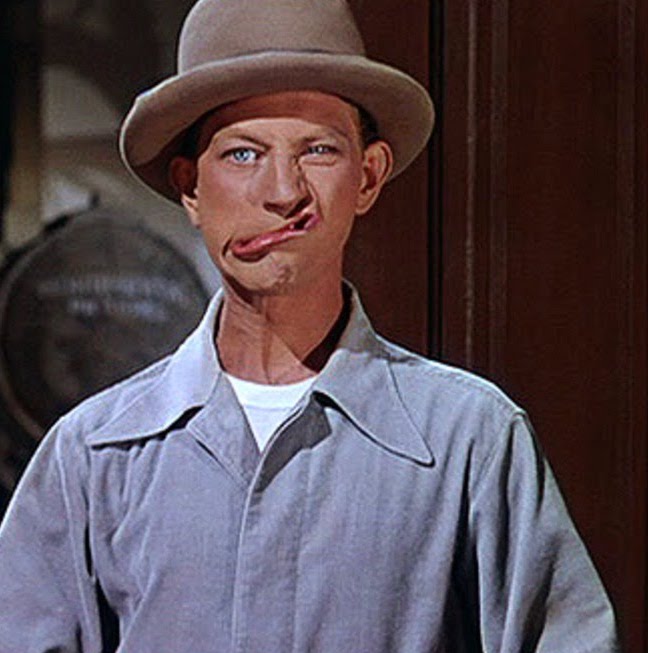
I love the movement imagination of these guys. So inventive! Donald O’Connor: Make ’em Laugh
You could make a case for this being the best physical comedy act ever. It’s got everything but the kitchen sink. I wrote a lot more about it here.
The Mathurins
HIgh-speed, high-caliber comedy acrobatics (even if the host says “it looks easy”). Not big on character, but boy do you get your money’s worth!
George Carl There are many versions of this amazing act available online, and I’m sure you’ve all seen at least one. Still, Santa would be remiss to leave him off the list.
Charlie Rivel: Comedy Trapeze
The legendary Catalonian clown could do it all. This is from the movie, Acrobat-Oh!
Red Skelton: Guzzler’s Gin (“Smooth!”)
Perhaps the classic drunk act. For more on Red Skelton, see my previous post.
Dick Van Dyke & Rose Marie: Mary’s Drunk Uncle
I came across this piece since I wrote this post and this postabout Van Dyke. As with Jean Lorraine, what I absolutely love here is Van Dyke’s back-and-forth between two states of being.
Beijing Opera: The Fight in the Dark
This one goes back centuries, but it’s a masterpiece of physical dexterity. This is the tradition Jackie Chan came from, and it’s easy to see the connections. Fifteen minutes long, and it’s not all comedy, but it’s great.
The Wiere Brothers
A recent discovery, which you can read all about here, and see lots more videos.
Lupino Lane with Lillian Roth (The Love Parade, 1929)
Lupino Lane was one of the great silent film comedians, although his characters never registered as strongly as those of Keaton or Chaplin. He was, however, every bit their match as a physical comedian. A member of the legendary Lupino family, with theatre lineage dating back to the pantomime days of Joseph Grimaldi, he was a superb dancer and acrobat. As it turned out, he could also sing and act well enough to survive the transition to sound. Lubitsch’s Love Parade, starring Maurice Chevalier and Jeanette McDonald, was one of the first good movie musicals, and it signaled Lane’s new career direction. Shortly thereafter he left Hollywood and returned to London, where he remained a star on stage and screen for decades. Lots more on Lane hereand here.
The Jovers (1980)
Here’s proof that you don’t have to be skinny and you don’t have to have 15 tricks in a row to do good physical comedy. (Not that there’s anything wrong with that!)
Alrighty then, that’s twelve, one for each day of Christmas, but let’s make this a baker’s dozen in honor of all the people who never bake the rest of the year but are churning out cookies for Santa while we lazily sit around watching these videos.
Wilson & Keppel
Long before Steve Martin’s King Tut, there was this sublimely silly sand dance performed by Jack Wilson, born in Liverpool in 1894, and Joe Keppel, born in Ireland a year later. Wilson and Keppel first performed together in New York in March 1919 as a comedy acrobatic and tap dancing act in vaudeville, and continued working together until 1963. Yep, that’s 44 years together.
Way back in the day, 1980 to be precise, when I was working with Joe Killian and Michael Zerphy, whenever we saw other performers do a bit we really liked, we’d say “consider it stolen!” I think the phrase originated with Joe, but he may have stolen it.
You know what they say, there’s nothing new under the sun, and that mostly holds true for physical comedy. I’m always amused, for example, when the Marx Brothers (or even Lucille Ball) are given credit for originating the broken mirror routine (Duck Soup), when in fact it not only appears in many early silent film comedies, but is referenced in even earlier reviews of vaudeville acts. Sure, there’s originality, but there’s a whole lot of borrowing going on and —if we’re lucky— creative reshaping of traditional materials.
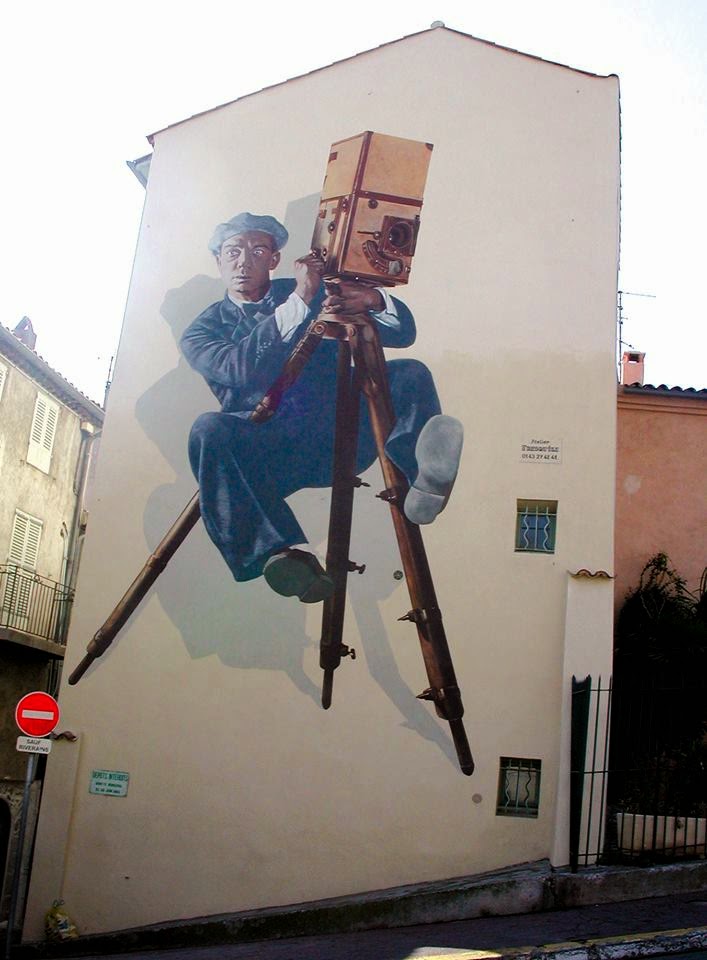
Keaton as The Cameraman
The historian-detective in me has enjoyed tracing this kind of thing, for example in this post on what I call the oblivious gag. My return to this theme is inspired by some excellent detective work done by silent film pianist and historian Ben Model, showing how Singin’ in the Rain (1952)borrowed from Buster Keaton’s The Cameraman (1928). But we’ll get to that juicy discovery a bit later…
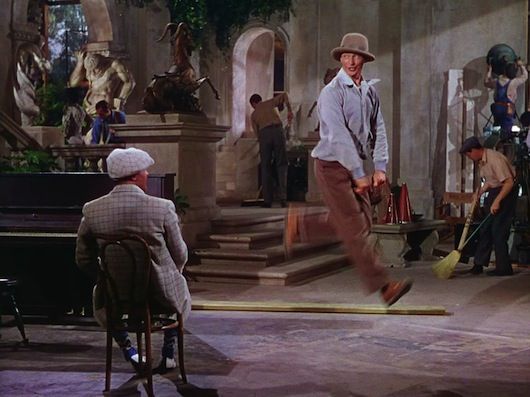
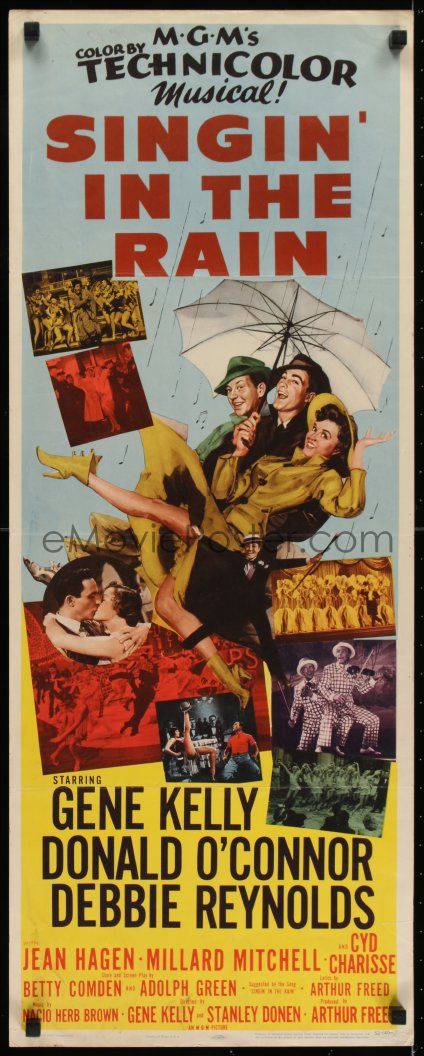
You all know Singin’ in the Rain, right? If not, you’re in for a treat! It’s a corny but delightful MGM musical from1952 starring Gene Kelly, Debbie Reynolds, and Donald O’Connor, all about the rough transition from silent film to sound. The remarkable thing about Singin’ in the Rain is that it began not as a story idea but as a musical woven around old songs, but also a musical partially woven around old physical comedy material.
The big musical link was Arthur Freed. As Cecil Adams points out in thisStraight Dope article, “Freed, the producer responsible for most of the MGM musicals of the 40s and 50s, began his career as a songwriter. “Singin’ in the Rain” was part of Brown and Freed’s score for MGM’s first “all talking, all singing, all dancing” musical, The Hollywood Revue of 1929. In 1952, Freed decided to use his own songbook as the basis for an original musical, as he had done with Jerome Kern’s songs in 1946 (Till the Clouds Roll By) and George Gershwin’s in 1951 (An American in Paris).”
They had Freed’s songs, might as well shape a show around them!
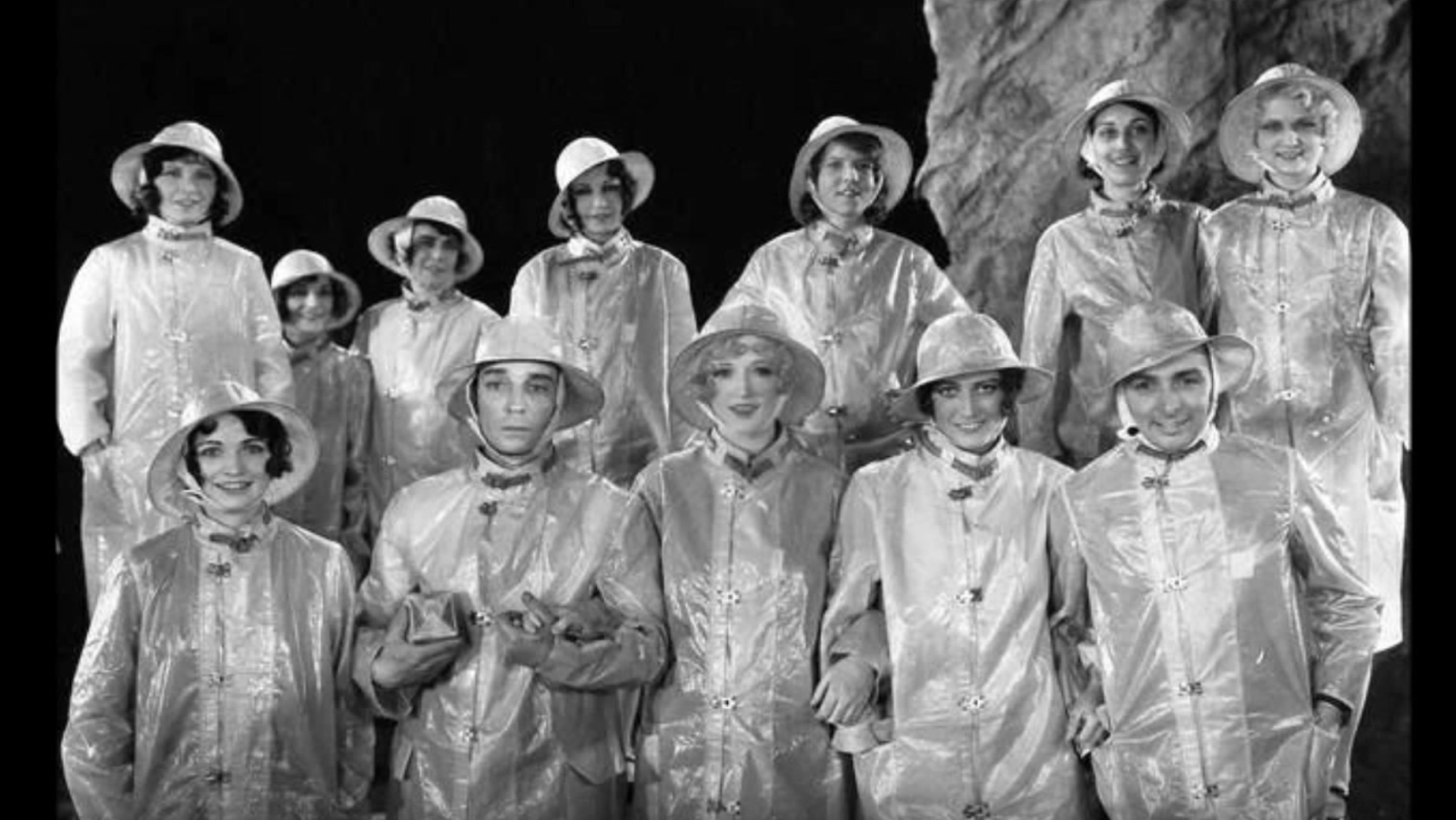
So the song Singin’ in the Rain goes all the way back to one of the two first big MGM musicals of the sound era, which featured “30 MGM stars! More Stars Than There Are in Heaven!” Here it is, the show’s big finale:
Not only did the songs come first, but the fact that they all came from the late 1920s gave screenwriters Comden & Green the idea for the story. According to this piece on the Cafe Songbook site, “Betty Comden and Adolph Green returned to M-G-M in May of 1950 to begin work on the screenplay for the movie they had been contracted to write, believing they were also contracted to write the lyrics for its songs. M-G-M clarified the terms of the contract to them. It was the studio’s option regarding the lyrics and M-G-M’s choice was that all the songs would be by the songwriting team of Arthur Freed (the film’s producer) and Nacio Herb Brown, his songwriting partner. Furthermore, they would be almost exclusively songs from their existing catalog. While looking at these songs, Comden and Green noticed that Freed-Brown songs such as “Should I?,” “All I Do Is Dream of You,” “Good Morning,” You Were Meant for me,” “You Are My Lucky Star,” “Singin’ in the Rain,” etc. were written in the late twenties which gave them the idea to create a story that came from that period; and the lynch pin of the plot they created was based on the disastrous results that sometimes occurred when silent screen actors and actresses were forced to talk on screen, to be heard no matter how awful they might sound.”
All these songs made it into the film, or should I say “made the film”?
Donald O’Connor
A Tale of Two Tunes
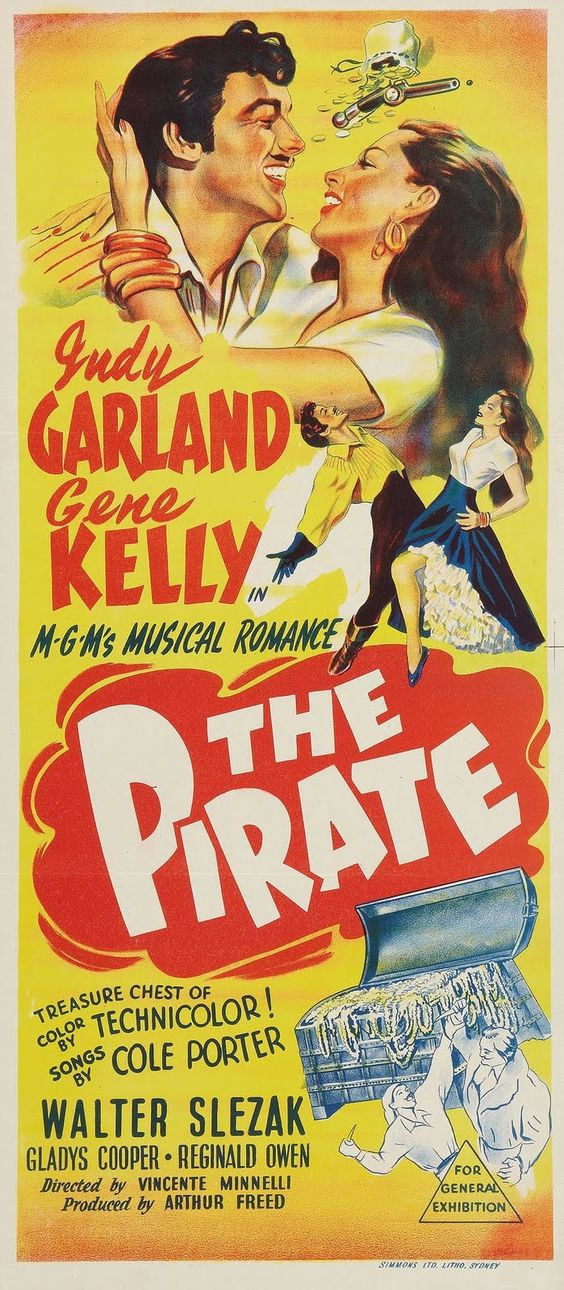
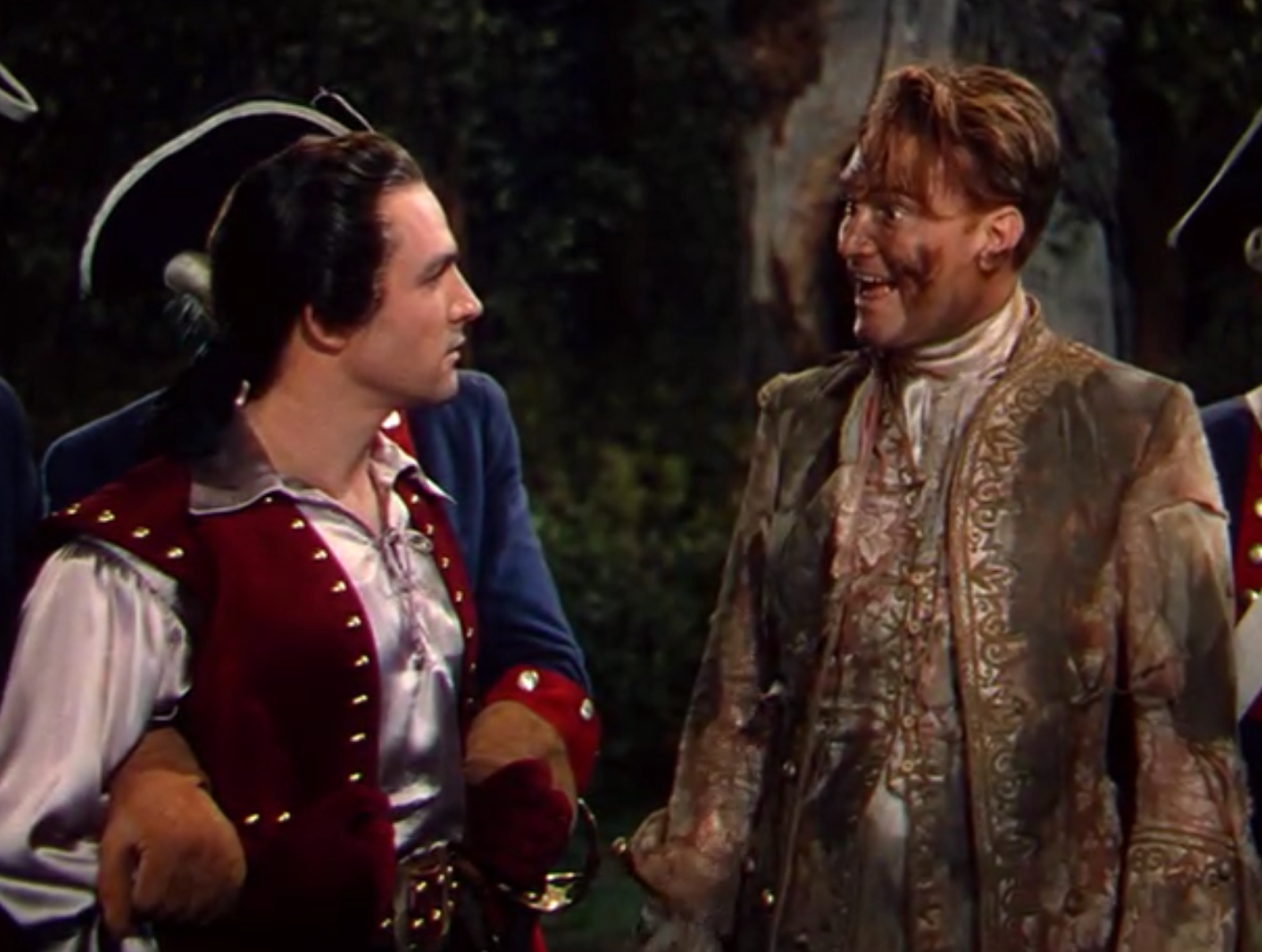
The film was coming together, but co-director Stanley Donen still wanted a solo number for Donald O’Connor, who played Gene Kelly’s comic sidekick and was a talented and very physical comedian. In fact, O’Connor’s parents were vaudevillians, his father an Irish-born circus strongman, dancer, and comedian, and his mother a circus acrobat, bareback rider, tightrope walker, and dancer. There was nothing in the Arthur Freed oeuvre that fit, but that didn’t stop MGM from doing some more borrowing. They just went back to an earlier MGM movie starring Gene Kelly, The Pirate (1948), and “borrowed” from Cole Porter instead.
Again according to Cecil Adams, “Donen suggested that Brown and Freed write a new song, pointing to Porter’s “Be a Clown” as the sort of thing he thought would fit in at that point in the script. Brown and Freed obliged —maybe too well— with “Make ‘Em Laugh.” Donen called it “100 percent plagiarism,” but Freed was the boss and the song went into the film. Cole Porter never sued, although he obviously had grounds enough. Apparently he was still grateful to Freed for giving him the assignment for The Pirate at a time when Porter’s career was suffering from two consecutive Broadway flops.”
Grateful, or simply too afraid of MGM’s power?
So that’s the background. Ironically, Kelly sang the original “Be a Clown” song, and in Make ’em Laugh, it is O’Connor singing to cheer up Kelly’s character. Here’s a short comparison, brief excerpts from each so you can see the similarity between the two tunes and the message.
But it’s not just the tune that was lifted. The Make ‘en Laugh lyrics directly paraphrase those of Be a Clown. Clever but barely disguised plagiarism:
In The Pirate, Kelly is about to be hung by his neck in the town square. O’Connor quotes what that immortal bard, Samuel J. Snodgrass, said “as he was about to be led to the guillotine.”
While O’Connor’s dad advised him to “be an actor my son, but be a comical one,” Kelly was only three when his “clever” mom told him “I’ve got your future sewn up if you take this advice: be a clown, be a clown.”
And why go into the funny business? Because you’ll get rich, unlike in those other more effete professions. Kelly’s mom asks him “Why be a great composer with your rent in arrears? Why be a major poet and you’ll owe it for years? A college education I should never propose. A bachelor’s degree won’t even keep you in clothes.” Likewise, O’Connor’s dad warns him that “you could study Shakespeare and be quite elite, and you could charm the critics and have nothing to eat.”
But if you’re funny, what happens? Kelly is promised a bright future where he’ll “only stop with top folks” and “he’ll never lack” and “millions you will win.” O’Connor likewise will have “the world at your feet.”
Okay, sounds good. But what does it take to be funny? Kelly’s clown is instructed to…
• show ‘em tricks, tell ‘em jokes
• wear the cap and the bells
• be a crack Jackanapes
• give ’em quips, give ’em fun
• act the fool, play the calf
• stand on your head
• wiggle your ears
• wear a painted mustache
• spin on your nose
• quack like a duck
O’Connor’s comical actor must…
• slip on a banana peel
• [perform] old honky-tonk monkeyshines
• tell ‘em a joke, but give it plenty of hoke.
• take a fall, butt a wall, split a seam.
• start off by pretending you’re a dancer with grace, wiggle till they’re giggling all over the place, then get a great big custard pie in the face
The actual acts differ more than the lyrics because they are structured around the individual talents of the performers. “Be a Clown” actually is done twice in The Pirate, first with Kelly and the fabulous Nicklaus Brothers, and is later reprised by Kelly and Judy Garland. In both cases, it’s a partner number with more of a dance base to it. O’Connor, on the other hand, is both a better comedian and a far more skilled acrobat. The result, one of the greatest physical comedy acts ever, became his signature piece.
Here are the complete versions. Enjoy!
Be a Clown #1 (Kelly & the Nicklaus Brothers)
Be a Clown #2 (Kelly & Judy Garland)
Make ’em Laugh
The Plot Thickens
Keaton & Josephine the
monkey in The Cameraman
But that’s just the beginning! As I said at the top, this blog post got jump-started by Ben Model unearthing a less obvious and even more fascinating Singin’ in the Rain borrow. And this one is all the juicier because it involves our hero, Buster Keaton.
Take it away, Ben…
Wow! Like I said, great detective work. And as if that wasn’t amazing enough, think back to the original version of the song from The Hollywood Revue of 1929. In that cavalcade of stars, did you notice the one luminary who couldn’t / wouldn’t have “a smile on his face”? Yep, that’s “the great stoneface” himself at the 39-second mark.
The one thing I would add to Ben’s chronology is that in the years before Singin’ in the Rain (1952), Keaton was an uncredited gag writer for a bunch of MGM movies, including the Marx. Brothers, but especially a slew of Red Skelton vehicles, right up to his 1950 Watch the Birdie, which was partially a remake of The Cameraman, and two more 1951 Skelton films. So if Keaton wasn’t directly consulted on Singin’ in the Rain, he was certainly still a presence at the studio. It was also in 1950 that his appearance on the Ed Wynn Show led to a lot of work on early television and made him less dependent on the Hollywood film industry.
Kelly & Skelton in Du Barry Was a Lady
And speaking of Red Skelton…
A talented pantomimist, Red Skelton, like Keaton, had grown up in show business, performing in medicine shows at the age of ten, and later burlesque and vaudeville. Keaton’s work with him in the 1940s would be enough to fill another blog post (don’t get me started!), but there are a couple of possible links between Skelton and Singin’ in the Rain. Gene Kelly’s “Broadway Ballet” fantasy sequence was apparently based on an idea that was used for MGM’s Du Barry Was a Lady (1943), starring Skelton as a nightclub worker who dreams that he’s King Louis XV. And who was his romantic rival for Lucille Ball’s affections in that one? Gene Kelly, natch. (And before the film, it was a Broadway musical starring Bert Lahr chasing Ethel Merman.)
But even more interesting than that is the similarity between some of Skelton’s pratfall moves from Du Barry and those of O’Connor, as seen in this comparison video. In the first part, Skelton and friend think they have tricked Gene Kelly into downing the drink with the Mickey Finn, but (of course!) the glasses have been switched, which leads to Skelton’s wonderful drunk pratfall sequence. Skeleton is drunk, O’Conner is giddy, but the writhing around and the circular movements when on their side on the floor are strikingly similar.
Did O’Connor borrow this? Who knows? —but not necessarily. It’s just as likely that these moves were standard fare. After all, the 108 pratfall was also common property (if you could do it!). Still, you need someone to preserve the vocabulary, and in the yakkety-yak-yak 1940s, that someone may well have been Red Skelton.
Of course, once you start making these connections, it’s endless —ancestry.com run amok— so I’ll stop the narrative here and just leave you with a few tidbits for dessert…
• When they made the biopic The Buster Keaton Story in 1957, can you guess who played Keaton? Dramatic pause. Are you really guessing? Space filler. Space filler Space filler. More space filler. Even more space filler. Yep, Donald O’Connor. This stuff’s downright incestuous.
• Trav SD points outthat Singin’ in the Rain producer/songwriter Arthur Freed wrote material for the Marx Brothers’ act and performed in their sketches way back in their vaudeville days.
• As for the Nicklaus Brothers, according to Wikipedia “this dance sequence was omitted when shown in some cities in the South, such as Memphis, because it featured black performers the Nicholas Brothers, Fayard and Harold, dancing with Kelly. It was the first time they had danced onscreen with a Caucasian, and while it was Kelly’s insistence that they perform with him, they were the ones who were punished. Essentially blackballed, they moved to Europe and did not return until the mid-60s.”
• Kevin Kline does his own version of “Be a Clown” in the 2004 Cole Porter biopic, De-Lovely. Interesting enough and a much bigger production number.
• In 2006 or so, Volkswagon did this commercialwhere they remade Gene Kelly’s dance in the rain, using his face and choreography but a break dancer’s body and moves. Very interesting!
• Anthony Balducci, whose Journal blog I highly recommend, has an excellent pieceabout gag borrowing/ stealing, with some interesting comparisons between the tv work of Ernie Kovacs and the sketches of the British comedy duo Morecambe & Wise.
• Braggedy-brag-brag, but my personal show-biz DNA intersects with several of the performers mentioned here:
—My first acting job was just days past my 7th birthday, a skit with Skelton and Jackie Gleason on the Red Skelton Show. Skelton had worked extensively with Keaton, and Keaton had done a version of clown Sliver Oakley’s classic one-man baseball pantomime in The Cameraman. The skit I did with Gleason & Skelton was —yep!— about a baseball game. Also, around this time, Skelton did some research for creating his Freddie the Freeloader tramp clown. He visited Coney Island and studied the clown Freddy the Tramp, later “borrowing” some of his bits for his new character. Freddy the Tramp was the father of my long-time clown partner, Fred Yockers. When Fred, Jan Greenfield, and I started the First NY International Clown-Theatre Festival in 1983, Skelton agreed to be honorary chairperson, though we never actually got to speak with him.
—Keaton was on the Ed Wynn Show in 1950, and I was on a tv show with Wynn about nine years later. (There’s no way telling which of us Wynn preferred working with.)
— In The Pirate, the great character actor Walter Slezak played the town mayor who (spoiler alert!) is really the pirate Macoco. In 1958 I acted with Slezak on “Beaver Patrol,” a comic drama on the U.S. Steel Hour about an eccentric New York uncle who visits relatives in Beverly Hills, takes over a scout troupe, and teaches the spoiled rich kids gritty New York City stuff. Yes, I’m the one looking at the camera. I do remember Slezak as being very affable and a pleasure to work with.
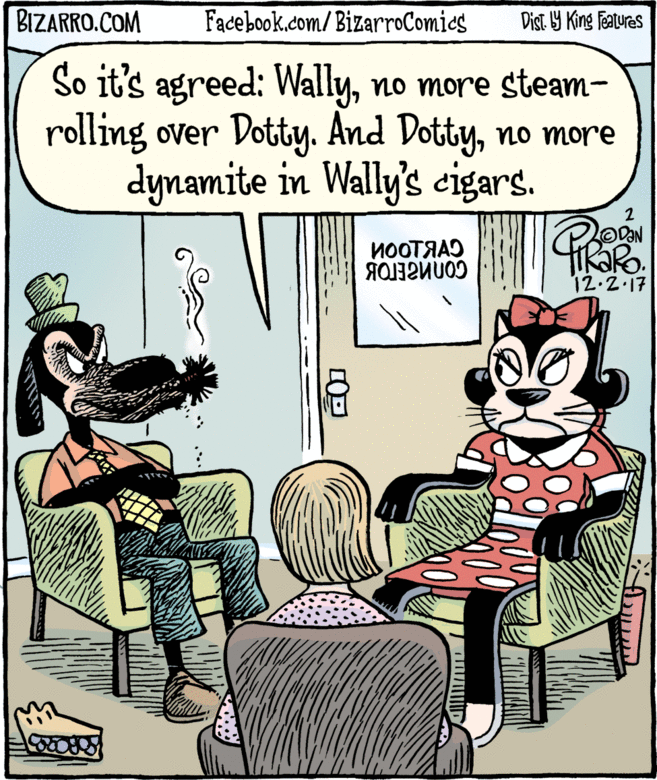
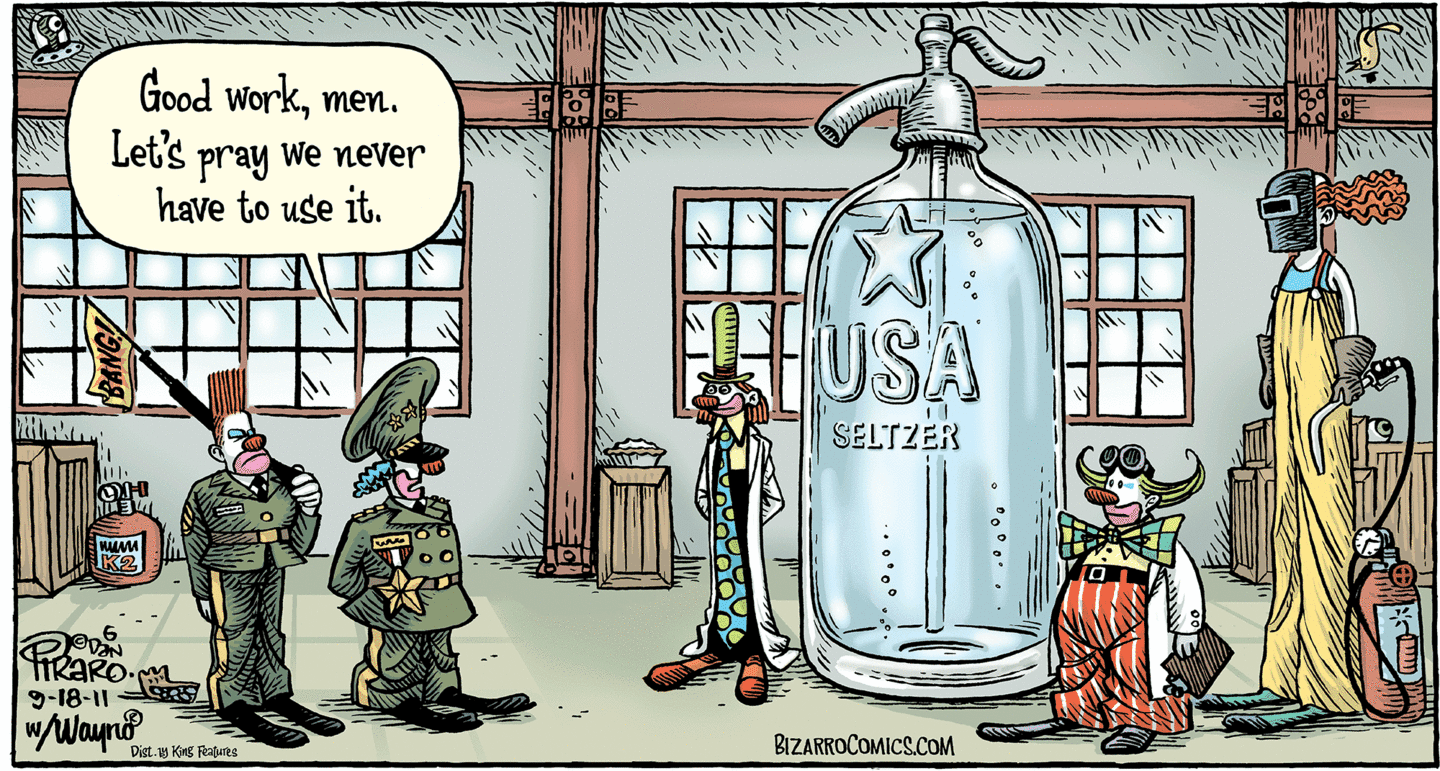
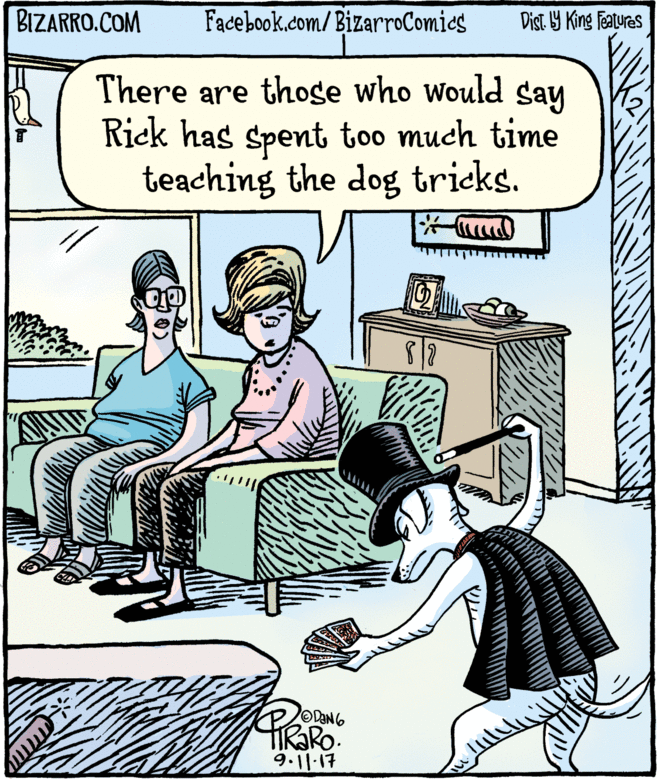
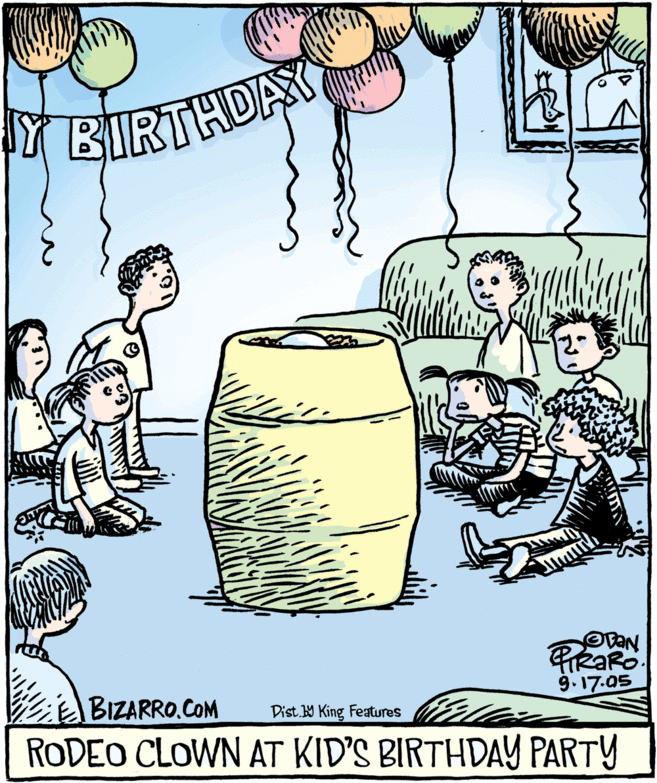
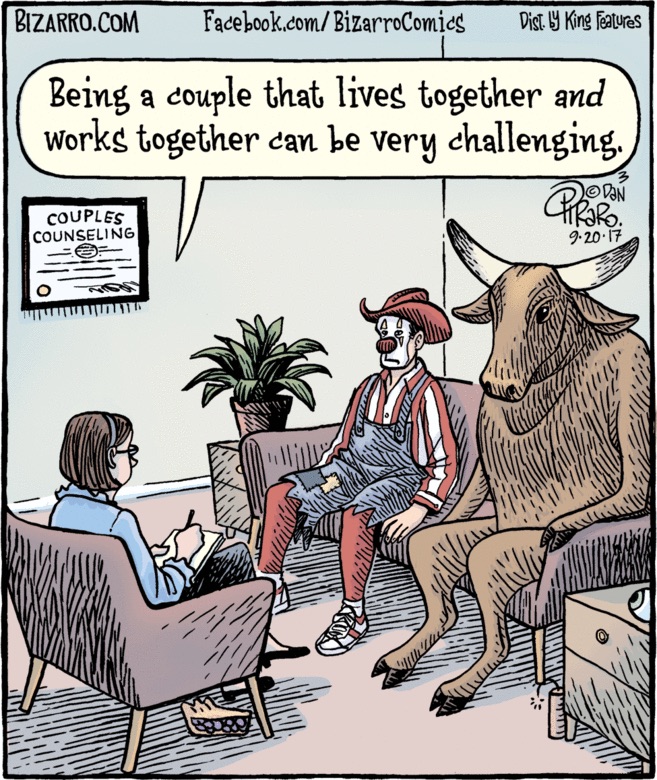
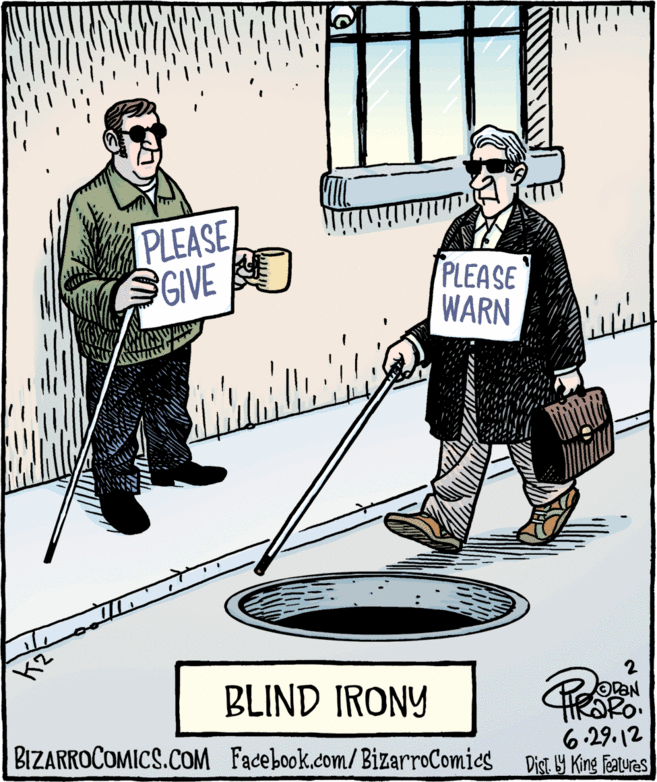
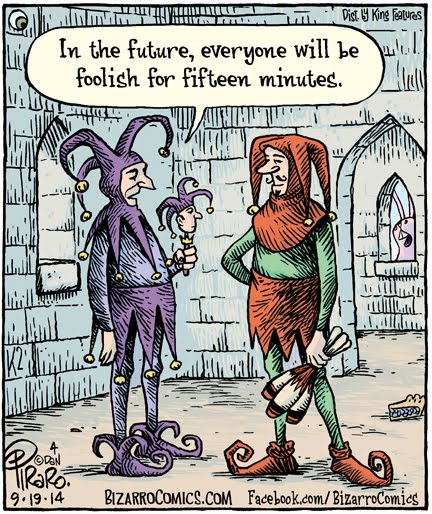
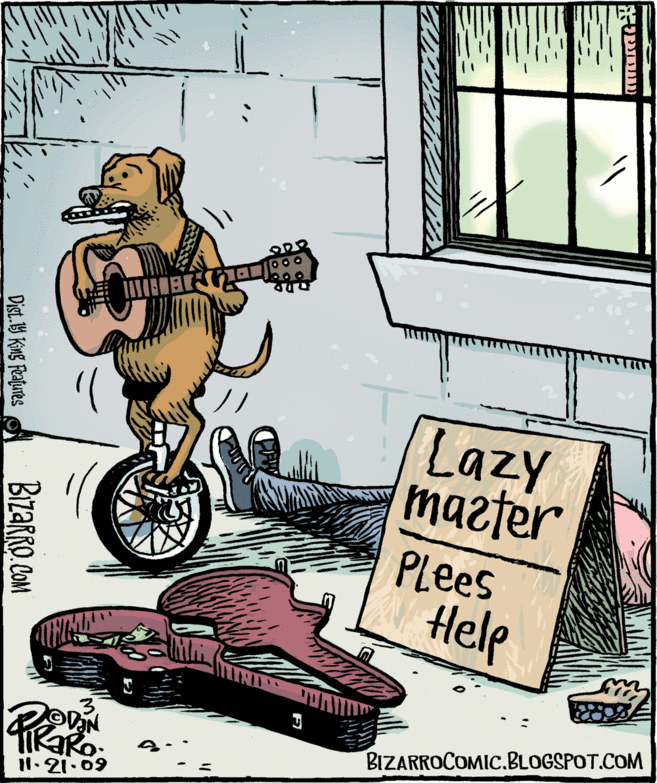
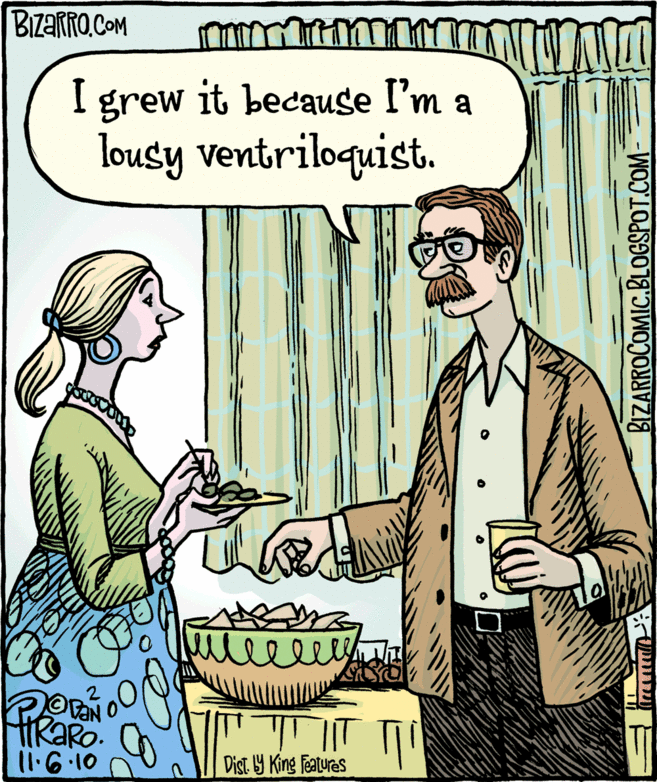
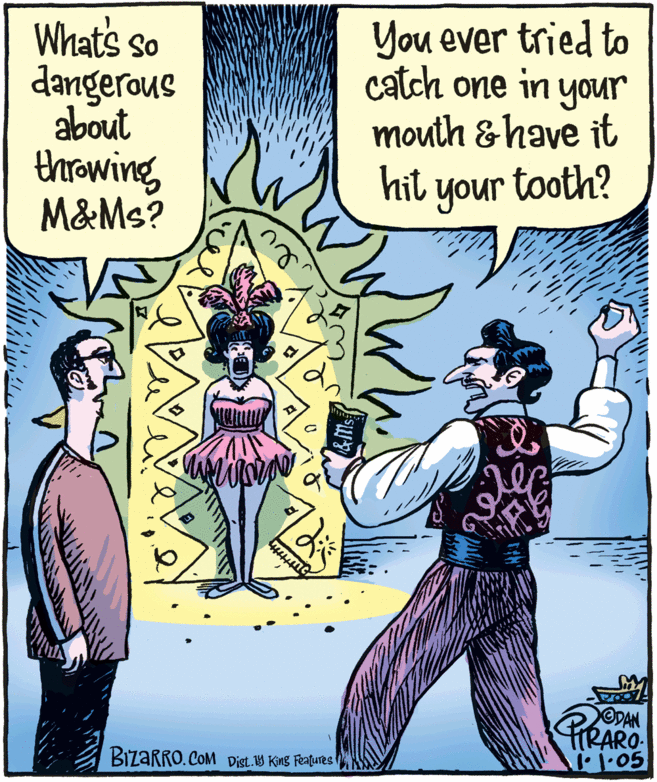
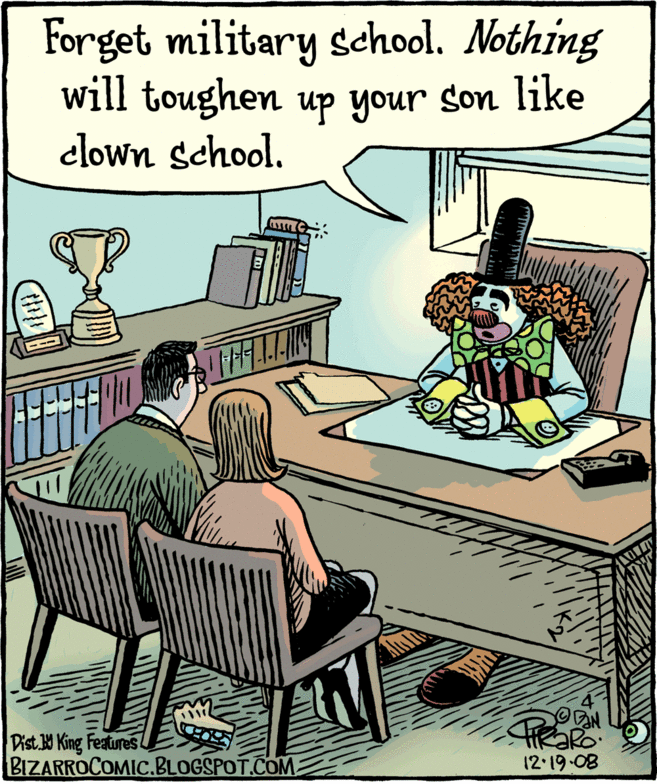
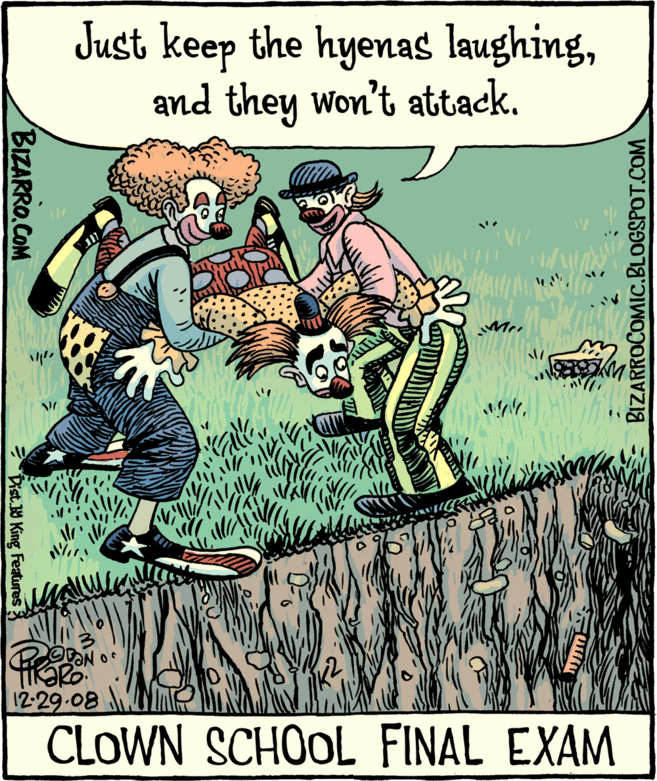
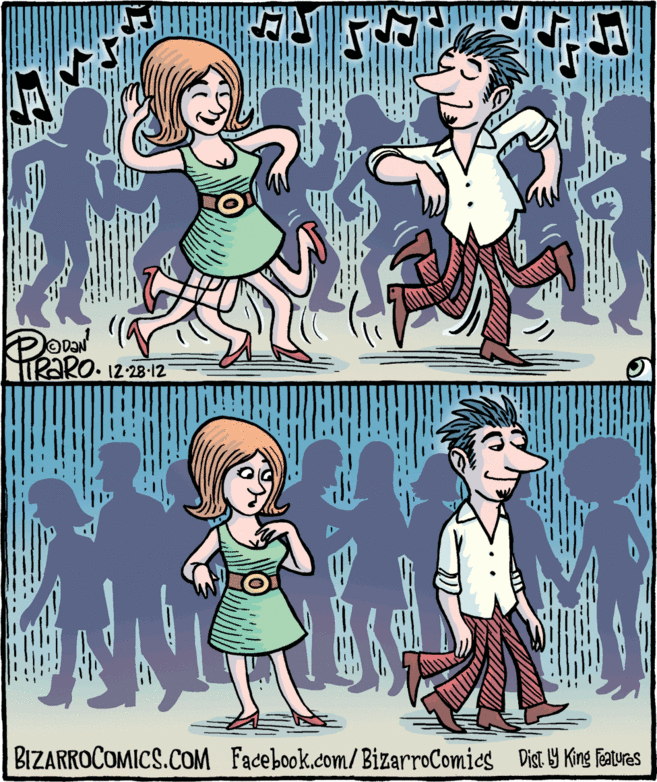
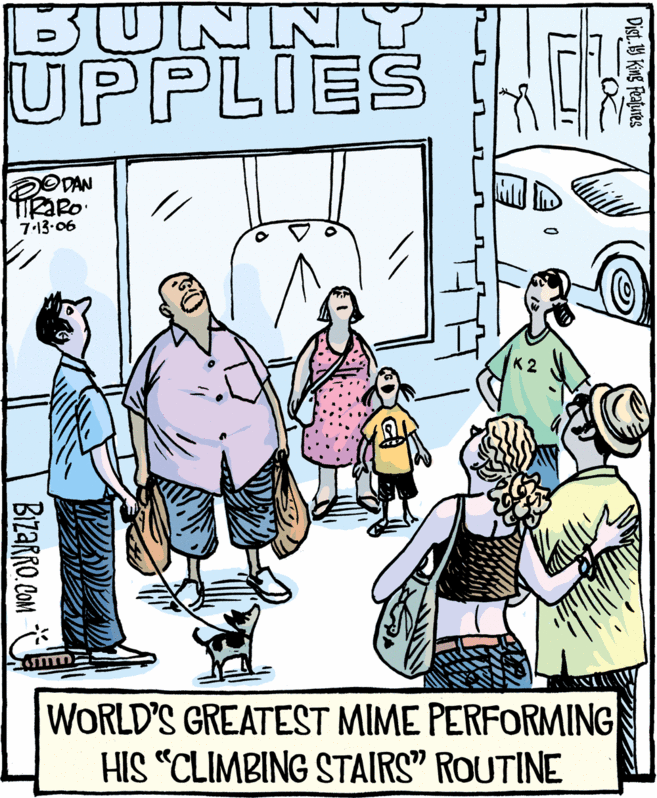
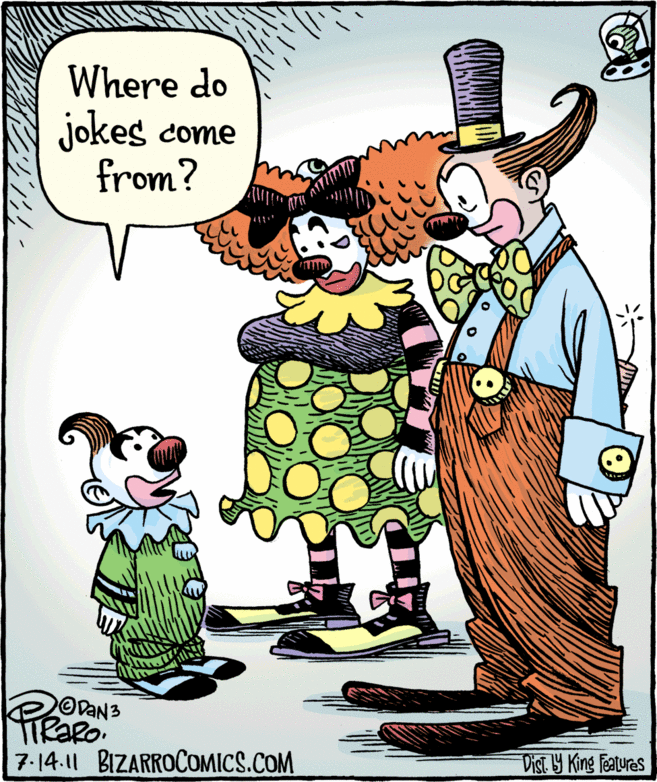
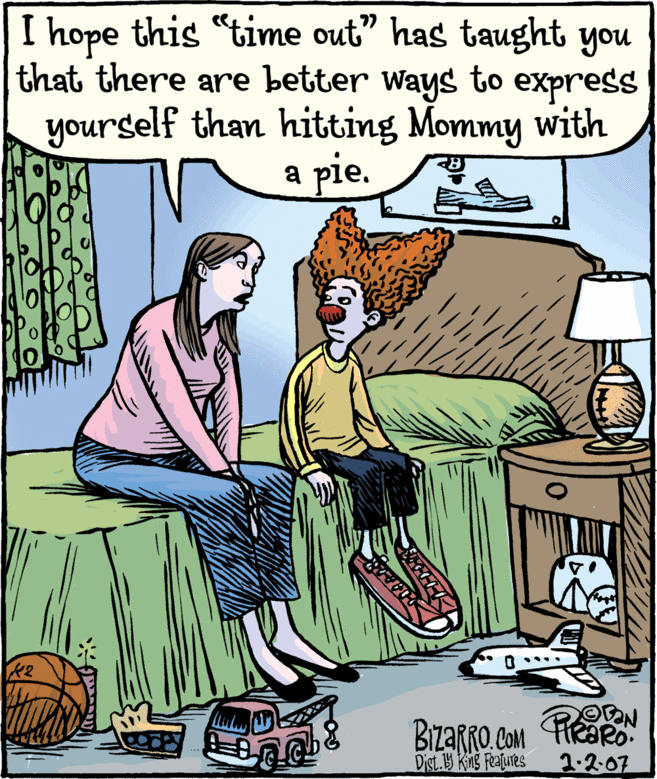
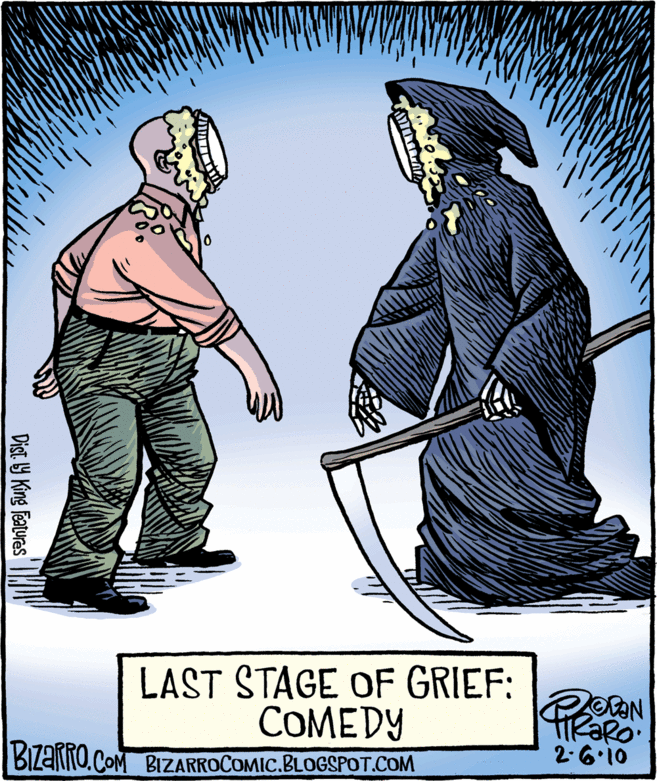
I collect cartoons —even wrote a book that had some great ones! Of course, I collect those that have something to do with physical comedy, directly or indirectly. One of my favorite cartoonists is Dan Piraro, whose Bizarro strip is consistently funny, on a daily basis no less. He seems to have a special interest in clowns and variety performers. Many of his cartoons are based on clichés —the clown car, the custard pie in the face, balloon animals, etc.— but a good number of them are still pretty damn funny. Here are some of my favorites. Enjoy!
For more cartoons on this blog, just enter “cartoons” in the search window at the top of the page and you’ll find lots of past compilations!
The Wiere Brothers (previous post) are a hard act to follow. It’s like when my clown partner Fred Yockers and I were in the Hubert Castle Circus and had to go on after the boxing kangaroo.
Fuhgeddaboudit!
But still, the Three Loose Screws are part of the same eccentric comedy tradition as the Wiere Brothers, and are a whole lot of fun, what with their rapid-fire medley of fancy footwork, one-liners, and slapstick acrobatics. Now that I think about it, they’re also part of the same comic tradition as that boxing kangaroo.
It was in fact while researching the Wiere Brothers in the British Pathé collection that I stumbled upon this other screwy trio, filmed for archival purposes without a live audience. The two videos I found are all I know about them, period. The Great God Google has much to say about a California company of the same name that specializes in corkless wines, and likewise lists current prices and vendors for actual loose screws, but all it knows about our unsung heroes is that they appeared in a panto Cinderella in the 1939-40 Christmas pantomime season. So, no, I don’t know the names of the performers or anything else about their career, but at least we have this six minutes of footage.
Yes, that’s where it ends.
Once again a (slightly belated) shout out to the person(s) at British Pathé back in the 1930s who had the idea to archive all those brilliant variety artists. What a treat! And if anyone has more info on these guys, I trust you’ll send it my way.
When I want to sound old, I like to tell the youngins about how it wasn’t always quite so easy to study the work of the classic physical comedians. I’m talkin’ back in the day, before YouTube, before the internet, before DVDs and CD-ROMs, yes even before our obscure heroes showed up on VHS. Yep, in the 1970s, we’d have to wait for one of the movie revival houses in Manhattan to run an annual festival of the works of Keaton or Lloyd or Chaplin. We’d go to the Elgin (now the Joyce) and study Keaton’s shorts like the Holy Grail. And when I say we, I mean it seemed like half the clowns in NYC were in the audience, worshipping and taking notes.
Nowadays so much of our great tradition is at our fingertips, although a lot of young performers remain inexplicably, almost willfully, ignorant of most of it. But the best thing is that there are constant discoveries of great work from the vaudeville stage, silent film, the circus ring, and early television. Film footage sits in archives and private collections unnoticed, only to resurface decades or even a century later. It’s almost as if we’re living in 1917 and experiencing the original release of these works.
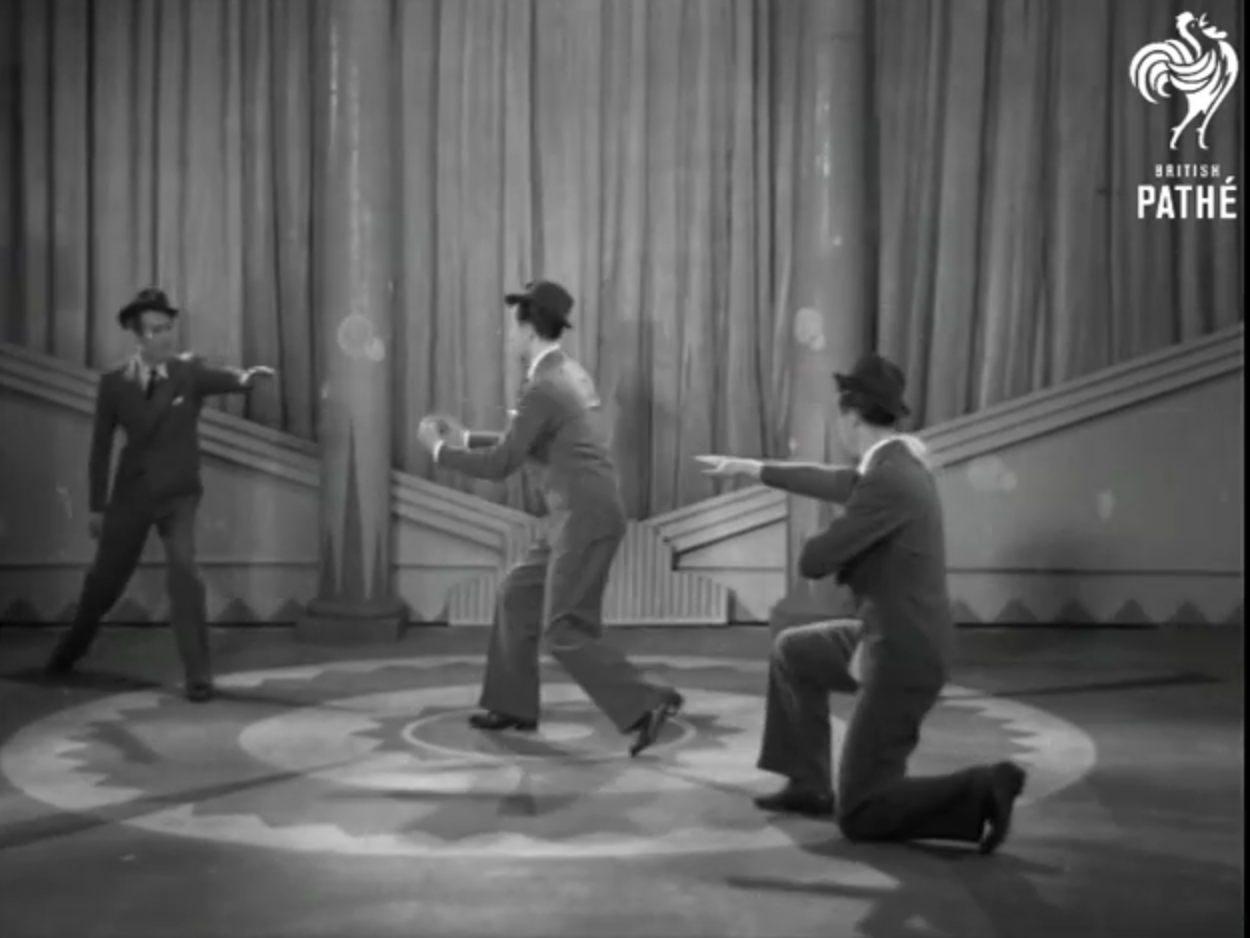
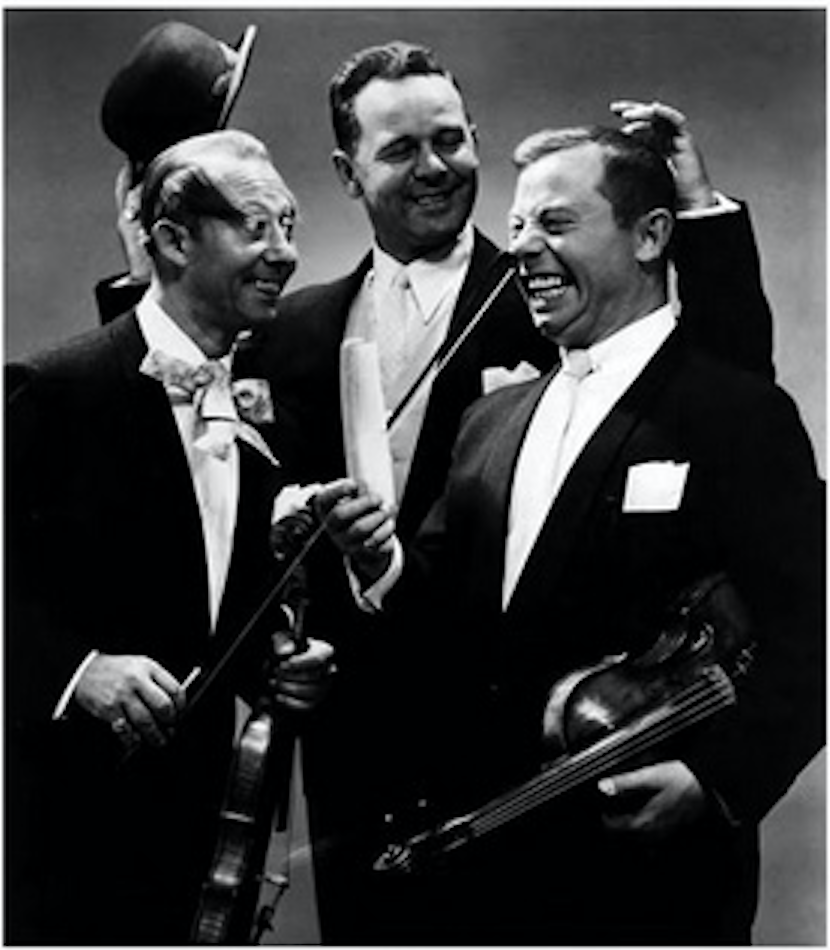
Which brings me to a new find, not quite so ancient, but decidedly vintage. And brilliant. Wolfe Browart turned me onto the Wiere Brothers, thank you very much, and I liked them so much I had to do me some more snooping. They were Harry Vetter (1906–1992), Herbert Vetter (1908-1999), and Sylvester Vetter (1909–1970). Growing up in a show business family in Central Europe, they first performed together in the 1920s and became a big success on the variety stage. In 1937 they moved to the U.S. to escape the deteriorating situation in Europe, and it was thanks to their appearance here in a handful of movies and tv variety shows that we can still enjoy their work. Before I retrace their career for you, here’s part of a performance from 1951 to get you started.
As you can see, we might label them “eccentric comedians.” They are certainly part of the semi-absurdist “crazy comedy” tradition most often identified with the Marx Brothers, but well represented as well by the Ritz Brothers, the Slate Brothers, the Runaway Four, Olsen & Johnson (Helzapoppin‘), and the British Crazy Gang, with a thru-line from there to the Goon Show, the Benny Hill Show, and Monty Python (minus a lot of the physicality, alas).
This combination of dry wit, eccentric dance, and hat manipulation can be seen in everything they did, but as you will see they grew as comedians over the decades without losing any of their physical chops. Most of the clips I’ve gathered repeat many of the same bits, but there are enough new wrinkles to warrant this little retrospective.
The earliest clip I have of the brothers is from July, 1931, a time when British Pathé was producing a series of film shorts, including documenting variety acts—thank you very much!— by filming them in their studio. There was no audience for these shoots, which makes any comedy act kind of strange, but at least we have the footage.
Also from Pathé, here they are two years later as “The Treble Tappers.”
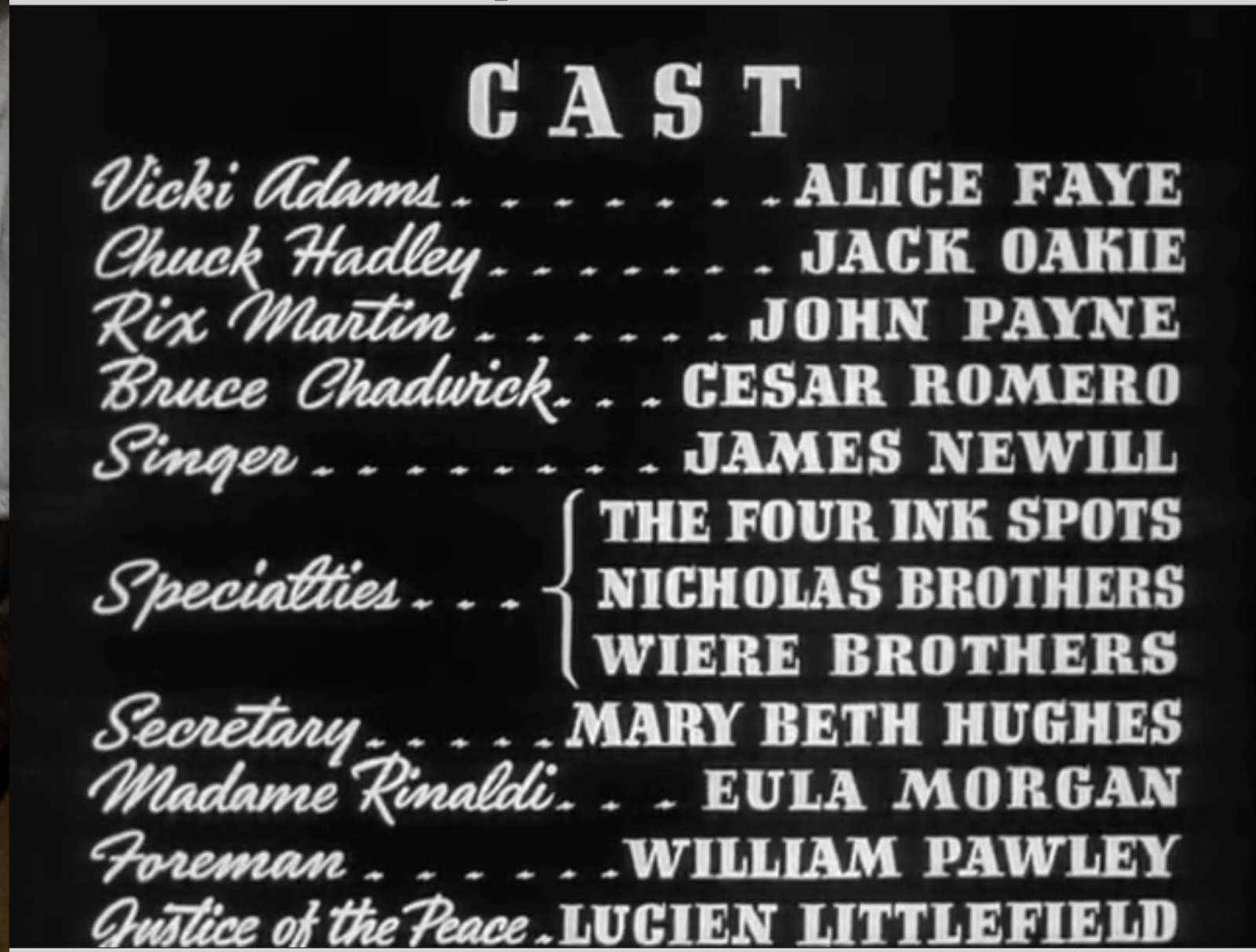
After coming to the U.S. in 1937, they were seen in two films that year, Variety Hour and Vogues of 1938 (later re-released as All This and Glamour Too!), but I haven’t been able to find copies of either. But four years later they appear in The Great American Broadcast as one of the “specialties” alongside the equally amazing (but better known) Nicholas Brothers and the Four Ink Spots. The two Wiere Brothers numbers in the movie show just how far they had evolved as comedians. Here they are as “The Stradivarians.”
And from the same movie, a very clever musical spoof of a cheese commercial. It being a radio commercial didn’t stop them from doing a couple of visual gags!
These guys are funny, right?
Others may have noticed as well, which would be why they were cast in actual roles in Road to Rio (1947) as musical sidekicks to Bob Hope and Bing Crosby. I admit to not yet having watched every minute of the movie, but Hope and Crosby are stranded in Rio and are desperate to sell their “American” musical group to the local night club, even if they have to pretend that the Wiere Brothers are American. The brothers were actually born in Berlin (Harry), Vienna (Herbert), and Prague (Sylvester), but here they are Spanish-speaking musicians —I guess this was before Brazilians started speaking Portuguese— who don’t speak English but are supposed to. The hiring scene:
The whole language thing doesn’t go too well:
And now my favorite scene! Bob, Bing, and the boys are unceremoniously booted out, which leads to this wonderful hat scene that deftly showcases the comedic talents of all the performers, (Play all the way to end!)
Throughout these years, the brothers were headlining at night clubs across the land, but their next recorded performance looks to be this one on the Ford Festival television program in 1951. The finale of their act is what I showed you in the clip at the top of this post (the one-minute waltz), but here’s the whole appearance:
The fifties and sixties saw appearances by the brothers in a variety of tv variety shows, including Colgate Comedy Hour, Ed Sullivan (twice), Perry Como, Dinah Shore, Gary Moore, Hollywood Palace, and Laugh-In, as well as in an Elvis Presley movie. Here they are with Jerry Lewis, reprising many of their old bits.
Intriguingly, in 1960 they were given their own tv show. Only thirteen episodes were filmed, and these weren’t broadcast until 1962. Other than this opening-credit clip, I haven’t found any trace of this, not even at the Paley Center (museum of broadcasting). Unfortunately, it is likely that any kinescopes have long since been discarded or copied over.
The act broke up after Sylvester died in 1970 —after nearly a half-century in show business—but Harry and Herbert lived into the 1990s.
If I (or you!) ever find anything more worth sharing, there’ll be another post!
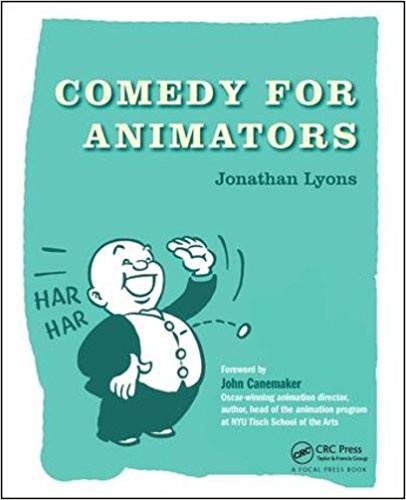
Book Review: Comedy for Animators by Jonathan Lyons
Most clowns I know love cartoons, often having the same reverence for Daffy Duck and Bugs Bunny that they have for Charlie Chaplin and Buster Keaton. Comedy animators have borrowed a lot from the (human) physical comedy tradition, but there’s a lot we can learn from animation. And a good place to start is the creative and historical work of Jonathan Lyons.
Jonathan has worked for over 25 years both in traditional animation and 3D, with an array of impressive credits that include the first four Pirates of the Caribbean films; Pillsbury Dough Boy commercials; two Clio awards while working at Industrial Light & Magic; his own independent films featuring Floyd the Android; and much much more. He has taught animation at the university level and for years has authored a blog, Comedy for Animators, which you should dive into headfirst at your earliest convenience.
________________________
“To get laughs with animation, you have two choices. Gags and jokes. A gag is intended to create laughter with visual humor. A joke uses words for the same purpose. Tex {Avery} was right, gags are hard to come by, requiring considerable time to develop and integrate into the action in a natural way. American television animation has relied on verbal jokes because they are far more efficient in production. A group of writers can sit around in a room and pitch storylines, then fill in some jokes, and before you know it the script is ready and there is only limited expectation on the artist to make it look good. Visual gags require much more time to invent, develop, and work into action. Jokes don’t really affect the storyline, whereas visual stunts will physically change the situation for the characters. Gags need careful timing and acting, which require more time than lip-synching words… One aspect of visual comedy does make it easier, though. A joke heard once is used up, whereas a good sight gag can be successfully recycled.”
________________________
Jonathan’s blog led to the book of the same name, which is targeted for animators who know how to draw funny characters but don’t understand the craft of physical comedy. Thus there are chapters on characterization, comedy teams, context, gags, and storytelling structure. Not all of this is new, but it is pulled together with a unique slant and analyzed with the precision of a creative artist who uses these concepts day to day and not that of an academic on the outside looking in. The book should be an essential source not only for animators trying to tell stories through images, but also for the readers of this blog engaged in live performance. Jonathan offers strong insights for performers telling stories through their own extreme physicality, making very useful connections between live action and animated movement. Highly recommended!
You can buy the book here
and check out his web site here.
And if you want proof that Jonathan knows his stuff, just check out these videos…
his demo reel
one of his Floyd the Android short films
And here are two wonderful video compilations Jonathan has put together analyzing physical comedy:
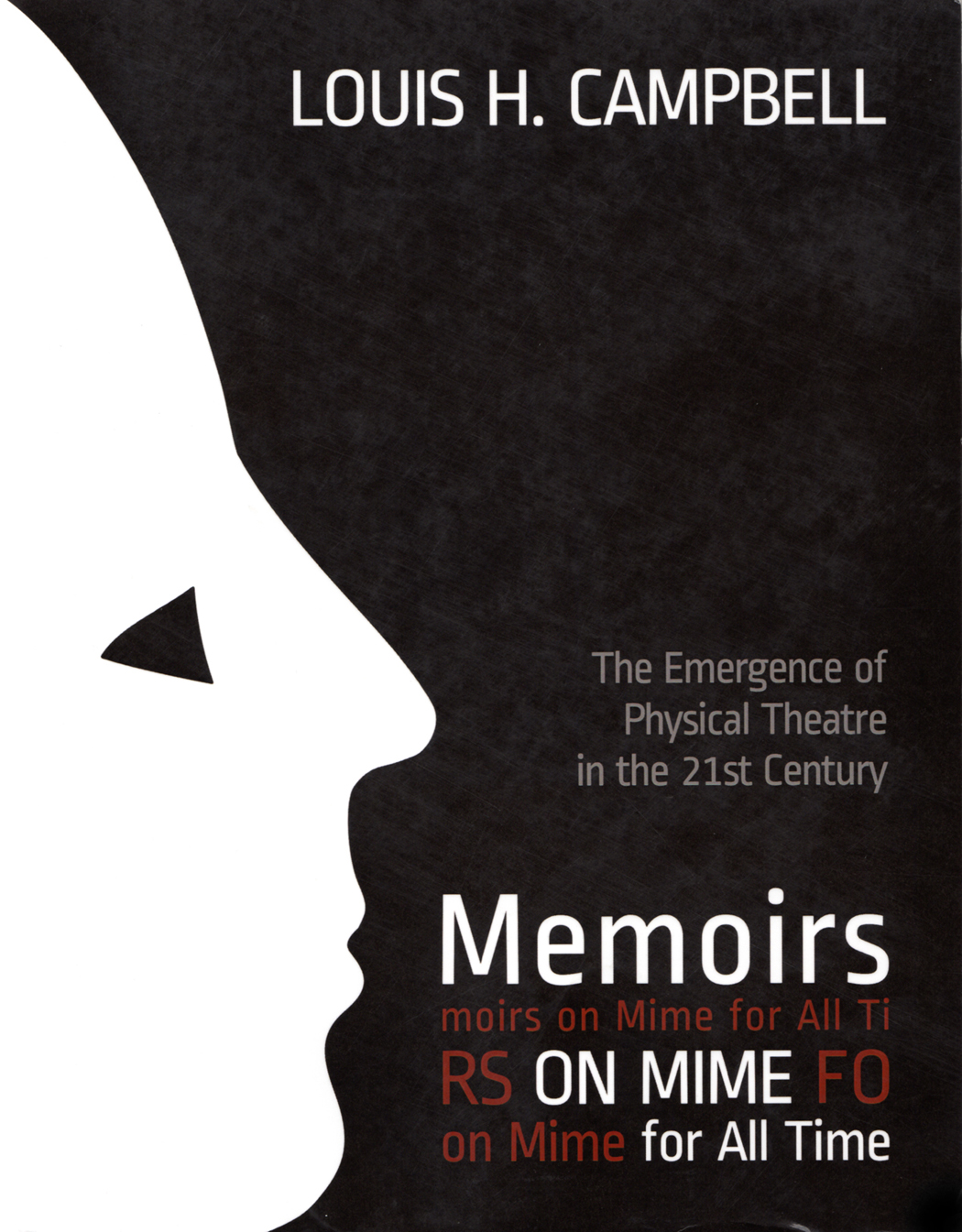
“Memoirs of Mime for all Time –The Emergence of Physical Theatre in the 21st Century” by Louis H. Campbell [Michael Evans is author of the book “The Great Salt Lake Mime Saga and Amsterdam’s Festival of Fools.” He graduated from art school, but spent a long career as an engineer and technician in private industry, higher education, theatre, and the arts. He is webmaster for the Cosmic Aeroplane Archive Site, about the early history of Salt Lake City’s still-vibrant Alternative Culture.]
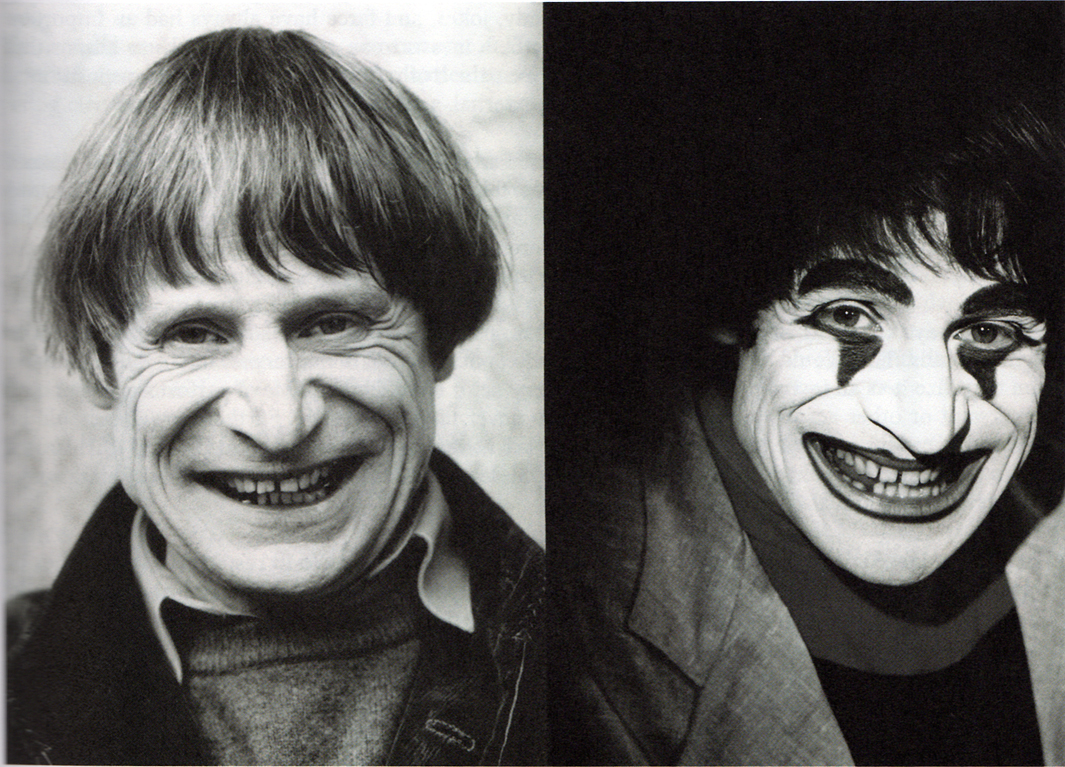
Lou Campbell
Dr. Louis Campbell is a teacher and theatrical director who has published about eighteen other books —all except one outside the field of physical theatre. Dimitri Mueller’s death at the age of 80 was my main impetus for undertaking this review. I acquired a previous version of this book in the 2000s and promised to write about it. Some very positive theater-related travel interfered with completing the project. The experience of writing my own book also modified my point of view of what it takes to publish these sorts of things.
Dr. Campbell’s book relies on dozens of names. I’ve chosen to review it according to its overall structure, keeping these metaphorical eggs in their cartons, and making the context clear.
Diversity in Mime Terminology
This chapter has only six pages but many viewpoints. It features a lot of names and matches them with quotes and concepts, so we might as well start this review with a baker’s dozen personalities encountered in the book: Etienne Decroux; Ladislav Fialka; Louis Dezseran; Yass Hakoshima; James Donlon; Claude Kipnis; Bob Francesconi; Tony Montanaro; Jacques Lecoq; Mamako Yoneyama; Adrian Pecknold; Richmond Shepard; Bari Rolfe; David Alberts; Antonin Hodek; and Geoffery Buckley, who states: “Mime is a very loose word.”
Major Influences and Solo Acts
Substantial historical sketches make this section a valuable resource on its own. There are also quotes, explanations, and anecdotes galore, along with a few references to other theatrical figures including: Isabella Canali Andreini (1562-1604); Joseph Grimaldi (1779-1837); Jean Gaspard Debarau or Debureau (1796-1846); François Delsarte (1811-1871); Jacques Copeau (1879-1949);Vsevolod Meyerhold (1874-1940); Charles Dullin (1885-1949); Jean-Louis Barrault (1910-1994); Etienne Decroux (1898-1991); Jacques Lecoq (1921-1999); Jerzy Grotowski (1933-1999); Marcel Marceau (1923-2007); Geoffrey Buckley (of England); Ctibor Turba (1944-); Adrian Pecknold (1920-2000); and Sigfido Aguilar (of Mexico).
Clown Dimitri A Major Force in Physical Theatre
This chapter starts with a short professional biography, and an appreciative quote by theatrical director Max Frisch. It continues with an outline of the curriculum at Dimitri’s own school in Ticino, Switzerland, told in clear colloquial English by the great man himself. A coda of appreciation finishes the chapter, with a few more quotes from Dimitri and his fellow performers.
Specialty Acts
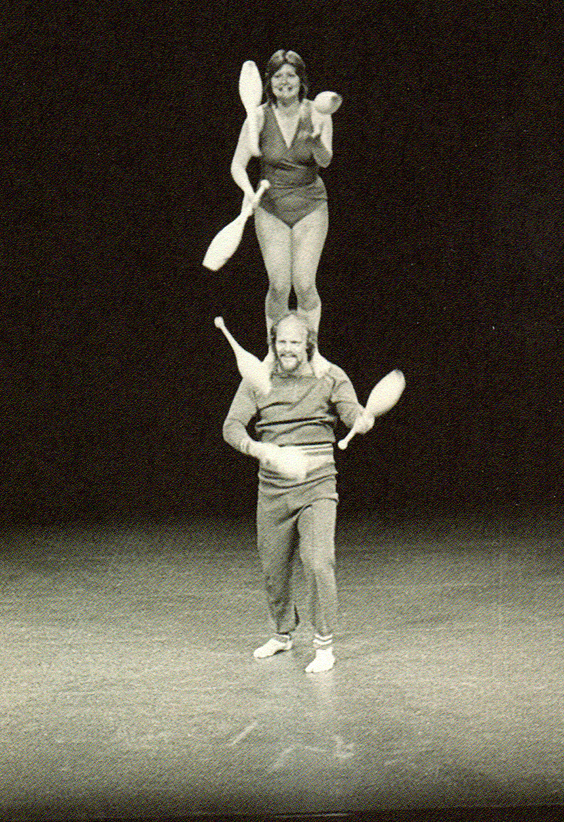
Hovey Burgess & Judy Finelli
1974 International Mime Festival
These dozen pages include the great Swiss performing company Mummenschanz, plus educators such as Hovey Burgess and Carlo Mazzone-Clementi. These pages embody the theme “… Emergence of Physical Theatre” in the title of the book. Other performers and their philosophies are described in this chapter, along with a mix of color and monochrome photos. They include: Avner Eisenberg; Mamako Yoneyama; Lotte Goslar; Ladislav Fialka; Charles E. Weidman; and Tom Leabhart.
Exploratory Glossary of Terms
These twelve pages contain innumerable quotes and reflections by practitioners introduced in the previous chapters. They are applied to seven subjects: The Value of Mime to the Actor; Techniques of Character Development; Circus Techniques in Mime Training; Commedia Dell’Arte in Relationship to Mime; Improvisation, and Mime and Dance in Physical Theatre. It barely touches on subjects that could make a whole shelf of books, but agreements and disagreements are stated, plus personal theories are expounded by various artists.
Mummenschanz at 1974 International Mime Festival
Forms of Mime
This is a chapter about hair-splitting. It is also a sincere attempt to articulate, in words, a visual art form that is supposed to be independent of words. Quite challenging, to say the least! There are more quotes and cross- references from most of the other practitioners found in the book, and Dr. Campbell tries hard to have the many artists speak for their own artistic practices.
Mask
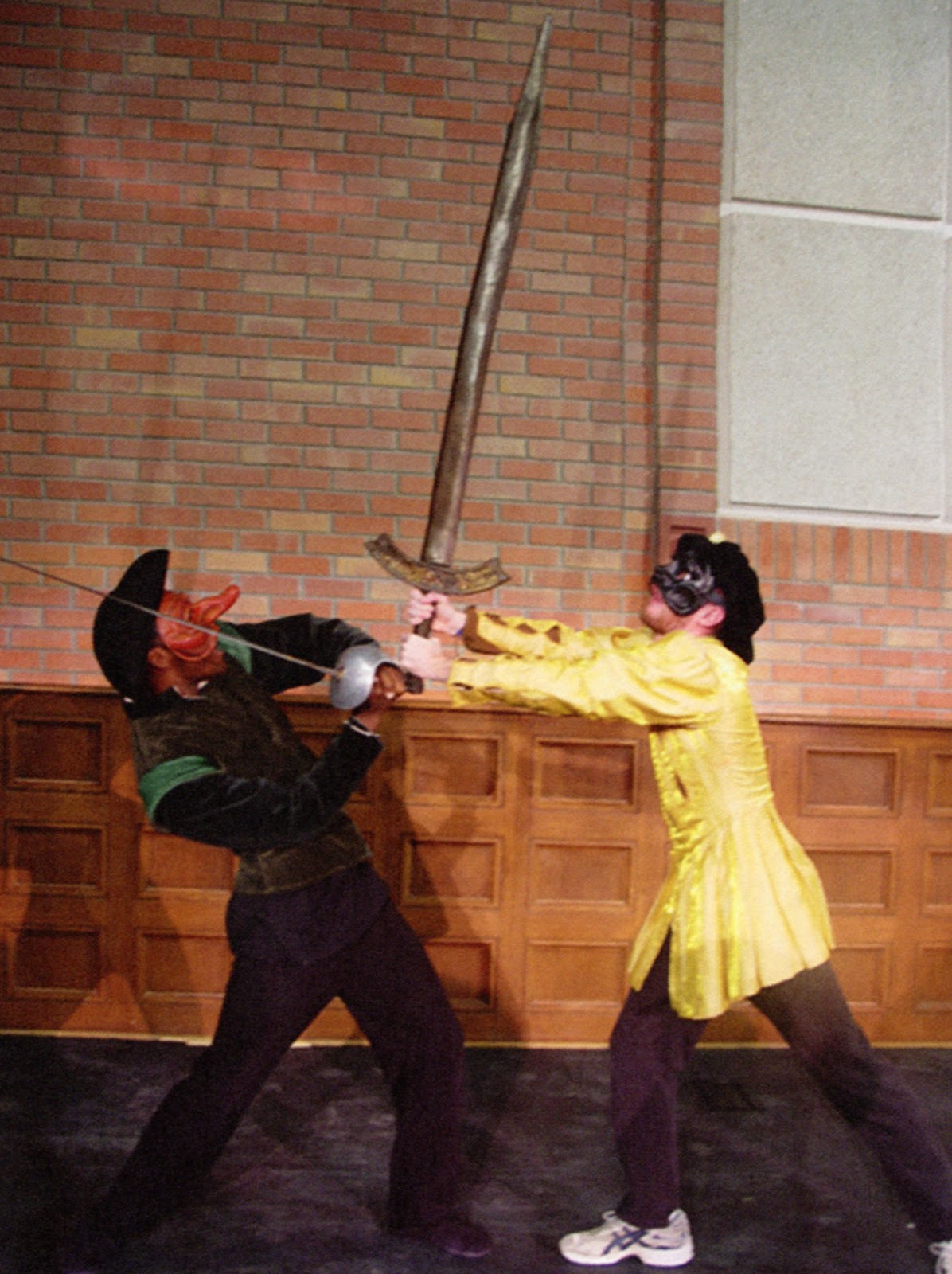
Commedia & stage fighting
This is a short essay about a vast subject, where the various dramatic functions of masks are bravely outlined in Dr. Campbell’s own voice.
Commedia Dell’Arte Overview —Timeline and Characters
This book starts getting personal as Dr. Campbell expounds about the rich history of these Italian stock characters. They still haunt the backgrounds of innumerable books, movies, and stage works, though! This chapter is illustrated with classic prints of major zany archetypes, and provides a graceful transition into Campbell’s most personal chapter of all.
Joshua Squad
This chapter seems to come right from Dr. Campbell’s heart, and delightfully so! There are forty-two pages of illustrations and descriptions of an international performing company (Joshua Squad) that put Dr. Campbell’s ideas and aesthetics into practice onstage. Commedia Dell’Arte seems to be their point of departure, but they look timeless rather than archaic. This is a book within a book with some early explanations, outlines, and policies constituting a de facto manifesto. It expresses so much in visual terms with lovely photographs from as late as 2011. Chapters Eight and Nine seem to be the soul of the book to me.
The Ultimate Gesture
Carlo Mazzone-Clementi
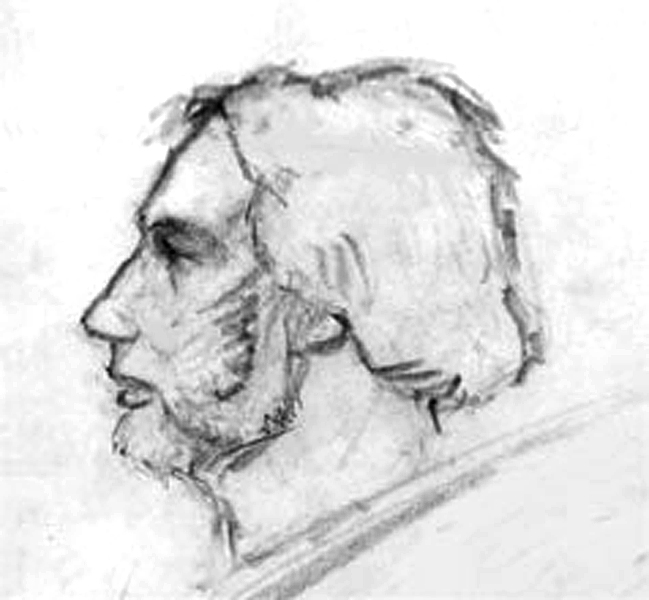
Sketch by Michael Evans
This chapter is an amalgamation of a workbook, more definitions, written exercises, a review of the previous material. There is a deeply personal essay about the International Mime Festival and Institute in 1974, with lots of names and stories about contacts with important individuals. Mary Wigman is mentioned, along with her association with important movement master, Rudolph Laban… like Laban, Dr. Campbell suggests drills of his concepts, and summarizes his interpretations of the work of Geoffrey Buckley, Robert Shields, Ladislav Fialka, Marcel Marceau, Charles Weidman, Antonin Hodek, Carlo Mazzone-Clementi, Mummenschanz, Lecoq, and Mamako.
Carlo Mazzone-Clementi
with Gunda & Dimitri, 1974
International Mime Festival
More Photos The final chapter consists mostly of pictures taken at the International Mime Festival and Institute in 1974. I saw a number of these artists myself. It is enjoyable to see these images, along with pictures of performances I missed.
Reviewer’s Random Thoughts
My own definition is simple —“Mime is the visual aspect of theater,” which even includes radio dramas. One needs to make decisions about what to say when there is nothing to see! The use of labels can help, or not help, but the decision is really up to people who are putting themselves on the line for their art. Some of this material was previously printed in a small hardback called: “Mime and Pantomime in the Twentieth Century – History Theory and Techniques” by Dr. Lou Campbell in 2008. The Foreword by Jewel Walker is much longer, with a separate Preface by Campbell. There were a couple of paragraphs about Leonard Pitt in Chapter One which aren’t in “Memoirs,” and the chapter “Mask” was not present at all. The content is almost identical through the first six chapters, except for “some textual errors,” as Campbell said to me. The quantity and quality of photos and illustration is much superior in “Memoirs of Mime for All Time.” The larger physical size of the second book is much friendlier to visual content, and Campbell’s wonderful personal chapters at the heart of the bigger book simply outdo the smaller volume.
Afterword
Dr. Campbell’s generosity has resulted in my making contact with Mamako Yoneyama. The fine lady is working on an essay about her career after 1980. She still performs in Japan.
Mamako
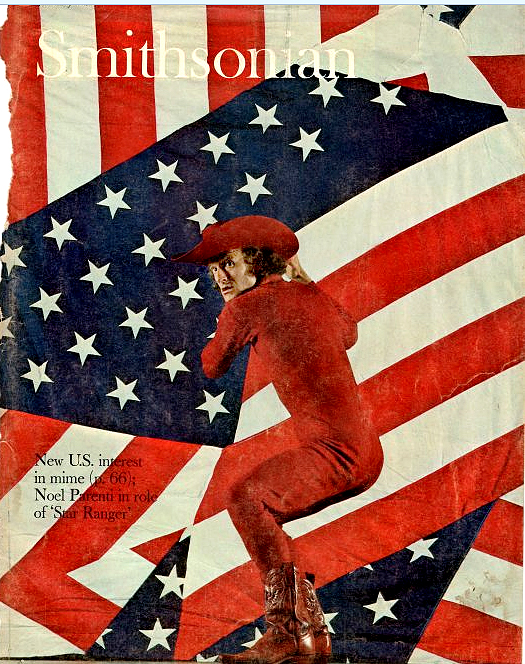
Dr. Campbell barely mentions Cirque du Soliel, arguably the most successful theatrical company of all time, and I vividly remember Noel Parenti’s performance and presence at the International Mime Festival, but nothing is said about him in this book. Parenti was on the cover of Smithsonian Magazine, which did a pictorial about this landmark event. I also wonder about the videotaped interviews recorded throughout the festival.
Noel Parenti
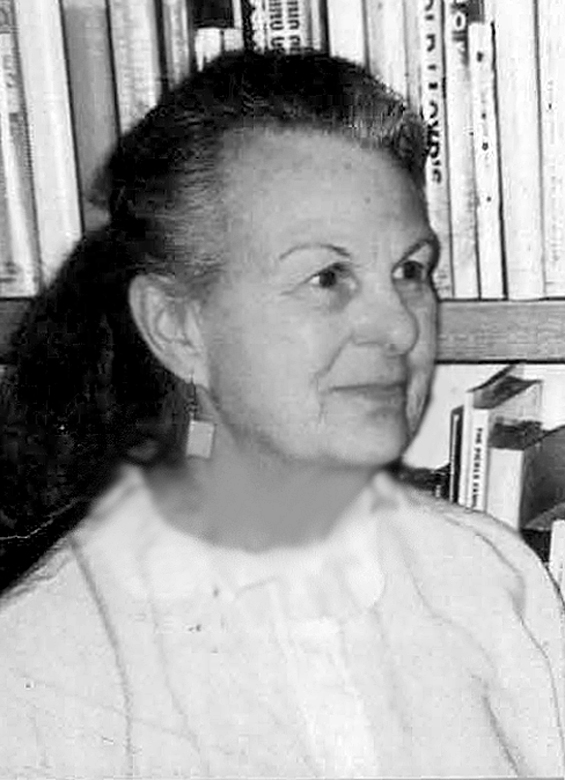
I would recommend any reference library possessing a copy of Dr. Lou Campbell’s “Memoirs of Mime …” without hesitation, but I’d also recommend having a copy of “Mimes on Miming” (1979) sitting on the shelf too. It was edited by Bari Rolfe, with essays by and about major figures in the art form. Ms. Rolfe was co-director of the International Mime Festival and Institute in 1974. The two books together provide a sweeping overview of Mime from differing perspectives.
Bari Rolfe
“Mimes on Miming” contains of historical sketches, attempted definitions, essays, and interviews —but with more artists than those included in Campbell’s survey, although there are overlapping subjects:
Mime in Greece and Rome; Lucian: On Pantomime; John Weaver: Pylades and Bathyllus; Charles Hacks: A Roman Premiere; Mime Through the Seventeenth Century; Two Miracle Plays; Paul Hippeau: Pantomime in Italian Comedy; Evaristo Gherardi: The Italian Theatre; Elizabethan Dumb Shows: Gorboduc; Hamlet; Herod and Antipater; Mime in Asia; Cecilia Sieu-Ling Zung: Some Symbolic Actions; Motokiyo Zeami: On the Noh; Ananda Coomaraswamy: Notes on Indian Dramatic Technique; Mime in the Eighteenth Century; R. J. Broadbent: Rich’s Miming; jean Georges Noverre: Ballet Pantomime; Jonathan Swift: A Pantomime Audience; Glaskull, the Edinburgh Butcher; Mime in the Nineteenth Century: France with Theodore de Banville: Deburau-Pierrot; Horace Bertin: How to Listen to a Pantomime; Raoul de Najac: Souvenirs of a Mime; Paul Margueritte: Pierrot Yesterday and Today; Saverin: The Last of the Pierrots by Barrett Clark; Mime in the Nineteenth Century: England, Europe: Grimaldi; Paul Hugounet: The Hanlon-Lees Go To America; Jacques Charles: Dan Leno; Ronald S. Wilson: The Pantomime Theatre of Tivoli Gardens; Carlo Blasis : On Pantomime.
Mime in the Twentieth Century to 1950 – France: Georges Wague: Resources of the Silent Art; Colette: Music Halls; The Cinema According to Max Linder; Etienne Decroux: Each Art Has Its Own Territory; Jean-Louis Barrault: Dramatic Art and the Mime; Serge Lifar: The Mime and the Dancer; Europe — Grock: Life’s a Lark; Rudolf Laban: The Mastery of Movement; USA — Charles Chaplin: My Sense of Drama; Buster Keaton: My Wonderful World of Slapstick; Harold Lloyd: My World of Comedy; Stan Laurel: Mr. Laurel and Mr. Hardy; Bert Williams, Everybody by Ann Charters; Angna Enters: Mime Is a Lonely Art; Charles Weidman: Random Remarks; Red Skelton: I’ll Tell All; Mime in the Twentieth Century: Contemporary – France: Marcel Marceau: The Adventure of Silence; Jacques Lecoq: Mime, Movement, Theatre; Jacques Tati: The Cinema According to Tati; Pinok and Matha: Mime and Something Else; Europe, Asia — Clifford Williams: Mime in Great Britain; Oleg Popov: Russian Clown; Henryk Tomaszewski: Movement Theatre; Dario Fo: The Art of Dario Fo; Ladislav Fialka: The Fools, or a Strange Dream of a Clown; Ctibor Turba: A Topsy-Turba World by Kuster Beaton; Dimitri: Dimitri, Clown; Mummenschanz: Mask, Mime and Mummenschanz, with Bari Rolfe; Mamako Yoneyama: Zen Mime; USA — Lotte Goslar: How Sweet It Is; Dick Van Dyke: Mime in the Medium; Paul J. Curtis: American Mime; Carlo Mazzone-Clementi: Commedia and the Actor; Antonin Hodek: Price of Folly; Samuel Avital: Mime, Self-Imposed Silence; Bernard Bragg: Signs of Silence, by Helen Powers; R. G. Davis: Method in Mime; and Robert Shields: Mime in the Streets, by Jack Fincher
In the last chapter, “Anti-Mime,” there are catty maunderings by Max Beerbohm, Marc Blanquet, and Woody Allen. They act as a record that there were warnings against artistic stasis by peers and competitors. The term “mime” would lose its luster in the USA, and become the butt of unfair jokes. However, Cirque du Soliel, Blue Man Group, Julie (Lion King) Taymor, and others associated with Lecoq’s school carried the art form to great heights of success, rarely using the term at all.
Here’s a little physical comedy gem for you from the 1954 Bing Crosby – Danny Kaye classic film, White Christmas. This is Danny and crew in “Choreography,” a parody of modern dance, and especially of Martha Graham. Enjoy!
BTW, Riley Kellogg found this photo of the real Martha Graham and also informs me that the structure the Kaye dancers climb on towards the end is a reference to the more than twenty sets the famous sculptor Isamu Noguchi built for Graham dances.
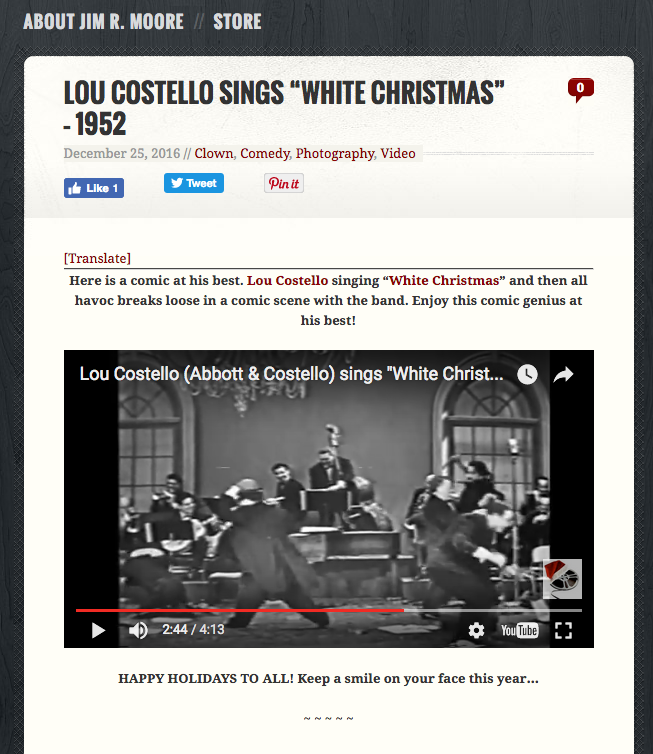
On the Second Day of Christmas Update: And this just in from my old friend Jim Moore, whose excellent VAUDEVISUALS blog yesterday featured a slapstick version of White Christmas performed by Lou Costello. Click here to watch. The mayhem starts around the minute and a half mark.
On the Third Day of Christmas Update: And this just in from Ira Seidenstein, who knows a thing or two about a thing or two. Choreography by Martha Graham and featuring Merce Cunningham.
From the Performing Arts Encyclopedia,: Performed by the Martha Graham Dance Group to music by Paul Nordoff, Every Soul Is a Circus premiered on December 27, 1939, at New York’s St. James Theatre. Costumes were designed by Edythe Gilfond and the set was created by Philip Stapp. This work marked the first appearance of Merce Cunningham, who became the second male dancer (after Erick Hawkins) to join Graham’s ensemble. Composer/critic David Diamond, writing in Modern Music (December 1939) said, “The circus she creates is one of silly behavior and ridiculous situations, its theme, the desire of woman to be the apex of a triangle, the beloved of a duet, who, as the spectator of her own actions, becomes the destroyer of experiences necessary to her essential dignity and integrity. It represents the fullest consummation of Miss Graham’s conceptions. She has unified her entire dance vocabulary into a simple and direct theatrical means of projection and communication. The perfection of her technique, the warmth of personality, make this performance a piece of the most poignant clowning seen in the dance.”
It is a pleasure and honor to have Mike Funt, artistic director of Four Clowns, join us as a guest contributor. Mike is well-known internationally for his workshops in clown, mask, and circus arts, and for the many physical theatre shows he has directed, including Servant of Two Masters, a stage adaptation of the 1971 film, Cold Turkey, and his own translation and adaptation of Molière’s The Imaginary Invalid. Clown training includes work with Philippe Gaulier, Aitor Basauri, Stefan Haves and John Gilkey of Cirque du Soleil, Avner the Eccentric, Aziz Gual, and instructors from Ringling Brothers. He has also studied with play expert Dr. Stuart Brown and trained extensively in Laughter Yoga with Dr. Madan Kataria. Here he shares his longtime interest in the sacred clown, which has led to him teaching a workshop on it this weekend (Dec. 3 & 4) in Los Angeles. Check it out here!
_________________________________
Jacques Lecoq, the renowned clown and theatre teacher was famous for his pedagogy. He helped to inspire and train some of the most brilliant and innovative theatre artists currently working. And at the heart of his teaching are the principles of le jeu (play), disponsibilité (openness), and complicité (connection or togetherness). When I became a clown twenty years ago, I found these tools useful as a performer. Now, more than ever, I find them useful as a person. I suffer from anxiety disorder, with frequent bouts of depression. For years I was on medication as I worked to start a career in the performing arts, not a task that is exactly helpful for those two issues. Then, as I began to work in clown more and more, I suddenly found that I no longer felt the need for the medication. So with the aid of a doctor, I was slowly able to ween myself off the medication and use clown as my anti-anxiety/anti-depression drug. (I repeat that I did this with the aid of a medical professional. I do not recommend taking a clown class and quitting any medication cold turkey.) For eight years, I have been without any medicine for my mental issues. As I began reading up on this, I discovered that there was an anthropological and scientific reason why this works. When was the last time you sang? When was the last time you danced? When was the last time you told a story? When was the last time you sat in silence? These activities are fundamental to a person’s well-being, and early humans knew this before they knew how to farm. By doing these things in a regular practice, the way you would yoga or tai chi, you begin to feel a sense of well-being and peace. So I began to understand why these aspects of performance can make a person feel good, but these things are not exclusive to the clown. What is it that clown adds to the process that made clown, at least for me, such a soothing panacea? Then I came across a book called Trickster Makes This World by Lewis Hyde. This is a fascinating book and it was eye-opening in answering my questions. The trickster is the “laughing shadow of the shaman.” The trickster sees the pageantry and ceremony of the shaman, and simply cannot take it all seriously.
Illustration of Coyote the trickster
In fact, according to Byrd Gibbens, Professor of English at the University of Arkansas at Little Rock, “Many native traditions held clowns and tricksters as essential to any contact with the sacred. People could not pray until they had laughed, because laughter opens and frees from rigid preconception. Humans had to have tricksters within the most sacred ceremonies for fear that they forget the sacred comes through upset, reversal, surprise.”
Heyoka, sacred clown
With this insight, I added a fifth question to the shaman’s list: When was the last time you laughed? And so my answer was clear. Why did clown help me so much? Because it has been helping people for thousands of years before I set foot on this planet. With this in mind, I created “The Sacred Clown,” a workshop that takes the principles of the clown and transforms it into more of a healthful mindfulness practice rather than exclusively a performance tool. Those familiar with clown will recognize Lecoq’s principles: Le jeu. Play. Do everything you do in life with that sense of play and joy and childlike innocence. Do your job this way. Go to school this way. Go on vacations this way. Treat every situation like you are the dumbest person in the room, and you will learn more, discover more, and be amazed by more than most people. And you will have a lot more fun. Complicité. Connection. A sense of “oneness” with others, what Emile Durkheim calls “communitas” or “collective effervescence.” Find that human connection with everyone in your life. Your friends. Your family. A stranger across the room at Starbucks. The person next to you on an airplane. Connect with other people, make eye contact, talk to them, touch them, share affection. Find your complicité, change the way others breathe, and you will meet new and fascinating individuals every single day. Disponsibilité. Openness. Give 100% of yourself to everyone you come in contact with. Hide nothing and share everything. Oh sure, there will be people who will respond negatively to this. They’ll say you’re weird or dumb or irresponsible. They’ll try to take advantage of you. But don’t take it personally. “This is not my audience,” says the clown. But if you keep celebrating your flaws in public, you will eventually find your audience. You will find your people because, as Philippe Gaulier says, the clown’s motto is, “Next time it will be better.” In “The Sacred Clown,” you will find elements of Lecoq and Gaulier as well Richard Ponchinko. However, you will also find a lot more tools to help you bring your clown off the stage and into your real life, and of course there will be LOTS of singing, dancing, stories, silence, and laughter. It works. I know from experience. To me Anxiety is an overwhelming and uncontrollable worry about the future, and Depression is an overwhelming and uncontrollable worry about the past. The clown lives only in the present. And when you force yourself to play and live exclusively in the present moment, a nifty little trick is played on Depression and Anxiety: there is no past or future for them to feed off of. Every day I still wake up to those two foes of mine, and they are worthy adversaries. I don’t always beat them, but I do fight them, every day. And my clown is my greatest weapon against them. The clown is pure goodness. He is the opposite of everything that is evil in the world. Joy and peace await the trickster if you try to stay in the mindset of what Gaulier calls the “Beautiful Idiot.” A Photo Essay on the Heyoka Clowns:
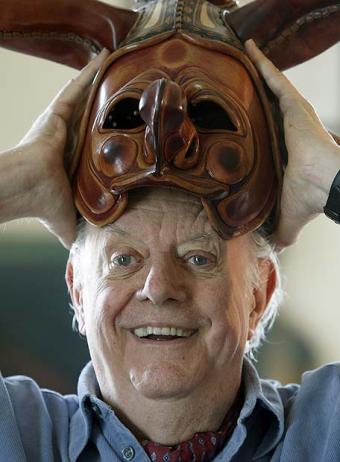
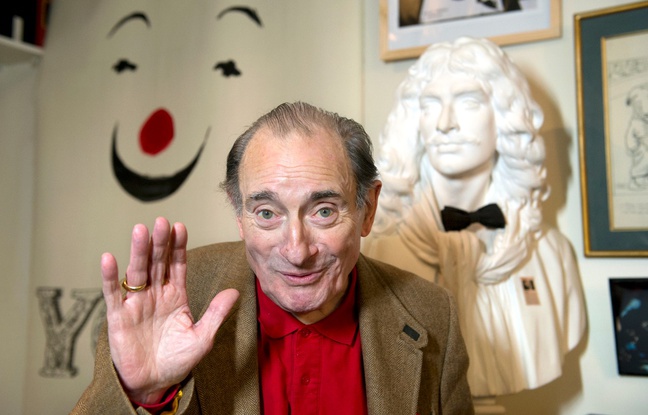
It seems that the world we know is being torn asunder. I speak not of Donald Trump and the wreckage and foul taste of his campaign, though it’s in some ways related. I’m thinking of all the wonderful clown sages we’ve just lost —first Dimitri, and then in the past two days, both Dario Fo and Pierre Etaix. (Which reminds me of U.S. presidents #2 and #3, John Adams and Thomas Jefferson, staying friends and pen pals in their later years, and then dying on the same day.)
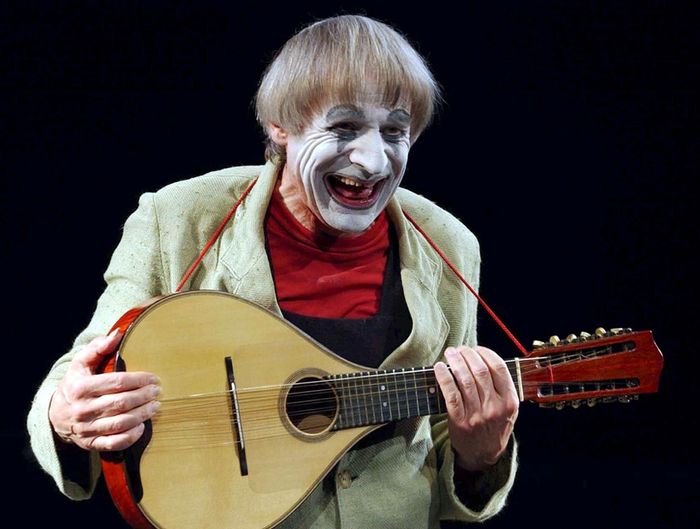
These losses were inevitable, but more stinging in a time when the media is suddenly obsessed with sightings of so-called “clowns” frightening people, as if these idiots were the real deal. Dressing up as an astronaut wouldn’t get me on the space shuttle, but a costume, make-up, and fright wig somehow make me a clown.
The craze started here in the United States, spread to England, and is apparently headed for the rest of Europe. It is not only damaging the image of clown performers, but costing them gigs as well.
Pierre Etaix
Just as the media has allowed Trump to drastically lower the level of discourse, they have allowed these masqueraders to be taken seriously. Once again, real clowns have to defend their art and answer the same stupid questions, which are on a par with “when did you stop beating your wife?” And that’s if they can find anyone to interview them. Part of me wants to write an Op Ed piece for the newspapers, patiently explaining that these are “Halloween clowns,” people dressing up as clowns with an exaggerated, macabre look designed to scare people, and have nothing to do with the noble and quite loving tradition of clowning.
Dimitri
But I haven’t bothered to write this, and won’t. The media is the media, and they will take this and run with it until it runs its course. Which it will. It’s a fad, and even its shallow-minded perpetrators will soon grow tired of it. The good news is that true clowns, who value and delight in the tradition of Dimitri, Fo, and Etaix, will honor these grand fools by continuing to do their good work tomorrow, next year, and centuries from now.
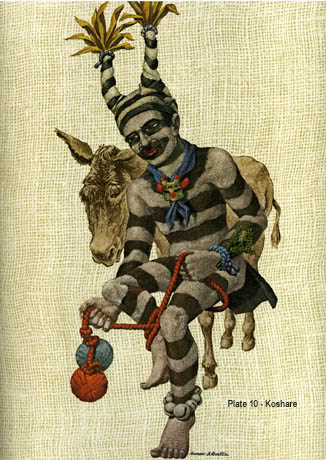
Here’s an à propos discovery I’d like to share with you. As some of you may know, I am working on a revised and expanded version of my book, Clowns. I’m not updating it, which is why I think of it as Clowns: Volume 1, but but but I know a lot more than I did forty years ago, when it was first published (Nov. 1, 1976!), so some sections are being significantly improved. One of them is the very beginning of the book, which starts with the clowning traditions of the native American cultures of the U.S. southwest, especially the Hopi peoples. What I am emphasizing more this time around is that the clown is a central part of the Hopi creation stories; the clown is there from the very beginning, is part of the fabric of life.
For the Hopi, in the beginning was The Emergence, and it was the clowns who led humans from the underworld to a higher level of existence. It was the clowns because they were the ones who could cross borders and teach lessons. And this is not just some myth gathering dust in the archives; rather, versions of it are re-enacted time and again in countless Pueblo ceremonies. Which is why this wonderful sculpture, The Emergence (1989), by Hopi artist Roxanne Swentzell, will be the first illustration in the new edition of my book.
But that’s not the discovery, this is:
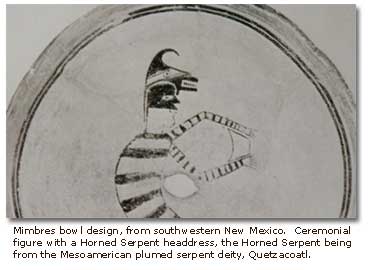
This Mimbres bowl, whose subject shows a clear kinship with Hopi koshare, is from the same southwest region and dates all the way back to between 1000 and 1250 A.D. I know what you’re saying! “It’s been a thousand years and they couldn’t even afford a new costume?” Point well taken, but that is how we know this stuff has been going on forever! My point is that what we should be talking about when we are talking about clowns is an elemental life force, and a very positive one. When pundits trash politics as a “circus” and politicians as “clowns,” my only response is, “ah, if only they could rise to that high level…”
And here are some more reasons to remain positive. Those performance traditions that we group under such labels as clown, circus, vaudeville, physical comedy, etc. —and which are repeatedly pronounced dead— are actually becoming a more widespread part of our culture. Clown training and performance is everywhere, with hundreds of times more practitioners than half a century ago. Clowns are in circuses and hospitals; in the theatre, in the street, and in refugee camps. Circus training is no longer just a family tradition. There are professional schools everywhere, especially in France and Australia. Circus education that’s not just for those with career goals is now contributing to positive youth development throughout the world. Social circuses —yes, I’m thinking of you, Circus Harmony— are doing amazing things to bring people and cultures together. There may be no formal vaudeville circuit, but countless individuals have embraced the variety arts as a means of self-expression, of sharing what they do best and what they love… and the staggering variety is a wonder to behold.
Likewise impressive are all the self-taught enthusiasts who do it for fun and only occasionally for profit. Think of all the slackliners executing incredible tricks between two trees. Or all the excellent jugglers who juggle because they love juggling. All the subway acrobats doing amazing hat moves with baseball caps. All the bartenders learning flair juggling to impress their customers. All the trick cyclists and parkour practitioners…. Clown and circus have indeed arrived, they just take different shapes and forms.
And this just today, which gave me a chuckle: a NY Times article on a new craze for bottle flipping, which is flipping a bottle so it lands upright on its own. (Depressingly, the last line in the article quotes the mother of an avid bottle flipper saying, well, at least he’s not dressing up as a scary clown —as if these were somehow either-or choices.)
Here’s the short video they share, but you can find more on YouTube.
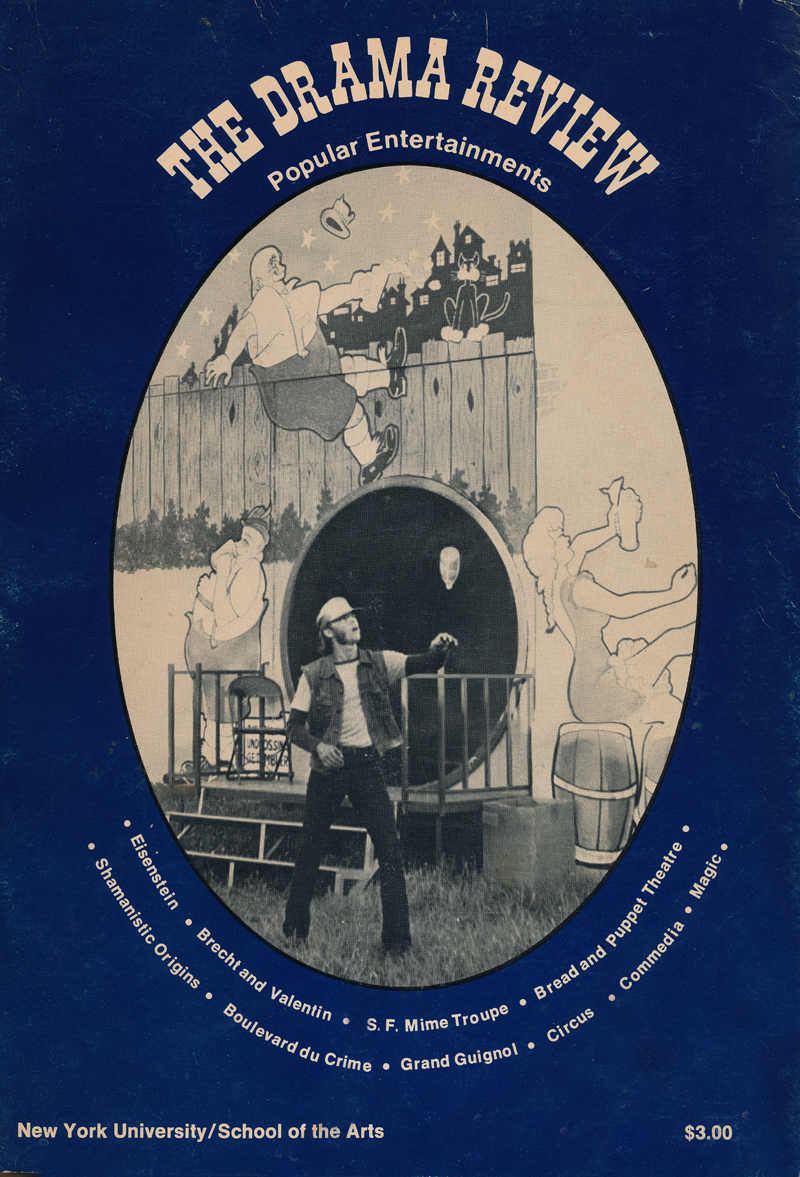
And why do I chuckle? Because in 1973, as an NYU grad student and TDR Assistant Editor, I co-edited a special popular entertainments edition of The Drama Review, and had to fight to use this Diane L. Goodman photo on the cover. We had seen this guy at a carnival in Ypsilanti, Michigan earlier that year. I knew what he was doing with that bottle, but my TDR colleagues didn’t think it was clear enough. Maybe they were right… or maybe I was just 43 years ahead of my time!
So my conclusion is: Don’t panic! Try to take the long-range view. This crap shall pass (so to speak) and the good shall endure. Meanwhile, here’s my recent tribute to Dimitri, and a tribute to Pierre Etaixthat I wrote back in 2010. I subsequently got to meet Etaix in Paris and he was a very sweet man. Such an honor. And in 1990, I was likewise honored to attend rehearsals at the Comédie Française for Dario Fo’s production of two Molière plays. I wrote an article about it for Yale Theater, which I will share with you in a future post.
To be continued… so keep on doing what you’re doing!