We last left Pierre Etaix (post 99) with the happy news of the legal triumph that restored his rights to his own films, paving the way for their reappearance in film festivals and, ultimately, their DVD debut. Now that I’m back on the case, I thought I should try to find out how much of that has actually come to pass since my May 19th post. Here’s the scoop:
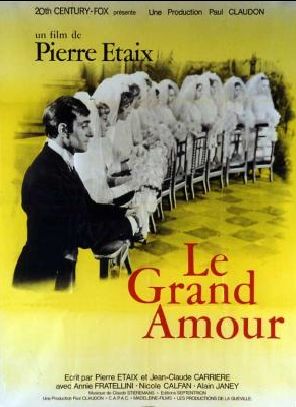
• A restored version of Etaix’s LeGrand Amourwas shown at this year’s Cannes Film Festival.
• Restoration of the entire Etaix ouevre was completed this July by the Technicolor Foundation and the Groupama Gan Foundation. Click here for details.
• At least four of his films are being screened this week at the Cinémathèque Québécois in Montreal. Click here for an article from the Montreal Gazette.
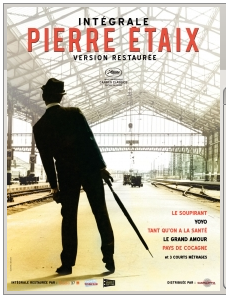
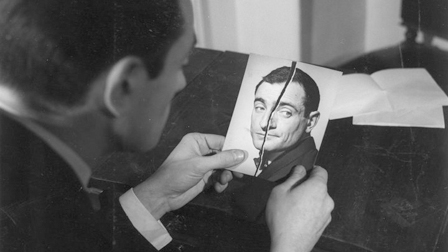
• A September DVD release of the collected works, Intégral Pierre Etaix, was said to be forthcoming from Carlotta, but their web site was only promoting live screenings and video on demand, and the VOD was only available in France • So I wrote Carlotta and this morning heard back from them that it is Arte, not Carlotta, that is releasing the entire collection — and it’s due out next week! Click here to link to Arte’s Etaix page. As of today, they are not yet taking orders, but the release date is set for November 2nd. So, yes, I will get my order in and try to post a review to your favorite physical comedy blog as soon as I can work my way through the nine hours (!) of material.
Meanwhile, here are a few tidbits for you:
• A new article by Frank Wren on the re-emergence of Etaix, with some interesting connections to Chinese cinema.
• There’s now an Etaix Facebook page. Search for Intégrale PIERRE ÉTAIX.
• And here’s a podcast of an interview (in French) with Etaix. Just click here to go the podcast.
One day after posting my In Search of Pierre Etaix piece, I was at Jeff Seal’s “Dead Herring” Williamsburgh loft, attending a fundraiser (image, right) for Jeff’s own quite exciting silent film comedy project, A Day’s Messing. The star attraction was Ben Model, the deservedly celebrated silent film accompanist, playing live piano to a nifty 1912 short, new to me, Robinet Cycliste, andtoChaplin’s The Rink (1916) and Keaton’s Neighbors (1920). (In my next life, I want to play piano like Ben does.)
While we waited for the sun to go down over the Williamsburgh Bridge, I had a chance to chat with Ben, and I was of course telling him the latest news on Etaix. It turns out that Ben had seen a 16mm copy of Etaix’s short Happy Anniversary for sale and snatched it up. He has since digitized it and generously uploaded it to YouTube. Here it is, in two parts:
You can visit Ben’s web site here and his blog here.
Postscript (pun intended):
So……. congratulations to me (he said modestly) on reaching post 100 on this blog. If nothing else, it justifies labeling my posts 023, 024, etc.; in fact, that served as inspiration to reach 100. Along the way, I sometimes wondered what post 100 would be, hoping it would somehow prove brilliant and marvelously repersentative of the blog. Forget the brilliant part, but I very much like that this one spans work from 1912, 1916, 1920, 1965, and 2010 — all linked by Ben’s piano chops. Good enough!
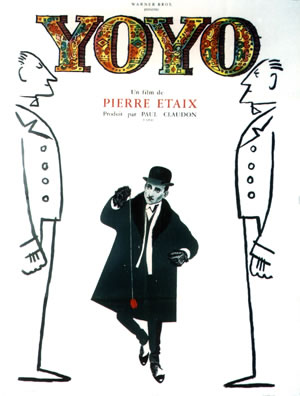
The year was 1973 and I was a student at Ringling’s Clown College where, as part of the training, dean Bill Ballantine screened comedy films. Yes, this was the Dark Ages, still several years before the first VHS tapes and a full two decades before DVDs. I fondly remember sitting with the likes of Penn Jillette, Michael Davis, and Mike Bongar, devouring the works of W.C. Fields, the Marx Brothers, and other classics. One delightful oddity that caught my attention was a modern-day silent film comedy, Yoyo (1965), directed by and starring the French renaissance man, Pierre Etaix. Although Jacques Tati — another French master of the modern silent film — was to complete his last feature film the next year (Parade, 1974), neither he nor Etaix were exactly household names in the United States.
Fast-forward to 2010, a mere 37 years later, and through correspondence with writer Frank Bren — more on whom later — I learned that Etaix was alive and well and on the comeback trail. Now a young 81, he had recently mounted and starred in a stage production in Bordeaux — Miousik Papillon — that he hoped to bring to Paris, and was involved in an intense legal and public relations battle to regain rights to his films, which he had sold to a company that then decided not to release them. That’s right, nearly four decades later and still no theatrical releases, no VHS tapes, no DVDs. [You can read a London Guardian article about this long battle by clicking here.]
Clearly something had to be done. A web publicity campaign was launched, petitions circulated, donations solicited. Major film artists lent their support. Here’s a clever promo video (in French) in which Etaix does some sleight-of-hand with five coins that disappear just like his movies did. Ultimately all he and co-creator Jean-Claude Carrière can do is pray to St. Anthony of Padua.
Hmm… since I was going to be in Paris for two weeks, perhaps I could connect with the Etaix campaign, maybe even with the old master himself, at least for an interview. In Search of Pierre Etaix. I had a mission! It was almost like being a real journalist.
So I signed the petition. I even made a donation. And I wrote to the friend of Etaix who was running the campaign. And no one answered. Being a crack investigative reporter, I took the next step. I wrote again, and I waited. I drank some Bordeaux, munched on my pain au levain and roquefort, and when that didn’t work, I showed great determination, consuming yet more wine, bread and cheese. And meanwhile waited some more. And then I had to leave Paris. Bummère, as they say along the banks of the Seine.
I thought this was the end of the story, but back in New York just a few days later I was greeted by a barrage of late-breaking Etaix news. There had been a victory in the film rights battle! Not only would the movies be released this summer, but Le Grand Amour was to be screened May 19th at the prestigious Cannes Film Festival. Here’s the Cannes press release:
The Cannes Classics programming of LeGrand Amour by Pierre Etaix is a major event. It was only recently, after a long legal battle, that the director succeeded in recovering the rights to his own films. Eight films by Pierre Etaix have now been restored and prepared for re-release. In Competition at Cannes in 1969, Le Grand Amour, which was the first colour film by Jacques Tati’s collaborator and assistant director, has been selected to open this special retrospective. A comic and poetic film, where Pierre (played by Pierre Etaix), though happily married, falls in love with his pretty young secretary and starts dreaming, Le Grand Amourwill be screened this evening in the presence of the director.
So even if my personal Etaix quest was a failure, here he is about to be rediscovered by the wider world, and at least I can help spread the word. To prime the pump, here’s some stuff you might want to know about this creative clown genius: • He won an Academy Award in 1963 for his short, Heureux anniversaire. • His writing partner was and is the prolific and talented Jean-Claude Carrière, who won much acclaim for his work with film director Luis Bunuel and stage director Peter Brook. • He worked as an illustrator and created designs and gags for Jacques Tati, serving as an assistant director on Mon Oncle. • He made five features between 1962 and 1971:The Suitor (1962),Yoyo (1964), So Long as You’re Healthy (1966), The Great Love (1969), and Land of Milk and Honey (1971). • He was cast by Jerry Lewis in his unreleased film The Day the Clown Cried. Lewis said of Etaix: “Twice in my life I understood what genius was. The first time was looking at the definition in the dictionary. The second was encountering Pierre Etaix.” •He returned to cabaret and circus performing in the the 70s and was married to the celebrated French circus clown Annie Fratellini, grand-daughter of the legendary Paul Fratellini; Annie played Etaix’s wife in Le Grand Amour and in the circus was the auguste to his whiteface clown. • Together they founded the first French national circus school, l’Ecole Nationale du Cirque Annie Fratellini, which pioneered the growth of circus as an art form in France and the emergence of “nouveau cirque.”
But all of this is just an introduction to the following excellent 2008 retrospective on Etaix’s career by the aforementioned Australian writer, Frank Bren. This is a “work in progress” from Mr. Bren’s forthcoming book, which currently has the working title, ETAIX — adventures in cinema. It is reprinted here from Film Ink magazine with the generous permission of Film Ink and Mr. Bren. Frank Bren: Pierre Etaix—France’s Forgotten Comic Genius
In a first for this blog, I am posting from 37,000 feet above earth, aboard a Delta Atlanta–NYC flight with free wi-fi (trial offer). I’m sure this will soon be standard, even for us bozos in coach, but right now I’m thinking it’s pretty cool.
Read the whole article here but — spoiler alert — we’re not talking a major find here.
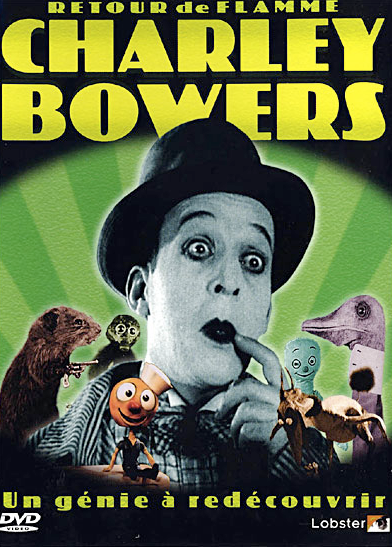
Charley Bowers: The Rediscovery of an American Comic Genius Co-produced by Image Entertainment (USA) and Lobster Films (France) 2-disc DVD; run time 149 mins. 2004
Several DVDs have come out in the past year or two that I should be blogging about, multi-disc sets of the work of Harry Langdon, Douglas Fairbanks, and Charley Chase, for example. Instead, I want to do some catching up and write about a DVD set that came out five years ago on the work of Charley Bowers (1889 – November 26, 1946) . Why? Because it’s exciting stuff, and because today is Thanksgiving and it was on this day 63 years ago that Bowers passed away in almost total obscurity. Let’s see if I can show you why we should be thankful for his life’s work.
I suspect that most of you are saying “who in the hell is Charley Bowers?” In brief, he was a cartoonist, animator, and silent film comedian who, between 1926 and 1931, created a series of short films (no features), sometimes labeled “novelty comedies,” that combined live action with stop-motion animation, and that display a unique comic imagination. While much of silent film comedy exhibits a certain formulaic sameness, Bowers is a refreshingly original thinker whose work I think you’ll love.
Bowers’ name does not even appear in many of the standard books on the silent era, such as Walter Kerr’s The Silent Clowns (1975), and the reason is simply that his films were lost for decades. Even Neil Pettigrew’s more recent authoritative history,The Stop-motion Filmography, does not mention Bowers, but that book came out in 1999, this DVD in 2004. Although Bowers was popular enough in his day to be able to write, animate, and usually star in over twenty movies for R-C Pictures and Educational Pictures, by the time Keaton, Chaplin, et. al. were being appreciated anew in the 60s and 70s, his name had long been forgotten.
The story of his rediscovery is told on a 15-minute documentary on disc 2 of the DVD. Raymond Borde of the Toulouse (France) Cinémathèque was a relentless collector of old films. He knew that traveling carnival acts would often open performances by showing a short American silent film comedy, so he would buy these from them whenever he could, paying for reels by the kilo, sight unseen. He hit the jackpot one day when a rusted cannister of films he bought from a gypsy family turned out to contain three films by Bowers. The only problem was that instead of being attributed to Charley Bowers, the sole credit was to Bricolo, the French name for his movie character. No one knew who this Bricolo was, and years went by without any progress. The films were even shown in a retrospective at the 1976 Annecy (France) film festival, without anyone yet knowing this was the work of Charley Bowers.
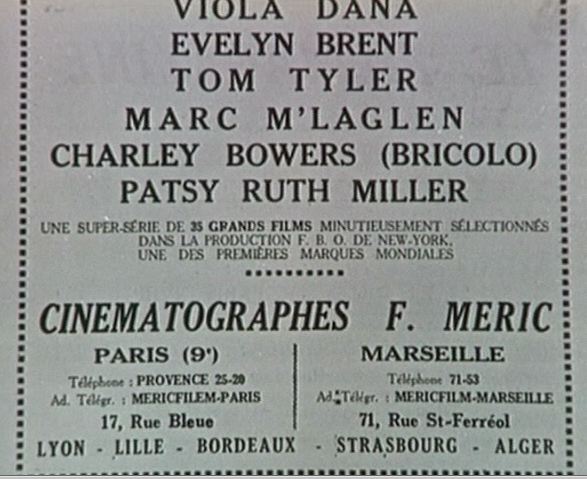
One day this ad in an old film directory was discovered, providing the link between Bricolo and Charley Bowers. This eventually led to a film historian in Montreal who had some slight knowledge of him and to a folder of info buried away at the Library of Congress. More information was uncovered, as were more films, but there are still eleven lost films, and the details of his life are few. The only account of his early years is from a 1928 press bio that seems too colorful to be true: he was born in 1889, the son of a French countess and an Irish doctor. When he was five, a tramp circus clown taught him tightrope. At age six, he was kidnapped by a circus. When he finally made it back home two years later, the shock killed his father.
Hmm..
What we do know is that between 1916 and 1926 he wrote, produced, and directed hundreds of cartoon film shorts based on the Mutt & Jeff comic strips. At some point he made the transition from these hand-drawn cel animations to stop-motion animation, in which you move or manipulate a physical object a small amount, recording a single frame so that when the movie is played back the object appears to move at normal speed. Here are two brief clips about an automated restaurant that show this transition. The first is from one of his Mutt & Jeff cartoons, Grill Room Express (1918, aka The Extra Quick Lunch), the second from He Done His Best (1926).
In 1926, he began combining stop-motion animation with live action, and there are historical references to the “Bowers process” and to a “Bowers camera” that he invented precisely for this purpose, but so far I haven’t uncovered any info on this. Bowers has been credited by some with being the first filmmaker to develop this hybrid form. This may not strictly be true, but the extent to which he did this, and the overall technical level of both the animation and the live action was very likely groundbreaking for 1926. In fact, the story has it that a scene where a herd of elephants seem to enter the Capitol building in Washington, D.C. so fooled people that certain muckety-mucks demanded an official investigation.
Before going any further, let’s get more of a taste of his work. (Both of these next two clips are on YouTube, but there’s not much more of his work up there.) First is a sample of Bowers the silent film comedian from Egged On (1926), the earliest film we have of this hybrid form. The live action star is none other than Charlie Bowers, playing an eccentric, misunderstood outsider whose persona has been compared to that of Keaton. (As a performer he’s no Keaton, but he gets the job done.) Charley the eccentric inventor can’t pay the rent, but he’s on the verge of riches with his invention of the unbreakable egg. His approach to selling his invention is a good example of Bower’s offbeat sense of humor.
The second clip, from his only sound film, the 1931 It’s a Bird, showcases his amazing animation talents. An expedition to deepest, darkest Africa has netted Charley a rare metal-eating bird, which he hopes will prove to be his road to riches:
A Bowers film tends to follow the same general formula. Charley is an eccentric but brilliant inventor, a 1920s Doc Brown, only Bowers is younger and counting on his creations to help him escape poverty and win the girl. To solve the predicament at hand, he typically throws together a Rube Goldberg contraption from spare parts that somehow performs miracles that defy the laws of science. His character’s French name, Bricolo, is from the French verb bricoler, to tinker, and the French noun bricolage, do-it-yourself. Bricolo’s invention always works, but his ultimate success can still be thwarted by unforeseen twists of fate. One aspect of his films I particularly enjoyed is the unpredictability of his endings. The first one I watched did not end well for Charley, so I assumed the stories would always be aiming for Chaplinesque pathos. The next film, however, was the opposite, more along the lines of a Keaton or Lloyd ultimate-vindication finale. He keeps you guessing.
Bowers attracted the attention of André Bréton, leader of the surrealist movement, who wrote of It’s a Bird! that it “took us away, for the first time, our eyes opened to the dull sensory distinction of reality and legend, to the heart of the black star.” (Those surrealists sure had a way with words.) And in his Fifty Year Surrealist Almanac (1950), Bréton listed the one film that had meant the most to him each year, and It’s a Bird! was one of those films, as was Duck Soup for 1933.
Bowers’ movies are uneven affairs, a bit choppy, what with the combination of elements, and at times the storytelling can come to a screeching halt while he shows off with lengthy animation sequences. In his best moments, however, Bowers’ humor is wonderfully quirky and even downright brilliant. At one point his character says “sometimes I nearly ran out of ideas,” but with Bowers the opposite is the case, his head bursting with wild premises. There he is, struggling to invent a non-slippery banana peel, or trying to win a Charleston contest by taking a correspondence course.
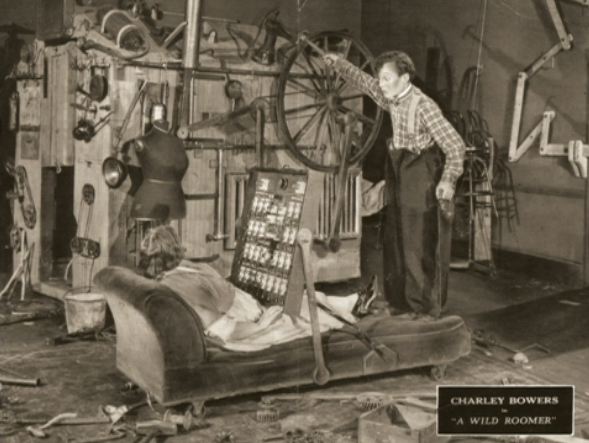
His physical comedy always goes one step further. His sweetheart’s cop father doesn’t throw him out the door, he throws him thru the door. In A Wild Roomer, he tows an entire staircase out of a house — by accident. I’m pretty sure he has the highest WDR (wall destruction ratio) of any silent film comedian.
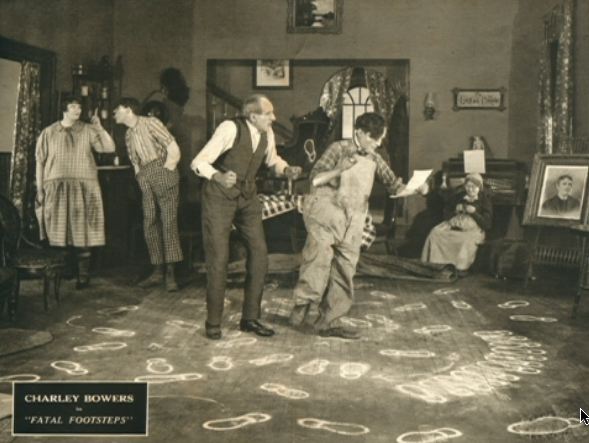
Bowers also does not shy from social commentary. In Fatal Footsteps, he satirizes uptight townspeople who are fighting the popularity of social dancing, and particularly the upcoming charleston contest. The name of the town is not subtle: Dumbville. Sam, the leader of the opposition is exposed as a hypocrite, but even he is eventually converted to the joys of cutting a rug when he accidentally puts on Charley’s latest invention, a pair of automated dancing shoes.
By movie’s end, Sam is getting his fellow old fogies to dance, and the final shot of the film is a fish dancing in its bowl.
Another example is the ending to Now You Tell One, one of my favorite Bowers movies, but I won’t spoil it for you since you can watch it below. It all starts at a meeting of a “Liar’s Club.” The head of the club is disappointed in the stories the members are coming up with. Stumbling on Charley and his story, he brings him to the club to tell it. Beginning of the movie within the movie.
It seems Charley fell for this girl and when he visited her house he discovered a sad picture. The girl’s house is seriously overrun with mice. The woodwork is full of holes and collapsing, the father gone batty from the onslaught. The sole cat is battered and beaten down. Charley moves in and sets to work developing a breed of more robust cats to fight the infestation. Here’s the rest of the movie:
There are a few hours of this on the DVD, so check it out. It looks like it’s on back order from most DVD vendors, but it is available on NetFlix.
Happy Thanksgiving, all!
_______________________
Disc One Egged On (1926; 24:08) He Done His Best (1926; 23:42) A Wild Roomer (1927; 24:27) Fatal Footsteps (1926; 22:20) Now You Tell One (1926; 22:21) Many a Slip (1927; 11:35) Nothing Doing (1927; 21:13) Disc Two Grill Room Express (1918; 5:36) [alternate title: The Extra-Quick Lunch] A.W.O.L. (1918; 5:24 ) Say Ah-h (1928; 14:03 = part 2 only) It’s a Bird (1930; 14:09 ) Believe it or Don’t (1935; 7:55 ) Pete Roleum & his Cousins (1939; 15:38) Wild Oysters (1941; 10:07) A Sleepless Night (1940; 11:00) Special Features Photo Album slideshow (1:45) Looking for Charley Bowers (15:43)
The first movie comedy I saw starred Danny Kaye. I might have been 6 or 7 and I laughed so hard that I still remember thinking, gee, I didn’t know anything could make you laugh that hard. My first Jacques Tati movie was Playtime. I was 19 and in Europe for the first time and, despite a show biz childhood, I had seen little if any silent film comedy. I was amazed. I remember thinking, zut alors, I didn’t know you could do that! It was as if I had discovered a new art form.
Although Playtime lost a lot of money, Tati’s legacy is in very good shape. His stature has grown, his movies are finding a new international audience on DVD, and this summer he is the subject of a retrospective in France housed at the Cinemathèque Française (through August 2nd), but with events outside of Paris as well. Here’s a very short promo for the Tati exposition:
Authorized Digression: Did you see Tati’s trademark pipe in that short animation? Well, believe it or not, they had to remove it from the print posters in the Paris métro:
Yep, I find that amazingly stupid (and I’m fairly anti-tobacco). What’s next, Chaplin’s cane? But what do you think? I think it’s about time this blog had a Raging Controversy! Don’t be shy — cast your vote in the poll (Raging Controversy #1) in the sidebar to the right.
There are a ton of Tati clips on YouTube, but you might want to avoid them. Better to see the whole movie to really get the whole picture. Tati weaves a complete tapestry with each movie, and what makes him unique is the overall world he creates, far more than just the isolated gag. [See the André Bazin article link below.] Furthermore, his cinematographic style and his sense of detail are best appreciated on the widest screen available; he even shot Playtime in 70 mm. Monsieur Hulot’s Holiday and Playtime are good starting points, though others will certainly argue for Mon Oncle, which won an Academy Award for Best Foreign Film of 1958.
What is singular about Tati is his ability to find physical comedy in everyday life. He is the master of observational visual humor; one critic labeled him “an entomologist of the material world.” Despite some big gags such as the fireworks scene in Hulot’s Holiday, most of his stuff is subtle and quirky. Often the main event happens off-camera, and our imagination is left to fill in the blank. “I want the film to start when you leave the theatre,” Tait explained.
Although he has a great eye for social interaction, we know very little about Tati’s characters, his alter ego Hulot included, and there is nothing that you could call a plot. People come together, they interact. Hulot, usually too old-fashioned for this modern world, struggles mightily with his environment, with the world of things, but nevertheless exudes a contagious joie de vivre, most appreciated by the very young and the very old. Before long the characters go their merry ways with tales to tell and fond memories of that odd man. End of story.
Tati is not the only director to attempt to revitalize the silent film form after The Jazz Singer (1927) precipitated its fall from public favor. To my mind, however, he may be the only one who truly succeeds, and he does so by finding his own style rather than by imitating the classics. I believe it was the Czech clown Bolek Polivka who said something to the effect that if you’re going to be silent, there needs to be a reason. Rather than choose silence, Tati relegates actual dialogue to background chatter. Environmental sounds and human speech are part of a broader soundscape that works seamlessly with the visual humor. Buster Keaton, who commented that “Tati started where we left off,” is said to have been so impressed that he asked Tati about working on new soundtracks for Keaton’s silent films.
Just as it’s hard to capture the essence of Tati in a YouTube clip, one might also wonder what a museum exhibit can add to the actual films. At least I wondered that. Here’s what the expo has to offer in Paris:
• A museum exhibit at the Cinemathèque with props, costumes, and dozens of screens with clips from the movies and from his life.
Good job here. Tons of costumes and props, some original, some reconstructed. Models of sets. Dozens of monitors showing not just clips but also some nice thematic compilations of Tati’s work juxtaposed with that of other directors.
A life-sized reconstruction of the set for Mon Oncle.
I didn’t get to see this, but you can see a video of it going up here.
A screening of a fully restored “director’s cut” version of Monsieur Hulot’s Holiday.
This was wonderful. The movie is 87 minutes long, but it felt like 50. If this comes to a movie theatre near you, don’t miss it! Like I said, a large screen does make a difference.
A commemorative book, Jacques Tati : Deux temps, trois mouvements.
I bought it, I like it, but not necessarily a must-have. Tons of images and documents and about 75 pages of short pieces on Tati, mostly by other artists. You can buy it here from the French Amazon.com
______________
Finally, I know I said that YouTube wasn’t necessarily a good way to get to know Tati, but here are a few unusual clips you might miss. The first is said to be Tati’s first screen appearance (he speaks!) dating from 1935:
The next is Tati dancing, again from an early short, The School for Postmen(1947). You can see the whole movie here. (In two parts.)
And you can even sing “the Jacques Tati”:
Update: Alert reader Jonathan Lyons has alerted me to another Tati song, Jacques Tati by the El Caminos. It’s available on iTunes, but I also found it here.
Other Perspectives:
David Kehr on Playtime:
Jacques Tati’s Playtime is perhaps the only epic achievement of the modernist cinema, a film that not only accomplishes the standard modernist goals of breaking away from closed classical narration and discovering a new, open form of story-telling, but also uses that form to produce an image of an entire society. After building a solid international audience through the 1950s with his comedies Jour de fête, Mr. Hulot’s Holiday, and Mon Oncle, Tati spent ten years on the planning and execution of what was to be his masterpiece, selling the rights to all his old films to raise the money he needed to construct the immense glass and steel set—nicknamed “Tativille”—that was his vision of modern Paris. The film—two hours and 35 minutes long, in 70mm and stereophonic sound—opened in France in 1967, and was an instant failure. It was quickly reduced, under Tati’s supervision, to a 108-minute version, and further reduced, to 93 minutes and 35 monaural, when it was released in the United States in 1972. Even in its truncated form, it remains a film of tremendous scope, density, and inventiveness.
Playtime is what its title suggests—an idyll for the audience, in which Tati asks us to relax and enjoy ourselves in the open space his film creates, a space cleared of the plot-line tyranny of “what happens next?,” of enforced audience identification with star performers, and of the rhetorical tricks of mise-en-scène and montage meant to keep the audience in the grip of pre-ordained emotions. Tati leaves us free to invent our own movie from the multitude of material he offers.
One of the ways in which Tati creates the free space of Playtime is by completely disregarding conventional notions of comic timing and cutting. There is no emphasis in the montage to tell us when to laugh, no separation in the mise-en-scène of the gag from the world around it. Instead of using his camera to break down a comic situation—to analyze it into individual shots and isolated movement—he uses deep-focus images to preserve the physical wholeness of the event and long takes to preserve its temporal integrity. Other gags and bits of business are placed in the foreground and background; small patterns, of gestures echoed and shapes reduplicated, ripple across the surface of the image. We can’t look at Playtime as we look at an ordinary film, which is to say, passively, through the eyes of the director. We have to roam the image—search it, work it, play with it.
With its universe of Mies van der Rohe boxes, Playtime is often described as a satire on the horrors of modern architecture. But the glass and steel of Playtime is also a metaphor for all rigid structures, from the sterile environments that divide city dwellers to the inflexible patterns of thought that divide and compartmentalize experience, separating comedy from drama, work from play. The architecture of Playtime is also an image for the rhetorical structures of classical filmmaking: the hard, straight lines are the lines of plot, and the plate glass windows are the shots that divide the world into digested, inert fragments. At one point in Playtime, M. Hulot stands on a balcony looking down on a network of office cubicles, seeing and hearing a beehive of human activity. As an escalator slowly carries him to the ground floor, the camera maintains his point of view, and the change in perspective gradually eclipses the human figures and turns the sound to silence. It is one of the most profound images of death ever seen in a film, yet it is a death caused by nothing more than a change in camera placement. Tati’s implication is that life can be restored to the empty urban desert simply by putting the camera in the right position, by finding the philosophical overview that integrates all of life’s contradictory emotions, events, and movements into a seamless whole. His film is proof that such a point of view is possible.
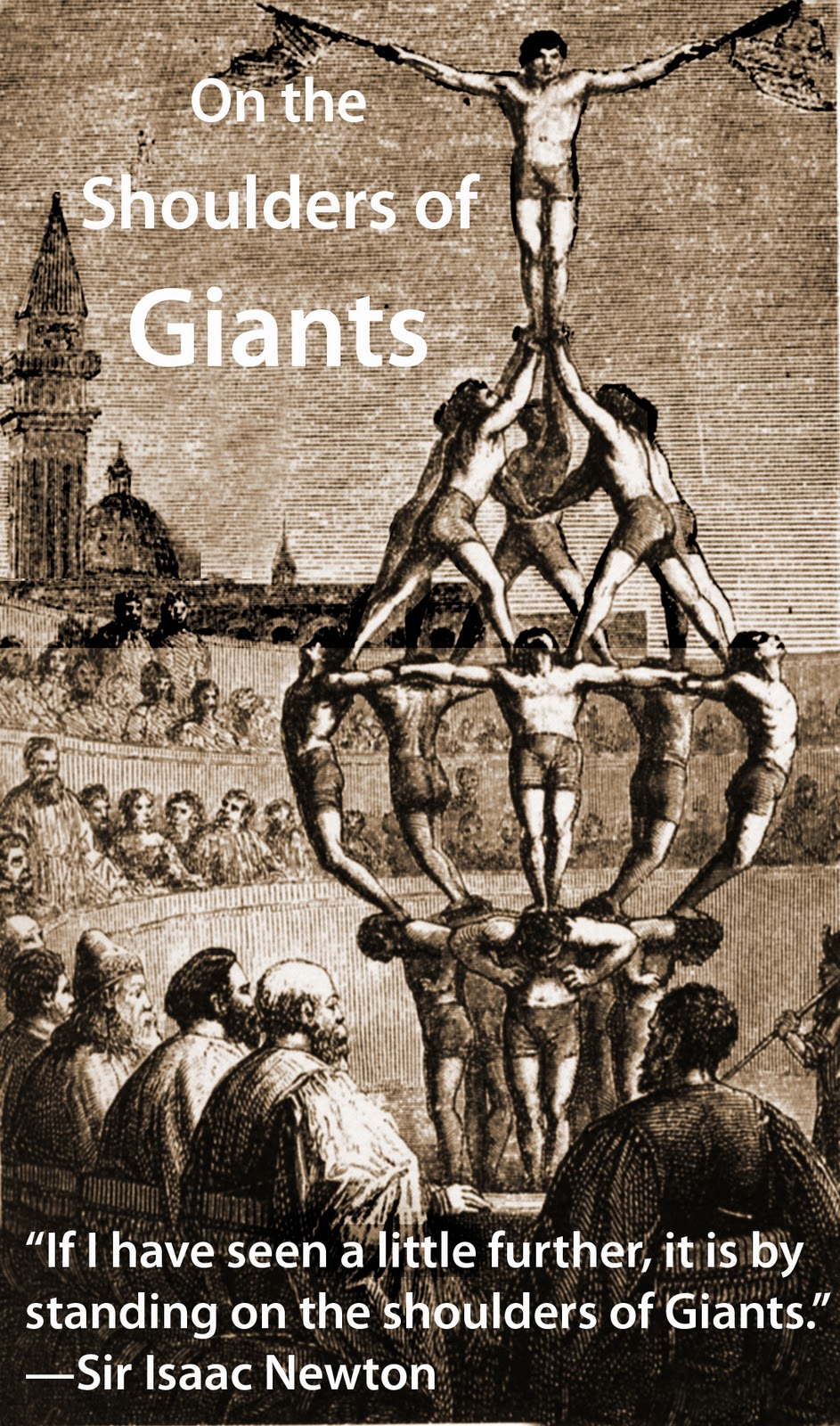
I thought it would be cute to begin a series entitled “On the Shoulders of Giants” by talking literally about standing on shoulders, what is commonly referred to as the “2-high.” Pile on more bodies, perhaps flying off a teeterboard, and you get a 3-high, a 4-high, etc., but I sure am the wrong person to ask about this. I was pretty good at your basic 2-high, but that was it. I can still see Fred Garbo, somersaulting at me off a teeterboard some thirty years ago in a Gregory Fedin – Nina Krasavina circus class in Hoboken, NJ. Garbo was wearing a mechanic, maybe even coming in at reduced speed, probably weighed all of 135 pounds, but all I wanted to do was duck. I think he landed on my shoulders once or twice, and I managed to grab him, sortakinda, but I doubt I actually saw much of this.
Update: See post 013 for some fantabuloso partner acrobatics from 1902-03 by the Julians Acrobats, with a lot of two-high variations.
The proper technique for the 2-high has been laid out quite thoroughly in Circus Techniques (pp. 68-72) by Hovey Burgess. [Full disclosure: I was an editor on this book, and Hovey was my first understander back in my NYU days, back when the Delaware Indians still ruled Manhattan.]
And yes, the 2-high is indeed executed by performers known as the understander and the topmounter. Karen Gersch, a skilled understander herself who once bravely had me on her shoulders as the middleman in a 3-high, remarked that understander was one of her favorite words in the English language because of its double meaning. Likewise, Corky Plunkett, father and understander in a family acrobatic troupe that was featured in a couple of circuses I was in, liked to say that “in acrobatics, you put the brains on the bottom of the pile.” This may not be what Shakespeare had in mind when he penned this bit of repartee for Two Gentlemen of Verona, but I’ve always liked to pretend it was: SPEED: Why, then, how stands the matter with them?
LAUNCE: Marry, thus: when it stands well with him, it stands well with her.
SPEED: What an ass art thou! I understand thee not.
LAUNCE: What a block art thou, that thou canst not! My staff understands me.
SPEED: What thou sayest?
LAUNCE: Ay, and what I do too: look thee, I’ll but lean, and my staff understands me.
SPEED: It stands under thee, indeed.
LAUNCE: Why, stand-under and under-stand is all one.
___________________
So let’s see where the laughs might come from with a 2- or 3-high — or for that matter a 31-high. I see two kinds of possibilities, because it seems to me that it might be useful to divide physical comedy into two categories. Now don’t you go frettin’ that I’m getting all intellectual on you here. Hey, I made it through grad school without understanding semiotics (though I did teach it once). But there are two types, and yes, this will be on the exam. (TOTAL DIGRESSION: one of my favorite quotes is “The world is divided into two kinds of people: those who believe the world is divided into two kinds of people, and those who don’t.”)
Did I mention there are two types of physical comedy? One is presentational, and in this case would take the form of comedy acrobatics, though of course there’s also comedy juggling, comedy magic, etc.. The performers present (attempt) an act of skill in the here and now, but get laughs along the way, usually through a series of mishaps that are eventually overcome. The other approach uses physical comedy within a storytelling structure, featuring characters in a real-life situation. The characters and the situation are often exaggerated, but there is a narrative that does not take place in the here and now. Just think of your typical silent film comedy. As you will find, I am a big fan of both (you want me in your audience) but my deepest interest lies in the use of physical comedy within a narrative framework. What can I say? I like stories, I like content and context, and I like what physical comedy can say about the life we live. You don’t have to share this bias… just letting you know.
Comedy Acrobatics & the 2-High Most of the comedy acrobatics I’ve seen centering around the 2-high involves the topmounter’s clumsiness in getting up there, slipping and falling on the way, and causing the understander to grimace pretty much non-stop. If the topmounter is female and wearing a dress, she might even falter and end up with the understander’s head under her dress. It’s been known to happen. In public.
I don’t have the perfect comedy acrobatic clip for you, but here are a few brief seconds of such clumsiness from a routine by two unnamed acrobats on the old Colgate Comedy Hour. [Anyone know who they are?] Notice the foot on the face.
In The Playhouse, Buster Keaton’s spoof of Vaudeville, a Zouave acrobatic act has to be replaced at the last moment by some ditch diggers from down the block, with the inevitable clumsiness.
The “broken column” dismount from the 2- or 3-high, as seen in this drawing from Georges Strehly’s 1903 classic, L’Acrobatie et les Acrobates, also usually gets a laugh. I’m guessing the laughter comes from the relief of tension, but you might have to ask Freud to be sure. The whole column tilts forward, staying in a straight line until the last split-second, when they all bail out into some variation of a forward roll. This can be done with two people but is much more visually arresting with three. I even saw three Taiwanese women acrobats go directly from a 3-high into a 3-person peanut roll and then roll backwards right back up into a 3-high. Wow! indeed. [Note: a peanut roll is what the “Colgate” acrobats do at the end of that video above.]
Just to prove I can still translate French, this is what Strehly wrote about it: One of the most original and unexpected moves is the broken column. The performers, balanced in a 3-high, let themselves fall forward and, at the moment when they are about to hit the ground, detach themselves from one another and complete the fall with a saut de nuque.
And what exactly is a saut de nuque? Translated literally it’s a neck dive, and is explained by Strehly as follows:
The saut de nuque, uniquely reserved for clowns, at first resembles the saut de lion, but instead of having the arms in front of the body, they are left glued to the body and, at the moment when it seems that the head is about to smash into the ground, the chin is brought to the chest so that it is the neck or, to be more precise, the muscles in the cervical region that break the fall.
Here’s a video clip of the acrobatic team Quatour Stomp doing a broken column from a 2-high, atop a table no less, though with a fairly early break and with a conventional forward roll.
And Strehly adds a variation I’d never heard of:
One increases the difficulty, but not the effect, of this cascade by falling backwards. At the moment when it seems that the three performers are about to land flat on their backs, they disengage from one another, execute a half-pirouette, place their hands en parade, and complete the movement with a saut de nuque.
I don’t know, I’ve never seen this done, but I’m betting it would increase the effect for me big time. [And no, I’m not positive what en parade means, though I could guess. Neither Harrap’s nor the internet are any help, but I’d be happy to hear from any of the 90 million francophones out there, most of whom I assume read this blog.]
Storytelling If you’re telling a story and one character is standing on another’s shoulders, there’s got to be a reason. You can’t just stand there and shout “Ta-Da!” Maybe you’re trying to reach somewhere you shouldn’t be. If so, you might need to make a quick escape. The classic example of this is from Buster Keaton’s1920 silent short, Neighbors. Keaton is in love with the girl next door but can’t marry her because the families are arch enemies, so elopement is the only answer. Unlike Romeo and Juliet, this one has a happy ending thanks to some, er, understanding friends.
Even given that the bride-to-be topmounter is replaced by a dummy in most of the shots, the dexterity with which the three-high disassembles and reunites to make its way through the neighborhood obstacle course is amazing and transforms what is usually a static stunt into a refreshingly original chase scene. Skill, story, and comedy merge perfectly.
Keaton was an incredibly creative comedian and filmmaker, so it would not be surprising for him to have concocted all this on his own, but he was also a Vaudeville veteran who had not only performed with his family’s knockabout troupe since the age of three, but had no doubt worked on the same bill with hundreds of other physical performers along the way. So I was not all that surprised to come across this poster of the Byrne Brothers’ Eight Bells while doing research for my Clowns book.
Notice the sneaky three-high off to the left, carrying off a trunk, not to mention the ladder pivoting on the fence, which also is a major physical gag in Neighbors. Eight Bells was performed by the Byrne Brothers from 1890 to 1914, when it was replaced by a similar piece, An Aerial Honeymoon. Keaton had begun performing in Vaudeville before the turn of the century, so I’d say the similarities are hardly coincidental.
Human Pyramids in a CGI World Fast forward to the 21st century (aka, now), where big budgets and CGI (computer-generated imagery) have resulted in some amazing television commercials that mine the physical comedy tradition to hawk such essentials as $100 sneakers and watered-down beer. But give credit where credit is due: some of these spots are highly creative and quite funny, though little or no physical skill may be involved. Here’s Kevin Garnett, in real life an immensely talented basketball player, in the Adidas “Carry” ad, backed up by Etta James singing “He’s Got the Whole World in His Hands.” The visual effects are by Method Studios (Santa Monica, Ca.).
And you thought I was joking about a 31-high! [Okay, 31 is an approximation, but you get the idea.]
Viewed as physical comedy, this commercial raises two obvious questions: is it physical and is it comedy?
You are of course right in assuming that Kevin Garnett did not walk around town with all those people on his back. Instead, he wore a rig that was used to collect position data for motion tracking so that performers hanging from a rig in a green screen studio could be composited into the shot. You can get a more thorough explanation from artist Andrew Bell, but meanwhile here are some pics showing how Street Shot w/ Rig + Greenscreen Shot = Final Composite:
There’s some physical work here — the guy diving off the building is probably a stunt man — but otherwise it’s pretty much an illusion. If this gets your dander up about truth and live vs. digital performance, I’m glad because I have every intention of fomenting controversy on this issue in later posts! Still, because this pyramid is such an obvious exaggeration, it doesn’t bother me as much as other faked physicality. It’s all done with a wink. And the joke itself isn’t bad, the gag of repetition leading to the “impossible” pyramid, nicely contrasting with the nonchalance of Garnett. I admit to liking it.
Here’s another video snippet of a wild human pyramid (this one dances!). I don’t even know what this is from, but you’ll find it on the Method Studios demo reel.
Okay, a 31-high is fine and all, but the Miller Lite “Break from the Crowd” commercial creates a 1200-body human pyramid that is a rampaging monster of conformity. (And you thought I was kidding about a 1200-high!) So what if 99.9% of the bodies aren’t real?
Yep, that was also done by Method Studios under the direction of Alex Frisch; they seem to have a thing about pyramids. Effects like these are accomplished with specialized crowd-creation AI software such as Massive. Here are some pics showing how they put together the shot at the end that combines these CGI bodies with a few real humans.
For those of you out there with a serious interest in visual effects, you can learn more about how this was done from an interview with Frisch at fxguideTV: there’s a high-bandwidth version and a low-bandwidth version. The discussion of this commercial starts at the 3–minute mark.
It looks like even less actual physicality went into the making of this one, but the visual idea of the monster pyramid representing the conformity of the crowd is a striking one, and our hero’s escape from it funny enough. Too bad it wasn’t for a better brand of beer.
Human Pyramids: Sacred Cultural Tradition? Widen the base of your three-high and you can add a lot more bodies, creating what’s called a human pyramid because of its inverted-V shape. We all did these in high school — you can probably still feel those knees in your shoulder blades — and YouTube is full of such stunts. They are supposed to teach teamwork, and with all those understanders there should be one huge heap of understanding.
In Catalonia (Spain), this is carried several steps further — oops, I mean higher — by the castell folk tradition dating back several centuries. “Castle-building” competitions pit large teams (650 members, all living, breathing sentient beings) against one another. One pyramid goes ten stories high and, according to this video, has a base of 400. Talk about community building!
And Now It’s Silly Time: A Three-High in Outer Space Eat your heart out, earthbound Catalans! This brief segment from Howard Smith’s odd documentary film Gizmo shows astronauts on the Skylab space station taking advantage of weightlessness to do a three high at the very beginning of the clip and, later on, a triple-decker, no-hands push-up.
__________________________________
As Sir Isaac Newton once said, “Th, th, that’s all folks.” Comments and additions welcome!
Chapter 5 from my book, Clowns: A Panoramic History
One more background piece. This chapter from my 1976 history of clowns dealt in detail with the development of physical comedy in the nineteenth century and, ultimately, its influence on American silent film comedy. Good stuff!
[The usual Scribd note: click on icon in upper-right corner to view document full-screen; click again on same icon to return to blog.]
 • So I wrote Carlotta and this morning heard back from them that it is Arte, not Carlotta, that is releasing the entire collection — and it’s due out next week! Click here to link to Arte’s Etaix page. As of today, they are not yet taking orders, but the release date is set for November 2nd. So, yes, I will get my order in and try to post a review to your favorite physical comedy blog as soon as I can work my way through the nine hours (!) of material.