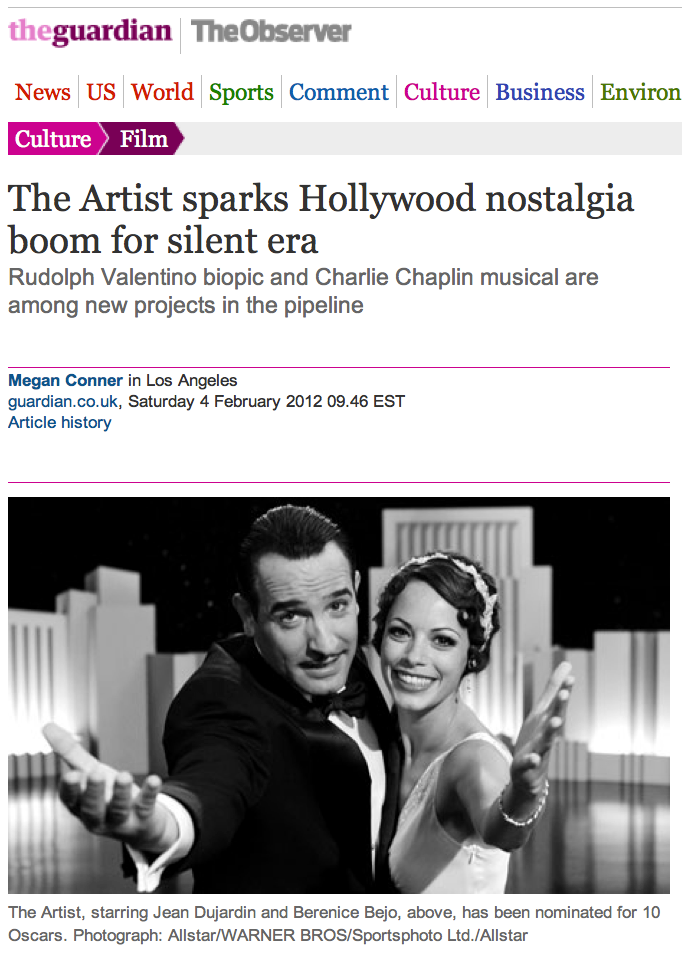
I know, I know, yet another post on The Artist — but this article from London’s Guardian newspaper is actually about some new film and stage projects that now have a better chance of success thanks to all this new interest in silent movies.
The surprise success of the silent film The Artist, tipped to make a clean sweep at the Academy awards, has inspired a series of stage and screen projects celebrating the early years of Hollywood.
This wave of nostalgia has prompted not only more silent movies, but plays and films paying homage to the stars of the time. One of the biggest projects is a musical based on the life of Charlie Chaplin, which will open on Broadway this year. It was first staged in California and had mixed reviews, but is being reworked and recast for New York. The script, by Thomas Meehan, who wrote the hit stage productions Hairspray and The Producers, delves into Chaplin’s controversial private life while tracing his journey from modest beginnings in London to the heights of Hollywood.
The producers of a film based on the silent era’s smouldering romantic lead Rudolph Valentino, star of The Sheik and The Eagle, also hope their movie will make it to the screen soon. Silent Life, an American film made by and starring Vlad Kozlov, a first-time director who has been successfully treated for a speech disorder so debilitating he could barely talk for almost 20 years, is being prepared for release after four years in production. Co-starring Isabella Rossellini as Valentino’s wife, it centres on the Italian actor’s untimely death at 31 after he slipped into a coma while being treated for peritonitis. Unaware of his fate, he understands his life through a dreamlike silent sequence in which he has fame and glory but the dearest things in his life have been taken from him.
Tim Gray, editor-in-chief of Variety, said it hardly came as a surprise that these silent-era-inspired stage and screen projects were now emerging. “When a surprise success story like The Artist comes along, you are always going to get imitators – it’s natural. Having said that, I do think The Artist is a one-off. The reason The Artist is a hit is not because it’s silent, it’s because it’s so clever and unusual. I’d be stunned if a large number of silent films popped up.”
He argues that while The Artist has spawned nostalgia for the period, if these projects are successful it will be because they tell a more personal story. “Perhaps the biggest trend in film-making now is biographies. People always want to make them and audiences always want to see them. Over the last few years we’ve seen people competing to make stories based on famous people’s lives – there were two Truman Capote movies in competition and three Janis Joplin films that never got made over the last few years.
“Right now, there’s a film being shot about a 1970s porn star nobody really knew anything about, Linda Lovelace. I wouldn’t be surprised if a lot of film-makers now have an interest in making a Chaplin biopic.”
To date, there has only been one film based on Chaplin’s life, the 1992 drama Chaplin, directed by Richard Attenborough and starring Robert Downey Jr. It received great acclaim, with Downey picking up a Bafta award and an Oscar nomination for best actor, but critics deemed Chaplin’s life too vast to be immortalised in film. Enjoying a career as an actor, producer, director and composer that spanned more than 75 years, Chaplin lived until the age of 88 and had a colourful personal life that saw him dating actresses as young as 15, embarking on several marriages and affairs and producing 12 children.
Other stars from the era whose lives could be retold in film include Greta Garbo, Buster Keaton and Harold Lloyd. But Gray argues that the moment will be fleeting.
“I don’t think you’re ever going to see a complete resurgence in silent movies,” he says. “The Artist’s greatest influence on Hollywood is in liberating film-makers to try something completely original, to push the envelope at a time when the investment is largely in ‘safe bets’ like comic book franchises and sequels.”
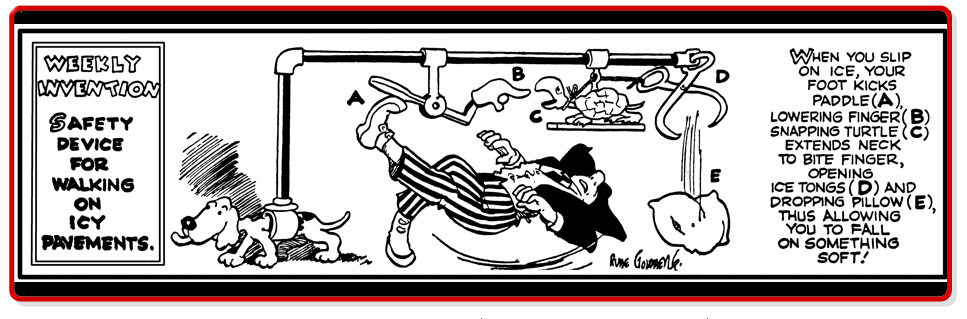
Rube Goldberg was an inventor and cartoonist born the same year as Max Linder (1883), which is to say a few years after Mack Sennett and a few years before Charlie Chaplin and Stan Laurel. He drew popular cartoons of elaborate gadgets that performed simple tasks in the most convoluted way imaginable.
Goldberg’s eccentric approach to tackling life’s everyday obstacles makes him a spiritual cousin to many of the silent film comedians, especially Buster Keaton. “Rube Goldberg machines” have continued to capture our imagination a century later, but I for one have never seen anything nearly as fantastic as the work of kinetic artist Joseph Herscher, as profiled in this cool video from the NY Times:
Although Herscher only makes himself a minor player in this machine drama, physical comedians do not hesitate to throw themselves into the action. Buster Keaton’s movies are full of oddball inventions, such as these from The Electric House (1922):
But this is a comedy, so every invention of Keaton’s must of course backfire in the second half of the movie. You can see for yourself by watching the whole movie online here, though I of course recommend treating yourself to a high-quality DVD. You deserve it!
I first previewed the new silent movie, The Artist, when it surfaced at the Cannes Film Festival in May, and then reviewed it when it opened in New York on Thanksgiving weekend, but now folks who know about these things are saying it might actually snatch the best-picture Oscar. We’ll have to wait until January 24th for the nominations, but meanwhile The Artist has won best picture in Boston and San Francisco, copped six Golden Globe nominations, garnered four nominations from the Vancouver Film Critics Circle, and was named by the Producers Guild of America and the Houston Film Critics Society as one of the year’s top 10 movies. As we get closer to the February 26th Academy Awards, money, reputations, and artistic correctness will all be at stake, so of course the opinions are flying!
The main criticism of The Artist is that it’s sentimental fluff, a lot of fun if you like that sort of thing, but not a film of any significance. And of course the question then arises — and it is a fair question — can a silent movie ever really plumb the depths of our complex world without the use of words? Isn’t Tree of Life profound and The Artist superficial?
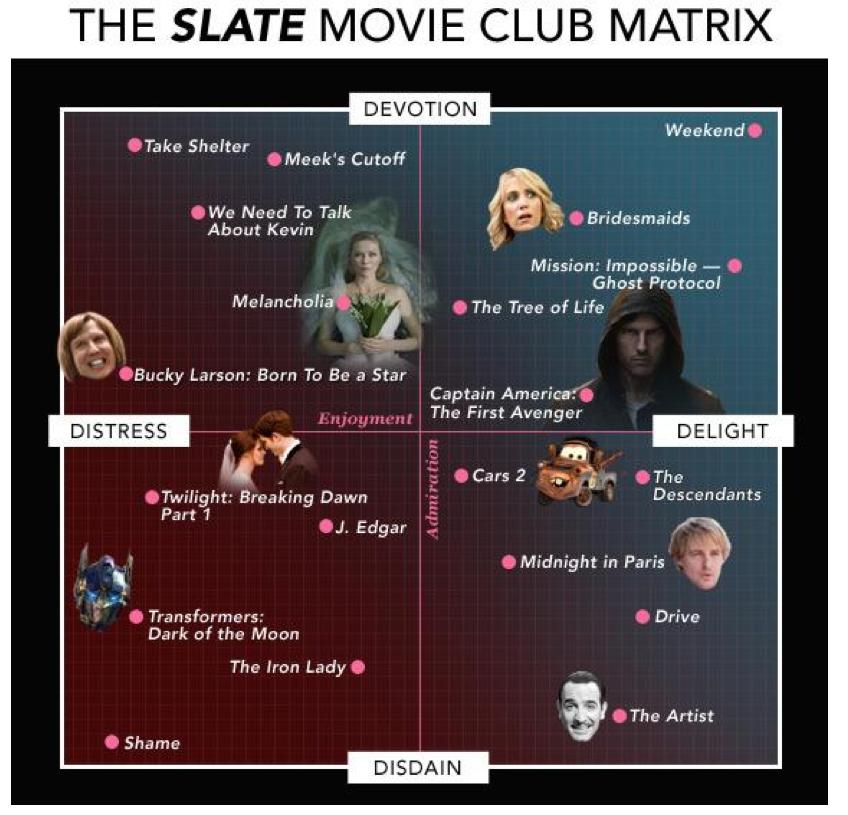
Here’s an exchange from the Movie Club section of the online magazine, Slate, which I found interesting enough to pass on to you. First up is a criticism by Dan Kois, talking about movies (see chart, below) that are difficult to watch but that you later find meaningful vs. enjoyable but forgettable flics:
Are there films that work in the reverse? Films that offer enjoyable viewing experiences, but then afterward provoke disdain? Of course! How about apparent Oscar front-runner The Artist, a charming piece of work that never tires, never bores, never in its 100 minutes stops tap-dancing for your smiles? As soon as it was over I was angry at myself for each chuckle I’d given the movie, and now, weeks later, it only provokes a shrug. This is what everyone is so crazy about? I don’t even mind that it’s a trifle—I like trifles! —but did it always have to go for the easiest joke, the simplest twist, the most obvious turn?
Coming right back at him is another Slate critic, Stephanie Zacharek, who said it better than I could have:
I think, as just the first round of Movie Club proves—as every full year of moviegoing proves—there are an infinite number of ways for movies to reach us, to sneak in through cracks we didn’t even know existed. If you have a house with cracks, you’ve got to seal them up. But for moviegoing, don’t seal the cracks! It’s how the light gets in, as Leonard Cohen said. Which leads me to something you said, Michael, about how both Melancholia and The Tree of Life were both made by directors who think cinematically, and my lack of warmth for TOL notwithstanding, you’re right. As you said, “Directors who don’t think cinematically sadly account for most of the movies we see all year.”
Which is why I really need to talk about The Artist, allegedly the Philistine’s choice for movie of the year. Because it’s not nearly as good as the great silents—it’s not Keaton, it’s not Murnau, it’s not Griffith. Because it’s a crowd-pleaser, a trifle, a soufflé of a movie with no overarching theme or purpose. Because it’s not as great as the buildup from Cannes led us to believe. Because Harvey Weinstein saw it and immediately thought, “I can make money off this.”
I’m afraid there are lots of reasons for not liking The Artist that actually have little or nothing to do with The Artist, and though that happens with lots of movies, I still find it troublesome. I love The Artist, as Dana said, “without disclaimers or shame.” I think shame is a useless construct when it comes to movies. (Disclaimers—well, we all need those once in a while.) In terms of cinematic thinking in 2011, Michel Hazanavicius trumps Terrence Malick. For one thing, he doesn’t need any “Oh, mother! Oh, father!” voice-overs, no shots of the sun peeping through tree branches, to make sure we’re feeling what we’re supposed to be feeling. And he’s relying on the grace of his actors, their way of moving, their subtle shifts in expression, to tell a story in purely visual terms. Not only is there no dialogue; there’s no expository dialogue, no overt explanation of why the lead character, Jean Dujardin’s George Valentin, is so resistant to talking pictures, which some of the movie’s detractors see as a flaw. For me, George Valentin lives in a mirror-universe where he foresees an actor in another universe (the real one), John Gilbert, drinking himself to death in 1936: The problem wasn’t that Gilbert’s voice wasn’t good enough for talkies (it was), but that filmmakers’ awkwardness in the new medium ended up reflecting badly on him, through little or no fault of his own. In other words, the fictional George Valentin had a premonition of something that happened in real life. Why wouldn’t he be afraid?
I love the economy and discipline of The Artist. Hazanavicius finds all he needs in the faces of his actors, Dujardin and Berenice Bejo. And I’m astonished by the effect the movie has had on audiences. I’ve seen it three times now, twice with a “real” audience (the first time, at Cannes, doesn’t count), and both times I’ve been amazed at how restless the audience is at the beginning—there’s that point where you expect the talking to kick in, and it just doesn’t—and how wrapped up they are by the end. I know, I know—just because lots of people love a movie doesn’t make it good. (The Dark Knight, anyone?) But I do think Hazanavicius and his actors have helped unlock the code of silent-film acting for many people, people who have always thought it was overdone or, at least, just too weird to understand. Film critics know all about silent film and silent-film acting, but who cares about us? As the writer Eileen Whitfield observed in her wonderful biography of Mary Pickford, Pickford: The Woman Who Made Hollywood, modern audiences often view silent movies as if they’re trying to be talkies and failing, whereas they’re really much closer to dance, a symbolic re-enactment. The Artist is all about faces and movement and the emotion that can be drawn out of those things together. To me, it’s elemental.
Here, here!
And two more morsels for you. That cool web site, Chaplin-Keaton-Lloyd Film Locations, has an excellent new post up about the shooting of The Artist. Check it out here. And here’s wonderdog Uggie visiting the offices of the London Guardian newspaper:
Ben Robinsonis both a master magician and an historian of magic, author of Twelve Have Died: Bullet Catching, The Story & Secrets and of The MagiCIAn: John Mulholland’s Secret Life, as well as numerous articles for major magic publications. Just last month, Ben’s decades-long research into the use of magic in silent films came to fruition with publication of his latest book, Magic and the Silent Clowns — a subject that had received scant attention until Ben’s work. Concurrent with that, Ben helped curate a fascinating show at New York’s Museum of the Moving Image entitled Magicians on Screen, including both a magic performance by Ben and a lecture-demo on the subject of magic and the silent clowns. In fact, Ben had first proposed the idea to the museum back in the 80s. Patience is indeed a virtue — though persistence sure helps! This blogopedia is very pleased to be able to share the first chapter from Magic & the Silent Clowns, and to be able to match Ben’s enthusiastic prose with a few video clips.
_____________________________________
Keaton the Conjuror
Buster Keaton’s education and use of the conjurer’s illusionary techniques.
by Ben Robinson
“Once Pop accidentally wrecked another act by tossing me into the backdrop curtain. This was the turn of Madame Herrmann, the widow of Herrmann the Great, one of the most popular magicians. She was working some of his simpler tricks. At the finish of her act she had dozens of white doves flying to her from every corner of the stage.” (My Wonderful World of Slapstick, p27)
Buster Keaton was an illusionist.
It is said that the world’s greatest illusionist, or magician, would never be truly known by the public at large. Why? Because so great a “talent” wouldn’t need the adulation, as the prowess by which the work was deployed would be best praised by not even being seen. In the shadows of show business and art, there would lie success. In the French this is referred to as eminence grise. While Buster is certainly known, his use of illusion is at best appreciated as an auxiliary component to the gag.
However, a deeper look into Buster’s upbringing and eventual use of his fantastic vaudeville education clearly expresses itself in his movies, some of his TV appearances and, more notably, when meeting the media. It might be assumed that the Keaton we see is an image he is in total control of. That being said, the controlled image we always saw was one of a surreal world where “magic” was part of the landscape, like air. In the famous Sid Avery photograph of Keaton, titled “What Elephant?” while Keaton looks forward, with his hand on his brow, the elephant’s trunk winds through his other arm, the pachyderm quietly standing behind the comedian. This is a vanishing elephant only to the person closest to the king of the forest, a good metaphor for Keaton’s “magic.”
While the examples of Keaton’s legerdemain are too numerous for inclusion here, this notion may bear some examination in the following examples.
Clearly, legend has it that Buster received his nickname from Houdini. While this may be a matter of conjecture, the legend sticks (and most vaudevillians would tell you that when it comes down to printing the myth or the truth, they yowl, “the myth, print that!”).
That Joe Keaton and Harry Houdini (1874-1926) once appeared before the audiences of the Midwest in a tent show is certainly a fact. It is also a fact that this show, The Keaton-Houdini Medicine Show, was not a great success, and occurred years before Houdini’s triumphant success in Europe in 1900. Of his father Keaton remarks that “he was an eccentric dancer, not an acrobat, but damn near.” The same might be said of Keaton: he wasn’t a magician in the classic sense, but damn near. Like a classic magician, everything that he saw, particularly of the mechanical variety, was always filed away in his memory for future use. His summer home amidst the actor’s colony in Muskegon, Michigan was not far from a little town named Marshall, among its distinctions being the home of the very first electrified house in the US. Called Honolulu House, it doesn’t have the electric staircase (escalator) Buster later used in his movie The Electric House, but it does have many other mechanical wonders, including the sliding bathtub that switches between rooms that Buster used on celluloid.
Backstage, Buster saw it all. He refers to utilizing some of Houdini’s tricks in his movie Sherlock Junior, and even opens Cops with a line credited to Houdini: “Love laughs at Locksmiths.” He also acknowledges a relatively little-remembered genuine Chinese vaudeville illusionist, Ching Ling Foo — whose grand feats included turning a somersault in mid-air and when he returned to a standing position, he held a bowl of goldfish that
appeared from nowhere!
Young Buster grew up learning that magic had to be “justified” or plausible for the introduction of an illusion. He realized in his movie-making career that “cartoon or impossible” gags (and illusions) had to be justified, like his jumping and impossibly disappearing into the briefcase held by a man (dressed as a woman) accomplice on the street (Sherlock Jr.)….
….or appearing as nine individual dancers on stage at the same time (The Playhouse)….
….or avoiding the tornado winds by hiding in a magician’s prop (Steamboat Bill Jr.)….
Whenever magic occurred, Keaton might have been justifying his conceit he explained as “I always want the audience to out guess me, and then I double cross them.”
Keaton’s use of illusion was not always as a trick per se. When the house he moves across the train tracks in One Week narrowly escapes destruction by an oncoming train, another train enters the frame — and his on-screen drama — and demolishes what we only thought, seconds before, was safe. The revelation of the perceptual difference of the first train set the audience up for the wow appearance of the second train.
Similarly a magician will make a scarf appear, only to have the audience relax at that manifestation. When a dove flutters from the folds of that scarf, there comes the “topper.” Buster just played with much larger props.
This type of drama, albeit small, is as much part of the conjurer’s lexicon as a rabbit and a hat. Magicians refer to this type of presentation as a “sucker gag.” Feigned failure, only to be consummated by winning success, or in the previous example, unexpected total destruction.
I believe Buster was schooled in such thinking about surprise (both magic and comedy being dependent on surprise) by his vaudeville and mud show upbringing. The magician’s technique he learned as a child pervaded his work on screen and elsewhere. On stage in France, in the late 1940s, he counseled the clowns in the Cirque Medrano how to get more out of the crowded clown car gag. Multiple large clowns (always ending with the largest of all) simply emerging from a small vehicle was impossible. Once Keaton showed them how the impossibility became surprising, then the illusion became magical, funny and even more surprising. How many times have we all seen this? And how many times have we seen the clowns emerge with beach chairs and finally a clown emerging with a full tray of food including a stuffed turkey? These were Keaton’s touches he culled from the Hanlon Bros. performance of clowning, magic and illusion that took place in
Europe and the US prior to 1900.
And now for the magic that hits you as reality. This may give you an example of Buster’s eminence grise.
Remember the famous scene in Sherlock Junior where Buster is “shadowing” a man walking in front of him? Now, watch as the man tosses a cigarette behind him which Buster catches, takes a drag of and then discards…or does he? Given that Buster is the fellow who had a whole side of a building fall around him, missing him by mere inches, I think handling a lighted cigarette in flight was child’s play for him. But slow down the image and you will see a nifty piece of sleight of hand he no doubt executed on many occasions, being an inveterate cigarette smoker.
Other hand magic: in The Cameraman Buster tried to catch the fancy of the photo assignment secretary by making a quarter disappear in his hand, only to be revealed from behind his ear.
In Steamboat Bill Jr., when attempting to have his father receive a loaf of bread in jail, Buster mimes the contents of the bread and involves another deception of the hands. Effortlessly. Gracefully. As if he yawned.
All magical illusions are understood by the student of the art, firstly through small, hand-held deceptions. Given Buster’s consummate understanding of the nature of his medium (in this case, film) it is likely Buster combined this understanding with his familiarity with the scene backstage where magicians show each other tricks they carry with them, one time known as “vest pocket magic.”
The point: Buster understood close-up magic because he was schooled in close-up magic from day one.
Whether it was dangling from a rope to save his wife from the pitfalls of a raging waterfall (a la Houdini) in Our Hospitality or making it appear as if he simply caught a lighted cigarette from the air, Keaton saw the meshing of illusion and reality in every situation, and exploited it. While performing off stage for a visiting film crew, in his later years, he created the illusion of catching a train, and bringing a 10-ton locomotive to a halt. One might say this was a developed version of catching the side of a moving car and being whisked from view, as in one of his short comedies.
Jack Flosso, the late owner of the world’s oldest magic shop, knew Keaton remotely through his father, the great Al Flosso, veteran of thousands of vaudeville and Coney Island sideshow performances. Flosso says, “When you do magic and don’t admit it, that’s great. Harpo did that, and where’d ya think he got that…Keaton! Buster had an eye for everything. Remember that.” That Keaton’s silent, surreal illusions should find a home in the 1930s amidst Harpo’s arsenal of wonders is not surprising to any Keaton scholar. What is delightful is that Keaton’s use of illusion was an integral part of his day-to-day life.
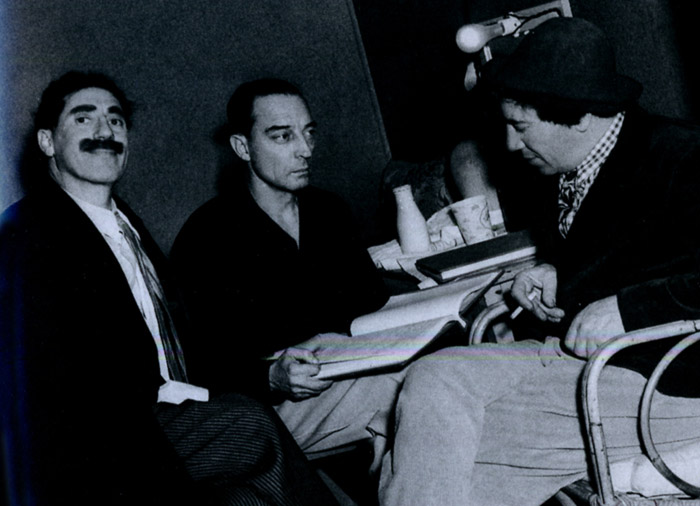
Buster Keaton working as a gag writer for the Marx Brothers
He frequently polished a window near him only to surprise his viewers by putting his head through the glass he had just polished, revealing that his polishing was deft pantomime… the illusionary transparent glass was only perceived as solid by his impromptu audience. Many remark what a great practical joker he was. Such visual jokes have their roots in illusion. In several newsreels depicting Buster at play one finds Keaton doing something short and sweet like sewing his fingers together (later adopted by Red Skelton) or making a baseball disappear for a dog (but not for the rest of the audience). Anything surprising, anything out of the ordinary from this apparently “ordinary” man made his magic more memorable and surprising.
We always hear of the “magic of the movies.” Buster Keaton is a master of a special type of movie magic that, often, you don’t even realize is right in front of you!
_________________________________________________
Sources:
Beckett, Samuel., FILM, Grove Press, NY 1969.
Bengtson, John., Silent Echoes (Discovering Early Hollywood Through the Films of Buster Keaton), Santa Monica Press, CA 2000.
Blesh, Rudi., Keaton, The Macmillan Company, New York, NY 1966.
Dardis, Tom., KEATON — The Man Who Wouldn’t Lie Down, Limelight Edition, 1996
Kerr, Walter., The Silent Clowns, Da Capo Press, NY 1975.
Keaton, Buster with Charles Samuels., My Wonderful World of Slapstick, Doubleday & Co., NY 1960.
Kline, Jim., The Complete Films of Buster Keaton, Citadel Press, NY 1993.
Knopf, Robert., The Theater and Cinema of Buster Keaton, Princeton University, Press, NJ 1999.
Meade, Marion., Buster Keaton Cut to the Chase., Harper Collins, NY 1995.
Tobias, Patricia Eliot, Ed., The Great Stone Face, The Magazine of the Damfinos, The International Buster Keaton Society, Volume 1, 1996.
Interview with Jack Flosso in New York City, December, 1999.
Kevin Brownlow, & David Gill (producers)., Keaton — A Hard Act to Follow, Thames TV production, 1987.
________________________________________
This article was originally published in The Keaton Chronicle, the magazine of the International Buster Keaton Society, The Damfino’s, in the Vol. 10 Issue 4, Autumn, 2002. Reprinted by permission. It is also part of Ben Robinson’s book Magic & The Silent Clowns (2011).
________________________________________
Visit Ben’s web site here, where you can also purchase his book directly via PayPal.
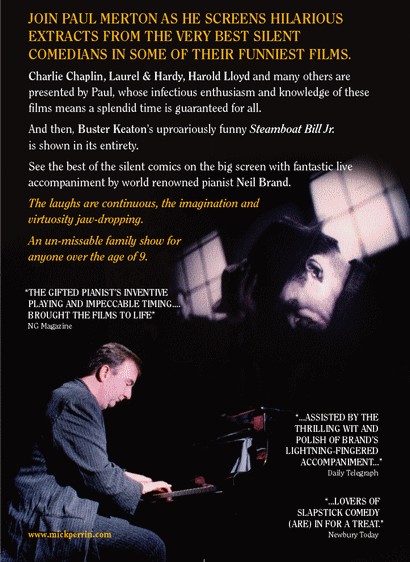
There are a ton of books about silent film comedy, many of them excellent, but they’re not written by performers. Paul Merton, author of Silent Comedy, is on the other hand a popular British comedian — mostly improv and stand-up, rarely silent —with a love for the heyday of slapstick. He has even done several lecture tours on the subject, bringing screenings with live music to theatre festivals and other venues throughout the U.K. In the past two years he has produced two documentaries on early film (not just comedy) for television: Paul Merton’s Weird and Wonderful World of Early Cinema (BBC Bristol, 2010) and The Birth of Hollywood (BBC2, 2011). He has also done an interactive presentation on early British film comedy for the British Film Institute, which you can view online here.
Merton is, first of all, a good writer! The problem I have with most historical works is that they’re too thorough. I know the impulse: you’ve done all that research, naturally you don’t want it to go to waste — “I suffered for my art; now it’s your turn!” — but the result is more info than the reader needs. You can’t see the forest for the trees. Merton’s chronicle is full of fascinating tidbits and anecdotes, but he marshalls those facts to make a point. They all contribute juice to the narrative flow and actually tell us something significant about the performer. The result is a rich and entertaining read, 329 mass-paperback pages, though obviously you’ll get a lot more out of it if you can view some of the films he’s talking about, easy enough with YouTube and a basic DVD collection. Think of it as a companion volume to the actual movies.
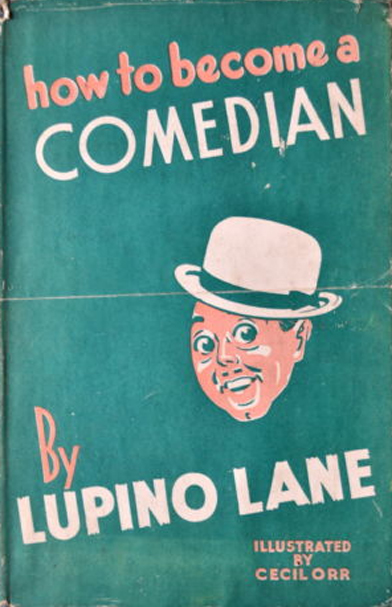
Merton chooses to limit his study to Chaplin, Keaton, Lloyd, and Laurel & Hardy. He is dismissive of Harry Langdon; other comedians such as Fatty Arbuckle and Charley Chase play only minor roles, and there’s no mention at all of Lupino Lane or Charley Bowers. Instead of separate sections on each comedian, the approach is chronological, which might sound boring and unimaginative, but isn’t because he switches back and forth between these powerhouses every year or two to show how they continually tried to outdo one another. This works very well, bringing fresh insights into their working methods; for example, how Lloyd’s success with the thrill comedy Safety Last spurred Keaton and Chaplin to create similar moments in Three Ages and The Gold Rush, respectively.
As a performer, Merton is always thinking from a performer’s point of view, getting inside their heads better than most silent film historians. To his credit, he notices what stunts are real, and very much appreciates the virtuoso skill and hours and hours of practice required. However, not being a physical performer, he’s not as sharply attuned to physical comedy vocabulary. It does not occur to him, for example, that the topmounter in the running 4-high in the elopement scene from Keaton’s Neighbors is — in most of the shots — very likely a rag-doll dummy, and not Virginia Fox.
________________________
“Slapstick comedy has a format, but it is hard to detect in its early stages unless you are one of those who can create it. The unexpected was our staple product, the unusual our object, and the unique was the ideal we were always hoping to achieve.” — Buster Keaton
________________________
As much as he admires the creativity of this golden age of cinema, Merton is not afraid to address its uglier aspects, specifically negative racial and gender stereotypes widely prevalent in those days. But he is also quick to point out progress made during the 20s in both areas, for example in Keaton ‘s ThePaleface (1922) and The Cameraman (1928).
Keaton and Chaplin in Limelight (1952)
With his successful silent film tours offering solid evidence, Merton is bully on the appeal of silent film comedy when presented in the right circumstances, a point I was emphasizing in my recent Revenge of the Silents post. Here are just a couple of examples Merton offers:
In January 2007 at the Colston Hall, Bristol, I presented Steamboat Bill Junior to over 1,500 people on a big screen with superb musical accompaniment from Neil Brand and Gunther Buchwald. The house front falling towards Buster is a tiny moment in a cyclone sequence that runs for nearly fifteen minutes, but when the stunt happened the audience cheered and applauded spontaneously. A few days after this ecstatic response I heard the playwright Mark Ravenhill extolling the virtues of Steamboat Bill Junior on a BBC Radio 4 arts programme. I seem to remember that he had seen the film on a big screen at an open-air festival many years before.
The other people in the studio, who sounded like professional critics, had each been given a DVD of the film to take home and watch. Their verdict was unanimous: it simply wasn’t funny because in their view humour dates very quickly, and black and white silent comedy couldn’t be more dated if it tried. How could they get it so wrong? Well, watching a silent film on a small television screen with inappropriate music as accompaniment can destroy the magic. It’s easy to see nothing….
Laurel and Hardy’s last silent film release before their first talkie has often been considered their best ever. I’ve watched Big Business more than thirty times with a live audience, and the responses have been remarkably uniform. They always laugh in the same places with the same regular rhythm. Stan and Leo [Mc Carey] previewed their films in exactly the same way as Harold, Buster and Charlie, and the films were recut according to the audiences’ reactions. That’s one of the reasons they still work so well today.
A page from Merton’s book, above, and a few more short selections below….
He [Keaton] was always proud that he didn’t use a stuntman. Larry Semon’s films are chockfull of stuntmen all pretending to be him, but it was Buster’s belief that stuntmen didn’t fall in a comical way. [NOTE: Keaton did have a stuntman pole-vault into the dorm window for him in College, which I believe was the only time he was doubled, at least in the silent era. —jt]
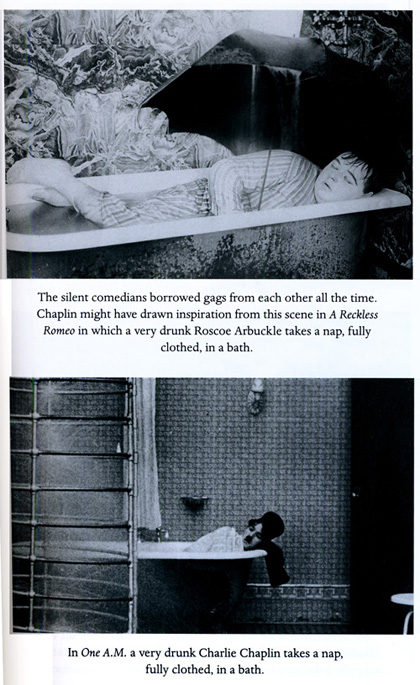
The tiresomely idiotic debate on Keaton versus Chaplin is, in my experience, overwhelmingly used by proponents of Buster to attempt to rubbish Charlie… It’s an appealing mind-set for some people, who say: “We’ve all heard that Charlie Chaplin was meant to be the greatest comedian in the world, but my preference for Buster Keaton demonstrates my ability to think for myself. Chaplin was overly sentimental, but Keaton’s coolness and cynical eye chime exactly with our Modern Times….” Well, the good news is that they are both fantastic. There’s no need to choose between them. Enjoy them both! That’s one of the main aims in my book. I shall examine the films of Charlie Chaplin and Buster Keaton, not in isolation, as has been the usual practice, but showing how they influenced each other in a creative rivalry that also featured Harold Lloyd. This rivalry and desire to make better and better comedies ensured a stream of high-quality pictures. Great works of art were created.
As much as he [Keaton] liked Roscoe [Arbuckle], he was trying to get away from unmotivated slapstick. In all the years they worked together, the only disagreement Buster had with Roscoe was over Roscoe’s assertion that the average mental age of an audience was twelve and that you should pitch your comedy at that level.
_______________________________
As for Paul Merton the comic, he is hardly silent, known instead for his surreal rants, often delivered dead pan, though he denies mimicking the Great Stone Face, Buster Keaton: “It comes from one of the first things I did as a stand-up in the early 80s called A Policeman on Acid, which was basically this policeman recounting in court the time someone gave him some acid and describing his trip. And I realized then it was much funnier if the policeman himself didn’t find anything he was saying funny, so the deadpan approach came from there, and I suppose that kind of set a style. I wasn’t deliberately copying Keaton at that point.”
Here’s the clip:
Merton is returning to touring his own comedy in 2012 in a “night of sketches, music, magic, variety, and dancing girls (two of them aren’t girls).” Click here for more information.
[post 221] Despite frequent tributes to the stars of the 1920s, despite all those beautifully remastered DVD sets, despite your enthusiasm and mine, our modern world has pretty much relegated silent film comedy to the nostalgia bin. Most of the younger generation has only vaguely heard of Chaplin or Keaton, much less seen any of their films, and names like Charley Chase, Harry Langdon, or Fatty Arbuckle mean nothing to them. I know; I teach college.
There are both good and bad reasons for this. Admittedly, the quality of these early films can vary drastically — not unlike television today. Many are formulaic, with minimal character or story development. Other than the action sequences, the pace must seem slow to a visual generation used to shots lasting only a couple of seconds. And did I mention — horrors! — they’re in black and white?
But presentation is also a major problem. Before you’d plunk down cash to buy a silent film comedy on DVD, you’re more likely to go to YouTube to watch one of the comedian’s movies, or more likely just an out-of-context clip. You’re going to be sitting at your desk, probably surfing the net at warp speed, seeking instant gratification. The video and audio quality is likely to be poor, depending on the source and the amount of compression for the web. Frustrated with the small size, you enlarge it to full screen, but now it’s all blurry and pixelated. The sound track, coming out of your computer’s sole speaker, is likely to be generic, just some ragtime tune slapped on top. If the clip doesn’t grab you in twenty seconds or less, you’re gone.
Ben Model
Contrast that with sitting in a crowded audience watching a restored print (film!) on a large screen. The music has been composed specifically for this movie and is being performed live by a talented and enthusiastic pianist, perhaps by an entire band. The audience is laughing loudly (they always do) and probably cheering and jeering as well. Soon you forget that it’s not in color, you forget that you can’t hear any dialogue. Instead you’re marveling at all that creativity, wondering why they can’t make movies like that any more. Silent film as a live performing art! But…. I’m guessing the number of people who’ve had this experience is way under 1%.
Is it at all possible, however, that the tide may be turning?
Not only are live performances of silent films growing in popularity, but two major commercial films about the silent era have just opened to rave reviews and serious talk of awards for best film of 2011. The first is The Artist, an actual black & white silent movie, which I previewed in this earlier post, when it almost won the Cannes Film Festival.The second is Martin Scorcese’s Hugo, based on the novel The Invention of Hugo Cabret, a book I wrote about in this earlier post on Georges Mélies. Hugo’s not silent, it’s color, and it’s even available in 3D, but much of it as a tribute to Mélies and the inventiveness of early cinema.
More on both of these shortly, but first honorable mentions to some of the silent film series that have paved the way. In New York, there are at least two ongoing series that you should know about, both of which have the imprint of Ben Model, silent film historian, composer, and pianist. The Silent Clowns Film Series, ongoing since 1997, presents about ten events a year, all free, and all featuring Ben on piano, with programming by Bruce Lawton and film notes by Steve Massa. Many of the films screened are not available anywhere else and are usually seen on newly restored prints. Always a fun time, full of revelations, and after the movies are over, Ben, Bruce, and Steve hold court, fielding questions from an audience of fellow fans.
Ben has also done a lot of similar work for the Museum of Modern Art, including the current film series Cruel and Unusual Comedy, focusing on social commentary in American slapstick, which he curates with Ron Magliozzi and Steve Massa. The most recent installment, however, focused on some marvelous rare early European comedy shorts from the Desmet Collection of the EYE Institute (Amsterdam). This was billed as “a sort of highlights reel of a complete 5-program series that will be presented at MoMA during 2012.” Judging by what I saw in October, this collection is a significant find. And while I hope it eventually ends up on DVD, that won’t be as cool as having seen the movies accompanied by a live band, with my Bloomfield College colleague Peter Gordon on saxophone!
Another place in NYC to learn more about the silent era is The Museum of the Moving Image in Astoria, Queens, which houses exhibits on movie history, but also has a steady stream of screenings and lectures. If you’re in town December 17th, don’t miss master magician Ben Robinson’s lecture, Magic and the Silent Clowns: There is a strong link between some of cinema’s great comedians and magic. Performers such as Buster Keaton, Charlie Chaplin, Harold Lloyd, and Harpo Marx started out in the world of vaudeville; many of their finest gags grew directly out of their love of magic. Magician and author Ben Robinson will show scenes from such movies as Grandma’s Boy, Sherlock Jr., The Circus, and Duck Soup to examine this important connection between magic, comedy, and cinema.
Also in New York, the Film Forum provides another home for screenings of silent movies with live musical accompaniment. They are currently in the midst of a Monday night series, The Silent Roar, featuring MGM films from 1924 to 1929, with Steve Sterner on the piano. Buster Keaton’s The Cameraman plays the day after Christmas.
Enough tooting the Big Apple’s horn…. don’t want to make all those New Yorkers blush! Back to our regularly scheduled programming…
Bérénice Bejo & Malcolm McDowell in The Artist
The Artist
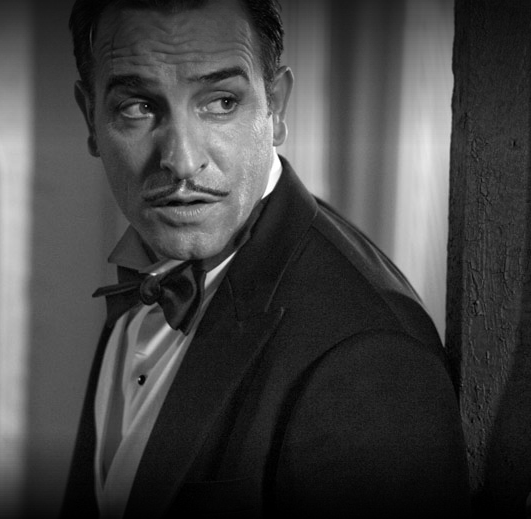
This is a French film directed by Michel Hazanavicius, most recently known for his OSS 117 spy spoofs, and starring Jean Dujardin and Bérénice Bejo (real-life wife of Hazanavicius). Other than its bland title, I was utterly won over by The Artist, whose story unfolds against the backdrop of the transition from silent films to sound. There are obvious parallels with Singing in the Rain, except The Artist actually is a silent movie, and a black and white one at that. It’s also stylish and sweet, quite funny, and very well acted. Dujardin and Bejo are easy to fall in love with, and John Goodman as the cigar-chomping Hollywood mogul and Uggie as the dog Uggie are both hilarious.
Jean Dujardin as George Valentin
Although the male lead, one George Valentin, is dashing, athletic, and comic, very much in the style of Douglas Fairbanks, The Artist does not attempt to recapture the world of the great physical comedians. “It wasn’t the slapstick that meant so much to me. It was the melodramas,” explained Hazanavicius. “The point was to share that sensual experience I felt sitting in the cinema watching Murnau’s Sunrise.” Be that as it may, the style is sumptuously visual and the acting ultimately physical. And did I mention that it’s very well done?
Bérénice Bejo as Pepe Miller
At the risk of sounding mushy and sentimental, I was also pleased to see characters that were not total jerks. Yes, self-serving jerks exist, but that can also be too easy of a writing choice. The George Valentin character could have been an arrogant womanizer and a bitter loser. Peppy Miller’s stardom could have made her totally full of herself. Goodman’s Al Zimmer could have been a ruthless producer. Instead, they all have their positive side, which (spoiler alert) makes a happy ending possible. Yes, you could argue that this is phony and manipulative. After all, Hollywood comes off very well in this French valentine to America, which is no doubt one reason The Artist is creating Academy Award buzz. But not the only reason. It’s an exceptional film, and has already won Best Film of the Year from the San Francisco Film Critics Circle and the Boston Society of Film Critics, and has six Golden Globe nominations, including Best Comedy.
Here’s the trailer:
Better yet, here’s a short scene from the movie with the director’s commentary:
Hugo Martin Scorcese’s Hugo is another valentine to the movies, but in this case an American director returns the compliment, reminding us all of France’s contribution to early film history, specifically the effects-laden work of magician-turned-director Georges Mélies. Hugo is quite the contrast, a full-color, all-talking, big-budget Hollywood movie with major stars (Ben Kingsley, Jude Law, Sacha Baron Cohen) and serious technology, including a cool secret world concealed within Paris’ Montparnasse train station, which for a price ($17.50 in Manhattan!) we get to explore in 3D.
But what on earth does this have to do with silent film comedy?
A lot, as it turns out, because [spoiler alert] that crotchety old man winding down his life selling wind-up toys in the train station is — true story — none other than silent film pioneer Georges Mélies, long since forgotten by the public, his early special effects movies all thought to have been destroyed. Not to worry: it is his fate to be rediscovered by an orphaned boy who secretly lives in the station, following in his father’s and uncle’s footsteps by caring for the clocks, one of which he of course ends up hanging from in the climactic chase scene, à la Harold Lloyd in Safety Last.
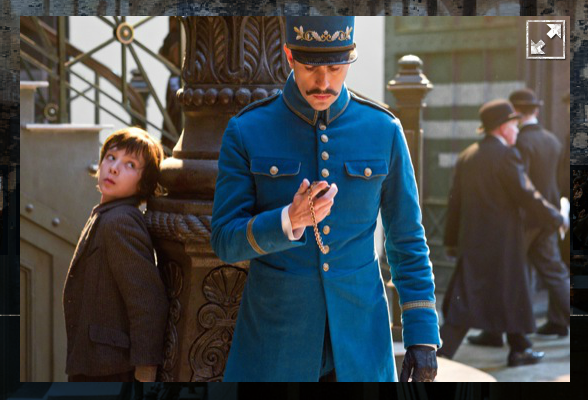
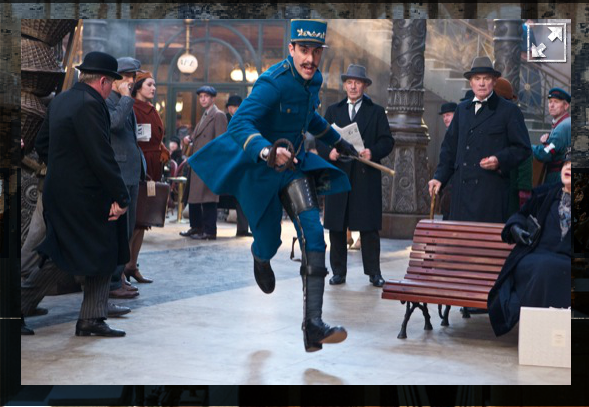
Speaking of chase scenes, Sacha Baron Cohen of Borat fame plays a nasty Keystone Kop with a leg brace who is intent on nabbing vagrant kids and packing them off to the orphanage, and therefore much chasing ensues. Unfortunately, Cohen’s comic genius does not get full rein here, and the potential for physical comedy is squandered. What is special, and to my mind well worth the price of admission, is the loving recreation of Mélies’ Paris studio and working methods — with Scorcese as a cameraman! — which constitutes the final section of the movie. Very cool. Indeed, the whole movie can be seen as a tribute to film preservation, with the film archivist (played by my former student, Michael Stuhlbarg) clearly modeled on Henri Langlois, founder of the Cinémathèque Française.
Here’s the official trailer:
A good movie, not necessarily perfect, but its heart is in the right place, and it has an important story to tell. Two weeks ago, when I first saw both of these, I would have thought American judges would be favoring Hugo over The Artist, but the opposite seems to be happening. We’ll have to wait and see but, either way, silent film is the winner.
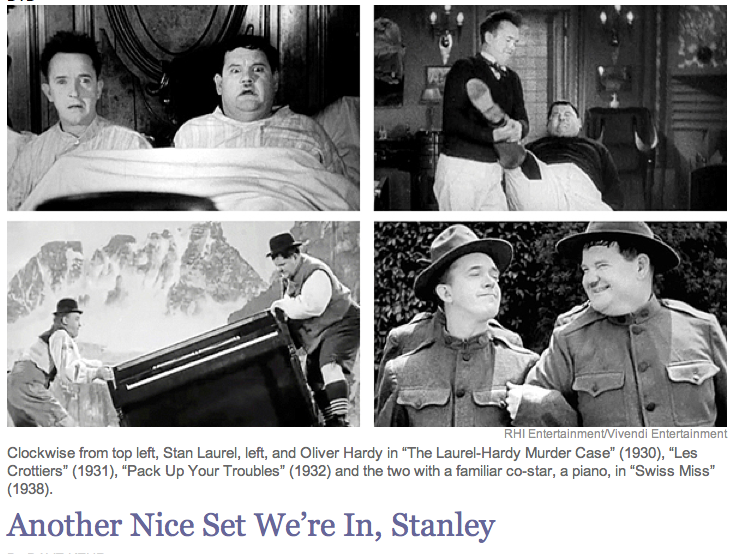
It hasn’t been hard to find something approaching the complete works of Keaton, Chaplin, Lloyd, and Langdon on DVD in recent years, but when I wanted to purchase the Laurel & Hardy opus, I had to order a 21-disc box set available only in the UK and deal with all the region and formatting conflicts. All that has now changed with the release of a 10-disc box set suitable for the region 1, NTSC market, Laurel & Hardy: The Essential Collection. True, this has only 32+ hours of footage, as opposed to 68+ on the British set, but then who’s counting?
I haven’t reviewed the British box set because, not surprisingly, I haven’t found the time to plow through it, and I haven’t seen this one yet either, but there’s a big article on it in today’s New York Times, which you can read here. Here’s a brief excerpt from the review:
Maturity remains a fluid and frequently elusive concept in Laurel and Hardy, which is certainly one of the reasons they appeal so much to children and remain a favorite of adults, who know how thin such facades can be. But what remains constant at every phase is the unbreakable bond of affection between the two friends, who seem at first so radically mismatched, both physically and temperamentally, but are ultimately inconceivable without each other. Among many other things “Laurel and Hardy: The Essential Collection” contains one of the most beautiful love stories the movies have ever told.
The list price is $100, but Amazon is selling it for $65.
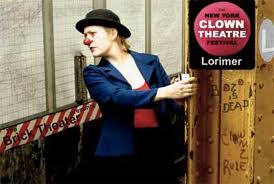
Last month I posted a preview of the Clowns on Filmevening at the NYC Clown-Theatre Festival, perhaps a shameless piece of self-promotion since I was co-hosting the event with Audrey Crabtree. I wrote that the work that evening would be great, since Audrey (festival co-director ) had told me so and I believed her, though honestly I hadn’t seen most of the films before stepping on stage. Of course my hidden agenda was to try to fill the voluminous Brick Theater to the rafters. If you’ve never been there, think Radio City Music Hall. (Yes, that was sarcasm.)
As luck would have it, we actually did sell out, the movies were truly excellent, and the audience had a helluva fun time. Plus we bribed them with free prizes.
I can’t replicate the evening for you since for that special night all of the filmmakers were in the audience and three of the movies were accompanied by live performance. And need I mention the charm, wit and acrobatic partnerings of the aforementioned co-hosts? However, I can now show you more than I could in that previous post, because three of the movies have since been put online. So… “let’s go to the videotape.”
Behind the Nose
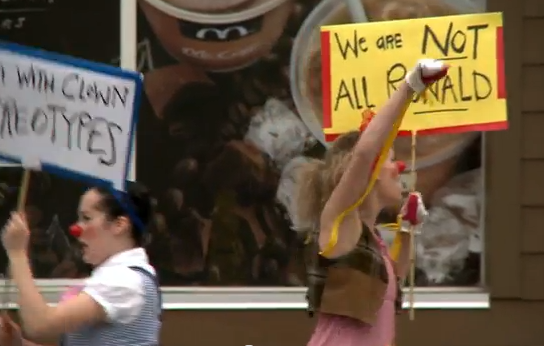
Another confession. This one was already on YouTube but I didn’t mention that in my previous post so I could lure unsuspecting patrons to the live screening and separate them from $15 of their accumulated wealth. Also, I knew it would be a hoot for everyone to watch this short film sitting in an audience of fellow clowns, all of whom struggle with the popular perception of clowning prevalent in America and, in this case, in Canada. Funny stuff, but still sadly true. The movie is the work of those fantastically spunky Toronto clowns, Morro & Jasp, who an hour earlier had just finished performing live their latest show, Morro & Jasp Gone Wild.
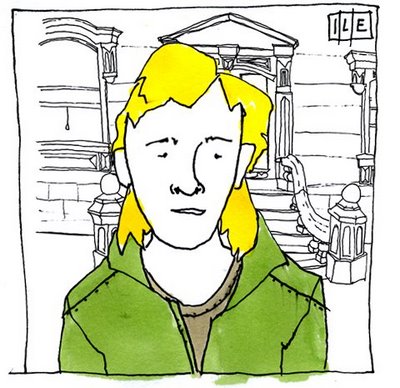
Isaac Littlejohn Eddy
Isaac is not only a performer in the New York edition of Blue Man Group, but he also has the coolest name of us all — though Zea is a close second! Isaac is at least a double threat, a performer but also a cartoonist / animator whose work has been seen in the New Yorker and Time Magazine. His festival piece was an updated version of the poor guy trying to choose between the advice of his good angel on one shoulder, his demon on the other, with Isaac performing live as the tormented soul while his would-be spiritual advisors appeared onscreen in the form of 2D animation. A very well-received piece, but Isaac says it’s still a work-in-progress and he wants to use it in future live performances, so he’s not posting it online just yet. You can, however, see plenty of his other work simply by clicking here.
Zea Barker
Zea, aka Bony Lil, is yet another performer-animator dynamo, the star and mastermind behind two films about “the extreme opposite ends of the creative process.” The first is Distraction, everything that prevents us from getting rolling, and the second is Creation, that happy time when all the juices are flowing. Both movies are silent, in black & white, and come with soundtracks, but at the festival they were presented accompanied by two live musicians plus Zea and her director, Michael Pope, doing sound effects on a variety of ingenious devices. Highly original pieces that display strong talent and a heckuva lot of work.
Distraction
Creation
You can see more video, animation and art work at Zea’s web site and you can view her performance reel here.
A Day’s Messing
Jeff Seal’s A Day’s Messing is unusual in that it is a modern-day silent film that stylistically emulates the films of the 1920s. This is easier said than done, but in this case the experiment works quite well indeed. Story, cinematography, and physical comedy are all right on target, and its world premiere at the festival received enthusiastic and sustained applause from the live audience. Now that it’s been posted on Vimeo, you too can watch it. Enjoy!
Well, maybe it’s his birthday. The year was 1895 and the day was probably today.
It’s fitting that a blogopedia by the name of “All Fall Down” should celebrate Buster’s birthday by featuring a compilation of Keaton clips set to a song named “Don’t Bring Me Down” (Electric Light Orchestra, 1979). Thanks to YouTuberebhiggins90for the edit, which came my way by way of Riley Kellogg by way of Drew Richardson.
This post is not mere shameless self-promotion, at least not entirely. This Friday night (Sept. 16th) at 10 p.m., Audrey Crabtree and I will be co-hosting a presentation of short clown films at the NY Clown-Theatre Festival at the Brick Theater in Williamsburg, Brooklyn. And you should come, because we’ll be lonely without you, plus it’s going to be pretty exciting. Here’s why…
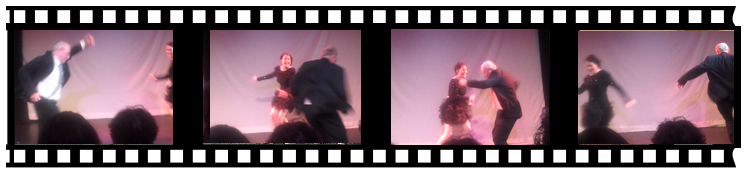
This is not just one of those screenings where you sit and politely watch movies in the dark. No way. One movie comes with a live band and another with live performance by Isaac Littlejohn Eddy of Blueman Group. And not only that, all the filmmakers will be on hand for you to meet. In fact, Morro and Jasp are doing a live show at 8 p.m. which is totally different from their movie. I saw them last year, they are downright funny, and their content is quite fresh for clowns — last year’s show was about puberty — so come for a double-header.
As if that weren’t enough, Audrey and I are concocting some surprises for you. All I can say, and this is strictly off the record, is that there will be prizes awarded and you, and I do mean the you who is reading this post at this very moment, have an excellent chance of winning.
Here are a couple of sneak-preview trailers for you.
And here’s a short trailer for Jeff Seal’s silent movie, A Day’s Messing which, miraculously, is that rare commodity, a successful modern-day silent film short.
For more information, go to bricktheater.com and click and scroll until you find this in a version large enough to actually read: