Tag: Dance

Guest Post: Betsy Baytos on Eccentric Dance

POST 300
Monday, November 5, 2012


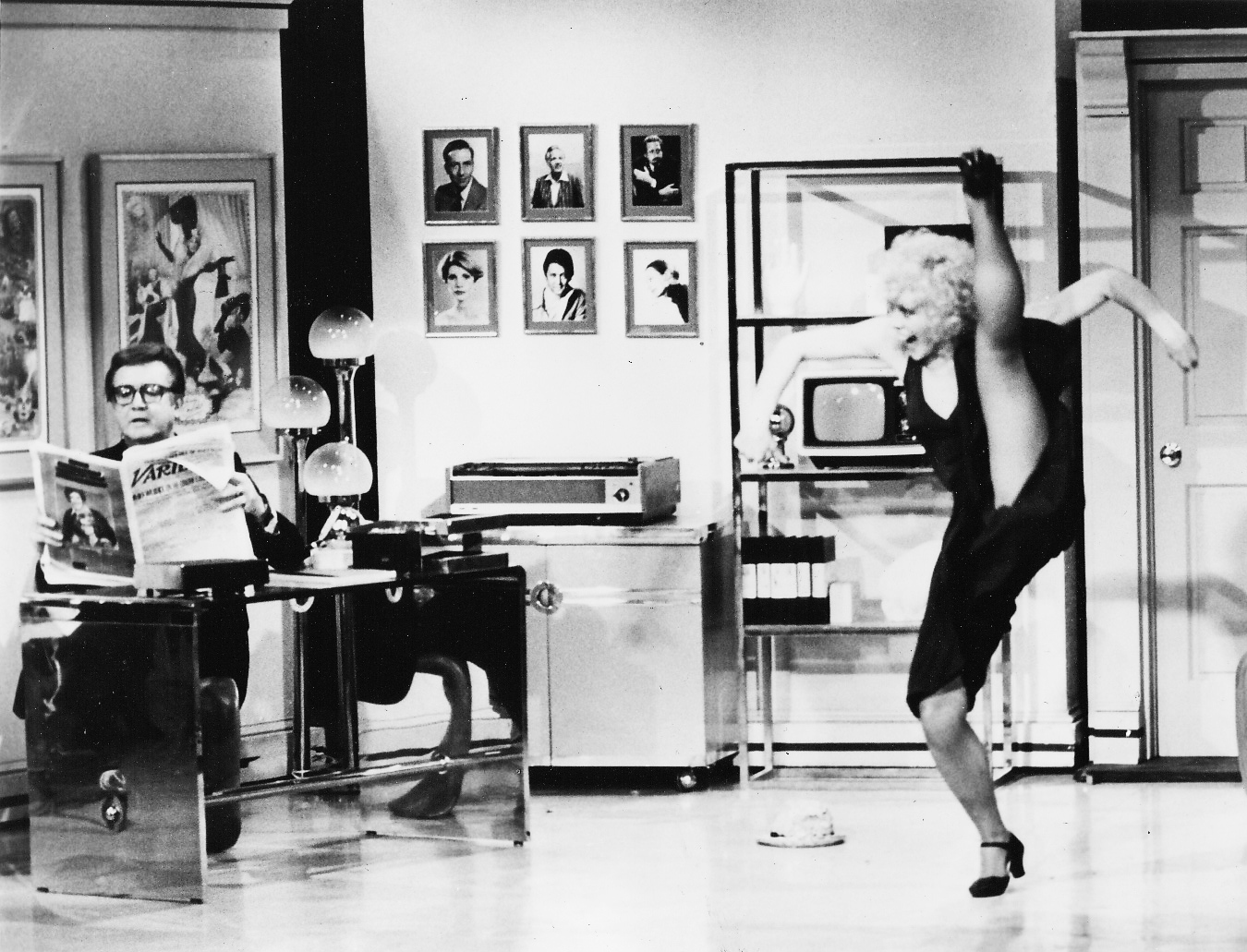
Betsy on the Steve Allen Show

I have the honor of turning my 300th post (!) over to eccentric dancer Betsy Baytos, whose documentary film project, Funny Feet: The Art of Eccentric Dance (see two posts ago) draws upon this dance background and her work as an animator with Disney Studios. A twin threat! Betsy has graciously agreed to favor us with a few guest posts on eccentric dance. For starters, she’ll share some of her own work with us and explain how she came to straddle the worlds of animation and eccentric dance. (And by “straddle” I mean a full split!) 
____________________________________

There is a good reason I have followed the unchartered path of the eccentric dancer! Early on, while working as a young animator at Disney Studios, I studied dance from an old vaudevillian, Jon Zerby, who quickly noted my extreme flexibility and lack of control at the ballet barre, concluding that I was destined for another path. He taught me my first “silly walk” and talked a great deal about the eccentric dancers he worked with on the bill. And I never looked back.

Gil Lamb

I was always searching for new opportunities to apply the eccentric movement I learned from anyone who would teach me, and was stunned to observe actual steps, a repertoire of movement and routines that every eccentric dancer performed. The unique nature of the eccentric dancer is — depending on their flexibility and individual idiosyncrasies — to add their own twist to an already comical and exaggerated position.

There are three distinct eccentric styles: traditional (Cagney, Al Norman, Hal Leroy) inspired with a Celtic flavor of loose footwork; snakehips (Snakehips Tucker, Josephine Baker, Cab Calloway), reflecting a West African looseness in the hips; and legmania (Will B. Able, Gil Lamb, Charlotte Greenwood, Melissa Mason), which is rooted in the French can-can and takes the high kick to a new level! But many eccentrics excelled in all three, and along with great character and a storyline to dictate the reason for their movement, created their own signature act.
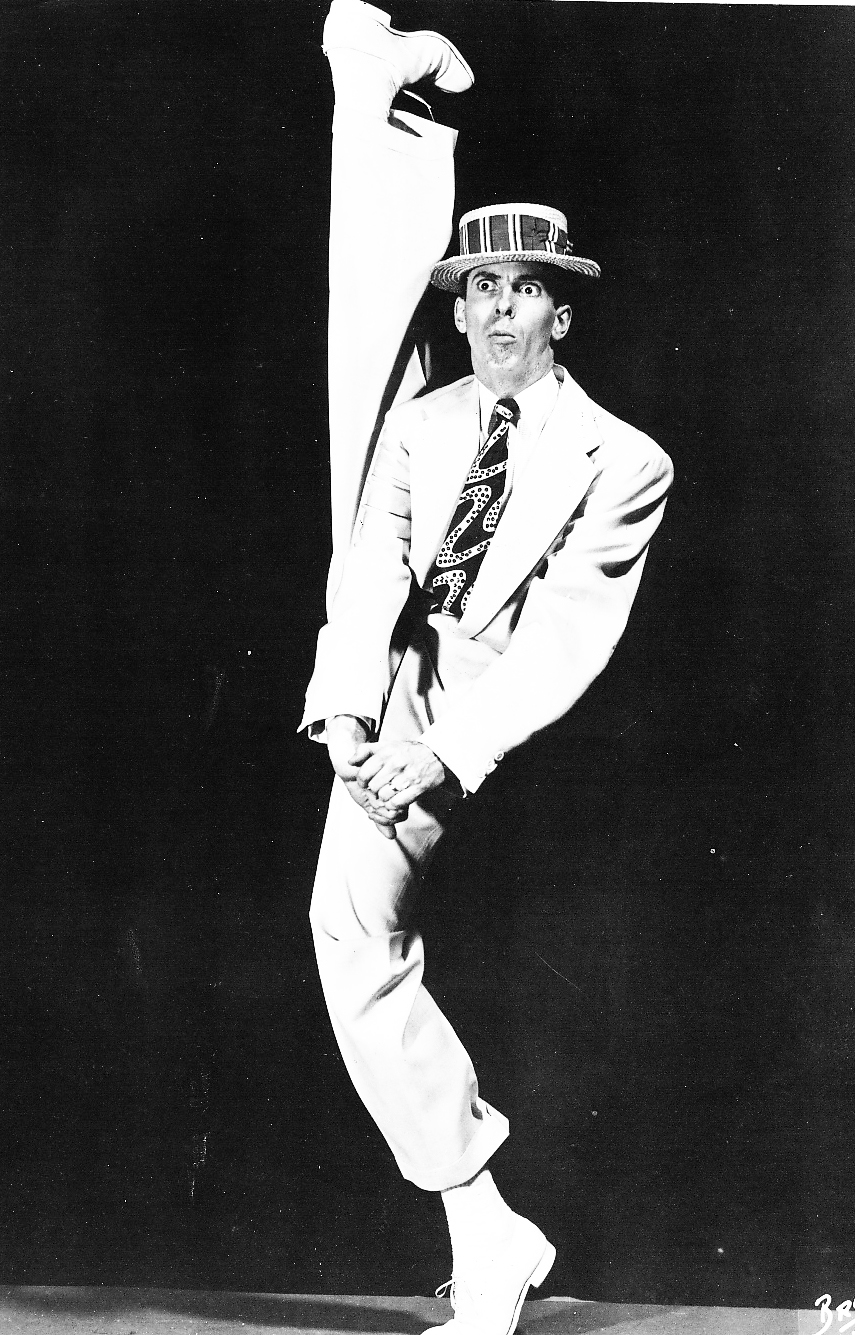
Will B. Able

My first mentor in eccentric was the great 6′ 6″ tall legmania dancer Will B. Able, who hired me for his vaudeville/burlesque Show, Baggy Pants & Co., followed by Gil Lamb, who I pulled out of a poker game at Milt Larsen’s wonderful Variety Arts Theater in Los Angeles. I’ll never forget Gil, staring at me incredulously while holding a spread of cards, cigar jutting out of the corner of his mouth and bifocals teetering low on the bridge of his nose, finally agreeing to teach me. After working with them both, I knew these legends were pure gold! It was Milt who then generously provided me with my first films to study from the old Ed Wynn Show, where many eccentric dancers were featured.

The Muppet Show! A friend provided me with a chance of a lifetime, and I was soon auditioning for a bewildered Jim Henson at the Beverly Wilshire, in front of their fireplace mantel, demonstrating my full-bodied eccentric dancing ostrich idea. Twelve weeks later, I was working in London on the Muppet Show, and the Betsy Bird was born!


I tried everything while working the remaining two seasons, puppeteering and exploring how the costumes could be re-designed for maximum flexibility. From there came the Muppet’s first live performance at the Kennedy Center, where the Betsy Bird was featured in a bird-like, whimsical pas de deux. But London proved to be the pandora’s box in my quest for eccentric knowledge, and I was stunned at the vast amount of material available and the scores of eccentric dancers abiding in this unchartered territory.

I was soon spending time with the legendary Max Wall and Benny Hill, Johnny Hutch, Norman Wisdom & Lord Lew Grade, and discovered this style was rooted in an even older European tradition. And it was here that they spoke of the “art of pantomime,” the commedia slapstick school, and the advent of the American minstrel show. Here that the eccentric, the early visual comics, now integrating strong character personalities and storylines, flourished for over 200 years. It was in England where eccentric took form. I realized that eccentric dance was beyond mere satire and schtick, but a universal language, and a direct reflection of our culture.

Upon returning from the Muppet Show, I was invited to appear on the Steve Allen Show, in a sketch that was based on my actual audition. Steve, a champion of my work in this field, encouraged me to continue, as did Hermes Pann, Fred Astaire’s choreographer. Hermes made clear that I understood, in one emotional moment, the torch I was destined to pass along.

More determined, I was soon back at Disney and a promotional tour for the re-release of Bambi, where I talked them into allowing me to draw, then dance with Thumper, and a 6-week tour followed.

I continued to study, learning snake-hips from Buster Brown, and doing research, whenever and wherever I could….it was while working in the basement, on a 10′ x 20′ mural for Disney Corporate in New York City, that a phone call changed everything. I was soon auditioning for the Broadway Show, Stardust, with an act I had been developing for 10 years. A throw-back to vaudeville, dancing with a puppet was not unique, but coming back as the puppet, and in this case, a 1920’s gigolo named “Maurice” certainly was! With a desire to perform eccentric while wearing a tux, while paying tribute to Ray Bolger and Leon Erroll, I was soon featured as the physical comedienne in the show, which ran for two years, working with the great choreographer Henry Letang (Sophisticated Ladies, Cotton Club, Tap). For the first time I could pay homage to all those eccentric masters and carry the torch that much further.

I hope you enjoyed these performances. Thank you!
___________________________________

Visit Betsy’s web site here.

And come back soon for more eccentric posts!

SHARE
EXPLORE FURTHER

Funny Feet: The Art of Eccentric Dance

POST 298
Tuesday, October 23, 2012

In my next life I’m hoping to come back as an eccentric dancer. I wants me some rubber legs. I’m sure you feel the same.

I never get enough of this stuff, but if Betsy Baytos has her way, I soon will, because she’s been hard at work on a documentary titled Funny Feet: The Art of Eccentric Dance. She fell in love with the subject while working as a Disney animator and has been researching it for a couple of decades now. Here’s her definition:

It’s the cockeyed strut of Jimmy Cagney in Yankee Doodle Dandy and the classic tramp of Charlie Chaplin, the wild banana dance of Josephine Baker or Groucho’s zany twist kicks, the sentimental scarecrow of Ray Bolger and Goofy being, well, Goofy! The ‘Lord of the Rings’ Andy Serkis as dance master in TopsyTurvy and John Cleese’s indomitable ‘Ministry of Silly Walks’, Massine’s spirited Peruvian in Gaiete’ Parisienne and the outrageous and impossible break dancers of today. Yep, it’s ALL Eccentric and it’s ALL visual ‘comedy in dance’, with the funniest feet, rubber legs, snake hips, and craziest legmania hi-kicks, where twists, falls and the most exaggerated and outrageous comical movement, delineate a unique character, who performs a surprising, but always hilarious, story through dance!

A lot of work has been done, but she now has a Kickstarter campaign aimed at financing the rest. Here’s her pitch (click green arrow), worth watching for the footage and because if she pulls it off, it will be a valuable addition to performing arts history.


UPDATE (12-5-12): The Kickstarter campaign is over, but you can read more about the project here, and please do consider donating.

SHARE
EXPLORE FURTHER

Comedy Dance: Bob Fosse & Gwen Verdon in “Damn Yankees”

POST 282
Sunday, October 7, 2012

Two dance legends with some funny moves and sharp partner work.

Thanks to Riley Kellogg for the link.

SHARE
EXPLORE FURTHER

Donald O’Connor, Gene Kelly, and Two Chairs

POST 262
Sunday, April 15, 2012

Here’s a charming piece where comedy-dance greats Donald O’Connor and Gene Kelly decide to reprise their greatest hits — sitting down! Fun, especially if you’re familiar with the dance numbers they’re referencing. Thanks to Riley Kellogg for the link!

SHARE
EXPLORE FURTHER

Stephen Colbert Joins the Bolshoi

POST 219
Friday, December 9, 2011

Stephen Colbert hosts David Hallberg from the American Ballet Theater, first American to perform with Moscow’s legendary Bolshoi Ballet, and joins him and Hee Seo in a selection from Tchaikovsky’s The Nutcracker. Not uproarious, but you have to give Colbert credit here — better ballet chops than you’d expect from a stand-up comic!

Which reminds me of an old Smothers Brothers bit that believe it or not was fought by the CBS censors back in the late 60s:
Tom (as a Volga boatman):  Russia has a great ballet.
Dick:  Bolshoi…
Tom:  No, Dicky, really they do.

Thanks to Riley Kellogg for the link.

SHARE
EXPLORE FURTHER

Jerry Lewis & Dean Martin Dancing Lesson

POST 129
Tuesday, April 19, 2011

A few posts back we looked at Lou Costello taking a dance lesson.  This time we see Martin & Lewis going at it.  Yes, I know the world is divided into those who like Jerry Lewis and those who don’t, but whichever side you’re on I think you’ll enjoy the physical comedy moves in this piece from the old television show, the Colgate Comedy Hour.  Dean Martin is the instructor, Lewis the oafish and slow-witted student.  The first half is full of solo gyrations by Lewis, while the second half has some real nice partner work.

Update (4-1-12): The blog New Slapstick has a post analyzing a segment of this routine: Creating Simple Double Act Material

SHARE
EXPLORE FURTHER

Seven Brides for Seven Brothers: Barnraising Dance

POST 80
Saturday, February 27, 2010

If you’re not into musicals then you’ve probably never seen MGM’s 1954 movie, Seven Brides for Seven Brothers. Starring Howard Keel and Jane Powell, the movie is especially known for its robust dances, choreographed by Michael Kidd, whose Broadway and Hollywood credits are about as impressive as you can get.

The famous and acrobatic barnraising dance (video, below) took three or four days to film, according to director Stanley Donen. In fact, they shot two versions, widescreen Cinemascope and one at normal aspect ratio, which necessitated reblocking much of the dance. Both are available on the 2004 DVD release.

While it doesn’t seem to show up in its entirety online, you sure can find a lot of versions of this dance (sans acrobatics) from high school productions! In the movie, the brides-to-be were played by professional dancers and the brothers, who have the more acrobatic roles, were played by dancers, gymnasts, and athletes. These included Jacques d’Amboise, principal dancer with the NYC Ballet; Tommy Rall, who danced for Kidd in Kiss Me Kate and in the Danny Kaye vehicle, Merry Andrew; and Russ Tamblyn, who seven years later played Riff, leader of the Jets gang, in the movie version of West Side Story.

Some elaboration from Wikipedia:

To perform the electrifying dance numbers and grueling action sequences, choreographer Michael Kidd cast four professional dancers, a gymnast and even a baseball player as Adam Pontipee’s six rough and tumble brothers. Adam: Howard Keel appeared as “Adam,” the romantic lead and eldest of the seven brothers. Benjamin: Jeff Richards, who played “Benjamin,” was a former professional baseball star. Dancers: The actors playing Caleb, Daniel, Ephraim and Frank were all professional dancers – with Jacques d’Amboise (Ephraim) appearing on loan from the New York City Ballet. They balanced on a beam together during their famous barn-raising dance. Gideon: Russ Tamblyn beat Morton Downey Jr. for the role of youngest brother Gideon. Tamblyn showcased his gymnastics training throughout the action sequences.

I’ve included the setup for the dance so you get a feeling for the context. The basic story is that one of the ladies has married a rough-and-tumble mountain man and, unhappy with her life amongst his six crude brothers, has set out to civilize them so she can marry them off and be rid of them. To that end she sets out to educate the brothers— they’re lumberjacks but they’re okay — in manners and social dancing so they’ll have a chance in the courting game. An early confrontation between the fine gentlemen found in town and these country yokels comes at a barnraising dance that turns into a competition for the attention of the six available ladies.

This rivalry allows the dancers to showcase an impressive repertoire of acrobatic stunts as each side tries to top the other. For exuberance alone you’d have to give the dance high grades, but I also love its partner moves, its blend of ballet and more naturalistic movement, and its imaginative use of all the visual elements you’d associate with building a barn. As for the ladies, they no doubt enjoy the company of the townies but — surprise! surprise! — their dancing sure does loosen up when they take flight with the less refined backwoodsmen.

And, yes, I am assuming that Tommy Rall was attached to wires when running in place atop that well bucket crank.

And apologies for the small version but right now Blogger is balking at uploading anything wider than 320 pixels; so much for CinemaScope. I settled for the 320 then stretched it to column width, which creates some blurriness. Of course you can rent it on Netflix or buy either a single-disc or two-disc version of the movie on Amazon or elsewhere.

SHARE
EXPLORE FURTHER

Charlie Cairoli — Rare Footage

POST 79
Thursday, February 25, 2010

Back in 1985 through some contact in Germany I vaguely remember as “clown David” (hello, wherever you are!), I got hold of what I’m pretty sure was the first tape of Grock’s full-length show to make its way to the United States. We premiered it on what today would be considered a small television set for an appreciative audience (that included Bill Irwin) at our 2nd NY International Clown-Theatre Festival. Also on that tape was this unidentified clip starring Charlie Cairoli (1910—1980) doing some musical clowning and busting out with some killer dance steps. I guess it’s rarer than I realized, because not only don’t I see it anywhere on the web, I don’t see any of his work.

This is surprising, since Cairoli had a long and prolific career as a clown, including a lot of television work. A few highlights:

• Born in Italy into a Franco-Italian circus family, married Violetta Fratellini, settled in England in 1939, which he made his permanent home and where he reigned as its most celebrated clown for four decades.
• He performed in the Blackpool Tower Circus every summer for 39 or 40 years in a row (depending on which source you believe) as well as in English pantomimes, television shows, and films.
• Television appearances included the Ed Sullivan Show, Hollywood Palace, and This is Your Life.
• As Pat Cashin points out on his blog, Caroli’s 100th birthday was just 11 days ago. (Despite my frequent birthday salutes, in this case I was oblivious, just happening to come across the clip two days ago while digitizing some old tapes.)


The most informative bio of Cairoli is not from his Wikipedia page but from the excellent but hard to find Clowns & Farceurs:


Cairoli (Charlie), born Affori, Italy, 1910. Died Blackpool, U.K., 1980. He was known to the English as “Our Charlie.” They had adopted him because, for 39 years, he made them laugh, performing five months each season in the ring of the Tower Circus in Blackpool. Appreciated by the French in 1929 as “Carletto,” part of a classical trio with his father Jean-Marie and his brother Filip (or the marvelous Porto). Upon arriving in England in 1939 he changed his approach and took advantage of all the possibilities offered by British clowning, what one might call “foam & water pantomime,” a style intentionally violent, even cruel. His first partner (1947) was his father, after which he had as his whiteface clown partner Paul Freeman (1948—1959); Paul King (1960—1967); Paul Connor (1968—1973); and his son, Charles Jr., starting in 1974. Contrary to custom, only the name Charlie Cairoli appeared on the posters and programs, those around him often forming an anonymous troupe, referred to only as “and Company.” From this troupe there emerged in 1953 the grimacer Jimmy Buchanan, who played suffering and sadness with a passivity that was irresistibly droll. Charlie Cairoli differed from other augustes because he was the instigator of the gag; it often seemed the only reason his straightman was there was because of tradition and to provide more amplitude to the musical interludes. Charlie Cairoli’s talent was all-encompassing, including broad farce that some might consider to be of questionable taste. And connoisseurs who study his mimicry, listen to his musical selections, or delight in his inventions, perceive that what guides them is not so much the choice of a repertoire but rather a concession to certain comic processes.

[My loose translation; not really sure what they’re trying to say with that last sentence.]

As you will see, this clip looks to be from a movie, perhaps Happidrome (1943). Although the whiteface clown is likewise not identified, if it is Happidrome then according to the cast list for that movie in IMDB we are watrching the “Cairoli brothers.” However, the notation on the box of the original PAL VHS tape I received says it is Charlie Cairoli and father.

It’s quite a strange clip, I suspect from a low-budget production. Supposedly they’re performing for a live audience, but other than the couple in the box there’s not much public in evidence until the curtain call shot. The first part is too verbal for my tastes and not all that interesting, but the last two minutes are dynamite.


_________________________

Update (2-28-10): In my undying efforts to be consistently senile, I overlooked that I had another clip of Cairoli, this one from the London Hippodrome in 1966. In some bits he’s more the straightman than the auguste. I’m thinking that the clown in the suit and crumpled hat with feather who comes close to stealing the show must be the above-mentioned Jimmy Buchanan.

_________________________
Update (4-22-10): Just received this e-mail:

Hi John, I can assure you that it is Jimmy Buchanan as Charlie’s stooge in the clip. Thanks for the opportunity of viewing it. — Kind regards, Brian Nicholson (designer of The Charlie Cairoli Exhibition at Blackpool Tower).
_________________________

SHARE
EXPLORE FURTHER

Guest Post: Jeff Raz — Butoh Workshop in Tokyo

POST 77
Monday, February 22, 2010

Please welcome guest poster Jeff Raz! This is just the first paragraph of his full and very impressive bio:

Jeff Raz, the Founder and Director of The San Francisco Clown Conservatory, has worked with Cirque du Soleil for the past 5 years, playing the lead role of the dead clown (photo, below) in Corteo in English and in Japanese, training CdS performers in clowning, coaching clown acts, and leading Cirque du Monde (social circus) workshops for at-risk youth in the U.S. and Japan. In addition, Mr. Raz teaches acrobatics at the Tony-award-winning American Conservatory Theater MFA program, and trains clowns in the Big Apple Circus’ Clown Care Unit. He is now the S.F. Bay Area Casting Partner for Cirque du Soleil as well as the Associate Producer of Circus Flora, a 25-year-old classical circus.

I’m honored that Jeff found the time to write the following report for us on a butoh dance workshop he took recently in Tokyo, and certainly look forward to more posts.
_______________________________________

I was recently in Tokyo, performing with Cirque du Soleil’s “Corteo”. Our assistant director organized a workshop in Butoh given by the Dairakudakan Company, the oldest and largest Butoh company in the world. Butoh is a Japanese dance form that grew in the ‘50’s out of a post-war urge to look inward rather than absorb Western forms. I have very little knowledge of Butoh, which looks delicate and grotesque, with bone-thin performers covered in ashy make-up slowly creating shapes that remind me of A-bomb victims.

Our four teachers, all with shaved heads, focused on a basic concept of imagining one’s body as a water balloon, with the flow of water up and down, side to side, as a movement metaphor. Another main concept was that our actions were initiated outside of ourselves, from an imagined puppeteer or from the flow of our imagined water. The work felt wonderful in my body and accessible to my imagination; the primary teacher was charming, supportive and had a lovely sense of humor, not what I expected from someone dedicated to Butoh.

At the end of the workshop, the two thinnest teachers performed a short piece, beginning as we had by simply standing and removing their ‘selves’ from their bodies, leaving empty shells. We could clearly see this happen. The director then gave the performers prompts, leading them eventually to walk over a field of headless corpses, then laugh and, finally, freeze their laughing bodies. It was quite astounding to see these performers interpret the director’s images differently and both with incredible specificity and clarity of movement. It also showed us the pain embedded in the wonderfully flowing, relaxing movements.

After the workshop, a few of us discussed the performance, wondering if we would be as fascinated with a full Butoh show, in the absence of the context of the workshop, the English translation and our personal connection with the artists. Over the years, I have noticed that I am attracted to works of art and artistic disciplines in two ways — because practicing a certain form feels good in my body and heart and/or because I love experiencing that art made by others. At 14, juggling felt so right for my body that I loved practicing many hours a day — it was all I wanted to do. To this day, I love to juggle but am not a particular fan of juggling acts. Shakespeare moves me in similar ways – I love to taste Will’s words in my mouth but don’t seek out productions of the Bard’s work to attend. On the other hand, I love capoeira, Bach cello suites, and really good hand balancing acts without any interest in performing any of these. Clowning is one of the few art forms that I love to do and (often) love to see.

Dairakudakan Company
Our four teachers were:
• Ikko Tamura ( Leader of the workshop)
• Takuya Muramatsu (one of the performers, with more than 10 years experience in Butoh and is one of the Top Officials of Dairakudakan)
• Kumotaro Mukai (the other performer, he also has more than 10 years experience in Butoh and is one of the Top Officials of Dairakudakan)
• Daiichiro Yuyama (Interpreter)

Here is some information we received about Butoh:
• Butoh is a contemporary avant-garde dance-theatre form that originated in Japan. It was pioneered in the early 1960s by Tatsumi Hijikata and Kazuo Ohno and was initiated as a reaction against both traditional Japanese and Western dance styles.
• It has been described as a dance of the senses, of pure emotional states expressed through the body (instead of through words), of universal imagery, of poetry and metaphor. It combines dance, theatre, improvisation, and ritual, crossing cultural borders in its search for the universal.
• At its heart, Butoh aims to reveal the unconscious, inner world of the performer, stripped of his/her social mask.
• Traditionally performed in white body paint, loincloths and shaved heads, Butoh parades a tableau of distorted and grotesque forms, striving to reach the audience at a gut level. It reveals the neglected underbelly of human behaviour, embodying an appealing ambiguity with multiple and conflicting levels of interpretation.
• Butoh develops deep focus and physical awareness, a rich imagination, courage, and the ability to express emotions honestly and openly with the entire body.
• “(Butoh) is a way of life, not an organisation of movements. My art is an art of improvisation. It is dangerous. I try to carry in body all the weight and mystery of life, to follow my memories until I reach my mothers womb.” — Ohno Kazuo (co-founder of Butoh)
• “Butoh breaks through all verbal definitions and snatches the audience’s sensibilities away to a state of nakedness.” — Eguchi Osamu

SHARE
EXPLORE FURTHER

Happy Birthday, Jack Wilson! (Sand Dance)

POST 61
Friday, January 29, 2010

Who?

Long before Steve Martin’s King Tut, there was this hysterical sand dance performed by Jack Wilson, born in Liverpool this day in 1894, and Joe Keppel, born in Ireland a year later. Along with a succession of Bettys, they formed the music-hall comedy act of Wilson, Keppel & Betty. This birthday salute is just an excuse to showcase their work, a delicious parody of an earlier craze for all things Egyptian, sparked by the 1922 discovery of the tomb of Tutankhamun, just as Martin’s was inspired by the wildly popular 1978 U.S. tour of the Treasures of Tutankhamun.


Wilson and Keppel first performed together in New York in March 1919 as a comedy acrobatic and tap dancing act in vaudeville, and continued working together until 1963. Yep, that’s 44 years together. Yikes! In 1928 they were joined in the act by Betty Knox, former stage partner of Jack Benny, who retired in 1941 to go into journalism, but was followed by something like seven other Bettys, beginning with Knox’s own daughter, Patsy.

They toured internationally and, according to legend, were denounced by Goebbels as “bad for the morals of Nazi Youth” after a 1936 performance at Berlin’s Wintergarden because they showed too much bare leg. Mussolini, on the other hand, was said to have had no problem enjoying the act. In 1950, they even shared the bill with Frank Sinatra when he headlined the London Palladium.


Along the way, their signature piece, the sand dance, became a cult favorite. Film historian Luke McKernan (see below) commented that “I worked at the National Film and Television Archive for a number of years, and I think this one piece of film was requested by the public more times than any other.”


Like Anna Pavlova before them and Steve Martin decades later, Wilson & Keppel are all profile and angles and limbs, funnier than Pavlova and more skilled than Martin — and perhaps vice-versa. Their slender frames and straight faces are perfect for the mock-seriousness of the piece.

Here it is, their trademark sand dance, to the tune of Luigini’s Ballet Egyptien, arranged for them by none other than Hoagy Carmichael.

And here’s another version, courtesy of British Pathé. It’s part of a 1933 variety show at the Trocadero Restaurant, and unfortunately they’re in front of the curtain instead of their pyramid backdrop. It includes a cute little dance up and down the stairs.

As Cleopatra, Betty provided the sultriness with her Dance of the Seven Veils and gave the guys something to play off of. Here’s my favorite bit from Cleopatra’s Nightmare.

Last and perhaps least, one more cute novelty.

You can view a few more incidental clips on YouTube, and can read Luke McKernan’s excellent history of the act (pdf download) by clicking here.

SHARE
EXPLORE FURTHER
Check out My New Book

Visual and verbal humor for the cognitively and artistically curious!

“A book to treasure!”
—Bill Irwin

Upcoming Events