Tag: Steve Massa

Guest Post: Ben Robinson Reviews the Marcel Perez Collection

POST 397
Tuesday, February 17, 2015


The Return of Marcel Perez!
The DVD and Companion book

Ben Model / Steve Massa
reviewed by Ben Robinson
(Full Disclosure: I was one of the 150+ Kickstarter backers who contributed to the production of this work. The producers did not ask for my endorsement. —BR)

In 1968, the phone did not stop ringing at the New York City booking agency CTA. A twenty-year-old agent and co-founder of the booming business, Marty Hoberman (1949—1999) sat back completely satisfied. Many of his acts were touring nightclubs and performing in rock concerts. Each day the mail brought stacks of checks. Jim Morrison of The Doors had just been cited for contempt of court, and public indecency, and while The Doors management tore their hair out because of the recalcitrance of the lead singer, well-paying offers for The Doors did not slow down to Hoberman’s small agency. Hoberman had booked The Doors into the Miami concert where Morrison allegedly exposed himself to the audience.

Truth told, there were only three full-time employees that showed up for work around noon. Yet, the building foyer index noted at least ten different departments and as many as fifty agents in the company!
An act showed up in the later days of the agency complaining they’d not been paid for a date played six weeks earlier. Marty Hoberman tried to pay respect to the angry magician calling, listening politely as the act railed, “Why is it that I can book myself nationally, on TV, in films and you can’t even get me the lousy $400 you owe me for Westchester Community College?”

 When the breathless artist slowed his rant, the prescient agent offered:
“Sweetheart—yeah, you’re right. The check is in the process. No excuses. But, you don’t seem to realize one strong rule of show biz: If you worked under different names, offered different acts, you’d be working nightly instead of this weekend crap, and you wouldn’t be so hard up for the lousy four-hundred. You want to book yourself? Go ahead. But you better use a different name. No one who writes checks pays artists directly. It don’t happen.” Marcel Perez and his astonishingly prolific career is testament to what we might now call Marty’s Rule #1.

Perez disguising himself as garbage in Camouflage (1918)
Courtesy Undercrank Prods/Library of Congress

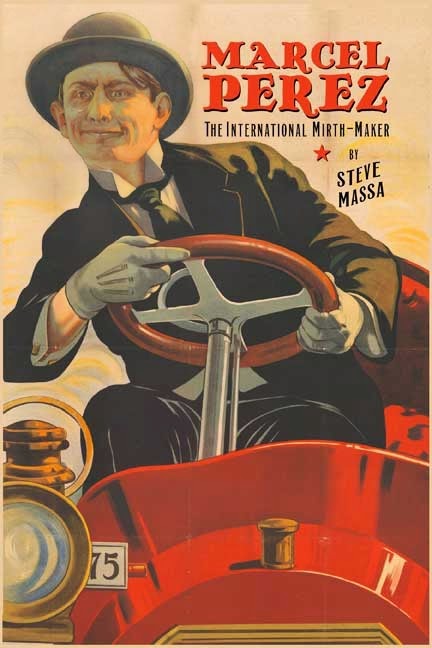
Marcel Perez, who author Steve Massa in his book Marcel Perez—The International Mirth Maker, calls “the greatest silent film clown you’ve never heard of,” worked under at least a half-dozen professional names:  Tweedledum, Marcel Fabre, Robinet, Fernando Perez, Tweedy, Bungels, and  Twede-Dan. He was an international star in the years between 1900 and his death in 1928.

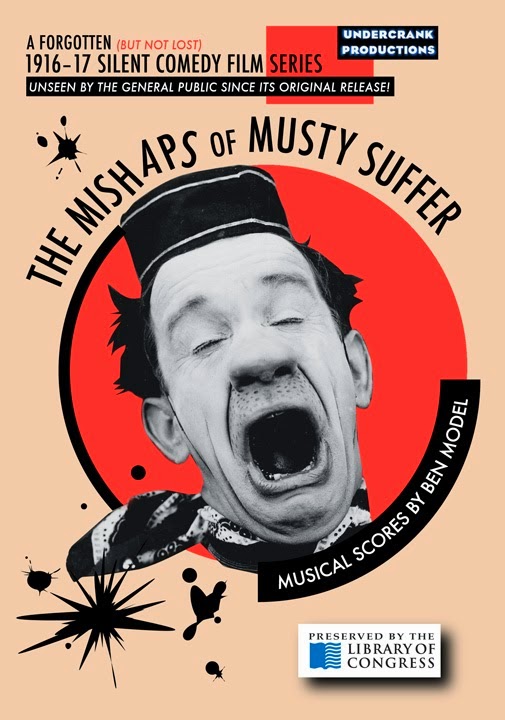
In 1912 he made an astonishing 35 films that we know of. It is estimated by film historians Ben Model and Steve Massa, the producers of this wonderful DVD, that this great clown may have made over 200 movies, long and short. In 2015, Perez re-emerges as a force of nature largely because of Messrs. Model and Massa’s seeming archeological dig to find Perez’s films in France, Italy, the Netherlands and the massive 1.1 million films held by the Library of Congress. Both the Library of Congress and the EYE Filmmuseum of the Netherlands contributed 35mm and 16mm prints. Digitally remastered for global consumption, these charming short films are a spectacular follow-up to the Model–Massa 2014 release, The Mishaps of Musty Suffer (also available from Undercrank Productions on Amazon.com).

Perez attempts to be a good Samaritan in Sweet Daddy (1921)
Courtesy Undercrank Prods/Library of Congress

 So, what do you get when you lay down your $$ on Amazon for both book and DVD?

Undercrank Productions has provided another first-rate edition to their expanding catalog of lovingly restored silent clown series. Perez is featured in five films made in the US, and another five made in Torino, Italy. Working under so many different names probably led to his productivity, as the production schedules noted and the many companies he worked for are staggering. Yet, having shed one clown skin for another seems to have worked well for this man who spoke many languages —with the exception of English! No matter: the language of silent film comedy and title cards changed to what language was needed, which was all that mattered to audiences who reveled in his films released in the first quarter of the 20th century.

In this DVD he appears first in a 1911 short titled Robinet’s White Suit. Any clown aficionado will immediately know that when a clown wears a white suit what is likely to ensue. Nevertheless, the invention of the dirtying of the suit is hilarious and not sentimentally inspired. What struck this writer immediately were his physical moves. Given what we know of George M. Cohan and his pigeon-toed arched dance moves…we can now wonder who came first; Cohan or Perez. A later reference will take clown scholars by surprise. Whirls, kicks and spins reminiscent of the great George Carl.

A lovely time-capsule bonus of these ten shorts, with new scores played by maestro Model, is seeing Torino, Italy from 100 years ago. Other locations all over Europe and the U.S. (Jacksonville, FL for instance) are also seen, and this gives us a touch of what the Lumière brothers had intended with their invention — “to bring the world to the world.”

In our fast-changing internet-driven society, the expectant viewer rushing to the cinema to see the latest “whirl” by Musty Suffer or the hyper-kinetic chases and daring acrobatics of Marcel Perez are given a shot of worldly adrenalin; the action is non-stop, we see another time, another world, and delight in the fashions, and the unchanging simplicity of what makes us laugh. The DVD provides a solid 2 hours of truly “otherworldly” entertainment. Largely the film world of Perez pre-dates the first World War.

While Perez is the focus and locus of Mr. Massa and Mr. Model’s Sherlockian dig into film history, the detective story to uncover who Perez was, what his real name was, and the facts of his sad demise are equally fascinating to film students and physical comedy fans.

Just as it seems that every magician who has the money to advertise in public is eventually compared to Houdini, so are silent film clowns compared to Charlie Chaplin. This is natural that the best-known arbiters of stage and cinema (Houdini was also a movie star) should naturally inspire and cast a long shadow for moderns. Yet, Perez began in film about 14 years before Chaplin ever made a single frame; hardly any of the films made in France 1900-10 survive. The comparisons between the two are, as Shakespeare glowered, “odious.”

No comparisons needed. All one needs to do is plunk down their coin (to adopt a phrase of the Perez period) and enjoy.

The DVD is very well authored and attractively produced. The companion book is chock full of well-produced production stills that support the tragic story of this clown who was written about as dying in 1928, “alone and ignored.”

“Laughing on the outside, and crying on the inside” is the cliché applied to many who use stage theatrics to make us guffaw. In the case of this internationally loved clown who wrought impossibly amazing gags such as a car driving over him (with no discernible switch to a dummy), his birth (possibly) in 1885, and assuredly his death in 1928, is as close as we come to the poetic appellation of the clown’s inside driving force.  An amputated leg because of a cancerous tumor wrought the beginning of his end. He directed, he produced; he made audiences howl and swell with glee. Yet, today and shortly after his demise, with the rampaging advent of sound entering films in 1927, Perez and a great body of his work seems to have frittered away to the sands of time.

However, like a great phoenix rising, Perez is lovingly brought back to life by both the book and DVD offered by Undercrank Productions. It’s worth every penny, and more. Can a price be put on delightful surprise in the fragile 21st century?

LINKS
• The Marcel Perez Collection DVD available here from Amazon.
• The book Marcel Perez, The International Mirth Maker by Steve Massa available here from Amazon.
• A Perez web site
• An article about the date of his death
SHARE
EXPLORE FURTHER

“Meet Musty Suffer” — Guest Post by Ben Robinson

POST 375
Tuesday, April 15, 2014


THE MISHAPS OF MUSTY SUFFER
Starring Harry Watson Jr.


Produced for video by Ben Model
Films preserved by the Library of Congress
Released April 22, 2014 by Undercrank Productions
Ben Model & Steve Massa, curators
Piano scores written and played by Ben Model
Companion booklet by Steve Massa


Originally produced by George Kleine, March 1916 – June 1917
Eight short films from the twenty-four surviving films in the Library of Congress collection
117 min. 


Reviewed by Ben Robinson

“You know man, she’s grotty, as in gro-tesque.”
—George Harrison, from A HARD DAY’S NIGHT, 1964.

Full disclosure: I was one of the Kickstarter backers of this project. That means nothing more than I contributed the minimum to help launch this DVD. I had only seen one film in a private showing, and then followed the rollout of the proposed Kickstarter campaign. Amazingly, the minimum was quickly reached, and $1,000 more was contributed that made possible the additional well-produced printed booklet by Steve Massa that accompanies the DVD and the future YouYube-only release of additional films that did not fit on the DVD. It’s a most welcome addition because anyone who loves silent film comedy, clowns, circus, vaudeville, performance art, avant-garde film or surrealism will inhale this DVD and booklet.

There are mostly simple plots (with riveting action and comedy):

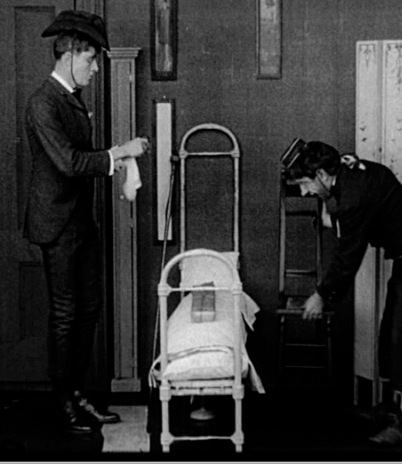
A man applies for job as a messenger; a man in Automat feeds the machines with food to be dispensed; the Outside Inn, a hotel where there is a “thin room” for one of the stock players of this company who is all but the skinny man from the circus. There is a cabinet just the width of his cane. His hat is pinched as if someone sat on it. He seems so thin a single bed is triple the size he needs. A man dreams of love. As a result, six maidens appear in striking lingerie—fun and mishaps ensue.

Musty happens along at the exact moment another man becomes perturbed with his bellhop, played by a boy. The man picks up the boy and throws him out of a door. At that exact moment, Musty catches the boy, looks him up and down, and then discards him too with gritty abandon as well.

In the world of Musty Suffer, anything can and does happen, and it’s not always pretty—to the cognoscenti, that is the beauty of these films: they are not pretty. An oversize rolling pin is saturated with powder. When Musty hits the thief in the Automat with this rolling pin, a cloud of powder arises when the pilferer is bonked. It’s broad, fast…grotesque, but also…clean. An auto accident is so dense with triple whirling acrobatics it is no wonder these films were subtitled “Another whirl.”

UNSEEN SINCE 1916

These films have not been seen since they appeared in 1916–1917, nearly one hundred years ago. Hence, this is not only a “find,” it is the painstakingly exact work of several film historians, lab technicians and the Library of Congress, which owns these films and generously allowed Messieurs Model and Massa to penetrate their massive archives and bring out these jewels for the world to see once more.  See Musty lay horizontal in space as he is picked up by a human size pair of ice tongs. He is carted about as if he were a wastebasket.

Jewels they are!  If you love a clown who carries a bundle of material that seems too wide for the doorway he seeks to pass through, and therefore engages a saw and cuts wide slots for his cargo (as opposed to just inverting the material, as in the so-called normal world), then you’ll dig this. The dance with the mannequin with the magical surprise ending is worth the price of admission.

The DVD of this whizz bang series brings us Harry Watson Jr., star of the Ziegfeld Follies playing the irrepressible MUSTY SUFFER, whose face contorts, squashes, and explodes much in the same way we have come to appreciate from Stan Laurel or Harpo Marx’s rubber faces. Musty Suffer definitely comes under the rubric of what 19th-century clowns were sometimes called: Grotesques. He  is joined by his vaudeville and circus partner George Bickel who plays a character named Willie Work. There are also characters Dippy Mary and Inna Hurry. (Historical note: Dippy Mary is played by Alma Hanlon, daughter of George Hanlon of the famous knockabout stage extravaganzas of the Hanlon Brothers.)

It would seem impossible to separate this clown from his face, one-armed athletics, or amazing feats of metamorphosis, such as his filmic magical changes of clothing, and then one continuous shot of Mr. Watson, as Musty, deftly engaging us with a genuine “quick-change” act done in almost real time (save for snip edits).  His dream sequence where he has dreamt of being hit in the head with an axe is frightening, deft and clever.

The opening shot gives us Musty drinking the drippings of a tail pipe in a tin cup. When he placed the tin cup beneath the parked car, I wondered silently, “What’s he’s going to do with that?” When he drank what the cup caught, I nearly fell out of my seat. Clearly the authors and curators of this DVD chose to introduce Musty to us with a sock right in the kisser of comedy. His other trademark —opposite his rough physicality—is his spritely magic. In one scene he changes clothing quickly and amazingly by having a barrel pass over him once.

Musty sometimes breaks into a small dance. In this tiny dance, where the legs cross and the arms flail with abandon, he only moves a mere two inches with all of the movement. It takes but a few seconds and he doesn’t really go anywhere. Yet the dance is expressive and funny. His little dance is currently seen in the repertoire of Bello Nock on B’way and in the huge avant-garde theatre extravaganza of RAOUL by James Thierree (as seen at The Brooklyn Academy of Music, NY).

HARRY WATSON JR. & MUSTY SUFFER 

Harry Watson Jr. was a major star in American vaudeville beginning in the early 1900s. He and his partner George Bickel led the laughs in the Ziegfeld Follies season after season. It was rough work by performers doing as many as fourteen shows a week of very precise physical comedy, because in their act one could get hit in the face easily during their laugh-filled boxing act, which is seen in the Extras of this retrospective.

Musty Suffer is a broad character. In press, he is referred to as a “clown.” Given the broad world of the clown (“An orangutan who can do the impossible” in one definition), the ensuing “clown logic” or flat-out chaos is the definition of “rough and tumble.” This is very rough slapstick, with a nod to 19th- century French cinema, where plates walk up walls like a row of ants seeking their nest. Stop-motion action is highly complemented by Musty chasing a car to hop a free ride, only to be violently dumped (and feeling still not a care in the world).

THE DVD EXTRAS

There are portraits of Harry Watson Jr. in his prime with Ziegfeld Follies, with George Bickel, and it ends with loving, color snapshots of Mr. Watson in retirement in Canada, 1960, five years before his death. He looks happy and rubber-faced as ever.

The Chicago Daily of January 1916 notes that Chaplin might have a rival in Musty Suffer. George Kleine produced a short “Capturing Chicago.” The film shows Musty winning big crowds with an outdoor serenade by him on a trombone as he is paraded through the streets in an open-air moving car. This turns out to have been during a major film exhibitor’s convention held in Chicago at the time.  Clowning can be very $eriou$ business. This was not advertising folly.

Courtesy of the good folks at The Library of Congress and the Billy Rose Theater Collection at the Lincoln Center Library for the Performing Arts (New York), we are provided a time capsule that roars forth with hard-clad evidence that while Chaplin was prodded and poked at by the press of these clowns, and businessmen, Chaplin was not to be rivaled in 1916. Even the skills of this team could not knock Chaplin off his box office pedestal. The Musty Suffer films were originally produced as a 5-reel movie that portrayed a “clown Job.” But George Kleine decided to cut them down and present them weekly as a “another whirl” with Musty.

That is fact and history. It is also now part of our collective history that those who took a shot at beating Chaplin were some mighty fine contenders. It was a skewed thought, but Harry Watson’s acrobatics, executed standing on one arm while the rest of his iron body laid on the floor made me think of Sylvester Stallone doing his one armed push ups as Rocky. It’s a valid comparison given the competitive business of film comedy in 1916.

Musty Suffer’s 30 short films were released once a week from early 1916 to the autumn of 1917. Demand was high. Crowds loved ‘em. They were shot in the Bronx, New York, in one of the boroughs of the City of New York, north of upper Manhattan (Harlem). Fortunately, the Library of Congress has preserved 24 of the Musty Suffer films, the best of which are represented on the DVD.

In 2014, humans are at the point of “saving” films, not necessarily making them look all shiny, new and clear as the Chaplin Archive (Bolonga, Italy) has so beautifully done with such a film as Chaplin’s PAYDAY (1923).

Buy on Amazon right here. And if you like it, give it a review and a whole bunch of stars!

SHARE
EXPLORE FURTHER
Check out My New Book

Visual and verbal humor for the cognitively and artistically curious!

“A book to treasure!”
—Bill Irwin

Upcoming Events