Here’s a riddle for you: what do the sticky floors of New York City subway cars and dusty, musty books on Elizabethan drama have in common? For the answer, just read on….
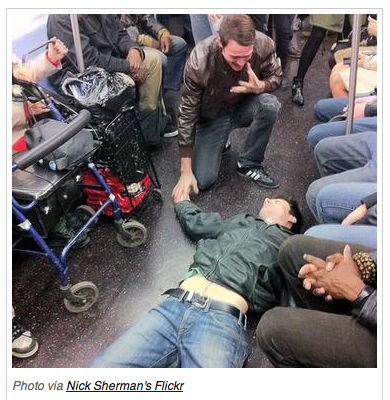
First clue: flash back to last spring. I’m on a crowded E train from JFK airport when a quartet of performers bound onto the train, loudly announcing their act with no little modesty. More hip-hop popping I’m guessing, ho-hum, which is why I don’t bother to whip out my Flip camera. Suddenly these guys burst across the length of the car in a flurry of handsprings and somersaults and some nifty partner moves, all dangerously close to their (truly) captive audience — “if I touch you, I’ll give you a dollar.” I especially like the peanut rolls (double forward roll holding each other’s ankles) because they have to make precise, last-second detours to avoid impaling themselves on the car’s vertical poles.
I really didn’t think you could do any of that on a standing-room-only subway train bolting along at 40 mph. I was wrong. Unfortunately, at under two minutes, by the time I got my camera out, they were gone. A YouTube search turned up nothing, but inspired by the next act in this post, I searched again yesterday, this time successfully. I still don’t know who they are, but this is definitely them.
Because camera angles are a challenge in a subway car, here are two views of the same act:
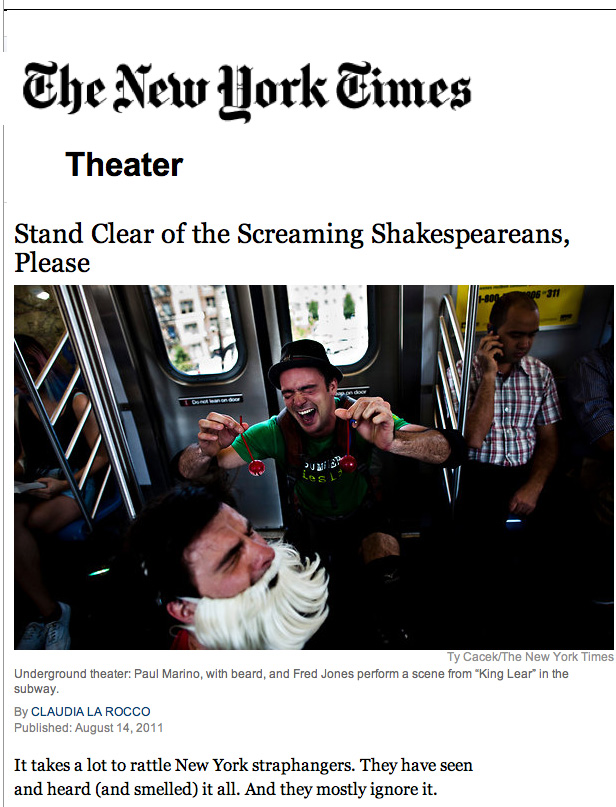
And then yesterday I noticed a NY Times article on two performers, Paul Marino and Fred Jones, who call themselves Popeye & Cloudy and who are no strangers to subway floors. They have been earning a reputation and a fair amount of loot by doing another form of action drama underground, casting the passengers as groundlings as they perform quick renditions of scenes from Shakespeare, favorites being Romeo’s suicide and Macbeth’s decapitation. Not only that, but they also throw in some Abbott & Costello as well; yes, Who’s on First?
“Not all subway lines are well suited to Shakespeare,” writes a reporter for the Wall St. Journal in an earlier article. “The long cars of the N and R trains allow for a bigger audience per scene. And the J,M,Z trains, which cross the Williamsburg Bridge, give riders time to relax for a lengthy performance. Riders who frequent the 4,5 and 6 trains in Manhattan are out of luck: those lines are too crowded for a proper death scene or sword fight, the actors say.”
Here’s the Popeye & Cloudy website.
Here’s that article from the Wall Street Journal and a short WSJ video.
If you want to see more, here’s a 12-minute Vimeo video montage that includes some of the Who’s on First.
So speaking of Shakespeare, and hopefully bringing this post full circle, here’s some more chapter two material, this time two complete public domain books on the fool characters in Shakespeare’s plays.
Studies in the Development of the Fool in the Elizabethan Drama by Olive Mary Busby
Our first dusty, musty book answers that eternal question, “whence came this insistent demand of the English public for the buffooneries of the fool?” Okay, so I exaggerated; it was never published as a book, it’s just a 1923 master’s thesis. Hard to believe, but it cost money to publish books back in what is now known as the Pre-PDF Era. I’m guessing Olive Mary Busby went to her grave not knowing that this blogopedia would make her famous.
The Fools of Shakespeare by Frederick Warde
This 1913 work starts with a chapter on “the fool in life and literature,” followed by individual chapters devoted to each of Shakespeare’s principal fool characters, including: Yorick, Touchstone, Trinculo, Feste, Launcelot Gobbo, the grave-digger in Hamlet, and the fool in King Lear. Fools of Shakespeare
In the early days of modernism, conceptual artists such as Marcel Duchamp and George Grosz delighted in blurring the line between art and reality. In 1917, Duchamp submitted an upside-down urinal as a work of art, though one obviously lacking in the aesthetic appeal traditionally associated with Art with a capital A. This “found object” was unaltered except for its label. He named it “Fountain.” The piece was rejected by the show’s curator and was soon lost, yet went on to make art history.
In the 60s came happenings, interactive public events that were part scripted, part improvisatory. Since then, post-modern art movements have continued to explore non-traditional approaches, concocting every variety of performance art that not only acknowledged but constantly referenced its own artificiality.
On television, Candid Camera (first broadcast in 1948!) stayed on the air for more than half a century in various formats and ignited a tradition of filmed practical jokes that are, if anything, even more popular today.
Guerrilla street theatre often went beyond agitprop skits to stage provocative theatrical events. Abbie Hoffman showering the NY Stock Exchange with dollar bills just so the press could witness brokers diving for a few measly bucks was a classic political publicity stunt. Hoffman’s “Yippies”(Youth International Party) “became known for mocking the political establishment and the social status quo through pranks and street theater, leading some to refer to them as Groucho Marxists.” Custard pies in the faces of politicians are as popular as ever, and this year has seen a lot of anti-gay politicians getting “glittered” (e.g., Michelle Bachman just two weeks ago).
Now that we live in the post-post-modern era — or is it the post-post-post? I do get confused — pranking has almost become its own art form, with flash mobs a common enough sight in major cities across the globe. The New York City group Improv Everywhere [motto: “we cause scenes”] is perhaps the best known practitioner.
With all of life and all public space as their canvas, it’s natural that IE’s humor goes beyond mere jokes. Free from the constraints of stage and screen, assisted by an army of volunteers often numbering in the hundreds, they create large-scale events where weird and silly mass behavior — for example, the spontaneous eruption of a splashy Broadway-style musical number in a small fast-food restaurant — is offered up to an unsuspecting public as perfectly normal. Hidden cameras shoot spectator reactions, with YouTube viewers being the real target audience.
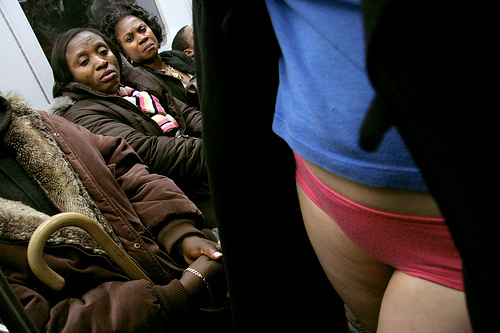
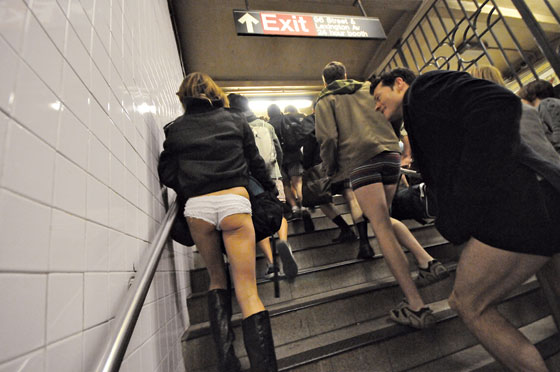
The most famous of these is their No Pants Subway Ride, in which groups of commuters enter New York City subways (in the winter!) wearing nothing but underpants on their legs; this has become an annual event that has spread to 48 cities in 22 countries.
The work is aways very visual, usually quite comic, and at times even physical, but is it physical comedy? And is it improv?
The typical IE event is in fact highly structured. Many involve professional actors (“agents”), a script, and rehearsals. In others, volunteers follow precise instructions and engage in synchronized actions. For example, in a series of MP3 Experiments, a group of participants wearing headphones start listening to the same series of audio instructions at the exact same time, the result being a well-coordinated ballet of eccentric actions meant to stun and delight the onlookers. Improvisation, however, is fairly limited, as is any consequential interaction with the audience.
I’m sure many of you have seen their work before, but here are some good examples. First the latest no-pants video:
And the latest MP3 experiment:
Many of their pieces do indeed overlap with the world of physical comedy. In The Mute Button, they transform everyday life into a silent movie:
And in this one, they turn off movement, creating a freeze-frame Grand Central Station:
____________________________
“The golden rule for a prank is that it should be as fun for the person getting pranked as it is for the prankster.” — Charlie Todd, IE founder
____________________________
A spoof on the cliché of the would-be suicide leaper getting talked down from a high ledge:
Here’s a fake hypnotist act, with shades of A Midsummer Night’s Dream, the young lovers being puckishly tricked into falling in love with the wrong person.
____________________________
“Someone once told me, ‘What you’re doing is giving other people anecdotes.’ You don’t regularly see things in New York that make you go, ‘Wow, that’s awesome.’ You don’t see humans interacting in a way that takes you off guard and makes you smile. You see a guy taking a shit on the sidewalk.” — Charlie Todd
____________________________
Finally, their most clownesque piece, the Worst Ice Skater Ever. Watch it first, then I’ll give you my two cents!
Or as Huckleberry Finn said: “And by and by a drunk man tried to get into the ring — said he wanted to ride; said he could ride as well as anybody that ever was. They argued and tried to keep him out, but he wouldn’t listen, and the whole show come to a standstill. Then the people begun to holler at him and make fun of him, and that made him mad, and he begun to rip and tear; so that stirred up the people, and a lot of men begun to pile down off of the benches and swarm towards the ring, saying, “Knock him down! Throw him out!” and one or two women begun to scream. So, then, the ringmaster he made a little speech, and said he hoped there wouldn’t be no disturbance, and if the man would promise he wouldn’t make no more trouble he would let him ride if he thought he could stay on the horse. So everybody laughed and said all right, and the man got on. The minute he was on, the horse begun to rip and tear and jump and cavort around, with two circus men hanging on to his bridle trying to hold him, and the drunk man hanging on to his neck, and his heels flying in the air every jump, and the whole crowd of people standing up shouting and laughing till tears rolled down. And at last, sure enough, all the circus men could do, the horse broke loose, and away he went like the very nation, round and round the ring, with that sot laying down on him and hanging to his neck, with first one leg hanging most to the ground on one side, and then t’other one on t’other side, and the people just crazy. It warn’t funny to me, though; I was all of a tremble to see his danger. But pretty soon he struggled up astraddle and grabbed the bridle, a-reeling this way and that; and the next minute he sprung up and dropped the bridle and stood! and the horse a-going like a house afire too. He just stood up there, a-sailing around as easy and comfortable as if he warn’t ever drunk in his life — and then he begun to pull off his clothes and sling them. He shed them so thick they kind of clogged up the air, and altogether he shed seventeen suits. And, then, there he was, slim and handsome, and dressed the gaudiest and prettiest you ever saw, and he lit into that horse with his whip and made him fairly hum — and finally skipped off, and made his bow and danced off to the dressing-room, and everybody just a-howling with pleasure and astonishment.”
In other words, whether on horseback, a tight wire, or ice skates, this is one of the oldest acts in the book. The problem here is that it’s very underdeveloped: he stumbles around a bit, eventually gets his footing, and is then revealed to be an elegant skater. Ta-da! But they missed so many movement possibilities and great opportunities to interact with rink staff and audience. It’s the bare bones of the gag without the meat.
I guess I am of two minds about IE’s work. I enjoy it, I find a lot of it funny, and I’m glad they’re doing it. On the other hand, it’s more cutesy than provocative, and far less improvisational and interactive than I would like to see, but that’s more of a quibble than a criticism; you can’t please everyone all the time. And as you know, I do like to write about new directions in physical comedy, what I call “physical comedy in the 21st century,” and right now I’m thinking that this performance paradigm may have far more potential than we realize. Gotta think about that one….
_______________________________
Some links:
• Web site for Improv Everywhere. For each project, you’ll find not only the video, but also an article about how they did it, photos, and sometimes supplementary video footage.
• Urban Prankster, another blog by Charlie Todd covering “pranks, hacks, participatory art, and other creative endeavors that take place in public places in cities across the world.” It has all the IE videos, but stuff by other groups as well.
• An earlier blog post of mine about a flash mob of commuters in the Antwerp (Belgium) train station suddenly dancing their hearts out to “Do-Re-Mi” from The Sound of Music.
• A 2002 IE article with photos (no video) of two IE “stuntmen” who dazzle the crowd with such harrowing feats as running with scissors and sitting too close to a TV.
• A New York Magazineprofile
• A Rolling Stonearticle • A Wall Street Journal article • A New York Times article
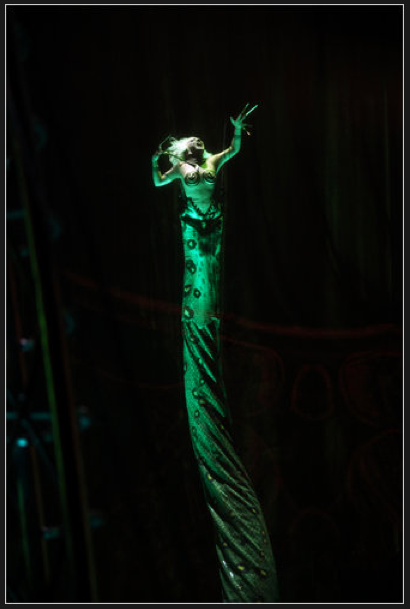
Or so says the New York Times. A mere five days after a lengthy profile of Cirque du Soleil co-founder and owner Guy Laliberté, which I wrote about in this post, the Times is back with a three-page preview of Cirque’s upcoming debut at Radio City Music Hall, the stage show Zarkana. And though their previews tend to be fluff pieces, the Times is again raising questions about the Cirque’s artistic direction, comparing Zarkana to Spider-Man: Turn Off the Dark and wondering out loud about the caliber of the theatre and clowning components.
Here are a few quotes:
In an effort to rebound from the rare failure of the intimate “Banana Shpeel” in New York last year, the one thing everyone agrees on is that this will be a very big show. There will be daredevil feats, bold images and high-flying acrobatic spectacle. As Mr. Girard put it: “No theater. No vaudeville. We want to be more Cirque than Cirque.”
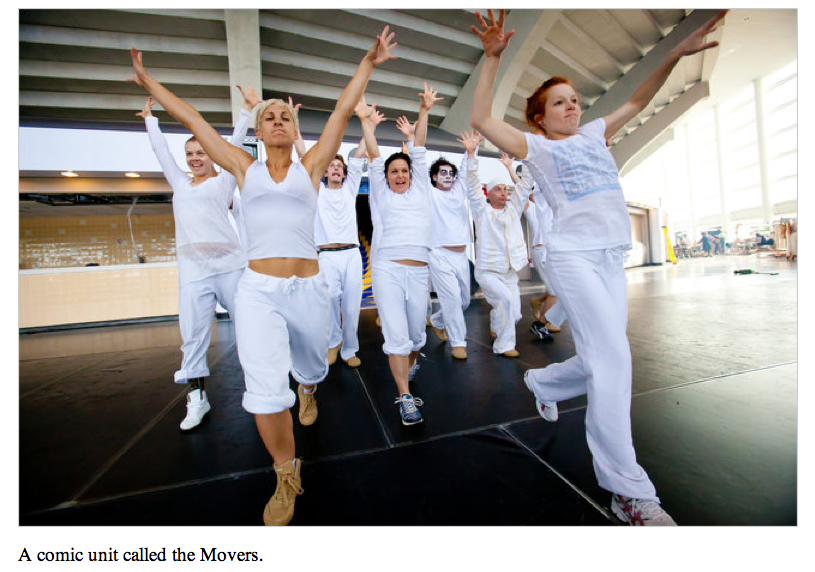
Mr. Bazinet’s job is to help guide 15 performers of diverse backgrounds into a comic unit called the Movers. Less than a week earlier he had spoken to his friend David Shiner, the director of “Banana Shpeel,” who told him what he already knew: that clowning at a theater the size of Radio City is impossible. “The clowns are going to die,” Mr. Shiner says. “You need an intimate space for clowning, otherwise you have nothing.”
At Cirque du Soleil no one is more depressed than the clowns. That’s not just because the painted smiles hide a deep-seated sadness, although there is some truth to that stereotype. (“You can’t imagine the number of clowns I’ve seen cry in my life,” Mr. Laliberté says.) Rather, it is because developing a clown act requires more experimentation and spontaneity than the Machine allows time for. And Cirque was built on arty, sometimes twee clowning that can’t fill up a large space like Radio City.
[Okay, I admit it, I thought “twee” was a typo, but it turns out it means “excessively or affectedly quaint, pretty, or sentimental.” —jt]
The story is, if anything, more impenetrable. When asked about it, Mr. Girard answers abruptly, Cirque “is not a good place to tell a story, period.”
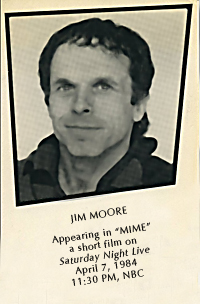
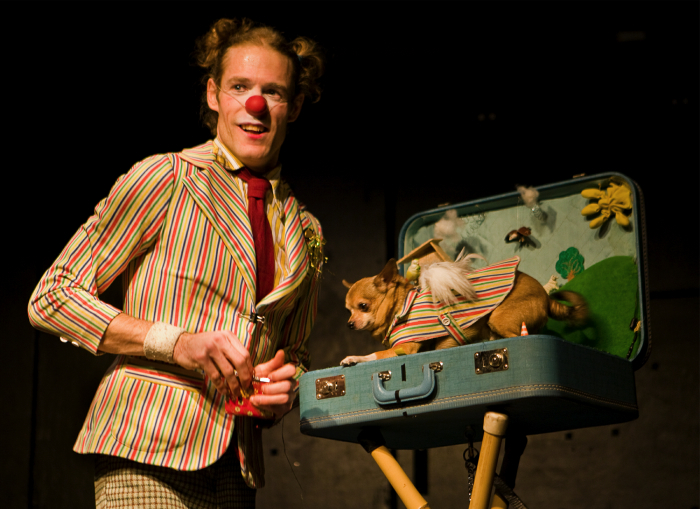
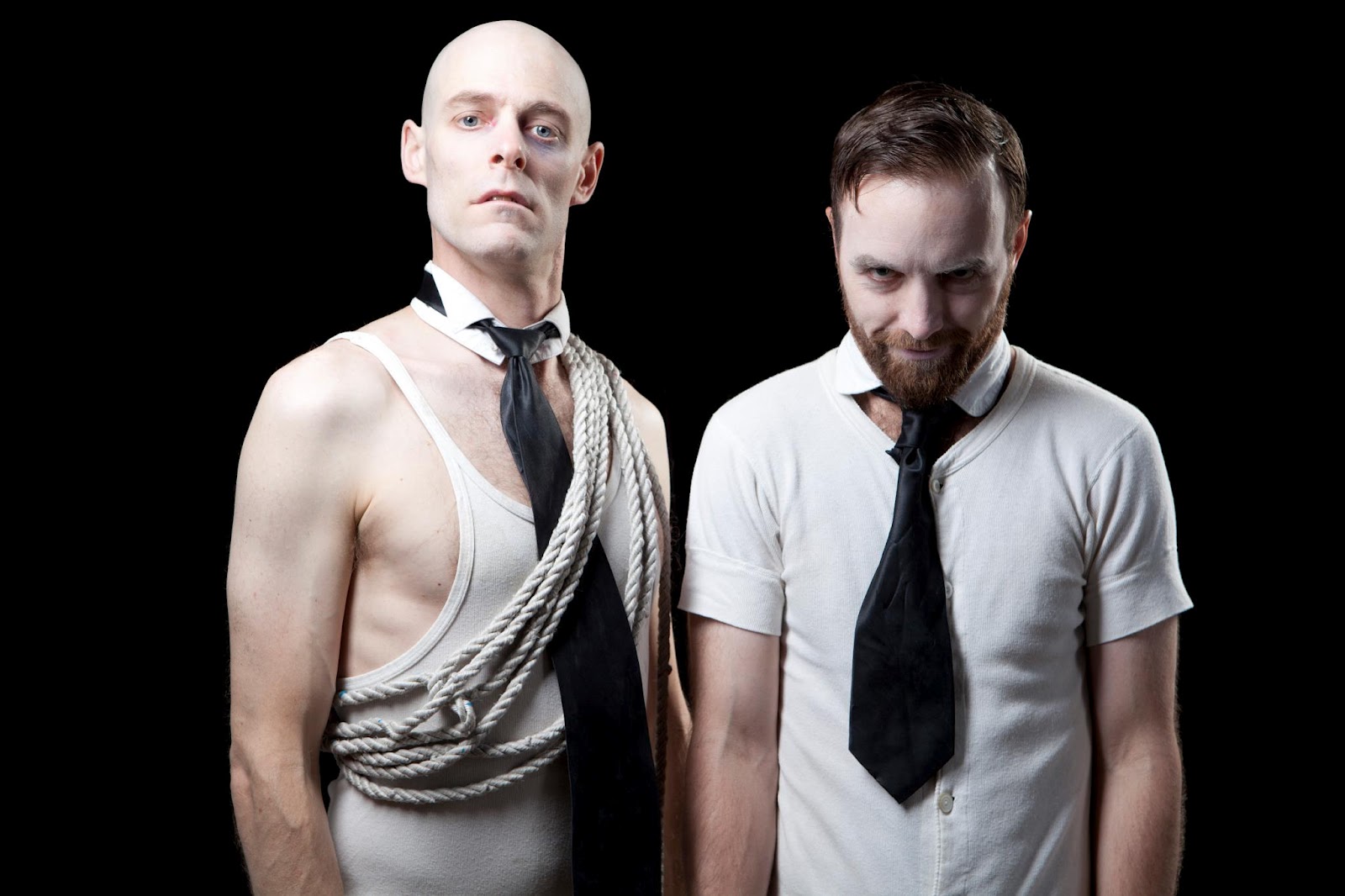
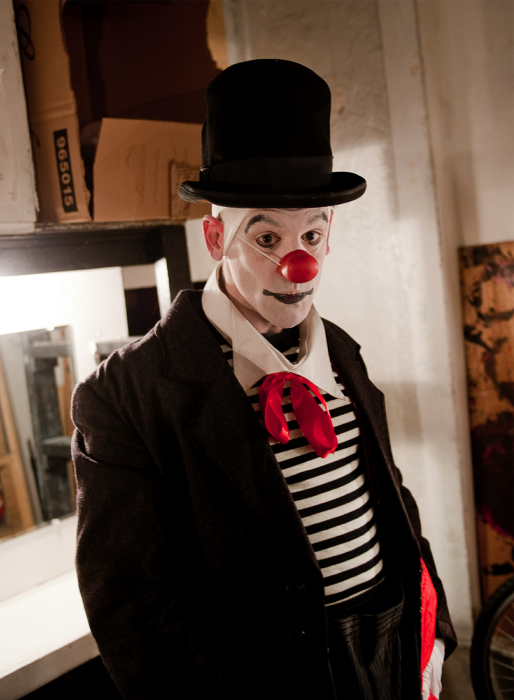
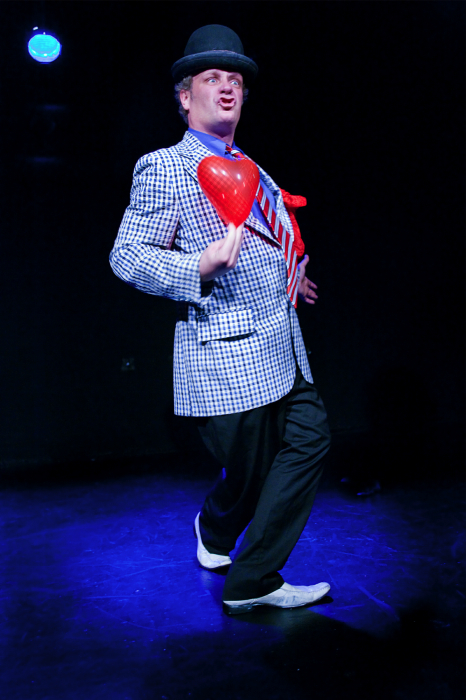
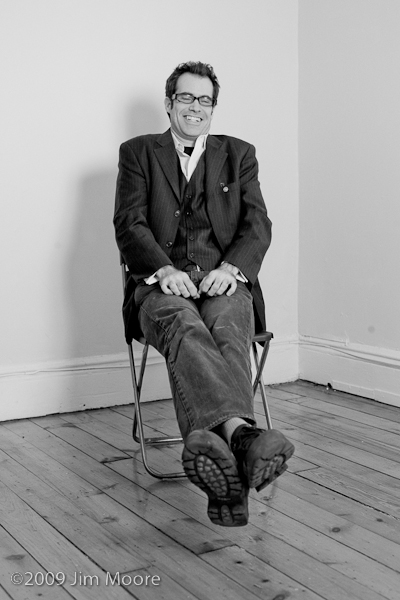
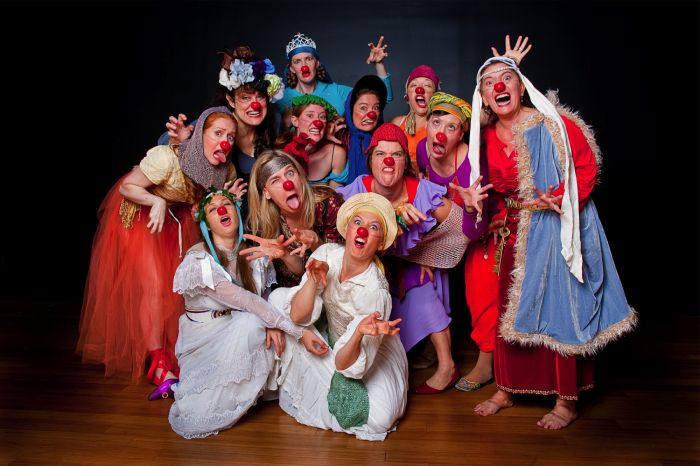
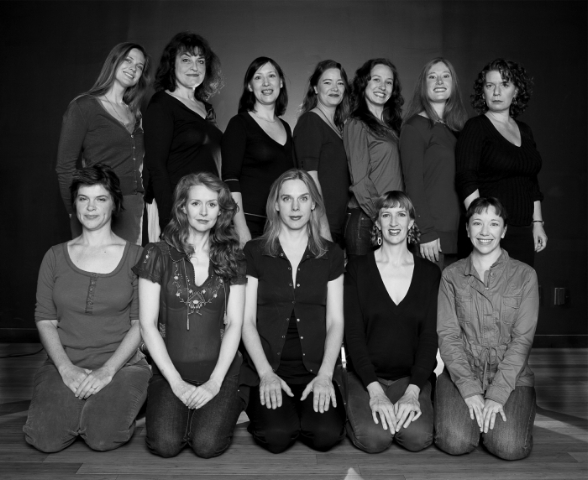
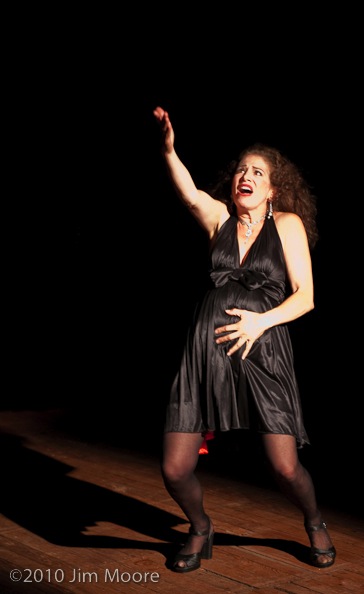
Jim Moore, whose photography I wrote about in this early blog post, has a new show of clown photos opening tomorrow at Manhattan’s Cornelia Street Café. Since I realize most of you aren’t anywhere near New York City, I’m planning to have a glass of wine in your honor at tomorrow’s opening — one glass per missing blog reader — provided the wine’s free. I also thought I’d show you some of what you’re missing with this preview of photos from the exhibit.
But first here’s the official program introduction to the exhibit written by — quelle coincidence — little old moi:
If they hold a clown show in New York and Jim Moore’s not there, do they still do the show? I wouldn’t know, because I’m not sure if that’s actually ever happened.
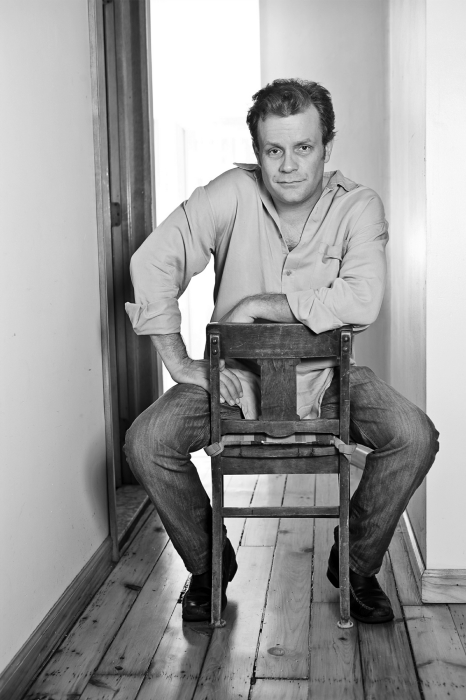
Since his early days as a street performer and photographer in 1970’s New York, Jim has made it his business to know every variety performer and to be everywhere they performed. And to photograph them. Constantly. He lived the life and knew the people, then and now. Whether he shot you in performance, on location, or in his studio, he’s always had that uncanny ability to capture the essence of these highly individualistic characters — especially the clowns and eccentrics.
And he never stopped doing it. For 40+ years! Like all fine photographers, Jim has more than just a keen eye and polished technique. He has an instinctual feel for his subjects and, above all, their total trust. In this revealing exhibit of miniatures, he shoots not only from his honorary front-row seat, but meets the performers backstage, in his studio, in their homes, in their rehearsal spaces — capturing the person and the persona and giving us a glimpse into a more deeply textured world.
On with the show!
John Leo
Joel Jeske
Audrey Crabtree
Ambrose Martos
Matt Mitler
Glen Henroy
Kevin C. Carr
Eric Davis
Clowns Ex Machina
Hilary Chaplain
Tanya Elchuk
___________________________________
For more of Jim’s work, see his excellent blog, Vaude Visuals.
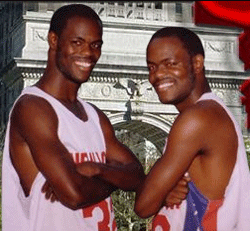
“Washington Square Park is the entertainment capital of the world.”
— Tic and/or Tac
(Hey, they’re twins, they speak in unison; how am I supposed to know which one said it?)
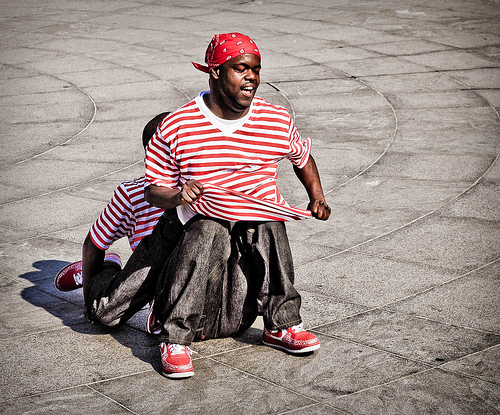
A mere hour ago I was walking home from viewing Werner Herzog’s amazing 3D documentary about the Chauvet caves of southern France, Cave of Forgotten Dreams, when I saw Tic & Tac performing in Washington Square Park. I’d seen them many times before, but I stopped “just for a moment” and ended up staying for the whole show.
What Tic & Tac do isn’t exactly what a purist like me would label physical comedy, but rather a mixture of straight acrobatics and stand-up comedy and audience participation. They are street acrobats who intersperse a few impressive stunts with a lot of verbal comedy, most of it centering around racial stereotyping. Lots of build-up, not that many tricks, but they make it work.
They are smart enough to make more fun of themselves than they do of the spectators, so the audience is comfortable enough to join in the fun. And it is effective — as in they haul in a ton of cash. Or as they say, “thank you for making it possible for us to work two days a week while you work five.”
So I was thinking, these guys are pretty much an institution here in New York, but maybe not to most of my gazillion and one blog readers. You know what I should do? I should go home, grab my handy-dandy Flip camera, come back to their next show (all of 15 minutes later), shoot it, and post it. Luckily, I checked YouTube first and, happily, many people had already beat me to the punch. Which is why I’m sitting here sipping my second glass of chilled white wine, writing this intro, and embedding some html code, instead of kneeling on the hard concrete shooting a show I admire but, alas, also know by heart.
So here’s a two-part clip from 2009, not the show I just saw, but you get the spirit and the m.o. They’ve continued to evolve the act since then and you can see other versions on YouTube. Or, better yet, come visit us in New York for the very latest update!
It’s street theater. People don’t know how difficult it really is to stop people from doing whatever they’re doing and just look at you. Especially New Yorkers. New Yorkers are prone to, even if you go to a comedy club, they’re in there demanding “Make me laugh.” What kind of attitude is that? In street theater, sometimes we get up there and we haven’t even done anything yet and you still have people looking at you like, “You better do something good.” It’s fun to be able to win them over.
This YouTube video announces an upcoming Tic & Tac DVD documentary coming soon, but no specifics. If anyone knows more, drop me a line.
And, finally, a short but good interview with Tic & Tac here.
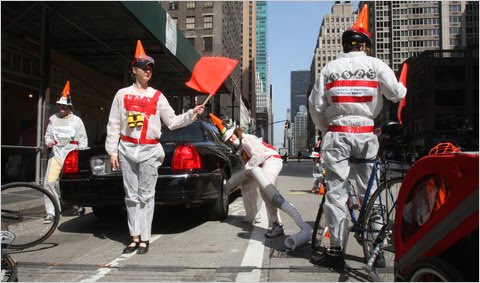
The Bureau of Organized Bikelane Safety, on patrol on 6th Avenue Friday.
“Excuse me, sir,” Barbara Ross said to the driver of a black town car parked on Avenue of the Americas near 37th Street. “You are obstructing a bike lane.”
Considering that Ms. Ross, 46, was wearing a white hazmat suit and an orange traffic cone on her head and riding a large red tricycle, the driver, Ross Ravita, took her relatively seriously. He protested that he was making only a quick stop, and though he did at one point tell her, “Hold your horses, lady, this isn’t your street,” he yielded his ground and drove away.
It was another victory for the Bureau of Organized Bikelane Safety, a provisional wing of the environmental advocacy group Time’s Up, which staged a street-theater action Friday afternoon to urge drivers to stop blocking the city’s more than 300 miles of bicycle lanes.
The six riders started at Madison Square Park before crawling up Avenue of the Americas to Bryant Park. While takeout deliverers and messengers zipped past vehicles blocking bicycle lanes, the bike-lane safety team, armed with crime-scene tape and fake parking summonses, set cones around the illegally parked vehicles and reenacted crash scenes.
“It’s a bike lane, not a parking lot,” one member of the group, Benjamin Shepard, shouted to a minivan driver.
Although the city has pushed to make the streets more pedestrian friendly in recent years, cyclists say drivers still ignore the white bike lines and not enough get slapped with the $115 fines.
Ms. Ross said that enforcing fines would help ease the fears of new cyclists. “We want to make biking for everyone,” she added.
Of the half-dozen lane-blocking drivers ambushed by the enforcement team — from a Fresh Direct delivery truck to a silver Lincoln Town Car — all moved without hesitation, except for a cement truck driver who shrugged his shoulders and said he had nowhere else to park.
The cyclists, who carried a boom box blaring ’80s tunes, called their ride a success and ended with a victory dance.
“Whenever we don’t dress up like clowns,” Mr. Shepard said, “they don’t move as fast.”
About a month ago I wrote about Jon Davison’s clown research project over in the UK. Today I want to report another such effort, this one here in New York City by Brian A. Bernhard.
Brian has been running around interviewing all kinds of clown folks and putting the results up on a web site devoted to this project: A Fool’s Idea. The goal is to turn the site into a forum where reader questions will eventually generate not just discussion, but videos on that subject.
Here’s part of Brian’s intro:
“A FOOL’S IDEA” is a new interactive documentary web series that explores the world of clown in a way never experienced before. The first few episodes will set the baseline for the ideas and basic concept of clown, after the first few inspirational episodes, a dialogue will be opened up to the audience. Viewers are encouraged to ask questions about clown, performance, character, or just life in general. Future episodes of the series will be based on YOUR questions.”
So check it out and give Brian some feedback. He’s got tons of energy, so put him to work!
Let the Great World Spin a novel by Colum McCann NY: Random House, 2009 349 pages
Take a careful look at the top of the book cover above and you’ll see a wire walker, balancing pole in hand, pencil-thin atop a spreading megalopolis. It is 1974, and the wire walker is Philippe Petit, poised between the twin towers of New York City’s World Trade Center. Let the Great World Spin is not really a novel about Philippe Petit, but it uses his “artistic crime of the 20th century” and August 7, 1974 as the centerpiece for a soaring tale that dissects not just New York City, but the divide between human aspiration and the muck and mire of everyday existence, between all that pulls us up to the heavens and all that yanks us down, down, down. Or as Oscar Wilde once famously put it, “We are all in the gutter, but some of us are looking at the stars.”
Although Petit is just one of many characters in the book, all the action is refracted through the lens of his walk and arrest. Mc Cann conjures a tapestry of interlocking stories, shifting from 3rd-person to 1st-person narrative, getting into the heads of a broad swath of New Yorkers. The NY Times book review said it much better than I can: “Like a great pitcher in his prime, McCann is constantly changing speeds, adopting different voices, tones and narrative styles as he shifts between story lines… McCann just keeps rolling out new people, deftly linking each to the next, as his story moves toward its surprising and deeply affecting conclusion.”
All in all, a deeply felt tale, a feat of superior storytelling, and certainly one of the best novels I’ve read in recent years. I am not at all surprised that it won the National Book Award and was named Amazon’s Book of the Year, amongst other honors. A damn good read, and if you’re not in the habit of devouring serious contemporary fiction (hey, what’s up with that?), this would be a great place to start. And you can get the paperback on Amazon for a mere $7.50 — the price of a beer in many a New York bar.
Update (Sept. 7, 2011):
The NY Times has started a new online book discussion group, Big City Book Club, and their first selection is none other than Let the Great World Spin. The host (Gina Bellafante) poses some questions and readers share their views but, unlike your typical comments section, the host joins in the dialogue on a regular basis. Check it out here.
Runners have a saying: the older I get, the faster I used to be. Maybe it’s the same for clowns: do our younger selves just keep getting funnier and funnier? Yep, nothing beats nostalgia, which we proved this past September 19th by staging a clown-theatre reunion in my apartment here in New York, bringing together a crowd of people who had worked together back in the day on the NY International Festival of Clown-Theatre (1983, 1985) and other creative projects. I am happy to report that all the women are still strong, all the men still good-looking, and all our children way above average.
Close to 70 people — including guests from Sarasota, Chicago, Berkeley, Boston, Vermont, and the San Juan Islands (Washington state) — squeezed themselves into my humble abode, more than doubling the previous record, and sending my cats into hiding for the duration. The party was even broadcast live via a webcast, which means all you needed was an internet connection to watch whatever was going on within range of my laptop’s camera, which is to say in about one-third of one of the rooms… but it was still kinda cool.
So here’s a Flickr slideshow of 183 images, some from the 80s and some from the party, currently in no particular order, but I think you’ll be able to figure out which is which. (At some point I may organize them into two separate shows, but don’t count on it!) Click on the small arrow on the right to watch it here. Better yet, click on the title at the top of the slide show to see it full-size in Flickr, then click on “Slideshow.” To see captions and photo credits, click on “Show Info” at the top of the slideshow window.
And what is a gala party without awards? So here be the Award Winners, which I am announcing a mere three months after the festivities:
Sounds Exactly the Same:
Marilyn Galfin
Doesn’t Look a Day Older:
Rhona Halpern
Looks a Tad Older, but Certainly Much Younger than Other People Their Age: Everyone else
Biggest Career Shift:
Jan Greenfield (physician’s assistant)
Gained the Most Weight: None of us, not even a pound
Actually Weighs Less than 25 Years Ago:
Judith Harding
Has the Most Children:
Jan Greenfield? (3)
Most Frequent Flyer Mileage:
Hilary Chaplain
Sound Like They’re Descended from Legendary Clowns Even if They’re Not:
John Grimaldi and Hilary Chaplain
Burl Ives Lookalike Contest:
Fred Yockers
John McCain Lookalike Contest: Jim Moore
That Name Change Will Never Fool the FBI: Zeke Peterhoff
Traveled the Longest Distance:
Fred Yockers
Traveled the Shortest Distance:
Michael McGuigan & Joanna Sherman
Stayed the Longest: Celia McCarthy (7 hours), who also brought us these cool Schtick Happens stickers
Toughest Cookie: Karen McCarty
Brought the Best Food:
Toss-up between Hovey Burgess and Christopher Agostino/Lorraine Zeller
Reunited Clown Partners:
Michael Zerphy & Hilary Chaplain; Albert & François Fratellini; Michael Zerphy & Joe Killian; John Towsen & Fred Yockers; Will Shaw & David Tabatsky
Reunited Lovers: Heh heh, wouldn’t you like to know…
Youngest Clown:
Ishah Janssen-Faith
Most Asked Whatever Happened To?: Noel Parenti
That’s it for now, though additional award nominations will be gratefully accepted, and if anyone has more pics, before or after, just e-mail them (screen rez) to me and I’ll put them up there. And on a serious note, it was truly wonderful seeing everyone at the reunion. A truly nice group of people. And while I’m being mushy and all, it sure does feel good reaching the 50-post point with this blog. It’s been fun revisiting all this cool stuff, but especially wonderful to get back in touch with many old friends and be introduced to a lot of new folks. Merry Christmas, one and all! —jt
Joshua Allen Harris is a very clever guy. This may or may not be physical comedy, but I’m guessing you’ll like it. This is a New York Magazine video, and here’s their intro:
Call us boring and simple-minded, but before we saw the work of street artist Joshua Allen Harris we never once considered the artistic possibilities of subway exhaust. Using only tape and garbage bags, Harris creates giant inflatable animals that become animated when fastened to a sidewalk grate. Steven Psyllos caught up with Harris recently to discuss his older works (including a bear and a giraffe) and unveil a new beast that looks not unlike the Cloverfield monster. Video by Jonah Green