Tag: Commedia dell’Arte

Complete Books: Carlo Goldoni (4!)

POST 169
Thursday, July 21, 2011

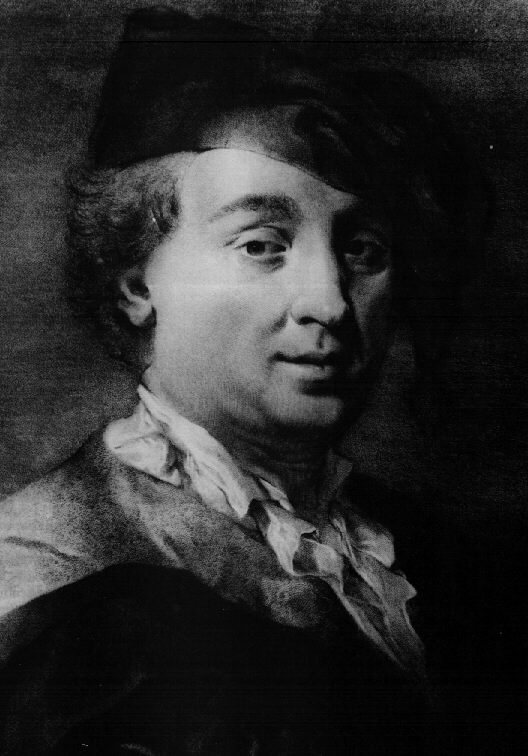
Carlo Goldoni (1707–1793) was the Molière of Italy, the comic playwright who drew upon the traditions of the commedia dell’arte while creating tightly scripted plays. The best known of these is A Servant of Two Masters, a popular choice of modern theatre companies wanting to do a commedia-style show without actually working in improvisational mode.
When first written for the actor Antonio Sacco in 1743, the play had large sections open for improvisation. The complete script we know today came ten years later. Goldoni had come to see himself as a reformer, a writer who could add depth to the commedia’s stereotypical stock characters and subtlety to the dialogue, now totally written rather than semi-improvised. In other words, he was a “commedia playwright,” as oxymoronic as that may sound.

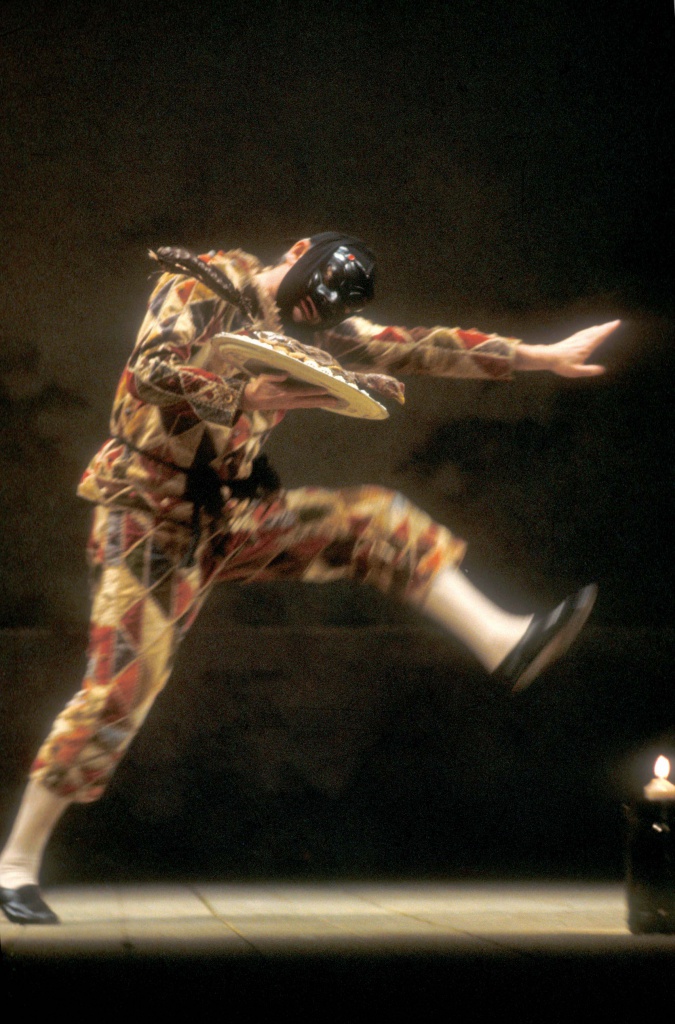
The servant with the two masters was Truffaldino, a commedia “zanni” similar to Arlecchino (Harlequin). Giorgio Strehler’s landmark 20th-century production at the Piccolo Teatro di Milano in fact transformed Truffaldino into Arlecchino and retitled the piece Arlecchino, Servitore di Due Padroni. It’s been in the Picolo repertoire since 1947 — that’s ten years more than Ionesco’s The Bald Soprano has been running in Paris! — and in all that time Arlecchino (photos above) has only been played by two actors, Marcello Moretti and Ferruccio Soleri.

Here’s a Picolo video about Goldoni and the production:

Or you can read this introduction to the production from the Picolo program:

Staged for the first time in 1947 by Giorgio Strehler, Harlequin, Servant of Two Masters has become, over the course of the years, the Piccolo Teatro’s worldwide ambassador.
Like a phoenix rising from its ashes, this show is a challenge to the primarily ephemeral nature of theatre, without however being a museum piece.
On the contrary, the image that Giorgio Strehler has often used to define his Harlequin is that of a “living organism”, almost by definition requiring continuous evolution, change, and re-readings that, with the passing of time, have lead to the production of 11 versions which bear witness to the transformation of a custom, put to the test innovations in playwriting, and tell of the evolution of a director and a theatre. A true example of “memory in action”.
Harlequin is therefore to be considered as one of the founding productions in the history of the Piccolo, a kind of “pre-text” on which to recreate a tradition which favors the art of the actor, his virtuosity, and, as Strehler often maintained “the pleasure of acting” and “the pleasure of being”.In this sense Harlequin, in continuous evolution, expresses a kind of “auroral” phase of the theatre, understood and treasured by audiences from all around the world.

Update: Have come across a lot more material on the play. Simply go back to the future and you’ll find it all at post 171.

Here is the complete text of the play in English translation.

The Servant of Two Masters

Next up are Goldoni’s memoirs, which apparently are far from being 100% accurate, but then who’s counting?

Memoirs of Carlo Goldoni

A Goldoni biography H.C. Chatfield-Taylor:

GoldoniBio

And finally, for the true Goldoni scholar — there’s got to be one of you out there — one more book, Goldoni & the Venice of His Time by none other than Joseph Kennard, author of Masks & Marionettes, which you’ll find two posts ago.

Kennard-Goldoni

A reminder that these .pdf documents can all be enlarged, read, downloaded, searched, and printed using the handy-dandy buttons at the bottom of each Scribd window.

Links:
• You can find part one of a documentary (in Italian) about the Picolo Teatro di Milano here.
• More plays by Goldoni at the Gutenberg Project or at Google Books.
• See the sidebar for a chronological list of all complete books available on this site.

SHARE
EXPLORE FURTHER

Complete Book: “Masks and Marionettes” by Joseph Kennard

POST 167
Tuesday, July 19, 2011

When I was writing Clowns, these were the books I consulted the most for my section on commedia dell’arte:
Masks, Mimes & Miracles by Alardyce Nicoll
The World of Harlequin by Alardyce Nicoll
The Italian Comedy by Pierre Duchartre
The History of the Harlequinade by Maurice Sand
Scenarios of the Commedia Dell’Arte by Flaminio Scala
• The Commedia Dell’Arte by Giacomo Oreglia

I did not read Masks and Marionettes by Joseph Kennard, nor have I since then, but browsing through it now it seems to be a reasonable overview of the subject, and one that touches on the closely related puppet theatre of the time. And since the above-mentioned books are not available for free and this one is, I though it worth including here.

Masks and Marionettes

SHARE
EXPLORE FURTHER

Complete Book: “The Commedia Dell’Arte” by Winifred Smith

POST 165
Friday, July 15, 2011

Because the essence of commedia dell arte was improvisation, recreating it for the modern reader has always been a tough task for scholars, and because it never pretended to be great dramatic literature, it didn’t get much interest from theatre historians or practitioners until the early 20th century. This started to change with directors like Copeau and Meyerhold, who took commedia as inspiration for a new approach to actor training, and modern art movements such as dada, futurism, and surrealism, that were less interested in literature than in the spontaneous theatrical event. Winifred Smith, one of the first commedia scholars from this period, was also a translator of futurist plays, and apparently quite a pioneer in her day. Here’s her bio from the web site of her alma mater, Vassar College, a prestigious women’s college that didn’t go co-educational until 1969:

Winifred Smith (1897-1967) was born in Cincinnati, Ohio. She was the daughter of Henry Preserved Smith, a leading Biblical scholar, and the sister of Preserved Smith, noted historian of the Reformation. After graduating from Vassar in 1904 and spending a year as a tutor at Mt. Holyoke College, and a year of student at the Sorbonne, Winifred Smith earned a Ph.D. from Columbia University in 1912.


In 1911 Miss Smith came to Vassar as an instructor in English, rising to the rank of professor. In 1916 she started a theatrical museum at Vassar and, with Emmeline Moore, a Shakespeare Garden to commemorate the 300th anniversary of Shakespeare’s birth. Winifred Smith’s scholarly interest was in dramatic literature. She wrote books on The Commedia dell-Arte and Italian Actors in the Renaissance and numerous articles and reviews for periodicals such as The Nation and The Dial. She also translated many futurist plays from the French and Italian. When the Division of Drama was organized in 1938, she became its chairman, working closely with Hallie Flanagan Davis during the years of the Experimental Theatre.


Professor Smith was also active in the suffrage movement and participated in local civic activities, including the Community Theatre, the Women’s City and County Club, and the Citizens Better Housing League. She was the first president of the Dutchess County local of the American Federation of Teachers. She was interested in such social issues as disarmament and child labor.


Her retirement in 1947 was marked by an only slightly slower pace in a career outstanding for her willingness to act on a broad range of social concerns and scholarly interests. In a faculty memorial minute, Winifred Smith was named “one of Vassar’s great teachers” and “one of its great rebels.”

And here’s her complete book, The Commedia Dell ‘Arte: A Study in Italian Popular Comedy (1912).

The Commedia Dell Arte

SHARE
EXPLORE FURTHER

“Clowns”: Chapter Two — Supplementary Material

POST 162
Sunday, July 10, 2011

Chapter two (previous post) covered a lot of ground — about twenty centuries and at least four continents — so there’s a ton of potential supplementary material. I’ll just throw a few at you here, and then follow up in my next posts with some free books.

The first comes from the 18th-century tradition of French fairground theatre, which thrived outside the censorship laws imposed on the royally-sanctioned “serious” theatres in Paris. The most popular form of fairground comedy was a short farcical sketch known as a parade.  Popular, that is, until they were closed down by the police in 1777.

Below is a quite humorous example by Thomas-Simon Gueullette (1683–1766), a lawyer and scholar who wrote over sixty pieces for the commedia actors of the Théâtre-Italien. Rather than inventing much that was new, I suspect that Gueullette, like Goldoni and Gozzi, took much of the comic business made popular by the improvisatory commedia actors and repackaged it in a more tightly structured, written form. The good news is that he did a nice job of it.

One Armed, Blind Deaf Mute

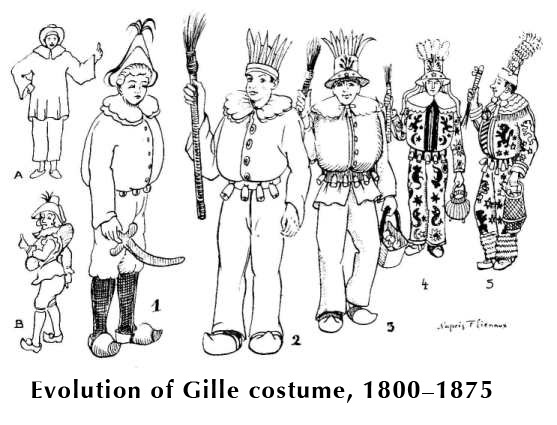
Here’s what that dumb comic servant Gille may have looked like:

And click here for a recent Ph.D. dissertation on the work of Gueullette.

If you’ve seen my favorite movie ever, Children of Paradise (1945), you already have some sense of the fairground theatre atmosphere, but transported half a century later from Gueullette’s time to the heyday of the Boulevard du Crime in Paris. If you haven’t seen Children of Paradise, you are hereby ordered to do so. Soon! It’s on DVD and it’s available on Netflix, though if you can actually see it in a movie theatre, it’s worth the money to take it all in on a big screen. Much of the action takes place at the Théâtre des Funambules (theatre of the wirewalkers) and centers around the legendary mime, Jean-Gaspard Deburau (1796–1846), immortalized in the performance of Jean-Louis Barrault.

Here’s a scene that did a lot to popularize pantomime. This is Barrault as a not-yet-famous Deburau, dismissed as the family idiot, forced to work the platform in front of the Funambules to help draw in paying customers.

There are no subtitles, but you won’t need them. When the master criminal Lacenaire picks the pocket of a bourgeois gentleman, his accomplice Garance gets the blame. The police ask if there are any witnesses, and the silent mime suddenly speaks, saying he saw it all. Once he acts it out, Garance goes free, and her show of gratitude triggers a romance that is one of the movie’s central plot lines.

___________________________________

“Act! Act! You have the wrong place. We are not allowed to act here. We walk on our hands! And you know why? They bully us. If we put on plays, they’d have to close their great, noble theaters! Their public is bored to death by museum pieces, dusty tragedies and declaiming mummies who never move! But the Funambules is full of life, movement! Extravaganzas! Appearances, disappearances, like in real life! And then, BOOM, the kick in the pants!”   
— the director of the Funambules

___________________________________

A mime piece performed by Barrault as Deburau at the Funambules:

Stay tuned: I will be posting a complete book (in French) of Deburau’s mime pieces in a week or two.

Now here’s a real curiosity: Etienne Decroux, the father of French mime, teacher of Marceau and Barrault, and later the creator of the more abstract corporeal mime style carried on by his students Tom Leabhart, Daniel Stein, and Steve Wasson, amongst others. Yes, that Etienne Decroux. Here he is, eye lashes fluttering, jabbering away, hamming it up like crazy as Deburau’s very verbose father!

________________________________

“A kick in the ass, if well delivered, is a sure laugh. It’s true. There’s an entire order, a science, a style of kicks in the ass.”
— Anselme Debureau (played by Etienne Decroux)

________________________________
Did I mention this is a great movie? Not only that, but once you’ve seen it, you’ll want to know more about this whole theatrical era. Well, you’ve come to the right place, and I’m referring to our final supplemental item, “The Golden Age of the Boulevard” by Marvin Carlson.
When I was in graduate school at NYU and working as an assistant editor for TDR (The Drama Review), I commissioned this article from the distinguished theatre scholar Dr. Marvin Carlson for an issue on popular entertainments I was putting together. It gives me great satisfaction, almost forty years later, to have been back in touch with Professor Carlson, who kindly consented to have his article reprinted on this blog so it could reach a new and wider audience. It’s an excellent article, and I once again thank Mr. Carlson for this and his many other contributions to theatre scholarship, which you can check out here.

Golden Age

___________________________

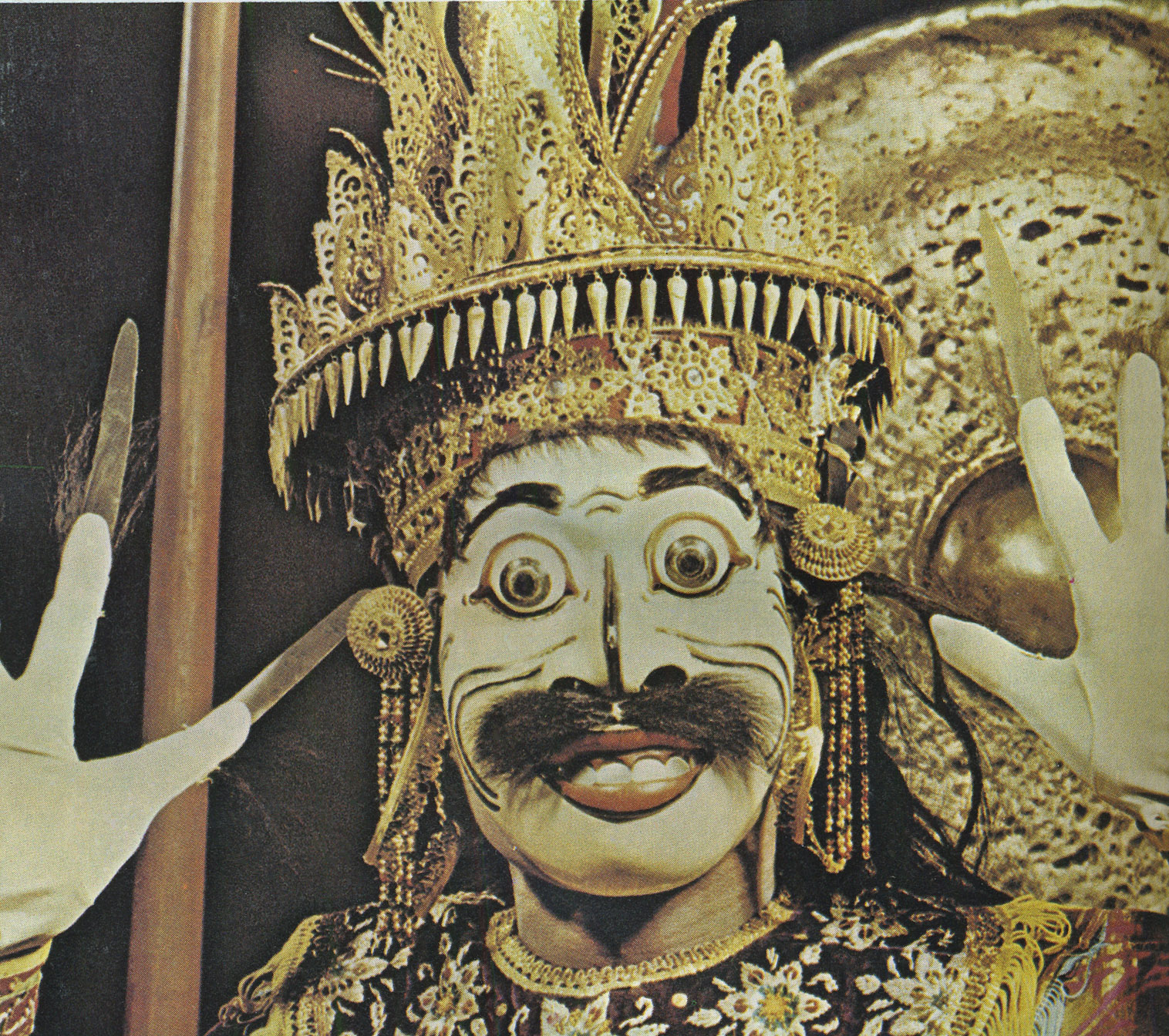
And, last but not least, an important correction. The following photo, from a Columbia Records lp of gamelan music, appeared in the color plate section of my book with the caption “Clown character from the wajang wong, the Balinese dance-drama.”

Well, it turns out that was wayway wrong. After the book was published, I received a note from Leonard Pitt — mime, maskmaker, student of the above-mentioned Etienne Decroux, and expert on Balinese theatre — advising me that this photo was mislabeled. My bad for not having double-checked this. But I did save the note, and when I visited Leonard last year at his Flying Actor Studio in San Francisco, I was able to show it to him (35 years later!) and promise to finally make amends. I wanted to scan the note for this post, but it is lost somewhere here in my office. If instead I showed you a picture of my office, you’d see why it might take me a while to retrieve the note! Anyway, correction made, photo removed, and thank you again Leonard!

___________________________

Coming next, the following complete books, all related to Chapter Two material:
The Mimes of Herodas
The Commedia dell’Arte by Winifred Smith
Masques et Bouffons by Maurice Sand
Mimes et Pierrots by Paul Hugounet
Memoirs of Carlo Goldoni
• Goldoni: A Biography by H.C. Chatfield-Taylor
The Memoirs of Count Carlo Gozzi
• The Life of Moliere by Henry M. Trollope
Le Théâtre des Funambules by Louis Péricaud
Pantomimes de Gaspard et Charles Deburau

SHARE
EXPLORE FURTHER

“Clowns”: Chapter Two — The Clown to the Stage

POST 161
Thursday, July 7, 2011

When I started this blog more than two years ago, I thought one thing I would definitely do would be to get my book Clowns, long since out of print, up on the blog so all of you could access it for free. The problem is that doing so involves a lot of tedious work (scanning; optical character recognition; proofreading; layout; etc.), plus I wanted to provide supplementary material for each chapter. Ideally I would rewrite it to improve it (hey, I was 26 at the time!) and bring it up to date, but that possibility will have to wait until I retire, at which point I’ll probably prefer to do something that’s more fun.

Still, even I am amazed that it’s been two years and I’ve only posted chapter five (the one most related to physical comedy) and chapter one. So here goes chapter two.  At this rate, I’ll have the whole book up there by 2020! If you’re impatient, you can usually find a used copy on Amazon, with prices ranging from $15 to $200. If I were you, I’d hold out for a cheaper copy.

So here’s chapter two, a long one, which covers the clown character in various dramatic traditions, including of course commedia dell’arte. It could have been broken up into more than one chapter, but I had deadlines to meet and had to limit it somehow.

I’ll follow up with some related material, including some complete books, more than you will ever have time to read. Or me either, for that matter…

Clicking on the bottom-left button shows it full screen, and you can of course download it, print it, etc.

ch02

SHARE
EXPLORE FURTHER

Method in Mime by R.G. Davis, founder of the San Francisco Mime Troupe

POST 65
Friday, February 5, 2010

In writing about San Francisco on my last post, I mentioned the influence the San Francisco Mime Troupe had on the popular-arts performance scene there. If you’ve seen their work, you’ve probably wondered why they label themselves a mime troupe. The answer lies in their early years under the direction of their founder, R.G. Davis (photo, right). This manifesto on mime and pantomime, written by Davis in 1962, shows the troupe’s roots and still raises some interesting questions today.

What I liked about this when I first read it sometime back in the 70s were the clear distinctions Davis was able to make between a broad commedia style of physical performance and the more precious tradition of the white-faced pantomime artist. Now that I’m older and wiser (oh yeah, sez who?), I’m a bit more wary of dialectic reasoning where things are either this or that with no wiggle room. People who think like that can be very difficult to deal with! Still, I think it’s a useful argument, a provocative read, at least if seasoned with a grain or two of salt. And although Davis was eventually replaced by a collective leadership and the troupe’s performance style became less “mime-y,” their work has in fact retained an essential commedia feel and flavor.

Anyway, it’s only three pages, well worth your time, just be sure to click on “Fullscreen.”

Method in Mime

SHARE
EXPLORE FURTHER

Who is Your Favorite Commedia Character?

POST 21
Tuesday, August 18, 2009


I’m sure if they had included Arlecchino the numbers would have skyrocketed. —jt

SHARE
EXPLORE FURTHER
Check out My New Book

Visual and verbal humor for the cognitively and artistically curious!

“A book to treasure!”
—Bill Irwin

Upcoming Events