Day: May 13, 2009

Performance Report: Humor Abuse

POST 5
Wednesday, May 13, 2009

I grew up in show business — as a child actor in New York City television in the late 50s — and my first performance ever was in a skit with Red Skelton and Jackie Gleason on the Red Skelton Show on CBS a few days after my 7th birthday. Lorenzo Pisoni also grew up in show business — in the San Francisco-based Pickle Family Circus, to be precise — hanging out in company that included clowns Geoff Hoyle and Bill Irwin, and performing and touring widely in an act with his father, Larry Pisoni.

I remember enjoying my childhood career and yet at times hating being the freak, the weirdo kid with the long hair who disappeared from school to go into rehearsal. Looking back, I often wished I had grown up “normal,” whatever that means, yet at the same time I enjoyed being special. As time passed, I forgot about it. It was another me who lived a lifetime or two ago … though I still took pleasure in occasionally dropping the names of a few stars I’d worked with (otherwise I might still be a virgin).

Just to push the comparison a bit (and to drop another name), here are photos of me with Julie Andrews and of Lorenzo with Willie the Clown. Don’t know who that is? None other than Bill Irwin.
But I didn’t come from a show business family and my involvement was on a part-time basis. Lorenzo Pisoni, on the other hand, not only lived the circus life, not only worked season-long in an act with his father, Larry Pisoni, but actually performed as a visual clone of his father in an act that also featured a life-sized puppet that was Lorenzo’s spitting image. I can’t help but think of Buster Keaton growing up in his family’s vaudeville act, The Three Keatons, likewise dressed to match:
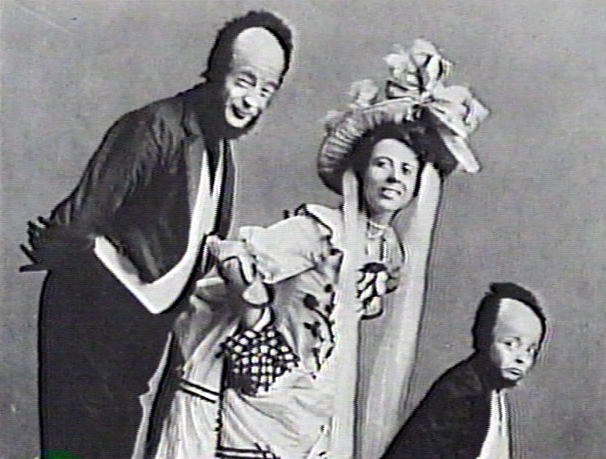
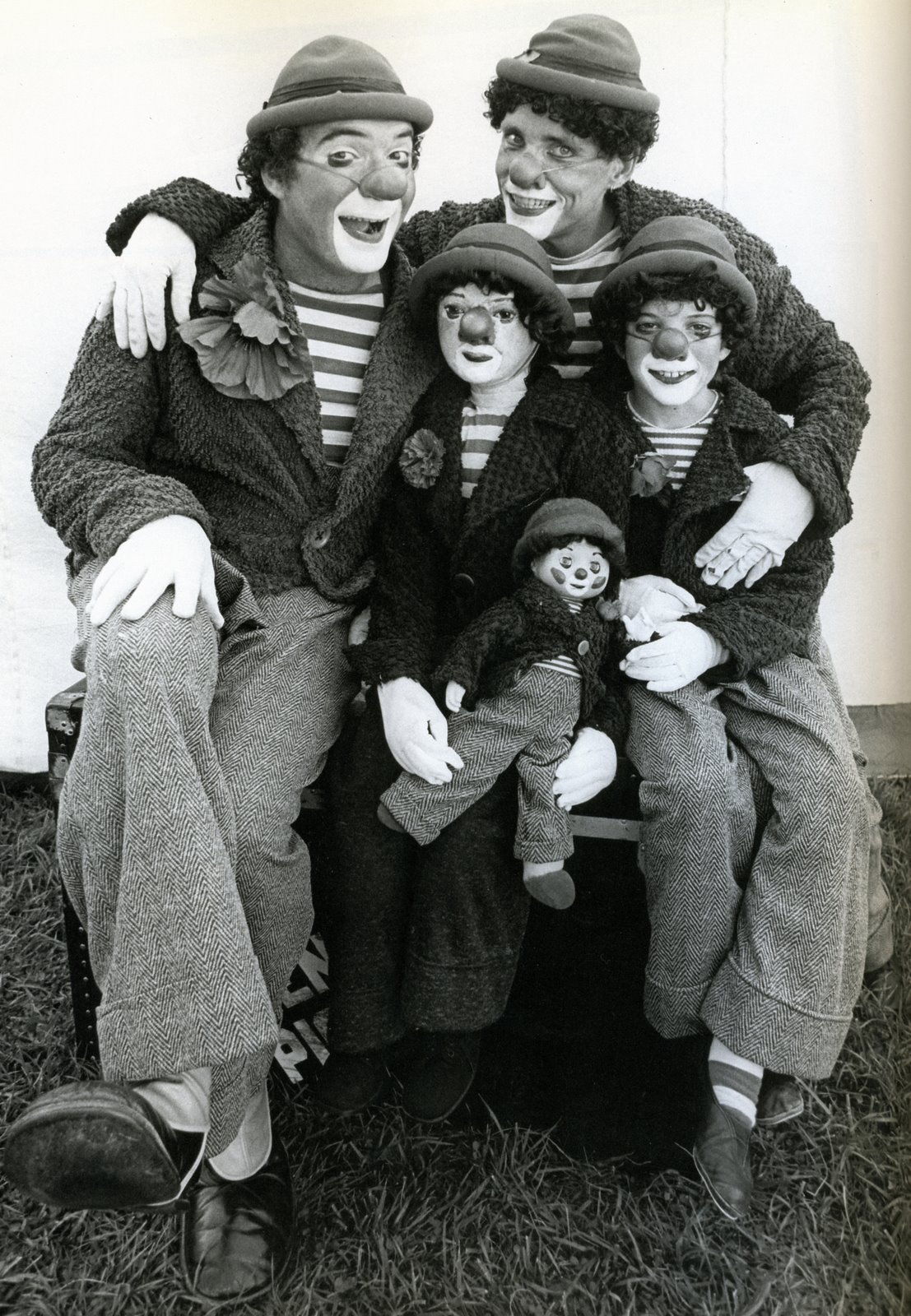
If that ain’t a recipe for major therapy bills, I don’t know what is.

Take a look at this slide show of Pickle Famliy Circus photos to get a feel for what I’m talking about. Can you spot the puppets?

[The usual Scribd note: click on icon in upper-right corner to view document full-screen; click again on same icon to return to blog.]

Larry Lorenzo

[A big thanks to Terry Lorant for allowing me to share those excellent photos with you. They’re from The Pickle Family Circus (SF: Chronicle Books, 1986), one of your better circus books, which Terry co-authored with Jon Carroll. Check out more of Terry’s work at his web site.]

Update (1–23-10): Last week I saw that an old 30-minute documentary on the Pickle Family Circus had shown up on YouTube broken down into several segments. Today only the opening segment was there. Hmm… Here it is:

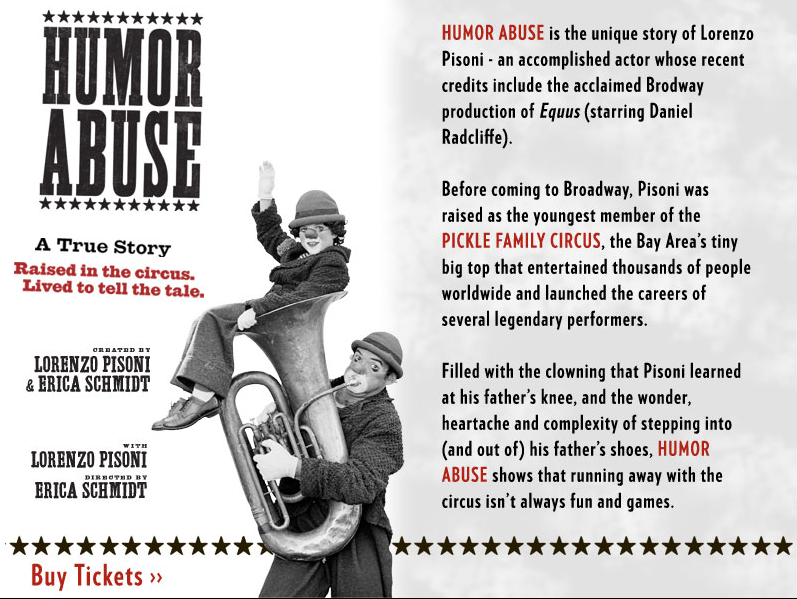
The happy result of Lorenzo’s, er, unorthodox upbringing, is Humor Abuse, his one-man autobiographical show that just completed a successful New York run at the Manhattan Theatre Club. Co-written with Erica Schmidt, who also directed, it deftly chronicles the child’s perception of a strange but wonderful world via words, slides, and re-enactments of the comic bits that defined their existence. Simply put, the show is quite well crafted and well performed, tough and sweet at the same time. It reminded me of Mike Birbiglia’s one-man show, Come Sleepwalk with Me, still running in New York (through June 7th). Pisoni is a clown and Birbiglia a stand-up comic, but in essence they are both excellent storytellers whose humor serves their content. Lorenzo’s content reminded me all too well what it was like to grow up too fast, to always be in the public eye, to love and resent what you’re doing.

Although Lorenzo early on offers the disclaimer that he’s not funny, the clown pieces he does perform are top-notch and interwoven nicely with the narrative. I had never seen Larry’s sandbag routine, which he featured in his one-man theatre show, and it is quite spectacular. Wherever the clown stands, a sandbag — which gives every impression of being heavily (perhaps lethally) weighted — releases from the rafters, misses his head by what seems to be inches, and lands on the stage with a large thud. Try as he might to find a safety zone, he can’t, though of course he always escapes actual impact. The act manages to be thrilling, scary, and hysterically funny, all at the same time.

The show did, however, leave me with one reservation I can’t quite shake. Lorenzo is often critical of his father’s dictatorial ways, and depicts him as at times a lonely, perhaps even bitter man. I don’t know Larry personally, but that’s not the point. I’m just left uneasy by attacks, even mild ones, on someone who can’t be there to defend himself. Maybe I’m just worried that my son the stand-up comic will start doing a show about me! (No, we didn’t perform together.) It’s like that uncomfortable feeling you get when a friend starts trashing their ex to you; you want to be supportive, but you know there are two sides to the story. That being said, the show does come across as an honest, non-vindictive attempt to deal with the past, and I think it succeeds admirably. If it ever tours to a theatre near you, be sure to see it.

_______________

OK, that’s just my take on it. You can read pretty much all the reviews on it at the Critic-O-Meter blog.

SHARE
EXPLORE FURTHER

Chapter 5 — Supplemental Material

POST 4
Wednesday, May 13, 2009

As I said in my previous post, I have a bunch of additional material relevant to each of the twelve chapters of Clowns. This is especially true of Chapter 5, because it focuses on physical comedy. In fact, you could view this entire blog as Chapter 5 supplemental material! In addition, I’m still a huge fan of the Hanlon-Lees and I could overwhelm you with stuff on them, but I’m going to wait for the publication this fall of Mark Codson’s book (see below) to dive back into their work.

That being said, a few miscellaneous goodies…

__________________

On pages 5-6, I talk about nineteenth-century performers such as Mazurier and Klischnigg, who did remarkable imitations of monkeys, starring in vehicles such as Jocko, or the Monkey of Brazil. You can get some sense of what that might have been like from this comic turn by Buster Keaton in his brilliant short, The Playhouse (1921).

_______________

Baudelaire on clowns: the Vertigo of Hyperbole

When Tom Mathews’ English pantomime troupe visited Paris in 1853, one of the spectators was the French poet, Charles Baudelaire. Despite his well-known interest in the macabre and the grotesque, Baudelaire was somewhat taken aback by the British clown, the “English Pierrot.”


I shall long remember the first English pantomime that I saw. . . It seemed to me that the distinguishing characteristic of this genre of comedy was violence. . . . The English Pierrot was by no means this character pale as the moon, mysterious as silence, supple and mute as the serpent, lean and long as a pole, to which we were accustomed by Deburau. The English Pierrot comes in like a whirlwind, falls like a bale, and when he laughs he makes the room shake; his laughter sounds like joyful thunder. He is a short, thick fellow, who has increased his bulk by a costume filled with ribbons. On his whitened face he has crudely plastered — without gradation or transition — two enormous slabs of pure red. His mouth is made longer by a simulated prolongation of the lips in the form of two carmine strokes, so that when he laughs his mouth seems to open from ear to ear. . . . His moral nature is basically the same as that of the Pierrot we know: insouciance and neutrality, leading to the realization of all the rapacious and gluttonous desires, to the detriment sometimes of Harlequin, and sometimes of Cassandre or Léandre. But where Deburau thrust in the point of his finger so that he might afterwards lick it, the clown thrusts in both hands and both feet, and this may express all that he does: his is the vertigo of hyperbole. This English Pierrot passes by a woman who is washing her doorstep: after emptying her pockets, he seeks to cram into his own the sponge, the broom, the soap, and even the water…. Because of the peculiar talent of the English actors for hyperbole, all these monstrous farces take on a strangely gripping reality.

— De L’Essence du Rire
(my translation)

__________________

In the book, I described The Duel Between Two Clowns, a clown act between Boswell and one of the Price Brothers (apparently William) involving an attempted two-high, a ringmaster, a duel, and some quick change. Amazingly there is an actual transcript of this routine from the 1840s in Entrées Clownesques, a collection of clown texts compiled by the great French circus historian, Tristan Rémy. I have no idea what the original source for this document is. Rémy’s book was translated into English by Bernard Sahlins as Clown Scenes (Chicago: Dee, 1997). Unfortunately, for some reason he only includes 48 out of the 60 entrées contained in the original, and Le Duel Entre Deux Clowns ain’t one of them. Thanks, Bernie, for forcing me back into the highly lucrative clown entrée translation business!

Here it is, hot off the press. Please use your imagination to see beyond the dialogue and picture the act performed by two very strong clowns.

[Forthcoming!]

__________________

Another link between 19th-century pantomime and early film: First here’s a poster of the train wreck from Le Voyage en Suisse (1879):

And now here’s a shot from the 1904 Georges Méliès film, The Impossible Voyage, courtesy of the Library of Congress.


Coincidence? I think not.

Méliès was, as many of you probably already know, a stage magician who became a pioneer of special effects in early film. And while we’re on the subject, the connections between film effects and circus-style performance is the subject of an intriguing blog that you might want to check out: Circo Méliès.

_______________

And in my first On the Shoulders of Giants installment, I reinforce the obvious connection between the Byrne Brothers’ Eight Bells and Buster Keaton’s Neighbors by showing the Keaton clip that brings the poster to life (and then some).

_______________

Mistakes? What mistakes?

Probably plenty; here’s one…. Mark Codson, whose excellent dissertation on the Hanlons will be published this fall, pointed out that I persisted in translating the title of Le Voyage en Suisse into English, when in fact the show toured to England and the United States with the original French title. I was probably thrown off by a few bi-lingual posters and by a previous commentator or two who also referred to it as A Trip to Switzerland. The correction has been made, so thank you Mark. If anyone has additional corrections, just let me know.
UPDATE (11-17-09): Mark’s book is now slated for publication on February 2, 2010. You can order it here.

_______________

UPDATE (11-17-09): You can see a version of Auriol’s bottle-walking act in Cirkus Cirkör’s production, Inside Out. Read all about in in this post.

_______________

So what’s missing?

It’s the second longest chapter in the book, and one of my favorites, but it has at least one glaring omission, the work of American pantomime clown George L. Fox. Yes, I do mention him, but that’s about it. He was wildly popular and a colorful character (he went insane), but I think at the time it was hard to find all that much about his actual performing. Or perhaps I just ran out of time.

A few years later, when Bill Irwin was first considering doing a show based on Fox’s life, I helped him out with some additional research, including uncovering some original pantomime scripts. It was not until 1999 that Laurence Senelick’s excellent study appeared: The Age & Stage of George L. Fox, 1825-1877. Armed with this thorough research, Bill finally did his show, Mr. Fox: A Rumination in 2004 as part of his season of work for the Signature Theatre.

SHARE
EXPLORE FURTHER

A note on Clowns: A Panoramic History

POST 3
Wednesday, May 13, 2009

Finally I get to answer all those questions I’ve been getting for over 30 years!

If Clowns was published back in 1976, aren’t you like 100 years old by now??
I was young then, now I’m 60 (but I still do triathlons).

Why isn’t it still in print?
Because my publisher, Hawthorn Books, got bought by Dutton who got swallowed up by Elsevier and, back in those pre-Amazon days, a global conglomerate like Elsevier had no reason to keep a niche book in print if bookstores were no longer stocking it. Counting the hardcover and the paperback, it sold nearly 20,000 copies (no, I didn’t get rich), but at a certain point the Law of Diminishing Returns kicks in.

Can you sell me a copy?
Nope. I only have three hardcovers and one paperback to my name, and they’re all falling apart, which is kind of strange since it’s not my favorite reading material. When I prepared chapter five for this blog (see previous post), it was the first time I’d read it since I wrote it.

Couldn’t you have gotten it reprinted by some university press or small publishing house?
Maybe, but no one ever made me an offer I couldn’t refuse, and I never had the time to pursue it. Life gets busy, life gets complicated, you develop other interests, you have other matters you have to deal with. Furthermore, I would have wanted to improve it rather than just do a straight reprint, and that meant work I didn’t have time for.

What kind of improvements?
First, correcting mistakes. Yes, I wrote the book under a deadline in little more than a year’s time, so there’s stuff to fix. Furthermore, there are sections I would expand upon, and of course plenty has happened in the clown world since 1975.

So why are you suddenly doing this blog?
Because I’m entering a full-year sabbatical from my teaching job at Bloomfield College. Because I did a lot of work toward a physical comedy book that I never had time to finish. Because I’m still a big fan.

Will we see more chapters from the Clowns book?
Well… no promises, but the plan is to put them all online as pdfs, suitable for printing. It is a lot of work: proofreading the OCR text, scanning pictures, redoing the layout, fixing mistakes. I also want to offer supplemental material on each chapter; I have a ton. For example, there was a 100-page appendix to the book — all sorts of scripts and related documents — that got as far as galley proof stage but then never got printed because Hawthorn realized it would just cost them $ without boosting sales.

And then will you reprint the book?
Ideally, yes, but again no promises. It’s more likely to happen if the blog process helps me improve the product, which is why I welcome your corrections, comments, and suggestions.

And since this is a blog and I’m supposed to provide a lot of visual elements so you don’t get bored by too much reading (God forbid!), here’s a pic of what the original Clowns wraparound cover looked like before they opted for the Otto Griebling cover you see above.

SHARE
EXPLORE FURTHER

Chapter 5 — Knockabouts & Cascadeurs

POST 002
Wednesday, May 13, 2009

Chapter 5 from my book, Clowns: A Panoramic History
One more background piece. This chapter from my 1976 history of clowns dealt in detail with the development of physical comedy in the nineteenth century and, ultimately, its influence on American silent film comedy. Good stuff!

[The usual Scribd note: click on icon in upper-right corner to view document full-screen; click again on same icon to return to blog.]

Chapter 5 Chapter 5 towsen

SHARE
EXPLORE FURTHER
Check out My New Book

Visual and verbal humor for the cognitively and artistically curious!

“A book to treasure!”
—Bill Irwin

Upcoming Events