From the BBC wire, 12 August 2011. Richard Westcott reports: Staff at Birmingham’s Central Library have discovered a priceless collection of more than 500 silent movie music scores. They made the find during a clearout before a move to a new building and unearthed more than just a bit of old junk.
Here’s the video:
More informative is this longer article from the Birmingham Post. It notes that…
• The treasure trove included Marche Groteque (1916),”a unique theme from a Charlie Chaplin film.”
• “There’s a lot of European material here that didn’t make it to the States, because they had so much material they didn’t need to buy from European stuff.”
• “Experts say the discovery disproves the myth that film-goers were routinely subjected to a single pianist to accompany the likes of Chaplin and Buster Keaton and shows musical directors used a wide range of themes to cover action, comedy and tragedy.”
[post 176]
Whether or not you’ve been following all my posts on commedia dell’arte and the various Carlos (Goldoni, Gozzi, Mazzone-Clementi), whether or not you think commedia is the holy grail of ultimate theatricality or merely a corny, hoary, outdated performance style, you will probably be surprised to learn that a modern adaptation of Goldoni’s Servant of Two Masters is the hottest ticket in London.
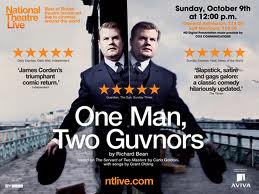
What we’re talking about is One Man, Two Guvnors, an adaptation of the Goldoni play by Carlo Bean — oops, I mean Richard Bean — currently in rep at the National Theatre but scheduled to open a commercial run in the West End’s Adelphi Theatre on November 8th. According to Variety, producer Bob Boyett already has plans to bring it to Broadway.
Playwright Bean, who must be a spiritual brother to Rowan Atkinson’s Mr. Bean, has moved the play’s action to 1963 Brighton and our two masters/guvnors are now gangsters. The reviewers all say that the intricate plot is hard to describe but that it works magnificently well. The BBC critic, for example, called it ‘the single funniest production I’ve ever seen.”
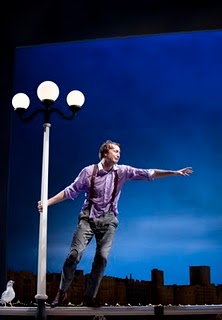
What excited me was the equally unanimous verdict that the production, directed by the always impressive Nicholas Hytner, is a masterpiece of physical comedy, with James Corden in the lead and Tom Edden as the waiter receiving particular praise. This rave from the reviewer for the Daily Telegraph is typical:
Corden, with a face like an enormous potato and a physical dexterity that is astonishing in one so corpulent, brings a winningly warm and harassed humanity to the role. He constantly button-holes the audience with asides and ad-libs, and turns the play’s great set piece in which he simultaneously serves dinner to his two masters into one of the most uproarious scenes of farcical comedy I have ever witnessed. He is brilliantly abetted by Tom Edden as a doddery ancient waiter who suffers no end of humiliation and keeps falling down the stairs. During this set-piece I found myself physically helpless with laughter.
This is the official National Theatre preview video:
The National Theatre web site features the following series of six behind-the-scenes “video diaries.” Aimed at the general public, they’re not as informative as you or I might like, but at only a minute or two each, they’re worth a look-see; the intros to each video are from the NT web site
Video Diary #1 — Meet Daniel
Take a peek into rehearsal room one and meet Daniel Rigby, an actor in One Man, Two Guvnors. See him rehearsing, hot seating and improvising as well as meeting some other cast members.
Video Diary #2 — Stage Fighting
Jemima Rooper takes us for a sneaky peek into Daniel Rigby’s fight rehearsal. Watch Combat Kate teach the cast how to stage fight. Meet more of the cast. WARNING: Do not try this at home!
Video Diary #3 — Singing and Dancing
Watch the cast singing and dancing their way through rehearsals. Meet more of the cast. See the girls strut their stuff, get a sneak listen to one of the tunes in the show and see the skiffle band in action.
Video Diary #4 — The Dinner Scene
The Dinner Scene is one of the highlights of the show One Man, Two Guvnors. It is beautifully choregraphed slapstick comedy requiring split-second timing and many many props.
Video Diary #5 — Tech Rehearsal
‘Tech rehearsal’ stands for ‘technical rehearsal’. In a tech rehearsal all the technical elements of a show – lights, sound, set, props, costume – are put together on stage for the first time. Tech rehearsals take several days and can mean lots of sitting around for the actors. In this video diary we get a glimpse backstage at the One Man, Two Guvnors tech rehearsal.
Video Diary #6 — Press Night
Press night is the first formal night of the show’s run after previews. All the theatre critics are invited to see the show and many of them will write reviews. Everyone gets excited and nervous before press night. Good reviews can mean a sell out show. See the cast of One Man, Two Guvnors getting ready for press night.
Here are a few excerpts from reviews, with links to the full articles:
Guardian “But what makes the show a triumph is its combination of visual and verbal comedy. Bean and his director, Nicholas Hytner, have managed to make the dinner scene funnier than ever by adding a character: an octogenarian waiter, magnificently played by Tom Edden, whose hand alarmingly quivers as he serves a tureen of soup and who has an amazing capacity to fall backwards down stairs and return like a rubber ball.”
Full review is here.
Variety “Aided by physical theater expert and associate director Cal McCrystal, director Nicholas Hytner expertly harnesses that comedy energy to build a tight, towering succession of character shtick, sight gags, slapstick and chase sequences unseen since “Noises Off.” All of which prepares everyone for the play’s most famous scene. Desperate to keep his masters apart, Henshall is forced to serve dinner to them separately but simultaneously. But Bean and Hytner go one better, adding in a new-to-the-job, 87-year-old deaf waiter with the shakes, played by Tom Fedden as a magnificently doddering disaster-zone replete with jaw-dropping comedy pratfalls.”
Full review is here.
Sketches on Theatre “Hytner strikes the perfect balance between slick comedy and potential chaos and nails the infamous central banquet scene. Corden screeches across the stage, skidding on food and nearly sending the decrepit butler to his (late) grave. It’s a bit like watching Faulty Towers on fast forward with the sound at full blast.”
Full review is here.
New York Times “If you’re allergic to British farce as practiced by the likes of Benny Hill and depicted in the “Carry On” movies, Two Guvnors may well have you sneezing convulsively. And yet I – who have always switched channels whenever anything remotely Benny Hill-ish crossed my television screen – found myself succumbing to the glazed rapture that spread throughout the audience on Friday night. That audience, by the way, included the actors Jonathan Pryce, Imelda Staunton and Patricia Hodge, and the Booker Prize-winning novelist Howard Jacobson. Crude, rude and socially unattractive, One Man, Two Guvnors is, my dear, the chicest ticket in town.”
Full review is here.
The Independent “Driven by the dictates of his empty stomach and bewilderment over his duties, Corden displays great natural gifts for physical clowning – whether picking a fight with himself that is a mad paroxysm of auto-pugilism or, in a sequence that could be called a tour de farce, dishing lunch to his two masters in separate rooms of The Cricketers’ Arms, a challenge not helped by a doddery, cadaverous, 87-year-old fellow-waiter with a pacemaker, balance problems and an ongoing relationship with the staircase that its roughly that of rubbish to chute. One Man, Two Guvnors, one massive hit.”
Full review is here.
_________________________________
Seeing the Play in London:
The National Theatre run is sold out, but if you’re there between now and September 19th, you can see the show for only £10, or £5 standing room. A limited number of day tickets (check schedule since it doesn’t play every day) go on sale at 9:30 a.m. I’ve been doing this since 1970, when I got off the plane early in the morning, headed to the National, and nabbed a £10 ticket to see Laurence Olivier play Shylock in A Merchant of Venice. I’m still doing that four decades later! I usually get there 45–60 minutes early, but for a big hit like this, at least 90 minutes would be safer; bring a book! These cheap day tickets are only at the National Theatre and will not be available for the West End run.
Seeing the Play in a Movie Theatre Near You!?
On September 15th you can see a live telecast of this production in select movie theatres in cities acros the globe. Maybe there’s a venue near you. The web site’s a bit confusing, but apparently in NYC it will be screened on September 21 at Skirball NYU… but maybe elsewhere on the 15th?!? I know I’ll be there, hopefully on the right night.
More Links:
• The National Theatre web pagefor this production
• You can download the script for Goldoni’s Servant of Two Masters onthis recent blog postand learn more about Giorgio Strehler’s famous production here.
• You can buy the script for One Man, Two Guvnorshere.
“It is a far better thing that I do now than I have ever done before #splat” — Tweet earlier today by pie-thrower Jonnie Marbles
Another emergency interruption of our series of complete books on the commedia dell’ arte… but definitely in the commedia spirit!
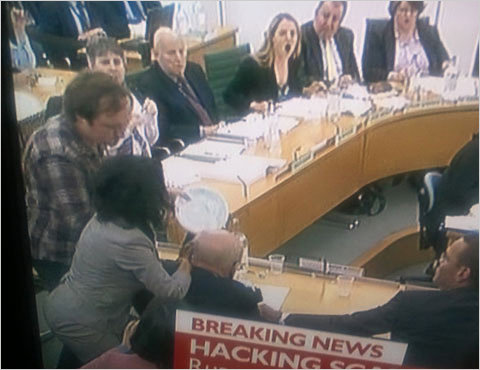
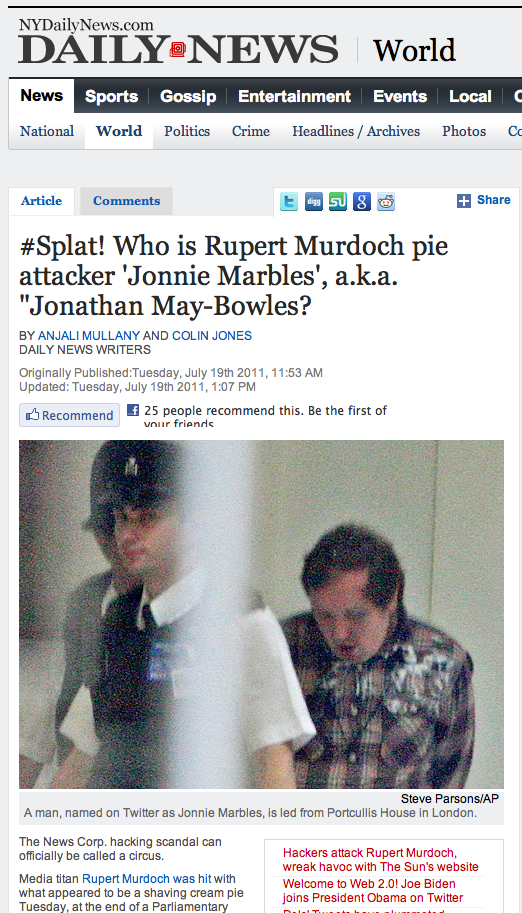
Just a few posts ago, in writing about Improv Everywhere, I also got to talking about the history of guerrilla theatre, and the practice of “pieing” prominent political figures. So this just in: a British comedian/activist who goes by the name of Jonnie Marbles somehow got himself and a shaving cream pie into the Parliamentary interrogation of media baron Rupert Murdoch and managed to plaster the old guy right in the kisser. (If you don’t know who Murdoch is or why he’s suddenly in trouble, click here… and read the newspaper once in a while, why dontcha?!) Marble had tweeted about his planned attack beforehand, paraphrasing the famous last sentence from Charles Dickens’ A Tale of Two Cities.
Dickens: It is a far, far better thing that I do, than I have ever done; it is a far, far better rest that I go to, than I have ever known. Marbles: It is a far better thing that I do now than I have ever done before #splat
Here’s a video that caught some of the action, as reported by Murdoch’s own Fox News:
The event is getting a lot of media attention. For example, from the NY Daily News:
You can read the whole article here. If you check out the media coverage of the event, you’ll see that some news outlets try to frame it as an act of violence meant to harm Murdoch physically rather than as a stunt meant to embarrass him and send a message. Hmm….
Did you ever enjoy a great act in person and then later see it on video and find it flat and nowhere near as exciting? Yes, it’s incredible to be able to watch performances from around the world on our laptop computer or even on a telephone, but still there’s nothing like live performance.
A case in point is Craig Reid, whose Elvis Presley hula-hoop act blew me away both for its technical virtuosity and its sharp humor. Sheer delight. This video clip — just an excerpt — doesn’t quite capture it for me, but here he is. Enjoy, but do try to catch his show if you can.
And here’s one I haven’t seen live, his take on The Wizard of Oz.
Which reminds me of another one of my favorite pieces, Bobby McFerrin’s version of The Wizard of Oz.
Comedians and clowns have been parodying Shakespeare for centuries now, and “reduced Shakespeare” companies have become somewhat of a comedy franchise since the 80s. Here’s a nice physical Rowan Atkinson piece, a fake lecture on Shakespearean acting from 1991. Despite the title, his tights are not pink and there aren’t all that many props — but a great title nonetheless. Atkinson is best known for his Mr. Bean character, but his range is much broader. The following piece, which co-stars Angus Deayton, is just one example.
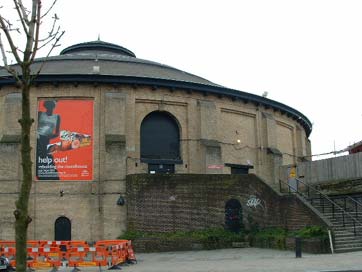
I blazed through London for three jet-lagged days on my way to Paris, and managed to catch part of a circus festival (ongoing through May 16th) at the Roundhouse Theatre in fashionable Camden Town.
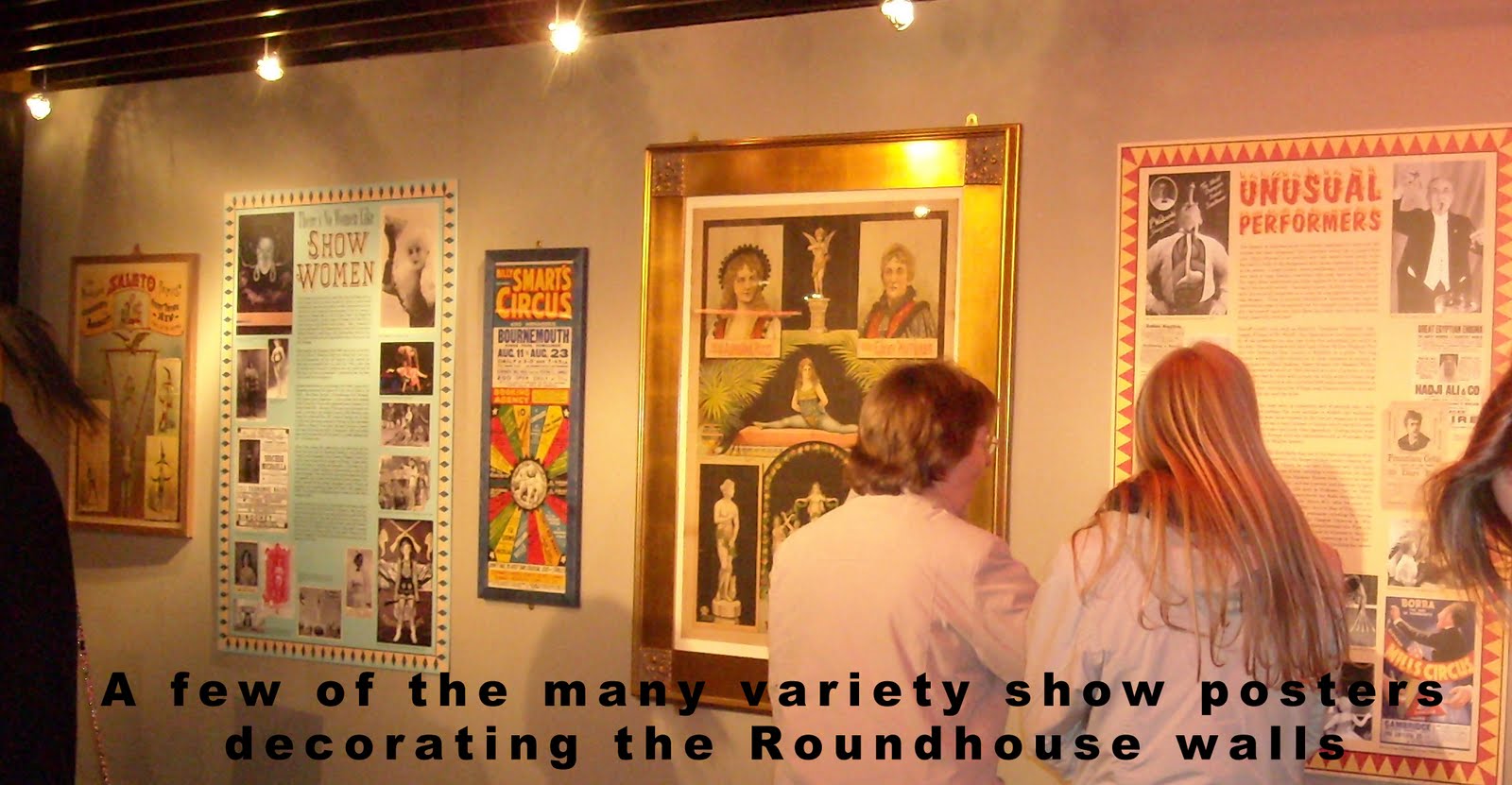
The Roundhouse is a great space. Originally a steam engine repair shed, it was first used as a performance venue in the 60s by political playwright Arnold Wesker, and soon was hosting such attractions as Jimi Hendrix, Pink Floyd, Peter Brook, the Living Theatre, and the Doors. When funding dried up in 1983, the space went dark until 1996. In 2004 it closed again, but this time for some big-time (and handsome) renovations, reopening in 2006. It is indeed round and quite impressive — its main space can house 1,800 people seated or 3,300 standing — and reminds you of such permanent circus buildings as the Cirque d’Hiver in Paris. The similarities don’t end there: circus and variety arts constitute a major portion of their programming.
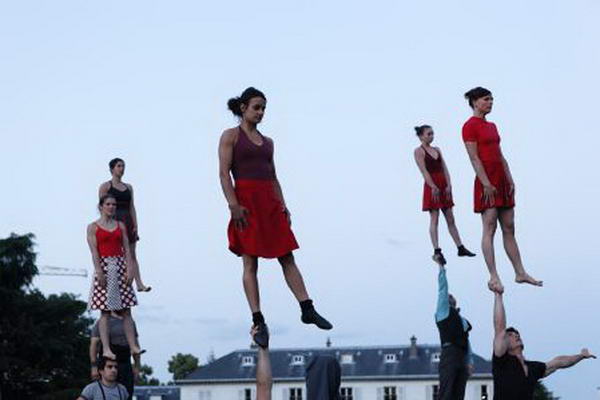
The show that impressed me mostwas a nouveau cirque production from France, Compagnie XY. One trademark of nouveau cirque is its choice to not use animal acts. Compagnie XY went much further: they chose to perform without circus hoopla: no applause cues, no “Ta-Da’s!” no glitzy costumes, hardly any props (three, to be exact), and no dramatic music — not even a drum roll — just some charming Parisian melodies, full of accordions, and more reminiscent of the world of Edith Piaf than of the world of the circus.
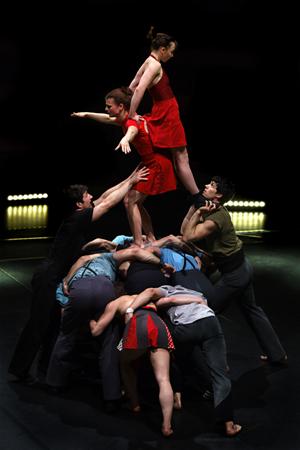
It begins in the semi-dark. Very slowlythe performers wander into the ring, eventually gathering themselves into a shadowy pyramid, after which they casually disperse. It of course picks up steam from there, but throughout retains a matter-of-fact manner; intense focus, of course, but calm nonetheless.
What we get instead of over-the-top pizazz is an ensemble of performers — all of them in the ring 90% of the time — working together to explore the countless possibilities of group acrobatics; more specifically, throwing each other every which way and constructing a dazzling array of pyramids. That’s it. No jugglers, no wirewalkers, no clowns, no daredevils on motorcycles. Just group acrobatics. The only human cannonballs are launched by human hands and human feet.
The technical level is high, with many a 4-high in the mix, but what impresses is the inventiveness and the contagious joy of all these group creations. . As always, you had to be there, but this two-minute video shows the kind of work they do, though not the effect of the whole evening.
And some more photos:
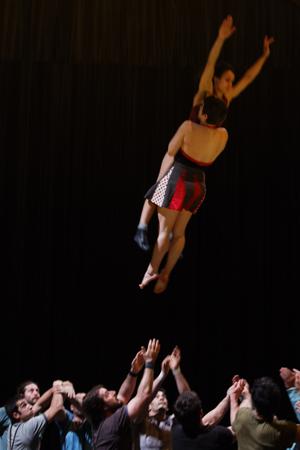
Partner work this strong and inventive is at least a second cousin to physical comedy partner work, but I think it’s more difficult to do actual comedy as part of a show like this. What do you play off of? There’s less suspense, not much in the way of defined roles. There are no stars and no star turns. The (warm) message is one of mutual trust and cooperation. The few comic bits they tried work quite well, however, especially the attempts of the one rather heavy member of the troupe to perform feats usually associated with a light and lithe acrobat. Of course he ultimately succeeds as a topmounter, much to everyone’s astonishment and delight. I also liked the flying “trust” leaps into the hands of about 10 catchers, all of whom collapse upon impact while the flyer walks nonchalantly away.
All in all, a sweet and terrific show. We were there opening night, and they got lots of applause without signaling for it, and a final ovation that was foot-stompingly loud and enthusiastically sustained.
Back in 1985 through some contact in Germany I vaguely remember as “clown David” (hello, wherever you are!), I got hold of what I’m pretty sure was the first tape of Grock’s full-length show to make its way to the United States. We premiered it on what today would be considered a small television set for an appreciative audience (that included Bill Irwin) at our 2nd NY International Clown-Theatre Festival. Also on that tape was this unidentified clip starring Charlie Cairoli (1910—1980) doing some musical clowning and busting out with some killer dance steps. I guess it’s rarer than I realized, because not only don’t I see it anywhere on the web, I don’t see any of his work.
This is surprising, since Cairoli had a long and prolific career as a clown, including a lot of television work. A few highlights:
• Born in Italy into a Franco-Italian circus family, married Violetta Fratellini, settled in England in 1939, which he made his permanent home and where he reigned as its most celebrated clown for four decades. • He performed in the Blackpool Tower Circus every summer for 39 or 40 years in a row (depending on which source you believe) as well as in English pantomimes, television shows, and films. • Television appearances included the Ed Sullivan Show, Hollywood Palace, and This is Your Life. • As Pat Cashin points out on his blog, Caroli’s 100th birthday was just 11 days ago. (Despite my frequent birthday salutes, in this case I was oblivious, just happening to come across the clip two days ago while digitizing some old tapes.)
The most informative bio of Cairoli is not from his Wikipedia page but from the excellent but hard to find Clowns & Farceurs: Cairoli (Charlie), born Affori, Italy, 1910. Died Blackpool, U.K., 1980. He was known to the English as “Our Charlie.” They had adopted him because, for 39 years, he made them laugh, performing five months each season in the ring of the Tower Circus in Blackpool. Appreciated by the French in 1929 as “Carletto,” part of a classical trio with his father Jean-Marie and his brother Filip (or the marvelous Porto). Upon arriving in England in 1939 he changed his approach and took advantage of all the possibilities offered by British clowning, what one might call “foam & water pantomime,” a style intentionally violent, even cruel. His first partner (1947) was his father, after which he had as his whiteface clown partner Paul Freeman (1948—1959); Paul King (1960—1967); Paul Connor (1968—1973); and his son, Charles Jr., starting in 1974. Contrary to custom, only the name Charlie Cairoli appeared on the posters and programs, those around him often forming an anonymous troupe, referred to only as “and Company.” From this troupe there emerged in 1953 the grimacer Jimmy Buchanan, who played suffering and sadness with a passivity that was irresistibly droll. Charlie Cairoli differed from other augustes because he was the instigator of the gag; it often seemed the only reason his straightman was there was because of tradition and to provide more amplitude to the musical interludes. Charlie Cairoli’s talent was all-encompassing, including broad farce that some might consider to be of questionable taste. And connoisseurs who study his mimicry, listen to his musical selections, or delight in his inventions, perceive that what guides them is not so much the choice of a repertoire but rather a concession to certain comic processes.
[My loose translation; not really sure what they’re trying to say with that last sentence.]
As you will see, this clip looks to be from a movie, perhaps Happidrome (1943). Although the whiteface clown is likewise not identified, if it is Happidrome thenaccording to the cast list for that movie in IMDB we are watrching the “Cairoli brothers.” However, the notation on the box of the original PAL VHS tape I received says it is Charlie Cairoli and father.
It’s quite a strange clip, I suspect from a low-budget production. Supposedly they’re performing for a live audience, but other than the couple in the box there’s not much public in evidence until the curtain call shot. The first part is too verbal for my tastes and not all that interesting, but the last two minutes are dynamite.
_________________________
Update (2-28-10): In my undying efforts to be consistently senile, I overlooked that I had another clip of Cairoli, this one from the London Hippodrome in 1966. In some bits he’s more the straightman than the auguste. I’m thinking that the clown in the suit and crumpled hat with feather who comes close to stealing the show must be the above-mentioned Jimmy Buchanan.
_________________________
Update (4-22-10): Just received this e-mail:
Hi John, I can assure you that it is Jimmy Buchanan as Charlie’s stooge in the clip. Thanks for the opportunity of viewing it. — Kind regards, Brian Nicholson (designer of The Charlie Cairoli Exhibition at Blackpool Tower).
Long before Steve Martin’s King Tut, there was this hysterical sand dance performed by Jack Wilson, born in Liverpool this day in 1894, and Joe Keppel, born in Ireland a year later. Along with a succession of Bettys, they formed the music-hall comedy act of Wilson, Keppel & Betty. This birthday salute is just an excuse to showcase their work, a delicious parody of an earlier craze for all things Egyptian, sparked by the 1922 discovery of the tomb of Tutankhamun, just as Martin’s was inspired by the wildly popular 1978 U.S. tour of the Treasures of Tutankhamun.
Wilson and Keppel first performed together in New York in March 1919 as a comedy acrobatic and tap dancing act in vaudeville, and continued working together until 1963. Yep, that’s 44 years together. Yikes! In 1928 they were joined in the act by Betty Knox, former stage partner of Jack Benny, who retired in 1941 to go into journalism, but was followed by something like seven other Bettys, beginning with Knox’s own daughter, Patsy.
They toured internationally and, according to legend, were denounced by Goebbels as “bad for the morals of Nazi Youth” after a 1936 performance at Berlin’s Wintergarden because they showed too much bare leg. Mussolini, on the other hand, was said to have had no problem enjoying the act. In 1950, they even shared the bill with Frank Sinatra when he headlined the London Palladium.
Along the way, their signature piece, the sand dance, became a cult favorite. Film historian Luke McKernan (see below) commented that “I worked at the National Film and Television Archive for a number of years, and I think this one piece of film was requested by the public more times than any other.”
Like Anna Pavlova before them and Steve Martin decades later, Wilson & Keppel are all profile and angles and limbs, funnier than Pavlova and more skilled than Martin — and perhaps vice-versa. Their slender frames and straight faces are perfect for the mock-seriousness of the piece.
Here it is, their trademark sand dance, to the tune of Luigini’s Ballet Egyptien, arranged for them by none other than Hoagy Carmichael.
And here’s another version, courtesy of British Pathé. It’s part of a 1933 variety show at the Trocadero Restaurant, and unfortunately they’re in front of the curtain instead of their pyramid backdrop. It includes a cute little dance up and down the stairs.
As Cleopatra, Betty provided the sultriness with her Dance of the Seven Veils and gave the guys something to play off of. Here’s my favorite bit from Cleopatra’s Nightmare.
Last and perhaps least, one more cute novelty.
You can view a few more incidental clips on YouTube, and can read Luke McKernan’s excellent history of the act (pdf download) by clicking here.
Today I introduce yet another new feature to this blog, a complete book in the form of a pdf file suitable for reading online, downloading, or printing. Because of legal issues, most if not all books presented here will be from the pre-copyright era, roughly a century or more ago, and therefore of a historical nature.
We start off with a classic, the Memoirs of Joseph Grimaldi, edited by none other than Charles Dickens (pseudonym Boz). Grimaldi (1779–1837) was perhaps the most celebrated clown who ever lived, the clown credited with elevating the craft to an art form, the man from whom latter-day clowns derived the nickname “joey.” If you want a quick introduction to Grimaldi, go to post 002 on this blog and take a look at chapter five (pp.8–14) from my book Clowns.
How these memoirs apparently came about is its own story, here summed up by our good friend Dr. Wikipedia:
The book’s accuracy is not entirely clear, since it went through a number of revisions, not all with Grimaldi’s input. Grimaldi’s original manuscript, which he mostly dictated, was about 400 pages; he completed it in December 1836. The original “excessively voluminous” version was apparently not good enough for publication, and in early 1837 he signed a contract with a collaborator, the obscure Grub Street writer Thomas Egerton Wilks, to “rewrite, revise, and correct” the manuscript. However, two months after signing the contract, Grimaldi died, and Wilks finished the job on his own, not only cutting and condensing the original but introducing extra material based on his conversations with Grimaldi. Wilks made no indication which parts of his production were actually written by Grimaldi and which parts were original to Wilks. He also chose to change Grimaldi’s first-person narration to the third person.
In September 1837, Wilks offered the Memoirs to Richard Bentley, publisher of the magazine Bentley’s Miscellany. Bentley bought it, after securing the copyright from Grimaldi’s estate, but he thought it was still too long and also badly edited, so he asked one of his favorite young writers, the novelist Charles Dickens, then twenty-five years old, to re-edit and re-write it. At first Dickens was not inclined to take the job, and he wrote to Bentley in October 1837:
“I have thought the matter over, and looked it over, too. It is very badly done, and is so redolent of twaddle that I fear I cannot take it up on any conditions to which you would be disposed to accede. I should require to be assured three hundred pounds in the first instance without any reference to the sale — and as I should be bound to stipulate in addition that the book should not be published in numbers I think it would scarcely serve your purpose.”
However, Bentley agreed to Dickens’ terms (a guarantee of three hundred pounds and an agreement to publish the book all at once, and not in monthly numbers.) Dickens signed a contract in November 1837, and completed the job in January 1838, mostly by dictation. Dickens seems never to have seen Grimaldi’s original manuscript (which remained in the hands of the executor), but only worked from Wilks’ version, which he heavily edited and re-wrote. Bentley published it in two octavo volumes in February 1838.
How faithful this twice-edited, twice-rewritten version is to the original cannot now be determined, since the original manuscript was sold at an estate sale in 1874 and has never been seen since.
Tech Note: The scan of this book is by Google, which you may have heard is ruffling a lot of feathers by trying to digitize every book they can get their hands on, copyright be damned. As far as I can tell, what they do is scan the book as an image, that’s all, nothing but a bunch of dumb pixels that don’t even know they’re banding together to form language. Google makes no attempt to perform OCR (optical character recognition), which would translate the image of text into individual letters and words a computer can recognize separate from one another, thus allowing for searching topics, copying & pasting, editing, etc. The reason they don’t do this is that OCR software is not 100% accurate, especially when applied to old books, so for it to come out right someone would have to spend hours…. and hours… and hours of proofreading the entire book. Unfortunately, an old scanned book is harder on the eyes than one converted to crisp, clear text but — you know what they say — you get what you pay for.