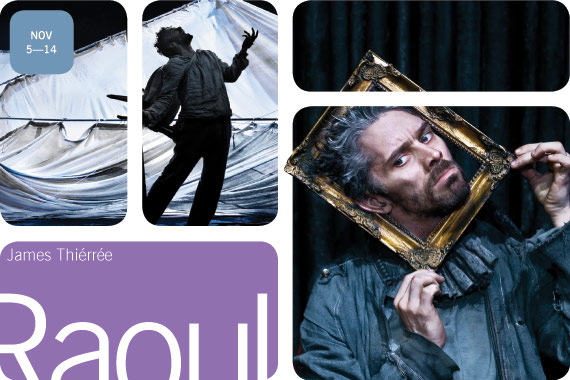

As the lights went down at the end of the final performance of James Thiérrée’s Raoul at the Brooklyn Academy of Music this afternoon, the entire audience immediately jumped to its feet to give him a rousing standing ovation. And yet the New York Times review argued that “the charms of Raoul the show quickly wear thin.”
What gives?
I’ll tell you what we’ve got here. On the one hand there’s the performer’s skill and magnetism, the world he creates, its impact on the audience. On the other hand there’s the MEANING of the piece, so dear to critics, the overarching themes that connect everything and hopefully add up to a whole greater than its parts. Call it plot, structure, choreography, playwrighting, whatever….
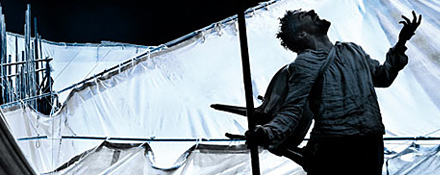
So let’s start with the performer, James Thiérrée, in what is essentially a one-man show. Great-grandson of playwright Eugene O’Neill, grandson of Charlie Chaplin, son of Jean-Baptiste Thiérrée and Victoria Chaplin (Cirque Imaginaire), kid brother of Aurélia Thiérrée (see my post #67) — well obviously he has a lot to live up to. Lucky for him, luckier for us, he manages quite nicely, thank you very much. Thus the standing ovation, which Jim Moore, Jan Greenfield, and I had no hesitation in joining.

Thiérrée’s movement is a stunning, fluid, and seamless blend of mime, circus, physical comedy, and dance. His routines are inspired and at times so complexly layered that you can only compare him to physical comedians such as George Carl or Bill Irwin at their best, or to a comic like Reggie Watts at his wildest. There were many moments during the show when I felt as if I had been privileged to see Charlie Chaplin live. Yes, there is a family resemblance (he’s not adopted!), and Thiérrée’s physical virtuosity reminds one of why W.C. Fields paid Chaplin the supreme compliment of saying “He’s a goddamn ballet dancer. I’d like to strangle him with my bare hands.” If you’re really interested in physical comedy, and not just reading this blog to impress me, do not miss a chance to see Thiérrée live.
But what is the show about and why was the Times so dismissive? Well, you can read the review here, but the argument in a nutshell is that the world Thiérrée creates ultimately doesn’t add up to much of anything and doesn’t go anywhere. This is not necessarily an unfair argument, though certainly harsh. There’s no clear linear narrative, and the character is not anchored in naturalistic detail. We gather that this is a tale of a man whose home is gradually destroyed, but we know not why. We see his fight to survive and make sense of his existence, but again it is not always clear what’s going on. In those moments when Thiérrée isn’t wowing us, the piece tends to sag because we lack the conventional hooks of story and character.
What we get instead is more of a surrealistic dream world. Raoul is in essence an abstract piece, open to multiple interpretations, pretty much like 90% of the dance pieces I see these days… though somehow they don’t meet with the same scorn from the press. Ditto opera, though I must admit I don’t see much of that. The reality is that some shows are more performer-based and others more literary-based, and an ideal melding of the two usually proves pretty elusive. I think Bill Irwin pulled it off for most of Regard of Flight, but at least 95% of the time we have to accept an imperfect universe.
Note to publicist: Don’t evoke Beckett in your press release. Too much to live up to; a strategy pretty much guaranteed to backfire with your more high-toned critics.
But here’s another thing I like: our star’s formidable talents, which the Times haughtily disparages as “Mr. Thiérrée’s shtick,” are not merely technical. His interaction with the physical world has one foot in the inventions of Buster Keaton and the other firmly in a futuristic mindscape — thus my placing this show in my coveted category, Physical Comedy in the 21st Century — a designation reserved for performances that point the art form in new directions. It is Thiérrée’s genius to transform all of the physical world, everything on stage, curtains and all. As surely as Dali painting a landscape, Thiérrée’s body and imagination interact with a dynamic theatrical set that itself becomes another character in the show. What the hell am I talking about?? Hey, you gotta see the show, but take it from me that nothing on that stage is nailed down; nothing remains what it was. Dali, Bréton, Magritte, Miro and the gang would be proud.
Hey, I’d love to show you some representative video to back up my enthusiasms, but not doing too well there. I continue to be unimpressed (shocked, actually) as to how so many strong shows have such poor promo videos. And why is it that funny shows have to have these artsy, lyrical trailers that don’t even hint at comedy? For example:
But like I said, try to see the show. Meanwhile, here are a few good links for you, courtesy of Jim Moore.
• London Telegraph
• Sadler’s Wells (London)
• The Age (Australia)
• The New Yorker